Enterprise Prediction Market Data: What to Require
Enterprise Prediction Market Data: What to Require
Enterprise Prediction Market Data: What to Require
What enterprise-grade prediction market data requires: venue coverage, history, normalization, auditability and US rules. A buyer's checklist for quants and developers.

Enterprise Prediction Market Data: What to Require
Enterprise prediction market data is cross-venue, normalized, historically deep and auditable enough that a quant team can backtest on it and a production system can depend on it. Free venue endpoints show you live prices. They do not hand you one schema across Polymarket, Kalshi and Limitless, a clean history, or a record of how each row was captured. This guide covers what to require before you commit a pipeline, a research desk or an AI agent to a data source.
Assymetrixdata.assymetrix.comUnify Prediction Market DataAccess Polymarket, Kalshi, and Limitless data through one API, with approximately 1.5 terabytes of historical trading activity.Explore the Data API
TL;DR
“Enterprise” in this category means four things: coverage across venues, normalized identifiers and schemas, deep and honest history, and delivery you can build on (REST, WebSocket, bulk export).
Live prices are easy to get. History quality, cross-venue matching and capture provenance are what separate research-grade data from a scrape.
Test any source on order-book completeness, timestamp type, resolution handling and identifier stability before you backtest on it.
In the US, event contracts on registered exchanges sit under CFTC oversight, and the rules are still moving. Check current rules for your own use case.
Our Data API covers Polymarket, Kalshi and Limitless through one integration, backed by roughly 1.5 TB of history.
Table of Contents
What “enterprise” means for prediction market data
The five kinds of data you will be asked for
Live data: free at the venue, hard at scale
Historical data: how to judge depth honestly
Normalization: where the real engineering sits
Seven checks before you trust a source for backtesting
Intelligence on top of the raw feed
Our perspective
Build, buy or combine
Where our Data API fits
US rules that touch prediction market data
How to run an evaluation in one week
Sources
What “enterprise” means for prediction market data
Most enterprise data advice is written for firmographic or CRM data. The market reports that dominate this query talk about big-data platforms and predictive analytics software, which is a different product: tools that forecast things. Prediction market data is the record of what people priced and traded on event contracts: prices, order books, trades, positions, outcomes and the wallets or accounts behind them, where a venue exposes them.
For a team that has to rely on that record, “enterprise” reduces to a short list of requirements:
Multi-venue coverage. A single venue shows one slice of the market. Cross-venue work, such as arbitrage, divergence or consensus pricing, needs all the relevant venues in one place.
Normalization. The same real-world event has different identifiers, tick sizes, resolution wording and payoff conventions on each venue. Someone has to reconcile them.
Depth of history. Backtests and models need years of trades and order-book changes, not a rolling window.
Delivery and reliability. REST for queries, WebSocket for live updates, bulk export for research, with stable schemas that do not break your code.
Auditability. You should be able to say how each row was captured, and what is missing.
The rest of this article takes these in turn.
The five kinds of data you will be asked for
Before you evaluate any provider, list the data your use case needs. Requests from quants, bot builders and agent developers usually fall into five groups.
Data type | What it contains | Typical consumer |
|---|---|---|
Market metadata | Events, markets, outcomes, categories, close and resolution times | Everyone; the join key for all other data |
Prices and snapshots | Last trade, midpoint, bid/ask, periodic price history | Dashboards, signal models, agents |
Order books | Depth, level changes, spreads | Execution research, market-making, microstructure |
Trades and positions | Fills with size, side and time; holder-level activity where exposed | Flow analysis, wallet and skill scoring |
Resolution and outcomes | Final result, resolution time, disputes or voids | Calibration, accuracy studies, labels for ML |
Two things follow from this table. First, metadata and resolution data are not glamorous, but every other table depends on them being right. A backtest with a wrong resolution label is worse than no backtest. Second, order-book data is the hardest to get and the easiest to get wrong, so it deserves its own test (see below). Our guide to prediction market order book data for developers walks through the integration details.
Live data: free at the venue, hard at scale
Venues publish their own REST and WebSocket interfaces, and market data on them is generally readable without trading privileges. For a prototype, a single-venue bot or a notebook, that is often enough, and it costs nothing.
The problems start when the system grows:
Three integrations, three maintenance burdens. Each venue has its own authentication, pagination, rate limits, message formats and change cadence. When one changes, your pipeline breaks at 2 a.m.
No shared identifiers. The same underlying question is a different object on each venue, so you maintain your own mapping table, and keep it correct as new markets list.
Streaming state. A WebSocket gives you deltas. To trust a local order book you need snapshots, sequence checks and reconnect logic, and you need to know what you missed during a disconnect.
Different semantics. Price conventions, fee treatment and settlement mechanics differ across venues. A naive price comparison across them can show an “arbitrage” that is only a fee or settlement difference.
An aggregation layer exists to take that work off your team. If your live requirements are algorithmic, our notes on real-time prediction market data for algorithmic systems cover latency and state handling, and the REST and WebSocket API guide shows what one integration across three feeds looks like.
Historical data: how to judge depth honestly
“We have history” is not a specification. Ask what kind of history, at what granularity, and captured how.
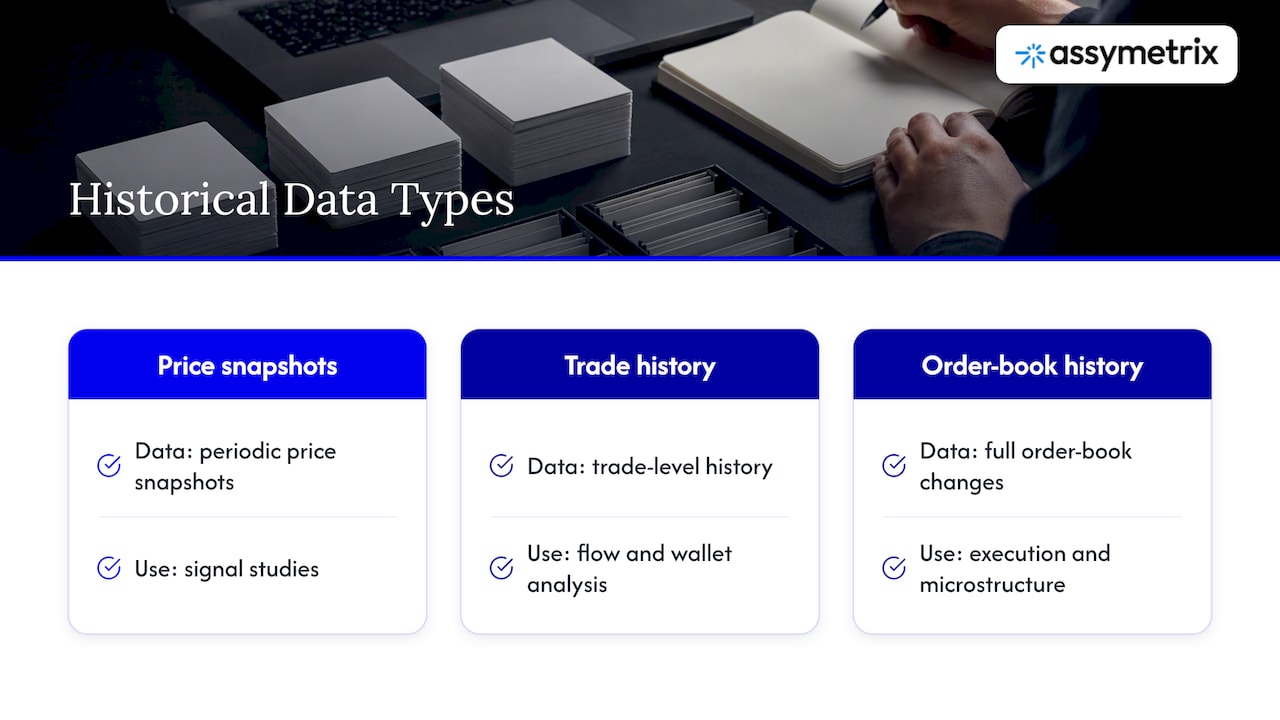
Granularity. Periodic price snapshots are enough for many signal studies. Trade-level history supports flow and wallet analysis. Full order-book change history supports execution and microstructure work. These are three different datasets, and a provider may have all three for one venue and only one for another.
Capture method. Venue archives and backfills are not equal to data captured live. The open-source h5i-db project documents this plainly: historical order-book quality differs by venue and archive, with missing sequences, arrival timestamps in place of venue timestamps and incomplete delta coverage all weakening replay compared with prospective capture. Treat that as a checklist for any vendor you evaluate, including us.
Scale. Our own dataset is built on approximately 1.5 TB of historical data spanning nearly one billion rows of trading activity across Polymarket, Kalshi and Limitless. If you want the detail, see the institutional data page and the overview of the 900M+ event feed. Row counts tell you volume, not quality, so use them alongside the tests below.
Normalization: where the real engineering sits
Cross-venue analysis fails most often at the join. Here is what normalization has to settle.
Canonical identifiers
A canonical ID maps each venue’s market to one stable entity: the event, the outcome and the venue-specific contract. With it, “show me every venue’s price for this question” is a single query. Without it, it is a fuzzy text match that quietly breaks when wording differs. Our canonical-ID guide for cross-venue data explains the approach.
Price and payoff conventions
Binary contracts are generally quoted as a price between 0 and 1 (or in cents), where the price approximates the market’s implied probability. But venues differ on tick size, minimum order, fee structure and what happens on a void or early close. Normalize to one representation, and keep the raw venue values alongside so you can audit the transformation.
Resolution semantics
Two markets that look identical can resolve on different sources or at different times. Before you treat two contracts as the same bet, compare the resolution criteria text, the resolution source and the close time. Mark pairs as equivalent, near-equivalent or not comparable, and carry that flag into your signals.
Time
Store venue timestamps and your own receipt timestamps separately. Latency analysis, replay and cross-venue lead-lag studies all depend on knowing which is which.
Seven checks before you trust a source for backtesting
Run these on a sample before you build on any dataset, whoever sells it.
Timestamp type. Are timestamps from the venue or from the collector’s arrival time? Arrival time smears event order.
Sequence gaps. For order-book deltas, can you detect missing sequence numbers? Are gaps documented?
Snapshot cadence. How often do full book snapshots anchor the deltas?
Survivorship. Are delisted, voided and low-volume markets in the history, or only the ones that resolved cleanly?
Resolution labels. Spot-check twenty resolved markets against the venue’s own result.
Identifier stability. Do IDs stay constant across re-listings and schema updates?
Coverage statement. Does the provider say, per venue and per data type, from what date coverage is complete?
If a provider cannot answer these, the history may still be useful for exploration. It is not yet a foundation for capital allocation. Our walkthrough on backtesting prediction market strategies applies these ideas to a concrete workflow, and the Python developer guide covers the code side.
Intelligence on top of the raw feed
Raw rows are the substrate. Teams that pay for data usually want derived signals as well, and those signals are only as good as the normalization beneath them:
Smart Money wallet tracking, which follows the activity of wallets with a record of profitable positioning, on venues where on-chain data makes this possible. See our Polymarket on-chain analytics guide.
Trader Skill Scores, which rank participants on realized performance rather than on a single lucky position.
Cross-venue arbitrage and divergence signals, which flag when equivalent contracts price apart. The signal generation guide shows how to avoid false positives from fee and resolution differences.
Alerts and copy-trading inputs for developers building tools on top: see smart money alerts.
For AI agents, the same data needs predictable schemas and canonical IDs so a model can call an endpoint and reason over the result without custom parsing. That is covered in our guide to prediction market APIs for AI agents.
Our perspective
We built Assymetrix because the hard part of this market is not getting a price. It is getting the same question, priced on three venues, in one schema, with a history you can audit.
Our position is venue neutrality. A data layer owned by one exchange has an incentive to describe that exchange well. An independent layer can put Polymarket, Kalshi and Limitless side by side on equal terms, including where they disagree. That disagreement is the source of the divergence and arbitrage signals we publish, and it is why we keep raw venue values next to normalized ones.
We also think buyers should be skeptical of history claims, ours included. Ask for coverage by venue, data type and start date. Ask how deltas were captured. Run the seven checks above on a sample. A provider that welcomes that process is one you can build on.
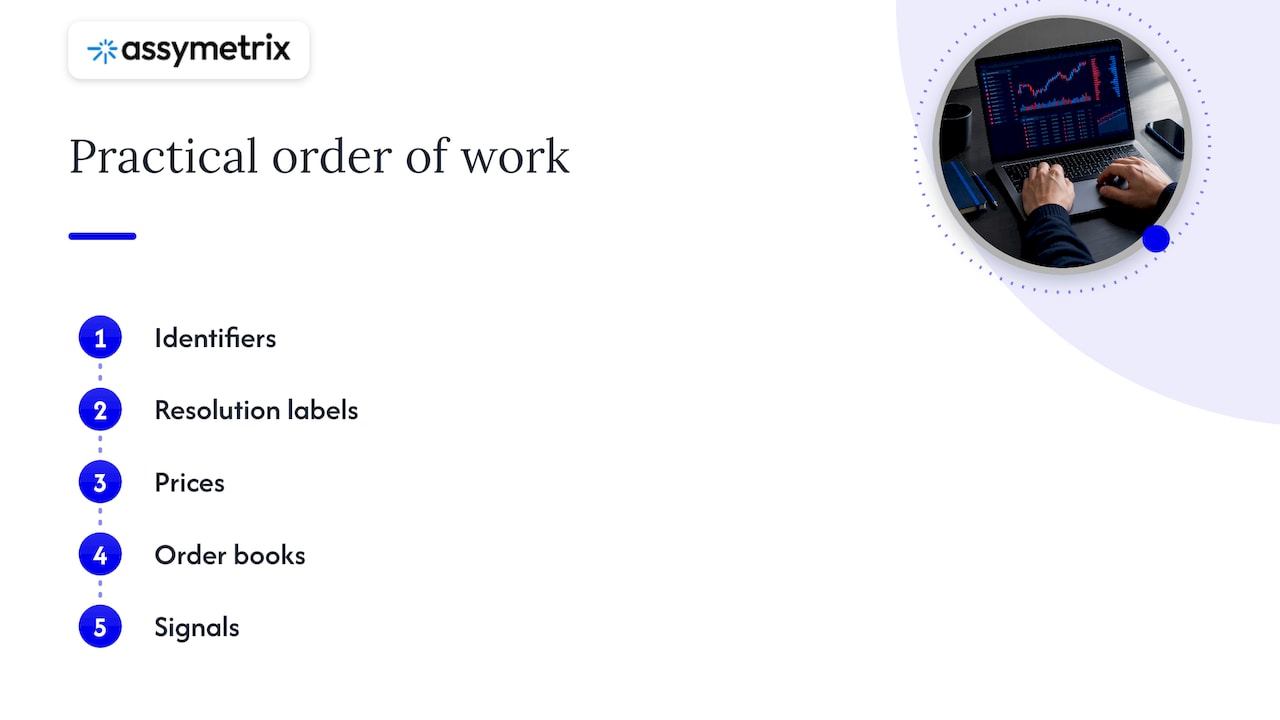
The practical order of work, in our experience: fix identifiers first, then resolution labels, then prices, then order books. Signals come last. Teams that start with signals spend months debugging joins.
— Dean
Build, buy or combine
Approach | Strengths | Costs |
|---|---|---|
Venue APIs directly | Free, authoritative for that venue, lowest latency to source | One integration per venue; no shared IDs; you own history capture from day one |
Build your own aggregator | Full control of schema and capture | Engineering time, ongoing maintenance, no history before you started collecting |
Aggregated data API | One integration, normalized schema, existing backfill | Subscription cost; you must verify coverage and capture quality |
Combination | Venue feeds for execution, aggregated API for research and cross-venue signals | Two systems to reconcile |
Many teams end up in the last row: they trade through venue connections for execution and use an aggregated API for research, cross-venue monitoring and agents. The question for build versus buy is mostly about history. You cannot collect last year’s order books today, so if backtests matter, the backfill is the asset. Our overview, Skip Months of Engineering, sets out that tradeoff in more detail.
Where our Data API fits
The Assymetrix Data API gives developers, quants, bots and AI agents unified access to real-time and historical data across Polymarket, Kalshi and Limitless through a single integration, with REST and streaming delivery, canonical IDs and bulk export. Tiers include free and paid access, commercial licenses for developers and institutions, and non-commercial or academic access for researchers. For current plans, see the Data API page. To see the signal layer, start with the intelligence overview.
US rules that touch prediction market data
This is background for your planning, not legal advice. For anything that affects your product, such as trading on behalf of others, redistributing data, or offering contracts, consult a securities or derivatives attorney.
In the US, event contracts listed on CFTC-registered exchanges fall under the Commodity Futures Trading Commission. The agency has been working on the rules for them: on June 10, 2026, the CFTC issued a proposed rule on the types of event contracts that can be listed on registered prediction markets, and the proposal was published in the Federal Register on June 12, 2026. Proposals change before they become final, so check the current status before you rely on them.
Two practical points for data buyers. Market data itself is generally public information from the venues, but the terms of use of each venue and of your data provider govern what you may store, redistribute or use commercially. And the legal status of a contract can differ by venue, product category and state, so a data feed should not be read as a statement about whether you can trade a given market.
How to run an evaluation in one week
Day 1: write down your required data types, venues and the earliest date you need.
Day 2: pull a sample of resolved markets and check labels against the venues.
Day 3: check order-book samples for gaps, timestamp type and snapshot cadence.
Day 4: test cross-venue matching on ten events you know well, including edge cases such as voids.
Day 5: load-test the streaming connection, including reconnects, and review rate limits and licensing terms.
If a source passes, move to a paid pilot on a narrow use case, such as one strategy or one agent, before expanding.
FAQ
What is enterprise prediction market data?
It is prediction market data delivered with the coverage, consistency and auditability a business or research team can depend on. That usually means several venues in one schema, canonical identifiers, deep history with documented capture, and stable APIs. The venues’ own free feeds cover live prices, but not the normalization or history work.
Is prediction market data free?
Live prices and basic market data are generally available from the venues themselves. What costs money is the work around it: cross-venue normalization, deep historical backfill, wallet analytics and reliable delivery at scale. Whether that is worth paying for depends on how much engineering time and history your use case requires.
How far back does historical prediction market data go?
It depends on the venue, the data type and how the provider captured it. Trade history can reach back further than order-book history, and archived books can have gaps. Ask any provider for coverage by venue and data type, with start dates, and test a sample.
Are prediction markets legal in the United States?
Event contracts on CFTC-registered exchanges operate under federal oversight, and the CFTC proposed new rules on permitted contract types in June 2026. State-level and category-specific questions remain active. Talk to a derivatives attorney about your specific situation before building a product around trading.
Sources
Enterprise Prediction Market Data: What to Require
Enterprise prediction market data is cross-venue, normalized, historically deep and auditable enough that a quant team can backtest on it and a production system can depend on it. Free venue endpoints show you live prices. They do not hand you one schema across Polymarket, Kalshi and Limitless, a clean history, or a record of how each row was captured. This guide covers what to require before you commit a pipeline, a research desk or an AI agent to a data source.
Assymetrixdata.assymetrix.comUnify Prediction Market DataAccess Polymarket, Kalshi, and Limitless data through one API, with approximately 1.5 terabytes of historical trading activity.Explore the Data API
TL;DR
“Enterprise” in this category means four things: coverage across venues, normalized identifiers and schemas, deep and honest history, and delivery you can build on (REST, WebSocket, bulk export).
Live prices are easy to get. History quality, cross-venue matching and capture provenance are what separate research-grade data from a scrape.
Test any source on order-book completeness, timestamp type, resolution handling and identifier stability before you backtest on it.
In the US, event contracts on registered exchanges sit under CFTC oversight, and the rules are still moving. Check current rules for your own use case.
Our Data API covers Polymarket, Kalshi and Limitless through one integration, backed by roughly 1.5 TB of history.
Table of Contents
What “enterprise” means for prediction market data
The five kinds of data you will be asked for
Live data: free at the venue, hard at scale
Historical data: how to judge depth honestly
Normalization: where the real engineering sits
Seven checks before you trust a source for backtesting
Intelligence on top of the raw feed
Our perspective
Build, buy or combine
Where our Data API fits
US rules that touch prediction market data
How to run an evaluation in one week
Sources
What “enterprise” means for prediction market data
Most enterprise data advice is written for firmographic or CRM data. The market reports that dominate this query talk about big-data platforms and predictive analytics software, which is a different product: tools that forecast things. Prediction market data is the record of what people priced and traded on event contracts: prices, order books, trades, positions, outcomes and the wallets or accounts behind them, where a venue exposes them.
For a team that has to rely on that record, “enterprise” reduces to a short list of requirements:
Multi-venue coverage. A single venue shows one slice of the market. Cross-venue work, such as arbitrage, divergence or consensus pricing, needs all the relevant venues in one place.
Normalization. The same real-world event has different identifiers, tick sizes, resolution wording and payoff conventions on each venue. Someone has to reconcile them.
Depth of history. Backtests and models need years of trades and order-book changes, not a rolling window.
Delivery and reliability. REST for queries, WebSocket for live updates, bulk export for research, with stable schemas that do not break your code.
Auditability. You should be able to say how each row was captured, and what is missing.
The rest of this article takes these in turn.
The five kinds of data you will be asked for
Before you evaluate any provider, list the data your use case needs. Requests from quants, bot builders and agent developers usually fall into five groups.
Data type | What it contains | Typical consumer |
|---|---|---|
Market metadata | Events, markets, outcomes, categories, close and resolution times | Everyone; the join key for all other data |
Prices and snapshots | Last trade, midpoint, bid/ask, periodic price history | Dashboards, signal models, agents |
Order books | Depth, level changes, spreads | Execution research, market-making, microstructure |
Trades and positions | Fills with size, side and time; holder-level activity where exposed | Flow analysis, wallet and skill scoring |
Resolution and outcomes | Final result, resolution time, disputes or voids | Calibration, accuracy studies, labels for ML |
Two things follow from this table. First, metadata and resolution data are not glamorous, but every other table depends on them being right. A backtest with a wrong resolution label is worse than no backtest. Second, order-book data is the hardest to get and the easiest to get wrong, so it deserves its own test (see below). Our guide to prediction market order book data for developers walks through the integration details.
Live data: free at the venue, hard at scale
Venues publish their own REST and WebSocket interfaces, and market data on them is generally readable without trading privileges. For a prototype, a single-venue bot or a notebook, that is often enough, and it costs nothing.
The problems start when the system grows:
Three integrations, three maintenance burdens. Each venue has its own authentication, pagination, rate limits, message formats and change cadence. When one changes, your pipeline breaks at 2 a.m.
No shared identifiers. The same underlying question is a different object on each venue, so you maintain your own mapping table, and keep it correct as new markets list.
Streaming state. A WebSocket gives you deltas. To trust a local order book you need snapshots, sequence checks and reconnect logic, and you need to know what you missed during a disconnect.
Different semantics. Price conventions, fee treatment and settlement mechanics differ across venues. A naive price comparison across them can show an “arbitrage” that is only a fee or settlement difference.
An aggregation layer exists to take that work off your team. If your live requirements are algorithmic, our notes on real-time prediction market data for algorithmic systems cover latency and state handling, and the REST and WebSocket API guide shows what one integration across three feeds looks like.
Historical data: how to judge depth honestly
“We have history” is not a specification. Ask what kind of history, at what granularity, and captured how.
Granularity. Periodic price snapshots are enough for many signal studies. Trade-level history supports flow and wallet analysis. Full order-book change history supports execution and microstructure work. These are three different datasets, and a provider may have all three for one venue and only one for another.
Capture method. Venue archives and backfills are not equal to data captured live. The open-source h5i-db project documents this plainly: historical order-book quality differs by venue and archive, with missing sequences, arrival timestamps in place of venue timestamps and incomplete delta coverage all weakening replay compared with prospective capture. Treat that as a checklist for any vendor you evaluate, including us.
Scale. Our own dataset is built on approximately 1.5 TB of historical data spanning nearly one billion rows of trading activity across Polymarket, Kalshi and Limitless. If you want the detail, see the institutional data page and the overview of the 900M+ event feed. Row counts tell you volume, not quality, so use them alongside the tests below.
Normalization: where the real engineering sits
Cross-venue analysis fails most often at the join. Here is what normalization has to settle.
Canonical identifiers
A canonical ID maps each venue’s market to one stable entity: the event, the outcome and the venue-specific contract. With it, “show me every venue’s price for this question” is a single query. Without it, it is a fuzzy text match that quietly breaks when wording differs. Our canonical-ID guide for cross-venue data explains the approach.
Price and payoff conventions
Binary contracts are generally quoted as a price between 0 and 1 (or in cents), where the price approximates the market’s implied probability. But venues differ on tick size, minimum order, fee structure and what happens on a void or early close. Normalize to one representation, and keep the raw venue values alongside so you can audit the transformation.
Resolution semantics
Two markets that look identical can resolve on different sources or at different times. Before you treat two contracts as the same bet, compare the resolution criteria text, the resolution source and the close time. Mark pairs as equivalent, near-equivalent or not comparable, and carry that flag into your signals.
Time
Store venue timestamps and your own receipt timestamps separately. Latency analysis, replay and cross-venue lead-lag studies all depend on knowing which is which.
Seven checks before you trust a source for backtesting
Run these on a sample before you build on any dataset, whoever sells it.
Timestamp type. Are timestamps from the venue or from the collector’s arrival time? Arrival time smears event order.
Sequence gaps. For order-book deltas, can you detect missing sequence numbers? Are gaps documented?
Snapshot cadence. How often do full book snapshots anchor the deltas?
Survivorship. Are delisted, voided and low-volume markets in the history, or only the ones that resolved cleanly?
Resolution labels. Spot-check twenty resolved markets against the venue’s own result.
Identifier stability. Do IDs stay constant across re-listings and schema updates?
Coverage statement. Does the provider say, per venue and per data type, from what date coverage is complete?
If a provider cannot answer these, the history may still be useful for exploration. It is not yet a foundation for capital allocation. Our walkthrough on backtesting prediction market strategies applies these ideas to a concrete workflow, and the Python developer guide covers the code side.
Intelligence on top of the raw feed
Raw rows are the substrate. Teams that pay for data usually want derived signals as well, and those signals are only as good as the normalization beneath them:
Smart Money wallet tracking, which follows the activity of wallets with a record of profitable positioning, on venues where on-chain data makes this possible. See our Polymarket on-chain analytics guide.
Trader Skill Scores, which rank participants on realized performance rather than on a single lucky position.
Cross-venue arbitrage and divergence signals, which flag when equivalent contracts price apart. The signal generation guide shows how to avoid false positives from fee and resolution differences.
Alerts and copy-trading inputs for developers building tools on top: see smart money alerts.
For AI agents, the same data needs predictable schemas and canonical IDs so a model can call an endpoint and reason over the result without custom parsing. That is covered in our guide to prediction market APIs for AI agents.
Our perspective
We built Assymetrix because the hard part of this market is not getting a price. It is getting the same question, priced on three venues, in one schema, with a history you can audit.
Our position is venue neutrality. A data layer owned by one exchange has an incentive to describe that exchange well. An independent layer can put Polymarket, Kalshi and Limitless side by side on equal terms, including where they disagree. That disagreement is the source of the divergence and arbitrage signals we publish, and it is why we keep raw venue values next to normalized ones.
We also think buyers should be skeptical of history claims, ours included. Ask for coverage by venue, data type and start date. Ask how deltas were captured. Run the seven checks above on a sample. A provider that welcomes that process is one you can build on.
The practical order of work, in our experience: fix identifiers first, then resolution labels, then prices, then order books. Signals come last. Teams that start with signals spend months debugging joins.
— Dean
Build, buy or combine
Approach | Strengths | Costs |
|---|---|---|
Venue APIs directly | Free, authoritative for that venue, lowest latency to source | One integration per venue; no shared IDs; you own history capture from day one |
Build your own aggregator | Full control of schema and capture | Engineering time, ongoing maintenance, no history before you started collecting |
Aggregated data API | One integration, normalized schema, existing backfill | Subscription cost; you must verify coverage and capture quality |
Combination | Venue feeds for execution, aggregated API for research and cross-venue signals | Two systems to reconcile |
Many teams end up in the last row: they trade through venue connections for execution and use an aggregated API for research, cross-venue monitoring and agents. The question for build versus buy is mostly about history. You cannot collect last year’s order books today, so if backtests matter, the backfill is the asset. Our overview, Skip Months of Engineering, sets out that tradeoff in more detail.
Where our Data API fits
The Assymetrix Data API gives developers, quants, bots and AI agents unified access to real-time and historical data across Polymarket, Kalshi and Limitless through a single integration, with REST and streaming delivery, canonical IDs and bulk export. Tiers include free and paid access, commercial licenses for developers and institutions, and non-commercial or academic access for researchers. For current plans, see the Data API page. To see the signal layer, start with the intelligence overview.
US rules that touch prediction market data
This is background for your planning, not legal advice. For anything that affects your product, such as trading on behalf of others, redistributing data, or offering contracts, consult a securities or derivatives attorney.
In the US, event contracts listed on CFTC-registered exchanges fall under the Commodity Futures Trading Commission. The agency has been working on the rules for them: on June 10, 2026, the CFTC issued a proposed rule on the types of event contracts that can be listed on registered prediction markets, and the proposal was published in the Federal Register on June 12, 2026. Proposals change before they become final, so check the current status before you rely on them.
Two practical points for data buyers. Market data itself is generally public information from the venues, but the terms of use of each venue and of your data provider govern what you may store, redistribute or use commercially. And the legal status of a contract can differ by venue, product category and state, so a data feed should not be read as a statement about whether you can trade a given market.
How to run an evaluation in one week
Day 1: write down your required data types, venues and the earliest date you need.
Day 2: pull a sample of resolved markets and check labels against the venues.
Day 3: check order-book samples for gaps, timestamp type and snapshot cadence.
Day 4: test cross-venue matching on ten events you know well, including edge cases such as voids.
Day 5: load-test the streaming connection, including reconnects, and review rate limits and licensing terms.
If a source passes, move to a paid pilot on a narrow use case, such as one strategy or one agent, before expanding.
FAQ
What is enterprise prediction market data?
It is prediction market data delivered with the coverage, consistency and auditability a business or research team can depend on. That usually means several venues in one schema, canonical identifiers, deep history with documented capture, and stable APIs. The venues’ own free feeds cover live prices, but not the normalization or history work.
Is prediction market data free?
Live prices and basic market data are generally available from the venues themselves. What costs money is the work around it: cross-venue normalization, deep historical backfill, wallet analytics and reliable delivery at scale. Whether that is worth paying for depends on how much engineering time and history your use case requires.
How far back does historical prediction market data go?
It depends on the venue, the data type and how the provider captured it. Trade history can reach back further than order-book history, and archived books can have gaps. Ask any provider for coverage by venue and data type, with start dates, and test a sample.
Are prediction markets legal in the United States?
Event contracts on CFTC-registered exchanges operate under federal oversight, and the CFTC proposed new rules on permitted contract types in June 2026. State-level and category-specific questions remain active. Talk to a derivatives attorney about your specific situation before building a product around trading.
Sources
Other Blog


