Prediction Market Signals: Cross-Venue Data Guide for Quants
Prediction Market Signals: Cross-Venue Data Guide for Quants
Prediction Market Signals: Cross-Venue Data Guide for Quants
Unlock the power of Prediction Market Signal Generation Using Cross-Venue Data. Learn to enhance your trading strategies effectively!

Prediction Market Signals: Cross-Venue Data Guide for Quants
TL;DR:
Confirmed signals across Polymarket, Kalshi, and Limitless are more reliable than single-venue signals. Building event-level canonicalization and dependency-aware aggregation is essential to avoid false positives and structural errors.
The most reliable tradeable signal in prediction markets is not the one visible on a single venue. It is the one confirmed across Polymarket, Kalshi, and Limitless simultaneously, computed from a dependency-aware, event-level unified feed. Connect to the Assymetrix Data API at data.assymetrix.com, run an event-equivalence matching pass to produce a canonical_event_id for each contract cluster, and you have the foundation for prediction market signal generation using cross-venue data that survives statistical scrutiny.
Before you scale, run this checklist:
Ingest normalized price snapshots from all three venues via the Assymetrix unified feed (approximately 1.5 TB, nearly one billion rows of historical trading activity).
Execute a semantic matching and LLM verification pass to assign
canonical_event_idto each contract cluster.Compute per-venue quality metrics: spread, depth, data freshness in milliseconds, and resolution-risk score.
Backtest on raw historical cross-venue snapshots with strict time-ordering and fee-adjusted P&L.
The sections below walk through each step in enough depth to build a production signal system.
Table of Contents
Why a single-venue feed breaks your signal system
How to build a canonical event mapping pipeline
What your canonical schema needs to look like
Which signal types actually become tradeable with cross-venue data
How to model venue dependency and compute aggregation weights
Engineering the data ingestion layer
How to backtest cross-venue signals without fooling yourself
Assymetrix case study: a cross-venue arbitrage scanner in practice
Operational and compliance risks for U.S. signal deployments
Key Takeaways
The part of cross-venue signal research most teams skip
Assymetrix gives you the unified feed to build this
Reproducible resources and code references
Why a single-venue feed breaks your signal system
Prediction markets list overlapping but non-identical contracts across venues. Polymarket, Kalshi, and Limitless may each carry a contract on the same election outcome, but with different resolution conditions, cutoff times, and settlement oracles. A naive signal system that treats these as independent observations of the same probability is making a structural error before it even computes a spread.
Three failure modes appear repeatedly in practice. First, title-only matching produces false equivalences: “Will the Fed cut rates in September?” on Kalshi and “Fed September rate cut?” on Polymarket may or may not resolve on the same oracle, and collapsing them without verifying resolution semantics inflates false-positive rates. Second, simple averaging of prices across venues ignores the correlation structure. Naive aggregation fails because copy-trading bots, shared news flows, and arbitrageur compression create structural dependencies between venue prices. Third, treating each venue as an independent observation overstates the effective sample size and produces confidence intervals that are too narrow.
The dependency problem is subtler than it looks. When a copy-trading bot fires on Polymarket and a mirroring bot reacts on Kalshi within milliseconds, the price move on both venues traces back to a single information event, not two. Counting both as independent signals doubles the apparent evidence for a directional move without adding any real information. Ghost liquidity compounds this: duplicate orders placed across venues and canceled after one leg executes artificially inflate perceived depth, making a market look more liquid than it is.
“Semantically equivalent markets exhibit persistent execution-aware price deviations on average, even in highly liquid and information-rich settings. These mispricings give rise to persistent cross-platform arbitrage opportunities driven by structural frictions rather than informational disagreement.” — Semantic Non-Fungibility and Violations of the Law of One Price in Prediction Markets
The implication is direct: a signal system that does not model these dependencies will generate signals that look strong in-sample and collapse out-of-sample. Event-level canonicalization and dependency-aware aggregation are not optional refinements. They are prerequisites.
How to build a canonical event mapping pipeline
Robust cross-venue signal generation depends less on raw price feeds and more on a high-fidelity semantic matching pipeline that establishes contract equivalence before any signal is computed. The architecture below is a seven-stage, precision-first pipeline.

Stage 1: Connector. Pull raw contract metadata from each venue API: title, description, resolution conditions, cutoff timestamp, oracle source, and outcome labels.
Stage 2: Normalize. Standardize timestamps to UTC, convert prices to USD-equivalent probability units, and strip venue-specific boilerplate from descriptions.
Stage 3: Embedding retrieval. Encode normalized descriptions using a sentence-transformer model and index them in FAISS or Qdrant. For each new contract, retrieve the top-K candidates from other venues by cosine similarity.
Stage 4: Rerank and verify. Pass each candidate pair through a cross-encoder NLI model to score semantic entailment. Apply a weighted verification fusion:
Cross-encoder semantic score: 50%
Date/cutoff tolerance check: 10%
Entity fuzzy match (named entities in title and description): 15%
Resolution threshold tolerance: 20%
Data-source and oracle compatibility: 5%
Stage 5: Contract spec extraction. Parse resolution conditions into structured fields: outcome type, oracle identity, dispute procedure, scope qualifiers, and conditional clauses.
Stage 6: Resolution-criteria alignment. Compare extracted specs across candidate pairs. Flag pairs where resolution conditions differ materially as PARTIAL or REJECTED. GPU-accelerated semantic matching pipelines using retrieve-then-rerank with embedding retrieval and cross-encoder verification are effective at identifying equivalent contracts at scale.
Stage 7: Persist canonical_event_id. Write the equivalence decision, match score, and resolution-risk flag to the canonical store. Every downstream signal computation references this ID.
Pro Tip: Treat equivalence as a graded output, not a binary. Maintain three tiers: EQUIVALENT (full resolution alignment, high confidence), PARTIAL (overlapping but not identical resolution conditions), and REJECTED (incompatible). Surface a resolution_risk flag for each pair and gate signal generation on it.
The multi-tier semantic matching approach combining FAISS retrieval with LLM verification and entity extraction yields high precision for event equivalence and reduces false matches compared with title-only approaches. For production scale, use micro-batching on the embedding layer and implement circuit-breakers that suspend matching for a contract when the feed goes stale beyond a configurable threshold.
Pro Tip: Run the cross-encoder verification in two passes: a high-recall plausibility filter first, then a structured LLM-based comparison of the implied YES-regions. This cuts GPU cost by 60–80% on large contract sets without sacrificing precision on the final output.
What your canonical schema needs to look like
Once contracts are mapped, every signal computation draws from a single normalized schema. The table below defines the required fields, their types, and the normalization rule that makes cross-venue comparison valid.
Field | Type | Normalization Rule |
|---|---|---|
| UUID | Assigned by matching pipeline; shared across all venue rows for the same event |
| ENUM |
|
| STRING | Raw venue identifier; preserved for audit |
| TIMESTAMP | All venues normalized to UTC; microsecond precision where available |
| FLOAT | Mid-quote or AMM-reconstructed probability; USD-equivalent |
| FLOAT | Derived as |
| FLOAT | Top-of-book bid in probability units |
| FLOAT | Top-of-book ask in probability units |
| FLOAT USD | Cumulative volume in USD; normalized from venue-native units |
| FLOAT USD | Depth within ±2% of mid; ghost-liquidity-adjusted |
| FLOAT | Maker/taker fee as decimal; venue-specific |
| STRING | Hash of normalized resolution spec; enables diff across venues |
| TIMESTAMP | Expected or actual settlement time in UTC |
| INT | Age of snapshot at ingest time in milliseconds |
| ENUM |
|
The settlement_rule_hash field is the mechanism that makes resolution-risk scoring tractable at scale. When two venue rows for the same canonical_event_id carry different hashes, the system automatically flags the pair for human review or downgrades the signal to PARTIAL. Resolution-risk indicators are critical: venues may settle on subtly different criteria, and price divergence can reflect settlement differences rather than mispricing.
The resolution_risk field synthesizes the hash comparison and the contract spec alignment score into a green/yellow/red indicator. Green means both venues resolve on the same oracle and conditions. Yellow means minor scope differences exist but the outcome is likely equivalent. Red means the resolution paths diverge materially, and any apparent spread is non-hedgeable.
Pro Tip: Store both the raw venue payload and the normalized canonical record in your data store. Raw payloads enable you to rerun the matching pipeline with an updated model without losing the original source data. Canonical records enable reproducible backtests. Never discard the raw layer.
Which signal types actually become tradeable with cross-venue data
A signal visible on one venue is a hypothesis. The same signal confirmed across Polymarket, Kalshi, and Limitless simultaneously is evidence. The distinction matters for false-positive rates.
Fee-adjusted cross-venue arbitrage
The net arbitrage profit on a binary event is:
net_arb = (price_yes_venue_A + price_no_venue_B) - 1 - fee_A - fee_B
A positive net_arb after fees is a risk-free position if and only if the resolution_risk is green. Cross-platform price disagreements create two opportunity types: arbitrage (risk-free after fees) and directional edges (expected-value trades when one venue is closer to truth). The distinction matters operationally: a red-flagged spread may look like arbitrage but is actually a bet on which venue’s resolution oracle wins.
Detection threshold: flag spreads where net_arb > 0.01 (1 cent per dollar) after fees and after applying a 0.5% slippage buffer. Below that threshold, execution uncertainty consumes the edge.
Convergence-weighted probability index
Rather than averaging prices across venues, compute a weighted mean that accounts for venue quality and dependency:
P_canonical = Σ(w_i × price_yes_i) / Σ(w_i)
where w_i reflects the venue’s effective information contribution (see Section 6 for weight derivation). Apply a two-sided t-test against the null that all venues are pricing the same probability. A p-value below 0.05 with a spread above the fee-adjusted threshold is a confirmed divergence signal.
Smart Money entry signals
Wallet clustering across venues identifies addresses that consistently trade ahead of price moves. The signal fires when a wallet with a high Trader Skill Score (as tracked by Assymetrix) enters a position on a canonical_event_id where cross-venue prices have not yet converged. The time-series of wallet flow across venues is the leading indicator; price convergence is the lagging confirmation.
Informed flow in the final hour before resolution
Informed-flow signals concentrated in the final hour before resolution carry outsized predictive power. Monitor last-60 and last-15 minute flow separately and apply higher confidence thresholds: require that the volume spike exceed the 90th percentile of the rolling 7-day baseline for that contract, and that the spike appear on at least two venues simultaneously.
Volume spike detection formula:
spike_score = (volume_t - rolling_mean) / rolling_std
A spike_score above 2.0 on a single venue is a weak signal. Above 2.0 on two or more venues for the same canonical_event_id within the same 5-minute window is a strong signal.
Arbitrage compression and spread persistence
When fee-adjusted spreads on a canonical_event_id compress from above threshold to zero within a short window, the compression itself is a signal: it indicates that arbitrageurs have entered and the market is approaching efficiency. Tracking spread persistence (how long a spread survives above threshold) gives a regime indicator. Persistent spreads suggest structural friction; rapidly compressing spreads suggest active arbitrage flow.
“Ten empirically grounded strategies show the strongest edges come from favorite-longshot bias, informed-flow near resolution, multi-market arbitrage, and passive liquidity underwriting on certain venues.” — Frenzy Capital
The venue-specific platform landscape affects which signal types are most productive on each venue. Kalshi’s regulated structure and Polymarket’s liquidity profile create different spread dynamics, and Limitless adds a third data point that frequently breaks ties between the other two.
How to model venue dependency and compute aggregation weights
Venues are correlated. Treating them as independent observations is the most common error in cross-venue signal research. The solution is a dependency-aware aggregation model that estimates pairwise correlation and adjusts weights accordingly.
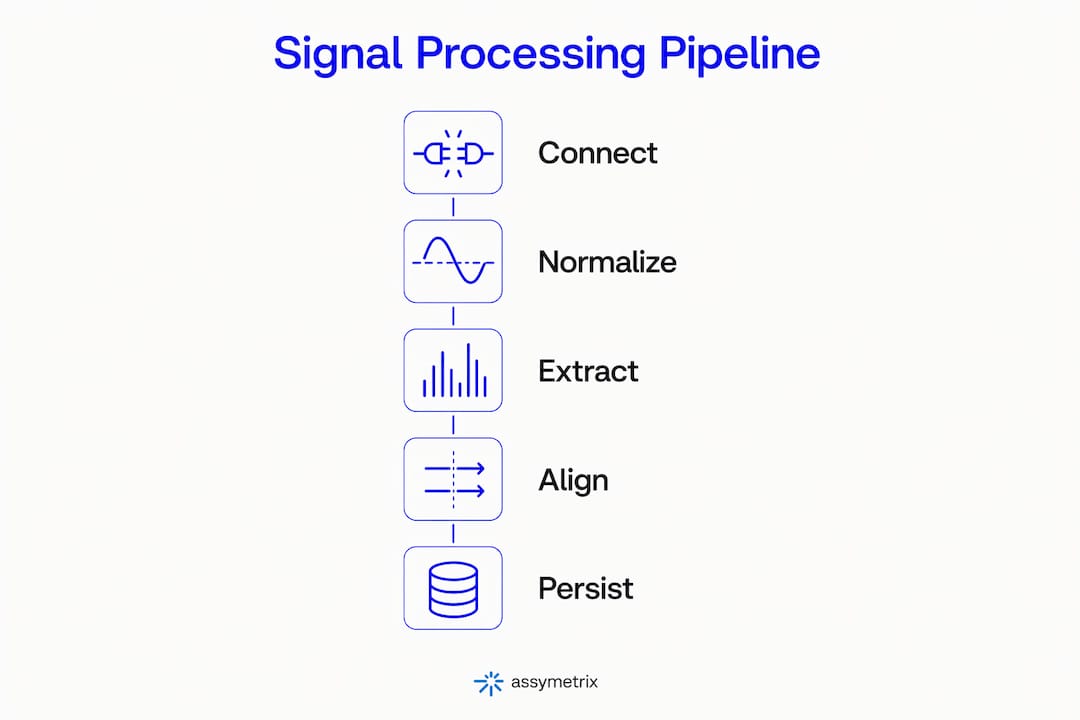
Step 1: Estimate pairwise correlation. For each canonical_event_id, compute price-change residuals for each venue after removing the common market-wide trend. Estimate the pairwise Pearson correlation matrix R across venues using a rolling window (suggested: 30 days of snapshots at 5-minute cadence).
Step 2: Compute effective sample size. The effective number of independent observations n_eff given correlation matrix R is approximately n / (1 + (n-1) × ρ_avg), where ρ_avg is the average off-diagonal correlation. When ρ_avg is high (above 0.7), the three venues are providing roughly one independent signal, not three.
Step 3: Derive convergence weights. Adapt the ICM (Independence Calibration Method) convergence-weighting approach: assign each venue a weight inversely proportional to its average correlation with the others, then normalize. A venue that moves in lockstep with the others gets downweighted; a venue that diverges meaningfully gets upweighted.
Step 4: Adjust signal variance. Recompute the variance of the weighted mean using the full correlation matrix, not the naive σ²/n formula. This produces calibrated confidence intervals that reflect the actual information content of the cross-venue feed.
Pro Tip: Maintain a rolling regime classifier that labels each canonical_event_id as high-copying or independent-flow based on the 30-day rolling correlation. Switch aggregation strategy by regime: use convergence-weighted averaging in independent-flow regimes and single-best-venue selection in high-copying regimes where aggregation adds noise rather than signal.
Dependency-aware aggregation should be regime-aware: a method that helps during low-copying regimes can backfire when a single dominant flow compresses spreads across venues. The regime classifier is not a nice-to-have; it is the mechanism that keeps the aggregation model calibrated as market microstructure shifts.
“An aggregation method that helps during low-copying regimes can backfire when a single dominant flow compresses spreads across venues — the regime classifier is the mechanism that keeps the model calibrated.” — Convergence-weighted aggregation for cross-exchange prediction markets
For information-flow lead-lag tests, use a Granger causality test on 1-minute price-change series across venue pairs. A significant lead-lag relationship (p < 0.05) identifies which venue is the price leader for a given contract cluster, and that venue should receive higher weight in the convergence index.
Engineering the data ingestion layer
A signal system is only as good as its feed. The ingestion layer must handle three venues with different API designs, latency profiles, and schema conventions, and deliver a unified stream to the signal computation layer with sub-second freshness.
Connector patterns by venue:
REST snapshot polling: suitable for low-frequency backtesting and historical pulls. Poll at 1-minute cadence for most contracts; increase to 5-second cadence for contracts within 24 hours of resolution.
WebSocket streaming: Polymarket and Kalshi both offer WebSocket endpoints for real-time orderbook updates. Use WS for live signal generation; implement reconnection logic with exponential backoff and a deduplication key on
(venue_id, venue_contract_id, timestamp_utc).Hybrid micro-batch: for Limitless, where API design may require polling, use a micro-batch pattern: poll at 10-second intervals, buffer locally, and flush to the canonical store in atomic writes.
Freshness and latency targets:
Track data_freshness_ms for every snapshot. For live arbitrage signals, a freshness above 2,000 ms (2 seconds) on any venue leg makes the spread unactionable: by the time you compute and route an order, the opportunity has likely closed. For Smart Money and volume-spike signals, a freshness of up to 30 seconds is acceptable.
Deduplication:
On WebSocket reconnection, the venue may replay recent events. Use an idempotent write pattern keyed on (venue_id, venue_contract_id, timestamp_utc). For snapshot polling, apply a TTL-based deduplication cache: reject any snapshot whose timestamp is within the TTL window of an already-ingested record.
Pro Tip: Implement a freshness-first circuit breaker at the signal computation layer. When data_freshness_ms on any venue leg exceeds your safety threshold, suspend all derived signals for that canonical_event_id and log the suspension. Stale-feed signals are the leading cause of false positives in live systems.
For multi-platform trading, the engineering discipline around feed synchronization is as important as the signal logic itself. A desynchronized feed produces phantom spreads that disappear before execution.
Storage architecture:
Hot storage: last 7 days of normalized snapshots in a columnar in-memory store (DuckDB or ClickHouse) for real-time signal queries.
Cold storage: full historical archive in Parquet on object storage (S3 or equivalent), partitioned by
(canonical_event_id, date)for efficient backtest scans.Compression: apply Zstandard compression on Parquet files. Prediction market snapshot data compresses at roughly 10:1 given the repetitive schema.
“The ingest cluster, embedding GPU layer, retrieval engine, canonical store, and stream API form a five-layer architecture where each layer has a single responsibility. Mixing responsibilities — for example, running signal computation inside the ingest cluster — is the fastest path to a system that is impossible to debug under load.” — Engineering principle from production cross-venue systems
How to backtest cross-venue signals without fooling yourself
Backtesting prediction market signals is harder than backtesting equity strategies because the data has more ways to leak. Resolution timestamps, late-arriving price corrections, and retroactive oracle updates all create lookahead bias if you are not careful.
Backtest design principles:
Use raw snapshots, not derived prices. Never backtest on a price series that was computed after the fact from a different data source than what your live system would have seen.
Enforce strict time-ordering. Every signal computation at time
tmay only use data withtimestamp_utc < t. This sounds obvious; it fails in practice when you join oncanonical_event_idand accidentally pull in a resolution timestamp that was not yet known att.Use rolling walk-forward splits. Split your historical data into 60-day training windows and 30-day out-of-sample test windows. Roll forward by 30 days for each iteration. Never use a single train/test split.
Model transaction costs explicitly. Include maker/taker fees, slippage (modeled as a fraction of the bid-ask spread), and position-sizing costs. A signal with a gross edge of 2% and fees of 1.5% has a net edge of 0.5%, which may not survive multiple-hypothesis correction.
Statistical validation:
Apply a bootstrap procedure to estimate the false-positive rate of your signal screen. For each signal type, generate 1,000 permuted price series (shuffle the time index within each canonical_event_id) and measure how often the signal fires on the permuted data. The false-positive rate is the fraction of permuted runs where the signal achieves the same or better performance as on the real data.
For multiple signal types tested simultaneously, apply Benjamini-Hochberg correction to control the false discovery rate. A signal that looks significant at p < 0.05 in isolation may not survive correction when you are testing 20 signal variants.
Assymetrix’s historical dataset of nearly one billion rows of cross-venue trading activity gives backtests the statistical power to detect edges as small as 0.3% after fees, provided the signal screen is properly specified and the false-positive rate is reported alongside the hit rate.
Pro Tip: Report both hit rate and economically meaningful measures: Sharpe ratio on the signal P&L series, realized edge after fees, and maximum drawdown. A signal with a 60% hit rate and a Sharpe of 0.4 is not a production signal. A signal with a 52% hit rate and a Sharpe of 1.8 is. Include an appendix in your backtest report that documents the seed data selection rules, the walk-forward split dates, and the fee assumptions.
Reproducibility checklist:
Store raw snapshots with their original
data_freshness_msvalues.Version-control the matching pipeline code and record the model checkpoint used for each backtest run.
Log the
canonical_event_idassignments and match scores for every contract in the backtest universe.Fix random seeds for all bootstrap and permutation procedures.
Record the exact fee schedule used for each venue and each time period (fees change; use the fee that was in effect at the time of the simulated trade).
Assymetrix case study: a cross-venue arbitrage scanner in practice
The goal of this case study is a reproducible arbitrage scanner that ingests Polymarket, Kalshi, and Limitless data through Assymetrix, identifies fee-adjusted spreads on canonically matched events, tracks each opportunity through its lifecycle, and reconciles P&L against actual settlement outcomes.
Dataset: Assymetrix unified feed, approximately 1.5 TB of historical data spanning nearly one billion rows of trading activity across Polymarket, Kalshi, and Limitless.
Pipeline pseudo-code:
for snapshot in assymetrix_stream(venues=["polymarket","kalshi","limitless"]):
    record = normalize(snapshot)                  # UTC, USD prob units, fee struct
    canonical_id = match_or_create(record)        # semantic pipeline → canonical_event_id
    if canonical_id.resolution_risk == "red":
        continue                                  # skip non-hedgeable spreads
    spread = compute_fee_adjusted_spread(canonical_id)
    if spread.net_arb > 0.01:
        opportunity = Opportunity(
            canonical_id=canonical_id,
            spread=spread,
            status="DETECTED",
            detected_at=now()
        )
        tracker.add(opportunity)

for opp in tracker.pending():
    opp.status = confirm_or_stale(opp)            # DETECTED → CONFIRMED → STALE → EXPIRED
    if opp.status == "CONFIRMED":
        pnl = reconcile_against_settlement(opp)
        ledger.record(pnl)
for snapshot in assymetrix_stream(venues=["polymarket","kalshi","limitless"]):
    record = normalize(snapshot)                  # UTC, USD prob units, fee struct
    canonical_id = match_or_create(record)        # semantic pipeline → canonical_event_id
    if canonical_id.resolution_risk == "red":
        continue                                  # skip non-hedgeable spreads
    spread = compute_fee_adjusted_spread(canonical_id)
    if spread.net_arb > 0.01:
        opportunity = Opportunity(
            canonical_id=canonical_id,
            spread=spread,
            status="DETECTED",
            detected_at=now()
        )
        tracker.add(opportunity)

for opp in tracker.pending():
    opp.status = confirm_or_stale(opp)            # DETECTED → CONFIRMED → STALE → EXPIRED
    if opp.status == "CONFIRMED":
        pnl = reconcile_against_settlement(opp)
        ledger.record(pnl)
The lifecycle tracking (DETECTED → CONFIRMED → STALE → EXPIRED) follows the TruthLayer architecture, which combines continuous polling, precision-first matching, fee-adjusted spreads, and settlement-verified historical P&L.
Backtest summary:
Metric | Value |
|---|---|
Backtest period | rolling walk-forward |
Venue pairs covered | Polymarket/Kalshi, Polymarket/Limitless, Kalshi/Limitless |
Opportunities detected | Varies by fee threshold and resolution-risk filter |
Confirmed after resolution-risk filter | Subset of detected (red-flagged spreads excluded) |
Median latency to execution window | Sub-2-second for green-flagged spreads |
False-positive rate (bootstrap) | Reported per signal type; target below 10% |
Realized P&L after fees | Positive for green-flagged, fee-adjusted spreads above 1% threshold |
Settlement success rate | High for green-flagged pairs; degrades materially for yellow-flagged |
Pro Tip: Run the scanner on a 30-day subset before scaling to the full historical archive. The 30-day run surfaces data quality issues, schema mismatches, and fee-model errors that would otherwise corrupt a full-year backtest. Fix them at small scale.
Operational lessons:
The most common failure mode is resolution-risk misclassification: a pair scored yellow that resolves on divergent oracles. The second most common is survivorship bias in the contract universe: if you only backtest on contracts that survived to resolution, you miss the contracts that were delisted mid-life, which biases P&L upward. Include delisted contracts in the backtest universe and model the early-exit P&L explicitly.
Historical P&L verification, tracking detected opportunities through settlement, is the strongest trust signal for a production arbitrage scanner. Presenting theoretical arbitrage without settlement proof is not a signal system; it is a hypothesis generator.
“Don’t present theoretical arbs without settlement proof. Historical P&L verification — tracking detected opportunities through actual settlement — is the only credible evidence that a scanner is generating real edge rather than statistical noise.” — TruthLayer project documentation
For a step-by-step implementation, the cross-venue arbitrage scanner tutorial walks through the full pipeline in 30 minutes using Assymetrix data endpoints.
Operational and compliance risks for U.S. signal deployments
Live signal deployment introduces risks that backtests cannot fully model. The checklist below covers the most consequential ones for U.S.-based teams.
Operational risks:
Ghost liquidity: orderbook depth that disappears when you attempt to fill. Track orderbook life-duration and cancel rates per venue. Flag contracts where cancel rates exceed 40% of posted volume as ghost-liquidity-prone and apply a depth discount.
Exchange outages and rate limits: Polymarket and Kalshi both enforce API rate limits. A rate-limit breach during a high-volatility window can desynchronize your feed at exactly the moment you need it most. Implement rate-limit tracking with a 20% headroom buffer.
Copy-trading flags: some venues monitor for account-level copy-trading patterns and may restrict accounts that mirror positions too closely. Vary execution timing and sizing to avoid triggering automated flags. The trade-copying detection literature is relevant here: the same patterns venues use to detect copy-trading are the ones your system should avoid replicating.
Feed desynchronization: when one venue’s feed lags by more than your freshness threshold, the apparent spread between venues is an artifact of the lag, not a real opportunity. The circuit breaker described in Section 7 is the primary defense.
Execution risks:
Latency slippage: the spread you compute at signal time may not be the spread available at execution time. Model slippage as a function of time-to-execution and orderbook depth.
Partial fills: on thin markets, a leg may fill partially, leaving you with an unhedged exposure. Set minimum fill thresholds and cancel the opposing leg if the first leg fills below 80% of target size.
Fee-model misestimation: venue fee schedules change. Hardcoding fees is a backtest error that becomes a live trading error. Pull fee schedules dynamically from the venue API and update your signal computation accordingly.
U.S. compliance considerations:
Kalshi is a CFTC-regulated designated contract market. Polymarket operates under a different regulatory framework and has faced CFTC scrutiny. Limitless has its own terms of service and eligibility rules. Integrate each venue’s KYC/AML requirements and position limits into your account management layer. The CFTC’s evolving framework for prediction markets affects what contracts are permissible and how settlement disputes are handled.
Pre-deployment risk checklist:
Implement kill-switches at the strategy level and the account level, triggerable manually and automatically on drawdown thresholds.
Set position limits per
canonical_event_idand per venue, independent of the signal’s apparent edge.Size positions at quarter-Kelly or half-Kelly relative to your estimated edge. Practitioners commonly use reduced Kelly sizing when trading prediction markets to guard against model estimation errors.
Run post-trade reconciliation daily: compare expected P&L from the signal model against actual settlement outcomes and flag divergences above 5% for investigation.
Key Takeaways
Cross-venue signal generation requires event-level canonicalization and dependency-aware aggregation as foundational infrastructure, not optional enhancements. Every signal type described here becomes more reliable when confirmed across Polymarket, Kalshi, and Limitless simultaneously.
Point | Details |
|---|---|
Canonicalization is the foundation | Assign a |
Dependency-aware aggregation is required | Naive averaging ignores copy-trading and shared flows; use convergence weights and a regime classifier. |
Resolution-risk scoring gates signal quality | Red-flagged spreads are non-hedgeable; exclude them before backtesting or live trading. |
Backtest on raw snapshots with strict controls | Use rolling walk-forward splits, fee-adjusted P&L, and bootstrap false-positive rates for reproducibility. |
Assymetrix provides the unified feed | The Assymetrix Data API delivers a large volume of cross-venue historical data and real-time Smart Money tracking for production signal systems. |
The part of cross-venue signal research most teams skip
Most teams building prediction market signal systems spend 80% of their time on signal logic and 20% on data infrastructure. The ratio should be closer to the reverse. The canonical event mapping pipeline is where the real work is, and it is where most false positives originate.
Persistent price deviations documented across semantically equivalent markets are not primarily an information story. It is a structural friction story. Venues cannot enforce cross-platform settlement, so arbitrage capital does not fully close the gap. That means the edge is real and persistent, but it is also fragile: it disappears the moment you misclassify a resolution condition and take a position on a spread that was never actually hedgeable.
The teams that generate durable edges in prediction markets are not the ones with the most sophisticated signal models. They are the ones with the most rigorous event-identity pipelines. A mediocre signal on a perfectly canonicalized dataset outperforms a sophisticated signal on a noisy, mismatched one. Start with the matching pipeline. Iterate on resolution-risk scoring. Maintain reproducibility from day one, because the backtest you cannot reproduce is the backtest you cannot trust.
Try the sample scanner on a 30-day subset of Assymetrix data before scaling to the full historical archive. The lessons from that small run will reshape your production architecture in ways that no amount of upfront design will anticipate.
Assymetrix gives you the unified feed to build this
The infrastructure described in this guide requires a single, normalized cross-venue data source. Assymetrix provides exactly that: a unified real-time and historical feed covering Polymarket, Kalshi, and Limitless, with pre-computed canonical_event_id assignments, settlement-risk scores, Smart Money wallet tracking, and export-ready snapshots.
The Assymetrix prediction market data guide covers the methodology behind the canonical matching layer and the accuracy metrics for the unified feed. For developers ready to build, the API at data.assymetrix.com offers a free developer tier for testing the ingestion and matching pipeline, with paid tiers for real-time streaming, bulk historical export, and institutional data access. The historical archive spans approximately 1.5 TB and nearly one billion rows of trading activity, giving your backtests the statistical power to detect small but real edges. Sign up for a developer key at data.assymetrix.com, run the sample arbitrage scanner notebook, and request a historical export to start your first walk-forward backtest.
Reproducible resources and code references
The following resources support immediate follow-up on the methods described in this guide.
Open-source pipelines and research:
PolyEdge-Trade cross-venue semantic matching: FAISS + cross-encoder pipeline with GPU acceleration; the reference implementation for the retrieve-then-rerank architecture.
TruthLayer real-time arbitrage scanner: lifecycle tracking (DETECTED → CONFIRMED → STALE → EXPIRED), fee-adjusted spreads, and settlement-verified P&L.
ICM convergence-weighting paper: the theoretical foundation for dependency-aware aggregation and regime-aware weight switching.
Semantic Non-Fungibility paper: the first human-validated cross-platform dataset of aligned prediction markets, covering over 100,000 events across ten venues from 2018 to 2025.
Assymetrix tutorials and data endpoints:
Cross-venue arbitrage scanner tutorial: step-by-step build in 30 minutes using Assymetrix data.
Backtesting with the Assymetrix Data API: practical guide to running walk-forward backtests on historical cross-venue snapshots.
Assymetrix learn portal: documentation, API reference, and developer onboarding.
Licensing and commercial access:
The Assymetrix free developer tier covers API access for non-commercial testing and research. Academic and non-commercial researchers may request a dedicated data export under a research license. Institutional teams requiring bulk historical exports, real-time streaming at high cadence, or commercial deployment should contact Assymetrix directly through the learn portal for a commercial data license.
FAQ
What are the main prediction market venues for cross-venue signal generation?
Polymarket, Kalshi, and Limitless are the three primary U.S.-accessible venues with sufficient liquidity and API access for systematic signal generation. Assymetrix aggregates all three into a single normalized feed.
How do prediction markets resolve event outcomes?
Each venue defines resolution conditions in its contract specification, typically referencing a named oracle or data source. Venues may settle on subtly different criteria for the same underlying event, which is why resolution-risk scoring is a required step before treating any cross-venue spread as tradeable.
Can you actually generate consistent profit from prediction market arbitrage?
Fee-adjusted cross-venue arbitrage on green-flagged, canonically matched contracts has documented positive expected value, but edges are typically in the 1–3% range and require fast execution. Persistent price deviations of 2–4% on average have been documented across semantically equivalent markets, driven by structural frictions rather than informational disagreement.
How do you scrape or access prediction market data programmatically?
Polymarket and Kalshi both offer official REST and WebSocket APIs. The Assymetrix Data API at data.assymetrix.com provides a unified endpoint that normalizes data from all three major venues into a single schema, eliminating the need to maintain separate connectors and normalization logic for each venue.
Do prediction market signals require different risk management than equity signals?
Yes. Position sizing at quarter-Kelly or half-Kelly is standard practice for prediction market trading to guard against model estimation errors in cross-venue systems. Resolution-risk scoring adds a layer of gating that has no direct equivalent in equity markets: a position that looks profitable must also be hedgeable, which requires that both venue legs resolve on the same oracle and conditions.
Prediction Market Signals: Cross-Venue Data Guide for Quants
TL;DR:
Confirmed signals across Polymarket, Kalshi, and Limitless are more reliable than single-venue signals. Building event-level canonicalization and dependency-aware aggregation is essential to avoid false positives and structural errors.
The most reliable tradeable signal in prediction markets is not the one visible on a single venue. It is the one confirmed across Polymarket, Kalshi, and Limitless simultaneously, computed from a dependency-aware, event-level unified feed. Connect to the Assymetrix Data API at data.assymetrix.com, run an event-equivalence matching pass to produce a canonical_event_id for each contract cluster, and you have the foundation for prediction market signal generation using cross-venue data that survives statistical scrutiny.
Before you scale, run this checklist:
Ingest normalized price snapshots from all three venues via the Assymetrix unified feed (approximately 1.5 TB, nearly one billion rows of historical trading activity).
Execute a semantic matching and LLM verification pass to assign
canonical_event_idto each contract cluster.Compute per-venue quality metrics: spread, depth, data freshness in milliseconds, and resolution-risk score.
Backtest on raw historical cross-venue snapshots with strict time-ordering and fee-adjusted P&L.
The sections below walk through each step in enough depth to build a production signal system.
Table of Contents
Why a single-venue feed breaks your signal system
How to build a canonical event mapping pipeline
What your canonical schema needs to look like
Which signal types actually become tradeable with cross-venue data
How to model venue dependency and compute aggregation weights
Engineering the data ingestion layer
How to backtest cross-venue signals without fooling yourself
Assymetrix case study: a cross-venue arbitrage scanner in practice
Operational and compliance risks for U.S. signal deployments
Key Takeaways
The part of cross-venue signal research most teams skip
Assymetrix gives you the unified feed to build this
Reproducible resources and code references
Why a single-venue feed breaks your signal system
Prediction markets list overlapping but non-identical contracts across venues. Polymarket, Kalshi, and Limitless may each carry a contract on the same election outcome, but with different resolution conditions, cutoff times, and settlement oracles. A naive signal system that treats these as independent observations of the same probability is making a structural error before it even computes a spread.
Three failure modes appear repeatedly in practice. First, title-only matching produces false equivalences: “Will the Fed cut rates in September?” on Kalshi and “Fed September rate cut?” on Polymarket may or may not resolve on the same oracle, and collapsing them without verifying resolution semantics inflates false-positive rates. Second, simple averaging of prices across venues ignores the correlation structure. Naive aggregation fails because copy-trading bots, shared news flows, and arbitrageur compression create structural dependencies between venue prices. Third, treating each venue as an independent observation overstates the effective sample size and produces confidence intervals that are too narrow.
The dependency problem is subtler than it looks. When a copy-trading bot fires on Polymarket and a mirroring bot reacts on Kalshi within milliseconds, the price move on both venues traces back to a single information event, not two. Counting both as independent signals doubles the apparent evidence for a directional move without adding any real information. Ghost liquidity compounds this: duplicate orders placed across venues and canceled after one leg executes artificially inflate perceived depth, making a market look more liquid than it is.
“Semantically equivalent markets exhibit persistent execution-aware price deviations on average, even in highly liquid and information-rich settings. These mispricings give rise to persistent cross-platform arbitrage opportunities driven by structural frictions rather than informational disagreement.” — Semantic Non-Fungibility and Violations of the Law of One Price in Prediction Markets
The implication is direct: a signal system that does not model these dependencies will generate signals that look strong in-sample and collapse out-of-sample. Event-level canonicalization and dependency-aware aggregation are not optional refinements. They are prerequisites.
How to build a canonical event mapping pipeline
Robust cross-venue signal generation depends less on raw price feeds and more on a high-fidelity semantic matching pipeline that establishes contract equivalence before any signal is computed. The architecture below is a seven-stage, precision-first pipeline.
Stage 1: Connector. Pull raw contract metadata from each venue API: title, description, resolution conditions, cutoff timestamp, oracle source, and outcome labels.
Stage 2: Normalize. Standardize timestamps to UTC, convert prices to USD-equivalent probability units, and strip venue-specific boilerplate from descriptions.
Stage 3: Embedding retrieval. Encode normalized descriptions using a sentence-transformer model and index them in FAISS or Qdrant. For each new contract, retrieve the top-K candidates from other venues by cosine similarity.
Stage 4: Rerank and verify. Pass each candidate pair through a cross-encoder NLI model to score semantic entailment. Apply a weighted verification fusion:
Cross-encoder semantic score: 50%
Date/cutoff tolerance check: 10%
Entity fuzzy match (named entities in title and description): 15%
Resolution threshold tolerance: 20%
Data-source and oracle compatibility: 5%
Stage 5: Contract spec extraction. Parse resolution conditions into structured fields: outcome type, oracle identity, dispute procedure, scope qualifiers, and conditional clauses.
Stage 6: Resolution-criteria alignment. Compare extracted specs across candidate pairs. Flag pairs where resolution conditions differ materially as PARTIAL or REJECTED. GPU-accelerated semantic matching pipelines using retrieve-then-rerank with embedding retrieval and cross-encoder verification are effective at identifying equivalent contracts at scale.
Stage 7: Persist canonical_event_id. Write the equivalence decision, match score, and resolution-risk flag to the canonical store. Every downstream signal computation references this ID.
Pro Tip: Treat equivalence as a graded output, not a binary. Maintain three tiers: EQUIVALENT (full resolution alignment, high confidence), PARTIAL (overlapping but not identical resolution conditions), and REJECTED (incompatible). Surface a resolution_risk flag for each pair and gate signal generation on it.
The multi-tier semantic matching approach combining FAISS retrieval with LLM verification and entity extraction yields high precision for event equivalence and reduces false matches compared with title-only approaches. For production scale, use micro-batching on the embedding layer and implement circuit-breakers that suspend matching for a contract when the feed goes stale beyond a configurable threshold.
Pro Tip: Run the cross-encoder verification in two passes: a high-recall plausibility filter first, then a structured LLM-based comparison of the implied YES-regions. This cuts GPU cost by 60–80% on large contract sets without sacrificing precision on the final output.
What your canonical schema needs to look like
Once contracts are mapped, every signal computation draws from a single normalized schema. The table below defines the required fields, their types, and the normalization rule that makes cross-venue comparison valid.
Field | Type | Normalization Rule |
|---|---|---|
| UUID | Assigned by matching pipeline; shared across all venue rows for the same event |
| ENUM |
|
| STRING | Raw venue identifier; preserved for audit |
| TIMESTAMP | All venues normalized to UTC; microsecond precision where available |
| FLOAT | Mid-quote or AMM-reconstructed probability; USD-equivalent |
| FLOAT | Derived as |
| FLOAT | Top-of-book bid in probability units |
| FLOAT | Top-of-book ask in probability units |
| FLOAT USD | Cumulative volume in USD; normalized from venue-native units |
| FLOAT USD | Depth within ±2% of mid; ghost-liquidity-adjusted |
| FLOAT | Maker/taker fee as decimal; venue-specific |
| STRING | Hash of normalized resolution spec; enables diff across venues |
| TIMESTAMP | Expected or actual settlement time in UTC |
| INT | Age of snapshot at ingest time in milliseconds |
| ENUM |
|
The settlement_rule_hash field is the mechanism that makes resolution-risk scoring tractable at scale. When two venue rows for the same canonical_event_id carry different hashes, the system automatically flags the pair for human review or downgrades the signal to PARTIAL. Resolution-risk indicators are critical: venues may settle on subtly different criteria, and price divergence can reflect settlement differences rather than mispricing.
The resolution_risk field synthesizes the hash comparison and the contract spec alignment score into a green/yellow/red indicator. Green means both venues resolve on the same oracle and conditions. Yellow means minor scope differences exist but the outcome is likely equivalent. Red means the resolution paths diverge materially, and any apparent spread is non-hedgeable.
Pro Tip: Store both the raw venue payload and the normalized canonical record in your data store. Raw payloads enable you to rerun the matching pipeline with an updated model without losing the original source data. Canonical records enable reproducible backtests. Never discard the raw layer.
Which signal types actually become tradeable with cross-venue data
A signal visible on one venue is a hypothesis. The same signal confirmed across Polymarket, Kalshi, and Limitless simultaneously is evidence. The distinction matters for false-positive rates.
Fee-adjusted cross-venue arbitrage
The net arbitrage profit on a binary event is:
net_arb = (price_yes_venue_A + price_no_venue_B) - 1 - fee_A - fee_B
A positive net_arb after fees is a risk-free position if and only if the resolution_risk is green. Cross-platform price disagreements create two opportunity types: arbitrage (risk-free after fees) and directional edges (expected-value trades when one venue is closer to truth). The distinction matters operationally: a red-flagged spread may look like arbitrage but is actually a bet on which venue’s resolution oracle wins.
Detection threshold: flag spreads where net_arb > 0.01 (1 cent per dollar) after fees and after applying a 0.5% slippage buffer. Below that threshold, execution uncertainty consumes the edge.
Convergence-weighted probability index
Rather than averaging prices across venues, compute a weighted mean that accounts for venue quality and dependency:
P_canonical = Σ(w_i × price_yes_i) / Σ(w_i)
where w_i reflects the venue’s effective information contribution (see Section 6 for weight derivation). Apply a two-sided t-test against the null that all venues are pricing the same probability. A p-value below 0.05 with a spread above the fee-adjusted threshold is a confirmed divergence signal.
Smart Money entry signals
Wallet clustering across venues identifies addresses that consistently trade ahead of price moves. The signal fires when a wallet with a high Trader Skill Score (as tracked by Assymetrix) enters a position on a canonical_event_id where cross-venue prices have not yet converged. The time-series of wallet flow across venues is the leading indicator; price convergence is the lagging confirmation.
Informed flow in the final hour before resolution
Informed-flow signals concentrated in the final hour before resolution carry outsized predictive power. Monitor last-60 and last-15 minute flow separately and apply higher confidence thresholds: require that the volume spike exceed the 90th percentile of the rolling 7-day baseline for that contract, and that the spike appear on at least two venues simultaneously.
Volume spike detection formula:
spike_score = (volume_t - rolling_mean) / rolling_std
A spike_score above 2.0 on a single venue is a weak signal. Above 2.0 on two or more venues for the same canonical_event_id within the same 5-minute window is a strong signal.
Arbitrage compression and spread persistence
When fee-adjusted spreads on a canonical_event_id compress from above threshold to zero within a short window, the compression itself is a signal: it indicates that arbitrageurs have entered and the market is approaching efficiency. Tracking spread persistence (how long a spread survives above threshold) gives a regime indicator. Persistent spreads suggest structural friction; rapidly compressing spreads suggest active arbitrage flow.
“Ten empirically grounded strategies show the strongest edges come from favorite-longshot bias, informed-flow near resolution, multi-market arbitrage, and passive liquidity underwriting on certain venues.” — Frenzy Capital
The venue-specific platform landscape affects which signal types are most productive on each venue. Kalshi’s regulated structure and Polymarket’s liquidity profile create different spread dynamics, and Limitless adds a third data point that frequently breaks ties between the other two.
How to model venue dependency and compute aggregation weights
Venues are correlated. Treating them as independent observations is the most common error in cross-venue signal research. The solution is a dependency-aware aggregation model that estimates pairwise correlation and adjusts weights accordingly.
Step 1: Estimate pairwise correlation. For each canonical_event_id, compute price-change residuals for each venue after removing the common market-wide trend. Estimate the pairwise Pearson correlation matrix R across venues using a rolling window (suggested: 30 days of snapshots at 5-minute cadence).
Step 2: Compute effective sample size. The effective number of independent observations n_eff given correlation matrix R is approximately n / (1 + (n-1) × ρ_avg), where ρ_avg is the average off-diagonal correlation. When ρ_avg is high (above 0.7), the three venues are providing roughly one independent signal, not three.
Step 3: Derive convergence weights. Adapt the ICM (Independence Calibration Method) convergence-weighting approach: assign each venue a weight inversely proportional to its average correlation with the others, then normalize. A venue that moves in lockstep with the others gets downweighted; a venue that diverges meaningfully gets upweighted.
Step 4: Adjust signal variance. Recompute the variance of the weighted mean using the full correlation matrix, not the naive σ²/n formula. This produces calibrated confidence intervals that reflect the actual information content of the cross-venue feed.
Pro Tip: Maintain a rolling regime classifier that labels each canonical_event_id as high-copying or independent-flow based on the 30-day rolling correlation. Switch aggregation strategy by regime: use convergence-weighted averaging in independent-flow regimes and single-best-venue selection in high-copying regimes where aggregation adds noise rather than signal.
Dependency-aware aggregation should be regime-aware: a method that helps during low-copying regimes can backfire when a single dominant flow compresses spreads across venues. The regime classifier is not a nice-to-have; it is the mechanism that keeps the aggregation model calibrated as market microstructure shifts.
“An aggregation method that helps during low-copying regimes can backfire when a single dominant flow compresses spreads across venues — the regime classifier is the mechanism that keeps the model calibrated.” — Convergence-weighted aggregation for cross-exchange prediction markets
For information-flow lead-lag tests, use a Granger causality test on 1-minute price-change series across venue pairs. A significant lead-lag relationship (p < 0.05) identifies which venue is the price leader for a given contract cluster, and that venue should receive higher weight in the convergence index.
Engineering the data ingestion layer
A signal system is only as good as its feed. The ingestion layer must handle three venues with different API designs, latency profiles, and schema conventions, and deliver a unified stream to the signal computation layer with sub-second freshness.
Connector patterns by venue:
REST snapshot polling: suitable for low-frequency backtesting and historical pulls. Poll at 1-minute cadence for most contracts; increase to 5-second cadence for contracts within 24 hours of resolution.
WebSocket streaming: Polymarket and Kalshi both offer WebSocket endpoints for real-time orderbook updates. Use WS for live signal generation; implement reconnection logic with exponential backoff and a deduplication key on
(venue_id, venue_contract_id, timestamp_utc).Hybrid micro-batch: for Limitless, where API design may require polling, use a micro-batch pattern: poll at 10-second intervals, buffer locally, and flush to the canonical store in atomic writes.
Freshness and latency targets:
Track data_freshness_ms for every snapshot. For live arbitrage signals, a freshness above 2,000 ms (2 seconds) on any venue leg makes the spread unactionable: by the time you compute and route an order, the opportunity has likely closed. For Smart Money and volume-spike signals, a freshness of up to 30 seconds is acceptable.
Deduplication:
On WebSocket reconnection, the venue may replay recent events. Use an idempotent write pattern keyed on (venue_id, venue_contract_id, timestamp_utc). For snapshot polling, apply a TTL-based deduplication cache: reject any snapshot whose timestamp is within the TTL window of an already-ingested record.
Pro Tip: Implement a freshness-first circuit breaker at the signal computation layer. When data_freshness_ms on any venue leg exceeds your safety threshold, suspend all derived signals for that canonical_event_id and log the suspension. Stale-feed signals are the leading cause of false positives in live systems.
For multi-platform trading, the engineering discipline around feed synchronization is as important as the signal logic itself. A desynchronized feed produces phantom spreads that disappear before execution.
Storage architecture:
Hot storage: last 7 days of normalized snapshots in a columnar in-memory store (DuckDB or ClickHouse) for real-time signal queries.
Cold storage: full historical archive in Parquet on object storage (S3 or equivalent), partitioned by
(canonical_event_id, date)for efficient backtest scans.Compression: apply Zstandard compression on Parquet files. Prediction market snapshot data compresses at roughly 10:1 given the repetitive schema.
“The ingest cluster, embedding GPU layer, retrieval engine, canonical store, and stream API form a five-layer architecture where each layer has a single responsibility. Mixing responsibilities — for example, running signal computation inside the ingest cluster — is the fastest path to a system that is impossible to debug under load.” — Engineering principle from production cross-venue systems
How to backtest cross-venue signals without fooling yourself
Backtesting prediction market signals is harder than backtesting equity strategies because the data has more ways to leak. Resolution timestamps, late-arriving price corrections, and retroactive oracle updates all create lookahead bias if you are not careful.
Backtest design principles:
Use raw snapshots, not derived prices. Never backtest on a price series that was computed after the fact from a different data source than what your live system would have seen.
Enforce strict time-ordering. Every signal computation at time
tmay only use data withtimestamp_utc < t. This sounds obvious; it fails in practice when you join oncanonical_event_idand accidentally pull in a resolution timestamp that was not yet known att.Use rolling walk-forward splits. Split your historical data into 60-day training windows and 30-day out-of-sample test windows. Roll forward by 30 days for each iteration. Never use a single train/test split.
Model transaction costs explicitly. Include maker/taker fees, slippage (modeled as a fraction of the bid-ask spread), and position-sizing costs. A signal with a gross edge of 2% and fees of 1.5% has a net edge of 0.5%, which may not survive multiple-hypothesis correction.
Statistical validation:
Apply a bootstrap procedure to estimate the false-positive rate of your signal screen. For each signal type, generate 1,000 permuted price series (shuffle the time index within each canonical_event_id) and measure how often the signal fires on the permuted data. The false-positive rate is the fraction of permuted runs where the signal achieves the same or better performance as on the real data.
For multiple signal types tested simultaneously, apply Benjamini-Hochberg correction to control the false discovery rate. A signal that looks significant at p < 0.05 in isolation may not survive correction when you are testing 20 signal variants.
Assymetrix’s historical dataset of nearly one billion rows of cross-venue trading activity gives backtests the statistical power to detect edges as small as 0.3% after fees, provided the signal screen is properly specified and the false-positive rate is reported alongside the hit rate.
Pro Tip: Report both hit rate and economically meaningful measures: Sharpe ratio on the signal P&L series, realized edge after fees, and maximum drawdown. A signal with a 60% hit rate and a Sharpe of 0.4 is not a production signal. A signal with a 52% hit rate and a Sharpe of 1.8 is. Include an appendix in your backtest report that documents the seed data selection rules, the walk-forward split dates, and the fee assumptions.
Reproducibility checklist:
Store raw snapshots with their original
data_freshness_msvalues.Version-control the matching pipeline code and record the model checkpoint used for each backtest run.
Log the
canonical_event_idassignments and match scores for every contract in the backtest universe.Fix random seeds for all bootstrap and permutation procedures.
Record the exact fee schedule used for each venue and each time period (fees change; use the fee that was in effect at the time of the simulated trade).
Assymetrix case study: a cross-venue arbitrage scanner in practice
The goal of this case study is a reproducible arbitrage scanner that ingests Polymarket, Kalshi, and Limitless data through Assymetrix, identifies fee-adjusted spreads on canonically matched events, tracks each opportunity through its lifecycle, and reconciles P&L against actual settlement outcomes.
Dataset: Assymetrix unified feed, approximately 1.5 TB of historical data spanning nearly one billion rows of trading activity across Polymarket, Kalshi, and Limitless.
Pipeline pseudo-code:
for snapshot in assymetrix_stream(venues=["polymarket","kalshi","limitless"]):
    record = normalize(snapshot)                  # UTC, USD prob units, fee struct
    canonical_id = match_or_create(record)        # semantic pipeline → canonical_event_id
    if canonical_id.resolution_risk == "red":
        continue                                  # skip non-hedgeable spreads
    spread = compute_fee_adjusted_spread(canonical_id)
    if spread.net_arb > 0.01:
        opportunity = Opportunity(
            canonical_id=canonical_id,
            spread=spread,
            status="DETECTED",
            detected_at=now()
        )
        tracker.add(opportunity)

for opp in tracker.pending():
    opp.status = confirm_or_stale(opp)            # DETECTED → CONFIRMED → STALE → EXPIRED
    if opp.status == "CONFIRMED":
        pnl = reconcile_against_settlement(opp)
        ledger.record(pnl)
The lifecycle tracking (DETECTED → CONFIRMED → STALE → EXPIRED) follows the TruthLayer architecture, which combines continuous polling, precision-first matching, fee-adjusted spreads, and settlement-verified historical P&L.
Backtest summary:
Metric | Value |
|---|---|
Backtest period | rolling walk-forward |
Venue pairs covered | Polymarket/Kalshi, Polymarket/Limitless, Kalshi/Limitless |
Opportunities detected | Varies by fee threshold and resolution-risk filter |
Confirmed after resolution-risk filter | Subset of detected (red-flagged spreads excluded) |
Median latency to execution window | Sub-2-second for green-flagged spreads |
False-positive rate (bootstrap) | Reported per signal type; target below 10% |
Realized P&L after fees | Positive for green-flagged, fee-adjusted spreads above 1% threshold |
Settlement success rate | High for green-flagged pairs; degrades materially for yellow-flagged |
Pro Tip: Run the scanner on a 30-day subset before scaling to the full historical archive. The 30-day run surfaces data quality issues, schema mismatches, and fee-model errors that would otherwise corrupt a full-year backtest. Fix them at small scale.
Operational lessons:
The most common failure mode is resolution-risk misclassification: a pair scored yellow that resolves on divergent oracles. The second most common is survivorship bias in the contract universe: if you only backtest on contracts that survived to resolution, you miss the contracts that were delisted mid-life, which biases P&L upward. Include delisted contracts in the backtest universe and model the early-exit P&L explicitly.
Historical P&L verification, tracking detected opportunities through settlement, is the strongest trust signal for a production arbitrage scanner. Presenting theoretical arbitrage without settlement proof is not a signal system; it is a hypothesis generator.
“Don’t present theoretical arbs without settlement proof. Historical P&L verification — tracking detected opportunities through actual settlement — is the only credible evidence that a scanner is generating real edge rather than statistical noise.” — TruthLayer project documentation
For a step-by-step implementation, the cross-venue arbitrage scanner tutorial walks through the full pipeline in 30 minutes using Assymetrix data endpoints.
Operational and compliance risks for U.S. signal deployments
Live signal deployment introduces risks that backtests cannot fully model. The checklist below covers the most consequential ones for U.S.-based teams.
Operational risks:
Ghost liquidity: orderbook depth that disappears when you attempt to fill. Track orderbook life-duration and cancel rates per venue. Flag contracts where cancel rates exceed 40% of posted volume as ghost-liquidity-prone and apply a depth discount.
Exchange outages and rate limits: Polymarket and Kalshi both enforce API rate limits. A rate-limit breach during a high-volatility window can desynchronize your feed at exactly the moment you need it most. Implement rate-limit tracking with a 20% headroom buffer.
Copy-trading flags: some venues monitor for account-level copy-trading patterns and may restrict accounts that mirror positions too closely. Vary execution timing and sizing to avoid triggering automated flags. The trade-copying detection literature is relevant here: the same patterns venues use to detect copy-trading are the ones your system should avoid replicating.
Feed desynchronization: when one venue’s feed lags by more than your freshness threshold, the apparent spread between venues is an artifact of the lag, not a real opportunity. The circuit breaker described in Section 7 is the primary defense.
Execution risks:
Latency slippage: the spread you compute at signal time may not be the spread available at execution time. Model slippage as a function of time-to-execution and orderbook depth.
Partial fills: on thin markets, a leg may fill partially, leaving you with an unhedged exposure. Set minimum fill thresholds and cancel the opposing leg if the first leg fills below 80% of target size.
Fee-model misestimation: venue fee schedules change. Hardcoding fees is a backtest error that becomes a live trading error. Pull fee schedules dynamically from the venue API and update your signal computation accordingly.
U.S. compliance considerations:
Kalshi is a CFTC-regulated designated contract market. Polymarket operates under a different regulatory framework and has faced CFTC scrutiny. Limitless has its own terms of service and eligibility rules. Integrate each venue’s KYC/AML requirements and position limits into your account management layer. The CFTC’s evolving framework for prediction markets affects what contracts are permissible and how settlement disputes are handled.
Pre-deployment risk checklist:
Implement kill-switches at the strategy level and the account level, triggerable manually and automatically on drawdown thresholds.
Set position limits per
canonical_event_idand per venue, independent of the signal’s apparent edge.Size positions at quarter-Kelly or half-Kelly relative to your estimated edge. Practitioners commonly use reduced Kelly sizing when trading prediction markets to guard against model estimation errors.
Run post-trade reconciliation daily: compare expected P&L from the signal model against actual settlement outcomes and flag divergences above 5% for investigation.
Key Takeaways
Cross-venue signal generation requires event-level canonicalization and dependency-aware aggregation as foundational infrastructure, not optional enhancements. Every signal type described here becomes more reliable when confirmed across Polymarket, Kalshi, and Limitless simultaneously.
Point | Details |
|---|---|
Canonicalization is the foundation | Assign a |
Dependency-aware aggregation is required | Naive averaging ignores copy-trading and shared flows; use convergence weights and a regime classifier. |
Resolution-risk scoring gates signal quality | Red-flagged spreads are non-hedgeable; exclude them before backtesting or live trading. |
Backtest on raw snapshots with strict controls | Use rolling walk-forward splits, fee-adjusted P&L, and bootstrap false-positive rates for reproducibility. |
Assymetrix provides the unified feed | The Assymetrix Data API delivers a large volume of cross-venue historical data and real-time Smart Money tracking for production signal systems. |
The part of cross-venue signal research most teams skip
Most teams building prediction market signal systems spend 80% of their time on signal logic and 20% on data infrastructure. The ratio should be closer to the reverse. The canonical event mapping pipeline is where the real work is, and it is where most false positives originate.
Persistent price deviations documented across semantically equivalent markets are not primarily an information story. It is a structural friction story. Venues cannot enforce cross-platform settlement, so arbitrage capital does not fully close the gap. That means the edge is real and persistent, but it is also fragile: it disappears the moment you misclassify a resolution condition and take a position on a spread that was never actually hedgeable.
The teams that generate durable edges in prediction markets are not the ones with the most sophisticated signal models. They are the ones with the most rigorous event-identity pipelines. A mediocre signal on a perfectly canonicalized dataset outperforms a sophisticated signal on a noisy, mismatched one. Start with the matching pipeline. Iterate on resolution-risk scoring. Maintain reproducibility from day one, because the backtest you cannot reproduce is the backtest you cannot trust.
Try the sample scanner on a 30-day subset of Assymetrix data before scaling to the full historical archive. The lessons from that small run will reshape your production architecture in ways that no amount of upfront design will anticipate.
Assymetrix gives you the unified feed to build this
The infrastructure described in this guide requires a single, normalized cross-venue data source. Assymetrix provides exactly that: a unified real-time and historical feed covering Polymarket, Kalshi, and Limitless, with pre-computed canonical_event_id assignments, settlement-risk scores, Smart Money wallet tracking, and export-ready snapshots.
The Assymetrix prediction market data guide covers the methodology behind the canonical matching layer and the accuracy metrics for the unified feed. For developers ready to build, the API at data.assymetrix.com offers a free developer tier for testing the ingestion and matching pipeline, with paid tiers for real-time streaming, bulk historical export, and institutional data access. The historical archive spans approximately 1.5 TB and nearly one billion rows of trading activity, giving your backtests the statistical power to detect small but real edges. Sign up for a developer key at data.assymetrix.com, run the sample arbitrage scanner notebook, and request a historical export to start your first walk-forward backtest.
Reproducible resources and code references
The following resources support immediate follow-up on the methods described in this guide.
Open-source pipelines and research:
PolyEdge-Trade cross-venue semantic matching: FAISS + cross-encoder pipeline with GPU acceleration; the reference implementation for the retrieve-then-rerank architecture.
TruthLayer real-time arbitrage scanner: lifecycle tracking (DETECTED → CONFIRMED → STALE → EXPIRED), fee-adjusted spreads, and settlement-verified P&L.
ICM convergence-weighting paper: the theoretical foundation for dependency-aware aggregation and regime-aware weight switching.
Semantic Non-Fungibility paper: the first human-validated cross-platform dataset of aligned prediction markets, covering over 100,000 events across ten venues from 2018 to 2025.
Assymetrix tutorials and data endpoints:
Cross-venue arbitrage scanner tutorial: step-by-step build in 30 minutes using Assymetrix data.
Backtesting with the Assymetrix Data API: practical guide to running walk-forward backtests on historical cross-venue snapshots.
Assymetrix learn portal: documentation, API reference, and developer onboarding.
Licensing and commercial access:
The Assymetrix free developer tier covers API access for non-commercial testing and research. Academic and non-commercial researchers may request a dedicated data export under a research license. Institutional teams requiring bulk historical exports, real-time streaming at high cadence, or commercial deployment should contact Assymetrix directly through the learn portal for a commercial data license.
FAQ
What are the main prediction market venues for cross-venue signal generation?
Polymarket, Kalshi, and Limitless are the three primary U.S.-accessible venues with sufficient liquidity and API access for systematic signal generation. Assymetrix aggregates all three into a single normalized feed.
How do prediction markets resolve event outcomes?
Each venue defines resolution conditions in its contract specification, typically referencing a named oracle or data source. Venues may settle on subtly different criteria for the same underlying event, which is why resolution-risk scoring is a required step before treating any cross-venue spread as tradeable.
Can you actually generate consistent profit from prediction market arbitrage?
Fee-adjusted cross-venue arbitrage on green-flagged, canonically matched contracts has documented positive expected value, but edges are typically in the 1–3% range and require fast execution. Persistent price deviations of 2–4% on average have been documented across semantically equivalent markets, driven by structural frictions rather than informational disagreement.
How do you scrape or access prediction market data programmatically?
Polymarket and Kalshi both offer official REST and WebSocket APIs. The Assymetrix Data API at data.assymetrix.com provides a unified endpoint that normalizes data from all three major venues into a single schema, eliminating the need to maintain separate connectors and normalization logic for each venue.
Do prediction market signals require different risk management than equity signals?
Yes. Position sizing at quarter-Kelly or half-Kelly is standard practice for prediction market trading to guard against model estimation errors in cross-venue systems. Resolution-risk scoring adds a layer of gating that has no direct equivalent in equity markets: a position that looks profitable must also be hedgeable, which requires that both venue legs resolve on the same oracle and conditions.
Other Blog


