Stop Rebuilding Three Feeds: Prediction Market API for Devs & Quants
Stop Rebuilding Three Feeds: Prediction Market API for Devs & Quants
Stop Rebuilding Three Feeds: Prediction Market API for Devs & Quants
REST for discovery, WebSocket for live books. Use recovery and canonical IDs to make cross venue prediction market APIs production ready.

Stop Rebuilding Three Feeds: Prediction Market API for Devs & Quants
Use REST for market discovery, metadata, and historical snapshots. Use WebSocket for live order-book updates, trades, and lifecycle events. In production, a unified cross-venue API that normalizes schema and handles recovery, like the Assymetrix Data API, beats stitching together separate connections to Polymarket, Kalshi, and Limitless yourself.
TL;DR:
Use REST for market discovery, historical data, and periodic audits, especially when latency tolerance is high and real-time updates are unnecessary.
Employ WebSocket for live order-book updates, trades, and market events that require millisecond reaction times, particularly for market-making bots.
Always re-snapshot via REST after any WebSocket disconnection longer than a few seconds to prevent silent state inconsistencies and data drift.
Map venue-specific IDs to a canonical ID scheme, attach high-precision timestamps, and shard by symbol hash to ensure reliable cross-venue data aggregation at scale.
Implement structured error handling, rate limit management, and continuous state reconciliation to maintain resilient, production-ready trading integrations.
Assymetrixassymetrix.comUnify Your Prediction Market DataAssymetrix gives developers and quants unified access to Polymarket, Kalshi, and Limitless data through a single Data API integration.Explore the Data API
Table of Contents
Prediction Market Data API: REST vs WebSocket, When to Use Each
What REST Endpoints Actually Matter for Prediction Markets
How to Stream Live Order Books Without Losing State
Authentication, Rate Limits, and Error Handling That Won’t Break in Production
Building for Scale: Canonical IDs, Sequencing, and Replay
SDKs and Client Libraries: When to Build vs When to Adopt
Historical Data and Backfill: Getting Backtests Right
Assymetrix: A Unified Cross-Venue Data API
Data Format and Schema Details Developers Should Expect
Security Practices Beyond Basic Authentication
Handling API Versioning and Backward Compatibility
Testing WebSocket Connections and Mock Data Strategies
Monitoring API Usage for Performance and Reliability
What Actually Matters When You Build This Yourself
Get Production API Access at Assymetrix
Sources
Prediction Market Data API: REST vs WebSocket, When to Use Each
REST and WebSocket solve different problems, and conflating them is the single most common architecture mistake in prediction market tooling. REST is stateless and request driven, which makes it the right tool for anything you query on demand rather than watch continuously.
REST handles market discovery (which contracts exist, what their strike conditions and expiries are), metadata lookups, historical price queries, and the periodic audit snapshots your compliance or research team needs to reconcile positions after the fact. Gemini’s prediction market docs describe exactly this split: REST for discovery and history, WebSocket for the tick-by-tick updates that matter once you’re actually trading.
WebSocket, by contrast, is a persistent, push-based channel. It carries the order-book deltas, executed trades, and market lifecycle events (a contract resolving, a market pausing) that a REST poll loop would either miss or arrive at too late to act on.
Three questions decide which pattern you need for a given workflow:
Latency tolerance. If a stale price for two or three seconds breaks your logic, you need WebSocket. If a once-per-minute refresh is fine, REST is simpler and cheaper to operate.
Sampling frequency. A dashboard refreshing every 30 seconds should poll REST. A quoting bot reacting to every book change needs a stream.
Backtest vs live. Backtests run entirely on historical REST pulls. Live execution runs on WebSocket, with REST as the fallback for state recovery.
A market-making bot’s quoting loop lives almost entirely on WebSocket: it holds a live book, reacts to depth changes, and cancels or replaces quotes in milliseconds. A backtest researcher, meanwhile, never touches a socket at all. Every data point comes from REST history endpoints, pulled once and stored for repeated experiments.
What REST Endpoints Actually Matter for Prediction Markets
Not every endpoint a vendor exposes is worth building around. For serious prediction market applications, five categories cover nearly everything you’ll need:
Markets/events — the catalog endpoint. Persist the instrument symbol, the venue’s native event ID, your own canonical ID if you’re aggregating across venues, resolution criteria, and expiry timestamp. Skipping the canonical ID here is the mistake that costs the most engineering hours later.
Orderbook/quotes — REST snapshots of current bid/ask depth, useful for periodic reconciliation against your WebSocket-maintained book.
Trades/executions — historical fill data, needed for slippage analysis and building realistic backtest fill models.
Candles/OHLCV — aggregated price bars at fixed intervals, the backbone of most signal backtesting.
Wallet and positions — account-level holdings and settlement history, critical for PnL tracking and for Smart Money style wallet analysis if you’re studying other traders’ behavior.
Pagination deserves its own attention. Offset-based pagination silently corrupts results when new events are inserted mid-scan; a cursor pointing to the last seen timestamp or ID is far more reliable, especially where new markets and price ticks arrive continuously. When backfilling months of history, request in bounded time windows (a day or a week at a time) rather than one enormous unbounded call. It keeps individual requests fast and makes retries cheap when one window fails.
For reproducible backtests, store raw REST responses exactly as received, in a structured format such as Parquet, alongside your own ingestion timestamp. Reconciliation later becomes a matter of replaying stored REST snapshots against your live book rather than trusting memory of what happened.
How to Stream Live Order Books Without Losing State
Every serious WebSocket integration follows the same core pattern: snapshot first, then apply diffs. Request a REST snapshot of the book, note its sequence number, open the WebSocket subscription, and discard any diff messages older than that sequence. Everything after that point layers cleanly on top of the snapshot.
The channels that matter most across prediction market venues are a book ticker (best bid/ask), depth diffs (incremental order-book changes), a trade stream (executed fills), and lifecycle events (market pauses, resolutions, and status changes). Gemini’s market data documentation recommends exactly this recovery pattern: if your local sequence counter detects a gap, don’t try to patch around it. Discard the local book and pull a fresh REST snapshot.
Subscription strategy depends on how many markets you’re watching. For a handful of symbols, single-symbol subscriptions are simpler to reason about. For hundreds or thousands, batch subscriptions reduce connection overhead but require more careful message routing on your end. Hot tokens (contracts with active trading) deliver updates in near real time, while cold tokens sitting far from the matching engine’s edge infrastructure can lag by hundreds of milliseconds, according to architecture notes from Sequence’s prediction market API docs. Request a REST snapshot for cold tokens if you need deterministic timing on the very first event.
A few operational habits separate resilient integrations from fragile ones:
Track sequence numbers per symbol, not globally, since a single connection often multiplexes many markets.
Deduplicate incoming trade and diff messages by their message ID, since reconnects can replay events you already processed.
Set a maximum staleness threshold (say, 10 seconds without a heartbeat) that triggers an automatic resubscribe.
Log every gap detection event with the sequence numbers involved. It’s the fastest way to diagnose which venue’s feed is actually unreliable.
Pro Tip: Never assume a reconnect resumes exactly where you left off. Always re-snapshot via REST after any WebSocket disconnect longer than a couple of seconds. The cost of an extra REST call is trivial next to the cost of trading on a stale, silently-wrong book.
Authentication, Rate Limits, and Error Handling That Won’t Break in Production
Authentication for prediction market APIs generally falls into three patterns, and which one you use often depends on whether you’re reading data or placing orders. Simple API-key headers cover most read-only REST calls. HMAC-signed requests, where you sign a payload with a secret key, are common for authenticated trading endpoints. RSA-PSS and EIP-712 style signature handshakes appear on venues built around wallet-based identity, where the signature proves control of an address rather than possession of a static secret.
WebSocket authentication usually happens at handshake time rather than per message: you sign a challenge or attach a signed header during the connection upgrade, and the session stays authenticated until it drops. Gemini’s developer documentation notes that many venues require custom upgrade headers unsupported by browser WebSocket clients, which is why authenticated trading connections should run from a server or a local client, never from browser JavaScript.
Rate limits come in two shapes worth distinguishing. Per-endpoint limits cap how often you can hit a specific route (order placement is almost always tighter than market data reads). Global limits cap total requests across your whole API key, regardless of endpoint. Hitting either should trigger exponential backoff with jitter, not a fixed retry interval, since synchronized retries from many clients are exactly what causes cascading rate-limit failures during volatile markets.
Sound error handling for production trading systems includes:
Idempotency keys on every order placement request, generated client-side and stored locally, so a retried submit after a timeout never results in a duplicate order.
REST-based state recovery after any WebSocket reconnect, rather than trusting the socket to replay missed messages.
Structured logging of every HTTP status code and WebSocket close code, tagged by venue, so a monitoring dashboard can distinguish “Kalshi is rate-limiting us” from “Polymarket’s feed dropped.”
Circuit breakers that pause new order submissions after repeated failures, rather than retrying blindly into a degraded venue.
Building for Scale: Canonical IDs, Sequencing, and Replay
Cross-venue aggregation breaks down fast without a canonical identifier scheme. Polymarket, Kalshi, and Limitless each use their own internal event and market IDs, formatted differently and with no shared namespace. Mapping “will the same real-world event resolve on all three venues” without a canonical ID layer turns into a fragile string-matching problem that breaks the moment a venue renames a market.
Unified API architectures like Sequence’s solve this by exposing a venue parameter alongside identical response shapes, so the same client code queries Kalshi and Polymarket without branching logic. That’s the model worth copying even if you’re building your own aggregation layer rather than buying one.
Four practices matter most as you scale past a handful of markets:
Assign a canonical ID at ingestion, before any downstream processing touches the record, so every service in your pipeline references the same key.
Attach a nanosecond-precision
observed_at_nstimestamp from a monotonic clock to every message, separate from the venue’s own timestamp, so replay ordering never depends on clock skew between systems.Shard WebSocket subscribers by symbol hash, not by venue, so a burst of activity on one contract doesn’t starve processing for unrelated markets.
Retain raw snapshots for a defined window (30, 60, or 90 days depending on your compliance needs) in an exportable format, so any position dispute can be resolved against the original feed data rather than a derived table.
Latency behavior differs meaningfully by token activity level. Hot tokens near the matching engine’s edge infrastructure typically deliver events within a few seconds, while cold tokens routed from more distant edges can take roughly 900 milliseconds longer to arrive, per Sequence’s documented architecture. Design your subscriber logic to expect that gap rather than treating it as a bug when a cold market lags a hot one.
SDKs and Client Libraries: When to Build vs When to Adopt
Writing a raw HTTP client and a hand-rolled WebSocket parser is a reasonable weekend project. It’s a poor foundation for a production trading system. Vendor SDKs that ship typed schemas, built-in reconnect logic, and sequence tracking save weeks of debugging time that’s better spent on strategy logic. Databento’s approach illustrates the pattern well: language clients for Python, Rust, and C++, alongside both HTTP and raw binary protocols, so teams pick the integration depth that matches their latency requirements.
Favor an SDK when it gives you typed response schemas (catching a field rename at compile time instead of runtime), automatic reconnect with exponential backoff, and built-in gap detection against sequence numbers. Fall back to a raw client only when you need protocol-level control an SDK doesn’t expose, or when no SDK exists for your target venue.
Before shipping any integration to production, run it against a sandbox environment for at least a full trading day, and cover it with automated tests, ideally as part of your continuous integration pipeline:
Unit tests against recorded, replayed WebSocket message sequences, including deliberately corrupted or out-of-order frames.
Integration tests that simulate a mid-stream disconnect and verify your client correctly re-snapshots via REST.
A CI job that runs your full ingestion pipeline against sandbox credentials before every deploy, not just before a release.
Historical Data and Backfill: Getting Backtests Right
Backtesting any prediction market strategy depends on clean historical series, and the REST endpoints for price_history and OHLCV candles are where that data comes from. Pull data in bounded batches rather than one sprawling request. A week-sized window per call keeps retries cheap and makes partial failures easy to isolate.
Event-driven contracts introduce caveats that don’t exist in traditional markets. A contract’s price series ends at settlement, not at a fixed calendar date, so your backfill logic needs to detect and handle expiry rather than assuming every series runs the same length. Cross-venue normalization is its own project: two venues pricing conceptually similar contracts can use different tick sizes, different settlement timing conventions, or different rounding on the final resolved price.
Prefer bulk export files over repeated on-demand queries when backfilling more than a few weeks of history. It’s far gentler on rate limits and typically faster end to end, a pattern Databento’s historical data offering reflects in how it packages tick-level and aggregated data separately.
Persist raw OHLCV bars locally rather than re-deriving them from tick data every time you rerun a backtest.
Store the settlement price and resolution timestamp alongside the price series, not in a separate table, so a join failure can’t silently corrupt your final-bar data.
A dedicated backtesting reference covers the storage and replay mechanics in more depth if you’re building a research pipeline from scratch.
Assymetrix: A Unified Cross-Venue Data API
A unified Data API that exposes REST and WebSocket access to multiple prediction market venues through one integration, with a consistent schema and canonical IDs across those venues. That means the mapping problem described above (matching the same real-world event across differently-formatted venue IDs) is handled before the data ever reaches your application.
The scale behind it is substantial for a category this young: Assymetrix indexes more than 900 million events, maintains over 200 million OHLCV snapshots, and holds more than 2 billion rows of trading activity dating back to September 2020. For research pipelines and live trading systems alike, that’s a single source of historical depth that would otherwise require separately building and reconciling three venue-specific ingestion pipelines.
Beyond raw feeds, the platform can layer in Smart Money wallet tracking and other derived intelligence that normally takes a dedicated quant team months to build on top of raw tick data. Documentation, SDK references, and sandbox access are available through the developer API guide for teams evaluating onboarding paths.
Data Format and Schema Details Developers Should Expect
Most prediction market APIs, Assymetrix’s included, communicate in JSON over both REST and WebSocket, with a handful of recurring structural conventions worth building your parsers around. A market or event object typically carries a canonical ID, a venue identifier, a human-readable title, resolution criteria as a string field, a strike or threshold value where applicable, and ISO 8601 timestamps for creation, open, and expiry.
Orderbook payloads follow a consistent bid/ask array structure, each entry a two-element pair of price and size, sorted by proximity to the mid. Trade messages carry a trade ID, price, size, side (buy or sell), and a timestamp with nanosecond or millisecond precision depending on the venue’s native resolution. Candle/OHLCV objects follow the standard open, high, low, close, volume shape, keyed to an interval start timestamp and a fixed bar duration (one minute, one hour, one day).
Field-naming consistency matters more than it sounds like it should. A venue that returns size in one endpoint and quantity in another forces every downstream consumer to write translation logic, which is exactly the kind of friction a normalized schema is supposed to eliminate. When evaluating any API, check whether the same concept (say, a contract’s current price) uses the same field name and unit across every endpoint that returns it, not just within a single endpoint’s response.
Numeric precision deserves explicit attention too: prediction market prices typically run from 0 to 1 (or 0 to 100 as a percentage), and mixing those two conventions across venues without normalizing is a common source of silent calculation bugs in aggregated dashboards.
Security Practices Beyond Basic Authentication
Authentication proves who’s calling the API. It doesn’t protect the data in transit or at rest, and treating auth as the whole security story is a mistake that shows up in production incidents more often than it should.
Every connection, REST and WebSocket alike, should run over TLS with certificate validation enforced, not disabled for convenience during development and forgotten in production. API keys and signing secrets belong in a secrets manager or encrypted environment store, never committed to a repository or hardcoded in a deployed container image.
For teams handling wallet-linked data or account-level position information, encrypt sensitive fields at rest, separate from the bulk of market data that carries no privacy sensitivity. Rotate API keys on a defined schedule rather than treating them as permanent credentials, and revoke immediately any key that’s been exposed in a log line or an error report, since logs are a surprisingly common leak vector for supposedly secret values.
Least-privilege access matters at the account level too. A research pipeline that only reads historical OHLCV data has no business holding a key scoped for order placement. Separate read-only and trading credentials, even within the same team, so a compromised research service can’t place trades on your behalf. Audit which services hold which scopes on a recurring basis, not just at initial setup, since permission creep over months of feature additions is how overprivileged keys accumulate unnoticed.
Handling API Versioning and Backward Compatibility
Prediction market APIs evolve as venues add contract types, change settlement logic, or expand market coverage, and version discipline determines whether that evolution breaks your integration or passes by unnoticed. A version identifier in the URL path (/v1/, /v2/) or in a request header is the standard approach, and it lets a provider run two schema versions simultaneously while clients migrate on their own schedule.
Treat any additive field change (a new optional field appearing in a response) as safe to ignore in your parsing logic, but treat a field type change, a renamed field, or a removed field as a breaking change requiring a version bump. Well-run APIs document this distinction explicitly; if a provider’s changelog doesn’t distinguish additive from breaking changes, assume every change could be breaking and pin your integration to an explicit version rather than always pulling latest.
For WebSocket connections specifically, version negotiation typically happens at subscription time, where you specify the channel version you expect. A provider changing the diff message format without a version bump is the single fastest way to silently corrupt every subscriber’s local order book, so if you’re evaluating a vendor, ask directly how they’ve handled schema changes historically.
Build your own client with a tolerance layer: parse known fields explicitly, and don’t fail hard on unrecognized fields you don’t yet consume. That one habit alone prevents most of the breakage that comes from a provider’s routine, well-intentioned schema additions.
Testing WebSocket Connections and Mock Data Strategies
A WebSocket integration that’s never been tested against failure conditions will eventually fail in front of real capital, usually at the worst possible moment. Build your test suite around three layers rather than relying on manual, ad hoc checks against a live feed.
Recorded replay tests. Capture a real WebSocket session (snapshot, diffs, a reconnect, a resubscribe) once, and replay it deterministically in CI to catch regressions in your parsing and sequencing logic.
Fault injection tests. Simulate a dropped connection mid-stream, a duplicated message, and an out-of-order sequence number, and verify your client recovers correctly each time rather than silently continuing on corrupted state.
Sandbox integration tests. Run against the provider’s sandbox environment, if one exists, before every production deploy, exercising real authentication and real (if synthetic) market data rather than only mocked responses.
Mock data generation matters most for edge cases you can’t reliably trigger against a live sandbox, like a market resolving mid-session or a sequence gap of a specific size. Generate synthetic message sequences that hit those specific edge cases directly, rather than hoping a live test run happens to produce them.
Treat your WebSocket client’s reconnect logic as a first-class piece of tested code, not an afterthought bolted on after the happy path works. It’s the code path that runs during the exact moments (network instability, venue outages) when correctness matters most.
Monitoring API Usage for Performance and Reliability
Production integrations need observability at three layers: connection health, message throughput, and data correctness. Skipping any one of them means you’ll find out about a problem from a bad trade rather than from a dashboard.
Track WebSocket connection uptime per venue, time since last heartbeat, and reconnect frequency. A venue reconnecting every few minutes under normal conditions is a signal worth escalating, not a quirk to route around silently. On the REST side, log request latency percentiles (p50, p95, p99) per endpoint, since a slowly degrading endpoint often precedes an outage by hours.
Message-level metrics matter just as much as connection-level ones. Track messages processed per second per symbol, sequence gaps detected per hour, and the time between snapshot requests, since an unusually high snapshot-request rate usually means your gap detection is firing more than expected. Alert on rate-limit responses (429s) specifically, tagged by endpoint, so you can distinguish a genuinely overloaded integration from a single misbehaving background job hammering one route.
Correctness monitoring closes the loop: periodically reconcile your live order book against a fresh REST snapshot, and alert if the two diverge beyond a small tolerance. That single check catches silent WebSocket bugs (a missed diff, a subtle parsing error) that connection-level metrics alone will never surface.
What Actually Matters When You Build This Yourself
Most REST versus WebSocket guides treat the choice as binary, as if picking the right protocol solves the integration problem. It doesn’t. The protocol choice is the easy part. The hard part, and the part conventional advice consistently underweights, is everything downstream of the socket: canonical IDs, sequence tracking, and the discipline to re-snapshot via REST every time state might be wrong rather than hoping it isn’t.
Teams that build their own three-venue integration usually get REST and WebSocket working individually within a week. They spend the next two months on the unglamorous work of reconciling Kalshi’s event IDs against Polymarket’s, debugging a silent sequence gap that corrupted a week of backtest data, and rebuilding a “temporary” mapping layer for the third time. That’s not a criticism of any single engineering team. It’s what happens when the schema-normalization problem gets treated as a detail instead of the actual core of the project.
If you take one thing from this guide, prioritize the canonical ID and sequencing layer before you write a single line of trading logic. Everything else, including which protocol handles which call, is comparatively easy to get right once that foundation exists.
— Dean
Get Production API Access at Assymetrix
Building and maintaining separate REST and WebSocket integrations for multiple prediction market venues means managing multiple authentication schemes, schemas to normalize, and reconnect logic to debug when issues arise. A unified Data API replaces multiple connections with a single connection, consistent field names, and canonical IDs that resolve the cross-venue mapping problem discussed in this guide.
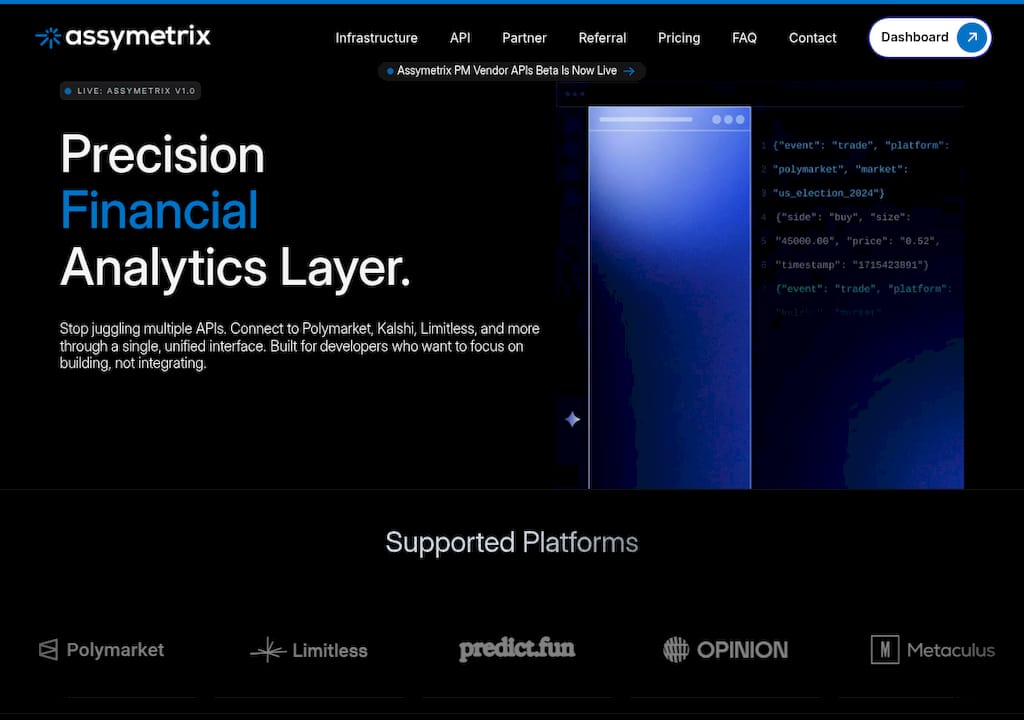
Developers often get sandbox access, SDK references, and authentication documentation before committing to a paid tier, enabling validation of schema and latency against their workload. With more than 900 million indexed events and over 2 billion rows of historical trading activity dating back to September 2020 behind the Data API, backfill and live streaming run on the same infrastructure rather than two disconnected systems. Visit Assymetrix to start a trial, review the endpoint reference, and see which subscription tier matches your query volume and latency requirements.
Sources
FAQ
What Is the Difference Between REST and WebSocket for Prediction Markets?
REST handles on-demand queries like market discovery, historical prices, and audit snapshots, while WebSocket delivers continuous, low-latency updates for order books, trades, and market lifecycle events.
Which Endpoints Matter Most for a Trading Bot?
Orderbook and trade streams over WebSocket for live execution, plus REST endpoints for markets/events metadata and OHLCV candles for signal generation and backtesting.
How Does Authentication Work for Prediction Market WebSocket Feeds?
Most venues authenticate at connection handshake time using API keys, HMAC signatures, or wallet-based signature schemes like EIP-712, rather than authenticating each individual message.
Why Use a Unified API Instead of Connecting to Each Venue Directly?
A unified API like the Assymetrix Data API normalizes schema and assigns canonical IDs across Polymarket, Kalshi, and Limitless, eliminating the need to build and maintain three separate integrations with three different data formats.
How Should I Recover From a Dropped WebSocket Connection?
Discard your local order book, request a fresh REST snapshot to reestablish the current state, then resubscribe to the WebSocket stream and apply new diffs from that snapshot’s sequence number forward.
Stop Rebuilding Three Feeds: Prediction Market API for Devs & Quants
Use REST for market discovery, metadata, and historical snapshots. Use WebSocket for live order-book updates, trades, and lifecycle events. In production, a unified cross-venue API that normalizes schema and handles recovery, like the Assymetrix Data API, beats stitching together separate connections to Polymarket, Kalshi, and Limitless yourself.
TL;DR:
Use REST for market discovery, historical data, and periodic audits, especially when latency tolerance is high and real-time updates are unnecessary.
Employ WebSocket for live order-book updates, trades, and market events that require millisecond reaction times, particularly for market-making bots.
Always re-snapshot via REST after any WebSocket disconnection longer than a few seconds to prevent silent state inconsistencies and data drift.
Map venue-specific IDs to a canonical ID scheme, attach high-precision timestamps, and shard by symbol hash to ensure reliable cross-venue data aggregation at scale.
Implement structured error handling, rate limit management, and continuous state reconciliation to maintain resilient, production-ready trading integrations.
Assymetrixassymetrix.comUnify Your Prediction Market DataAssymetrix gives developers and quants unified access to Polymarket, Kalshi, and Limitless data through a single Data API integration.Explore the Data API
Table of Contents
Prediction Market Data API: REST vs WebSocket, When to Use Each
What REST Endpoints Actually Matter for Prediction Markets
How to Stream Live Order Books Without Losing State
Authentication, Rate Limits, and Error Handling That Won’t Break in Production
Building for Scale: Canonical IDs, Sequencing, and Replay
SDKs and Client Libraries: When to Build vs When to Adopt
Historical Data and Backfill: Getting Backtests Right
Assymetrix: A Unified Cross-Venue Data API
Data Format and Schema Details Developers Should Expect
Security Practices Beyond Basic Authentication
Handling API Versioning and Backward Compatibility
Testing WebSocket Connections and Mock Data Strategies
Monitoring API Usage for Performance and Reliability
What Actually Matters When You Build This Yourself
Get Production API Access at Assymetrix
Sources
Prediction Market Data API: REST vs WebSocket, When to Use Each
REST and WebSocket solve different problems, and conflating them is the single most common architecture mistake in prediction market tooling. REST is stateless and request driven, which makes it the right tool for anything you query on demand rather than watch continuously.
REST handles market discovery (which contracts exist, what their strike conditions and expiries are), metadata lookups, historical price queries, and the periodic audit snapshots your compliance or research team needs to reconcile positions after the fact. Gemini’s prediction market docs describe exactly this split: REST for discovery and history, WebSocket for the tick-by-tick updates that matter once you’re actually trading.
WebSocket, by contrast, is a persistent, push-based channel. It carries the order-book deltas, executed trades, and market lifecycle events (a contract resolving, a market pausing) that a REST poll loop would either miss or arrive at too late to act on.
Three questions decide which pattern you need for a given workflow:
Latency tolerance. If a stale price for two or three seconds breaks your logic, you need WebSocket. If a once-per-minute refresh is fine, REST is simpler and cheaper to operate.
Sampling frequency. A dashboard refreshing every 30 seconds should poll REST. A quoting bot reacting to every book change needs a stream.
Backtest vs live. Backtests run entirely on historical REST pulls. Live execution runs on WebSocket, with REST as the fallback for state recovery.
A market-making bot’s quoting loop lives almost entirely on WebSocket: it holds a live book, reacts to depth changes, and cancels or replaces quotes in milliseconds. A backtest researcher, meanwhile, never touches a socket at all. Every data point comes from REST history endpoints, pulled once and stored for repeated experiments.
What REST Endpoints Actually Matter for Prediction Markets
Not every endpoint a vendor exposes is worth building around. For serious prediction market applications, five categories cover nearly everything you’ll need:
Markets/events — the catalog endpoint. Persist the instrument symbol, the venue’s native event ID, your own canonical ID if you’re aggregating across venues, resolution criteria, and expiry timestamp. Skipping the canonical ID here is the mistake that costs the most engineering hours later.
Orderbook/quotes — REST snapshots of current bid/ask depth, useful for periodic reconciliation against your WebSocket-maintained book.
Trades/executions — historical fill data, needed for slippage analysis and building realistic backtest fill models.
Candles/OHLCV — aggregated price bars at fixed intervals, the backbone of most signal backtesting.
Wallet and positions — account-level holdings and settlement history, critical for PnL tracking and for Smart Money style wallet analysis if you’re studying other traders’ behavior.
Pagination deserves its own attention. Offset-based pagination silently corrupts results when new events are inserted mid-scan; a cursor pointing to the last seen timestamp or ID is far more reliable, especially where new markets and price ticks arrive continuously. When backfilling months of history, request in bounded time windows (a day or a week at a time) rather than one enormous unbounded call. It keeps individual requests fast and makes retries cheap when one window fails.
For reproducible backtests, store raw REST responses exactly as received, in a structured format such as Parquet, alongside your own ingestion timestamp. Reconciliation later becomes a matter of replaying stored REST snapshots against your live book rather than trusting memory of what happened.
How to Stream Live Order Books Without Losing State
Every serious WebSocket integration follows the same core pattern: snapshot first, then apply diffs. Request a REST snapshot of the book, note its sequence number, open the WebSocket subscription, and discard any diff messages older than that sequence. Everything after that point layers cleanly on top of the snapshot.
The channels that matter most across prediction market venues are a book ticker (best bid/ask), depth diffs (incremental order-book changes), a trade stream (executed fills), and lifecycle events (market pauses, resolutions, and status changes). Gemini’s market data documentation recommends exactly this recovery pattern: if your local sequence counter detects a gap, don’t try to patch around it. Discard the local book and pull a fresh REST snapshot.
Subscription strategy depends on how many markets you’re watching. For a handful of symbols, single-symbol subscriptions are simpler to reason about. For hundreds or thousands, batch subscriptions reduce connection overhead but require more careful message routing on your end. Hot tokens (contracts with active trading) deliver updates in near real time, while cold tokens sitting far from the matching engine’s edge infrastructure can lag by hundreds of milliseconds, according to architecture notes from Sequence’s prediction market API docs. Request a REST snapshot for cold tokens if you need deterministic timing on the very first event.
A few operational habits separate resilient integrations from fragile ones:
Track sequence numbers per symbol, not globally, since a single connection often multiplexes many markets.
Deduplicate incoming trade and diff messages by their message ID, since reconnects can replay events you already processed.
Set a maximum staleness threshold (say, 10 seconds without a heartbeat) that triggers an automatic resubscribe.
Log every gap detection event with the sequence numbers involved. It’s the fastest way to diagnose which venue’s feed is actually unreliable.
Pro Tip: Never assume a reconnect resumes exactly where you left off. Always re-snapshot via REST after any WebSocket disconnect longer than a couple of seconds. The cost of an extra REST call is trivial next to the cost of trading on a stale, silently-wrong book.
Authentication, Rate Limits, and Error Handling That Won’t Break in Production
Authentication for prediction market APIs generally falls into three patterns, and which one you use often depends on whether you’re reading data or placing orders. Simple API-key headers cover most read-only REST calls. HMAC-signed requests, where you sign a payload with a secret key, are common for authenticated trading endpoints. RSA-PSS and EIP-712 style signature handshakes appear on venues built around wallet-based identity, where the signature proves control of an address rather than possession of a static secret.
WebSocket authentication usually happens at handshake time rather than per message: you sign a challenge or attach a signed header during the connection upgrade, and the session stays authenticated until it drops. Gemini’s developer documentation notes that many venues require custom upgrade headers unsupported by browser WebSocket clients, which is why authenticated trading connections should run from a server or a local client, never from browser JavaScript.
Rate limits come in two shapes worth distinguishing. Per-endpoint limits cap how often you can hit a specific route (order placement is almost always tighter than market data reads). Global limits cap total requests across your whole API key, regardless of endpoint. Hitting either should trigger exponential backoff with jitter, not a fixed retry interval, since synchronized retries from many clients are exactly what causes cascading rate-limit failures during volatile markets.
Sound error handling for production trading systems includes:
Idempotency keys on every order placement request, generated client-side and stored locally, so a retried submit after a timeout never results in a duplicate order.
REST-based state recovery after any WebSocket reconnect, rather than trusting the socket to replay missed messages.
Structured logging of every HTTP status code and WebSocket close code, tagged by venue, so a monitoring dashboard can distinguish “Kalshi is rate-limiting us” from “Polymarket’s feed dropped.”
Circuit breakers that pause new order submissions after repeated failures, rather than retrying blindly into a degraded venue.
Building for Scale: Canonical IDs, Sequencing, and Replay
Cross-venue aggregation breaks down fast without a canonical identifier scheme. Polymarket, Kalshi, and Limitless each use their own internal event and market IDs, formatted differently and with no shared namespace. Mapping “will the same real-world event resolve on all three venues” without a canonical ID layer turns into a fragile string-matching problem that breaks the moment a venue renames a market.
Unified API architectures like Sequence’s solve this by exposing a venue parameter alongside identical response shapes, so the same client code queries Kalshi and Polymarket without branching logic. That’s the model worth copying even if you’re building your own aggregation layer rather than buying one.
Four practices matter most as you scale past a handful of markets:
Assign a canonical ID at ingestion, before any downstream processing touches the record, so every service in your pipeline references the same key.
Attach a nanosecond-precision
observed_at_nstimestamp from a monotonic clock to every message, separate from the venue’s own timestamp, so replay ordering never depends on clock skew between systems.Shard WebSocket subscribers by symbol hash, not by venue, so a burst of activity on one contract doesn’t starve processing for unrelated markets.
Retain raw snapshots for a defined window (30, 60, or 90 days depending on your compliance needs) in an exportable format, so any position dispute can be resolved against the original feed data rather than a derived table.
Latency behavior differs meaningfully by token activity level. Hot tokens near the matching engine’s edge infrastructure typically deliver events within a few seconds, while cold tokens routed from more distant edges can take roughly 900 milliseconds longer to arrive, per Sequence’s documented architecture. Design your subscriber logic to expect that gap rather than treating it as a bug when a cold market lags a hot one.
SDKs and Client Libraries: When to Build vs When to Adopt
Writing a raw HTTP client and a hand-rolled WebSocket parser is a reasonable weekend project. It’s a poor foundation for a production trading system. Vendor SDKs that ship typed schemas, built-in reconnect logic, and sequence tracking save weeks of debugging time that’s better spent on strategy logic. Databento’s approach illustrates the pattern well: language clients for Python, Rust, and C++, alongside both HTTP and raw binary protocols, so teams pick the integration depth that matches their latency requirements.
Favor an SDK when it gives you typed response schemas (catching a field rename at compile time instead of runtime), automatic reconnect with exponential backoff, and built-in gap detection against sequence numbers. Fall back to a raw client only when you need protocol-level control an SDK doesn’t expose, or when no SDK exists for your target venue.
Before shipping any integration to production, run it against a sandbox environment for at least a full trading day, and cover it with automated tests, ideally as part of your continuous integration pipeline:
Unit tests against recorded, replayed WebSocket message sequences, including deliberately corrupted or out-of-order frames.
Integration tests that simulate a mid-stream disconnect and verify your client correctly re-snapshots via REST.
A CI job that runs your full ingestion pipeline against sandbox credentials before every deploy, not just before a release.
Historical Data and Backfill: Getting Backtests Right
Backtesting any prediction market strategy depends on clean historical series, and the REST endpoints for price_history and OHLCV candles are where that data comes from. Pull data in bounded batches rather than one sprawling request. A week-sized window per call keeps retries cheap and makes partial failures easy to isolate.
Event-driven contracts introduce caveats that don’t exist in traditional markets. A contract’s price series ends at settlement, not at a fixed calendar date, so your backfill logic needs to detect and handle expiry rather than assuming every series runs the same length. Cross-venue normalization is its own project: two venues pricing conceptually similar contracts can use different tick sizes, different settlement timing conventions, or different rounding on the final resolved price.
Prefer bulk export files over repeated on-demand queries when backfilling more than a few weeks of history. It’s far gentler on rate limits and typically faster end to end, a pattern Databento’s historical data offering reflects in how it packages tick-level and aggregated data separately.
Persist raw OHLCV bars locally rather than re-deriving them from tick data every time you rerun a backtest.
Store the settlement price and resolution timestamp alongside the price series, not in a separate table, so a join failure can’t silently corrupt your final-bar data.
A dedicated backtesting reference covers the storage and replay mechanics in more depth if you’re building a research pipeline from scratch.
Assymetrix: A Unified Cross-Venue Data API
A unified Data API that exposes REST and WebSocket access to multiple prediction market venues through one integration, with a consistent schema and canonical IDs across those venues. That means the mapping problem described above (matching the same real-world event across differently-formatted venue IDs) is handled before the data ever reaches your application.
The scale behind it is substantial for a category this young: Assymetrix indexes more than 900 million events, maintains over 200 million OHLCV snapshots, and holds more than 2 billion rows of trading activity dating back to September 2020. For research pipelines and live trading systems alike, that’s a single source of historical depth that would otherwise require separately building and reconciling three venue-specific ingestion pipelines.
Beyond raw feeds, the platform can layer in Smart Money wallet tracking and other derived intelligence that normally takes a dedicated quant team months to build on top of raw tick data. Documentation, SDK references, and sandbox access are available through the developer API guide for teams evaluating onboarding paths.
Data Format and Schema Details Developers Should Expect
Most prediction market APIs, Assymetrix’s included, communicate in JSON over both REST and WebSocket, with a handful of recurring structural conventions worth building your parsers around. A market or event object typically carries a canonical ID, a venue identifier, a human-readable title, resolution criteria as a string field, a strike or threshold value where applicable, and ISO 8601 timestamps for creation, open, and expiry.
Orderbook payloads follow a consistent bid/ask array structure, each entry a two-element pair of price and size, sorted by proximity to the mid. Trade messages carry a trade ID, price, size, side (buy or sell), and a timestamp with nanosecond or millisecond precision depending on the venue’s native resolution. Candle/OHLCV objects follow the standard open, high, low, close, volume shape, keyed to an interval start timestamp and a fixed bar duration (one minute, one hour, one day).
Field-naming consistency matters more than it sounds like it should. A venue that returns size in one endpoint and quantity in another forces every downstream consumer to write translation logic, which is exactly the kind of friction a normalized schema is supposed to eliminate. When evaluating any API, check whether the same concept (say, a contract’s current price) uses the same field name and unit across every endpoint that returns it, not just within a single endpoint’s response.
Numeric precision deserves explicit attention too: prediction market prices typically run from 0 to 1 (or 0 to 100 as a percentage), and mixing those two conventions across venues without normalizing is a common source of silent calculation bugs in aggregated dashboards.
Security Practices Beyond Basic Authentication
Authentication proves who’s calling the API. It doesn’t protect the data in transit or at rest, and treating auth as the whole security story is a mistake that shows up in production incidents more often than it should.
Every connection, REST and WebSocket alike, should run over TLS with certificate validation enforced, not disabled for convenience during development and forgotten in production. API keys and signing secrets belong in a secrets manager or encrypted environment store, never committed to a repository or hardcoded in a deployed container image.
For teams handling wallet-linked data or account-level position information, encrypt sensitive fields at rest, separate from the bulk of market data that carries no privacy sensitivity. Rotate API keys on a defined schedule rather than treating them as permanent credentials, and revoke immediately any key that’s been exposed in a log line or an error report, since logs are a surprisingly common leak vector for supposedly secret values.
Least-privilege access matters at the account level too. A research pipeline that only reads historical OHLCV data has no business holding a key scoped for order placement. Separate read-only and trading credentials, even within the same team, so a compromised research service can’t place trades on your behalf. Audit which services hold which scopes on a recurring basis, not just at initial setup, since permission creep over months of feature additions is how overprivileged keys accumulate unnoticed.
Handling API Versioning and Backward Compatibility
Prediction market APIs evolve as venues add contract types, change settlement logic, or expand market coverage, and version discipline determines whether that evolution breaks your integration or passes by unnoticed. A version identifier in the URL path (/v1/, /v2/) or in a request header is the standard approach, and it lets a provider run two schema versions simultaneously while clients migrate on their own schedule.
Treat any additive field change (a new optional field appearing in a response) as safe to ignore in your parsing logic, but treat a field type change, a renamed field, or a removed field as a breaking change requiring a version bump. Well-run APIs document this distinction explicitly; if a provider’s changelog doesn’t distinguish additive from breaking changes, assume every change could be breaking and pin your integration to an explicit version rather than always pulling latest.
For WebSocket connections specifically, version negotiation typically happens at subscription time, where you specify the channel version you expect. A provider changing the diff message format without a version bump is the single fastest way to silently corrupt every subscriber’s local order book, so if you’re evaluating a vendor, ask directly how they’ve handled schema changes historically.
Build your own client with a tolerance layer: parse known fields explicitly, and don’t fail hard on unrecognized fields you don’t yet consume. That one habit alone prevents most of the breakage that comes from a provider’s routine, well-intentioned schema additions.
Testing WebSocket Connections and Mock Data Strategies
A WebSocket integration that’s never been tested against failure conditions will eventually fail in front of real capital, usually at the worst possible moment. Build your test suite around three layers rather than relying on manual, ad hoc checks against a live feed.
Recorded replay tests. Capture a real WebSocket session (snapshot, diffs, a reconnect, a resubscribe) once, and replay it deterministically in CI to catch regressions in your parsing and sequencing logic.
Fault injection tests. Simulate a dropped connection mid-stream, a duplicated message, and an out-of-order sequence number, and verify your client recovers correctly each time rather than silently continuing on corrupted state.
Sandbox integration tests. Run against the provider’s sandbox environment, if one exists, before every production deploy, exercising real authentication and real (if synthetic) market data rather than only mocked responses.
Mock data generation matters most for edge cases you can’t reliably trigger against a live sandbox, like a market resolving mid-session or a sequence gap of a specific size. Generate synthetic message sequences that hit those specific edge cases directly, rather than hoping a live test run happens to produce them.
Treat your WebSocket client’s reconnect logic as a first-class piece of tested code, not an afterthought bolted on after the happy path works. It’s the code path that runs during the exact moments (network instability, venue outages) when correctness matters most.
Monitoring API Usage for Performance and Reliability
Production integrations need observability at three layers: connection health, message throughput, and data correctness. Skipping any one of them means you’ll find out about a problem from a bad trade rather than from a dashboard.
Track WebSocket connection uptime per venue, time since last heartbeat, and reconnect frequency. A venue reconnecting every few minutes under normal conditions is a signal worth escalating, not a quirk to route around silently. On the REST side, log request latency percentiles (p50, p95, p99) per endpoint, since a slowly degrading endpoint often precedes an outage by hours.
Message-level metrics matter just as much as connection-level ones. Track messages processed per second per symbol, sequence gaps detected per hour, and the time between snapshot requests, since an unusually high snapshot-request rate usually means your gap detection is firing more than expected. Alert on rate-limit responses (429s) specifically, tagged by endpoint, so you can distinguish a genuinely overloaded integration from a single misbehaving background job hammering one route.
Correctness monitoring closes the loop: periodically reconcile your live order book against a fresh REST snapshot, and alert if the two diverge beyond a small tolerance. That single check catches silent WebSocket bugs (a missed diff, a subtle parsing error) that connection-level metrics alone will never surface.
What Actually Matters When You Build This Yourself
Most REST versus WebSocket guides treat the choice as binary, as if picking the right protocol solves the integration problem. It doesn’t. The protocol choice is the easy part. The hard part, and the part conventional advice consistently underweights, is everything downstream of the socket: canonical IDs, sequence tracking, and the discipline to re-snapshot via REST every time state might be wrong rather than hoping it isn’t.
Teams that build their own three-venue integration usually get REST and WebSocket working individually within a week. They spend the next two months on the unglamorous work of reconciling Kalshi’s event IDs against Polymarket’s, debugging a silent sequence gap that corrupted a week of backtest data, and rebuilding a “temporary” mapping layer for the third time. That’s not a criticism of any single engineering team. It’s what happens when the schema-normalization problem gets treated as a detail instead of the actual core of the project.
If you take one thing from this guide, prioritize the canonical ID and sequencing layer before you write a single line of trading logic. Everything else, including which protocol handles which call, is comparatively easy to get right once that foundation exists.
— Dean
Get Production API Access at Assymetrix
Building and maintaining separate REST and WebSocket integrations for multiple prediction market venues means managing multiple authentication schemes, schemas to normalize, and reconnect logic to debug when issues arise. A unified Data API replaces multiple connections with a single connection, consistent field names, and canonical IDs that resolve the cross-venue mapping problem discussed in this guide.
Developers often get sandbox access, SDK references, and authentication documentation before committing to a paid tier, enabling validation of schema and latency against their workload. With more than 900 million indexed events and over 2 billion rows of historical trading activity dating back to September 2020 behind the Data API, backfill and live streaming run on the same infrastructure rather than two disconnected systems. Visit Assymetrix to start a trial, review the endpoint reference, and see which subscription tier matches your query volume and latency requirements.
Sources
FAQ
What Is the Difference Between REST and WebSocket for Prediction Markets?
REST handles on-demand queries like market discovery, historical prices, and audit snapshots, while WebSocket delivers continuous, low-latency updates for order books, trades, and market lifecycle events.
Which Endpoints Matter Most for a Trading Bot?
Orderbook and trade streams over WebSocket for live execution, plus REST endpoints for markets/events metadata and OHLCV candles for signal generation and backtesting.
How Does Authentication Work for Prediction Market WebSocket Feeds?
Most venues authenticate at connection handshake time using API keys, HMAC signatures, or wallet-based signature schemes like EIP-712, rather than authenticating each individual message.
Why Use a Unified API Instead of Connecting to Each Venue Directly?
A unified API like the Assymetrix Data API normalizes schema and assigns canonical IDs across Polymarket, Kalshi, and Limitless, eliminating the need to build and maintain three separate integrations with three different data formats.
How Should I Recover From a Dropped WebSocket Connection?
Discard your local order book, request a fresh REST snapshot to reestablish the current state, then resubscribe to the WebSocket stream and apply new diffs from that snapshot’s sequence number forward.
Other Blog


