Canonical IDs First: Cross-Venue Prediction Market Data for Devs
Canonical IDs First: Cross-Venue Prediction Market Data for Devs
Canonical IDs First: Cross-Venue Prediction Market Data for Devs
Developer- and quant-first guide to unifying Polymarket, Kalshi, and Limitless. Learn canonical IDs, real-time streams, and production patterns for...

Canonical IDs First: Cross-Venue Prediction Market Data for Devs
A unified prediction-market Data API gives you normalized market IDs, synchronized real-time and historical feeds, and cross-venue primitives so you can build arbitrage detection, quant research, and trading systems without reimplementing venue-specific pipelines for Polymarket, Kalshi, and Limitless separately. Assymetrix runs a production Data API that already handles this normalization layer. Start with the quickstart below to validate your first calls in minutes.
TL;DR:
Cross-venue arbitrage opportunities require normalized, synchronized market prices across Polymarket, Kalshi, and Limitless, with price divergences easily comparable.
A unified API simplifies handling incompatible schemas, authentication, and API changes, reducing maintenance and risk for research and trading workflows.
Building a reliable streaming system involves snapshot-plus-delta patterns, gap detection, and latency control to ensure accurate real-time data for arbitrage or market making.
Proper timestamp normalization, stable pagination, and provenance tracking are essential for accurate backtesting and avoiding lookahead bias across multiple venues.
Assymetrix offers a pre-built, normalized data layer with extensive historical data, streamlining cross-venue analysis, arbitrage detection, and AI agent development in prediction markets.
Table of Contents
Why Cross-Venue Prediction Market Data Matters
Quickstart: Hosted vs Self-Hosted, Authentication, and First Calls
How Canonical Normalization Turns Three Schemas Into One
What Endpoints Does a Cross-Venue API Actually Expose?
Streaming Order Books and Events Across Venues in Real Time
Production Patterns That Keep Cross-Venue Pipelines Running
Building Reproducible Backtests From Cross-Venue Data
Detecting Smart Money and Arbitrage Across Venues
Data Quality and Reliability Across Venues
How to Handle Conflicting Data Between Venues
Security Best Practices for Prediction Market Data APIs
Real-World Applications of Unified Cross-Venue Data
Benchmarking and Optimizing a Unified API Integration
What I’d Prioritize Building This Again
Get Started With the Assymetrix Data API
Sources
Why Cross-Venue Prediction Market Data Matters
No single venue gives you the full picture. Polymarket, Kalshi, and Limitless each list overlapping but non-identical markets, and pricing on the same underlying event can diverge by several points at any given moment because liquidity, order flow, and participant bases differ by platform.
That divergence is not noise. It is the raw material for arbitrage. If a market resolving on the same real-world event trades at 62 cents on one venue and 58 cents on another, the spread only becomes actionable once you can compare the two prices on a common timestamp and a common schema. Without that alignment, you are comparing apples to a vaguely apple-shaped object.
The same logic applies to signal confirmation. A single wallet moving size on Kalshi might be noise, a hedge, or an informed bet. That same wallet’s directional pattern showing up in a related market on Polymarket at roughly the same time is a materially stronger signal. Cross-venue confirmation is what separates a real Smart Money read from a lucky guess, and you cannot confirm anything across venues if your data pipeline treats each platform as an island.
Building that pipeline yourself means solving three problems at once: incompatible schemas (Kalshi tickers look nothing like Polymarket slugs or Limitless market identifiers), separate authentication systems for each venue, and constant maintenance overhead as each platform ships breaking changes to its own API with little warning. Most teams underestimate the third problem until they have already shipped a trading bot that silently stops updating because a venue renamed a field.
Quickstart: Hosted vs Self-Hosted, Authentication, and First Calls
You have two deployment paths for cross-venue integration. A hosted unified API gets you querying normalized data in minutes because someone else maintains the venue connectors, the schema mapping, and the uptime. Self-hosting gives you full custody of the pipeline and infrastructure, which matters if your compliance requirements demand it, but you take on the maintenance burden every time Polymarket or Kalshi changes a response shape. For most research and trading workflows, hosted is the faster and more reliable default. The PMXT documentation frames this same tradeoff for unified prediction-market SDKs: a shared method surface with a hosted or self-hosted choice underneath it.
Authentication typically follows a standard pattern: an API key for read-only market data, and client credentials with rotating scopes for anything that touches order placement. Rotate keys on a schedule, not just after an incident.
Once you have credentials, run these checks before writing a single line of strategy code:
Call
/marketsand confirm you get a consistent object shape regardless of thevenueparameter you pass.Call
/quotesfor a known active market and confirm the bid/ask you see matches what the venue’s own UI shows.Confirm your local clock and the API’s timestamps agree within a few hundred milliseconds.
Verify token ID resolution: the same market should return the same canonical ID across repeated calls.
Check price and decimal conventions. Some venues quote in cents, others in probability fractions.
How Canonical Normalization Turns Three Schemas Into One
Polymarket identifies markets by condition IDs and token IDs on-chain. Kalshi uses human-readable tickers tied to series and event structures. Limitless has its own slug and market ID conventions. None of these map to each other out of the box, and a naive integration that stores each venue’s native identifiers separately makes cross-venue joins a manual, error-prone exercise.
A canonical schema solves this by assigning every market a stable, venue-agnostic ID, then storing a parent_event_id and event_id alongside it so you can group related markets (all outcomes of one election, for instance) regardless of which venue they originated from. The token_ids array preserves the venue-native identifiers you need when you actually place an order, since execution still happens on the source venue.
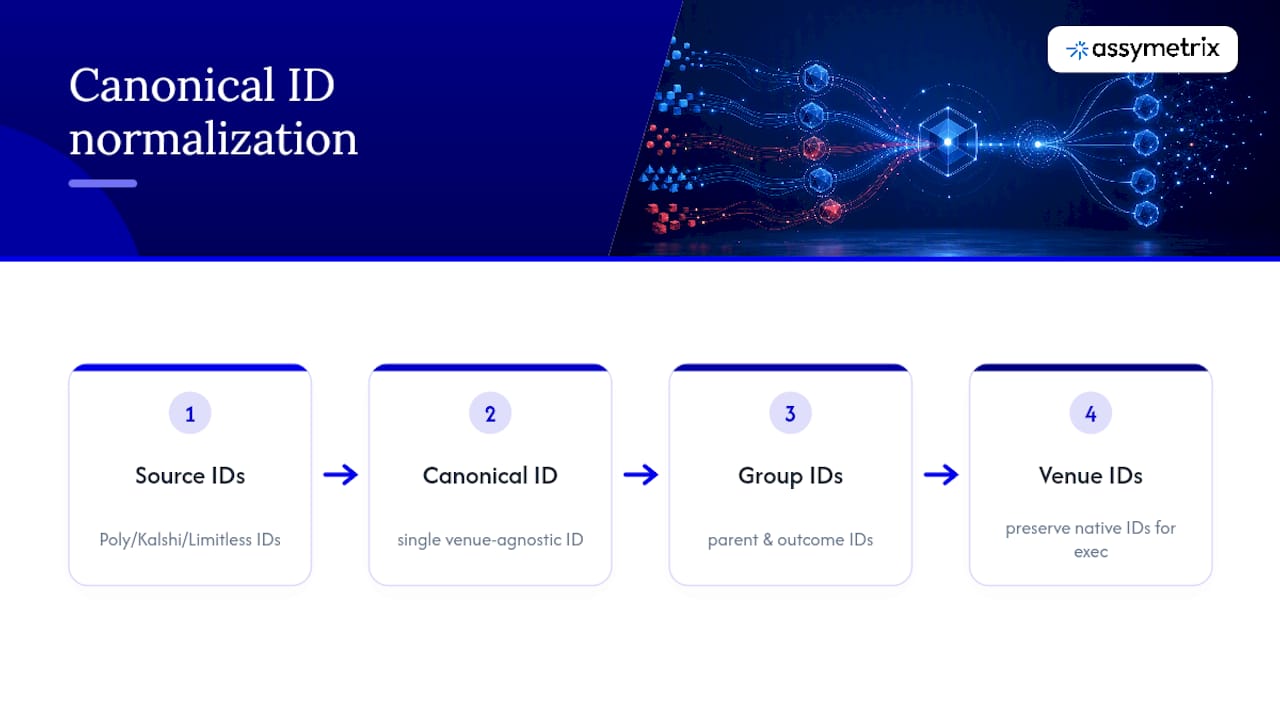
Field-level mapping matters just as much as ID mapping. Fields like volume_24h, best_yes_bid, best_yes_ask, and spread_pct need consistent definitions across venues, and some of them will legitimately be null. A market with no recent trades has no meaningful spread_pct, and a normalized schema needs to represent that as null rather than zero, which would imply a locked market instead of an illiquid one.
Quick fact: Unified datastore approaches that normalize diverse source APIs into one interface consistently reduce the custom integration maintenance burden teams would otherwise carry per data source, which is the same principle applied here across three prediction market venues instead of three arbitrary SaaS backends.
Binary outcome expansion is the trickiest normalization case. Many venues represent a multi-outcome event (say, “Who wins the primary?”) as a single parent market row with nested outcomes, while others flatten each outcome into its own binary market. Requesting ?expand=outcomes and grouping by parent_slug or parent_event_id lets you reconstruct the full outcome set regardless of which representation the source venue used.
What Endpoints Does a Cross-Venue API Actually Expose?
Every unified prediction-market API worth using converges on the same handful of primitives, because these are the only objects that actually matter for trading and research. Sequence’s prediction market API documents this pattern explicitly: universal endpoints like quote, trades, price_history, stream, and orders, each accepting a venue parameter to target a specific platform while returning a consistent shape.
/marketsreturns market metadata: canonical ID, title, venue, status, and resolution criteria. Accepts both slug and ticker as lookup inputs so you never need venue-specific query logic./quotesreturns current best bid and ask, useful for a lightweight NBBO check across venues without pulling the full order book./price_historyreturns time-series price snapshots at your chosen resolution, the backbone of any backtest or trend detector./tradesreturns individual executed trades with size, price, and timestamp, which is what you need for volume analysis and wallet tracking./orderslets you submit and manage orders, taking the venue-native token ID as input even though your strategy logic operates on the canonical ID./settlementreturns resolution outcome and timestamp, critical for auditing whether your model’s predicted resolution matched reality.
Pagination across all of these uses a cursor rather than offset-based paging, which avoids skipped or duplicated rows when new data arrives mid-walk. Practical advice: only request expand=outcomes when you actually need the full outcome set, since it increases payload size meaningfully on multi-outcome events; and always resolve token IDs through /markets before attempting to place an order, since venue-native execution IDs and your canonical ID are related but not interchangeable.
Streaming Order Books and Events Across Venues in Real Time
Polling /quotes on a timer works for research but falls apart for anything latency-sensitive. Real trading and arbitrage systems need a websocket connection that pushes updates the moment they happen on any venue.
A well-designed stream typically exposes a handful of channels: new_markets for discovery of freshly listed markets, market_resolved for settlement events, quotes for top-of-book changes, and trades for executed order flow. Subscribing to all four across three venues on one connection is the entire point of a unified stream. Rebuilding that yourself means managing three separate websocket connections with three separate reconnection logics.
The reliable pattern combines an initial snapshot with incremental deltas afterward. On connect, you pull a full snapshot of current state; every message after that is a delta applied on top. If your connection drops, you don’t guess what you missed, you request a fresh snapshot and resume from there. Sequence number gaps in the delta stream are your signal to trigger that resync rather than silently drifting out of sync with the true book.
Snapshot on connect, deltas afterward, resync on any sequence gap.
Treat reconnection as a first-class code path, not an edge case you handle later.
For cross-venue NBBO, a smart order router style aggregation layer that merges quote streams by canonical ID gives you a true best-price view instead of three disconnected order books.
Pro Tip: Build your reconnection and gap-detection logic before your strategy logic. A trading system that trusts a stale book for even a few seconds during a reconnect will misprice trades far more often than one with a naive but honest strategy running on a reliable feed.
Latency matters more for cross-venue arbitrage than single-venue trading, since your edge disappears the moment either venue’s price moves before you act on the divergence you detected.
Production Patterns That Keep Cross-Venue Pipelines Running
Cursor-based pagination is non-negotiable for exhaustive data walks, but a subtle trap catches teams anyway: sorting your paginated query by a volatile field like volume_24h while paginating breaks the walk, since rows can shift position between pages as volume updates mid-walk. Sort by a stable field, such as creation timestamp or canonical ID, when you need to guarantee complete coverage.
Rate limits differ by venue, and polling three platforms on independent timers is a fast way to get throttled on your busiest venue while under-polling your quietest one. Batch requests where the API supports it, and implement exponential backoff keyed to each venue’s actual rate-limit headers rather than a single global retry policy.
Time alignment is where most cross-venue backtests quietly go wrong. Normalize every timestamp to UTC at ingestion, never at query time, and pick a consistent sample rate before you start comparing series. A one-minute snapshot from Kalshi compared against a five-minute snapshot from Polymarket will show phantom divergence that has nothing to do with real market behavior.
Sort pagination by a stable field, never by a field that updates in real time.
Normalize timestamps to UTC at write time, not read time.
Monitor for silent drift: alert when a venue’s update frequency drops below its historical baseline.
Version your schema mapping so a venue’s field rename doesn’t break ingestion without anyone noticing.
Pro Tip: Set up a canary query that runs against each venue every hour and checks response shape against a stored schema fingerprint. Venue APIs change without much notice, and catching a field rename in an automated check beats catching it three days later in a broken dashboard.
Building Reproducible Backtests From Cross-Venue Data
A backtest is only as trustworthy as the data feeding it, and cross-venue backtests fail in ways single-venue ones don’t: lookahead bias creeps in easily when you reconstruct a historical feed from data that wasn’t actually available in that sequence at the time.
Capture timestamped snapshots of everything, not just closing prices: price at regular intervals, order book tops, individual trade ticks, and settlement records with their resolution timestamps. Bitquery’s prediction market query model demonstrates this with PredictionTrades and PredictionSettlements queries that expose the lifecycle events, trade metadata, and settlement fields you need for audit trails.
Reconstruct the feed in the exact order your live system would have received it, not in whatever order your database happens to return rows. Cross-venue feeds that arrive on independent timers need explicit interleaving logic to avoid feeding your backtest information it wouldn’t have had live.
Audit provenance on every row. Know which venue, which endpoint version, and which ingestion timestamp produced each data point, since reproducibility depends on being able to answer “where did this number come from” months later.
Handling gaps honestly matters too. Venue maintenance windows, holidays, and outages create missing data that a naive backtest will interpolate right through, manufacturing a false sense of continuity. The BacktestMarket blog covers this exact problem for minute-bar data and holiday gaps, a useful reference regardless of asset class. Stable identifiers and provenance metadata are what let you reconstruct the exact feed your live system used, which is the entire point of doing this work carefully instead of quickly.
Detecting Smart Money and Arbitrage Across Venues
A single large trade on one venue tells you something. The same directional position appearing on a related market across two venues within a short window tells you a lot more. Cross-venue confirmation is the single biggest lever for improving Smart Money signal quality, because it filters out venue-specific noise like a market maker rebalancing inventory rather than acting on information.
A workable arbitrage pipeline needs four components: canonical IDs so you’re comparing the same real-world event, an NBBO comparison layer that pulls best bid and ask from every venue on a synchronized clock, a divergence scorer that accounts for the latency and slippage you’d actually face executing on both sides, and an alerting layer that fires only above a threshold wide enough to survive execution costs.
Historical verification sharpens this further. A wallet’s directional calls only mean something once you can check them against actual settlement outcomes over time, which is the foundation of a trader skill score.
A wallet that shows an 8-point average edge over close on 40+ resolved markets across two venues is a fundamentally different signal than a wallet with one lucky call on a single platform. Confirmation across venues, weighted by a track record built on realized outcomes, is what turns raw transaction data into an actionable trading signal.
Compare implied probability, not raw price, when the venues use different quoting conventions.
Weight signals by a trader’s historical resolved-market accuracy, not by position size alone.
Score divergence net of estimated execution cost before alerting, or you’ll chase spreads that vanish on contact.
Assymetrix builds this layer on top of roughly 1.5 terabytes of historical trading data spanning nearly one billion rows across Polymarket, Kalshi, and Limitless, which is the depth of history that makes trader skill scoring statistically meaningful rather than a guess based on a handful of trades.
Data Quality and Reliability Across Venues
Reliability in a cross-venue pipeline is not one property, it’s three: uptime of the venue’s own API, freshness of your ingestion relative to that API, and correctness of your normalization logic once data arrives. A pipeline can be fast and still be wrong if a mapping rule silently misclassifies an outcome.
Venue-specific quirks are the most common source of quiet data corruption. Kalshi’s settlement fields don’t map one-to-one onto Polymarket’s resolution structure, and Limitless has its own conventions for how it flags a market as resolved versus disputed. Treating “resolved” as a single boolean across all three venues without accounting for these differences will eventually produce a backtest that thinks a market settled days before it actually did.
Freshness monitoring deserves its own dashboard, not a line item in a general uptime check. Track time-since-last-update per venue per market type, since a quiet market with genuinely no new trades looks identical to a broken feed unless you’re also tracking whether the venue’s own activity has actually gone dark.
The practical takeaway: build reliability checks around the assumption that each venue will occasionally behave unlike the other two, not around the hope that a single validation rule covers all three. A unified data fabric approach that queries sources in place rather than duplicating them into fragile ETL jobs reduces one class of failure, but it doesn’t remove the need to validate each venue’s quirks independently before trusting a cross-venue join.
How to Handle Conflicting Data Between Venues
Sometimes two venues will report different prices, different volumes, or even different resolution outcomes for what looks like the same underlying event, and your system needs a defined policy for that rather than picking whichever number arrived first.
Price and quote discrepancies are usually not conflicts at all. They’re the actual market signal, since two venues showing different prices for correlated markets is precisely the divergence an arbitrage strategy is built to catch. Don’t reconcile these away. Flag genuine data conflicts separately from genuine price divergence, because collapsing them into the same bucket destroys the signal you’re trying to detect.
Resolution conflicts are more serious. If two venues settle what should be the same real-world event to different outcomes, that’s either a genuine difference in resolution criteria (the markets weren’t actually equivalent) or a data error on one venue’s side. The fix is not automatic reconciliation. It’s flagging the discrepancy for manual review and excluding the affected markets from automated signal generation until resolved.
Timestamp conflicts, where two venues report the “same” event at meaningfully different times, usually trace back to clock skew or reporting delay rather than a real disagreement. Normalize against a single reference clock at ingestion and log the raw venue timestamp alongside the normalized one, so you can audit which venue lagged when a discrepancy shows up later. Never silently overwrite one venue’s timestamp with another’s best guess.
Security Best Practices for Prediction Market Data APIs
Prediction market data access carries risk profiles that generic API security advice doesn’t fully cover, mostly because the data feeds both research systems and live trading systems that move real capital.
Scope your API keys tightly. A key used for read-only market research has no business holding order-placement permissions, and separating these scopes limits the blast radius if a key leaks. Rotate keys on a fixed schedule rather than only after a suspected compromise, and store them in a secrets manager rather than in environment files committed to a repository, however tempting that shortcut is during a hackathon sprint.
Authentication for order placement deserves stronger controls than authentication for quote access: short-lived tokens, IP allowlisting where the venue supports it, and separate credentials per bot instance so you can revoke one compromised deployment without taking down your entire trading stack.
Validate every response, not just the ones you expect to be malformed. A venue API that unexpectedly returns null where you expect a price, or a settlement field, can cascade into a bad trade if your code assumes the response is always well-formed. Fail closed, not open, when validation fails on anything touching order logic.
Log every order-related API call with enough context to reconstruct exactly what your system saw and decided, since a dispute over an executed trade is much easier to resolve with a full request and response trail than with a “the bot did something unexpected” incident report.
Real-World Applications of Unified Cross-Venue Data
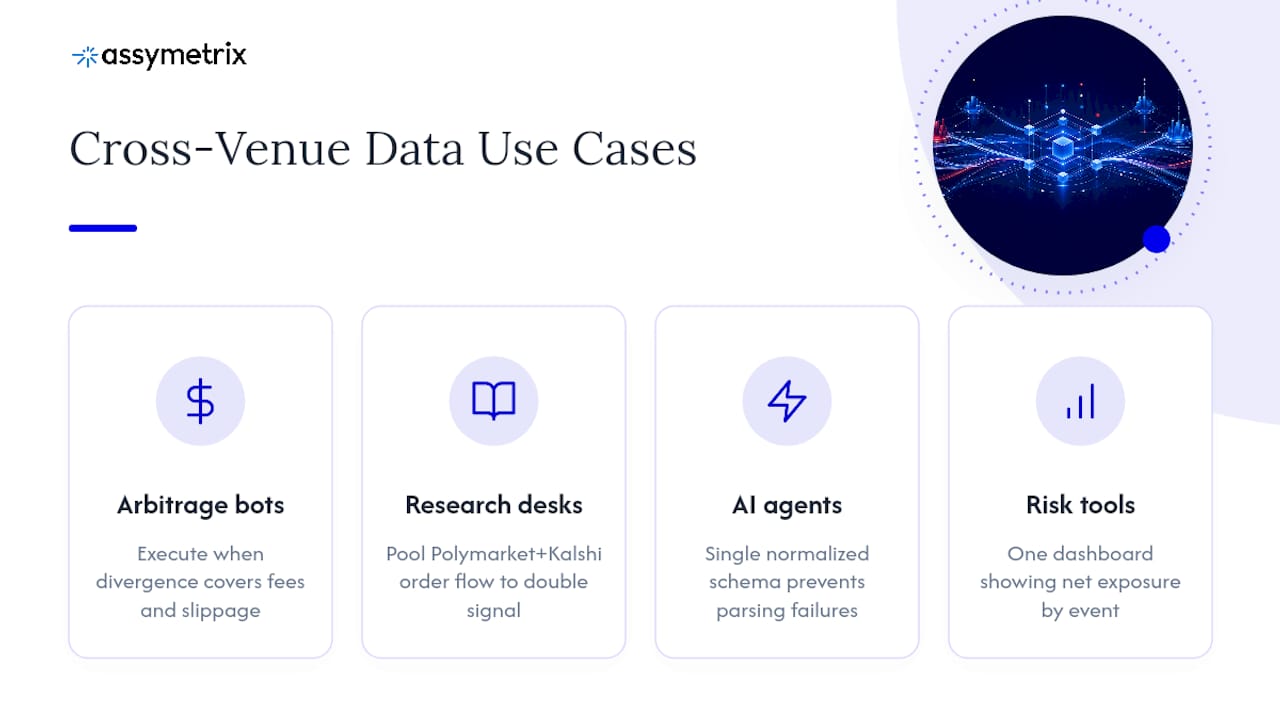
The clearest use case is cross-venue arbitrage bots that monitor correlated markets on Polymarket and Kalshi simultaneously, executing when divergence exceeds a threshold wide enough to cover slippage and fees on both sides. This only works with synchronized, normalized quotes, since a bot comparing prices on different clocks or different schemas will misfire constantly.
Research desks use unified historical data to build election and macro-event forecasting models that pool sample sizes across venues, since a single platform’s market for a given event often lacks the trade volume needed for a statistically meaningful model on its own. Combining Polymarket and Kalshi order flow for the same underlying event effectively doubles the usable signal.
AI agents represent the fastest-growing consumer category. An agent tasked with monitoring geopolitical or economic prediction markets needs a consistent schema to reason over, since an LLM-driven agent parsing three different response shapes on the fly introduces failure modes that have nothing to do with its actual reasoning ability. A single normalized feed removes that entire class of error.
Portfolio-level risk tools are the quieter application. A trader running positions across all three venues needs one dashboard showing net exposure by canonical event, not three separate venue dashboards that require manual reconciliation to understand true position size on a given outcome. As structured, high-quality market data increasingly powers algorithmic strategy validation across asset classes generally, prediction markets are following the same trajectory from manual venue-by-venue tracking toward unified, machine-readable feeds.
Benchmarking and Optimizing a Unified API Integration
Latency is the first thing to benchmark, and it needs measuring separately for each leg of your pipeline: time from venue event to API ingestion, time from ingestion to your application receiving a websocket push, and time from receipt to your strategy logic acting on it. A slow strategy loop sitting behind a fast feed still loses the arbitrage window.
Throughput matters differently for research versus trading workloads. A backtest pulling years of historical snapshots cares about bulk export speed and pagination efficiency, while a live trading bot cares almost entirely about single-request latency on the hot path. Benchmark each workload against its own relevant metric rather than a single blended number that misrepresents both.
Caching strategy separates efficient integrations from wasteful ones. Market metadata that changes rarely (title, resolution criteria) can be cached aggressively, while quotes and order book tops should never be cached beyond the length of your polling interval, since stale quotes are worse than no quotes for anything execution-related.
A federated, zero-copy query pattern is worth evaluating if your team already runs analytics infrastructure that queries multiple data sources: federated access without duplicating data into new storage cuts both the ETL maintenance burden and the staleness window between source update and query result, which matters when three venues are updating on independent schedules. Measure your actual query patterns before optimizing, since premature caching or premature federation both tend to solve problems your pipeline doesn’t actually have yet.
What I’d Prioritize Building This Again
Canonical IDs come first, always. Get identifier mapping wrong early and every downstream system inherits the bug. Centralize time handling in one module, not scattered across ingestion scripts. Automate schema change detection with a canary check, because venue APIs change quietly and often. Teams consistently underestimate maintenance cost, not build cost. Default to hosted unless custody requirements force your hand.
— Dean
Get Started With the Assymetrix Data API
Building and maintaining three separate venue integrations, each with its own authentication, schema quirks, and breaking-change risk, is a permanent engineering tax most teams didn’t budget for. Assymetrix runs that normalization layer for you: unified market IDs, one consistent schema across Polymarket, Kalshi, and Limitless, real-time streaming, and roughly 1.5 terabytes of historical data across nearly a billion rows already indexed and ready to query.
Instead of writing three ingestion pipelines and reconciling three sets of field names, you point one integration at Assymetrix’s Data API and get normalized quotes, trades, price history, and settlement data with Smart Money and arbitrage signals layered on top. If you’re building backtests, the historical dataset guide walks through what’s available for reproducible research. Start with the free tier to validate connectivity against your own strategy logic, then move to a paid tier or an enterprise license once you’re ready to run it in production.
Sources
FAQ
What is a unified prediction market API?
A unified prediction market API is a single REST or websocket interface that normalizes data from multiple prediction market venues, such as Polymarket, Kalshi, and Limitless, into one consistent schema with shared identifiers.
Why can’t I just use each venue’s native API separately?
You can, but you’ll spend significant engineering time mapping incompatible schemas, managing three authentication systems, and maintaining the integration every time a venue changes its API, work a unified layer like Assymetrix’s Data API already handles.
How does cross-venue arbitrage detection actually work?
It compares normalized quotes for the same canonical event across venues on a synchronized clock, then scores the price divergence net of estimated execution cost before triggering an alert.
What historical data do I need for a cross-venue backtest?
You need timestamped price snapshots, order book tops, individual trade ticks, and settlement records from each venue, aligned to a single UTC clock and reconstructed in the exact order your live system would have received them.
Does Assymetrix support real-time streaming across all three venues?
Yes. Assymetrix provides websocket streams covering new markets, resolutions, quotes, and trades across Polymarket, Kalshi, and Limitless through one connection with normalized message shapes.
Canonical IDs First: Cross-Venue Prediction Market Data for Devs
A unified prediction-market Data API gives you normalized market IDs, synchronized real-time and historical feeds, and cross-venue primitives so you can build arbitrage detection, quant research, and trading systems without reimplementing venue-specific pipelines for Polymarket, Kalshi, and Limitless separately. Assymetrix runs a production Data API that already handles this normalization layer. Start with the quickstart below to validate your first calls in minutes.
TL;DR:
Cross-venue arbitrage opportunities require normalized, synchronized market prices across Polymarket, Kalshi, and Limitless, with price divergences easily comparable.
A unified API simplifies handling incompatible schemas, authentication, and API changes, reducing maintenance and risk for research and trading workflows.
Building a reliable streaming system involves snapshot-plus-delta patterns, gap detection, and latency control to ensure accurate real-time data for arbitrage or market making.
Proper timestamp normalization, stable pagination, and provenance tracking are essential for accurate backtesting and avoiding lookahead bias across multiple venues.
Assymetrix offers a pre-built, normalized data layer with extensive historical data, streamlining cross-venue analysis, arbitrage detection, and AI agent development in prediction markets.
Table of Contents
Why Cross-Venue Prediction Market Data Matters
Quickstart: Hosted vs Self-Hosted, Authentication, and First Calls
How Canonical Normalization Turns Three Schemas Into One
What Endpoints Does a Cross-Venue API Actually Expose?
Streaming Order Books and Events Across Venues in Real Time
Production Patterns That Keep Cross-Venue Pipelines Running
Building Reproducible Backtests From Cross-Venue Data
Detecting Smart Money and Arbitrage Across Venues
Data Quality and Reliability Across Venues
How to Handle Conflicting Data Between Venues
Security Best Practices for Prediction Market Data APIs
Real-World Applications of Unified Cross-Venue Data
Benchmarking and Optimizing a Unified API Integration
What I’d Prioritize Building This Again
Get Started With the Assymetrix Data API
Sources
Why Cross-Venue Prediction Market Data Matters
No single venue gives you the full picture. Polymarket, Kalshi, and Limitless each list overlapping but non-identical markets, and pricing on the same underlying event can diverge by several points at any given moment because liquidity, order flow, and participant bases differ by platform.
That divergence is not noise. It is the raw material for arbitrage. If a market resolving on the same real-world event trades at 62 cents on one venue and 58 cents on another, the spread only becomes actionable once you can compare the two prices on a common timestamp and a common schema. Without that alignment, you are comparing apples to a vaguely apple-shaped object.
The same logic applies to signal confirmation. A single wallet moving size on Kalshi might be noise, a hedge, or an informed bet. That same wallet’s directional pattern showing up in a related market on Polymarket at roughly the same time is a materially stronger signal. Cross-venue confirmation is what separates a real Smart Money read from a lucky guess, and you cannot confirm anything across venues if your data pipeline treats each platform as an island.
Building that pipeline yourself means solving three problems at once: incompatible schemas (Kalshi tickers look nothing like Polymarket slugs or Limitless market identifiers), separate authentication systems for each venue, and constant maintenance overhead as each platform ships breaking changes to its own API with little warning. Most teams underestimate the third problem until they have already shipped a trading bot that silently stops updating because a venue renamed a field.
Quickstart: Hosted vs Self-Hosted, Authentication, and First Calls
You have two deployment paths for cross-venue integration. A hosted unified API gets you querying normalized data in minutes because someone else maintains the venue connectors, the schema mapping, and the uptime. Self-hosting gives you full custody of the pipeline and infrastructure, which matters if your compliance requirements demand it, but you take on the maintenance burden every time Polymarket or Kalshi changes a response shape. For most research and trading workflows, hosted is the faster and more reliable default. The PMXT documentation frames this same tradeoff for unified prediction-market SDKs: a shared method surface with a hosted or self-hosted choice underneath it.
Authentication typically follows a standard pattern: an API key for read-only market data, and client credentials with rotating scopes for anything that touches order placement. Rotate keys on a schedule, not just after an incident.
Once you have credentials, run these checks before writing a single line of strategy code:
Call
/marketsand confirm you get a consistent object shape regardless of thevenueparameter you pass.Call
/quotesfor a known active market and confirm the bid/ask you see matches what the venue’s own UI shows.Confirm your local clock and the API’s timestamps agree within a few hundred milliseconds.
Verify token ID resolution: the same market should return the same canonical ID across repeated calls.
Check price and decimal conventions. Some venues quote in cents, others in probability fractions.
How Canonical Normalization Turns Three Schemas Into One
Polymarket identifies markets by condition IDs and token IDs on-chain. Kalshi uses human-readable tickers tied to series and event structures. Limitless has its own slug and market ID conventions. None of these map to each other out of the box, and a naive integration that stores each venue’s native identifiers separately makes cross-venue joins a manual, error-prone exercise.
A canonical schema solves this by assigning every market a stable, venue-agnostic ID, then storing a parent_event_id and event_id alongside it so you can group related markets (all outcomes of one election, for instance) regardless of which venue they originated from. The token_ids array preserves the venue-native identifiers you need when you actually place an order, since execution still happens on the source venue.
Field-level mapping matters just as much as ID mapping. Fields like volume_24h, best_yes_bid, best_yes_ask, and spread_pct need consistent definitions across venues, and some of them will legitimately be null. A market with no recent trades has no meaningful spread_pct, and a normalized schema needs to represent that as null rather than zero, which would imply a locked market instead of an illiquid one.
Quick fact: Unified datastore approaches that normalize diverse source APIs into one interface consistently reduce the custom integration maintenance burden teams would otherwise carry per data source, which is the same principle applied here across three prediction market venues instead of three arbitrary SaaS backends.
Binary outcome expansion is the trickiest normalization case. Many venues represent a multi-outcome event (say, “Who wins the primary?”) as a single parent market row with nested outcomes, while others flatten each outcome into its own binary market. Requesting ?expand=outcomes and grouping by parent_slug or parent_event_id lets you reconstruct the full outcome set regardless of which representation the source venue used.
What Endpoints Does a Cross-Venue API Actually Expose?
Every unified prediction-market API worth using converges on the same handful of primitives, because these are the only objects that actually matter for trading and research. Sequence’s prediction market API documents this pattern explicitly: universal endpoints like quote, trades, price_history, stream, and orders, each accepting a venue parameter to target a specific platform while returning a consistent shape.
/marketsreturns market metadata: canonical ID, title, venue, status, and resolution criteria. Accepts both slug and ticker as lookup inputs so you never need venue-specific query logic./quotesreturns current best bid and ask, useful for a lightweight NBBO check across venues without pulling the full order book./price_historyreturns time-series price snapshots at your chosen resolution, the backbone of any backtest or trend detector./tradesreturns individual executed trades with size, price, and timestamp, which is what you need for volume analysis and wallet tracking./orderslets you submit and manage orders, taking the venue-native token ID as input even though your strategy logic operates on the canonical ID./settlementreturns resolution outcome and timestamp, critical for auditing whether your model’s predicted resolution matched reality.
Pagination across all of these uses a cursor rather than offset-based paging, which avoids skipped or duplicated rows when new data arrives mid-walk. Practical advice: only request expand=outcomes when you actually need the full outcome set, since it increases payload size meaningfully on multi-outcome events; and always resolve token IDs through /markets before attempting to place an order, since venue-native execution IDs and your canonical ID are related but not interchangeable.
Streaming Order Books and Events Across Venues in Real Time
Polling /quotes on a timer works for research but falls apart for anything latency-sensitive. Real trading and arbitrage systems need a websocket connection that pushes updates the moment they happen on any venue.
A well-designed stream typically exposes a handful of channels: new_markets for discovery of freshly listed markets, market_resolved for settlement events, quotes for top-of-book changes, and trades for executed order flow. Subscribing to all four across three venues on one connection is the entire point of a unified stream. Rebuilding that yourself means managing three separate websocket connections with three separate reconnection logics.
The reliable pattern combines an initial snapshot with incremental deltas afterward. On connect, you pull a full snapshot of current state; every message after that is a delta applied on top. If your connection drops, you don’t guess what you missed, you request a fresh snapshot and resume from there. Sequence number gaps in the delta stream are your signal to trigger that resync rather than silently drifting out of sync with the true book.
Snapshot on connect, deltas afterward, resync on any sequence gap.
Treat reconnection as a first-class code path, not an edge case you handle later.
For cross-venue NBBO, a smart order router style aggregation layer that merges quote streams by canonical ID gives you a true best-price view instead of three disconnected order books.
Pro Tip: Build your reconnection and gap-detection logic before your strategy logic. A trading system that trusts a stale book for even a few seconds during a reconnect will misprice trades far more often than one with a naive but honest strategy running on a reliable feed.
Latency matters more for cross-venue arbitrage than single-venue trading, since your edge disappears the moment either venue’s price moves before you act on the divergence you detected.
Production Patterns That Keep Cross-Venue Pipelines Running
Cursor-based pagination is non-negotiable for exhaustive data walks, but a subtle trap catches teams anyway: sorting your paginated query by a volatile field like volume_24h while paginating breaks the walk, since rows can shift position between pages as volume updates mid-walk. Sort by a stable field, such as creation timestamp or canonical ID, when you need to guarantee complete coverage.
Rate limits differ by venue, and polling three platforms on independent timers is a fast way to get throttled on your busiest venue while under-polling your quietest one. Batch requests where the API supports it, and implement exponential backoff keyed to each venue’s actual rate-limit headers rather than a single global retry policy.
Time alignment is where most cross-venue backtests quietly go wrong. Normalize every timestamp to UTC at ingestion, never at query time, and pick a consistent sample rate before you start comparing series. A one-minute snapshot from Kalshi compared against a five-minute snapshot from Polymarket will show phantom divergence that has nothing to do with real market behavior.
Sort pagination by a stable field, never by a field that updates in real time.
Normalize timestamps to UTC at write time, not read time.
Monitor for silent drift: alert when a venue’s update frequency drops below its historical baseline.
Version your schema mapping so a venue’s field rename doesn’t break ingestion without anyone noticing.
Pro Tip: Set up a canary query that runs against each venue every hour and checks response shape against a stored schema fingerprint. Venue APIs change without much notice, and catching a field rename in an automated check beats catching it three days later in a broken dashboard.
Building Reproducible Backtests From Cross-Venue Data
A backtest is only as trustworthy as the data feeding it, and cross-venue backtests fail in ways single-venue ones don’t: lookahead bias creeps in easily when you reconstruct a historical feed from data that wasn’t actually available in that sequence at the time.
Capture timestamped snapshots of everything, not just closing prices: price at regular intervals, order book tops, individual trade ticks, and settlement records with their resolution timestamps. Bitquery’s prediction market query model demonstrates this with PredictionTrades and PredictionSettlements queries that expose the lifecycle events, trade metadata, and settlement fields you need for audit trails.
Reconstruct the feed in the exact order your live system would have received it, not in whatever order your database happens to return rows. Cross-venue feeds that arrive on independent timers need explicit interleaving logic to avoid feeding your backtest information it wouldn’t have had live.
Audit provenance on every row. Know which venue, which endpoint version, and which ingestion timestamp produced each data point, since reproducibility depends on being able to answer “where did this number come from” months later.
Handling gaps honestly matters too. Venue maintenance windows, holidays, and outages create missing data that a naive backtest will interpolate right through, manufacturing a false sense of continuity. The BacktestMarket blog covers this exact problem for minute-bar data and holiday gaps, a useful reference regardless of asset class. Stable identifiers and provenance metadata are what let you reconstruct the exact feed your live system used, which is the entire point of doing this work carefully instead of quickly.
Detecting Smart Money and Arbitrage Across Venues
A single large trade on one venue tells you something. The same directional position appearing on a related market across two venues within a short window tells you a lot more. Cross-venue confirmation is the single biggest lever for improving Smart Money signal quality, because it filters out venue-specific noise like a market maker rebalancing inventory rather than acting on information.
A workable arbitrage pipeline needs four components: canonical IDs so you’re comparing the same real-world event, an NBBO comparison layer that pulls best bid and ask from every venue on a synchronized clock, a divergence scorer that accounts for the latency and slippage you’d actually face executing on both sides, and an alerting layer that fires only above a threshold wide enough to survive execution costs.
Historical verification sharpens this further. A wallet’s directional calls only mean something once you can check them against actual settlement outcomes over time, which is the foundation of a trader skill score.
A wallet that shows an 8-point average edge over close on 40+ resolved markets across two venues is a fundamentally different signal than a wallet with one lucky call on a single platform. Confirmation across venues, weighted by a track record built on realized outcomes, is what turns raw transaction data into an actionable trading signal.
Compare implied probability, not raw price, when the venues use different quoting conventions.
Weight signals by a trader’s historical resolved-market accuracy, not by position size alone.
Score divergence net of estimated execution cost before alerting, or you’ll chase spreads that vanish on contact.
Assymetrix builds this layer on top of roughly 1.5 terabytes of historical trading data spanning nearly one billion rows across Polymarket, Kalshi, and Limitless, which is the depth of history that makes trader skill scoring statistically meaningful rather than a guess based on a handful of trades.
Data Quality and Reliability Across Venues
Reliability in a cross-venue pipeline is not one property, it’s three: uptime of the venue’s own API, freshness of your ingestion relative to that API, and correctness of your normalization logic once data arrives. A pipeline can be fast and still be wrong if a mapping rule silently misclassifies an outcome.
Venue-specific quirks are the most common source of quiet data corruption. Kalshi’s settlement fields don’t map one-to-one onto Polymarket’s resolution structure, and Limitless has its own conventions for how it flags a market as resolved versus disputed. Treating “resolved” as a single boolean across all three venues without accounting for these differences will eventually produce a backtest that thinks a market settled days before it actually did.
Freshness monitoring deserves its own dashboard, not a line item in a general uptime check. Track time-since-last-update per venue per market type, since a quiet market with genuinely no new trades looks identical to a broken feed unless you’re also tracking whether the venue’s own activity has actually gone dark.
The practical takeaway: build reliability checks around the assumption that each venue will occasionally behave unlike the other two, not around the hope that a single validation rule covers all three. A unified data fabric approach that queries sources in place rather than duplicating them into fragile ETL jobs reduces one class of failure, but it doesn’t remove the need to validate each venue’s quirks independently before trusting a cross-venue join.
How to Handle Conflicting Data Between Venues
Sometimes two venues will report different prices, different volumes, or even different resolution outcomes for what looks like the same underlying event, and your system needs a defined policy for that rather than picking whichever number arrived first.
Price and quote discrepancies are usually not conflicts at all. They’re the actual market signal, since two venues showing different prices for correlated markets is precisely the divergence an arbitrage strategy is built to catch. Don’t reconcile these away. Flag genuine data conflicts separately from genuine price divergence, because collapsing them into the same bucket destroys the signal you’re trying to detect.
Resolution conflicts are more serious. If two venues settle what should be the same real-world event to different outcomes, that’s either a genuine difference in resolution criteria (the markets weren’t actually equivalent) or a data error on one venue’s side. The fix is not automatic reconciliation. It’s flagging the discrepancy for manual review and excluding the affected markets from automated signal generation until resolved.
Timestamp conflicts, where two venues report the “same” event at meaningfully different times, usually trace back to clock skew or reporting delay rather than a real disagreement. Normalize against a single reference clock at ingestion and log the raw venue timestamp alongside the normalized one, so you can audit which venue lagged when a discrepancy shows up later. Never silently overwrite one venue’s timestamp with another’s best guess.
Security Best Practices for Prediction Market Data APIs
Prediction market data access carries risk profiles that generic API security advice doesn’t fully cover, mostly because the data feeds both research systems and live trading systems that move real capital.
Scope your API keys tightly. A key used for read-only market research has no business holding order-placement permissions, and separating these scopes limits the blast radius if a key leaks. Rotate keys on a fixed schedule rather than only after a suspected compromise, and store them in a secrets manager rather than in environment files committed to a repository, however tempting that shortcut is during a hackathon sprint.
Authentication for order placement deserves stronger controls than authentication for quote access: short-lived tokens, IP allowlisting where the venue supports it, and separate credentials per bot instance so you can revoke one compromised deployment without taking down your entire trading stack.
Validate every response, not just the ones you expect to be malformed. A venue API that unexpectedly returns null where you expect a price, or a settlement field, can cascade into a bad trade if your code assumes the response is always well-formed. Fail closed, not open, when validation fails on anything touching order logic.
Log every order-related API call with enough context to reconstruct exactly what your system saw and decided, since a dispute over an executed trade is much easier to resolve with a full request and response trail than with a “the bot did something unexpected” incident report.
Real-World Applications of Unified Cross-Venue Data
The clearest use case is cross-venue arbitrage bots that monitor correlated markets on Polymarket and Kalshi simultaneously, executing when divergence exceeds a threshold wide enough to cover slippage and fees on both sides. This only works with synchronized, normalized quotes, since a bot comparing prices on different clocks or different schemas will misfire constantly.
Research desks use unified historical data to build election and macro-event forecasting models that pool sample sizes across venues, since a single platform’s market for a given event often lacks the trade volume needed for a statistically meaningful model on its own. Combining Polymarket and Kalshi order flow for the same underlying event effectively doubles the usable signal.
AI agents represent the fastest-growing consumer category. An agent tasked with monitoring geopolitical or economic prediction markets needs a consistent schema to reason over, since an LLM-driven agent parsing three different response shapes on the fly introduces failure modes that have nothing to do with its actual reasoning ability. A single normalized feed removes that entire class of error.
Portfolio-level risk tools are the quieter application. A trader running positions across all three venues needs one dashboard showing net exposure by canonical event, not three separate venue dashboards that require manual reconciliation to understand true position size on a given outcome. As structured, high-quality market data increasingly powers algorithmic strategy validation across asset classes generally, prediction markets are following the same trajectory from manual venue-by-venue tracking toward unified, machine-readable feeds.
Benchmarking and Optimizing a Unified API Integration
Latency is the first thing to benchmark, and it needs measuring separately for each leg of your pipeline: time from venue event to API ingestion, time from ingestion to your application receiving a websocket push, and time from receipt to your strategy logic acting on it. A slow strategy loop sitting behind a fast feed still loses the arbitrage window.
Throughput matters differently for research versus trading workloads. A backtest pulling years of historical snapshots cares about bulk export speed and pagination efficiency, while a live trading bot cares almost entirely about single-request latency on the hot path. Benchmark each workload against its own relevant metric rather than a single blended number that misrepresents both.
Caching strategy separates efficient integrations from wasteful ones. Market metadata that changes rarely (title, resolution criteria) can be cached aggressively, while quotes and order book tops should never be cached beyond the length of your polling interval, since stale quotes are worse than no quotes for anything execution-related.
A federated, zero-copy query pattern is worth evaluating if your team already runs analytics infrastructure that queries multiple data sources: federated access without duplicating data into new storage cuts both the ETL maintenance burden and the staleness window between source update and query result, which matters when three venues are updating on independent schedules. Measure your actual query patterns before optimizing, since premature caching or premature federation both tend to solve problems your pipeline doesn’t actually have yet.
What I’d Prioritize Building This Again
Canonical IDs come first, always. Get identifier mapping wrong early and every downstream system inherits the bug. Centralize time handling in one module, not scattered across ingestion scripts. Automate schema change detection with a canary check, because venue APIs change quietly and often. Teams consistently underestimate maintenance cost, not build cost. Default to hosted unless custody requirements force your hand.
— Dean
Get Started With the Assymetrix Data API
Building and maintaining three separate venue integrations, each with its own authentication, schema quirks, and breaking-change risk, is a permanent engineering tax most teams didn’t budget for. Assymetrix runs that normalization layer for you: unified market IDs, one consistent schema across Polymarket, Kalshi, and Limitless, real-time streaming, and roughly 1.5 terabytes of historical data across nearly a billion rows already indexed and ready to query.
Instead of writing three ingestion pipelines and reconciling three sets of field names, you point one integration at Assymetrix’s Data API and get normalized quotes, trades, price history, and settlement data with Smart Money and arbitrage signals layered on top. If you’re building backtests, the historical dataset guide walks through what’s available for reproducible research. Start with the free tier to validate connectivity against your own strategy logic, then move to a paid tier or an enterprise license once you’re ready to run it in production.
Sources
FAQ
What is a unified prediction market API?
A unified prediction market API is a single REST or websocket interface that normalizes data from multiple prediction market venues, such as Polymarket, Kalshi, and Limitless, into one consistent schema with shared identifiers.
Why can’t I just use each venue’s native API separately?
You can, but you’ll spend significant engineering time mapping incompatible schemas, managing three authentication systems, and maintaining the integration every time a venue changes its API, work a unified layer like Assymetrix’s Data API already handles.
How does cross-venue arbitrage detection actually work?
It compares normalized quotes for the same canonical event across venues on a synchronized clock, then scores the price divergence net of estimated execution cost before triggering an alert.
What historical data do I need for a cross-venue backtest?
You need timestamped price snapshots, order book tops, individual trade ticks, and settlement records from each venue, aligned to a single UTC clock and reconstructed in the exact order your live system would have received them.
Does Assymetrix support real-time streaming across all three venues?
Yes. Assymetrix provides websocket streams covering new markets, resolutions, quotes, and trades across Polymarket, Kalshi, and Limitless through one connection with normalized message shapes.
Other Blog


