Smart Money Alerts for Prediction Market Developers
Smart Money Alerts for Prediction Market Developers
Smart Money Alerts for Prediction Market Developers
Discover how smart money alerts can enhance prediction market trading. Get real-time notifications to capitalize on wallet flows and shift odds.

Smart Money Alerts for Prediction Market Developers
TL;DR:
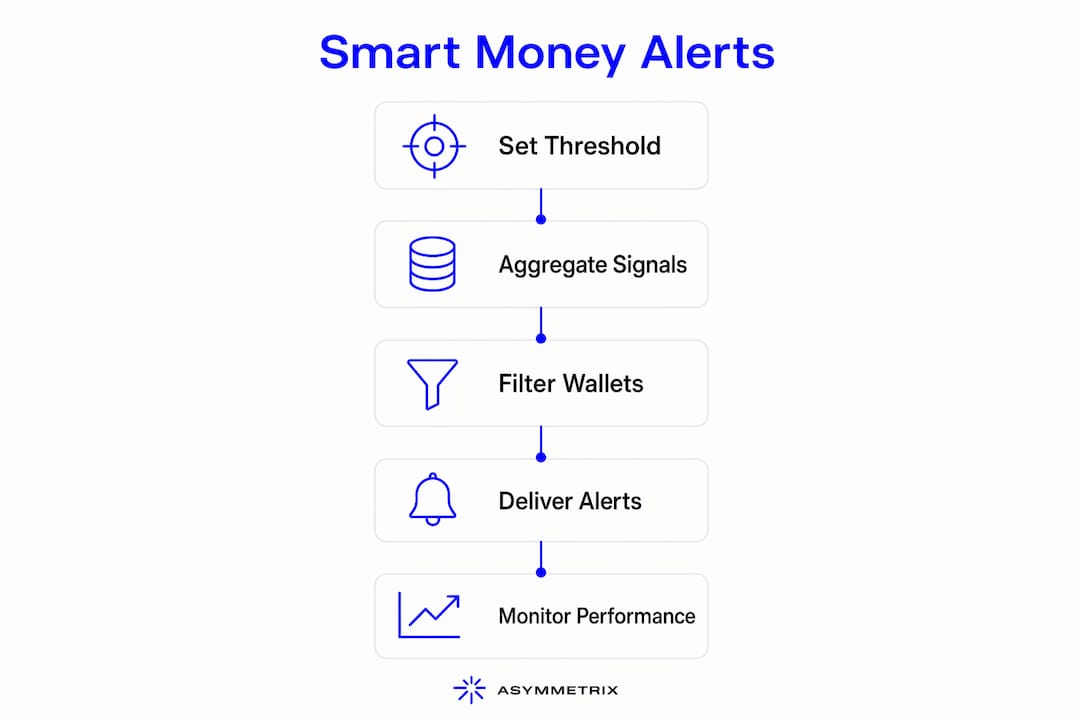
Smart Money alerts are real-time notifications that identify high-conviction prediction-market wallets before odds shift. They depend on deterministic labeling, aggregate flow signals, and Trader Skill Scores, delivered via webhooks or websockets. Proper architecture includes threshold setting, filtering, replay logs, and cautious risk management to ensure effective prediction trading.
Smart Money alerts are real-time notifications that flag high-conviction prediction-market wallet flows so trading systems and AI agents can act before odds shift. The integration path is direct: define signal rules, ingest wallet data from the Assymetrix Data API at data.assymetrix.com, deliver via webhook or websocket, then gate on Trader Skill Scores to cut noise. The venues in scope are Polymarket, Kalshi, and Limitless.
Implementation path in four steps:
Define threshold rules (P&L, position size, cross-venue alignment)
Subscribe to Assymetrix wallet-tracking and streaming endpoints
Deliver events via webhook or websocket to your bot or agent
Filter using Trader Skill Scores and rolling historical accuracy
Table of Contents
What are smart money alerts in prediction markets?
Which signal criteria should trigger a Smart Money alert?
How should you architect real-time Smart Money alert delivery?
How to implement Smart Money alerts using the Assymetrix Data API
How do you filter lucky wallets from genuinely sharp ones?
How should trading bots and AI agents consume Smart Money alerts?
How do you test and monitor Smart Money alerts in production?
What are the real risks of Smart Money alerts?
Key Takeaways
The signal is only as good as the system behind it
Assymetrix gives you production-ready Smart Money alerts
Useful sources and further reading
What are smart money alerts in prediction markets?
In traditional finance, a trade signal is a mechanical, emotion-free trigger that moves a system from observation to action. In prediction markets, Smart Money alerts serve the same function, but the underlying data is wallet-level rather than price-chart-level.
A Smart Money wallet is one that has demonstrated repeatable edge across multiple markets and time windows, not just a single lucky position. The labeling is deterministic: wallets qualify based on multi-month realized P&L thresholds, a minimum number of resolved markets, and cross-venue directional consistency on Polymarket, Kalshi, and Limitless. A wallet that won big on one meme-politics contract does not qualify.
What the alert does and does not tell you:
Does: flag that a labeled wallet has taken a meaningful position, with timestamp, market ID, position size, and current P&L
Does: surface cross-venue alignment when multiple labeled wallets move in the same direction within a short window
Does not: confirm the wallet’s thesis is correct — buying is a signal, not a guarantee
Does not: interpret selling without context; exits can mean profit-taking, not reversal conviction
Pro Tip: When moving from observation to live alerts, start with a 90-day realized P&L threshold and at least 20 resolved markets before labeling a wallet as Smart Money. Tighten from there once you have backtest data.
Which signal criteria should trigger a Smart Money alert?
Aggregate position shifts at or above a certain threshold of total open interest are stronger signals than single trades. The table below gives example threshold defaults for Polymarket, Kalshi, and Limitless.

Signal Dimension | Threshold (Default) | Notes |
|---|---|---|
Wallet realized P&L | Above a practical monetary threshold over a set period | Adjust down for smaller venues |
Position size vs. open interest | Above a small percentage of market liquidity | Filters out test trades |
Aggregate position change | Above a small percentage of total open interest | Tracks flow, not individual buys |
Entry timing vs. odds move | Entry precedes a notable odds shift | Confirms lead, not lag |
Cross-venue alignment window | Same direction within a short time window | Polymarket + Kalshi or Limitless |
A combined rule that fires with high confidence looks like this: wallet realized P&L > $5,000 AND new position > 1% of market liquidity AND at least one other labeled wallet moves in the same direction on a second venue within 60 minutes. That combination cuts single-wallet noise and rewards genuine cross-venue conviction.
Sensitivity tradeoffs are real. Lowering the P&L threshold catches more wallets but raises false positives. Raising the cross-venue window to 120 minutes catches slower coordination but risks acting after odds have already moved. For Kalshi, where liquidity is thinner, a 0.5% position-size threshold often works better than 1%.
Pro Tip: Run your threshold set against 30 days of historical Assymetrix data before going live. Precision below 60% on backtests usually means the P&L or position-size bar is too low.
How should you architect real-time Smart Money alert delivery?
Two delivery models dominate: webhooks for event-driven systems and websockets (or server-sent events) for streaming pipelines.
Webhooks push a POST payload to your endpoint on each qualifying event. Lower infrastructure overhead, but you absorb cold-start latency on the first event after idle periods.
Websockets maintain a persistent connection and stream events as they occur. Better for latency-sensitive bots; requires connection management and reconnect logic.
A production pipeline typically has four layers:
Ingestion: raw wallet events from Assymetrix streaming endpoints, pre-filtered by wallet label
Enrichment: attach Trader Skill Score, rolling historical accuracy, and cross-venue alignment flag
Deduplication and scoring: assign a composite score; dedupe by
(wallet_id, market_id, event_timestamp)keyDelivery: emit to downstream consumers (trading bot, AI agent, dashboard) with idempotency token
Operationally, authenticate with a bearer token on every request, respect rate limits with exponential backoff, and store raw events in an append-only log so you can replay and reconstruct alerts for debugging or backtesting.
How to implement Smart Money alerts using the Assymetrix Data API
The Assymetrix platform exposes the following endpoints at data.assymetrix.com for alert construction:
GET /wallets/{wallet_id}/positions— current and historical positions per walletGET /wallets/{wallet_id}/pnl— realized and unrealized P&L with resolution historyGET /markets/{market_id}/positions— aggregate position distribution across all walletsGET /traders/skill-scores— Trader Skill Scores with rolling 30/90/180-day windowsPOST /webhooks— register a webhook endpoint for streaming alert deliveryWS /stream— websocket channel for live wallet and market events
A minimal webhook payload looks like:
{
  "event_type": "smart_money_alert",
  "wallet_id": "0xabc…",
  "market_id": "pol-us-election-2026",
  "venue": "polymarket",
  "timestamp": "2026-07-14T14:32:00Z",
  "position_share": 0.023,
  "realized_pnl_90d": 8400,
  "skill_score": 82,
  "cross_venue_aligned": true,
  "alignment_venues": ["kalshi"],
  "idempotency_key": "evt_8f3a…"
}
{
  "event_type": "smart_money_alert",
  "wallet_id": "0xabc…",
  "market_id": "pol-us-election-2026",
  "venue": "polymarket",
  "timestamp": "2026-07-14T14:32:00Z",
  "position_share": 0.023,
  "realized_pnl_90d": 8400,
  "skill_score": 82,
  "cross_venue_aligned": true,
  "alignment_venues": ["kalshi"],
  "idempotency_key": "evt_8f3a…"
}
Pseudocode for a minimal filter-and-emit loop:
on_event(payload):
  if payload.skill_score < MIN_SKILL_SCORE: return
  if payload.realized_pnl_90d < MIN_PNL: return
  if payload.position_share < MIN_POSITION_SHARE: return
  if seen(payload.idempotency_key): return
  mark_seen(payload.idempotency_key)
  if payload.cross_venue_aligned:
    emit_alert(payload, priority="HIGH")
  else:
    emit_alert(payload, priority="STANDARD")
on_event(payload):
  if payload.skill_score < MIN_SKILL_SCORE: return
  if payload.realized_pnl_90d < MIN_PNL: return
  if payload.position_share < MIN_POSITION_SHARE: return
  if seen(payload.idempotency_key): return
  mark_seen(payload.idempotency_key)
  if payload.cross_venue_aligned:
    emit_alert(payload, priority="HIGH")
  else:
    emit_alert(payload, priority="STANDARD")
Assymetrix’s unified schema normalizes events across Polymarket, Kalshi, and Limitless so the same filter logic runs without venue-specific parsing. For missed events during downtime, use the backfill endpoint with a since timestamp to replay the gap.
Pro Tip: Store the raw event stream in an append-only table before any filtering. You will need it when you recalibrate thresholds or investigate a missed alert.
Assymetrix aggregates approximately 1.5 terabytes of historical prediction-market trading data, which means your backfill requests have deep coverage for threshold calibration.
How do you filter lucky wallets from genuinely sharp ones?
Skill and repeatability are stronger predictors than isolated wins. A wallet that hit 80% accuracy on three markets is statistically indistinguishable from noise. One that hit 65% accuracy across 50 markets over 180 days is not.
Validation metrics to track per wallet:
Trader Skill Score (Assymetrix): composite score weighting accuracy, P&L persistence, and market diversity
Historical hit rate: resolved-market accuracy over 30/90/180-day rolling windows
P&L persistence: does the edge hold across different market categories, or only in one topic area?
Frequency of repeatable edge: minimum 10 resolved markets per rolling window before the score is trusted
Backtest checklist before going live:
Confirm sample size: at least 30 resolved markets per labeled wallet
Remove lookahead bias: use only data available at the time of the alert, not resolution outcomes
Calculate precision (true alerts / total alerts) and recall (true alerts / total qualifying events)
Run bootstrap resampling to check whether precision holds across random subsamples
Practical filter sequence: require minimum Trader Skill Score (e.g., 70+) → require at least two wallets moving in the same direction on the same market → require position size above the liquidity threshold. Low-liquidity markets on Limitless need a higher skill-score floor because a single large wallet can move odds without representing genuine information.
For test trades — small positions in meme or novelty contracts — filter by minimum position size. A $50 position in a low-stakes contract is almost never a signal worth acting on.
How should trading bots and AI agents consume Smart Money alerts?
An automated consumption pipeline has five stages: alert received → pre-checks → gating rules → dry-run simulation → order submission.
Pre-checks: verify idempotency key, confirm market is still open, check current odds against the alert’s entry odds
Gating rules: require skill score above threshold, require cross-venue alignment flag, confirm position size is within your risk model’s limits
Dry-run: simulate the order at current market prices before committing capital; log expected slippage
Order submission: pace orders to respect venue rate limits; use venue-specific order APIs
For AI agents, the alert payload becomes a structured observation in the agent’s decision space. The agent should treat cross_venue_aligned: true as a stronger prior and skill_score as a confidence weight, not a binary gate. Safe default behavior: if the skill score is below threshold or the market has moved more than 5% since the alert timestamp, the agent abstains and logs the event for review.
Combine Smart Money alerts with your own position-size calculator and a local risk model. Cross-venue hedging rules — for example, taking a smaller position on Kalshi when the primary signal came from Polymarket — reduce venue-specific liquidity risk. The prediction market stack article covers where alerts fit within the broader infrastructure layer.
Pro Tip: Run your bot in shadow mode for at least two weeks before live trading. Log every alert, every gating decision, and every simulated outcome. The gap between shadow P&L and live P&L tells you where your latency or slippage assumptions are wrong.
How do you test and monitor Smart Money alerts in production?
Track these metrics from day one:
Metric | Target | Notes |
|---|---|---|
Alert precision | > 60% | True positives / total alerts fired |
Alert recall | > 60% | True positives / total qualifying events |
False positive rate | < 60% | Alerts that did not precede an odds move |
Mean alert latency | < 1 second | Wallet event to delivered alert |
API uptime / SLA | > 99% | Track against Assymetrix SLA commitments |
Alert-to-trade delta | < 2 seconds | Time from alert receipt to order submission |
Dashboard KPIs to review weekly: rolling 30/90/180-day accuracy per wallet cohort, P&L attribution broken down by alert type (single-wallet vs. cross-venue), and aggregate cross-venue alignment counts by venue pair.
For testing, run shadow mode first, then A/B test threshold variants on live traffic by routing a percentage of alerts to an experimental filter set. Keep replayable event logs so you can reconstruct any alert for incident review. When an alert fires but no trade executes, the log tells you whether the gating layer or the order layer was the bottleneck. Institutional-grade infrastructure expectations for prediction markets now include replayable streams as a baseline requirement.
What are the real risks of Smart Money alerts?
Overfitting to historic wallets: a wallet’s edge can decay as markets mature and other participants learn to front-run the same signals
Liquidity shocks: large positions in thin markets move odds before your order reaches the book, turning a signal into slippage
Memecoin and novelty market noise: signal quality degrades on low-stakes or meme contracts where even labeled wallets behave erratically
Labeling drift: a wallet that qualified six months ago may no longer meet current thresholds; re-evaluate labels on a rolling basis
False cross-venue matches: two wallets moving in the same direction on different venues within 60 minutes is not always coordination; check market category and timing carefully
Selling signals deserve special caution. An exit by a Smart Money wallet can mean profit-taking at a target, not a reversal call. Never treat a sell event as a short signal without additional confirmation.
Bank of America’s Bull & Bear Indicator research illustrates the broader principle: extreme sentiment alignment can precede reversals, not just continuations. In prediction markets, when every labeled wallet is on the same side of a contract, that concentration itself is a risk flag.
Best practices: conservative position sizing on new signals, multi-wallet confirmation before acting, human-in-the-loop review for markets with fewer than 30 days of history, and quarterly recalibration of all P&L and skill-score thresholds. U.S.-based market participants should confirm that their alert-driven trading activity complies with applicable regulations; consult your compliance team before deploying automated order submission at scale.
Key Takeaways
Smart Money alerts work when signal criteria are precise, delivery is low-latency, and Trader Skill Scores gate every alert before it reaches an ordering system.
Point | Details |
|---|---|
Define threshold rules first | Set P&L, position size, and cross-venue alignment criteria before subscribing to any endpoint. |
Use aggregate flows, not single trades | A 5%+ shift in open interest across multiple wallets is a far stronger signal than one large buy. |
Gate on Trader Skill Scores | Require a minimum score (e.g., 70+) and multi-event confirmation to cut false positives. |
Build replayable event logs | Append-only event storage lets you backtest threshold changes and debug missed alerts. |
Assymetrix as the integration layer | The Assymetrix Data API at data.assymetrix.com provides wallet tracking, Trader Skill Scores, cross-venue alignment, and streaming delivery in a single unified schema. |
The signal is only as good as the system behind it
Most teams building Smart Money alert systems spend 80% of their time on the signal definition and almost none on the operational layer. That is backwards. A well-defined signal delivered with 2-second latency and no deduplication logic will underperform a simpler signal delivered reliably at 200 ms with idempotent handling and a clean replay log.
The other thing worth saying plainly: cross-venue alignment is the single most underrated filter in this space. A wallet moving on Polymarket alone is interesting. The same wallet moving on Polymarket while a different labeled wallet moves in the same direction on Kalshi within 60 minutes is a different category of signal. That convergence is what Assymetrix’s cross-venue architecture is built to surface, and it is the reason a unified data layer matters more than scraping venues independently.
If you are building at prop or institutional scale, the prediction market landscape in 2026 has changed fast enough that threshold sets from even six months ago may need recalibration. Build the recalibration cadence into your ops calendar from day one.
Assymetrix gives you production-ready Smart Money alerts
The fastest path from signal idea to live alert system is a data layer that already has the wallets labeled, the skill scores computed, and the cross-venue positions normalized. That is what the Assymetrix Data API delivers.
Assymetrix aggregates real-time and historical data across Polymarket, Kalshi, and Limitless into a single schema, built on approximately 1.5 terabytes of trading history. The platform surfaces Smart Money wallet tracking, Trader Skill Scores, cross-venue alignment signals, and streaming delivery via webhook and websocket, all accessible through one integration. Free and developer tiers are available. Start at data.assymetrix.com to review endpoint documentation and request API access. For accuracy benchmarks and backtest methodology, the prediction market accuracy guide covers the validation framework in detail.
Useful sources and further reading
Trade Signals: How They Guide Buy and Sell Decisions — Investopedia
Smart Money wallet analytics and Trader Skill Scores — Assymetrix
Backtesting prediction market strategies with the Assymetrix Data API — Assymetrix
Unified prediction market data schema — Assymetrix
Institutional prediction market infrastructure — Assymetrix
Smart Money flow and aggregate signal methodology — Eco Support
Real-time alert delivery patterns — DataDigger
Bull & Bear contrarian indicator research — Business Insider
FAQ
What are Smart Money alerts in prediction markets?
Smart Money alerts are real-time notifications triggered when high-accuracy, labeled wallets take meaningful positions on Polymarket, Kalshi, or Limitless, typically before odds shift in the same direction.
How does Assymetrix label a wallet as Smart Money?
Assymetrix uses deterministic rules: multi-month realized P&L thresholds, a minimum number of resolved markets, and cross-venue directional consistency. Trader Skill Scores provide a rolling 30/90/180-day accuracy measure on top of the base label.
What delivery method is best for low-latency alert systems?
Websockets are better for latency-sensitive bots because they maintain a persistent connection and stream events as they occur. Webhooks are simpler to operate but add cold-start latency after idle periods.
How do you reduce false positives in Smart Money alerts?
Require a minimum Trader Skill Score (e.g., 70+), multi-wallet confirmation on the same market, and a position size above the liquidity threshold. Filter out test trades by setting a minimum dollar position floor.
Can AI agents consume Smart Money alerts directly?
Yes. Feed the structured alert payload into the agent’s decision space, weight skill_score as a confidence input, and build an explicit gating layer so the agent abstains when the score is below threshold or odds have moved more than 5% since the alert timestamp.
Smart Money Alerts for Prediction Market Developers
TL;DR:
Smart Money alerts are real-time notifications that identify high-conviction prediction-market wallets before odds shift. They depend on deterministic labeling, aggregate flow signals, and Trader Skill Scores, delivered via webhooks or websockets. Proper architecture includes threshold setting, filtering, replay logs, and cautious risk management to ensure effective prediction trading.
Smart Money alerts are real-time notifications that flag high-conviction prediction-market wallet flows so trading systems and AI agents can act before odds shift. The integration path is direct: define signal rules, ingest wallet data from the Assymetrix Data API at data.assymetrix.com, deliver via webhook or websocket, then gate on Trader Skill Scores to cut noise. The venues in scope are Polymarket, Kalshi, and Limitless.
Implementation path in four steps:
Define threshold rules (P&L, position size, cross-venue alignment)
Subscribe to Assymetrix wallet-tracking and streaming endpoints
Deliver events via webhook or websocket to your bot or agent
Filter using Trader Skill Scores and rolling historical accuracy
Table of Contents
What are smart money alerts in prediction markets?
Which signal criteria should trigger a Smart Money alert?
How should you architect real-time Smart Money alert delivery?
How to implement Smart Money alerts using the Assymetrix Data API
How do you filter lucky wallets from genuinely sharp ones?
How should trading bots and AI agents consume Smart Money alerts?
How do you test and monitor Smart Money alerts in production?
What are the real risks of Smart Money alerts?
Key Takeaways
The signal is only as good as the system behind it
Assymetrix gives you production-ready Smart Money alerts
Useful sources and further reading
What are smart money alerts in prediction markets?
In traditional finance, a trade signal is a mechanical, emotion-free trigger that moves a system from observation to action. In prediction markets, Smart Money alerts serve the same function, but the underlying data is wallet-level rather than price-chart-level.
A Smart Money wallet is one that has demonstrated repeatable edge across multiple markets and time windows, not just a single lucky position. The labeling is deterministic: wallets qualify based on multi-month realized P&L thresholds, a minimum number of resolved markets, and cross-venue directional consistency on Polymarket, Kalshi, and Limitless. A wallet that won big on one meme-politics contract does not qualify.
What the alert does and does not tell you:
Does: flag that a labeled wallet has taken a meaningful position, with timestamp, market ID, position size, and current P&L
Does: surface cross-venue alignment when multiple labeled wallets move in the same direction within a short window
Does not: confirm the wallet’s thesis is correct — buying is a signal, not a guarantee
Does not: interpret selling without context; exits can mean profit-taking, not reversal conviction
Pro Tip: When moving from observation to live alerts, start with a 90-day realized P&L threshold and at least 20 resolved markets before labeling a wallet as Smart Money. Tighten from there once you have backtest data.
Which signal criteria should trigger a Smart Money alert?
Aggregate position shifts at or above a certain threshold of total open interest are stronger signals than single trades. The table below gives example threshold defaults for Polymarket, Kalshi, and Limitless.
Signal Dimension | Threshold (Default) | Notes |
|---|---|---|
Wallet realized P&L | Above a practical monetary threshold over a set period | Adjust down for smaller venues |
Position size vs. open interest | Above a small percentage of market liquidity | Filters out test trades |
Aggregate position change | Above a small percentage of total open interest | Tracks flow, not individual buys |
Entry timing vs. odds move | Entry precedes a notable odds shift | Confirms lead, not lag |
Cross-venue alignment window | Same direction within a short time window | Polymarket + Kalshi or Limitless |
A combined rule that fires with high confidence looks like this: wallet realized P&L > $5,000 AND new position > 1% of market liquidity AND at least one other labeled wallet moves in the same direction on a second venue within 60 minutes. That combination cuts single-wallet noise and rewards genuine cross-venue conviction.
Sensitivity tradeoffs are real. Lowering the P&L threshold catches more wallets but raises false positives. Raising the cross-venue window to 120 minutes catches slower coordination but risks acting after odds have already moved. For Kalshi, where liquidity is thinner, a 0.5% position-size threshold often works better than 1%.
Pro Tip: Run your threshold set against 30 days of historical Assymetrix data before going live. Precision below 60% on backtests usually means the P&L or position-size bar is too low.
How should you architect real-time Smart Money alert delivery?
Two delivery models dominate: webhooks for event-driven systems and websockets (or server-sent events) for streaming pipelines.
Webhooks push a POST payload to your endpoint on each qualifying event. Lower infrastructure overhead, but you absorb cold-start latency on the first event after idle periods.
Websockets maintain a persistent connection and stream events as they occur. Better for latency-sensitive bots; requires connection management and reconnect logic.
A production pipeline typically has four layers:
Ingestion: raw wallet events from Assymetrix streaming endpoints, pre-filtered by wallet label
Enrichment: attach Trader Skill Score, rolling historical accuracy, and cross-venue alignment flag
Deduplication and scoring: assign a composite score; dedupe by
(wallet_id, market_id, event_timestamp)keyDelivery: emit to downstream consumers (trading bot, AI agent, dashboard) with idempotency token
Operationally, authenticate with a bearer token on every request, respect rate limits with exponential backoff, and store raw events in an append-only log so you can replay and reconstruct alerts for debugging or backtesting.
How to implement Smart Money alerts using the Assymetrix Data API
The Assymetrix platform exposes the following endpoints at data.assymetrix.com for alert construction:
GET /wallets/{wallet_id}/positions— current and historical positions per walletGET /wallets/{wallet_id}/pnl— realized and unrealized P&L with resolution historyGET /markets/{market_id}/positions— aggregate position distribution across all walletsGET /traders/skill-scores— Trader Skill Scores with rolling 30/90/180-day windowsPOST /webhooks— register a webhook endpoint for streaming alert deliveryWS /stream— websocket channel for live wallet and market events
A minimal webhook payload looks like:
{
  "event_type": "smart_money_alert",
  "wallet_id": "0xabc…",
  "market_id": "pol-us-election-2026",
  "venue": "polymarket",
  "timestamp": "2026-07-14T14:32:00Z",
  "position_share": 0.023,
  "realized_pnl_90d": 8400,
  "skill_score": 82,
  "cross_venue_aligned": true,
  "alignment_venues": ["kalshi"],
  "idempotency_key": "evt_8f3a…"
}
Pseudocode for a minimal filter-and-emit loop:
on_event(payload):
  if payload.skill_score < MIN_SKILL_SCORE: return
  if payload.realized_pnl_90d < MIN_PNL: return
  if payload.position_share < MIN_POSITION_SHARE: return
  if seen(payload.idempotency_key): return
  mark_seen(payload.idempotency_key)
  if payload.cross_venue_aligned:
    emit_alert(payload, priority="HIGH")
  else:
    emit_alert(payload, priority="STANDARD")
Assymetrix’s unified schema normalizes events across Polymarket, Kalshi, and Limitless so the same filter logic runs without venue-specific parsing. For missed events during downtime, use the backfill endpoint with a since timestamp to replay the gap.
Pro Tip: Store the raw event stream in an append-only table before any filtering. You will need it when you recalibrate thresholds or investigate a missed alert.
Assymetrix aggregates approximately 1.5 terabytes of historical prediction-market trading data, which means your backfill requests have deep coverage for threshold calibration.
How do you filter lucky wallets from genuinely sharp ones?
Skill and repeatability are stronger predictors than isolated wins. A wallet that hit 80% accuracy on three markets is statistically indistinguishable from noise. One that hit 65% accuracy across 50 markets over 180 days is not.
Validation metrics to track per wallet:
Trader Skill Score (Assymetrix): composite score weighting accuracy, P&L persistence, and market diversity
Historical hit rate: resolved-market accuracy over 30/90/180-day rolling windows
P&L persistence: does the edge hold across different market categories, or only in one topic area?
Frequency of repeatable edge: minimum 10 resolved markets per rolling window before the score is trusted
Backtest checklist before going live:
Confirm sample size: at least 30 resolved markets per labeled wallet
Remove lookahead bias: use only data available at the time of the alert, not resolution outcomes
Calculate precision (true alerts / total alerts) and recall (true alerts / total qualifying events)
Run bootstrap resampling to check whether precision holds across random subsamples
Practical filter sequence: require minimum Trader Skill Score (e.g., 70+) → require at least two wallets moving in the same direction on the same market → require position size above the liquidity threshold. Low-liquidity markets on Limitless need a higher skill-score floor because a single large wallet can move odds without representing genuine information.
For test trades — small positions in meme or novelty contracts — filter by minimum position size. A $50 position in a low-stakes contract is almost never a signal worth acting on.
How should trading bots and AI agents consume Smart Money alerts?
An automated consumption pipeline has five stages: alert received → pre-checks → gating rules → dry-run simulation → order submission.
Pre-checks: verify idempotency key, confirm market is still open, check current odds against the alert’s entry odds
Gating rules: require skill score above threshold, require cross-venue alignment flag, confirm position size is within your risk model’s limits
Dry-run: simulate the order at current market prices before committing capital; log expected slippage
Order submission: pace orders to respect venue rate limits; use venue-specific order APIs
For AI agents, the alert payload becomes a structured observation in the agent’s decision space. The agent should treat cross_venue_aligned: true as a stronger prior and skill_score as a confidence weight, not a binary gate. Safe default behavior: if the skill score is below threshold or the market has moved more than 5% since the alert timestamp, the agent abstains and logs the event for review.
Combine Smart Money alerts with your own position-size calculator and a local risk model. Cross-venue hedging rules — for example, taking a smaller position on Kalshi when the primary signal came from Polymarket — reduce venue-specific liquidity risk. The prediction market stack article covers where alerts fit within the broader infrastructure layer.
Pro Tip: Run your bot in shadow mode for at least two weeks before live trading. Log every alert, every gating decision, and every simulated outcome. The gap between shadow P&L and live P&L tells you where your latency or slippage assumptions are wrong.
How do you test and monitor Smart Money alerts in production?
Track these metrics from day one:
Metric | Target | Notes |
|---|---|---|
Alert precision | > 60% | True positives / total alerts fired |
Alert recall | > 60% | True positives / total qualifying events |
False positive rate | < 60% | Alerts that did not precede an odds move |
Mean alert latency | < 1 second | Wallet event to delivered alert |
API uptime / SLA | > 99% | Track against Assymetrix SLA commitments |
Alert-to-trade delta | < 2 seconds | Time from alert receipt to order submission |
Dashboard KPIs to review weekly: rolling 30/90/180-day accuracy per wallet cohort, P&L attribution broken down by alert type (single-wallet vs. cross-venue), and aggregate cross-venue alignment counts by venue pair.
For testing, run shadow mode first, then A/B test threshold variants on live traffic by routing a percentage of alerts to an experimental filter set. Keep replayable event logs so you can reconstruct any alert for incident review. When an alert fires but no trade executes, the log tells you whether the gating layer or the order layer was the bottleneck. Institutional-grade infrastructure expectations for prediction markets now include replayable streams as a baseline requirement.
What are the real risks of Smart Money alerts?
Overfitting to historic wallets: a wallet’s edge can decay as markets mature and other participants learn to front-run the same signals
Liquidity shocks: large positions in thin markets move odds before your order reaches the book, turning a signal into slippage
Memecoin and novelty market noise: signal quality degrades on low-stakes or meme contracts where even labeled wallets behave erratically
Labeling drift: a wallet that qualified six months ago may no longer meet current thresholds; re-evaluate labels on a rolling basis
False cross-venue matches: two wallets moving in the same direction on different venues within 60 minutes is not always coordination; check market category and timing carefully
Selling signals deserve special caution. An exit by a Smart Money wallet can mean profit-taking at a target, not a reversal call. Never treat a sell event as a short signal without additional confirmation.
Bank of America’s Bull & Bear Indicator research illustrates the broader principle: extreme sentiment alignment can precede reversals, not just continuations. In prediction markets, when every labeled wallet is on the same side of a contract, that concentration itself is a risk flag.
Best practices: conservative position sizing on new signals, multi-wallet confirmation before acting, human-in-the-loop review for markets with fewer than 30 days of history, and quarterly recalibration of all P&L and skill-score thresholds. U.S.-based market participants should confirm that their alert-driven trading activity complies with applicable regulations; consult your compliance team before deploying automated order submission at scale.
Key Takeaways
Smart Money alerts work when signal criteria are precise, delivery is low-latency, and Trader Skill Scores gate every alert before it reaches an ordering system.
Point | Details |
|---|---|
Define threshold rules first | Set P&L, position size, and cross-venue alignment criteria before subscribing to any endpoint. |
Use aggregate flows, not single trades | A 5%+ shift in open interest across multiple wallets is a far stronger signal than one large buy. |
Gate on Trader Skill Scores | Require a minimum score (e.g., 70+) and multi-event confirmation to cut false positives. |
Build replayable event logs | Append-only event storage lets you backtest threshold changes and debug missed alerts. |
Assymetrix as the integration layer | The Assymetrix Data API at data.assymetrix.com provides wallet tracking, Trader Skill Scores, cross-venue alignment, and streaming delivery in a single unified schema. |
The signal is only as good as the system behind it
Most teams building Smart Money alert systems spend 80% of their time on the signal definition and almost none on the operational layer. That is backwards. A well-defined signal delivered with 2-second latency and no deduplication logic will underperform a simpler signal delivered reliably at 200 ms with idempotent handling and a clean replay log.
The other thing worth saying plainly: cross-venue alignment is the single most underrated filter in this space. A wallet moving on Polymarket alone is interesting. The same wallet moving on Polymarket while a different labeled wallet moves in the same direction on Kalshi within 60 minutes is a different category of signal. That convergence is what Assymetrix’s cross-venue architecture is built to surface, and it is the reason a unified data layer matters more than scraping venues independently.
If you are building at prop or institutional scale, the prediction market landscape in 2026 has changed fast enough that threshold sets from even six months ago may need recalibration. Build the recalibration cadence into your ops calendar from day one.
Assymetrix gives you production-ready Smart Money alerts
The fastest path from signal idea to live alert system is a data layer that already has the wallets labeled, the skill scores computed, and the cross-venue positions normalized. That is what the Assymetrix Data API delivers.
Assymetrix aggregates real-time and historical data across Polymarket, Kalshi, and Limitless into a single schema, built on approximately 1.5 terabytes of trading history. The platform surfaces Smart Money wallet tracking, Trader Skill Scores, cross-venue alignment signals, and streaming delivery via webhook and websocket, all accessible through one integration. Free and developer tiers are available. Start at data.assymetrix.com to review endpoint documentation and request API access. For accuracy benchmarks and backtest methodology, the prediction market accuracy guide covers the validation framework in detail.
Useful sources and further reading
Trade Signals: How They Guide Buy and Sell Decisions — Investopedia
Smart Money wallet analytics and Trader Skill Scores — Assymetrix
Backtesting prediction market strategies with the Assymetrix Data API — Assymetrix
Unified prediction market data schema — Assymetrix
Institutional prediction market infrastructure — Assymetrix
Smart Money flow and aggregate signal methodology — Eco Support
Real-time alert delivery patterns — DataDigger
Bull & Bear contrarian indicator research — Business Insider
FAQ
What are Smart Money alerts in prediction markets?
Smart Money alerts are real-time notifications triggered when high-accuracy, labeled wallets take meaningful positions on Polymarket, Kalshi, or Limitless, typically before odds shift in the same direction.
How does Assymetrix label a wallet as Smart Money?
Assymetrix uses deterministic rules: multi-month realized P&L thresholds, a minimum number of resolved markets, and cross-venue directional consistency. Trader Skill Scores provide a rolling 30/90/180-day accuracy measure on top of the base label.
What delivery method is best for low-latency alert systems?
Websockets are better for latency-sensitive bots because they maintain a persistent connection and stream events as they occur. Webhooks are simpler to operate but add cold-start latency after idle periods.
How do you reduce false positives in Smart Money alerts?
Require a minimum Trader Skill Score (e.g., 70+), multi-wallet confirmation on the same market, and a position size above the liquidity threshold. Filter out test trades by setting a minimum dollar position floor.
Can AI agents consume Smart Money alerts directly?
Yes. Feed the structured alert payload into the agent’s decision space, weight skill_score as a confidence input, and build an explicit gating layer so the agent abstains when the score is below threshold or odds have moved more than 5% since the alert timestamp.
Other Blog


