1.5TB Backfill: Institutional Prediction Market Data for Quant Teams
1.5TB Backfill: Institutional Prediction Market Data for Quant Teams
1.5TB Backfill: Institutional Prediction Market Data for Quant Teams
See how a unified REST and WebSocket API normalizes Polymarket, Kalshi, and Limitless into per fill trade records and 1.5TB of historical backfill for...
1.5TB Backfill: Institutional Prediction Market Data for Quant Teams
Institutional prediction market data is a unified, audited feed combining hourly probability series with per-fill trade records and resolved outcomes, drawn across regulated and on-chain venues. Quant desks use it for event-driven trading around macro catalysts, backtesting against labeled ground truth, and feeding AI models with distributional inputs. The practical path to production is a single API that normalizes venue schemas, ships both REST and WebSocket access, and carries deep historical backfill.
TL;DR:
Accurate prediction market data for institutions requires stable identifiers, deep historical backfill, and provenance verification to ensure reliable backtesting and analysis.
Combining on-chain records from Polymarket and exchange-reported data from Kalshi simplifies cross-venue arbitrage and reduces integration complexity.
Real-time signals depend on WebSocket streaming, while historical analysis relies on REST endpoints for bulk data, both needing normalization to a common schema.
Verification of resolved outcomes and reconciliation checks are essential before deploying strategy code to avoid discrepancies between backtests and live performance.
An aggregated, standardized data feed enables institutions to focus on signal development rather than infrastructure, especially when strategies span multiple prediction market venues.
AssymetrixBuild On Unified Market IntelligenceAssymetrix brings Polymarket, Kalshi, and Limitless data together through one API for quantitative research, trading tools, and AI agents.Explore Assymetrix
Table of Contents
How Institutional Traders Actually Use Prediction Market Data
What Institutional-Grade Prediction Market Data Requires
Reconciling On-Chain and Regulated Venue Data Shapes
Building an Integration Pipeline for Prediction Market Data
Quant Workflows: Signals, Backtests, and Arbitrage Filters
Assymetrix: Cross-Venue Coverage Built for Institutional Pipelines
Where Prediction Market Data Actually Earns Its Cost
Get Started With the Assymetrix Data API
Sources
How Institutional Traders Actually Use Prediction Market Data
Event-driven desks trade prediction markets around Fed decisions, CPI prints, earnings surprises, M&A votes, and regulatory rulings, where contract prices update continuously as new information hits. That continuous repricing is the point: a Fed-funds contract on Kalshi or a rate-decision market on Polymarket gives you an hourly probability path, not a single survey number released once a month.
Quant teams treat that path as a distributional feature rather than a point estimate, pulling implied means, variance, and skew directly into signal generation, an approach Dune’s prediction market research documents across both venues. Because contracts resolve to a binary outcome, they double as labeled ground truth for backtesting, something reporting on institutional adoption has flagged as a driver of rising desk interest.
Common institutional applications include:
Event-driven entries and exits timed to scheduled macro or corporate catalysts
Macro research that cross-references implied probabilities against rates and options’ markets
AI agent inputs where continuous probability series serve as real-time features
Backtest validation using resolved contracts as objective labels
Smart-money wallet tracking as an early signal ahead of price moves
Pro Tip: Don’t treat a single prediction market price as a forecast. Pull the full hourly series and compute the trailing volatility of the probability path. Contracts with wide overnight swings ahead of resolution carry more information than ones drifting flat.
What Institutional-Grade Prediction Market Data Requires
Retail dashboards tell you a market’s current price. Production trading systems need something closer to exchange-grade infrastructure, and the gap between the two is where most homegrown scrapers fail.
Five requirements separate institutional prediction market data from a scraped price feed.
Uptime and access mode. WebSocket connections for real-time streaming, REST endpoints for bulk historical pulls, and no single point of failure during high-volatility events like election nights or Fed days.
Canonical schema and stable IDs. Every market and contract needs a persistent identifier that survives renames, plus normalized timezones, so a query written today still resolves correctly against data ingested a year from now.
Granular trade and price tables. Per-fill trade records, hourly price series, resolution flags, and settlement timestamps, not just a last-traded price snapshot.
Historical backfill depth. Multi-year hourly series and per-fill history matter more than real-time polish, since reproducible backtests require the same depth a live signal will eventually run against.
Provenance and auditability. On-chain transaction traces or exchange-issued resolution records that let a data team verify an outcome independently rather than trust a vendor’s label.
Coverage windows matter here too: Dune’s collection notes Kalshi data reaching back to June 2021 and Polymarket to November 2022, which sets a practical floor for how far back any cross-venue backtest can honestly run. Trust infrastructure is not a side detail. Chainlink’s analysis of institutional adoption argues that verifiable settlement and consistent metadata are the actual barrier holding larger allocators back, more than liquidity itself.
Reconciling On-Chain and Regulated Venue Data Shapes
Polymarket and Kalshi are not the same kind of data source, and treating them as interchangeable is a fast way to break a reconciliation pipeline. Polymarket runs on Polygon, so every trade leaves an immutable on-chain record tied to a wallet address, with maker and taker sides visible to anyone querying the chain. Polymarket’s developer documentation confirms this real-time, per-fill transparency as a core feature of the venue.

Kalshi, a CFTC-regulated exchange, reports fills through exchange infrastructure instead of a public ledger. That means fee metadata, contract labeling, and settlement records come from the exchange itself rather than a block explorer, which changes how you build fee-adjusted P&L and how much independent verification is even possible.
The practical differences show up in a few places:
Smart-money studies are easier on Polymarket, where wallet-level history is public by design
Fee-adjusted returns require exchange-reported schedules on Kalshi that don’t exist on-chain
Regulatory labeling (CFTC contract designations) only applies to the regulated venue
Backfill depth differs by venue start date, so blended historical queries need explicit coverage flags
Normalizing both shapes into one schema, with a shared contract ID structure and consistent timestamp convention, is what makes a single query span both venue types without silently dropping rows.
Building an Integration Pipeline for Prediction Market Data
Engineering teams standing up a prediction market pipeline generally need two access modes running in parallel, not one or the other.
Use REST for historical and bulk exports. Pull full market catalogs, multi-year hourly price series, and per-fill trade history for backtesting and model training.
Use WebSocket for live signals. Stream order book updates, new fills, and price changes with the latency event-driven strategies actually require.
Map to a canonical schema early. Standardize column names across trades, hourly prices, markets, and positions tables so downstream code never branches on venue.
Normalize timestamps at ingestion. Settlement times and resolution flags should land in one timezone convention before they touch a model.
Run reconciliation checks on every batch. Verify resolved outcomes against known results, check volume parity against venue totals, and replay hourly price series for gaps.
Start with a sandbox before going live. Test schema assumptions and query patterns against a smaller dataset before pointing production traffic at full historical backfill.
Assymetrix’s prediction market data feed API guide walks through both endpoint types with working query examples for teams building this from scratch.
Pro Tip: Build your reconciliation job before your signal, not after. A pipeline that silently drops resolved-outcome rows will produce a backtest that looks great and a live strategy that doesn’t match it.
Quant Workflows: Signals, Backtests, and Arbitrage Filters
Distributional features come first in most quant workflows. Converting an hourly probability series into an implied expectation, variance, and skew gives you inputs closer to what an options desk builds from an implied volatility surface than a single directional bet.
Backtesting against resolved contracts works because the outcome label already exists in the data. Build the SQL pipeline once, filtering on resolution_timestamp and settled_outcome, and rerun it against any new market without rewriting logic. Smart-money detection layers on top of this: cluster wallets by historical accuracy and position sizing, then weight new fills from high-conviction wallets more heavily as a leading signal ahead of price moves.
Cross-venue lead-lag analysis is where arbitrage filters live. If Kalshi and Polymarket price the same real-world event, a persistent gap between the two, adjusted for fees and settlement risk, is a screenable signal.
Deduplicate fills before computing volume-weighted price
Align timestamps to a single timezone before any lead-lag calculation
Flag and exclude outlier fills below a minimum size threshold
Recompute implied probability after every resolution to catch stale cached values
Assymetrix: Cross-Venue Coverage Built for Institutional Pipelines
The platform aggregates trading activity across Polymarket, Kalshi, and Limitless into one normalized schema, enabling queries against one venue’s contract structure to work similarly against others. That unification is the actual engineering problem institutional buyers are trying to solve when they evaluate a data vendor instead of building three separate scrapers.
The dataset spans a substantial volume of historical data across extensive rows of trading activity, intended to provide backtests with depth sufficient to cover multiple market cycles.
Typical evaluation may include:
Canonical market and contract IDs stable across venue-side changes
REST access for historical and bulk queries, WebSocket for real-time streaming
Per-fill trade tables and hourly price series with resolution flags
Wallet tracking and trader skill scores layered on top of raw fills
Cross-venue arbitrage signals computed from a normalized schema
Teams evaluating a supplier should request a sample dataset, review the schema documentation, and run their own reconciliation test against known resolved outcomes before committing. The Assymetrix historical data guide covers query patterns for exactly that kind of validation pass.
Where Prediction Market Data Actually Earns Its Cost
Single-venue direct feeds make sense if a desk trades exclusively on one exchange and has no interest in cross-venue arbitrage. Most institutional strategies don’t fit that constraint, and an aggregated feed earns its cost the moment a strategy touches more than one venue or needs backfill deeper than a single vendor’s launch date.
The real tradeoff isn’t cost against alpha in the abstract. It’s operational cost against how many strategies actually depend on cross-venue consistency, which for most quant teams is more strategies than they initially assume. Start with a sandbox backtest against resolved outcomes, validate the schema holds up under your own reconciliation logic, then pilot in paper trading before committing capital.
— Dean
Get Started With the Assymetrix Data API
Most teams evaluating prediction market infrastructure waste weeks reconciling three separate venue feeds before writing a single line of strategy code. This setup can be replaced with one integration: a unified schema across Polymarket, Kalshi, and Limitless, built on extensive historical trading activity, enabling engineers to focus on signals instead of data plumbing.
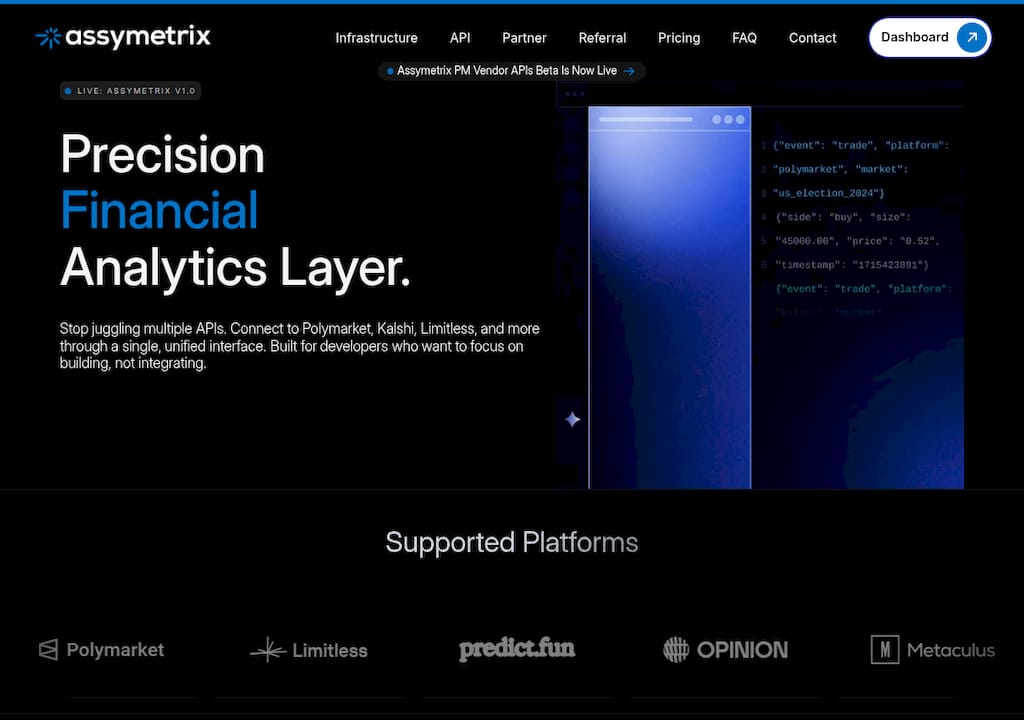
A demo walks through endpoint specs, live sample queries, and a slice of the historical backfill so your team can see the schema before committing to anything. Trial access includes a sandbox dataset and integration guidance for both REST and WebSocket feeds, and Assymetrix’s Polymarket-specific resources cover on-chain analytics for teams building wallet-level signals. Pricing for the Data API is available on request. Head to the Assymetrix Data API documentation to request trial keys and start querying.
Sources
FAQ
What Is the Most Accurate Prediction Market?
Accuracy varies by event category and liquidity depth rather than by a single venue winning outright. Markets with deeper order books and more active wallets, which Dune’s research tracks across both Kalshi and Polymarket, tend to produce tighter, faster-updating probability estimates than thinly traded contracts.
What Is the Latest News on Institutional Prediction Market Adoption?
Institutional interest accelerated through 2026, with Reuters reporting rising trading volumes as prediction markets court larger allocators. Trust infrastructure and settlement verification remain the main friction points slowing broader institutional entry.
What Are the Two Big Prediction Market Companies?
Polymarket and Kalshi dominate institutional discussion, though they operate under different structures. Polymarket runs on-chain with public wallet-level trade records, while Kalshi operates as a CFTC-regulated exchange with exchange-reported fills and fee metadata.
What Is the Best Data Source for Institutional Prediction Market Analysis?
The best source depends on whether a team needs single-venue depth or cross-venue coverage for arbitrage and backtesting. Assymetrix aggregates Polymarket, Kalshi, and Limitless into one normalized schema with canonical IDs, REST and WebSocket access, and roughly 1.5 terabytes of historical trading data for teams that need consistency across venues rather than three separate integrations.
1.5TB Backfill: Institutional Prediction Market Data for Quant Teams
Institutional prediction market data is a unified, audited feed combining hourly probability series with per-fill trade records and resolved outcomes, drawn across regulated and on-chain venues. Quant desks use it for event-driven trading around macro catalysts, backtesting against labeled ground truth, and feeding AI models with distributional inputs. The practical path to production is a single API that normalizes venue schemas, ships both REST and WebSocket access, and carries deep historical backfill.
TL;DR:
Accurate prediction market data for institutions requires stable identifiers, deep historical backfill, and provenance verification to ensure reliable backtesting and analysis.
Combining on-chain records from Polymarket and exchange-reported data from Kalshi simplifies cross-venue arbitrage and reduces integration complexity.
Real-time signals depend on WebSocket streaming, while historical analysis relies on REST endpoints for bulk data, both needing normalization to a common schema.
Verification of resolved outcomes and reconciliation checks are essential before deploying strategy code to avoid discrepancies between backtests and live performance.
An aggregated, standardized data feed enables institutions to focus on signal development rather than infrastructure, especially when strategies span multiple prediction market venues.
AssymetrixBuild On Unified Market IntelligenceAssymetrix brings Polymarket, Kalshi, and Limitless data together through one API for quantitative research, trading tools, and AI agents.Explore Assymetrix
Table of Contents
How Institutional Traders Actually Use Prediction Market Data
What Institutional-Grade Prediction Market Data Requires
Reconciling On-Chain and Regulated Venue Data Shapes
Building an Integration Pipeline for Prediction Market Data
Quant Workflows: Signals, Backtests, and Arbitrage Filters
Assymetrix: Cross-Venue Coverage Built for Institutional Pipelines
Where Prediction Market Data Actually Earns Its Cost
Get Started With the Assymetrix Data API
Sources
How Institutional Traders Actually Use Prediction Market Data
Event-driven desks trade prediction markets around Fed decisions, CPI prints, earnings surprises, M&A votes, and regulatory rulings, where contract prices update continuously as new information hits. That continuous repricing is the point: a Fed-funds contract on Kalshi or a rate-decision market on Polymarket gives you an hourly probability path, not a single survey number released once a month.
Quant teams treat that path as a distributional feature rather than a point estimate, pulling implied means, variance, and skew directly into signal generation, an approach Dune’s prediction market research documents across both venues. Because contracts resolve to a binary outcome, they double as labeled ground truth for backtesting, something reporting on institutional adoption has flagged as a driver of rising desk interest.
Common institutional applications include:
Event-driven entries and exits timed to scheduled macro or corporate catalysts
Macro research that cross-references implied probabilities against rates and options’ markets
AI agent inputs where continuous probability series serve as real-time features
Backtest validation using resolved contracts as objective labels
Smart-money wallet tracking as an early signal ahead of price moves
Pro Tip: Don’t treat a single prediction market price as a forecast. Pull the full hourly series and compute the trailing volatility of the probability path. Contracts with wide overnight swings ahead of resolution carry more information than ones drifting flat.
What Institutional-Grade Prediction Market Data Requires
Retail dashboards tell you a market’s current price. Production trading systems need something closer to exchange-grade infrastructure, and the gap between the two is where most homegrown scrapers fail.
Five requirements separate institutional prediction market data from a scraped price feed.
Uptime and access mode. WebSocket connections for real-time streaming, REST endpoints for bulk historical pulls, and no single point of failure during high-volatility events like election nights or Fed days.
Canonical schema and stable IDs. Every market and contract needs a persistent identifier that survives renames, plus normalized timezones, so a query written today still resolves correctly against data ingested a year from now.
Granular trade and price tables. Per-fill trade records, hourly price series, resolution flags, and settlement timestamps, not just a last-traded price snapshot.
Historical backfill depth. Multi-year hourly series and per-fill history matter more than real-time polish, since reproducible backtests require the same depth a live signal will eventually run against.
Provenance and auditability. On-chain transaction traces or exchange-issued resolution records that let a data team verify an outcome independently rather than trust a vendor’s label.
Coverage windows matter here too: Dune’s collection notes Kalshi data reaching back to June 2021 and Polymarket to November 2022, which sets a practical floor for how far back any cross-venue backtest can honestly run. Trust infrastructure is not a side detail. Chainlink’s analysis of institutional adoption argues that verifiable settlement and consistent metadata are the actual barrier holding larger allocators back, more than liquidity itself.
Reconciling On-Chain and Regulated Venue Data Shapes
Polymarket and Kalshi are not the same kind of data source, and treating them as interchangeable is a fast way to break a reconciliation pipeline. Polymarket runs on Polygon, so every trade leaves an immutable on-chain record tied to a wallet address, with maker and taker sides visible to anyone querying the chain. Polymarket’s developer documentation confirms this real-time, per-fill transparency as a core feature of the venue.
Kalshi, a CFTC-regulated exchange, reports fills through exchange infrastructure instead of a public ledger. That means fee metadata, contract labeling, and settlement records come from the exchange itself rather than a block explorer, which changes how you build fee-adjusted P&L and how much independent verification is even possible.
The practical differences show up in a few places:
Smart-money studies are easier on Polymarket, where wallet-level history is public by design
Fee-adjusted returns require exchange-reported schedules on Kalshi that don’t exist on-chain
Regulatory labeling (CFTC contract designations) only applies to the regulated venue
Backfill depth differs by venue start date, so blended historical queries need explicit coverage flags
Normalizing both shapes into one schema, with a shared contract ID structure and consistent timestamp convention, is what makes a single query span both venue types without silently dropping rows.
Building an Integration Pipeline for Prediction Market Data
Engineering teams standing up a prediction market pipeline generally need two access modes running in parallel, not one or the other.
Use REST for historical and bulk exports. Pull full market catalogs, multi-year hourly price series, and per-fill trade history for backtesting and model training.
Use WebSocket for live signals. Stream order book updates, new fills, and price changes with the latency event-driven strategies actually require.
Map to a canonical schema early. Standardize column names across trades, hourly prices, markets, and positions tables so downstream code never branches on venue.
Normalize timestamps at ingestion. Settlement times and resolution flags should land in one timezone convention before they touch a model.
Run reconciliation checks on every batch. Verify resolved outcomes against known results, check volume parity against venue totals, and replay hourly price series for gaps.
Start with a sandbox before going live. Test schema assumptions and query patterns against a smaller dataset before pointing production traffic at full historical backfill.
Assymetrix’s prediction market data feed API guide walks through both endpoint types with working query examples for teams building this from scratch.
Pro Tip: Build your reconciliation job before your signal, not after. A pipeline that silently drops resolved-outcome rows will produce a backtest that looks great and a live strategy that doesn’t match it.
Quant Workflows: Signals, Backtests, and Arbitrage Filters
Distributional features come first in most quant workflows. Converting an hourly probability series into an implied expectation, variance, and skew gives you inputs closer to what an options desk builds from an implied volatility surface than a single directional bet.
Backtesting against resolved contracts works because the outcome label already exists in the data. Build the SQL pipeline once, filtering on resolution_timestamp and settled_outcome, and rerun it against any new market without rewriting logic. Smart-money detection layers on top of this: cluster wallets by historical accuracy and position sizing, then weight new fills from high-conviction wallets more heavily as a leading signal ahead of price moves.
Cross-venue lead-lag analysis is where arbitrage filters live. If Kalshi and Polymarket price the same real-world event, a persistent gap between the two, adjusted for fees and settlement risk, is a screenable signal.
Deduplicate fills before computing volume-weighted price
Align timestamps to a single timezone before any lead-lag calculation
Flag and exclude outlier fills below a minimum size threshold
Recompute implied probability after every resolution to catch stale cached values
Assymetrix: Cross-Venue Coverage Built for Institutional Pipelines
The platform aggregates trading activity across Polymarket, Kalshi, and Limitless into one normalized schema, enabling queries against one venue’s contract structure to work similarly against others. That unification is the actual engineering problem institutional buyers are trying to solve when they evaluate a data vendor instead of building three separate scrapers.
The dataset spans a substantial volume of historical data across extensive rows of trading activity, intended to provide backtests with depth sufficient to cover multiple market cycles.
Typical evaluation may include:
Canonical market and contract IDs stable across venue-side changes
REST access for historical and bulk queries, WebSocket for real-time streaming
Per-fill trade tables and hourly price series with resolution flags
Wallet tracking and trader skill scores layered on top of raw fills
Cross-venue arbitrage signals computed from a normalized schema
Teams evaluating a supplier should request a sample dataset, review the schema documentation, and run their own reconciliation test against known resolved outcomes before committing. The Assymetrix historical data guide covers query patterns for exactly that kind of validation pass.
Where Prediction Market Data Actually Earns Its Cost
Single-venue direct feeds make sense if a desk trades exclusively on one exchange and has no interest in cross-venue arbitrage. Most institutional strategies don’t fit that constraint, and an aggregated feed earns its cost the moment a strategy touches more than one venue or needs backfill deeper than a single vendor’s launch date.
The real tradeoff isn’t cost against alpha in the abstract. It’s operational cost against how many strategies actually depend on cross-venue consistency, which for most quant teams is more strategies than they initially assume. Start with a sandbox backtest against resolved outcomes, validate the schema holds up under your own reconciliation logic, then pilot in paper trading before committing capital.
— Dean
Get Started With the Assymetrix Data API
Most teams evaluating prediction market infrastructure waste weeks reconciling three separate venue feeds before writing a single line of strategy code. This setup can be replaced with one integration: a unified schema across Polymarket, Kalshi, and Limitless, built on extensive historical trading activity, enabling engineers to focus on signals instead of data plumbing.
A demo walks through endpoint specs, live sample queries, and a slice of the historical backfill so your team can see the schema before committing to anything. Trial access includes a sandbox dataset and integration guidance for both REST and WebSocket feeds, and Assymetrix’s Polymarket-specific resources cover on-chain analytics for teams building wallet-level signals. Pricing for the Data API is available on request. Head to the Assymetrix Data API documentation to request trial keys and start querying.
Sources
FAQ
What Is the Most Accurate Prediction Market?
Accuracy varies by event category and liquidity depth rather than by a single venue winning outright. Markets with deeper order books and more active wallets, which Dune’s research tracks across both Kalshi and Polymarket, tend to produce tighter, faster-updating probability estimates than thinly traded contracts.
What Is the Latest News on Institutional Prediction Market Adoption?
Institutional interest accelerated through 2026, with Reuters reporting rising trading volumes as prediction markets court larger allocators. Trust infrastructure and settlement verification remain the main friction points slowing broader institutional entry.
What Are the Two Big Prediction Market Companies?
Polymarket and Kalshi dominate institutional discussion, though they operate under different structures. Polymarket runs on-chain with public wallet-level trade records, while Kalshi operates as a CFTC-regulated exchange with exchange-reported fills and fee metadata.
What Is the Best Data Source for Institutional Prediction Market Analysis?
The best source depends on whether a team needs single-venue depth or cross-venue coverage for arbitrage and backtesting. Assymetrix aggregates Polymarket, Kalshi, and Limitless into one normalized schema with canonical IDs, REST and WebSocket access, and roughly 1.5 terabytes of historical trading data for teams that need consistency across venues rather than three separate integrations.
Other Blog


