Skip Months of Engineering: Prediction Market Data for Devs and Quants
Skip Months of Engineering: Prediction Market Data for Devs and Quants
Skip Months of Engineering: Prediction Market Data for Devs and Quants
For devs and quants: get unified prediction market data via one API. Skip months of dev work and access 1.5 TB of history and live feeds.

Skip Months of Engineering: Prediction Market Data for Devs and Quants
Prediction market data is the record of crowd-implied probabilities and the trades behind them: continuous price snapshots that function as forecasts, plus trade-level records tied to verifiable, binary outcomes. It matters for algorithmic trading and research because those outcomes settle in cash against a known truth, not a proxy. For production systems, the practical route is a normalized data API or commercial feed rather than stitching together venue-specific integrations by hand.
TL;DR:
Different prediction markets have varying microstructures, with Polymarket requiring complex blockchain decoding and Limitless offering incomplete API coverage.
Cross-venue arbitrage and trader skill analysis depend on normalized, high-frequency data that accounts for resolution biases and metadata inconsistencies.
Building or buying a data pipeline involves evaluating coverage, latency, schema stability, and cost, with unified feeds like Assymetrix saving significant engineering effort.
On-chain venues expose wallet activity that raises privacy concerns; responsible analytics should aggregate signals without revealing individual trader strategies.
Prediction market data is most useful when integrated into a standardized schema, stored efficiently, and validated against settlement timestamps to ensure accuracy in backtesting.
Table of Contents
What Does Prediction Market Data Actually Include?
How Does Data Differ Across Polymarket, Kalshi, and Limitless?
Why Is Raw Data Hard to Collect and Normalize?
What’s the Right Integration Pattern for a Production Pipeline?
How Do Quants and AI Agents Actually Use This Data?
What Legal and Regulatory Rules Apply to This Data?
What Are the Ethical and Privacy Concerns With This Data?
Practitioner Checklist: Build or Buy Your Data Layer?
Assymetrix: Unified Prediction Market Data Through One API
Sources
What Does Prediction Market Data Actually Include?
Raw prediction market data breaks into six functional categories, and most integration bugs trace back to a team missing one of them.
Price snapshots are time-series records: market_id, outcome_id, price, and timestamp, usually sampled at fixed intervals or on every book change. Trade-level records carry trade_id, size, price, and where the venue exposes it, taker/maker identity and fees. Orderbook and quote snapshots show live depth on both sides of a binary contract, alongside open interest, which tracks how much capital is actively positioned in a market rather than just how much has traded.
Resolution outcomes and official settlement timestamps, which anchor every backtest to ground truth
Wallet activity and position snapshots, available on fully on-chain venues but not on centralized ones
Market metadata: event text, category tags, close time, and the exact resolution rule
The last item causes more silent failures than any other. A poorly worded resolution rule (what counts as “yes” in an ambiguous event) can flip a settlement in ways your model never anticipated. Kalshi trade data has shown a measurable favourite-longshot bias, where cheap contracts win less often than their price implies, according to empirical analysis published by CEPR. Any strategy built on price snapshots alone, without that context, will misjudge its own edge.
How Does Data Differ Across Polymarket, Kalshi, and Limitless?
Each venue’s market microstructure shapes what you can extract and how much engineering it costs to get there.
Polymarket runs on-chain, so every trade, wallet balance, and position change is technically public. Reconstructing usable trade flow still requires a blockchain indexer to decode contract events, map wallet addresses to market positions, and handle chain reorganizations. Nothing about “public” means “ready to query.”
Kalshi operates as a CFTC-regulated designated contract market, which means quote-driven trading with defined contract specs and, increasingly, uncapped stake sizes that change how liquidity behaves compared to earlier US markets, per the Federal Reserve’s analysis of Kalshi. Trade-side metadata (maker versus taker) is more consistently available than on decentralized venues, which is why researchers lean on it for macro forecasting work.
Limitless and comparable smaller venues tend to have partial API coverage, inconsistent metadata tagging, and resolution delays that widen the gap between “market closed” and “outcome confirmed.”
Polymarket: complete but computationally expensive to reconstruct
Kalshi: cleaner metadata, regulated structure, documented contract terms
Limitless: fastest-growing coverage gaps, least standardized schema
Pro Tip: Never assume a “resolved” flag means the settlement is final. Cross-check the settlement timestamp against the venue’s own dispute window before writing it into a backtest’s ground-truth table.
Why Is Raw Data Hard to Collect and Normalize?
Three engineering problems dominate: fragmentation, timing, and storage design.
Schema mismatches across venues. Polymarket, Kalshi, and Limitless each define
market,outcome, andresolutionfields differently, so a naive merge produces silently wrong joins rather than clean errors.On-chain decoding costs. Full-chain backfills on Polymarket require indexing months or years of contract events, which is slow and expensive without dedicated infrastructure, a gap that open-source projects like the Jon-Becker prediction market indexer partially address for developers building their own pipelines.
Timestamp alignment. Trade timestamps, price-snapshot timestamps, and resolution timestamps often arrive in different time zones or granularities, and misaligned joins corrupt backtest sequencing before you notice.
Storage choices matter just as much as collection logic. Historical data belongs in Parquet, partitioned by market_date and market_id; live snapshots fit better in a time-series or OLAP store like ClickHouse. Best practice keeps a separate, reconciled resolution table as the single source of truth for backtests, a pattern the Jon-Becker schemas follow directly.
Pro Tip: Build a reconciliation job that runs nightly against resolution feeds, not just at ingest time. Kalshi and Polymarket both occasionally amend settlements after initial resolution, and a one-time ingest will miss the correction.
What’s the Right Integration Pattern for a Production Pipeline?
A canonical schema is the first decision, and it should predate any code. Most production pipelines converge on five core tables: market, outcome, price_snapshot, trade, and wallet_position, each keyed to a stable market_id and timestamp.
Streaming versus batch depends on latency needs. WebSocket or push feeds suit live trading and arbitrage detection; REST snapshots at fixed intervals are sufficient for daily research pulls and slower backtests.
Pipeline stage | Typical tool or method | Purpose |
|---|---|---|
Stream ingest | WebSocket/Push | Capture live price and trade events |
Deduplication | Idempotent keys on trade_id | Prevent duplicate rows on reconnect |
Normalization | Canonical schema mapping | Align venue fields to one structure |
Enrichment | Tag mapping, resolved labels | Add category and outcome metadata |
Storage | Parquet (historical), ClickHouse/BigQuery (live) | Support both backtest and query workloads |
Stream raw events from each venue’s feed.
Deduplicate on trade or snapshot ID before anything touches storage.
Normalize into the canonical schema, mapping venue-specific fields to shared columns.
Enrich with resolved-outcome labels and event tags once settlement confirms.
Store historical data in Parquet and serve live queries from a columnar store.
Backtest-ready datasets need consistent snapshot cadence and a resolution flag that only flips once settlement is final, not the moment a market closes. Operational monitoring should track feed health and flag missing resolutions automatically, since a silent gap in settlement data corrupts every downstream model trained on that period. The Assymetrix data feed guide walks through this exact schema for teams building their own pipeline before deciding whether to buy one.
Pro Tip: Track a reconciliation counter, not just an error log. A count of “resolutions confirmed vs. resolutions expected” catches silent data gaps that exception handling never triggers.
How Do Quants and AI Agents Actually Use This Data?
Four use cases account for most production demand, and each needs a different data slice.
Algorithmic event-driven trading and backtesting rely on dense price snapshots paired with trade flow to model entry and exit timing around news events. Smart Money tracking builds trader skill scores from wallet-level histories, flagging accounts with consistent directional accuracy rather than lucky single bets. Cross-venue arbitrage detection compares orderbook depth and price across Polymarket and Kalshi simultaneously, weighing execution latency against the spread, since a mispriced contract that takes ninety seconds to fill against isn’t really mispriced.
Backtesting and strategy research using historical price snapshots and trade-level records
Wallet-based skill scoring to separate consistent traders from noise
Latency-aware arbitrage signals across two or more venues at once
Feature engineering for AI agents, using price time-series as covariates alongside resolution-lagged labels
Academic work backs the underlying premise: prediction markets frequently outperform moderate forecasting benchmarks by aggregating dispersed information into a single tradable price. For AI agents specifically, that price series works as a high-frequency, event-labeled covariate. Modern multivariate forecasting approaches like TimesFM-3 are built to consume exactly this kind of covariate structure alongside other time-series inputs. External research on AI systems forecasting economic trends reinforces the same pattern: dense, verifiable, high-frequency data outperforms sparse survey-based inputs for near-term prediction.
What Legal and Regulatory Rules Apply to This Data?
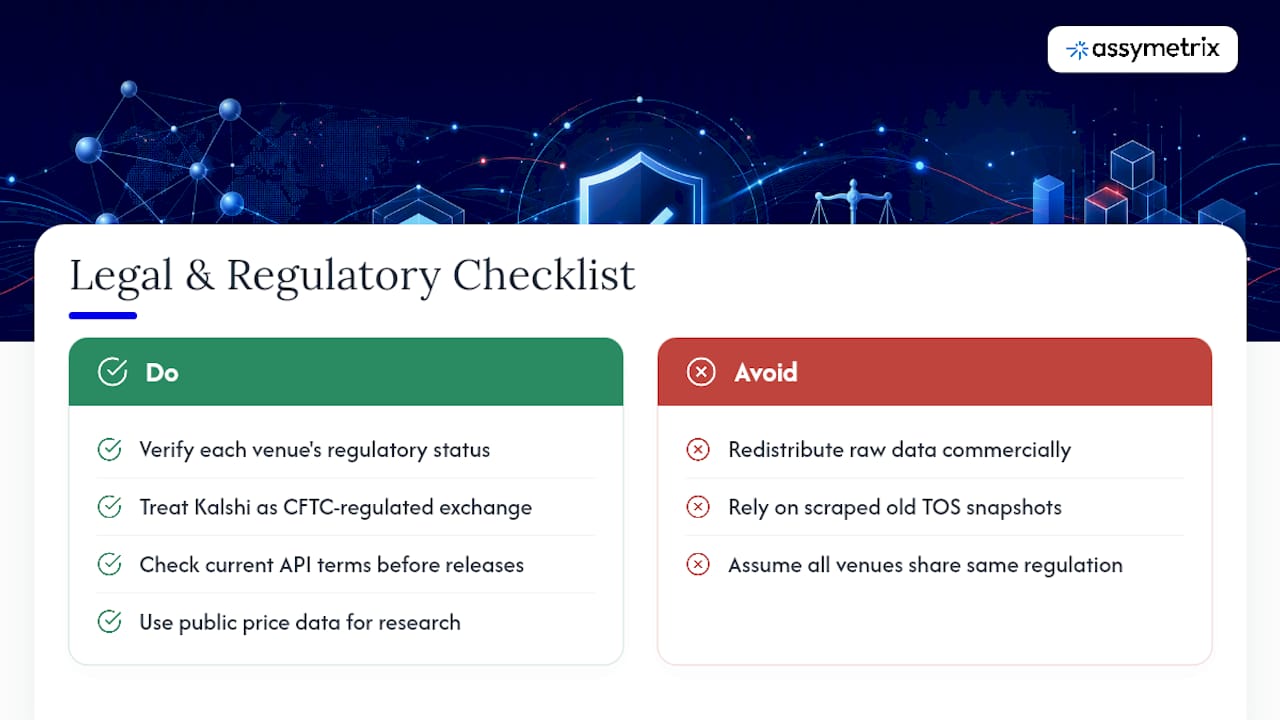
The legal picture depends heavily on which venue generated the data and where you operate. Kalshi is a CFTC-regulated designated contract market in the United States, which means its data reflects a federally overseen exchange with public contract specs and defined settlement rules. That regulatory status is part of why the Federal Reserve treats Kalshi price data as a legitimate macro forecasting input rather than a gray-market curiosity.
Polymarket and Limitless operate under different structures, and their regulatory status varies by jurisdiction and has shifted over time. Neither this article nor any general guide should be treated as a substitute for your own legal review of which venues you can access, trade on, or redistribute data from in your specific market. What’s clear across all three venues: publicly available trade and price data is generally fair to collect and analyze for research, but redistributing raw data commercially, or building trading products on top of it, often triggers separate licensing or terms-of-service obligations that vary by venue and change without much notice.
If you’re building anything commercial, don’t rely on scraped terms-of-service snapshots from a year ago. Venue terms change, enforcement priorities shift, and what was a gray area last year can become an explicit violation this year. Build a habit of checking each venue’s current API terms before every major release of a data product, not just at initial launch.
What Are the Ethical and Privacy Concerns With This Data?
On-chain venues like Polymarket expose wallet-level activity by default, which creates a genuine tension between transparency and privacy. A wallet address isn’t a legal identity, but persistent tracking of a wallet’s trading history, position sizes, and win rate can still amount to profiling an individual trader without their consent, even when no name is attached.
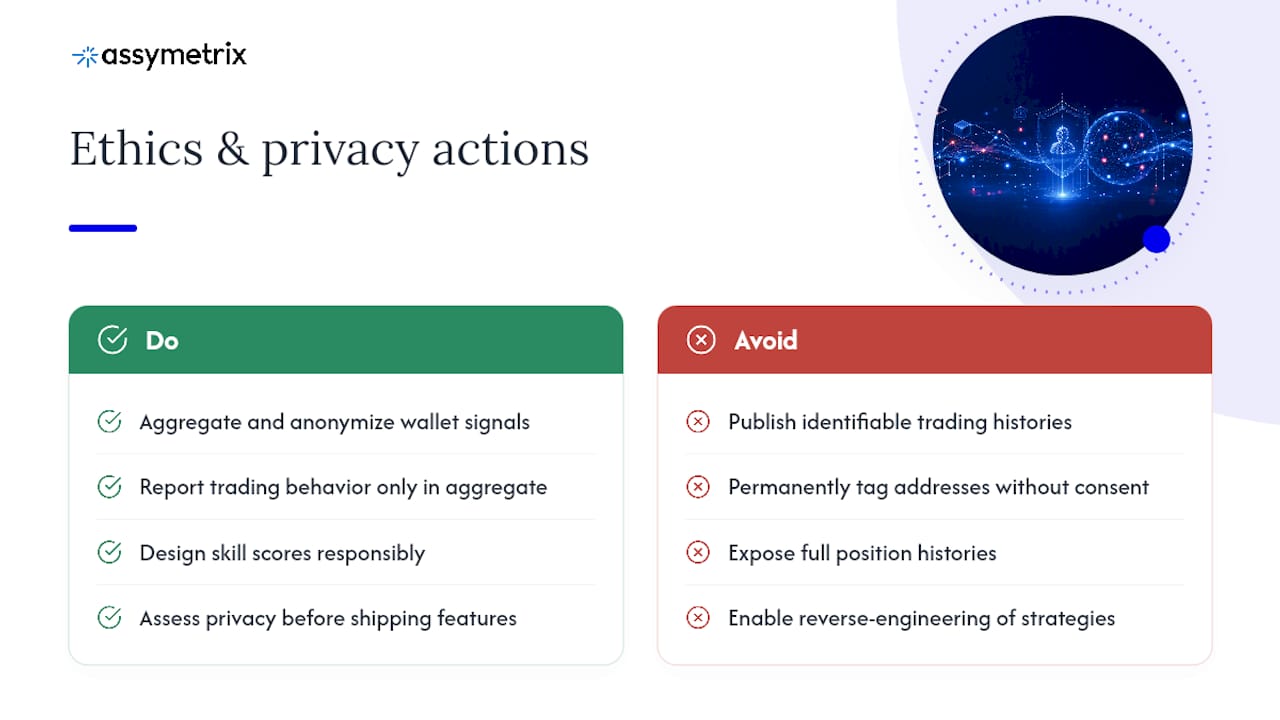
Smart Money tracking sits right in the middle of this tension. Flagging a wallet as a skilled trader is useful signal for research and for other traders deciding who to follow. It also means that address is now permanently tagged in someone’s dataset, whether or not the person behind it wants that visibility. Responsible use means aggregating and anonymizing wallet-level signals for public-facing analytics, rather than publishing identifiable trading histories that could expose an individual’s financial positions or strategy to competitors or bad actors.
Data collection itself carries a lower privacy bar than most fields, since trade and price data on public blockchains is, by design, publicly viewable. The ethical obligation shifts toward how that data gets used and packaged: skill scores and arbitrage signals built responsibly should describe trading behavior in aggregate, not expose an individual’s full position history in a way that lets someone reverse-engineer their strategy or financial exposure. Any team building trader-facing analytics products should think through that line before shipping a feature, not after a wallet owner complains.
Practitioner Checklist: Build or Buy Your Data Layer?
Before writing a line of ingest code, weigh six factors: coverage depth, years of history, latency SLA, schema stability, documentation quality, and total cost. Building in-house makes sense for a single-venue research project or an academic proof of concept with a narrow scope. Production algorithms, institutional research, and anything needing reconciled cross-venue data almost always favor a unified feed. Reinventing indexing infrastructure that already exists rarely pays for itself.
— Dean
Assymetrix: Unified Prediction Market Data Through One API
Assymetrix is the practical alternative to stitching together three separate venue integrations by hand. Instead of building and maintaining Polymarket blockchain indexers, Kalshi’s regulated API client, and a Limitless connector separately, you get one normalized schema covering all three venues through a single integration.
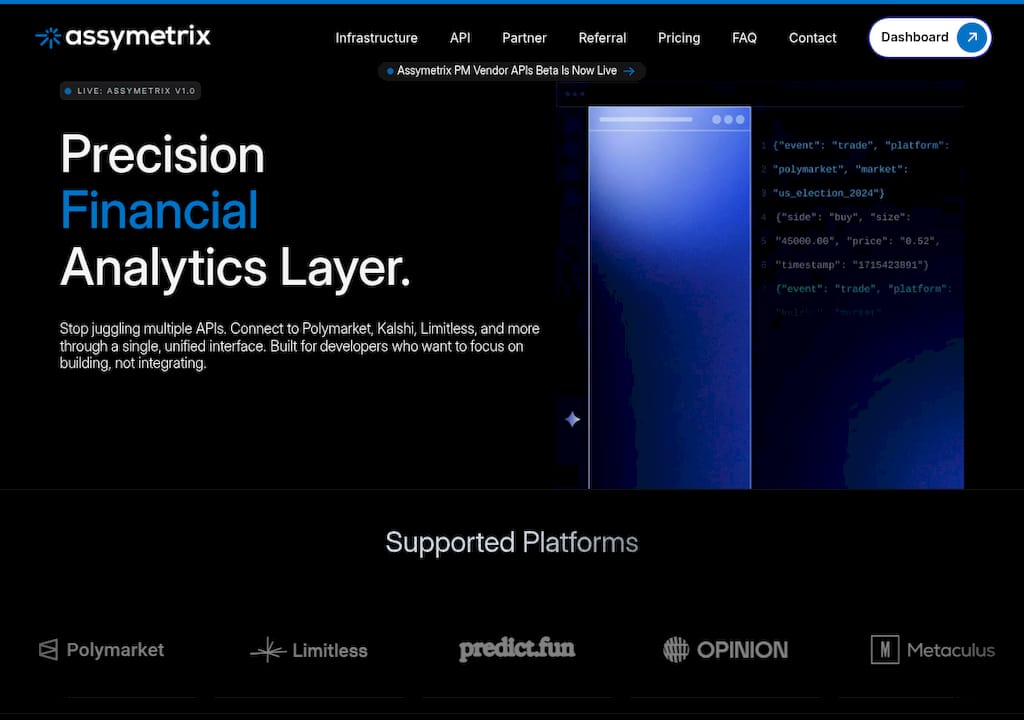
The scale behind that integration is substantial: roughly 1.5 terabytes of historical data, close to a billion rows of trading activity, and unified access spanning price snapshots, trade-level records, wallet analytics, and Smart Money signals. That means algorithmic bot builders and AI agent developers skip the months of engineering that on-chain decoding and schema reconciliation usually demand, and get straight to backtesting or live signal generation. The Assymetrix Data API documentation covers WebSocket streaming, REST endpoints, and bulk historical exports, and the Python quick-start guide has working code for pulling price snapshots and wallet histories in minutes rather than days.
If you’re evaluating cross-venue arbitrage signals or trader skill scoring for a production system, start at Assymetrix to review API docs and onboarding options for developers, quants, and institutional data consumers.
Sources
FAQ
How do you see prediction markets?
You can view individual venue prices directly on Polymarket, Kalshi, or Limitless, but seeing cross-venue prices, trade flow, and wallet activity together requires a normalized API like Assymetrix that aggregates all three into one feed.
Can you actually make money trading on prediction markets?
Some traders do, but CEPR’s analysis of Kalshi found a persistent favourite-longshot bias where cheap contracts underperform their implied odds, meaning profitability depends heavily on strategy design and which side of the trade you take.
Is the market predicted to go up or down?
Prediction market prices reflect the crowd’s current probability estimate for a specific, defined event, not a general market direction call. The Federal Reserve’s research on Kalshi treats these prices as a high-frequency signal of shifting expectations rather than a directional forecast.
Are prediction markets legal in the United States?
Kalshi operates as a CFTC-regulated designated contract market, making it legal for US residents to trade. Legal status for other venues varies by structure and jurisdiction, so verify each platform’s current regulatory standing before trading or building commercial products on its data.
Skip Months of Engineering: Prediction Market Data for Devs and Quants
Prediction market data is the record of crowd-implied probabilities and the trades behind them: continuous price snapshots that function as forecasts, plus trade-level records tied to verifiable, binary outcomes. It matters for algorithmic trading and research because those outcomes settle in cash against a known truth, not a proxy. For production systems, the practical route is a normalized data API or commercial feed rather than stitching together venue-specific integrations by hand.
TL;DR:
Different prediction markets have varying microstructures, with Polymarket requiring complex blockchain decoding and Limitless offering incomplete API coverage.
Cross-venue arbitrage and trader skill analysis depend on normalized, high-frequency data that accounts for resolution biases and metadata inconsistencies.
Building or buying a data pipeline involves evaluating coverage, latency, schema stability, and cost, with unified feeds like Assymetrix saving significant engineering effort.
On-chain venues expose wallet activity that raises privacy concerns; responsible analytics should aggregate signals without revealing individual trader strategies.
Prediction market data is most useful when integrated into a standardized schema, stored efficiently, and validated against settlement timestamps to ensure accuracy in backtesting.
Table of Contents
What Does Prediction Market Data Actually Include?
How Does Data Differ Across Polymarket, Kalshi, and Limitless?
Why Is Raw Data Hard to Collect and Normalize?
What’s the Right Integration Pattern for a Production Pipeline?
How Do Quants and AI Agents Actually Use This Data?
What Legal and Regulatory Rules Apply to This Data?
What Are the Ethical and Privacy Concerns With This Data?
Practitioner Checklist: Build or Buy Your Data Layer?
Assymetrix: Unified Prediction Market Data Through One API
Sources
What Does Prediction Market Data Actually Include?
Raw prediction market data breaks into six functional categories, and most integration bugs trace back to a team missing one of them.
Price snapshots are time-series records: market_id, outcome_id, price, and timestamp, usually sampled at fixed intervals or on every book change. Trade-level records carry trade_id, size, price, and where the venue exposes it, taker/maker identity and fees. Orderbook and quote snapshots show live depth on both sides of a binary contract, alongside open interest, which tracks how much capital is actively positioned in a market rather than just how much has traded.
Resolution outcomes and official settlement timestamps, which anchor every backtest to ground truth
Wallet activity and position snapshots, available on fully on-chain venues but not on centralized ones
Market metadata: event text, category tags, close time, and the exact resolution rule
The last item causes more silent failures than any other. A poorly worded resolution rule (what counts as “yes” in an ambiguous event) can flip a settlement in ways your model never anticipated. Kalshi trade data has shown a measurable favourite-longshot bias, where cheap contracts win less often than their price implies, according to empirical analysis published by CEPR. Any strategy built on price snapshots alone, without that context, will misjudge its own edge.
How Does Data Differ Across Polymarket, Kalshi, and Limitless?
Each venue’s market microstructure shapes what you can extract and how much engineering it costs to get there.
Polymarket runs on-chain, so every trade, wallet balance, and position change is technically public. Reconstructing usable trade flow still requires a blockchain indexer to decode contract events, map wallet addresses to market positions, and handle chain reorganizations. Nothing about “public” means “ready to query.”
Kalshi operates as a CFTC-regulated designated contract market, which means quote-driven trading with defined contract specs and, increasingly, uncapped stake sizes that change how liquidity behaves compared to earlier US markets, per the Federal Reserve’s analysis of Kalshi. Trade-side metadata (maker versus taker) is more consistently available than on decentralized venues, which is why researchers lean on it for macro forecasting work.
Limitless and comparable smaller venues tend to have partial API coverage, inconsistent metadata tagging, and resolution delays that widen the gap between “market closed” and “outcome confirmed.”
Polymarket: complete but computationally expensive to reconstruct
Kalshi: cleaner metadata, regulated structure, documented contract terms
Limitless: fastest-growing coverage gaps, least standardized schema
Pro Tip: Never assume a “resolved” flag means the settlement is final. Cross-check the settlement timestamp against the venue’s own dispute window before writing it into a backtest’s ground-truth table.
Why Is Raw Data Hard to Collect and Normalize?
Three engineering problems dominate: fragmentation, timing, and storage design.
Schema mismatches across venues. Polymarket, Kalshi, and Limitless each define
market,outcome, andresolutionfields differently, so a naive merge produces silently wrong joins rather than clean errors.On-chain decoding costs. Full-chain backfills on Polymarket require indexing months or years of contract events, which is slow and expensive without dedicated infrastructure, a gap that open-source projects like the Jon-Becker prediction market indexer partially address for developers building their own pipelines.
Timestamp alignment. Trade timestamps, price-snapshot timestamps, and resolution timestamps often arrive in different time zones or granularities, and misaligned joins corrupt backtest sequencing before you notice.
Storage choices matter just as much as collection logic. Historical data belongs in Parquet, partitioned by market_date and market_id; live snapshots fit better in a time-series or OLAP store like ClickHouse. Best practice keeps a separate, reconciled resolution table as the single source of truth for backtests, a pattern the Jon-Becker schemas follow directly.
Pro Tip: Build a reconciliation job that runs nightly against resolution feeds, not just at ingest time. Kalshi and Polymarket both occasionally amend settlements after initial resolution, and a one-time ingest will miss the correction.
What’s the Right Integration Pattern for a Production Pipeline?
A canonical schema is the first decision, and it should predate any code. Most production pipelines converge on five core tables: market, outcome, price_snapshot, trade, and wallet_position, each keyed to a stable market_id and timestamp.
Streaming versus batch depends on latency needs. WebSocket or push feeds suit live trading and arbitrage detection; REST snapshots at fixed intervals are sufficient for daily research pulls and slower backtests.
Pipeline stage | Typical tool or method | Purpose |
|---|---|---|
Stream ingest | WebSocket/Push | Capture live price and trade events |
Deduplication | Idempotent keys on trade_id | Prevent duplicate rows on reconnect |
Normalization | Canonical schema mapping | Align venue fields to one structure |
Enrichment | Tag mapping, resolved labels | Add category and outcome metadata |
Storage | Parquet (historical), ClickHouse/BigQuery (live) | Support both backtest and query workloads |
Stream raw events from each venue’s feed.
Deduplicate on trade or snapshot ID before anything touches storage.
Normalize into the canonical schema, mapping venue-specific fields to shared columns.
Enrich with resolved-outcome labels and event tags once settlement confirms.
Store historical data in Parquet and serve live queries from a columnar store.
Backtest-ready datasets need consistent snapshot cadence and a resolution flag that only flips once settlement is final, not the moment a market closes. Operational monitoring should track feed health and flag missing resolutions automatically, since a silent gap in settlement data corrupts every downstream model trained on that period. The Assymetrix data feed guide walks through this exact schema for teams building their own pipeline before deciding whether to buy one.
Pro Tip: Track a reconciliation counter, not just an error log. A count of “resolutions confirmed vs. resolutions expected” catches silent data gaps that exception handling never triggers.
How Do Quants and AI Agents Actually Use This Data?
Four use cases account for most production demand, and each needs a different data slice.
Algorithmic event-driven trading and backtesting rely on dense price snapshots paired with trade flow to model entry and exit timing around news events. Smart Money tracking builds trader skill scores from wallet-level histories, flagging accounts with consistent directional accuracy rather than lucky single bets. Cross-venue arbitrage detection compares orderbook depth and price across Polymarket and Kalshi simultaneously, weighing execution latency against the spread, since a mispriced contract that takes ninety seconds to fill against isn’t really mispriced.
Backtesting and strategy research using historical price snapshots and trade-level records
Wallet-based skill scoring to separate consistent traders from noise
Latency-aware arbitrage signals across two or more venues at once
Feature engineering for AI agents, using price time-series as covariates alongside resolution-lagged labels
Academic work backs the underlying premise: prediction markets frequently outperform moderate forecasting benchmarks by aggregating dispersed information into a single tradable price. For AI agents specifically, that price series works as a high-frequency, event-labeled covariate. Modern multivariate forecasting approaches like TimesFM-3 are built to consume exactly this kind of covariate structure alongside other time-series inputs. External research on AI systems forecasting economic trends reinforces the same pattern: dense, verifiable, high-frequency data outperforms sparse survey-based inputs for near-term prediction.
What Legal and Regulatory Rules Apply to This Data?
The legal picture depends heavily on which venue generated the data and where you operate. Kalshi is a CFTC-regulated designated contract market in the United States, which means its data reflects a federally overseen exchange with public contract specs and defined settlement rules. That regulatory status is part of why the Federal Reserve treats Kalshi price data as a legitimate macro forecasting input rather than a gray-market curiosity.
Polymarket and Limitless operate under different structures, and their regulatory status varies by jurisdiction and has shifted over time. Neither this article nor any general guide should be treated as a substitute for your own legal review of which venues you can access, trade on, or redistribute data from in your specific market. What’s clear across all three venues: publicly available trade and price data is generally fair to collect and analyze for research, but redistributing raw data commercially, or building trading products on top of it, often triggers separate licensing or terms-of-service obligations that vary by venue and change without much notice.
If you’re building anything commercial, don’t rely on scraped terms-of-service snapshots from a year ago. Venue terms change, enforcement priorities shift, and what was a gray area last year can become an explicit violation this year. Build a habit of checking each venue’s current API terms before every major release of a data product, not just at initial launch.
What Are the Ethical and Privacy Concerns With This Data?
On-chain venues like Polymarket expose wallet-level activity by default, which creates a genuine tension between transparency and privacy. A wallet address isn’t a legal identity, but persistent tracking of a wallet’s trading history, position sizes, and win rate can still amount to profiling an individual trader without their consent, even when no name is attached.
Smart Money tracking sits right in the middle of this tension. Flagging a wallet as a skilled trader is useful signal for research and for other traders deciding who to follow. It also means that address is now permanently tagged in someone’s dataset, whether or not the person behind it wants that visibility. Responsible use means aggregating and anonymizing wallet-level signals for public-facing analytics, rather than publishing identifiable trading histories that could expose an individual’s financial positions or strategy to competitors or bad actors.
Data collection itself carries a lower privacy bar than most fields, since trade and price data on public blockchains is, by design, publicly viewable. The ethical obligation shifts toward how that data gets used and packaged: skill scores and arbitrage signals built responsibly should describe trading behavior in aggregate, not expose an individual’s full position history in a way that lets someone reverse-engineer their strategy or financial exposure. Any team building trader-facing analytics products should think through that line before shipping a feature, not after a wallet owner complains.
Practitioner Checklist: Build or Buy Your Data Layer?
Before writing a line of ingest code, weigh six factors: coverage depth, years of history, latency SLA, schema stability, documentation quality, and total cost. Building in-house makes sense for a single-venue research project or an academic proof of concept with a narrow scope. Production algorithms, institutional research, and anything needing reconciled cross-venue data almost always favor a unified feed. Reinventing indexing infrastructure that already exists rarely pays for itself.
— Dean
Assymetrix: Unified Prediction Market Data Through One API
Assymetrix is the practical alternative to stitching together three separate venue integrations by hand. Instead of building and maintaining Polymarket blockchain indexers, Kalshi’s regulated API client, and a Limitless connector separately, you get one normalized schema covering all three venues through a single integration.
The scale behind that integration is substantial: roughly 1.5 terabytes of historical data, close to a billion rows of trading activity, and unified access spanning price snapshots, trade-level records, wallet analytics, and Smart Money signals. That means algorithmic bot builders and AI agent developers skip the months of engineering that on-chain decoding and schema reconciliation usually demand, and get straight to backtesting or live signal generation. The Assymetrix Data API documentation covers WebSocket streaming, REST endpoints, and bulk historical exports, and the Python quick-start guide has working code for pulling price snapshots and wallet histories in minutes rather than days.
If you’re evaluating cross-venue arbitrage signals or trader skill scoring for a production system, start at Assymetrix to review API docs and onboarding options for developers, quants, and institutional data consumers.
Sources
FAQ
How do you see prediction markets?
You can view individual venue prices directly on Polymarket, Kalshi, or Limitless, but seeing cross-venue prices, trade flow, and wallet activity together requires a normalized API like Assymetrix that aggregates all three into one feed.
Can you actually make money trading on prediction markets?
Some traders do, but CEPR’s analysis of Kalshi found a persistent favourite-longshot bias where cheap contracts underperform their implied odds, meaning profitability depends heavily on strategy design and which side of the trade you take.
Is the market predicted to go up or down?
Prediction market prices reflect the crowd’s current probability estimate for a specific, defined event, not a general market direction call. The Federal Reserve’s research on Kalshi treats these prices as a high-frequency signal of shifting expectations rather than a directional forecast.
Are prediction markets legal in the United States?
Kalshi operates as a CFTC-regulated designated contract market, making it legal for US residents to trade. Legal status for other venues varies by structure and jurisdiction, so verify each platform’s current regulatory standing before trading or building commercial products on its data.
Other Blog


