Prediction Market Data Feed: Real-Time and Historical API Guide
Prediction Market Data Feed: Real-Time and Historical API Guide
Prediction Market Data Feed: Real-Time and Historical API Guide
Unlock insights with the Prediction Market Data Feed. Real Time and Historical API Guide. Get live prices, historical data, and more!

Prediction Market Data Feed: Real-Time and Historical API Guide
A prediction market data feed API is a unified interface that delivers streaming and historical trading data from venues like Polymarket, Kalshi, and Limitless through a single integration point. For developers and quants, it is the foundation of every serious trading system, backtesting engine, and AI agent built on event-driven markets. Without it, you are writing custom connectors to three different schemas, managing three authentication flows, and reconciling three conflicting data formats every time a venue updates its API.
The core data types a production-grade feed delivers:
Live prices and implied probabilities updated tick-by-tick
Order book snapshots and L2 delta streams for depth and liquidity analysis
OHLCV candles at configurable intervals for charting and signal generation
Volume and trade prints with counterparty wallet identifiers
Market lifecycle events including creation, resolution, and settlement metadata
Wallet activity and Smart Money signals for tracking informed position changes
Historical resolution data with full odds paths back to market open
The fragmentation problem is real. Polymarket runs on a CLOB model with on-chain settlement; Kalshi operates as a regulated US exchange with its own REST and WebSocket endpoints; Limitless adds a third schema. A unified cross-venue feed normalizes all three into a canonical JSON structure, eliminating the maintenance burden that otherwise compounds every time you add a new venue or strategy.
Table of Contents
How to access and integrate real-time and historical prediction market data APIs
Why a unified cross-venue API outperforms connecting to each venue separately
Use cases: trading bots, backtesting engines, and AI agents
Assymetrix: technical overview of the unified prediction market data API
Data licensing and usage rights for prediction market APIs
Costs and pricing models for accessing prediction market data feeds
Assymetrix gives you the full data layer in one integration
Key Takeaways
How to access and integrate real-time and historical prediction market data APIs
The architectural choice between WebSocket and REST is not a preference. It is a function of what your system needs to do.
WebSocket feeds push data to your client the moment state changes. For live trading bots and real-time monitoring, this is the only viable path. Polling a REST endpoint introduces artificial latency that compounds across hundreds of markets. Sub-second real-time feeds via WebSocket are the standard for production trading infrastructure.
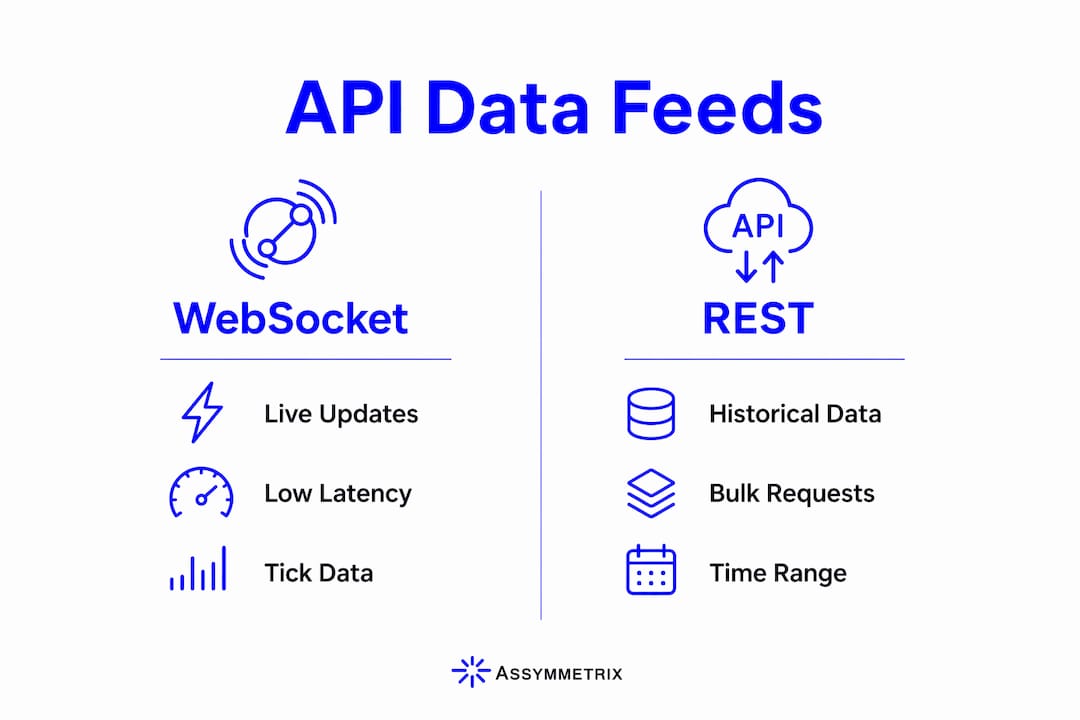
REST APIs serve historical retrieval. You define a time range, request bulk trade prints or OHLCV candles, and receive structured JSON or Parquet-compatible payloads. For backtesting, this is where your data pipeline starts.
A minimal WebSocket connection to a normalized prediction market feed looks like this:
import websocket, json

def on_message(ws, message):
    tick = json.loads(message)
    # tick: {"market_id": "...", "venue": "kalshi", "price": 0.63,
    #        "side": "yes", "timestamp": "2026-03-14T12:00:00.123Z"}
    process_tick(tick)

ws = websocket.WebSocketApp(
    "wss://data.assymetrix.com/v1/stream",
    header={"Authorization": "Bearer YOUR_API_KEY"},
    on_message=on_message
)
ws.run_forever()
import websocket, json

def on_message(ws, message):
    tick = json.loads(message)
    # tick: {"market_id": "...", "venue": "kalshi", "price": 0.63,
    #        "side": "yes", "timestamp": "2026-03-14T12:00:00.123Z"}
    process_tick(tick)

ws = websocket.WebSocketApp(
    "wss://data.assymetrix.com/v1/stream",
    header={"Authorization": "Bearer YOUR_API_KEY"},
    on_message=on_message
)
ws.run_forever()
For historical pulls via REST:
import requests

resp = requests.get(
    "https://data.assymetrix.com/v1/markets/history",
    params={"market_id": "kalshi-fed-rate-jun26", "from": "2026-01-01", "to": "2026-03-01"},
    headers={"Authorization": "Bearer YOUR_API_KEY"}
)
trades = resp.json()["trades"]
import requests

resp = requests.get(
    "https://data.assymetrix.com/v1/markets/history",
    params={"market_id": "kalshi-fed-rate-jun26", "from": "2026-01-01", "to": "2026-03-01"},
    headers={"Authorization": "Bearer YOUR_API_KEY"}
)
trades = resp.json()["trades"]
The normalized schema across both modes is identical, which means your signal logic runs without modification whether you are replaying history or trading live.
Integration best practices that matter in production:
Implement exponential backoff on WebSocket reconnects with jitter to avoid thundering-herd reconnection storms
Cache your authentication token and refresh it proactively before expiry
Use a dead-letter queue for missed ticks during reconnection windows
Validate
market_idandvenuefields on every message before routingSet explicit timeout thresholds on REST calls and log 429 responses with retry-after headers
Integration Mode | Latency Profile | Primary Use Case | Data Format |
|---|---|---|---|
WebSocket stream | Sub-second | Live bots, real-time monitoring | JSON tick stream |
REST historical | Batch | Backtesting, research pipelines | JSON / Parquet |
REST snapshot | Near-real-time | Dashboard polling, periodic checks | JSON |
Rate limit handling and error retry logic are not optional in production. A feed that silently drops ticks during a high-volume event is worse than no feed at all.
Why a unified cross-venue API outperforms connecting to each venue separately
Connecting to Polymarket, Kalshi, and Limitless individually means maintaining three authentication systems, three WebSocket protocols, three event schemas, and three sets of documentation that change without coordinated notice. The maintenance burden compounds every time any one venue pushes an API update.
A unified API resolves this by normalizing all venue data into a single canonical schema at ingestion. The architecture looks like this:
Polymarket CLOB API  ─┐
Kalshi REST/WS API   ─┼──► Normalization Layer ──► Canonical Schema ──► Your App
Limitless API        ─┘         (venue-specific        (market_id,
                                 adapters)              venue, price,
                                                        side, timestamp,
                                                        wallet_id, ...)
Polymarket CLOB API  ─┐
Kalshi REST/WS API   ─┼──► Normalization Layer ──► Canonical Schema ──► Your App
Limitless API        ─┘         (venue-specific        (market_id,
                                 adapters)              venue, price,
                                                        side, timestamp,
                                                        wallet_id, ...)
The normalization layer handles field mapping, timestamp standardization to UTC, price conversion to implied probability (0.00–1.00), and market lifecycle state alignment. Your application code sees one schema regardless of origin venue.
Field | Polymarket Raw | Kalshi Raw | Normalized (Canonical) |
|---|---|---|---|
Market identifier |
|
|
|
Price |
|
|
|
Timestamp | Unix ms | ISO date format | ISO date format UTC |
Outcome |
|
|
|
Venue tag | absent | absent |
|
Cross-venue arbitrage signals become detectable only when data is normalized this way. A 4-cent spread between Kalshi and Polymarket on the same underlying event is invisible if you are comparing raw schemas. Normalized, it surfaces as a structured signal your bot can act on.
Architectural advantages of the unified approach:
One API key, one authentication flow, one SDK to maintain
Consistent field names and types eliminate per-venue parsing bugs
Cross-venue market correlation and divergence become computable
Venue outages degrade gracefully rather than breaking your entire pipeline
Historical and real-time data share the same schema, so backtest code runs in production unchanged
Use cases: trading bots, backtesting engines, and AI agents
Live algorithmic trading on prediction markets requires L2 order book delta streams, not reconstructed snapshots. Raw delta tape data captures the precise sequence of add, cancel, and fill events that determine execution quality. Reconstructed snapshots lose this sequencing, making accurate fill simulation impossible. For a bot placing orders on Kalshi or Polymarket, the difference between a delta stream and a snapshot feed is the difference between a realistic backtest and a misleading one.
Quantitative backtesting depends on tick-level historical data. REST APIs that return only OHLCV candles at 15-minute intervals cannot reconstruct intrabar order execution. The Jon-Becker/prediction-market-analysis framework demonstrates this concretely: it collects trade history via API and blockchain indexers, stores data in Parquet format, and runs analysis scripts that require full trade-level granularity to produce accurate figures. Candle-only data would break every analysis that depends on intrabar price paths.
Raw L2 order-book delta streams provide the critical timing and liquidity information essential for quant trader arbitrage strategies. Delta tape data cannot be backfilled and must be captured live for accurate trading models. For backtesting, tick-level historical archives are the only substitute.
AI agents consuming prediction market data have a different requirement profile. They need structured market lifecycle context: when a market opened, how odds evolved over its lifetime, which wallets accumulated positions before a price move, and what the resolution outcome was. Raw price ticks alone are insufficient. Wallet analytics and Smart Money signals embedded in the data schema let an agent distinguish informed accumulation from noise, which is the signal that drives useful agent behavior.
Typical data consumers by use case:
Arbitrage bots: cross-venue normalized feeds with sub-second latency and delta order book streams
Trend-following bots: OHLCV candles plus volume-weighted price history
Backtesting engines: full tick-level historical archives with resolution metadata
AI agents: structured lifecycle events, wallet analytics, and Smart Money divergence signals
Quant researchers: bulk historical exports in Parquet or SQLite for pandas, DuckDB, or Polars workflows
Risk monitors: real-time position and liquidity snapshots across venues
Pro Tip: For prop trading evaluation, raw tick data from WebSocket streams is the only way to reconstruct your actual execution sequence. Snapshot-based data will make your strategy look better than it performed.
Assymetrix: technical overview of the unified prediction market data API
Assymetrix aggregates Polymarket, Kalshi, and Limitless into a single normalized intelligence layer built on approximately 1.5 terabytes of historical data spanning nearly one billion rows of trading activity. That archive is accessible via REST for bulk historical pulls and via WebSocket for live streaming, with the same canonical schema across both modes.
1.5 TB / ~1 billion rows of cross-venue prediction market trading data, normalized into a single schema and accessible through one API key.
The canonical schema includes fields that individual venue APIs do not expose: wallet_id for Smart Money tracking, skill_score for trader quality signals, and arbitrage_flag for cross-venue divergence detection. These fields are computed at ingestion and embedded directly in the normalized record.
Feature | Description |
|---|---|
Smart Money tracking | Wallet-level position monitoring with skill-score weighting |
Trader Skill Scores | Quantitative ranking of wallets by historical prediction accuracy |
Arbitrage signals | Cross-venue price divergence flags computed in real time |
Market divergence | Alerts when venue consensus splits on the same underlying event |
Bulk export | Parquet and JSON exports for offline research pipelines |
Key technical differentiators:
Single API key covers Polymarket, Kalshi, and Limitless simultaneously
Normalized schema eliminates per-venue parsing and field-mapping code
Smart Money and skill-score signals are embedded in the data layer, not a separate call
Historical archive supports full strategy backtesting with resolution outcomes included
WebSocket and REST share identical schemas for seamless research-to-production deployment
Pro Tip: When evaluating any prediction market data provider for latency-sensitive strategies, request a sample of their raw WebSocket message log and verify that order book deltas, not just snapshots, are present. Snapshot-only feeds will understate slippage in your backtest by a meaningful margin.
The institutional infrastructure required to aggregate, normalize, and serve this data at scale is what separates a production-grade feed from a hobbyist scraper. Assymetrix is built on that infrastructure.

Data licensing and usage rights for prediction market APIs
Licensing terms vary significantly across the prediction market data ecosystem and determine what you can legally do with the data you receive.
Most venue-native APIs grant access under terms that permit personal and commercial use within the platform’s ecosystem but restrict redistribution or resale of raw data. Kalshi’s API terms, for example, govern access to its market data but do not grant rights to sublicense that data to third parties. Polymarket’s public data, including its CLOB order book, is accessible but subject to its terms of service regarding commercial redistribution.
Aggregated and normalized data products occupy a different licensing category. When a provider like Assymetrix ingests, normalizes, and enriches raw venue data, the resulting dataset is a derivative work. Licensing for such products typically distinguishes between non-commercial research use, commercial internal use (trading systems, proprietary research), and redistribution rights (building data products for resale).
For quant researchers and academic institutions, non-commercial tiers are common and often provide access to historical archives at reduced or no cost. Commercial licenses for production trading systems carry different terms and pricing. Always verify whether your intended use, particularly bulk export, redistribution, or embedding data in a product you sell, falls within the license tier you are purchasing.
Costs and pricing models for accessing prediction market data feeds
Prediction market data pricing follows a few distinct models depending on the provider and data type.
Free public data exists at the venue level. Kalshi publishes market metadata and price snapshots through its public API. The manja316/polymarket-historical-data dataset offers a large number of price snapshots at regular intervals in SQLite format, with a full dataset available for a low one-time fee and a subscription tier for ongoing weekly updates. These are useful for exploratory research but lack the tick-level granularity and cross-venue normalization that production systems require.
Subscription SaaS tiers are the standard model for professional-grade feeds. Providers typically offer a free tier with rate-limited access, a developer tier with higher throughput and historical depth, and an institutional tier with full archive access, bulk export, and commercial licensing. Assymetrix operates on this model, with tiers covering free access through commercial and institutional plans at data.assymetrix.com.
Usage-based pricing appears in some API marketplaces, where you pay per API call or per gigabyte of historical data transferred. This model works for low-volume research but becomes expensive at production query volumes.
The real cost comparison is not just the subscription fee. Factor in engineering time to build and maintain custom connectors to each venue, data cleaning and normalization overhead, and the opportunity cost of delayed or missing data during venue API outages. A unified feed that eliminates those costs often has a lower total cost than three separate free-tier venue connections.
Assymetrix gives you the full data layer in one integration
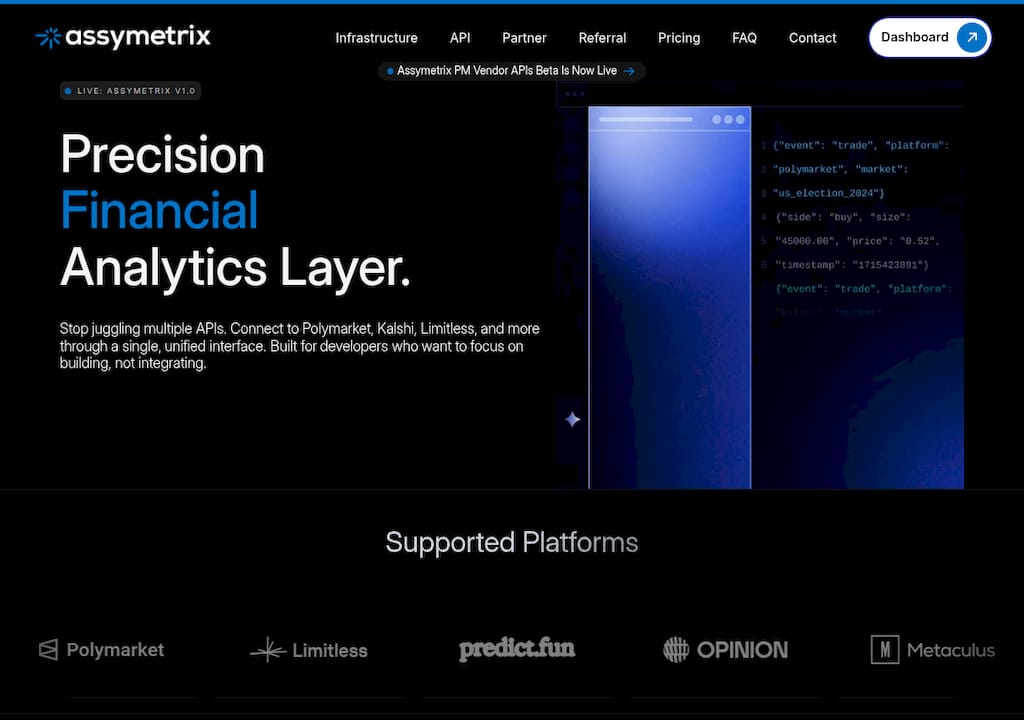
Building on three separate venue APIs means three times the integration work, three times the schema maintenance, and three times the failure surface. Assymetrix collapses that into a single connection at data.assymetrix.com, delivering normalized real-time and historical data from Polymarket, Kalshi, and Limitless through one authenticated endpoint.
The platform is built for the readers of this guide: developers wiring up trading bots, quants running backtests against nearly one billion rows of historical trade data, and AI agent builders who need structured wallet analytics and Smart Money signals in the data layer itself. The 2026 prediction market accuracy guide on the Assymetrix platform gives you the empirical foundation for evaluating signal quality before you commit to a data source.
Start with the free tier at data.assymetrix.com and run your first cross-venue query against live data today.
Key Takeaways
A unified, normalized prediction market data feed API is the only practical foundation for production trading systems, backtesting engines, and AI agents operating across Polymarket, Kalshi, and Limitless simultaneously.
Point | Details |
|---|---|
WebSocket vs. REST | WebSocket feeds serve live bots; REST endpoints serve historical backtesting. Both should share the same normalized schema. |
Normalization is the core problem | Raw venue schemas differ in field names, price formats, and timestamp conventions. A canonical schema eliminates per-venue parsing code. |
Tick-level data is non-negotiable | OHLCV candles cannot reconstruct intrabar execution. Accurate backtesting requires full trade-level historical archives. |
Licensing determines what you can build | Commercial use, redistribution, and bulk export each require different license tiers. Verify before you build. |
Assymetrix unified API | Covers Polymarket, Kalshi, and Limitless through one integration, with ~1 billion rows of historical data and embedded Smart Money signals. |
FAQ
What does a prediction market data feed API include?
A prediction market data feed API delivers live prices, order book depth, volume, trade prints, wallet activity, market lifecycle events, and historical resolution data. Production-grade feeds normalize this data across multiple venues into a single schema.
What is the difference between WebSocket and REST for prediction market data?
WebSocket streams push tick-by-tick updates for live trading and monitoring; REST endpoints serve bulk historical data for backtesting and research. The two modes are complementary, not interchangeable.
Why use a unified cross-venue API instead of connecting to each venue directly?
Connecting to Polymarket, Kalshi, and Limitless individually requires maintaining three separate schemas, authentication systems, and error-handling pipelines. A unified API normalizes all three into one canonical format, enabling cross-venue arbitrage detection and reducing maintenance overhead significantly.
How does Assymetrix handle cross-venue data normalization?
Assymetrix ingests data from Polymarket, Kalshi, and Limitless through venue-specific adapters, normalizes field names, timestamps, and price formats into a canonical JSON schema, and embeds computed signals like Smart Money flags and Trader Skill Scores directly in each record.
What historical data depth is available for backtesting prediction market strategies?
Assymetrix provides approximately 1.5 terabytes of historical data covering nearly one billion rows of trading activity across venues, accessible via REST for bulk export in JSON or Parquet format.
Prediction Market Data Feed: Real-Time and Historical API Guide
A prediction market data feed API is a unified interface that delivers streaming and historical trading data from venues like Polymarket, Kalshi, and Limitless through a single integration point. For developers and quants, it is the foundation of every serious trading system, backtesting engine, and AI agent built on event-driven markets. Without it, you are writing custom connectors to three different schemas, managing three authentication flows, and reconciling three conflicting data formats every time a venue updates its API.
The core data types a production-grade feed delivers:
Live prices and implied probabilities updated tick-by-tick
Order book snapshots and L2 delta streams for depth and liquidity analysis
OHLCV candles at configurable intervals for charting and signal generation
Volume and trade prints with counterparty wallet identifiers
Market lifecycle events including creation, resolution, and settlement metadata
Wallet activity and Smart Money signals for tracking informed position changes
Historical resolution data with full odds paths back to market open
The fragmentation problem is real. Polymarket runs on a CLOB model with on-chain settlement; Kalshi operates as a regulated US exchange with its own REST and WebSocket endpoints; Limitless adds a third schema. A unified cross-venue feed normalizes all three into a canonical JSON structure, eliminating the maintenance burden that otherwise compounds every time you add a new venue or strategy.
Table of Contents
How to access and integrate real-time and historical prediction market data APIs
Why a unified cross-venue API outperforms connecting to each venue separately
Use cases: trading bots, backtesting engines, and AI agents
Assymetrix: technical overview of the unified prediction market data API
Data licensing and usage rights for prediction market APIs
Costs and pricing models for accessing prediction market data feeds
Assymetrix gives you the full data layer in one integration
Key Takeaways
How to access and integrate real-time and historical prediction market data APIs
The architectural choice between WebSocket and REST is not a preference. It is a function of what your system needs to do.
WebSocket feeds push data to your client the moment state changes. For live trading bots and real-time monitoring, this is the only viable path. Polling a REST endpoint introduces artificial latency that compounds across hundreds of markets. Sub-second real-time feeds via WebSocket are the standard for production trading infrastructure.
REST APIs serve historical retrieval. You define a time range, request bulk trade prints or OHLCV candles, and receive structured JSON or Parquet-compatible payloads. For backtesting, this is where your data pipeline starts.
A minimal WebSocket connection to a normalized prediction market feed looks like this:
import websocket, json

def on_message(ws, message):
    tick = json.loads(message)
    # tick: {"market_id": "...", "venue": "kalshi", "price": 0.63,
    #        "side": "yes", "timestamp": "2026-03-14T12:00:00.123Z"}
    process_tick(tick)

ws = websocket.WebSocketApp(
    "wss://data.assymetrix.com/v1/stream",
    header={"Authorization": "Bearer YOUR_API_KEY"},
    on_message=on_message
)
ws.run_forever()
For historical pulls via REST:
import requests

resp = requests.get(
    "https://data.assymetrix.com/v1/markets/history",
    params={"market_id": "kalshi-fed-rate-jun26", "from": "2026-01-01", "to": "2026-03-01"},
    headers={"Authorization": "Bearer YOUR_API_KEY"}
)
trades = resp.json()["trades"]
The normalized schema across both modes is identical, which means your signal logic runs without modification whether you are replaying history or trading live.
Integration best practices that matter in production:
Implement exponential backoff on WebSocket reconnects with jitter to avoid thundering-herd reconnection storms
Cache your authentication token and refresh it proactively before expiry
Use a dead-letter queue for missed ticks during reconnection windows
Validate
market_idandvenuefields on every message before routingSet explicit timeout thresholds on REST calls and log 429 responses with retry-after headers
Integration Mode | Latency Profile | Primary Use Case | Data Format |
|---|---|---|---|
WebSocket stream | Sub-second | Live bots, real-time monitoring | JSON tick stream |
REST historical | Batch | Backtesting, research pipelines | JSON / Parquet |
REST snapshot | Near-real-time | Dashboard polling, periodic checks | JSON |
Rate limit handling and error retry logic are not optional in production. A feed that silently drops ticks during a high-volume event is worse than no feed at all.
Why a unified cross-venue API outperforms connecting to each venue separately
Connecting to Polymarket, Kalshi, and Limitless individually means maintaining three authentication systems, three WebSocket protocols, three event schemas, and three sets of documentation that change without coordinated notice. The maintenance burden compounds every time any one venue pushes an API update.
A unified API resolves this by normalizing all venue data into a single canonical schema at ingestion. The architecture looks like this:
Polymarket CLOB API  ─┐
Kalshi REST/WS API   ─┼──► Normalization Layer ──► Canonical Schema ──► Your App
Limitless API        ─┘         (venue-specific        (market_id,
                                 adapters)              venue, price,
                                                        side, timestamp,
                                                        wallet_id, ...)
The normalization layer handles field mapping, timestamp standardization to UTC, price conversion to implied probability (0.00–1.00), and market lifecycle state alignment. Your application code sees one schema regardless of origin venue.
Field | Polymarket Raw | Kalshi Raw | Normalized (Canonical) |
|---|---|---|---|
Market identifier |
|
|
|
Price |
|
|
|
Timestamp | Unix ms | ISO date format | ISO date format UTC |
Outcome |
|
|
|
Venue tag | absent | absent |
|
Cross-venue arbitrage signals become detectable only when data is normalized this way. A 4-cent spread between Kalshi and Polymarket on the same underlying event is invisible if you are comparing raw schemas. Normalized, it surfaces as a structured signal your bot can act on.
Architectural advantages of the unified approach:
One API key, one authentication flow, one SDK to maintain
Consistent field names and types eliminate per-venue parsing bugs
Cross-venue market correlation and divergence become computable
Venue outages degrade gracefully rather than breaking your entire pipeline
Historical and real-time data share the same schema, so backtest code runs in production unchanged
Use cases: trading bots, backtesting engines, and AI agents
Live algorithmic trading on prediction markets requires L2 order book delta streams, not reconstructed snapshots. Raw delta tape data captures the precise sequence of add, cancel, and fill events that determine execution quality. Reconstructed snapshots lose this sequencing, making accurate fill simulation impossible. For a bot placing orders on Kalshi or Polymarket, the difference between a delta stream and a snapshot feed is the difference between a realistic backtest and a misleading one.
Quantitative backtesting depends on tick-level historical data. REST APIs that return only OHLCV candles at 15-minute intervals cannot reconstruct intrabar order execution. The Jon-Becker/prediction-market-analysis framework demonstrates this concretely: it collects trade history via API and blockchain indexers, stores data in Parquet format, and runs analysis scripts that require full trade-level granularity to produce accurate figures. Candle-only data would break every analysis that depends on intrabar price paths.
Raw L2 order-book delta streams provide the critical timing and liquidity information essential for quant trader arbitrage strategies. Delta tape data cannot be backfilled and must be captured live for accurate trading models. For backtesting, tick-level historical archives are the only substitute.
AI agents consuming prediction market data have a different requirement profile. They need structured market lifecycle context: when a market opened, how odds evolved over its lifetime, which wallets accumulated positions before a price move, and what the resolution outcome was. Raw price ticks alone are insufficient. Wallet analytics and Smart Money signals embedded in the data schema let an agent distinguish informed accumulation from noise, which is the signal that drives useful agent behavior.
Typical data consumers by use case:
Arbitrage bots: cross-venue normalized feeds with sub-second latency and delta order book streams
Trend-following bots: OHLCV candles plus volume-weighted price history
Backtesting engines: full tick-level historical archives with resolution metadata
AI agents: structured lifecycle events, wallet analytics, and Smart Money divergence signals
Quant researchers: bulk historical exports in Parquet or SQLite for pandas, DuckDB, or Polars workflows
Risk monitors: real-time position and liquidity snapshots across venues
Pro Tip: For prop trading evaluation, raw tick data from WebSocket streams is the only way to reconstruct your actual execution sequence. Snapshot-based data will make your strategy look better than it performed.
Assymetrix: technical overview of the unified prediction market data API
Assymetrix aggregates Polymarket, Kalshi, and Limitless into a single normalized intelligence layer built on approximately 1.5 terabytes of historical data spanning nearly one billion rows of trading activity. That archive is accessible via REST for bulk historical pulls and via WebSocket for live streaming, with the same canonical schema across both modes.
1.5 TB / ~1 billion rows of cross-venue prediction market trading data, normalized into a single schema and accessible through one API key.
The canonical schema includes fields that individual venue APIs do not expose: wallet_id for Smart Money tracking, skill_score for trader quality signals, and arbitrage_flag for cross-venue divergence detection. These fields are computed at ingestion and embedded directly in the normalized record.
Feature | Description |
|---|---|
Smart Money tracking | Wallet-level position monitoring with skill-score weighting |
Trader Skill Scores | Quantitative ranking of wallets by historical prediction accuracy |
Arbitrage signals | Cross-venue price divergence flags computed in real time |
Market divergence | Alerts when venue consensus splits on the same underlying event |
Bulk export | Parquet and JSON exports for offline research pipelines |
Key technical differentiators:
Single API key covers Polymarket, Kalshi, and Limitless simultaneously
Normalized schema eliminates per-venue parsing and field-mapping code
Smart Money and skill-score signals are embedded in the data layer, not a separate call
Historical archive supports full strategy backtesting with resolution outcomes included
WebSocket and REST share identical schemas for seamless research-to-production deployment
Pro Tip: When evaluating any prediction market data provider for latency-sensitive strategies, request a sample of their raw WebSocket message log and verify that order book deltas, not just snapshots, are present. Snapshot-only feeds will understate slippage in your backtest by a meaningful margin.
The institutional infrastructure required to aggregate, normalize, and serve this data at scale is what separates a production-grade feed from a hobbyist scraper. Assymetrix is built on that infrastructure.
Data licensing and usage rights for prediction market APIs
Licensing terms vary significantly across the prediction market data ecosystem and determine what you can legally do with the data you receive.
Most venue-native APIs grant access under terms that permit personal and commercial use within the platform’s ecosystem but restrict redistribution or resale of raw data. Kalshi’s API terms, for example, govern access to its market data but do not grant rights to sublicense that data to third parties. Polymarket’s public data, including its CLOB order book, is accessible but subject to its terms of service regarding commercial redistribution.
Aggregated and normalized data products occupy a different licensing category. When a provider like Assymetrix ingests, normalizes, and enriches raw venue data, the resulting dataset is a derivative work. Licensing for such products typically distinguishes between non-commercial research use, commercial internal use (trading systems, proprietary research), and redistribution rights (building data products for resale).
For quant researchers and academic institutions, non-commercial tiers are common and often provide access to historical archives at reduced or no cost. Commercial licenses for production trading systems carry different terms and pricing. Always verify whether your intended use, particularly bulk export, redistribution, or embedding data in a product you sell, falls within the license tier you are purchasing.
Costs and pricing models for accessing prediction market data feeds
Prediction market data pricing follows a few distinct models depending on the provider and data type.
Free public data exists at the venue level. Kalshi publishes market metadata and price snapshots through its public API. The manja316/polymarket-historical-data dataset offers a large number of price snapshots at regular intervals in SQLite format, with a full dataset available for a low one-time fee and a subscription tier for ongoing weekly updates. These are useful for exploratory research but lack the tick-level granularity and cross-venue normalization that production systems require.
Subscription SaaS tiers are the standard model for professional-grade feeds. Providers typically offer a free tier with rate-limited access, a developer tier with higher throughput and historical depth, and an institutional tier with full archive access, bulk export, and commercial licensing. Assymetrix operates on this model, with tiers covering free access through commercial and institutional plans at data.assymetrix.com.
Usage-based pricing appears in some API marketplaces, where you pay per API call or per gigabyte of historical data transferred. This model works for low-volume research but becomes expensive at production query volumes.
The real cost comparison is not just the subscription fee. Factor in engineering time to build and maintain custom connectors to each venue, data cleaning and normalization overhead, and the opportunity cost of delayed or missing data during venue API outages. A unified feed that eliminates those costs often has a lower total cost than three separate free-tier venue connections.
Assymetrix gives you the full data layer in one integration
Building on three separate venue APIs means three times the integration work, three times the schema maintenance, and three times the failure surface. Assymetrix collapses that into a single connection at data.assymetrix.com, delivering normalized real-time and historical data from Polymarket, Kalshi, and Limitless through one authenticated endpoint.
The platform is built for the readers of this guide: developers wiring up trading bots, quants running backtests against nearly one billion rows of historical trade data, and AI agent builders who need structured wallet analytics and Smart Money signals in the data layer itself. The 2026 prediction market accuracy guide on the Assymetrix platform gives you the empirical foundation for evaluating signal quality before you commit to a data source.
Start with the free tier at data.assymetrix.com and run your first cross-venue query against live data today.
Key Takeaways
A unified, normalized prediction market data feed API is the only practical foundation for production trading systems, backtesting engines, and AI agents operating across Polymarket, Kalshi, and Limitless simultaneously.
Point | Details |
|---|---|
WebSocket vs. REST | WebSocket feeds serve live bots; REST endpoints serve historical backtesting. Both should share the same normalized schema. |
Normalization is the core problem | Raw venue schemas differ in field names, price formats, and timestamp conventions. A canonical schema eliminates per-venue parsing code. |
Tick-level data is non-negotiable | OHLCV candles cannot reconstruct intrabar execution. Accurate backtesting requires full trade-level historical archives. |
Licensing determines what you can build | Commercial use, redistribution, and bulk export each require different license tiers. Verify before you build. |
Assymetrix unified API | Covers Polymarket, Kalshi, and Limitless through one integration, with ~1 billion rows of historical data and embedded Smart Money signals. |
FAQ
What does a prediction market data feed API include?
A prediction market data feed API delivers live prices, order book depth, volume, trade prints, wallet activity, market lifecycle events, and historical resolution data. Production-grade feeds normalize this data across multiple venues into a single schema.
What is the difference between WebSocket and REST for prediction market data?
WebSocket streams push tick-by-tick updates for live trading and monitoring; REST endpoints serve bulk historical data for backtesting and research. The two modes are complementary, not interchangeable.
Why use a unified cross-venue API instead of connecting to each venue directly?
Connecting to Polymarket, Kalshi, and Limitless individually requires maintaining three separate schemas, authentication systems, and error-handling pipelines. A unified API normalizes all three into one canonical format, enabling cross-venue arbitrage detection and reducing maintenance overhead significantly.
How does Assymetrix handle cross-venue data normalization?
Assymetrix ingests data from Polymarket, Kalshi, and Limitless through venue-specific adapters, normalizes field names, timestamps, and price formats into a canonical JSON schema, and embeds computed signals like Smart Money flags and Trader Skill Scores directly in each record.
What historical data depth is available for backtesting prediction market strategies?
Assymetrix provides approximately 1.5 terabytes of historical data covering nearly one billion rows of trading activity across venues, accessible via REST for bulk export in JSON or Parquet format.
Other Blog


