Real-Time Prediction Market Data for Algorithmic Systems
Real-Time Prediction Market Data for Algorithmic Systems
Real-Time Prediction Market Data for Algorithmic Systems
Streamline your algorithmic systems with low-latency real-time prediction market data. Experience seamless integration and faster results.

Real-Time Prediction Market Data for Algorithmic Systems
Use a unified, low-latency streaming API with a normalized cross-venue schema. That is the shortest correct answer for any team integrating real-time prediction market data into production algorithmic systems. Polling REST endpoints on Polymarket, Kalshi, or Limitless individually introduces quantized latency, schema drift, and brittle normalization code that breaks every time a venue updates its API. A single streaming integration with a canonical schema eliminates all three problems at once.
The practical next steps are concrete:
Subscribe to a test stream first. Validate that your ingestion layer receives messages, parses timestamps correctly, and handles reconnects before touching production data.
Confirm dual timestamps. Every normalized event should carry both the venue-issued timestamp and your ingestion timestamp. The delta between them is your measurable one-way latency.
Wire a normalization layer before signal generation. Map venue-specific field names to a canonical schema once, at ingestion, so every downstream consumer sees the same event structure regardless of source venue.
Run a deterministic historical replay before going live. Replay confirms that your pipeline produces identical outputs given identical inputs, which is the minimum bar for backtesting validity.
Pro Tip: Start with the test stream, not production. Most integration bugs (timestamp parsing, reconnect loops, missing fields) surface within the first 30 minutes on a test stream and cost nothing to fix there.
Key Takeaways
A unified, low-latency streaming API with a normalized cross-venue schema is the most direct path to a production-ready prediction-market data pipeline for algorithmic systems.
Point | Details |
|---|---|
Stream, do not poll | WebSocket streaming eliminates quantized REST latency; polling introduces a staleness floor equal to half your polling interval. |
Dual timestamps are required | Store both venue timestamp and ingestion timestamp on every event to measure one-way latency and enable deterministic replay. |
Normalize at ingestion | Map venue-specific schemas to a canonical format before signal code ever sees the data, so venue schema changes never break signals. |
Replay before going live | Assymetrix’s backtesting infrastructure covers over 200 million price snapshots; deterministic replay catches timing bugs that unit tests miss. |
Unified API reduces maintenance | A single Assymetrix integration covers Polymarket, Kalshi, and Limitless with one schema, one auth flow, and one reconnect handler. |
Table of Contents
What makes a prediction-market data feed production-ready?
What data inputs does your algo actually need from prediction markets?
Why streaming beats polling for low-latency prediction market algos
How to architect a prediction-market data pipeline for production algos
Keeping your pipeline correct during disruptions
How to validate your algo before going live
Integration patterns for connecting to streaming prediction-market feeds
How the Assymetrix Data API solves cross-venue normalization
What to budget and what SLAs to negotiate for prediction-market data feeds
What teams consistently underestimate about production prediction-market ingestion
The Assymetrix Data API gives you the unified feed your algo needs
Sources
What makes a prediction-market data feed production-ready?
Production readiness is not a single metric. It is a checklist of properties that, if any one is missing, will eventually cause a live algo to act on stale, incorrect, or incomplete data.
Latency and jitter. P50 latency tells you the median experience. P99 tells you what your algo faces during congestion. For prediction markets, where prices can move sharply on news events, tail latency matters more than median. A feed with a 5ms p50 but a 400ms p99 is a liability during the exact moments your signal is most valuable. Measure both, and set alert thresholds on p99 specifically.
Schema stability and normalization. Venues change field names, add optional fields, and alter event structures without warning. A production feed must abstract that instability behind a stable canonical schema. If your signal code references market_id directly from a Kalshi payload and Kalshi renames it, your algo breaks silently. The normalization layer must own that mapping, not your signal code.
Full tick coverage: every trade, price update, and order book change, not just OHLCV bars.
Order book depth: at minimum top-of-book; ideally full depth for liquidity-sensitive strategies.
Resolution events: market closure and resolved outcome with a resolution timestamp, so stale signals are invalidated immediately.
Wallet and Smart Money activity: wallet IDs, position changes, and large transfers for informed-flow signals.
Trade corrections and cancels: feeds that silently drop corrections will cause P&L drift in backtests and live systems alike.
Operational SLAs. Uptime percentages matter, but the contractual backfill guarantee matters more. If a feed drops for 90 seconds, can you request the missed ticks? What is the maximum gap the provider will fill? Session limits and bandwidth caps also belong in this conversation before you sign a contract.
Security basics. API keys should be scoped to the minimum required permissions. All connections must use TLS. Key rotation should be possible without a service restart. Commercial licensing terms should explicitly cover algorithmic and automated use, because some data licenses prohibit redistribution or automated consumption.
Trust signals to verify before committing. Published latency benchmarks (not just marketing claims), a working test stream URL, SDKs or sample code in at least one language, and documented subscribe/unsubscribe message formats. The WebSocket Stream documentation from Alpaca is a useful reference for what a well-documented streaming API looks like: it covers subscribe/unsubscribe JSON formats, compression per RFC-7692, test stream URLs, and session error codes such as “connection limit exceeded.”
Pro Tip: Ask any data provider for their p99 latency figure under load, not just their advertised median. If they cannot produce it, treat that as a red flag.
What data inputs does your algo actually need from prediction markets?
The answer depends on your strategy, but most production algos need more than price. They need the full event stream.
Data Input | Why It Matters | Minimal Schema Fields |
|---|---|---|
Tick-level trades | Granular price discovery; required for VWAP, momentum, and flow signals |
|
Order book snapshots | Liquidity context; top-of-book spread and depth drive execution decisions |
|
Incremental book updates | Real-time liquidity changes without full snapshot overhead |
|
Trade flow and fills | Maker/taker attribution; execution venue for P&L accounting |
|
Wallet and Smart Money activity | Informed-flow detection; large wallet movements precede price moves |
|
Resolution events | Invalidate stale signals; trigger settlement logic |
|
Market status and halts | Prevent execution during halts or imbalances |
|
Trade corrections and cancels | Maintain accurate P&L; avoid acting on reversed trades |
|
Tick granularity is non-negotiable for any momentum or flow-based strategy. A bar-level feed (OHLCV per minute) loses the intra-bar sequence of trades, which is exactly where informed flow is visible. Polymarket Analytics illustrates the kinds of venue-level events prediction markets expose, including trade depth and market-specific metadata that bar feeds would aggregate away.
Wallet activity deserves particular attention. Large position changes by tracked wallets often precede price movement by seconds to minutes. Algos that ignore this input are leaving a signal on the table that is unique to prediction markets and has no direct equivalent in equity markets.
Resolution events are equally critical and often overlooked in early pipeline designs. A market that resolves “No” at 11:59 PM should immediately invalidate any open signal referencing that market. Without a resolution event handler, your algo may attempt to execute on a market that no longer exists.
Alpaca’s real-time stock pricing data documentation shows how mature feeds separate channels for bars, updated bars, trade corrections, and status events. Prediction-market feeds follow the same logical separation, and your ingestion layer should handle each channel type independently.
Why streaming beats polling for low-latency prediction market algos
Polling a REST endpoint on a 500ms interval means your algo sees data that is, on average, 250ms old. At the worst case, it is 499ms old. That is not a latency figure. That is a quantized staleness floor baked into your architecture.
The mechanics are straightforward. A polling loop sends an HTTP request, waits for a TCP handshake, waits for the server to process the query, receives the response, and then parses it. Every one of those steps adds latency. Head-of-line blocking means a slow response on one poll delays the next. Under load, REST endpoints also rate-limit aggressively, which forces longer polling intervals at exactly the moments when market activity is highest.
Streaming via WebSocket or a similar persistent-connection protocol inverts this. The server pushes updates as they occur. The connection is already established. There is no handshake overhead per message. Incremental updates mean only the delta is transmitted, not the full state.
Latency metrics every team should track from day one:
P50 one-way latency: median message delivery time from venue to your ingestion layer.
P90 and P99: the tail. Set alerts at p99 greater than your strategy’s acceptable staleness threshold.
Jitter: the variance in inter-arrival time. High jitter means your algo cannot rely on message timing for any time-sensitive logic.
Message inter-arrival time: for order book updates, gaps in inter-arrival signal either feed disruption or a quiet market. Know which one it is.
Measuring latency correctly requires synchronized clocks. Use NTP at minimum; PTP (IEEE 1588) for sub-millisecond accuracy. Store both the venue-issued timestamp and your ingestion timestamp on every event. The difference is your measured one-way latency. Round-trip measurements (ping/pong) are useful for connection health but do not substitute for one-way latency on data messages. Databento’s low-latency API infrastructure uses nanosecond PTP-synchronized timestamps and exchange colocation to minimize venue-to-cloud latency, which illustrates the upper bound of what production-grade latency infrastructure looks like.
For bandwidth, enable compression per RFC-7692 where the feed supports it. Binary frames reduce parse overhead compared to JSON text frames. The tradeoff is implementation complexity, but for high-frequency feeds with thousands of events per second, binary encoding can reduce CPU parse time meaningfully.
Pro Tip: To measure p99 correctly, collect at least 10,000 latency samples before drawing conclusions. A p99 computed from 100 samples is statistically unreliable and will miss tail events that only appear under load.
How to architect a prediction-market data pipeline for production algos
A production pipeline has five distinct layers. Each has a single responsibility. Mixing responsibilities across layers is the most common source of hard-to-debug latency and correctness bugs.
The most expensive architectural mistake in prediction-market data pipelines is placing normalization logic inside signal code. When a venue changes its schema, every signal breaks simultaneously. Isolate normalization at ingestion, and signal code never needs to know which venue the data came from.
1. Edge ingestion layer. One process per venue connection. Handles the WebSocket session lifecycle: connect, authenticate, subscribe, receive, and reconnect. Writes raw messages to a durable queue (Kafka, Redis Streams, or equivalent) with an ingestion timestamp appended. No parsing beyond what is needed to route the message. Session limits handling lives here: if the feed returns a “connection limit exceeded” error, the session manager backs off and retries with exponential backoff plus jitter.
2. Normalization workers. Read from the raw queue. Map venue-specific field names to the canonical schema. Canonicalize timestamps to UTC nanoseconds. Append provenance fields (source_venue, raw_seq_num). Write to the normalized event store. These workers are stateless and horizontally scalable. Shard by market symbol to preserve per-market ordering.
3. Time-series store. Normalized events land here. Optimized for time-range queries and replay. TimescaleDB, InfluxDB, or a columnar store like ClickHouse all work. The key requirement is that replay produces byte-identical output to the original stream, which requires storing the original venue timestamp alongside the ingestion timestamp.
4. Signal engine. Reads from the normalized store or subscribes to the normalized event stream. Applies windowing strategies (sliding windows, tumbling windows, event-count windows) to compute features. Outputs signals with a latency budget: if computing a signal takes longer than the budget, the signal is dropped, not delayed. Feature stores (Feast, Tecton, or a custom Redis-backed store) cache pre-computed features for low-latency lookup.
5. Execution gateway. Receives signals from the signal engine. Applies risk checks (position limits, notional caps, market halt checks). Throttles order submission to venue-imposed rate limits. Sends pre-signed execution messages or routes through a broker adapter. This layer must be able to reject a signal in under 1ms to avoid compounding latency from the signal engine.
Operational concerns worth addressing at design time:
Place deduplication at the normalization layer using sequence numbers from the raw message. A message with a
seq_numalready seen is dropped before it reaches the time-series store. This is the cheapest point to deduplicate because the normalized event has not yet been written anywhere.Backpressure protection between the raw queue and normalization workers prevents a burst of messages from overwhelming the normalization layer. Use bounded queues with explicit overflow handling (drop-oldest or alert-and-pause).
Autoscale normalization workers based on queue depth, not CPU. A deep queue means the normalization layer is falling behind the ingestion rate, which is the leading indicator of latency degradation.
Pro Tip: Shard your normalization workers by market symbol, not by venue. This preserves per-market message ordering across venues, which matters for cross-venue arbitrage signal generation where you need to compare the same market’s price on Polymarket and Kalshi in sequence.
Keeping your pipeline correct during disruptions
Feed disruptions are not edge cases. They are scheduled maintenance windows, unexpected venue outages, and network blips that happen on a regular cadence. A pipeline that has not been designed for disruption will produce incorrect signals during the exact moments when market volatility is highest.
Reconnection. Use exponential backoff with jitter. A fixed retry interval causes thundering-herd reconnects when a feed comes back online after an outage. Jitter spreads reconnect attempts across time. Maintain a warm standby session where the feed supports it: a second connection that is authenticated but not subscribed, ready to take over within milliseconds.
Backfill and gap detection. Every message should carry a sequence number. On reconnect, compare the last received sequence number against the first message received on the new connection. If there is a gap, request a backfill for the missing range immediately. Most production feeds support a historical replay endpoint for exactly this purpose. Apply backfilled messages using compare-and-swap semantics: only write a backfilled tick if the sequence slot is currently empty.
Message ordering and deduplication. Sequence numbers handle ordering. Idempotency keys (a hash of trade_id + venue + venue_ts) handle deduplication across reconnects. For complex multi-venue scenarios, vector clocks can track causal ordering across independent venue streams, though most teams find sequence numbers sufficient for prediction markets.
Late trades and corrections. A trade correction arrives after the original trade and carries the original trade_id plus corrected fields. Your reconciler must match corrections to their originals within a reconciliation window (typically 60–300 seconds, depending on venue behavior). Any signal computed from the original trade during that window should be flagged as potentially stale until the reconciliation window closes.
Here is a minimal pseudocode pattern for reconnect with backfill:
on_disconnect(last_seq):
    wait(backoff_with_jitter())
    connect()
    authenticate()
    subscribe(channels)
    first_msg = receive()
    if first_msg.seq_num > last_seq + 1:
        gap = (last_seq + 1, first_msg.seq_num - 1)
        backfill_msgs = request_backfill(gap)
        apply_backfill(backfill_msgs)
    resume_normal_processing()
on_disconnect(last_seq):
    wait(backoff_with_jitter())
    connect()
    authenticate()
    subscribe(channels)
    first_msg = receive()
    if first_msg.seq_num > last_seq + 1:
        gap = (last_seq + 1, first_msg.seq_num - 1)
        backfill_msgs = request_backfill(gap)
        apply_backfill(backfill_msgs)
    resume_normal_processing()
Pro Tip: Prefer at-least-once delivery at ingestion with deterministic deduplication at normalization. Exactly-once delivery at the transport layer is expensive to guarantee and unnecessary when your normalization layer can deduplicate cheaply using sequence numbers and idempotency keys.
How to validate your algo before going live
No algo should touch production data before it has passed three distinct validation gates: unit tests on normalization logic, integration tests on a live test stream, and deterministic historical replay.
Test streams. A test stream delivers real message formats with synthetic or delayed data. It is structurally identical to the production stream: same authentication flow, same subscribe/unsubscribe message format, same channel types. The difference is that test stream data carries no financial consequence. Use it to validate that your ingestion layer parses every message type correctly, handles reconnects, and processes corrections without crashing.
Deterministic historical replay. Feed your pipeline a recorded sequence of historical events and verify that it produces identical outputs on every run. Non-determinism in replay (caused by wall-clock dependencies, random seeds, or race conditions) means your backtest results are not reproducible. Assymetrix’s backtesting infrastructure, built on over 200 million price snapshots, demonstrates how deterministic replay at scale surfaces timing bugs that unit tests miss entirely.
A practical testing checklist:
Normalization unit tests: for every venue and every event type, assert that the canonical output matches the expected schema exactly.
Timestamp parsing tests: verify UTC conversion, nanosecond precision, and that venue timestamps and ingestion timestamps are stored independently.
Deduplication tests: send the same message twice and confirm the normalization layer produces exactly one output.
Reconnect and backfill integration tests: simulate a disconnect mid-stream and verify that the gap is detected and filled correctly.
Latency regression tests: run the full pipeline on a recorded replay and assert that p99 processing latency stays below your threshold.
Failover tests: kill the primary ingestion process and verify that the warm standby takes over within your SLA window.
Reconciliation tests: inject a trade correction and verify that the reconciler updates the original trade record and flags downstream signals correctly.
Use recorded replays in your CI/CD pipeline. Every pull request that touches normalization, deduplication, or signal logic should trigger a replay-based regression test. Teams that skip this step tend to discover subtle timing bugs only in production, where they are expensive to diagnose.
Pro Tip: Record a “golden dataset” from your first week on the test stream. Use it as the fixed input for all future regression tests. A golden dataset that never changes makes regressions immediately obvious.
Integration patterns for connecting to streaming prediction-market feeds
Authentication comes first. Generate scoped API keys with the minimum permissions your integration needs. A key used only for market data ingestion should not have execution permissions. Rotate keys on a schedule without requiring a service restart by storing the active key in a secrets manager (AWS Secrets Manager, HashiCorp Vault) and reloading it on reconnect.
Subscribe and unsubscribe message patterns follow a consistent structure across most streaming feeds. A typical subscribe message looks like this:
{
  "action": "subscribe",
  "markets": ["MARKET_ID_1", "MARKET_ID_2"],
  "channels": ["trades", "orderbook", "resolution"]
}
{
  "action": "subscribe",
  "markets": ["MARKET_ID_1", "MARKET_ID_2"],
  "channels": ["trades", "orderbook", "resolution"]
}
An unsubscribe message mirrors the structure with "action": "unsubscribe". Session lifecycle: connect, authenticate (send API key in the initial handshake or as a header), subscribe to the desired channels, process messages, and handle disconnects with the reconnect pattern described above. Alpaca’s WebSocket streaming documentation shows this pattern in detail, including compression negotiation per RFC-7692 and the exact format of session error responses.
Binary vs. text frames. JSON text frames are easier to debug but carry higher parse overhead. Binary frames (MessagePack, Protobuf, or a custom binary encoding) reduce CPU time per message, which matters at high message rates. For most prediction-market feeds operating at hundreds of messages per second, JSON is acceptable. Above a few thousand messages per second, binary encoding becomes worth the implementation cost.
Batching. Some feeds batch multiple events into a single frame to reduce per-message overhead. If your feed supports batching, process each event in the batch independently through your normalization pipeline. Never treat a batch as a single atomic event.
Error handling. Map server error codes to client actions:
Server Response | Client Action |
|---|---|
Connection limit exceeded | Back off, wait, retry with a different session slot |
Authentication failed | Rotate key, alert on-call, do not retry automatically |
Subscription rejected | Log the rejected channel, continue with accepted channels |
Rate limit exceeded | Reduce subscription scope, implement backpressure |
Unknown message type | Log and skip, do not crash the ingestion process |
A lightweight Python WebSocket client pattern for a prediction-market feed:
import asyncio, websockets, json

async def connect(uri, api_key, markets, channels):
    async with websockets.connect(uri) as ws:
        await ws.send(json.dumps({"action": "auth", "key": api_key}))
        await ws.send(json.dumps({
            "action": "subscribe",
            "markets": markets,
            "channels": channels
        }))
        async for message in ws:
            event = json.loads(message)
            normalize_and_enqueue(event)
import asyncio, websockets, json

async def connect(uri, api_key, markets, channels):
    async with websockets.connect(uri) as ws:
        await ws.send(json.dumps({"action": "auth", "key": api_key}))
        await ws.send(json.dumps({
            "action": "subscribe",
            "markets": markets,
            "channels": channels
        }))
        async for message in ws:
            event = json.loads(message)
            normalize_and_enqueue(event)
The Assymetrix developer guide and Python SDK tutorial provide subscribe message examples, schema documentation, and sandbox access specific to prediction-market feeds across Polymarket, Kalshi, and Limitless.
Pro Tip: Never parse JSON inside your hot path if you can avoid it. Parse once at ingestion, write the structured object to your internal queue, and let downstream consumers read the pre-parsed structure. JSON parsing is CPU-intensive at scale.
How the Assymetrix Data API solves cross-venue normalization
The core problem with building a multi-venue prediction-market pipeline from scratch is that Polymarket, Kalshi, and Limitless each expose different schemas, different authentication patterns, and different event types. Maintaining three separate ingestion clients, three normalization mappings, and three reconnect handlers is not a data problem. It is an engineering maintenance problem that compounds over time.
The Assymetrix Data API addresses this with a single WebSocket integration that delivers a unified schema across all three venues. One connection, one authentication flow, one set of subscribe/unsubscribe message patterns, and one canonical event structure regardless of source venue. The normalization work that would otherwise live in your codebase lives in Assymetrix’s infrastructure instead.
What the integration gives you:
Unified real-time streams for Polymarket, Kalshi, and Limitless with consistent field names and event types.
Historical replay built on approximately 1.5 terabytes of data spanning nearly one billion rows of trading activity.
Backtesting datasets covering over 200 million price snapshots for deterministic strategy validation.
Smart Money wallet tracking: position changes and large transfers from tracked wallets, normalized across venues.
Trader Skill Scores and cross-venue arbitrage signals for signal generation without building the analytics layer yourself.
Test stream access for integration validation before connecting to production data.
SDKs and sample code to reduce time-to-first-message.
A single integration to a normalized, cross-venue API compresses weeks of normalization engineering into hours of configuration. The signal development work that follows is where quant teams should be spending their time, not on field-name mapping.
For a team building cross-venue arbitrage signals, the unified schema means that comparing the same market’s price on Polymarket and Kalshi requires no translation layer. The market_id, price, and venue_ts fields are already in the same format. The Kalshi vs. Polymarket data guide covers venue-specific field differences and how the API normalizes them.
Pro Tip: Use the Assymetrix test stream to validate your full pipeline end-to-end before requesting production API credentials. The test stream exposes the same message format as production, so any integration bug you find there is one you will not encounter live.
What to budget and what SLAs to negotiate for prediction-market data feeds
Commercial pricing for prediction-market data feeds typically varies along four dimensions: session count, bandwidth or message volume, historical data depth, and access to premium analytics (Smart Money signals, arbitrage alerts, bulk export).
Session count is the most commonly underestimated constraint. A single WebSocket session may support a limited number of concurrent subscriptions. If your algo subscribes to hundreds of markets across three venues, you may need multiple sessions. Understand the per-session subscription limit before you design your subscription topology.
Historical data depth and replay windows are often priced separately from real-time access. If your backtesting strategy requires tick-level data going back two or more years, confirm that the provider’s replay window covers that range and that the pricing tier you are evaluating includes it.
Hidden costs to ask about explicitly:
Egress fees for bulk data exports or high-volume historical pulls.
Colocation or cross-connect fees if you need the lowest possible latency to the feed’s origin.
High-volume licensing clauses that trigger at message volume thresholds you may hit during market events.
SLA expectations for production use. Uptime percentages in the high nineties are standard marketing language. The contractual terms that matter are: the maximum gap the provider will backfill, the support response time for feed disruptions, and whether latency SLAs are contractually guaranteed or just advertised. Get the backfill guarantee in writing.
Negotiation tips. Start with a pilot pricing arrangement that includes performance SLAs on latency, not just uptime. Include a staged scale-up clause so your costs grow proportionally with your usage rather than jumping to an enterprise tier before you have validated the integration. If the provider offers a free tier or sandbox, exhaust it before committing to a paid plan.
Pro Tip: Treat the test stream as a free pilot. Run your full pipeline against it for at least two weeks before signing a production contract. Feed quality issues, schema inconsistencies, and latency problems are far cheaper to discover during a free evaluation than after you have committed to a subscription.
What teams consistently underestimate about production prediction-market ingestion
Speed and correctness pull in opposite directions at every layer of a prediction-market pipeline. The teams that ship fastest tend to defer correctness work, specifically deduplication, timestamp canonicalization, and reconciliation, until they encounter a live bug. By then, the fix requires touching every layer of the pipeline simultaneously.
The replay and deterministic testing investment pays back faster than most teams expect. A pipeline that can replay a week of historical data in minutes gives you a regression test suite that catches normalization bugs, timestamp drift, and deduplication failures before they reach production. Teams that skip replay infrastructure spend that time instead on production incident response.
Cross-venue normalization is the main time sink, and it is consistently underestimated. Mapping three venues’ schemas to a single canonical format sounds like a few hours of work. In practice, it involves handling venue-specific edge cases, undocumented field behaviors, and schema changes that arrive without notice. A unified API that owns that mapping removes the problem entirely from your engineering backlog.
The Assymetrix Data API gives you the unified feed your algo needs
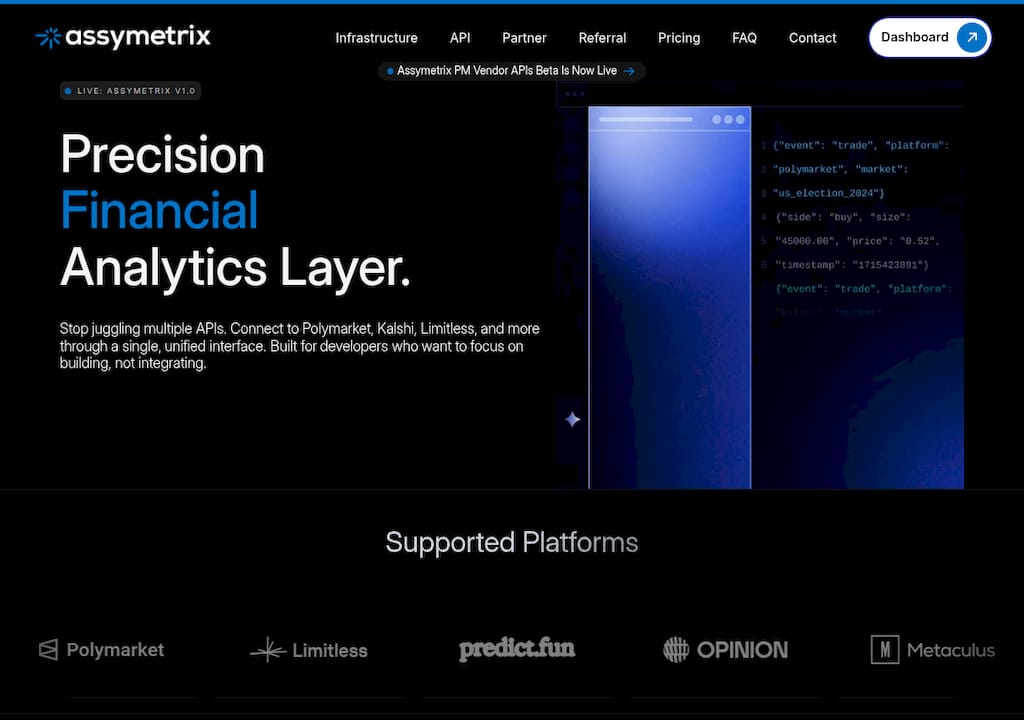
Building a production prediction-market pipeline from three separate venue integrations means three authentication systems, three normalization mappings, and three reconnect handlers to maintain indefinitely. The Assymetrix Data API replaces that with a single integration: one normalized schema, real-time WebSocket streams across Polymarket, Kalshi, and Limitless, historical replay on nearly one billion rows of trading data, and Smart Money signals ready to wire directly into your signal engine.
Your next step is concrete: grab a sandbox API key, point your WebSocket client at the test stream, send a subscribe message, and confirm you are receiving normalized events within minutes. The developer API guide and Python SDK walk through authentication, subscribe patterns, and schema documentation. Start there, validate your pipeline end-to-end on test data, and connect to production when your integration tests pass.
Sources
The following references cover the primary technical patterns and integrations described in this article. Read the test-stream and replay documentation before touching production data.
FAQ
What data inputs do prediction-market algos need beyond price?
Production algos need tick-level trades, order book snapshots, incremental book updates, wallet and Smart Money activity, resolution events, market status and halt events, and trade corrections. Price alone is insufficient for flow-based or informed-flow strategies.
Why does polling REST endpoints fail for low-latency prediction-market systems?
Polling introduces a staleness floor equal to roughly half the polling interval, plus TCP handshake and server processing overhead on every request. WebSocket streaming eliminates per-message connection overhead and delivers updates as they occur.
How does the Assymetrix Data API reduce normalization work?
Assymetrix delivers a single normalized schema across Polymarket, Kalshi, and Limitless through one WebSocket integration. Field names, event types, and timestamps are already canonicalized, so your signal code never needs to handle venue-specific schema differences.
What is the minimum testing requirement before deploying a prediction-market algo?
At minimum: unit tests on normalization logic for every event type, integration tests on a live test stream, a deterministic historical replay covering at least one week of data, and a reconnect-plus-backfill integration test that simulates a mid-stream disconnect.
How should you measure p99 latency for a prediction-market data feed?
Collect at least 10,000 latency samples using NTP or PTP-synchronized clocks, storing both the venue-issued timestamp and your ingestion timestamp on every event. The difference between the two is your one-way latency. Compute p99 from the full sample distribution, not from a small subset.
Real-Time Prediction Market Data for Algorithmic Systems
Use a unified, low-latency streaming API with a normalized cross-venue schema. That is the shortest correct answer for any team integrating real-time prediction market data into production algorithmic systems. Polling REST endpoints on Polymarket, Kalshi, or Limitless individually introduces quantized latency, schema drift, and brittle normalization code that breaks every time a venue updates its API. A single streaming integration with a canonical schema eliminates all three problems at once.
The practical next steps are concrete:
Subscribe to a test stream first. Validate that your ingestion layer receives messages, parses timestamps correctly, and handles reconnects before touching production data.
Confirm dual timestamps. Every normalized event should carry both the venue-issued timestamp and your ingestion timestamp. The delta between them is your measurable one-way latency.
Wire a normalization layer before signal generation. Map venue-specific field names to a canonical schema once, at ingestion, so every downstream consumer sees the same event structure regardless of source venue.
Run a deterministic historical replay before going live. Replay confirms that your pipeline produces identical outputs given identical inputs, which is the minimum bar for backtesting validity.
Pro Tip: Start with the test stream, not production. Most integration bugs (timestamp parsing, reconnect loops, missing fields) surface within the first 30 minutes on a test stream and cost nothing to fix there.
Key Takeaways
A unified, low-latency streaming API with a normalized cross-venue schema is the most direct path to a production-ready prediction-market data pipeline for algorithmic systems.
Point | Details |
|---|---|
Stream, do not poll | WebSocket streaming eliminates quantized REST latency; polling introduces a staleness floor equal to half your polling interval. |
Dual timestamps are required | Store both venue timestamp and ingestion timestamp on every event to measure one-way latency and enable deterministic replay. |
Normalize at ingestion | Map venue-specific schemas to a canonical format before signal code ever sees the data, so venue schema changes never break signals. |
Replay before going live | Assymetrix’s backtesting infrastructure covers over 200 million price snapshots; deterministic replay catches timing bugs that unit tests miss. |
Unified API reduces maintenance | A single Assymetrix integration covers Polymarket, Kalshi, and Limitless with one schema, one auth flow, and one reconnect handler. |
Table of Contents
What makes a prediction-market data feed production-ready?
What data inputs does your algo actually need from prediction markets?
Why streaming beats polling for low-latency prediction market algos
How to architect a prediction-market data pipeline for production algos
Keeping your pipeline correct during disruptions
How to validate your algo before going live
Integration patterns for connecting to streaming prediction-market feeds
How the Assymetrix Data API solves cross-venue normalization
What to budget and what SLAs to negotiate for prediction-market data feeds
What teams consistently underestimate about production prediction-market ingestion
The Assymetrix Data API gives you the unified feed your algo needs
Sources
What makes a prediction-market data feed production-ready?
Production readiness is not a single metric. It is a checklist of properties that, if any one is missing, will eventually cause a live algo to act on stale, incorrect, or incomplete data.
Latency and jitter. P50 latency tells you the median experience. P99 tells you what your algo faces during congestion. For prediction markets, where prices can move sharply on news events, tail latency matters more than median. A feed with a 5ms p50 but a 400ms p99 is a liability during the exact moments your signal is most valuable. Measure both, and set alert thresholds on p99 specifically.
Schema stability and normalization. Venues change field names, add optional fields, and alter event structures without warning. A production feed must abstract that instability behind a stable canonical schema. If your signal code references market_id directly from a Kalshi payload and Kalshi renames it, your algo breaks silently. The normalization layer must own that mapping, not your signal code.
Full tick coverage: every trade, price update, and order book change, not just OHLCV bars.
Order book depth: at minimum top-of-book; ideally full depth for liquidity-sensitive strategies.
Resolution events: market closure and resolved outcome with a resolution timestamp, so stale signals are invalidated immediately.
Wallet and Smart Money activity: wallet IDs, position changes, and large transfers for informed-flow signals.
Trade corrections and cancels: feeds that silently drop corrections will cause P&L drift in backtests and live systems alike.
Operational SLAs. Uptime percentages matter, but the contractual backfill guarantee matters more. If a feed drops for 90 seconds, can you request the missed ticks? What is the maximum gap the provider will fill? Session limits and bandwidth caps also belong in this conversation before you sign a contract.
Security basics. API keys should be scoped to the minimum required permissions. All connections must use TLS. Key rotation should be possible without a service restart. Commercial licensing terms should explicitly cover algorithmic and automated use, because some data licenses prohibit redistribution or automated consumption.
Trust signals to verify before committing. Published latency benchmarks (not just marketing claims), a working test stream URL, SDKs or sample code in at least one language, and documented subscribe/unsubscribe message formats. The WebSocket Stream documentation from Alpaca is a useful reference for what a well-documented streaming API looks like: it covers subscribe/unsubscribe JSON formats, compression per RFC-7692, test stream URLs, and session error codes such as “connection limit exceeded.”
Pro Tip: Ask any data provider for their p99 latency figure under load, not just their advertised median. If they cannot produce it, treat that as a red flag.
What data inputs does your algo actually need from prediction markets?
The answer depends on your strategy, but most production algos need more than price. They need the full event stream.
Data Input | Why It Matters | Minimal Schema Fields |
|---|---|---|
Tick-level trades | Granular price discovery; required for VWAP, momentum, and flow signals |
|
Order book snapshots | Liquidity context; top-of-book spread and depth drive execution decisions |
|
Incremental book updates | Real-time liquidity changes without full snapshot overhead |
|
Trade flow and fills | Maker/taker attribution; execution venue for P&L accounting |
|
Wallet and Smart Money activity | Informed-flow detection; large wallet movements precede price moves |
|
Resolution events | Invalidate stale signals; trigger settlement logic |
|
Market status and halts | Prevent execution during halts or imbalances |
|
Trade corrections and cancels | Maintain accurate P&L; avoid acting on reversed trades |
|
Tick granularity is non-negotiable for any momentum or flow-based strategy. A bar-level feed (OHLCV per minute) loses the intra-bar sequence of trades, which is exactly where informed flow is visible. Polymarket Analytics illustrates the kinds of venue-level events prediction markets expose, including trade depth and market-specific metadata that bar feeds would aggregate away.
Wallet activity deserves particular attention. Large position changes by tracked wallets often precede price movement by seconds to minutes. Algos that ignore this input are leaving a signal on the table that is unique to prediction markets and has no direct equivalent in equity markets.
Resolution events are equally critical and often overlooked in early pipeline designs. A market that resolves “No” at 11:59 PM should immediately invalidate any open signal referencing that market. Without a resolution event handler, your algo may attempt to execute on a market that no longer exists.
Alpaca’s real-time stock pricing data documentation shows how mature feeds separate channels for bars, updated bars, trade corrections, and status events. Prediction-market feeds follow the same logical separation, and your ingestion layer should handle each channel type independently.
Why streaming beats polling for low-latency prediction market algos
Polling a REST endpoint on a 500ms interval means your algo sees data that is, on average, 250ms old. At the worst case, it is 499ms old. That is not a latency figure. That is a quantized staleness floor baked into your architecture.
The mechanics are straightforward. A polling loop sends an HTTP request, waits for a TCP handshake, waits for the server to process the query, receives the response, and then parses it. Every one of those steps adds latency. Head-of-line blocking means a slow response on one poll delays the next. Under load, REST endpoints also rate-limit aggressively, which forces longer polling intervals at exactly the moments when market activity is highest.
Streaming via WebSocket or a similar persistent-connection protocol inverts this. The server pushes updates as they occur. The connection is already established. There is no handshake overhead per message. Incremental updates mean only the delta is transmitted, not the full state.
Latency metrics every team should track from day one:
P50 one-way latency: median message delivery time from venue to your ingestion layer.
P90 and P99: the tail. Set alerts at p99 greater than your strategy’s acceptable staleness threshold.
Jitter: the variance in inter-arrival time. High jitter means your algo cannot rely on message timing for any time-sensitive logic.
Message inter-arrival time: for order book updates, gaps in inter-arrival signal either feed disruption or a quiet market. Know which one it is.
Measuring latency correctly requires synchronized clocks. Use NTP at minimum; PTP (IEEE 1588) for sub-millisecond accuracy. Store both the venue-issued timestamp and your ingestion timestamp on every event. The difference is your measured one-way latency. Round-trip measurements (ping/pong) are useful for connection health but do not substitute for one-way latency on data messages. Databento’s low-latency API infrastructure uses nanosecond PTP-synchronized timestamps and exchange colocation to minimize venue-to-cloud latency, which illustrates the upper bound of what production-grade latency infrastructure looks like.
For bandwidth, enable compression per RFC-7692 where the feed supports it. Binary frames reduce parse overhead compared to JSON text frames. The tradeoff is implementation complexity, but for high-frequency feeds with thousands of events per second, binary encoding can reduce CPU parse time meaningfully.
Pro Tip: To measure p99 correctly, collect at least 10,000 latency samples before drawing conclusions. A p99 computed from 100 samples is statistically unreliable and will miss tail events that only appear under load.
How to architect a prediction-market data pipeline for production algos
A production pipeline has five distinct layers. Each has a single responsibility. Mixing responsibilities across layers is the most common source of hard-to-debug latency and correctness bugs.
The most expensive architectural mistake in prediction-market data pipelines is placing normalization logic inside signal code. When a venue changes its schema, every signal breaks simultaneously. Isolate normalization at ingestion, and signal code never needs to know which venue the data came from.
1. Edge ingestion layer. One process per venue connection. Handles the WebSocket session lifecycle: connect, authenticate, subscribe, receive, and reconnect. Writes raw messages to a durable queue (Kafka, Redis Streams, or equivalent) with an ingestion timestamp appended. No parsing beyond what is needed to route the message. Session limits handling lives here: if the feed returns a “connection limit exceeded” error, the session manager backs off and retries with exponential backoff plus jitter.
2. Normalization workers. Read from the raw queue. Map venue-specific field names to the canonical schema. Canonicalize timestamps to UTC nanoseconds. Append provenance fields (source_venue, raw_seq_num). Write to the normalized event store. These workers are stateless and horizontally scalable. Shard by market symbol to preserve per-market ordering.
3. Time-series store. Normalized events land here. Optimized for time-range queries and replay. TimescaleDB, InfluxDB, or a columnar store like ClickHouse all work. The key requirement is that replay produces byte-identical output to the original stream, which requires storing the original venue timestamp alongside the ingestion timestamp.
4. Signal engine. Reads from the normalized store or subscribes to the normalized event stream. Applies windowing strategies (sliding windows, tumbling windows, event-count windows) to compute features. Outputs signals with a latency budget: if computing a signal takes longer than the budget, the signal is dropped, not delayed. Feature stores (Feast, Tecton, or a custom Redis-backed store) cache pre-computed features for low-latency lookup.
5. Execution gateway. Receives signals from the signal engine. Applies risk checks (position limits, notional caps, market halt checks). Throttles order submission to venue-imposed rate limits. Sends pre-signed execution messages or routes through a broker adapter. This layer must be able to reject a signal in under 1ms to avoid compounding latency from the signal engine.
Operational concerns worth addressing at design time:
Place deduplication at the normalization layer using sequence numbers from the raw message. A message with a
seq_numalready seen is dropped before it reaches the time-series store. This is the cheapest point to deduplicate because the normalized event has not yet been written anywhere.Backpressure protection between the raw queue and normalization workers prevents a burst of messages from overwhelming the normalization layer. Use bounded queues with explicit overflow handling (drop-oldest or alert-and-pause).
Autoscale normalization workers based on queue depth, not CPU. A deep queue means the normalization layer is falling behind the ingestion rate, which is the leading indicator of latency degradation.
Pro Tip: Shard your normalization workers by market symbol, not by venue. This preserves per-market message ordering across venues, which matters for cross-venue arbitrage signal generation where you need to compare the same market’s price on Polymarket and Kalshi in sequence.
Keeping your pipeline correct during disruptions
Feed disruptions are not edge cases. They are scheduled maintenance windows, unexpected venue outages, and network blips that happen on a regular cadence. A pipeline that has not been designed for disruption will produce incorrect signals during the exact moments when market volatility is highest.
Reconnection. Use exponential backoff with jitter. A fixed retry interval causes thundering-herd reconnects when a feed comes back online after an outage. Jitter spreads reconnect attempts across time. Maintain a warm standby session where the feed supports it: a second connection that is authenticated but not subscribed, ready to take over within milliseconds.
Backfill and gap detection. Every message should carry a sequence number. On reconnect, compare the last received sequence number against the first message received on the new connection. If there is a gap, request a backfill for the missing range immediately. Most production feeds support a historical replay endpoint for exactly this purpose. Apply backfilled messages using compare-and-swap semantics: only write a backfilled tick if the sequence slot is currently empty.
Message ordering and deduplication. Sequence numbers handle ordering. Idempotency keys (a hash of trade_id + venue + venue_ts) handle deduplication across reconnects. For complex multi-venue scenarios, vector clocks can track causal ordering across independent venue streams, though most teams find sequence numbers sufficient for prediction markets.
Late trades and corrections. A trade correction arrives after the original trade and carries the original trade_id plus corrected fields. Your reconciler must match corrections to their originals within a reconciliation window (typically 60–300 seconds, depending on venue behavior). Any signal computed from the original trade during that window should be flagged as potentially stale until the reconciliation window closes.
Here is a minimal pseudocode pattern for reconnect with backfill:
on_disconnect(last_seq):
    wait(backoff_with_jitter())
    connect()
    authenticate()
    subscribe(channels)
    first_msg = receive()
    if first_msg.seq_num > last_seq + 1:
        gap = (last_seq + 1, first_msg.seq_num - 1)
        backfill_msgs = request_backfill(gap)
        apply_backfill(backfill_msgs)
    resume_normal_processing()
Pro Tip: Prefer at-least-once delivery at ingestion with deterministic deduplication at normalization. Exactly-once delivery at the transport layer is expensive to guarantee and unnecessary when your normalization layer can deduplicate cheaply using sequence numbers and idempotency keys.
How to validate your algo before going live
No algo should touch production data before it has passed three distinct validation gates: unit tests on normalization logic, integration tests on a live test stream, and deterministic historical replay.
Test streams. A test stream delivers real message formats with synthetic or delayed data. It is structurally identical to the production stream: same authentication flow, same subscribe/unsubscribe message format, same channel types. The difference is that test stream data carries no financial consequence. Use it to validate that your ingestion layer parses every message type correctly, handles reconnects, and processes corrections without crashing.
Deterministic historical replay. Feed your pipeline a recorded sequence of historical events and verify that it produces identical outputs on every run. Non-determinism in replay (caused by wall-clock dependencies, random seeds, or race conditions) means your backtest results are not reproducible. Assymetrix’s backtesting infrastructure, built on over 200 million price snapshots, demonstrates how deterministic replay at scale surfaces timing bugs that unit tests miss entirely.
A practical testing checklist:
Normalization unit tests: for every venue and every event type, assert that the canonical output matches the expected schema exactly.
Timestamp parsing tests: verify UTC conversion, nanosecond precision, and that venue timestamps and ingestion timestamps are stored independently.
Deduplication tests: send the same message twice and confirm the normalization layer produces exactly one output.
Reconnect and backfill integration tests: simulate a disconnect mid-stream and verify that the gap is detected and filled correctly.
Latency regression tests: run the full pipeline on a recorded replay and assert that p99 processing latency stays below your threshold.
Failover tests: kill the primary ingestion process and verify that the warm standby takes over within your SLA window.
Reconciliation tests: inject a trade correction and verify that the reconciler updates the original trade record and flags downstream signals correctly.
Use recorded replays in your CI/CD pipeline. Every pull request that touches normalization, deduplication, or signal logic should trigger a replay-based regression test. Teams that skip this step tend to discover subtle timing bugs only in production, where they are expensive to diagnose.
Pro Tip: Record a “golden dataset” from your first week on the test stream. Use it as the fixed input for all future regression tests. A golden dataset that never changes makes regressions immediately obvious.
Integration patterns for connecting to streaming prediction-market feeds
Authentication comes first. Generate scoped API keys with the minimum permissions your integration needs. A key used only for market data ingestion should not have execution permissions. Rotate keys on a schedule without requiring a service restart by storing the active key in a secrets manager (AWS Secrets Manager, HashiCorp Vault) and reloading it on reconnect.
Subscribe and unsubscribe message patterns follow a consistent structure across most streaming feeds. A typical subscribe message looks like this:
{
  "action": "subscribe",
  "markets": ["MARKET_ID_1", "MARKET_ID_2"],
  "channels": ["trades", "orderbook", "resolution"]
}
An unsubscribe message mirrors the structure with "action": "unsubscribe". Session lifecycle: connect, authenticate (send API key in the initial handshake or as a header), subscribe to the desired channels, process messages, and handle disconnects with the reconnect pattern described above. Alpaca’s WebSocket streaming documentation shows this pattern in detail, including compression negotiation per RFC-7692 and the exact format of session error responses.
Binary vs. text frames. JSON text frames are easier to debug but carry higher parse overhead. Binary frames (MessagePack, Protobuf, or a custom binary encoding) reduce CPU time per message, which matters at high message rates. For most prediction-market feeds operating at hundreds of messages per second, JSON is acceptable. Above a few thousand messages per second, binary encoding becomes worth the implementation cost.
Batching. Some feeds batch multiple events into a single frame to reduce per-message overhead. If your feed supports batching, process each event in the batch independently through your normalization pipeline. Never treat a batch as a single atomic event.
Error handling. Map server error codes to client actions:
Server Response | Client Action |
|---|---|
Connection limit exceeded | Back off, wait, retry with a different session slot |
Authentication failed | Rotate key, alert on-call, do not retry automatically |
Subscription rejected | Log the rejected channel, continue with accepted channels |
Rate limit exceeded | Reduce subscription scope, implement backpressure |
Unknown message type | Log and skip, do not crash the ingestion process |
A lightweight Python WebSocket client pattern for a prediction-market feed:
import asyncio, websockets, json

async def connect(uri, api_key, markets, channels):
    async with websockets.connect(uri) as ws:
        await ws.send(json.dumps({"action": "auth", "key": api_key}))
        await ws.send(json.dumps({
            "action": "subscribe",
            "markets": markets,
            "channels": channels
        }))
        async for message in ws:
            event = json.loads(message)
            normalize_and_enqueue(event)
The Assymetrix developer guide and Python SDK tutorial provide subscribe message examples, schema documentation, and sandbox access specific to prediction-market feeds across Polymarket, Kalshi, and Limitless.
Pro Tip: Never parse JSON inside your hot path if you can avoid it. Parse once at ingestion, write the structured object to your internal queue, and let downstream consumers read the pre-parsed structure. JSON parsing is CPU-intensive at scale.
How the Assymetrix Data API solves cross-venue normalization
The core problem with building a multi-venue prediction-market pipeline from scratch is that Polymarket, Kalshi, and Limitless each expose different schemas, different authentication patterns, and different event types. Maintaining three separate ingestion clients, three normalization mappings, and three reconnect handlers is not a data problem. It is an engineering maintenance problem that compounds over time.
The Assymetrix Data API addresses this with a single WebSocket integration that delivers a unified schema across all three venues. One connection, one authentication flow, one set of subscribe/unsubscribe message patterns, and one canonical event structure regardless of source venue. The normalization work that would otherwise live in your codebase lives in Assymetrix’s infrastructure instead.
What the integration gives you:
Unified real-time streams for Polymarket, Kalshi, and Limitless with consistent field names and event types.
Historical replay built on approximately 1.5 terabytes of data spanning nearly one billion rows of trading activity.
Backtesting datasets covering over 200 million price snapshots for deterministic strategy validation.
Smart Money wallet tracking: position changes and large transfers from tracked wallets, normalized across venues.
Trader Skill Scores and cross-venue arbitrage signals for signal generation without building the analytics layer yourself.
Test stream access for integration validation before connecting to production data.
SDKs and sample code to reduce time-to-first-message.
A single integration to a normalized, cross-venue API compresses weeks of normalization engineering into hours of configuration. The signal development work that follows is where quant teams should be spending their time, not on field-name mapping.
For a team building cross-venue arbitrage signals, the unified schema means that comparing the same market’s price on Polymarket and Kalshi requires no translation layer. The market_id, price, and venue_ts fields are already in the same format. The Kalshi vs. Polymarket data guide covers venue-specific field differences and how the API normalizes them.
Pro Tip: Use the Assymetrix test stream to validate your full pipeline end-to-end before requesting production API credentials. The test stream exposes the same message format as production, so any integration bug you find there is one you will not encounter live.
What to budget and what SLAs to negotiate for prediction-market data feeds
Commercial pricing for prediction-market data feeds typically varies along four dimensions: session count, bandwidth or message volume, historical data depth, and access to premium analytics (Smart Money signals, arbitrage alerts, bulk export).
Session count is the most commonly underestimated constraint. A single WebSocket session may support a limited number of concurrent subscriptions. If your algo subscribes to hundreds of markets across three venues, you may need multiple sessions. Understand the per-session subscription limit before you design your subscription topology.
Historical data depth and replay windows are often priced separately from real-time access. If your backtesting strategy requires tick-level data going back two or more years, confirm that the provider’s replay window covers that range and that the pricing tier you are evaluating includes it.
Hidden costs to ask about explicitly:
Egress fees for bulk data exports or high-volume historical pulls.
Colocation or cross-connect fees if you need the lowest possible latency to the feed’s origin.
High-volume licensing clauses that trigger at message volume thresholds you may hit during market events.
SLA expectations for production use. Uptime percentages in the high nineties are standard marketing language. The contractual terms that matter are: the maximum gap the provider will backfill, the support response time for feed disruptions, and whether latency SLAs are contractually guaranteed or just advertised. Get the backfill guarantee in writing.
Negotiation tips. Start with a pilot pricing arrangement that includes performance SLAs on latency, not just uptime. Include a staged scale-up clause so your costs grow proportionally with your usage rather than jumping to an enterprise tier before you have validated the integration. If the provider offers a free tier or sandbox, exhaust it before committing to a paid plan.
Pro Tip: Treat the test stream as a free pilot. Run your full pipeline against it for at least two weeks before signing a production contract. Feed quality issues, schema inconsistencies, and latency problems are far cheaper to discover during a free evaluation than after you have committed to a subscription.
What teams consistently underestimate about production prediction-market ingestion
Speed and correctness pull in opposite directions at every layer of a prediction-market pipeline. The teams that ship fastest tend to defer correctness work, specifically deduplication, timestamp canonicalization, and reconciliation, until they encounter a live bug. By then, the fix requires touching every layer of the pipeline simultaneously.
The replay and deterministic testing investment pays back faster than most teams expect. A pipeline that can replay a week of historical data in minutes gives you a regression test suite that catches normalization bugs, timestamp drift, and deduplication failures before they reach production. Teams that skip replay infrastructure spend that time instead on production incident response.
Cross-venue normalization is the main time sink, and it is consistently underestimated. Mapping three venues’ schemas to a single canonical format sounds like a few hours of work. In practice, it involves handling venue-specific edge cases, undocumented field behaviors, and schema changes that arrive without notice. A unified API that owns that mapping removes the problem entirely from your engineering backlog.
The Assymetrix Data API gives you the unified feed your algo needs
Building a production prediction-market pipeline from three separate venue integrations means three authentication systems, three normalization mappings, and three reconnect handlers to maintain indefinitely. The Assymetrix Data API replaces that with a single integration: one normalized schema, real-time WebSocket streams across Polymarket, Kalshi, and Limitless, historical replay on nearly one billion rows of trading data, and Smart Money signals ready to wire directly into your signal engine.
Your next step is concrete: grab a sandbox API key, point your WebSocket client at the test stream, send a subscribe message, and confirm you are receiving normalized events within minutes. The developer API guide and Python SDK walk through authentication, subscribe patterns, and schema documentation. Start there, validate your pipeline end-to-end on test data, and connect to production when your integration tests pass.
Sources
The following references cover the primary technical patterns and integrations described in this article. Read the test-stream and replay documentation before touching production data.
FAQ
What data inputs do prediction-market algos need beyond price?
Production algos need tick-level trades, order book snapshots, incremental book updates, wallet and Smart Money activity, resolution events, market status and halt events, and trade corrections. Price alone is insufficient for flow-based or informed-flow strategies.
Why does polling REST endpoints fail for low-latency prediction-market systems?
Polling introduces a staleness floor equal to roughly half the polling interval, plus TCP handshake and server processing overhead on every request. WebSocket streaming eliminates per-message connection overhead and delivers updates as they occur.
How does the Assymetrix Data API reduce normalization work?
Assymetrix delivers a single normalized schema across Polymarket, Kalshi, and Limitless through one WebSocket integration. Field names, event types, and timestamps are already canonicalized, so your signal code never needs to handle venue-specific schema differences.
What is the minimum testing requirement before deploying a prediction-market algo?
At minimum: unit tests on normalization logic for every event type, integration tests on a live test stream, a deterministic historical replay covering at least one week of data, and a reconnect-plus-backfill integration test that simulates a mid-stream disconnect.
How should you measure p99 latency for a prediction-market data feed?
Collect at least 10,000 latency samples using NTP or PTP-synchronized clocks, storing both the venue-issued timestamp and your ingestion timestamp on every event. The difference between the two is your one-way latency. Compute p99 from the full sample distribution, not from a small subset.
Other Blog


