900M+ Events: Prediction Market Data Feed for Developers and Quants
900M+ Events: Prediction Market Data Feed for Developers and Quants
900M+ Events: Prediction Market Data Feed for Developers and Quants
Developers and quants get a technical checklist: payload specs, point in time timestamps, sequence numbers, and REST and streaming integration for live...
900M+ Events: Prediction Market Data Feed for Developers and Quants
Production analytics, trading bots, and AI agents all need the same foundation: a unified prediction market data feed that delivers real-time ticks, orderbook depth, executed trades, wallet activity, and resolution events, paired with point-in-time historical backfill. The practical solution is a single API with a normalized schema, stable cross-venue IDs, and both REST and streaming access. Everything below explains what that requires and how to evaluate it.
TL;DR:
A unified prediction market data API must deliver consistent real-time and historical data, including timestamps, trades, orderbook snapshots, and resolution events, across multiple venues.
Proper timestamp semantics and sequence numbers are crucial to prevent lookahead bias and ensure data integrity during backtests and strategy deployment.
Low-latency streaming is ideal for real-time trading, while REST and bulk exports are better suited for backtesting and large-scale data analysis.
Reliable operation depends on monitoring latency percentiles, automatic gap detection, sequence integrity, provenance timestamps, and schema versioning.
Normalization of market IDs, outcome labels, and timestamps across venues simplifies cross-venue analysis and arbitrage detection, saving considerable time and effort.
AssymetrixBuild On Unified Market DataAssymetrix gives developers and quants unified access to cross-venue prediction market data through a single Data API integration.Explore the Data API
Table of Contents
What Is a Prediction Market Data API?
What Data Types and Fields Should the API Return?
Which Access Method Fits Real-Time vs. Historical Work?
What Reliability Guarantees Should a Production Feed Provide?
Why Does Normalized Cross-Venue Data Matter?
How Should You Integrate a Prediction Market Feed?
Which Use Case Needs Which Feed Capability?
How Assymetrix Delivers a Unified Feed at Scale
What Actually Matters When You’re Choosing a Feed
Getting Started With the Assymetrix Data API
Sources
What Is a Prediction Market Data API?
A prediction market data API is a programmatic interface that returns structured trading data from venues like Polymarket, Kalshi, and Limitless. Instead of scraping HTML or polling a dozen inconsistent venue endpoints, a developer queries one interface and gets prices, trades, order books, market metadata, and resolutions in a consistent shape.
The canonical data model behind a serious feed breaks down into six object types: markets (the tradable event and its outcomes), ticks (price or implied probability at a moment in time), trades (executed fills with size and side), orderbook snapshots (bid/ask depth at each price level), resolutions (final settlement value and timestamp), and wallet records (address-level activity tied to specific trades). Each object carries its own timestamp, and the ordering between them matters more than most new integrators expect.
Timestamp semantics deserve real attention. A tick timestamped at the moment it was generated on-chain or on-venue is not the same as a tick timestamped at the moment your ingestion pipeline received it, and conflating the two corrupts any point-in-time historical dataset. This is the exact failure mode that produces lookahead bias in backtests: a strategy that “sees” a price before it was actually knowable in live conditions. Point-in-time correctness (recording data with a provenance timestamp, not an arrival timestamp) is the difference between a backtest that means something and one that quietly cheats.
A production-grade feed’s core objects typically include:
Markets and outcomes: question text, outcome tokens, category, open/close times
Ticks: price/probability, timestamp, market ID, outcome ID
Trades: trade ID, price, size, side, wallet address, timestamp
Orderbook snapshots: bid/ask levels, depth, sequence number
Resolutions: final outcome, settlement timestamp, resolution source
Wallet activity: address, position history, realized P&L signals
What Data Types and Fields Should the API Return?
Product documentation across the space, including FinFeedAPI’s prediction markets API, converges on the same core payload categories: OHLCV candles, trades, quotes, and order-book snapshots. That convergence is worth noting. When multiple independent vendors enumerate the same six or seven data types as baseline, it tells you the market has settled on what “complete” actually means, and anything short of that list is a partial feed dressed up as a full one.
Here is what each payload should actually contain:
Top-of-book ticks: best bid, best ask, implied probability, market ID, outcome ID, and a timestamp precise to the millisecond
Trade records: a unique trade ID, executed price, size, side (buy/sell), and the wallet address that executed it
Orderbook snapshots: full depth by price level, plus a sequence number so consumers can detect a dropped update
OHLCV candles: open, high, low, close, and volume, bucketed by interval, built specifically for backtest ingestion
Resolution records: final settlement value, resolution timestamp, and the resolution source or oracle reference
Wallet and Smart Money fields: address, historical win rate, position size trends, and realized P&L over time
Data point: Assymetrix indexes more than 900 million events and over 200 million OHLCV snapshots across Polymarket, Kalshi, and Limitless, which gives a sense of the volume a genuinely unified cross-venue feed has to manage without dropping fidelity.
Sequence numbers on orderbook snapshots matter more than they sound. Without one, a client has no reliable way to tell the difference between “the book didn’t change” and “we missed an update,” which silently poisons any strategy built on depth signals.
Which Access Method Fits Real-Time vs. Historical Work?
REST, WebSocket, and bulk export each solve a different problem, and picking the wrong one is the most common integration mistake teams make on their first pass at a prediction market feed.
REST is the right tool for ad-hoc historical queries: pulling a specific market’s full trade history, fetching resolution records for a date range, or grabbing a snapshot to seed a model. It’s stateless, cacheable, and easy to debug, but it’s the wrong choice for anything needing sub-second updates.
Streaming interfaces, whether WebSocket, Server-Sent Events, gRPC, or Kafka, exist for low-latency work: live orderbook deltas, tick-by-tick price updates, and trade execution feeds that a trading bot has to react to in real time. Betstamp’s prediction markets API documentation describes median refresh times around 400 milliseconds for normalized order books, which is a useful benchmark for what “real-time” should mean in practice, not just in marketing copy.
GraphQL and unified query layers solve a third problem: flexible joins across datasets without writing custom aggregation code for every question. Bitquery’s Polymarket-focused API exposes trades, prices, and positions this way, which speeds up prototyping considerably, though teams doing serious model training still need robust, replayable bulk exports underneath.
For large-scale backfills or training data, bulk file exports or S3-style snapshot delivery beat paginated REST calls by orders of magnitude on both time and API budget.
Pro Tip: Match latency requirements to the access method before you pick a vendor. A dashboard refreshing every five minutes has no business paying for a streaming connection, and a market-making bot has no business polling REST.

What Reliability Guarantees Should a Production Feed Provide?
Uptime and latency percentiles are the headline numbers, but they’re not the whole story. A feed advertising 99.9% uptime that silently drops three minutes of orderbook updates during a resolution event has technically hit its SLA while still corrupting your data.
The operational requirements that actually protect a production pipeline break into five categories:
SLA with monitored latency percentiles, not just an uptime average. p50 latency tells you the typical case; p99 tells you what happens during a volatility spike, which is exactly when your system needs the data most.
Gap detection and automated backfill. The feed itself should notice a missing sequence range and backfill it without a support ticket.
Idempotency and sequence numbers on every stream so a consumer can safely replay a range without double-counting trades.
Point-in-time timestamp provenance, meaning every record carries the timestamp it actually occurred at, not just when your pipeline saw it, with reconciliation against the venue’s own record where possible.
Schema versioning and access control, so a field addition doesn’t silently break a downstream parser, and API keys are scoped to the access level a given integration actually needs.
A feed’s real reliability shows up not in its published uptime number but in what happens during the five minutes after an outage. Does it detect the gap, backfill it automatically, and preserve original timestamps, or does it just resume streaming and leave a hole in your historical record?
Backtesting research from EI Algos on common backtesting pitfalls identifies lookahead bias and timestamp mishandling as two of the most frequent, and quietest, sources of strategies that look profitable in simulation and lose money live. Gap handling and timestamp provenance aren’t operational nice-to-haves. They’re the mechanism that prevents exactly that failure.
Why Does Normalized Cross-Venue Data Matter?
Raw venue feeds fail in predictable, expensive ways. Polymarket, Kalshi, and Limitless each use different market ID formats, different outcome label conventions, and different timestamp standards, some Unix epoch, some ISO 8601, some relative to block time rather than wall clock time. Pull three raw feeds and you inherit three separate reconciliation problems before you’ve written a single line of strategy logic.
Normalization fixes this at the source rather than pushing the work downstream:
Stable cross-venue market IDs that persist even when a venue renames or restructures a market
Consistent outcome labels so “Yes” on one venue and “1” on another map to the same schema field
Unified timestamp standards across every venue, eliminating the epoch-versus-ISO guessing game
Deduplication logic that catches the same real-world event listed independently on two venues
The insight from Betstamp’s own product framing is blunt on this point: unified schemas and stable IDs are the single most important feature for teams doing cross-venue research, because without them, every arbitrage detection query starts with a manual mapping exercise instead of a join.
That’s the practical payoff. A normalized feed turns a cross-venue arbitrage query into a straightforward join on market ID rather than a fuzzy-matching project. Edge cases (a market that resolves early on one venue, a duplicate listing with slightly different wording) still happen, but a properly maintained intelligence layer catches and flags them instead of leaving you to discover the mismatch three weeks into a backtest.

Pro Tip: Before committing to any feed, run one test query: pull the same real-world event from two different venues and check whether the API returns matching or divergent market IDs. That single query tells you more about schema quality than any spec sheet.
How Should You Integrate a Prediction Market Feed?
A production integration follows a predictable four-stage pattern, and skipping a stage is where most pipelines eventually break in ways that are hard to diagnose after the fact.
Schema discovery. Pull the API’s schema definition first, before writing a single ingestion function, so your parser is built against the actual field set rather than a guess from documentation examples.
Full historical backfill. Request the complete history for the markets you care about, respecting pagination limits, before you ever open a live stream. Starting a stream without a backfilled baseline means your dataset has a hole from day one.
Live subscription. Open the WebSocket or streaming connection and start consuming ticks, trades, and orderbook deltas, using sequence numbers to detect any drop the moment it happens.
Reconciliation loop. On a fixed interval, run a checksum or count comparison between your local store and the API’s own historical endpoint for the same range, catching drift before it compounds.
Rate limits and pagination deserve planning, not improvisation. A historical pull spanning a full market’s lifetime across hundreds of markets can easily hit five or six figures of API calls; budget for cursor-based pagination and respect documented rate ceilings rather than hammering an endpoint and triggering throttling mid-backfill.
Testing belongs in a staging environment using replayed historical ranges, not live data. Replay a known 48 hour window with a documented volatility event and confirm your pipeline reproduces the same trade count and final price the API’s historical endpoint reports. This is the exact replay-based validation approach EI Algos recommends for avoiding backtesting pitfalls, and it catches timestamp bugs long before they reach production capital.
Pro Tip: Set up three specific monitors from day one: ingestion lag (time between event and your database write), gap count (missing sequence numbers per hour), and reconciliation drift (row count mismatch against the source). These three numbers catch almost every pipeline failure before a human notices.
Which Use Case Needs Which Feed Capability?
Different developer workflows stress different parts of a prediction market data API, and matching the right capability to the right job avoids paying for latency you don’t need or missing depth you do.
Low-latency trading bots need orderbook deltas and sub-second streaming above everything else. Median refresh times around 400 milliseconds, as cited by Betstamp, provide a useful benchmark for live price movement reaction times.
Backtesting depends on point-in-time historical snapshots and bulk export access, since paginated REST calls for a multi-year backtest quickly become the bottleneck rather than the strategy logic itself.
AI agents and model training need normalized time series with labeled resolution events baked in, so a model can learn from outcomes without a separate reconciliation step against a resolutions table.
Arbitrage detection and Smart Money tracking run on cross-venue divergence feeds and wallet-level signals, surfacing when the same event prices differently across Polymarket, Kalshi, and Limitless, or when a historically high-skill wallet takes a new position.
Dashboards and reporting run mostly on aggregated OHLCV data and market metadata, which is the lightest-weight consumption pattern of the five.
How Assymetrix Delivers a Unified Feed at Scale
Assymetrix builds its Data API around the exact checklist above: one schema, one set of stable IDs, and both real-time and historical access across Polymarket, Kalshi, and Limitless through a single integration.
The coverage claims are checkable against the platform’s own documentation:
Roughly 1.5 terabytes of historical data spanning close to one billion rows of trading activity
900 million-plus indexed events and 200 million-plus OHLCV snapshots across all three venues
A normalized schema with stable cross-venue market IDs, delivered via REST and WebSocket
Smart Money wallet tracking, Trader Skill Scores, and cross-venue arbitrage signals layered on top of the raw feed
Developers can start with the API developer guide for endpoint references and integration patterns, or work through the Python integration guide for working code examples covering backfill and streaming. Enterprise data consumers needing dedicated throughput or custom SLA terms can reach out directly through the platform for scoped access.
What Actually Matters When You’re Choosing a Feed
Correctness beats speed as a first priority. A feed that streams at 50 milliseconds but drops orderbook sequences during volatility spikes will cost you more than a feed running at 400 milliseconds with proven gap detection. Push the burden of normalization and schema stability onto the vendor, not your own team; that’s engineering time better spent on strategy logic. And build your reconciliation and replay-based testing tooling before you scale capital against the feed, not after something breaks in production.
— Dean
Getting Started With the Assymetrix Data API
Assymetrix is the practical answer to the gap most developers hit when they try to stitch together Polymarket, Kalshi, and Limitless feeds on their own: instead of maintaining three separate ingestion pipelines and a manual ID-mapping layer, you get one schema, one set of stable cross-venue IDs, and both REST and WebSocket access from a single API key.
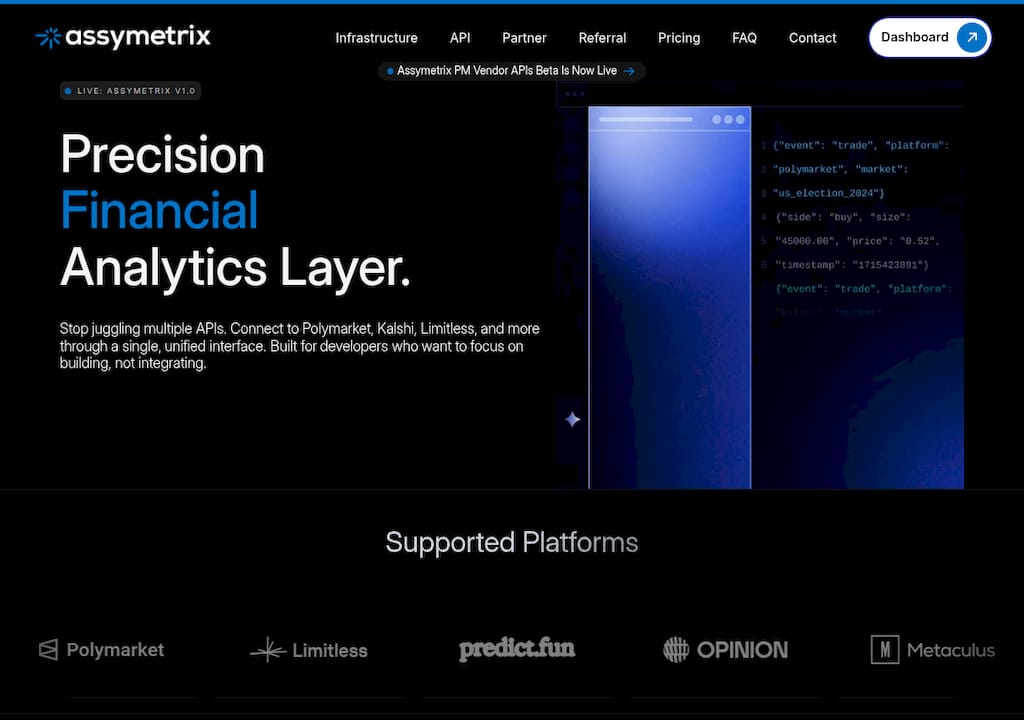
That unified layer already carries the Smart Money wallet tracking, Trader Skill Scores, and arbitrage signal detection that most teams end up building by hand on top of raw venue data anyway. If your project needs backtesting depth specifically, the backtesting guide built on 200 million-plus price snapshots walks through reproducing strategy performance against Assymetrix’s historical archive. Teams building bots that react to live orderbook changes can start directly with the WebSocket API documentation for streaming setup.
Start at Assymetrix to generate an API key on the free tier, test schema discovery and backfill against your target markets, and move to a paid streaming tier once your reconciliation loop is validated.
FAQ
What Is a Prediction Market Data API?
It’s a programmatic interface that returns structured prices, trades, order books, and resolution data from prediction market venues like Polymarket, Kalshi, and Limitless, replacing manual scraping or venue-by-venue integration.
What’s the Difference Between Live and Historical Prediction Market Data?
Live data streams current ticks, trades, and orderbook changes as they happen, usually over WebSocket, while historical data provides point-in-time backfill for backtesting, typically delivered via REST or bulk export.
Why Does Normalized Cross-Venue Data Matter for Trading?
Raw venue feeds use inconsistent market IDs, outcome labels, and timestamp formats, forcing manual reconciliation before any cross-venue analysis; normalization with stable IDs turns that reconciliation into a simple join.
How Much Historical Data Does Assymetrix Provide?
Assymetrix indexes more than 900 million events and 200 million-plus OHLCV snapshots across Polymarket, Kalshi, and Limitless, drawn from roughly 1.5 terabytes of historical trading data.
What Should I Check Before Trusting a Feed’s Uptime Claim?
Look past the average uptime number and ask specifically about gap detection, automated backfill, and whether sequence numbers let you verify no data was silently dropped during an outage.
900M+ Events: Prediction Market Data Feed for Developers and Quants
Production analytics, trading bots, and AI agents all need the same foundation: a unified prediction market data feed that delivers real-time ticks, orderbook depth, executed trades, wallet activity, and resolution events, paired with point-in-time historical backfill. The practical solution is a single API with a normalized schema, stable cross-venue IDs, and both REST and streaming access. Everything below explains what that requires and how to evaluate it.
TL;DR:
A unified prediction market data API must deliver consistent real-time and historical data, including timestamps, trades, orderbook snapshots, and resolution events, across multiple venues.
Proper timestamp semantics and sequence numbers are crucial to prevent lookahead bias and ensure data integrity during backtests and strategy deployment.
Low-latency streaming is ideal for real-time trading, while REST and bulk exports are better suited for backtesting and large-scale data analysis.
Reliable operation depends on monitoring latency percentiles, automatic gap detection, sequence integrity, provenance timestamps, and schema versioning.
Normalization of market IDs, outcome labels, and timestamps across venues simplifies cross-venue analysis and arbitrage detection, saving considerable time and effort.
AssymetrixBuild On Unified Market DataAssymetrix gives developers and quants unified access to cross-venue prediction market data through a single Data API integration.Explore the Data API
Table of Contents
What Is a Prediction Market Data API?
What Data Types and Fields Should the API Return?
Which Access Method Fits Real-Time vs. Historical Work?
What Reliability Guarantees Should a Production Feed Provide?
Why Does Normalized Cross-Venue Data Matter?
How Should You Integrate a Prediction Market Feed?
Which Use Case Needs Which Feed Capability?
How Assymetrix Delivers a Unified Feed at Scale
What Actually Matters When You’re Choosing a Feed
Getting Started With the Assymetrix Data API
Sources
What Is a Prediction Market Data API?
A prediction market data API is a programmatic interface that returns structured trading data from venues like Polymarket, Kalshi, and Limitless. Instead of scraping HTML or polling a dozen inconsistent venue endpoints, a developer queries one interface and gets prices, trades, order books, market metadata, and resolutions in a consistent shape.
The canonical data model behind a serious feed breaks down into six object types: markets (the tradable event and its outcomes), ticks (price or implied probability at a moment in time), trades (executed fills with size and side), orderbook snapshots (bid/ask depth at each price level), resolutions (final settlement value and timestamp), and wallet records (address-level activity tied to specific trades). Each object carries its own timestamp, and the ordering between them matters more than most new integrators expect.
Timestamp semantics deserve real attention. A tick timestamped at the moment it was generated on-chain or on-venue is not the same as a tick timestamped at the moment your ingestion pipeline received it, and conflating the two corrupts any point-in-time historical dataset. This is the exact failure mode that produces lookahead bias in backtests: a strategy that “sees” a price before it was actually knowable in live conditions. Point-in-time correctness (recording data with a provenance timestamp, not an arrival timestamp) is the difference between a backtest that means something and one that quietly cheats.
A production-grade feed’s core objects typically include:
Markets and outcomes: question text, outcome tokens, category, open/close times
Ticks: price/probability, timestamp, market ID, outcome ID
Trades: trade ID, price, size, side, wallet address, timestamp
Orderbook snapshots: bid/ask levels, depth, sequence number
Resolutions: final outcome, settlement timestamp, resolution source
Wallet activity: address, position history, realized P&L signals
What Data Types and Fields Should the API Return?
Product documentation across the space, including FinFeedAPI’s prediction markets API, converges on the same core payload categories: OHLCV candles, trades, quotes, and order-book snapshots. That convergence is worth noting. When multiple independent vendors enumerate the same six or seven data types as baseline, it tells you the market has settled on what “complete” actually means, and anything short of that list is a partial feed dressed up as a full one.
Here is what each payload should actually contain:
Top-of-book ticks: best bid, best ask, implied probability, market ID, outcome ID, and a timestamp precise to the millisecond
Trade records: a unique trade ID, executed price, size, side (buy/sell), and the wallet address that executed it
Orderbook snapshots: full depth by price level, plus a sequence number so consumers can detect a dropped update
OHLCV candles: open, high, low, close, and volume, bucketed by interval, built specifically for backtest ingestion
Resolution records: final settlement value, resolution timestamp, and the resolution source or oracle reference
Wallet and Smart Money fields: address, historical win rate, position size trends, and realized P&L over time
Data point: Assymetrix indexes more than 900 million events and over 200 million OHLCV snapshots across Polymarket, Kalshi, and Limitless, which gives a sense of the volume a genuinely unified cross-venue feed has to manage without dropping fidelity.
Sequence numbers on orderbook snapshots matter more than they sound. Without one, a client has no reliable way to tell the difference between “the book didn’t change” and “we missed an update,” which silently poisons any strategy built on depth signals.
Which Access Method Fits Real-Time vs. Historical Work?
REST, WebSocket, and bulk export each solve a different problem, and picking the wrong one is the most common integration mistake teams make on their first pass at a prediction market feed.
REST is the right tool for ad-hoc historical queries: pulling a specific market’s full trade history, fetching resolution records for a date range, or grabbing a snapshot to seed a model. It’s stateless, cacheable, and easy to debug, but it’s the wrong choice for anything needing sub-second updates.
Streaming interfaces, whether WebSocket, Server-Sent Events, gRPC, or Kafka, exist for low-latency work: live orderbook deltas, tick-by-tick price updates, and trade execution feeds that a trading bot has to react to in real time. Betstamp’s prediction markets API documentation describes median refresh times around 400 milliseconds for normalized order books, which is a useful benchmark for what “real-time” should mean in practice, not just in marketing copy.
GraphQL and unified query layers solve a third problem: flexible joins across datasets without writing custom aggregation code for every question. Bitquery’s Polymarket-focused API exposes trades, prices, and positions this way, which speeds up prototyping considerably, though teams doing serious model training still need robust, replayable bulk exports underneath.
For large-scale backfills or training data, bulk file exports or S3-style snapshot delivery beat paginated REST calls by orders of magnitude on both time and API budget.
Pro Tip: Match latency requirements to the access method before you pick a vendor. A dashboard refreshing every five minutes has no business paying for a streaming connection, and a market-making bot has no business polling REST.
What Reliability Guarantees Should a Production Feed Provide?
Uptime and latency percentiles are the headline numbers, but they’re not the whole story. A feed advertising 99.9% uptime that silently drops three minutes of orderbook updates during a resolution event has technically hit its SLA while still corrupting your data.
The operational requirements that actually protect a production pipeline break into five categories:
SLA with monitored latency percentiles, not just an uptime average. p50 latency tells you the typical case; p99 tells you what happens during a volatility spike, which is exactly when your system needs the data most.
Gap detection and automated backfill. The feed itself should notice a missing sequence range and backfill it without a support ticket.
Idempotency and sequence numbers on every stream so a consumer can safely replay a range without double-counting trades.
Point-in-time timestamp provenance, meaning every record carries the timestamp it actually occurred at, not just when your pipeline saw it, with reconciliation against the venue’s own record where possible.
Schema versioning and access control, so a field addition doesn’t silently break a downstream parser, and API keys are scoped to the access level a given integration actually needs.
A feed’s real reliability shows up not in its published uptime number but in what happens during the five minutes after an outage. Does it detect the gap, backfill it automatically, and preserve original timestamps, or does it just resume streaming and leave a hole in your historical record?
Backtesting research from EI Algos on common backtesting pitfalls identifies lookahead bias and timestamp mishandling as two of the most frequent, and quietest, sources of strategies that look profitable in simulation and lose money live. Gap handling and timestamp provenance aren’t operational nice-to-haves. They’re the mechanism that prevents exactly that failure.
Why Does Normalized Cross-Venue Data Matter?
Raw venue feeds fail in predictable, expensive ways. Polymarket, Kalshi, and Limitless each use different market ID formats, different outcome label conventions, and different timestamp standards, some Unix epoch, some ISO 8601, some relative to block time rather than wall clock time. Pull three raw feeds and you inherit three separate reconciliation problems before you’ve written a single line of strategy logic.
Normalization fixes this at the source rather than pushing the work downstream:
Stable cross-venue market IDs that persist even when a venue renames or restructures a market
Consistent outcome labels so “Yes” on one venue and “1” on another map to the same schema field
Unified timestamp standards across every venue, eliminating the epoch-versus-ISO guessing game
Deduplication logic that catches the same real-world event listed independently on two venues
The insight from Betstamp’s own product framing is blunt on this point: unified schemas and stable IDs are the single most important feature for teams doing cross-venue research, because without them, every arbitrage detection query starts with a manual mapping exercise instead of a join.
That’s the practical payoff. A normalized feed turns a cross-venue arbitrage query into a straightforward join on market ID rather than a fuzzy-matching project. Edge cases (a market that resolves early on one venue, a duplicate listing with slightly different wording) still happen, but a properly maintained intelligence layer catches and flags them instead of leaving you to discover the mismatch three weeks into a backtest.
Pro Tip: Before committing to any feed, run one test query: pull the same real-world event from two different venues and check whether the API returns matching or divergent market IDs. That single query tells you more about schema quality than any spec sheet.
How Should You Integrate a Prediction Market Feed?
A production integration follows a predictable four-stage pattern, and skipping a stage is where most pipelines eventually break in ways that are hard to diagnose after the fact.
Schema discovery. Pull the API’s schema definition first, before writing a single ingestion function, so your parser is built against the actual field set rather than a guess from documentation examples.
Full historical backfill. Request the complete history for the markets you care about, respecting pagination limits, before you ever open a live stream. Starting a stream without a backfilled baseline means your dataset has a hole from day one.
Live subscription. Open the WebSocket or streaming connection and start consuming ticks, trades, and orderbook deltas, using sequence numbers to detect any drop the moment it happens.
Reconciliation loop. On a fixed interval, run a checksum or count comparison between your local store and the API’s own historical endpoint for the same range, catching drift before it compounds.
Rate limits and pagination deserve planning, not improvisation. A historical pull spanning a full market’s lifetime across hundreds of markets can easily hit five or six figures of API calls; budget for cursor-based pagination and respect documented rate ceilings rather than hammering an endpoint and triggering throttling mid-backfill.
Testing belongs in a staging environment using replayed historical ranges, not live data. Replay a known 48 hour window with a documented volatility event and confirm your pipeline reproduces the same trade count and final price the API’s historical endpoint reports. This is the exact replay-based validation approach EI Algos recommends for avoiding backtesting pitfalls, and it catches timestamp bugs long before they reach production capital.
Pro Tip: Set up three specific monitors from day one: ingestion lag (time between event and your database write), gap count (missing sequence numbers per hour), and reconciliation drift (row count mismatch against the source). These three numbers catch almost every pipeline failure before a human notices.
Which Use Case Needs Which Feed Capability?
Different developer workflows stress different parts of a prediction market data API, and matching the right capability to the right job avoids paying for latency you don’t need or missing depth you do.
Low-latency trading bots need orderbook deltas and sub-second streaming above everything else. Median refresh times around 400 milliseconds, as cited by Betstamp, provide a useful benchmark for live price movement reaction times.
Backtesting depends on point-in-time historical snapshots and bulk export access, since paginated REST calls for a multi-year backtest quickly become the bottleneck rather than the strategy logic itself.
AI agents and model training need normalized time series with labeled resolution events baked in, so a model can learn from outcomes without a separate reconciliation step against a resolutions table.
Arbitrage detection and Smart Money tracking run on cross-venue divergence feeds and wallet-level signals, surfacing when the same event prices differently across Polymarket, Kalshi, and Limitless, or when a historically high-skill wallet takes a new position.
Dashboards and reporting run mostly on aggregated OHLCV data and market metadata, which is the lightest-weight consumption pattern of the five.
How Assymetrix Delivers a Unified Feed at Scale
Assymetrix builds its Data API around the exact checklist above: one schema, one set of stable IDs, and both real-time and historical access across Polymarket, Kalshi, and Limitless through a single integration.
The coverage claims are checkable against the platform’s own documentation:
Roughly 1.5 terabytes of historical data spanning close to one billion rows of trading activity
900 million-plus indexed events and 200 million-plus OHLCV snapshots across all three venues
A normalized schema with stable cross-venue market IDs, delivered via REST and WebSocket
Smart Money wallet tracking, Trader Skill Scores, and cross-venue arbitrage signals layered on top of the raw feed
Developers can start with the API developer guide for endpoint references and integration patterns, or work through the Python integration guide for working code examples covering backfill and streaming. Enterprise data consumers needing dedicated throughput or custom SLA terms can reach out directly through the platform for scoped access.
What Actually Matters When You’re Choosing a Feed
Correctness beats speed as a first priority. A feed that streams at 50 milliseconds but drops orderbook sequences during volatility spikes will cost you more than a feed running at 400 milliseconds with proven gap detection. Push the burden of normalization and schema stability onto the vendor, not your own team; that’s engineering time better spent on strategy logic. And build your reconciliation and replay-based testing tooling before you scale capital against the feed, not after something breaks in production.
— Dean
Getting Started With the Assymetrix Data API
Assymetrix is the practical answer to the gap most developers hit when they try to stitch together Polymarket, Kalshi, and Limitless feeds on their own: instead of maintaining three separate ingestion pipelines and a manual ID-mapping layer, you get one schema, one set of stable cross-venue IDs, and both REST and WebSocket access from a single API key.
That unified layer already carries the Smart Money wallet tracking, Trader Skill Scores, and arbitrage signal detection that most teams end up building by hand on top of raw venue data anyway. If your project needs backtesting depth specifically, the backtesting guide built on 200 million-plus price snapshots walks through reproducing strategy performance against Assymetrix’s historical archive. Teams building bots that react to live orderbook changes can start directly with the WebSocket API documentation for streaming setup.
Start at Assymetrix to generate an API key on the free tier, test schema discovery and backfill against your target markets, and move to a paid streaming tier once your reconciliation loop is validated.
FAQ
What Is a Prediction Market Data API?
It’s a programmatic interface that returns structured prices, trades, order books, and resolution data from prediction market venues like Polymarket, Kalshi, and Limitless, replacing manual scraping or venue-by-venue integration.
What’s the Difference Between Live and Historical Prediction Market Data?
Live data streams current ticks, trades, and orderbook changes as they happen, usually over WebSocket, while historical data provides point-in-time backfill for backtesting, typically delivered via REST or bulk export.
Why Does Normalized Cross-Venue Data Matter for Trading?
Raw venue feeds use inconsistent market IDs, outcome labels, and timestamp formats, forcing manual reconciliation before any cross-venue analysis; normalization with stable IDs turns that reconciliation into a simple join.
How Much Historical Data Does Assymetrix Provide?
Assymetrix indexes more than 900 million events and 200 million-plus OHLCV snapshots across Polymarket, Kalshi, and Limitless, drawn from roughly 1.5 terabytes of historical trading data.
What Should I Check Before Trusting a Feed’s Uptime Claim?
Look past the average uptime number and ask specifically about gap detection, automated backfill, and whether sequence numbers let you verify no data was silently dropped during an outage.
Other Blog


