Prediction Market Execution: Track Slippage Across Venues
Prediction Market Execution: Track Slippage Across Venues
Prediction Market Execution: Track Slippage Across Venues
See how prediction market traders and bot developers choose order types, size orders to book depth, use cross venue data, and measure slippage and shortfall.

Prediction Market Execution: Track Slippage Across Venues
Execution, meaning order type, size, and timing, shapes realized P&L as much as forecasting does. To protect your edge, use limit orders in thin markets, scale each order to the depth actually available, and slice institutional sizes with an algorithm. Then measure slippage and implementation shortfall after every trade, because an unmeasured fill cannot be improved; understanding these costs is crucial to optimize your trading, as explained in How It Works | DavinciPay.
TL;DR:
A market order consumes successive book levels until filled, while a limit order protects its price but may fill only partially or not at all.
Choose scheduled slicing for nonurgent orders, liquidity seeking when displayed size appears, and arrival price execution when a fast fading signal outweighs market impact.
Implementation shortfall compares realized results with the decision price, separating delay, execution, and opportunity costs from late submission, market impact, and unfilled shares.
Before submitting, check resolution timing and fees; afterward, compare venues, retain full order metadata, and change one execution rule at a time.
AssymetrixCompare Prediction Market Data Across VenuesAssymetrix brings Polymarket, Kalshi, and Limitless data into one API for execution research and cross-venue analysis.Explore the Data API
Table of Contents
Why execution decides who profits in prediction markets
How trades are matched and which order type to use
Execution strategies and algorithm classes that fit prediction markets
Measuring execution cost with slippage and implementation shortfall
A pre-trade, in-flight, and post-trade execution checklist
How cross-venue feeds and derived signals reduce execution uncertainty
Treating execution as a repeatable, measurable edge
Normalized cross-venue feeds for sizing, routing, and measurement
Sources
Why execution decides who profits in prediction markets
Forecasting and execution are separate skills, and only one of them shows up in your fill price. Academic simulations argue that execution quality, not information alone, largely determines who profits in prediction markets, and that execution algorithms can reduce measured slippage at institutional scale.
Execution, not forecasting accuracy alone, largely determines profitability in prediction markets, per simulation research on institutional-scale trading. A correct probability estimate still loses money if you pay the spread and move the price on entry.
The opportunity is real. Kalshi supplies high-frequency, trade-level data that can be mapped from binary contract prices into risk-neutral probability distributions. Richer signals mean more strategies, and more ways to execute them badly. Liquidity also concentrates in a handful of headline contracts, so fill quality is uneven: the same order size that is invisible in a presidential market can move a niche contract several ticks.
How trades are matched and which order type to use
Prediction markets are built from binary contracts that settle to $1 or $0, with prices between $0.01 and $0.99 that read as implied probabilities. Trades match on an order book. The best bid is the highest price a buyer will pay, the best ask is the lowest price a seller will accept, and the gap between them is the spread.
A market order hits the ask (or the bid, when selling) and keeps consuming levels until it is filled, so a large order walks the book and pays progressively worse prices. A limit order rests at your price and may fill in pieces over time, or not at all. In thin markets, limit orders avoid paying wide spreads. Platform flows such as Public’s order ticket also require you to choose the order type and review fees before submitting.
Fetch these from your feed before sending anything:
Best bid, best ask, and the resulting spread
Size available at the top of book on your side
Cumulative depth across multiple levels (see our liquidity metrics guide)
Recent trade sizes and timestamps
Orderbook imbalance between bid and ask depth
Execution strategies and algorithm classes that fit prediction markets
The right algorithm depends on urgency, size, and liquidity. The CFA Institute’s execution framework frames the core choice as market impact versus timing risk: trading slowly limits impact but exposes you to price drift, and the classes (scheduled, liquidity-seeking, arrival-price) map to different urgency levels.
Scheduled slicing (TWAP or VWAP style). For non-urgent size, split the parent order into equal or volume-weighted child orders across a window, each sized well below top-of-book depth.
Liquidity-seeking. In active markets, post adaptive limits at the touch and sweep only when displayed size appears, taking opportunistic fills without crossing the full spread.
Arrival-price. When your signal decays fast, front-load execution against the decision price and accept more impact in exchange for less drift.
Adaptive repricing. Reprice a resting limit one tick toward the market after a set interval without a fill, with a hard cap on how far you will chase.
Pro Tip: Run a monitoring loop that tracks fill rate per slice; if fills fall below plan, widen the interval before widening the price.
A developer sketch: size each child at a fixed fraction of top-3 depth, check fills at regular intervals, cancel and replace stale limits, and halt slicing if the spread widens beyond your threshold. Our price impact analysis shows how order size moves prices, which helps you pick the fraction.
Measuring execution cost with slippage and implementation shortfall
Slippage is the execution price minus a reference price, usually the mid or best quote at submission. Implementation shortfall compares your executed result against the decision price, and it decomposes into delay cost (decision to submission), execution cost (submission to fill), and opportunity cost (the unfilled remainder). Our slippage estimation guide covers the formulas in more detail.
Log these fields for every parent order:
Field | Purpose |
|---|---|
Decision timestamp and price | Anchor for implementation shortfall |
Submit timestamp | Separates delay cost from execution cost |
Execution timestamps and sizes | Reconstructs the fill path |
Execution prices | Computes slippage per child order |
Venue and contract ID | Enables cross-venue comparison |
To estimate expected cost before trading, replay historical top-of-book snapshots, simulate your planned slices against them, and record the slippage distribution for your order size. The Kalshi data described in the Federal Reserve working paper shows that trade-level prediction market data is suitable for this kind of simulation and backtesting.
A pre-trade, in-flight, and post-trade execution checklist
Work through these steps in order:
Pull top-of-book, spread, recent trade sizes, and orderbook imbalance.
Confirm resolution timing and fees so a late entry does not carry hidden cost.
Size the order against top N depth or recent executed trade sizes.
Choose limit orders whenever depth is smaller than your planned size.
Monitor fills and latency, and cancel or replace stale adaptive limits.
Throttle slices when observed fill rates drop.
Compute slippage and implementation shortfall once the order completes.
Two reminders sit around that sequence:
During execution, watch cross-venue divergence: a persistent price gap can justify routing the next slice elsewhere.
After execution, store full metadata for every order, then change one rule at a time so you can attribute the improvement.
How cross-venue feeds and derived signals reduce execution uncertainty
We built our data layer around the inputs execution models need most. Our team works with a unified history containing substantial data from Polymarket, Kalshi, and Limitless, and the useful pieces for execution are:
Normalized trade tapes across venues
Real-time top-of-book snapshots and aggregated depth
Per-wallet flow from Smart Money tracking
Time series of spread and depth for replay
Canonical IDs matter more than they sound. When the same event carries one identifier across venues, merging feeds for routing or simulation stops being a mapping project (our canonical IDs guide walks through it). For validation, log telemetry per trade and rerun your simulation on a regular cadence, so you learn when an execution rule has stopped working. Our orderbook integration guide covers ingestion.
Treating execution as a repeatable, measurable edge
Most traders I see treat a bad fill as bad luck and move on. That is the wrong frame. Execution is a process with inputs you control, so it deserves the same discipline as a forecasting model: telemetry on every order, an internal service level for acceptable slippage, and a periodic implementation shortfall review. Without that, forecast alpha leaks away in increments too small to notice.
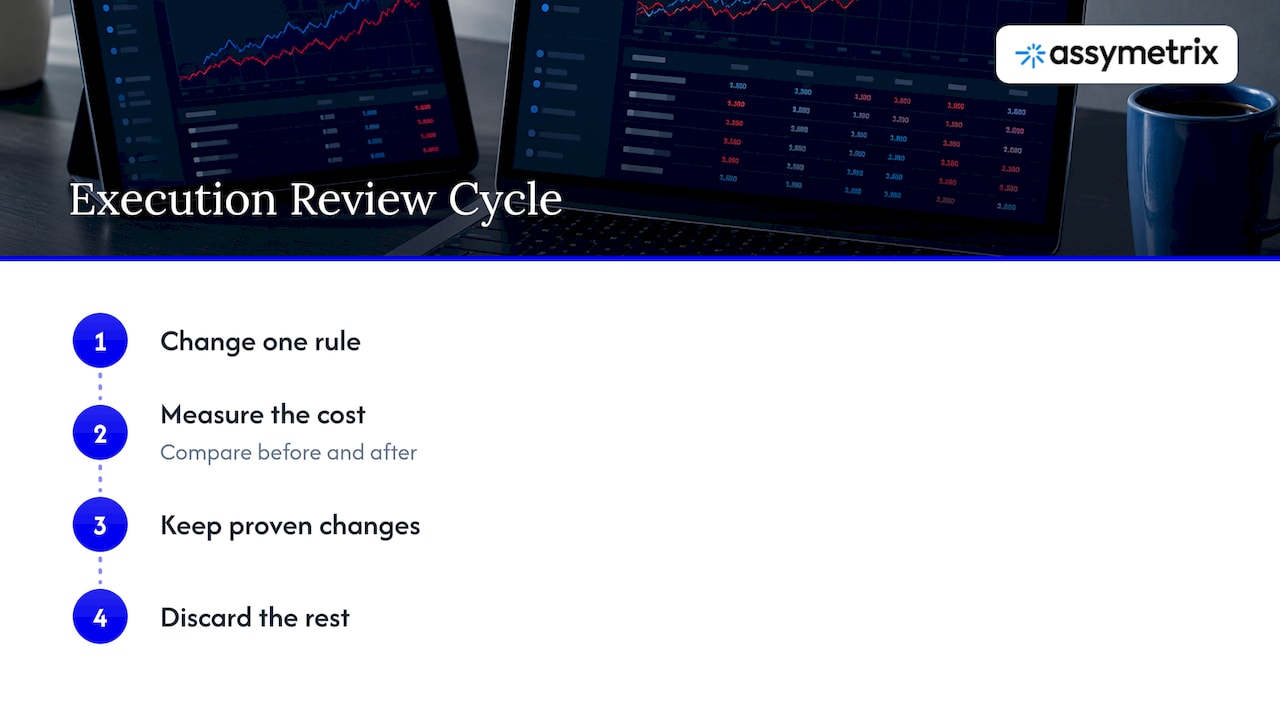
Replace ad-hoc fixes with iteration. Change one rule, measure the cost before and after, keep what holds up, and discard the rest.
— Dean
Normalized cross-venue feeds for sizing, routing, and measurement

Our Data API gives you real-time top-of-book feeds, historical trade tapes, canonical IDs, Smart Money wallet tracking, trader skill scores, and cross-venue arbitrage signals through one integration. Those are the inputs for sizing against real depth, routing between venues, and computing implementation shortfall afterward. If you are building execution simulation or monitoring, start with our data feed guide and try the feeds against your own order flow.
FAQ
What is the best order type in a thin prediction market?
A limit order is usually the better choice. Market orders hit the ask and can pay a wide spread, so resting limit orders protect your price at the cost of possible partial or missed fills.
What is implementation shortfall in prediction markets?
It is the gap between the price when you decided to trade and what you actually realized. It splits into delay, execution, and opportunity cost, which tells you whether the loss came from hesitation, impact, or unfilled size.
How do I reduce slippage on large orders?
Slice the order into smaller children sized against top-of-book depth, and spread them over time. The CFA Institute framework notes the tradeoff: slower trading lowers impact but raises exposure to price drift.
Does forecasting accuracy matter more than execution?
Both matter, but accuracy alone does not guarantee profit. Simulation research indicates execution quality largely determines who profits in prediction markets.
Sources
Prediction Market Execution: Track Slippage Across Venues
Execution, meaning order type, size, and timing, shapes realized P&L as much as forecasting does. To protect your edge, use limit orders in thin markets, scale each order to the depth actually available, and slice institutional sizes with an algorithm. Then measure slippage and implementation shortfall after every trade, because an unmeasured fill cannot be improved; understanding these costs is crucial to optimize your trading, as explained in How It Works | DavinciPay.
TL;DR:
A market order consumes successive book levels until filled, while a limit order protects its price but may fill only partially or not at all.
Choose scheduled slicing for nonurgent orders, liquidity seeking when displayed size appears, and arrival price execution when a fast fading signal outweighs market impact.
Implementation shortfall compares realized results with the decision price, separating delay, execution, and opportunity costs from late submission, market impact, and unfilled shares.
Before submitting, check resolution timing and fees; afterward, compare venues, retain full order metadata, and change one execution rule at a time.
AssymetrixCompare Prediction Market Data Across VenuesAssymetrix brings Polymarket, Kalshi, and Limitless data into one API for execution research and cross-venue analysis.Explore the Data API
Table of Contents
Why execution decides who profits in prediction markets
How trades are matched and which order type to use
Execution strategies and algorithm classes that fit prediction markets
Measuring execution cost with slippage and implementation shortfall
A pre-trade, in-flight, and post-trade execution checklist
How cross-venue feeds and derived signals reduce execution uncertainty
Treating execution as a repeatable, measurable edge
Normalized cross-venue feeds for sizing, routing, and measurement
Sources
Why execution decides who profits in prediction markets
Forecasting and execution are separate skills, and only one of them shows up in your fill price. Academic simulations argue that execution quality, not information alone, largely determines who profits in prediction markets, and that execution algorithms can reduce measured slippage at institutional scale.
Execution, not forecasting accuracy alone, largely determines profitability in prediction markets, per simulation research on institutional-scale trading. A correct probability estimate still loses money if you pay the spread and move the price on entry.
The opportunity is real. Kalshi supplies high-frequency, trade-level data that can be mapped from binary contract prices into risk-neutral probability distributions. Richer signals mean more strategies, and more ways to execute them badly. Liquidity also concentrates in a handful of headline contracts, so fill quality is uneven: the same order size that is invisible in a presidential market can move a niche contract several ticks.
How trades are matched and which order type to use
Prediction markets are built from binary contracts that settle to $1 or $0, with prices between $0.01 and $0.99 that read as implied probabilities. Trades match on an order book. The best bid is the highest price a buyer will pay, the best ask is the lowest price a seller will accept, and the gap between them is the spread.
A market order hits the ask (or the bid, when selling) and keeps consuming levels until it is filled, so a large order walks the book and pays progressively worse prices. A limit order rests at your price and may fill in pieces over time, or not at all. In thin markets, limit orders avoid paying wide spreads. Platform flows such as Public’s order ticket also require you to choose the order type and review fees before submitting.
Fetch these from your feed before sending anything:
Best bid, best ask, and the resulting spread
Size available at the top of book on your side
Cumulative depth across multiple levels (see our liquidity metrics guide)
Recent trade sizes and timestamps
Orderbook imbalance between bid and ask depth
Execution strategies and algorithm classes that fit prediction markets
The right algorithm depends on urgency, size, and liquidity. The CFA Institute’s execution framework frames the core choice as market impact versus timing risk: trading slowly limits impact but exposes you to price drift, and the classes (scheduled, liquidity-seeking, arrival-price) map to different urgency levels.
Scheduled slicing (TWAP or VWAP style). For non-urgent size, split the parent order into equal or volume-weighted child orders across a window, each sized well below top-of-book depth.
Liquidity-seeking. In active markets, post adaptive limits at the touch and sweep only when displayed size appears, taking opportunistic fills without crossing the full spread.
Arrival-price. When your signal decays fast, front-load execution against the decision price and accept more impact in exchange for less drift.
Adaptive repricing. Reprice a resting limit one tick toward the market after a set interval without a fill, with a hard cap on how far you will chase.
Pro Tip: Run a monitoring loop that tracks fill rate per slice; if fills fall below plan, widen the interval before widening the price.
A developer sketch: size each child at a fixed fraction of top-3 depth, check fills at regular intervals, cancel and replace stale limits, and halt slicing if the spread widens beyond your threshold. Our price impact analysis shows how order size moves prices, which helps you pick the fraction.
Measuring execution cost with slippage and implementation shortfall
Slippage is the execution price minus a reference price, usually the mid or best quote at submission. Implementation shortfall compares your executed result against the decision price, and it decomposes into delay cost (decision to submission), execution cost (submission to fill), and opportunity cost (the unfilled remainder). Our slippage estimation guide covers the formulas in more detail.
Log these fields for every parent order:
Field | Purpose |
|---|---|
Decision timestamp and price | Anchor for implementation shortfall |
Submit timestamp | Separates delay cost from execution cost |
Execution timestamps and sizes | Reconstructs the fill path |
Execution prices | Computes slippage per child order |
Venue and contract ID | Enables cross-venue comparison |
To estimate expected cost before trading, replay historical top-of-book snapshots, simulate your planned slices against them, and record the slippage distribution for your order size. The Kalshi data described in the Federal Reserve working paper shows that trade-level prediction market data is suitable for this kind of simulation and backtesting.
A pre-trade, in-flight, and post-trade execution checklist
Work through these steps in order:
Pull top-of-book, spread, recent trade sizes, and orderbook imbalance.
Confirm resolution timing and fees so a late entry does not carry hidden cost.
Size the order against top N depth or recent executed trade sizes.
Choose limit orders whenever depth is smaller than your planned size.
Monitor fills and latency, and cancel or replace stale adaptive limits.
Throttle slices when observed fill rates drop.
Compute slippage and implementation shortfall once the order completes.
Two reminders sit around that sequence:
During execution, watch cross-venue divergence: a persistent price gap can justify routing the next slice elsewhere.
After execution, store full metadata for every order, then change one rule at a time so you can attribute the improvement.
How cross-venue feeds and derived signals reduce execution uncertainty
We built our data layer around the inputs execution models need most. Our team works with a unified history containing substantial data from Polymarket, Kalshi, and Limitless, and the useful pieces for execution are:
Normalized trade tapes across venues
Real-time top-of-book snapshots and aggregated depth
Per-wallet flow from Smart Money tracking
Time series of spread and depth for replay
Canonical IDs matter more than they sound. When the same event carries one identifier across venues, merging feeds for routing or simulation stops being a mapping project (our canonical IDs guide walks through it). For validation, log telemetry per trade and rerun your simulation on a regular cadence, so you learn when an execution rule has stopped working. Our orderbook integration guide covers ingestion.
Treating execution as a repeatable, measurable edge
Most traders I see treat a bad fill as bad luck and move on. That is the wrong frame. Execution is a process with inputs you control, so it deserves the same discipline as a forecasting model: telemetry on every order, an internal service level for acceptable slippage, and a periodic implementation shortfall review. Without that, forecast alpha leaks away in increments too small to notice.
Replace ad-hoc fixes with iteration. Change one rule, measure the cost before and after, keep what holds up, and discard the rest.
— Dean
Normalized cross-venue feeds for sizing, routing, and measurement
Our Data API gives you real-time top-of-book feeds, historical trade tapes, canonical IDs, Smart Money wallet tracking, trader skill scores, and cross-venue arbitrage signals through one integration. Those are the inputs for sizing against real depth, routing between venues, and computing implementation shortfall afterward. If you are building execution simulation or monitoring, start with our data feed guide and try the feeds against your own order flow.
FAQ
What is the best order type in a thin prediction market?
A limit order is usually the better choice. Market orders hit the ask and can pay a wide spread, so resting limit orders protect your price at the cost of possible partial or missed fills.
What is implementation shortfall in prediction markets?
It is the gap between the price when you decided to trade and what you actually realized. It splits into delay, execution, and opportunity cost, which tells you whether the loss came from hesitation, impact, or unfilled size.
How do I reduce slippage on large orders?
Slice the order into smaller children sized against top-of-book depth, and spread them over time. The CFA Institute framework notes the tradeoff: slower trading lowers impact but raises exposure to price drift.
Does forecasting accuracy matter more than execution?
Both matter, but accuracy alone does not guarantee profit. Simulation research indicates execution quality largely determines who profits in prediction markets.
Sources
Other Blog


