Build Copy Trading for Prediction Markets with Canonical Data & Rules
Build Copy Trading for Prediction Markets with Canonical Data & Rules
Build Copy Trading for Prediction Markets with Canonical Data & Rules
Engineer-ready roadmap for copy trading in prediction markets: canonical cross venue data, deterministic belief to trade rules, fee aware execution, and...

Build Copy Trading for Prediction Markets with Canonical Data & Rules
Programmatic copy trading for prediction markets means running a deterministic trading layer on top of canonical, cross-venue data, not mirroring a single trader’s clicks. Building one requires five components: normalized data across venues, semantic matching that resolves identical questions into one canonical ID, a belief-to-trade layer that turns forecasts into sized orders, deterministic execution and risk controls, and a replayable backtest harness. Cross-venue aggregators supply the normalized data layer this architecture depends on.
TL;DR:
Ensuring normalized, cross-venue data with canonical IDs, price equivalence, and explicit multi-outcome handling is essential for accurate backtesting and trading.
Deriving signals like trader skill scores, divergence metrics, and semantic match confidence significantly improves trading decisions and downside management.
Modeling fees, order queue mechanics, and settlement risks explicitly in simulation reduces overestimation of strategy profitability.
Automating belief-to-trade rules with deterministic execution and risk caps outperforms forecast-only approaches and minimizes manual intervention.
Comprehensive, historical bulk data exports and strict event ordering are crucial for reliable backtesting and assessing true trading performance.
Assymetrixassymetrix.comBuild With Unified Market DataAssymetrix gives traders, developers, and AI agents unified cross venue prediction market data through a single Data API integration.Explore Assymetrix
Table of Contents
What Data and Signals Does Copy Trading Need?
Architecture for a Copy-Trading Pipeline
How to Integrate Feeds and Backtest Deterministically
Risk and Execution Considerations That Break Naive Systems
Legal and Regulatory Considerations for Copy Trading
Psychological and Behavioral Factors in Copy Trading
Technological Platforms and Tools for Copy Trading
What the Research Actually Tells Builders
How Assymetrix Maps to This Architecture
Sources
What Data and Signals Does Copy Trading Need?
A copy-trading system is only as good as the feed under it. At minimum, you need per-market fields: market ID, question text, resolution rules, cutoff timestamp, oracle ID, tick size, fee schedule, full orderbook snapshots, trade events, and timestamps normalized to UTC. Skip any of these and your backtests will disagree with live results the first time a market resolves ambiguously.
Normalization is where most homegrown pipelines break. You need a canonical ID strategy that maps the same real-world event across Polymarket, Kalshi, and Limitless to one identifier, USD-equivalent pricing so spreads are comparable, a unified time series despite each venue’s own tick cadence, and explicit handling for multi-outcome markets that partition probability across more than two states.
On top of raw data, derived signals are what make the system worth building, including the benefits of automated trade signals for smarter trading:
Smart Money wallet leaderboards that rank addresses by realized edge rather than volume alone.
Trader Skill Scores that separate consistent forecasters from lucky streaks.
Cross-venue spread and divergence metrics that flag when the same event prices differently on two platforms.
Semantic match confidence scores that quantify how sure your matching layer is that two listings describe the same event.
Data quality heuristics matter as much as the fields themselves: apply liquidity thresholding before trusting a quoted price, define staleness windows per venue, enforce a minimum depth per side before sizing a position, and flag markets whose resolution rules are worded ambiguously.
A hybrid statistical and LLM semantic filtering pipeline improved win rates and reduced the average size of losing trades on tested Kalshi markets, according to research on LLM semantic filtering for lead-lag trading. That single layer of semantic verification changes the shape of your downside, not just your hit rate.
Architecture for a Copy-Trading Pipeline
Four layers do the work, each with a narrow job and a clean interface to the next.
Canonical data layer. Ingestion pipelines pull orderbooks, trades, and resolution events from each venue, deduplicate them, and assign canonical IDs through semantic matching. This layer exposes normalized REST and WebSocket APIs for live consumption and bulk exports for backfill, so the same schema serves both your production bot and your historical research.
Belief-to-trade layer. This is where a forecast becomes an order. It applies candidate selection (which markets clear your confidence threshold), position sizing through fractional Kelly or another constrained rule, and deterministic stake logic so the same inputs always produce the same trade. Soft and hard exposure caps sit here too, capping single-market and portfolio-wide risk before anything reaches the execution layer.
Execution and risk. This module decides maker versus taker order placement, whether to use POST_ONLY or GTC, and how to route for the best fee-adjusted price. It enforces slippage guardrails, retry and cancel policies for stale quotes, and tracks capital locked against pending settlement or disputed resolutions, since that capital is not available for new positions.
Monitoring and archive. Every trade, snapshot, and wallet interaction gets logged for reproducible replay later. Anomaly detectors watch for coordinated wallet clusters acting in lockstep, which often precede manipulation attempts rather than organic signal.
Pro Tip: Persist a “pulse” artifact with every trade decision: the data snapshot, any external evidence consulted, and the pre-trade thesis, so a replay months later can reconstruct exactly why the system acted.
For a concrete walkthrough of wiring orderbook data into execution logic, our guide to building a Polymarket bot covers the data, signal, and execution stages in sequence.
How to Integrate Feeds and Backtest Deterministically
Integration starts with episode construction: replay orderbook updates, trade events, and settlement events together in strict UTC order with sequence numbers, so no event can be processed out of turn. Without strict ordering, a backtest can “see” a price move before the trade that caused it, producing results that never happen live.
Your simulator needs to model the mechanics that actually move P&L: maker and taker fee schedules, order queue semantics (who gets filled first at a given price level), deterministic fills rather than randomized ones, and settlement modeling that accounts for dispute-era lockups where capital is frozen pending resolution.
Once the simulator is in place, track metrics that reveal whether a strategy is real or a backtest artifact:
Edge after fees, not raw mid-price edge, since fee schedules can erase an apparent advantage.
Realized P&L and equity curves across the full replay window, not a cherry-picked segment.
Maximum drawdown, which tells you how much capital stress the strategy can survive.
Hit rate against forecast calibration, confirming your confidence scores mean what they claim.
Execution slippage decomposition, separating fee cost from timing cost from queue-position cost.
A sensible rollout sequence is a small-scope replay on high-liquidity events first, then sensitivity sweeps across latency, fee, and liquidity assumptions, and only then a full-sample reproducible run across your entire history. Deterministic, event-driven replay benchmarks that model maker and taker semantics, such as PredictionMarketBench, exist specifically so two teams testing different agents can compare results on identical ground. Our orderbook parsing reference walks through the field-level details this stage depends on.
Risk and Execution Considerations That Break Naive Systems
Fees decide profitability more often than signal quality does. At a 50 cent price with a 7% taker fee, a trade needs more than 53.5% edge just to break even, according to PredictionMarketBench’s fee analysis, and maker orders carry substantially lower costs than taker orders in the same schedule. A strategy that looks profitable on mid-price alone can flip to a loss the moment real fee-aware execution is applied.
Settlement and oracle divergence is a second failure mode. Cross-platform arbitrage analysis found an oracle disagreement rate of roughly 5.7% to 6.2%, meaning a hedge that looks risk-free on paper carries real counterparty exposure while capital sits locked awaiting resolution. Risk models need an explicit capital-lock horizon, not just a price-based VaR figure.
A third failure mode is semantic non-fungibility: two venues can list what looks like the same question with subtly different resolution rules, producing price deviations averaging 2% to 4% that look like arbitrage but are not. Mitigations worth building into any system:
Two-pass semantic matching, generating high-recall candidates by embedding similarity and temporal proximity, then verifying structurally with an LLM.
Coordinated wallet detection, flagging groups of addresses that trade in persistent lockstep.
Exposure caps and watchlists on flagged wallets or markets pending manual review.
Delayed execution windows on low-confidence semantic matches rather than firing immediately.
Legal and Regulatory Considerations for Copy Trading
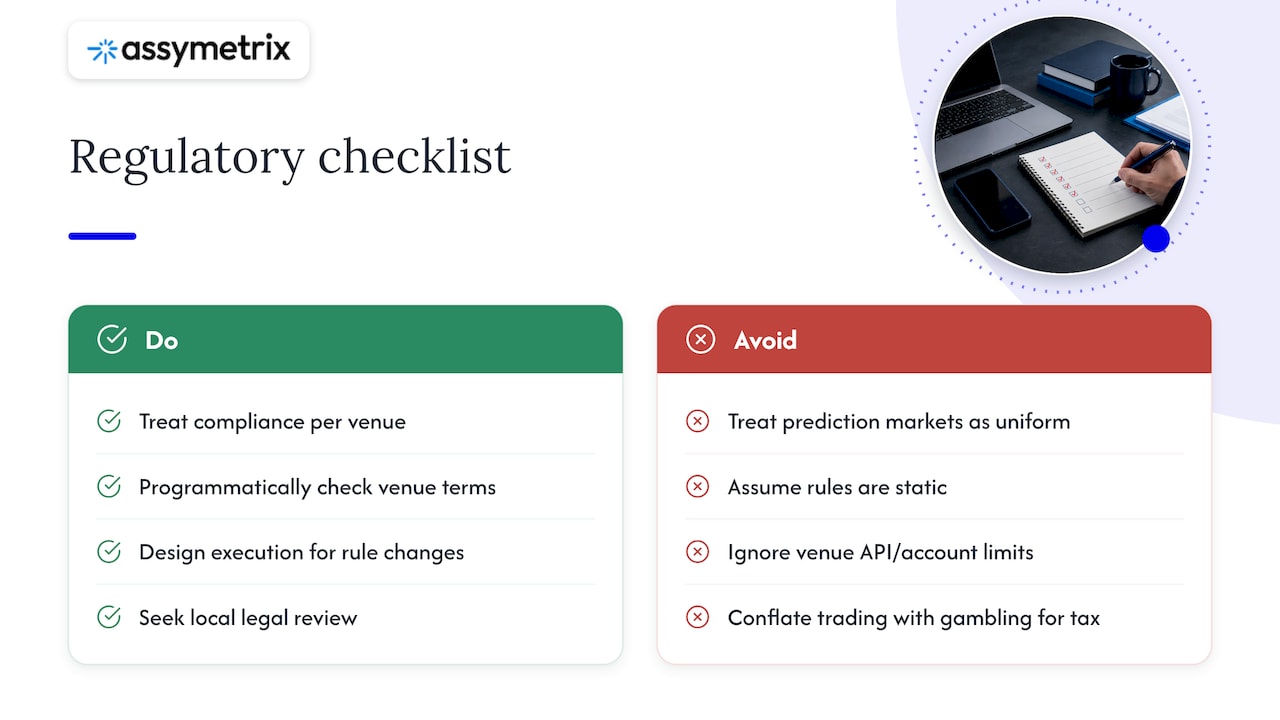
Regulatory treatment of prediction markets varies by venue structure and jurisdiction, and that variance carries directly into any automated system built on top of them. Some venues operate as regulated derivatives exchanges under commodities oversight, while others run as offshore or decentralized platforms with different compliance postures. A copy-trading system that routes capital across venues inherits each venue’s own regulatory status for that leg of the trade, so treating “prediction markets” as one uniform legal category is a mistake that shows up later as an operational surprise.
For developers, the practical questions are narrower than broad market legality: does the venue’s terms of service permit automated or algorithmic order placement, does API access require a specific account tier or disclosure, and does the venue restrict residents of certain jurisdictions from trading specific contract types. These terms change without much notice, so a production system should check venue terms programmatically where possible rather than assuming last quarter’s rules still apply.
Tax treatment of realized gains also differs by jurisdiction and by whether the activity is classified as trading or gambling, a distinction regulators have not settled uniformly. None of this substitutes for legal review specific to where you operate and where your users are based. Build the engineering assumption that compliance requirements are venue-specific and time-varying, and design your execution layer to accept per-venue rule changes without a code rewrite.
Psychological and Behavioral Factors in Copy Trading
Automating the belief-to-trade layer removes manual hesitation, but it does not remove behavioral risk from the system design itself. The most common failure is anchoring a sizing rule to a single backtest window that happened to favor the strategy, then treating that window’s Kelly fraction as universal truth rather than as a sample estimate with its own uncertainty.
A second pattern is overfitting confidence thresholds to past coordinated-wallet behavior that will not repeat identically. Wallets that showed skill in one market regime can revert once liquidity conditions or the pool of counterparties shifts, and a system tuned too tightly to historical Smart Money signals will lag that shift rather than adapt to it.
A third factor is the temptation to override deterministic rules manually after a losing streak, which defeats the purpose of building a deterministic layer in the first place. Research on belief-to-trade architectures found that a deterministic, auditable trading layer outperformed forecast-only approaches precisely because it removed discretionary intervention from the sizing and execution decision. Any team running a copy-trading agent should treat manual override as a logged, reviewed exception, not a routine adjustment, and should revisit sizing assumptions on a fixed schedule rather than in reaction to a single bad week.
Technological Platforms and Tools for Copy Trading
A working copy-trading stack has three layers of tooling, and conflating them is a common design mistake. The first is venue-native APIs: Polymarket, Kalshi, and Limitless each expose their own endpoints for orderbooks, trades, and account actions, with different schemas, rate limits, and authentication models. Building directly against three separate APIs means maintaining three separate integrations that drift out of sync every time one venue changes its schema.
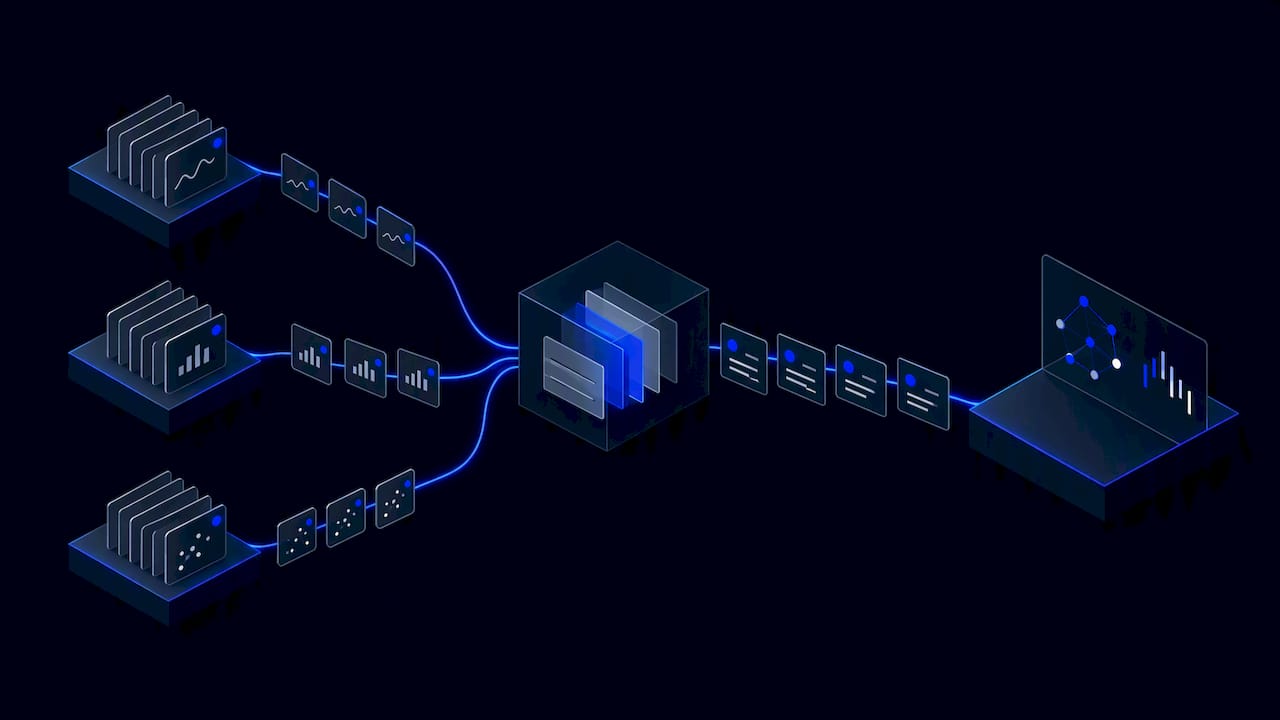
The second layer is cross-venue aggregation and intelligence, which normalizes those three schemas into one canonical feed, resolves semantic matching across venues, and surfaces derived signals like wallet skill scores and arbitrage spreads without requiring you to rebuild that logic from raw trade data. This is the layer most development time goes to when teams build in-house, and it is also the layer most prone to silent bugs, since a bad canonical match looks like valid data until a trade settles unexpectedly.
The third layer is execution and backtesting infrastructure: the order router, the risk engine, and the deterministic replay simulator described earlier in this piece. Open-source and research-grade tools exist for parts of this stack, including event-driven replay benchmarks and semantic matching frameworks, but production systems typically combine a licensed data layer with custom execution logic tuned to the operator’s own risk tolerance and capital base.
What the Research Actually Tells Builders
The clearest finding across recent prediction market research is that forecasting skill alone does not produce returns. The belief-to-trade architecture study found that a deterministic trading layer enforcing sizing and execution rules was the only tested policy to post a positive risk-adjusted return in a controlled replay, while forecast-only agents did not. Semantic filtering research reinforces the same lesson from a different angle: verification layers do not just catch noise, they cut the size of losing trades.
The practical prescription follows directly: pair a forecasting model with deterministic trading rules and fee-aware execution modeling, and evaluate the combination on a reproducible replay harness rather than a single historical run. Our AI agent architecture guide extends this reasoning into agent-specific design patterns.
— Dean
How Assymetrix Maps to This Architecture
Everything described above needs a canonical data layer underneath it, and that is the layer we built. A data API can normalize feeds across Polymarket, Kalshi, and Limitless into one schema, resolve semantic matching into canonical IDs to avoid false arbitrage from mismatched question text, and provide historical bulk exports large enough for building reproducible backtests.
For teams assembling the components in this piece, the integration list looks like this:
Normalized REST and WebSocket feeds covering multiple venues through unified access.
Canonical IDs that resolve semantically equivalent markets.
Wallet tracking and trader skill scores as inputs to a belief-to-trade layer.
Historical bulk exports sized for full-sample backtests rather than thin sample windows.
Check our Data API documentation to see the endpoints and schema in full.
FAQ
What is copy trading in prediction markets for developers?
For developers, copy trading means building a deterministic system that detects skilled trader or wallet behavior across venues and replicates it through sized, rule-based orders, not manually mirroring a single account. The components are canonical cross-venue data, a belief-to-trade sizing layer, and fee-aware execution.
How do I detect arbitrage across prediction market venues?
Reliable detection starts with semantic matching that resolves identical questions into one canonical ID, since naive text matching produces false positives from semantically non-fungible listings. Research on semantic non-fungibility found persistent price deviations averaging 2% to 4% between venues even on supposedly matched markets, which a two-pass embedding-plus-LLM verification step helps filter out.
Why do backtests overstate copy-trading profitability?
Most overstated backtests ignore maker and taker fee schedules and order queue semantics, both of which change realized P&L substantially. A deterministic, event-driven replay that models fees explicitly, such as the PredictionMarketBench approach, shows that a position needing over 53.5% edge to break even at a 50 cent price with a 7% taker fee can look profitable under a naive mid-price backtest and unprofitable once real execution costs are applied.
What data do I need before building a copy-trading bot?
At minimum you need normalized orderbook snapshots, trade events, resolution rules, and oracle identifiers across every venue you trade, all timestamped to UTC with a canonical ID scheme linking equivalent markets. Our cross-venue data feed guide details the schema fields this requires.
Does Assymetrix provide historical data for backtesting?
Yes, our Data API includes historical bulk exports spanning multiple terabytes across hundreds of millions of rows of cross-venue trading activity, suitable for full-sample reproducible backtests. Pricing and access details are available on our Data API page.
Sources
Build Copy Trading for Prediction Markets with Canonical Data & Rules
Programmatic copy trading for prediction markets means running a deterministic trading layer on top of canonical, cross-venue data, not mirroring a single trader’s clicks. Building one requires five components: normalized data across venues, semantic matching that resolves identical questions into one canonical ID, a belief-to-trade layer that turns forecasts into sized orders, deterministic execution and risk controls, and a replayable backtest harness. Cross-venue aggregators supply the normalized data layer this architecture depends on.
TL;DR:
Ensuring normalized, cross-venue data with canonical IDs, price equivalence, and explicit multi-outcome handling is essential for accurate backtesting and trading.
Deriving signals like trader skill scores, divergence metrics, and semantic match confidence significantly improves trading decisions and downside management.
Modeling fees, order queue mechanics, and settlement risks explicitly in simulation reduces overestimation of strategy profitability.
Automating belief-to-trade rules with deterministic execution and risk caps outperforms forecast-only approaches and minimizes manual intervention.
Comprehensive, historical bulk data exports and strict event ordering are crucial for reliable backtesting and assessing true trading performance.
Assymetrixassymetrix.comBuild With Unified Market DataAssymetrix gives traders, developers, and AI agents unified cross venue prediction market data through a single Data API integration.Explore Assymetrix
Table of Contents
What Data and Signals Does Copy Trading Need?
Architecture for a Copy-Trading Pipeline
How to Integrate Feeds and Backtest Deterministically
Risk and Execution Considerations That Break Naive Systems
Legal and Regulatory Considerations for Copy Trading
Psychological and Behavioral Factors in Copy Trading
Technological Platforms and Tools for Copy Trading
What the Research Actually Tells Builders
How Assymetrix Maps to This Architecture
Sources
What Data and Signals Does Copy Trading Need?
A copy-trading system is only as good as the feed under it. At minimum, you need per-market fields: market ID, question text, resolution rules, cutoff timestamp, oracle ID, tick size, fee schedule, full orderbook snapshots, trade events, and timestamps normalized to UTC. Skip any of these and your backtests will disagree with live results the first time a market resolves ambiguously.
Normalization is where most homegrown pipelines break. You need a canonical ID strategy that maps the same real-world event across Polymarket, Kalshi, and Limitless to one identifier, USD-equivalent pricing so spreads are comparable, a unified time series despite each venue’s own tick cadence, and explicit handling for multi-outcome markets that partition probability across more than two states.
On top of raw data, derived signals are what make the system worth building, including the benefits of automated trade signals for smarter trading:
Smart Money wallet leaderboards that rank addresses by realized edge rather than volume alone.
Trader Skill Scores that separate consistent forecasters from lucky streaks.
Cross-venue spread and divergence metrics that flag when the same event prices differently on two platforms.
Semantic match confidence scores that quantify how sure your matching layer is that two listings describe the same event.
Data quality heuristics matter as much as the fields themselves: apply liquidity thresholding before trusting a quoted price, define staleness windows per venue, enforce a minimum depth per side before sizing a position, and flag markets whose resolution rules are worded ambiguously.
A hybrid statistical and LLM semantic filtering pipeline improved win rates and reduced the average size of losing trades on tested Kalshi markets, according to research on LLM semantic filtering for lead-lag trading. That single layer of semantic verification changes the shape of your downside, not just your hit rate.
Architecture for a Copy-Trading Pipeline
Four layers do the work, each with a narrow job and a clean interface to the next.
Canonical data layer. Ingestion pipelines pull orderbooks, trades, and resolution events from each venue, deduplicate them, and assign canonical IDs through semantic matching. This layer exposes normalized REST and WebSocket APIs for live consumption and bulk exports for backfill, so the same schema serves both your production bot and your historical research.
Belief-to-trade layer. This is where a forecast becomes an order. It applies candidate selection (which markets clear your confidence threshold), position sizing through fractional Kelly or another constrained rule, and deterministic stake logic so the same inputs always produce the same trade. Soft and hard exposure caps sit here too, capping single-market and portfolio-wide risk before anything reaches the execution layer.
Execution and risk. This module decides maker versus taker order placement, whether to use POST_ONLY or GTC, and how to route for the best fee-adjusted price. It enforces slippage guardrails, retry and cancel policies for stale quotes, and tracks capital locked against pending settlement or disputed resolutions, since that capital is not available for new positions.
Monitoring and archive. Every trade, snapshot, and wallet interaction gets logged for reproducible replay later. Anomaly detectors watch for coordinated wallet clusters acting in lockstep, which often precede manipulation attempts rather than organic signal.
Pro Tip: Persist a “pulse” artifact with every trade decision: the data snapshot, any external evidence consulted, and the pre-trade thesis, so a replay months later can reconstruct exactly why the system acted.
For a concrete walkthrough of wiring orderbook data into execution logic, our guide to building a Polymarket bot covers the data, signal, and execution stages in sequence.
How to Integrate Feeds and Backtest Deterministically
Integration starts with episode construction: replay orderbook updates, trade events, and settlement events together in strict UTC order with sequence numbers, so no event can be processed out of turn. Without strict ordering, a backtest can “see” a price move before the trade that caused it, producing results that never happen live.
Your simulator needs to model the mechanics that actually move P&L: maker and taker fee schedules, order queue semantics (who gets filled first at a given price level), deterministic fills rather than randomized ones, and settlement modeling that accounts for dispute-era lockups where capital is frozen pending resolution.
Once the simulator is in place, track metrics that reveal whether a strategy is real or a backtest artifact:
Edge after fees, not raw mid-price edge, since fee schedules can erase an apparent advantage.
Realized P&L and equity curves across the full replay window, not a cherry-picked segment.
Maximum drawdown, which tells you how much capital stress the strategy can survive.
Hit rate against forecast calibration, confirming your confidence scores mean what they claim.
Execution slippage decomposition, separating fee cost from timing cost from queue-position cost.
A sensible rollout sequence is a small-scope replay on high-liquidity events first, then sensitivity sweeps across latency, fee, and liquidity assumptions, and only then a full-sample reproducible run across your entire history. Deterministic, event-driven replay benchmarks that model maker and taker semantics, such as PredictionMarketBench, exist specifically so two teams testing different agents can compare results on identical ground. Our orderbook parsing reference walks through the field-level details this stage depends on.
Risk and Execution Considerations That Break Naive Systems
Fees decide profitability more often than signal quality does. At a 50 cent price with a 7% taker fee, a trade needs more than 53.5% edge just to break even, according to PredictionMarketBench’s fee analysis, and maker orders carry substantially lower costs than taker orders in the same schedule. A strategy that looks profitable on mid-price alone can flip to a loss the moment real fee-aware execution is applied.
Settlement and oracle divergence is a second failure mode. Cross-platform arbitrage analysis found an oracle disagreement rate of roughly 5.7% to 6.2%, meaning a hedge that looks risk-free on paper carries real counterparty exposure while capital sits locked awaiting resolution. Risk models need an explicit capital-lock horizon, not just a price-based VaR figure.
A third failure mode is semantic non-fungibility: two venues can list what looks like the same question with subtly different resolution rules, producing price deviations averaging 2% to 4% that look like arbitrage but are not. Mitigations worth building into any system:
Two-pass semantic matching, generating high-recall candidates by embedding similarity and temporal proximity, then verifying structurally with an LLM.
Coordinated wallet detection, flagging groups of addresses that trade in persistent lockstep.
Exposure caps and watchlists on flagged wallets or markets pending manual review.
Delayed execution windows on low-confidence semantic matches rather than firing immediately.
Legal and Regulatory Considerations for Copy Trading
Regulatory treatment of prediction markets varies by venue structure and jurisdiction, and that variance carries directly into any automated system built on top of them. Some venues operate as regulated derivatives exchanges under commodities oversight, while others run as offshore or decentralized platforms with different compliance postures. A copy-trading system that routes capital across venues inherits each venue’s own regulatory status for that leg of the trade, so treating “prediction markets” as one uniform legal category is a mistake that shows up later as an operational surprise.
For developers, the practical questions are narrower than broad market legality: does the venue’s terms of service permit automated or algorithmic order placement, does API access require a specific account tier or disclosure, and does the venue restrict residents of certain jurisdictions from trading specific contract types. These terms change without much notice, so a production system should check venue terms programmatically where possible rather than assuming last quarter’s rules still apply.
Tax treatment of realized gains also differs by jurisdiction and by whether the activity is classified as trading or gambling, a distinction regulators have not settled uniformly. None of this substitutes for legal review specific to where you operate and where your users are based. Build the engineering assumption that compliance requirements are venue-specific and time-varying, and design your execution layer to accept per-venue rule changes without a code rewrite.
Psychological and Behavioral Factors in Copy Trading
Automating the belief-to-trade layer removes manual hesitation, but it does not remove behavioral risk from the system design itself. The most common failure is anchoring a sizing rule to a single backtest window that happened to favor the strategy, then treating that window’s Kelly fraction as universal truth rather than as a sample estimate with its own uncertainty.
A second pattern is overfitting confidence thresholds to past coordinated-wallet behavior that will not repeat identically. Wallets that showed skill in one market regime can revert once liquidity conditions or the pool of counterparties shifts, and a system tuned too tightly to historical Smart Money signals will lag that shift rather than adapt to it.
A third factor is the temptation to override deterministic rules manually after a losing streak, which defeats the purpose of building a deterministic layer in the first place. Research on belief-to-trade architectures found that a deterministic, auditable trading layer outperformed forecast-only approaches precisely because it removed discretionary intervention from the sizing and execution decision. Any team running a copy-trading agent should treat manual override as a logged, reviewed exception, not a routine adjustment, and should revisit sizing assumptions on a fixed schedule rather than in reaction to a single bad week.
Technological Platforms and Tools for Copy Trading
A working copy-trading stack has three layers of tooling, and conflating them is a common design mistake. The first is venue-native APIs: Polymarket, Kalshi, and Limitless each expose their own endpoints for orderbooks, trades, and account actions, with different schemas, rate limits, and authentication models. Building directly against three separate APIs means maintaining three separate integrations that drift out of sync every time one venue changes its schema.
The second layer is cross-venue aggregation and intelligence, which normalizes those three schemas into one canonical feed, resolves semantic matching across venues, and surfaces derived signals like wallet skill scores and arbitrage spreads without requiring you to rebuild that logic from raw trade data. This is the layer most development time goes to when teams build in-house, and it is also the layer most prone to silent bugs, since a bad canonical match looks like valid data until a trade settles unexpectedly.
The third layer is execution and backtesting infrastructure: the order router, the risk engine, and the deterministic replay simulator described earlier in this piece. Open-source and research-grade tools exist for parts of this stack, including event-driven replay benchmarks and semantic matching frameworks, but production systems typically combine a licensed data layer with custom execution logic tuned to the operator’s own risk tolerance and capital base.
What the Research Actually Tells Builders
The clearest finding across recent prediction market research is that forecasting skill alone does not produce returns. The belief-to-trade architecture study found that a deterministic trading layer enforcing sizing and execution rules was the only tested policy to post a positive risk-adjusted return in a controlled replay, while forecast-only agents did not. Semantic filtering research reinforces the same lesson from a different angle: verification layers do not just catch noise, they cut the size of losing trades.
The practical prescription follows directly: pair a forecasting model with deterministic trading rules and fee-aware execution modeling, and evaluate the combination on a reproducible replay harness rather than a single historical run. Our AI agent architecture guide extends this reasoning into agent-specific design patterns.
— Dean
How Assymetrix Maps to This Architecture
Everything described above needs a canonical data layer underneath it, and that is the layer we built. A data API can normalize feeds across Polymarket, Kalshi, and Limitless into one schema, resolve semantic matching into canonical IDs to avoid false arbitrage from mismatched question text, and provide historical bulk exports large enough for building reproducible backtests.
For teams assembling the components in this piece, the integration list looks like this:
Normalized REST and WebSocket feeds covering multiple venues through unified access.
Canonical IDs that resolve semantically equivalent markets.
Wallet tracking and trader skill scores as inputs to a belief-to-trade layer.
Historical bulk exports sized for full-sample backtests rather than thin sample windows.
Check our Data API documentation to see the endpoints and schema in full.
FAQ
What is copy trading in prediction markets for developers?
For developers, copy trading means building a deterministic system that detects skilled trader or wallet behavior across venues and replicates it through sized, rule-based orders, not manually mirroring a single account. The components are canonical cross-venue data, a belief-to-trade sizing layer, and fee-aware execution.
How do I detect arbitrage across prediction market venues?
Reliable detection starts with semantic matching that resolves identical questions into one canonical ID, since naive text matching produces false positives from semantically non-fungible listings. Research on semantic non-fungibility found persistent price deviations averaging 2% to 4% between venues even on supposedly matched markets, which a two-pass embedding-plus-LLM verification step helps filter out.
Why do backtests overstate copy-trading profitability?
Most overstated backtests ignore maker and taker fee schedules and order queue semantics, both of which change realized P&L substantially. A deterministic, event-driven replay that models fees explicitly, such as the PredictionMarketBench approach, shows that a position needing over 53.5% edge to break even at a 50 cent price with a 7% taker fee can look profitable under a naive mid-price backtest and unprofitable once real execution costs are applied.
What data do I need before building a copy-trading bot?
At minimum you need normalized orderbook snapshots, trade events, resolution rules, and oracle identifiers across every venue you trade, all timestamped to UTC with a canonical ID scheme linking equivalent markets. Our cross-venue data feed guide details the schema fields this requires.
Does Assymetrix provide historical data for backtesting?
Yes, our Data API includes historical bulk exports spanning multiple terabytes across hundreds of millions of rows of cross-venue trading activity, suitable for full-sample reproducible backtests. Pricing and access details are available on our Data API page.
Sources
Other Blog


