AI Agents in Prediction Markets: A 2026 Developer Guide
AI Agents in Prediction Markets: A 2026 Developer Guide
AI Agents in Prediction Markets: A 2026 Developer Guide
Discover how AI agents in prediction markets are revolutionizing trading. Learn to harness their power in this comprehensive 2026 developer guide.

AI Agents in Prediction Markets: A 2026 Developer Guide
Autonomous AI agents in prediction markets are software systems that ingest offchain data, compute outcome probabilities, compare those estimates to live market prices, and execute trades programmatically via smart contracts, all without human intervention. By 2025, total notional trading volume across major platforms reached $44 billion annually, with Kalshi and Polymarket together dominating between 85% and 97% of sector volume. That scale makes prediction markets a serious environment for algorithmic systems, not a sandbox.
The core operational loop is consistent across frameworks:
Data ingestion: Agents scrape news feeds, financial reports, and social media, then normalize inputs through NLP pipelines.
Probability scoring: Machine learning models assign outcome likelihoods, updating continuously as new data arrives.
Market comparison: The agent’s internal probability is compared to the current onchain price to identify a tradeable edge.
Trade execution: When edge exceeds a threshold, the agent submits orders via smart contract, often using the Chainlink Runtime Environment (CRE) to bridge offchain computation to onchain settlement.
Frameworks like the Gnosis prediction market agent and Nick AI provide scaffolding for this loop. Platforms like Polymarket and Kalshi expose the APIs and contract interfaces agents connect to. The Chainlink Runtime Environment handles the critical handoff between offchain AI logic and onchain execution.
How AI agents in prediction markets trade and what strategies they use

AI agents monitor a wide range of event categories: elections, central bank decisions, sports outcomes, and economic indicators. The breadth matters because edge concentration in a single category creates correlated risk across positions.
Common algorithmic strategies include:
Favorite-longshot bias arbitrage: Prediction market prices are systematically distorted, with true 50/50 contracts typically trading near 0.57. Agents using the Wang Transform, calibrated on 291,309 resolved contracts across six venues, exploit this distortion systematically.
Kelly criterion sizing: Fractional Kelly bets scale position size to the agent’s estimated edge, balancing growth against ruin risk.
Edge filtering: Agents reject trades where the gap between internal probability and market price falls below a minimum threshold, typically five percentage points, to avoid noise trades.
Inventory risk management: Agents cap exposure per event and across correlated contracts to prevent concentrated drawdowns.
Long-tail market coverage: Agents like Omenstrat and Polystrat scale analysis across hundreds of niche markets simultaneously, capturing opportunities human traders ignore.
Polystrat executed more than 4,200 trades on Polymarket within roughly a month of launch, recording single-trade returns as high as 376%. More than 37% of AI agents on the platform showed positive P&L, compared to roughly 18% of human participants. Agents also operate continuously, capturing pricing dislocations that appear and close within minutes, windows no individual human monitors reliably.
How to build and deploy an AI agent on Polymarket or Kalshi

Step 1: Establish data access
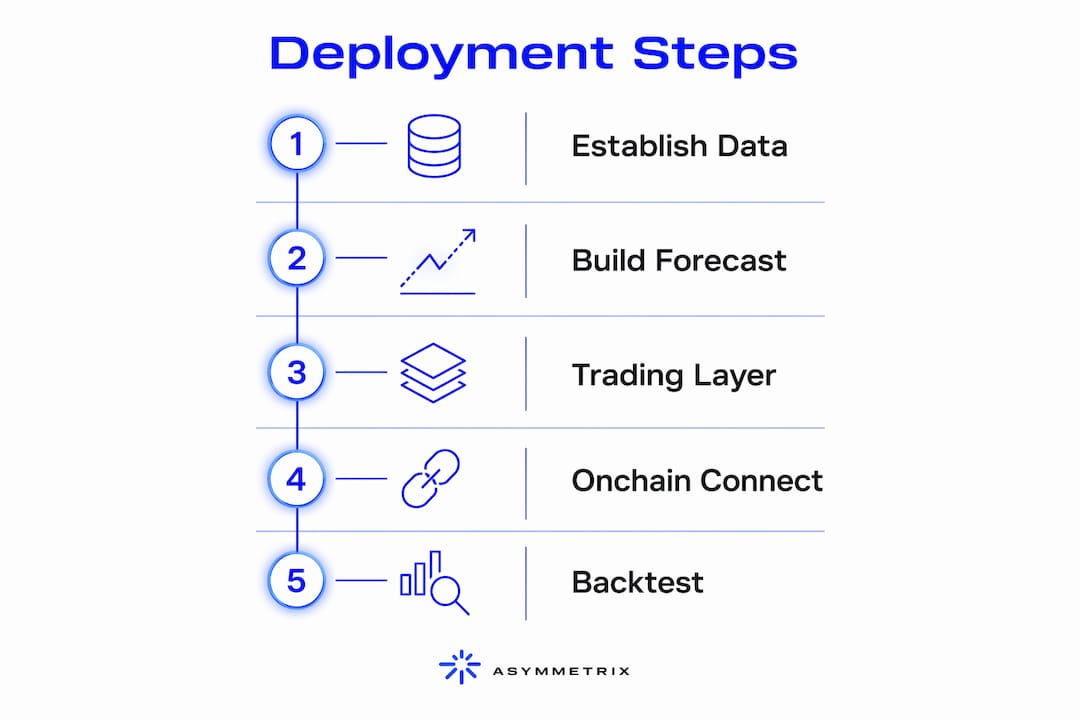
Request API credentials from Polymarket (via the CLOB client) and Kalshi (REST API). For historical depth, theAssymetrix Data API provides unified cross-venue access, built on approximately 1.5 terabytes of historical data spanning nearly one billion rows of trading activity.
Step 2: Build the forecasting module
The forecasting module takes a market question and returns a probability estimate. A minimal Python structure:
def forecast(market_question: str, evidence: list[str]) -> float:
    prompt = build_prompt(market_question, evidence)
    response = llm_client.complete(prompt)
    return parse_probability(response)
def forecast(market_question: str, evidence: list[str]) -> float:
    prompt = build_prompt(market_question, evidence)
    response = llm_client.complete(prompt)
    return parse_probability(response)
Keep this module stateless and swappable. The trading layer should call it, not depend on its internals.
Step 3: Implement the trading layer
The trading layer handles selection, sizing, and risk control independently of the forecasting module. Selection filters candidates by edge. Sizing applies fractional Kelly. Risk control enforces hard constraints before any order is submitted.
def evaluate_trade(market, agent_prob, market_prob):
    edge = agent_prob - market_prob
    if edge < MIN_EDGE_THRESHOLD:
        return None
    kelly_fraction = edge / (1 - market_prob)
    stake = min(kelly_fraction * BANKROLL * KELLY_MULTIPLIER, MAX_STAKE)
    return {"market": market, "stake": stake, "side": "YES" if agent_prob >
def evaluate_trade(market, agent_prob, market_prob):
    edge = agent_prob - market_prob
    if edge < MIN_EDGE_THRESHOLD:
        return None
    kelly_fraction = edge / (1 - market_prob)
    stake = min(kelly_fraction * BANKROLL * KELLY_MULTIPLIER, MAX_STAKE)
    return {"market": market, "stake": stake, "side": "YES" if agent_prob >
Step 4: Connect to onchain execution via Chainlink CRE
The Chainlink Runtime Environment acts as the orchestration layer, securely delivering offchain AI computations to onchain smart contracts. Configure CRE to receive your agent’s trade instructions and route them as fill-or-kill market orders.
Step 5: Backtest before going live
Run your agent against historical market data before committing capital. Replay archived decision sets with your trading layer to isolate whether returns come from forecasting quality or execution logic.
Pro Tip: Run your agent in market-blind mode first, where it never reads live prices, to confirm it generates independent alpha rather than mirroring market consensus.
Calibrated probability scores alone do not yield profitable trades. The gap between strong forecasting and positive returns is closed by an explicit, deterministic trading layer handling selection, sizing, and risk control as separate, auditable components.
Key features that define capable autonomous prediction market agents
The strongest agents share a modular architecture that separates concerns cleanly:
Decoupled forecasting and execution: The forecasting module is swappable; improvements to calibration and trading logic can be evaluated independently.
Deterministic risk constraints: Stop-loss triggers, aggregate exposure caps, per-event position limits, and portfolio-level drawdown halts are enforced as hard rules outside the language model prompt.
Multi-venue support: Agents like oracle3 operate across Kalshi, Polymarket, and additional venues simultaneously, routing orders where liquidity and edge are best.
Real-time data integration: Live news feeds, financial data streams, and sentiment signals feed continuous probability updates.
Wallet autonomy: Agents manage their own custody and submit orders without human approval on each trade.
Audit trails: Every order, its reasoning, and its outcome are logged for post-hoc analysis and strategy refinement.
Community-contributed strategies: Open-source frameworks like the Gnosis prediction market agent and predict-raven support community-contributed strategy modules, accelerating iteration.
Advanced practices for AI prediction market agent development
Decouple forecasting from execution
Separating the forecasting module from the trading layer is the single most important architectural decision. When forecasting and execution are entangled, a miscalibrated model can override risk controls. Keeping them separate means a confidently wrong forecast still hits the same hard constraints as any other.
Use hybrid model architectures
Complex transformer architectures excel at short-term signal discovery. Simpler, more stable models handle execution-side decisions more reliably over longer horizons. Combining both captures accuracy where it matters without sacrificing consistency.
Apply calibrated bias correction
The favorite-longshot bias is not noise. It is a structural feature of prediction market pricing, and agents that ignore it leave systematic edge on the table. The Wang Transform, fit via maximum likelihood estimation on resolved contract data, converts raw market prices into fair-value estimates that expose arbitrage opportunities invisible to uncorrected models.
Enforce risk constraints outside the LLM
Prompt-level risk guidance is unreliable under end-to-end LLM control. A language model that reasons about risk in its output can still produce orders that violate exposure limits when market conditions are unusual. Hard-coded service-layer constraints, enforced before orders reach the exchange, cannot be overridden by model output.
Market-blind forecasting, where the agent estimates probabilities without reading live odds, is the cleanest benchmark for true alpha. If performance degrades when market prices are hidden, the agent is restating consensus, not generating independent signal.
Statistic callout: 37% of AI agents on Polymarket showed positive P&L versus roughly 18% of human participants.
Regulatory and legal considerations for AI agents in US prediction markets
Kalshi operates as a designated contract market regulated by the Commodity Futures Trading Commission (CFTC), which means automated trading on Kalshi falls under the same regulatory framework as other CFTC-regulated derivatives markets. Agents trading on Kalshi must comply with Kalshi’s terms of service, including restrictions on market manipulation and wash trading. Polymarket, operating as a decentralized platform, sits in a more ambiguous regulatory position for US-based participants; the CFTC has taken enforcement action against Polymarket previously, and US persons face access restrictions.
Developers building agents for US markets should treat compliance as a design constraint, not an afterthought. This means logging every trade decision with its reasoning, maintaining audit trails, and building kill-switch mechanisms that halt trading immediately when triggered. Agents capable of detecting suspicious market patterns can also support compliance by flagging anomalies for human review.
Case studies of successful AI agent deployments in prediction markets
Polystrat on Polymarket demonstrated that a continuously running agent with disciplined strategy execution could outperform the majority of human participants. Within its first month, it executed more than 4,200 trades and achieved returns as high as 376% on individual positions, with over 37% of agent instances showing positive P&L.
Oracle3 operationalized the Wang Transform pricing model across Kalshi, Polymarket, and Solana simultaneously. By calibrating on 291,309 resolved contracts, it built a pricing engine that systematically identifies contracts where market prices deviate from fair value, then sizes positions via Kelly criterion. Its architecture includes eight constraint-based arbitrage strategies and two model-driven strategies, all routed through a unified risk manager.
Predict-raven (Raven-Agent) demonstrated the value of the explicit trading layer on a controlled replay of archived decisions. Among five tested policies, Raven-Agent achieved the only positive return and the only positive risk-adjusted return. The edge-proportional baseline, which sized by edge without selection filtering, underperformed flat sizing significantly, confirming that selection and risk filtering matter as much as informed sizing.
Assymetrix: unified data infrastructure for AI agents
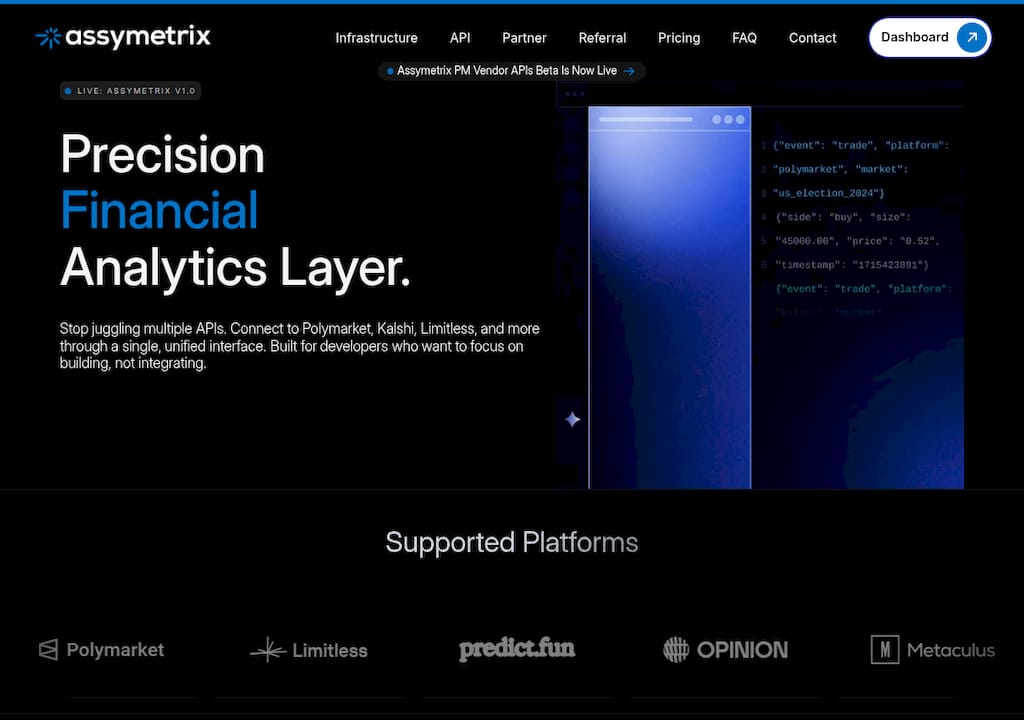
AI agents are only as good as the data they consume. Assymetrix aggregates real-time and historical data from Polymarket, Kalshi, and Limitless into a single normalized API, giving agents consistent market schemas, live odds, Smart Money wallet tracking, cross-venue arbitrage signals, and Trader Skill Scores through one integration. The Assymetrix Data API is built on approximately 1.5 terabytes of historical data spanning nearly one billion rows of trading activity, giving developers the depth needed for rigorous backtesting and live agent operation.
Key Takeaways
AI agents outperform most human prediction market traders by combining calibrated probability forecasting with deterministic, auditable trading layers that enforce risk constraints regardless of model output.
Point | Details |
|---|---|
Separate forecasting from execution | A decoupled trading layer enforces risk controls even when the forecasting model is confidently wrong. |
Enforce hard risk constraints | Stop-losses, exposure caps, and drawdown halts must be coded as service-layer rules, not LLM prompt instructions. |
Exploit structural market biases | The Wang Transform, calibrated on 291,309 contracts, converts the favorite-longshot bias into systematic arbitrage edge. |
Backtest with real historical data | Replay archived decision sets against historical market data before committing live capital. |
AI agents outperform human traders | 37% of AI agents on Polymarket showed positive P&L compared to 18% of human participants. |
At Assymetrix, we’re building intelligence at the intersection of news, events, and technology — synthesizing real-time data across every prediction market platform so event-driven traders see the full picture. Join the platform waitlist or explore our PM Vendor APIs.
FAQ
What are AI agents in prediction markets?
AI agents in prediction markets are autonomous programs that aggregate data, estimate outcome probabilities, and execute trades on platforms like Polymarket and Kalshi without human intervention at each step.
How does the Chainlink Runtime Environment help prediction market agents?
The Chainlink Runtime Environment bridges offchain AI computations, such as probability estimation and news sentiment analysis, to onchain smart contract execution, providing verifiable and secure trade settlement.
Why do AI agents outperform human traders on prediction markets?
AI agents operate 24/7 with no fatigue or emotional bias, applying consistent strategy execution. Data shows 37% of AI agents on Polymarket achieved positive P&L compared to 18% of human participants.
What is the favorite-longshot bias and how do agents exploit it?
The favorite-longshot bias means true 50/50 contracts typically trade near 0.57 on prediction markets. Agents using calibrated models like the Wang Transform identify this distortion and trade against it systematically for arbitrage profit.
What regulatory rules apply to AI agents trading on US prediction markets?
Agents trading on Kalshi fall under CFTC oversight as a designated contract market. Developers must comply with platform terms of service, avoid market manipulation, maintain trade logs, and build kill-switch controls for immediate shutdown.
AI Agents in Prediction Markets: A 2026 Developer Guide
Autonomous AI agents in prediction markets are software systems that ingest offchain data, compute outcome probabilities, compare those estimates to live market prices, and execute trades programmatically via smart contracts, all without human intervention. By 2025, total notional trading volume across major platforms reached $44 billion annually, with Kalshi and Polymarket together dominating between 85% and 97% of sector volume. That scale makes prediction markets a serious environment for algorithmic systems, not a sandbox.
The core operational loop is consistent across frameworks:
Data ingestion: Agents scrape news feeds, financial reports, and social media, then normalize inputs through NLP pipelines.
Probability scoring: Machine learning models assign outcome likelihoods, updating continuously as new data arrives.
Market comparison: The agent’s internal probability is compared to the current onchain price to identify a tradeable edge.
Trade execution: When edge exceeds a threshold, the agent submits orders via smart contract, often using the Chainlink Runtime Environment (CRE) to bridge offchain computation to onchain settlement.
Frameworks like the Gnosis prediction market agent and Nick AI provide scaffolding for this loop. Platforms like Polymarket and Kalshi expose the APIs and contract interfaces agents connect to. The Chainlink Runtime Environment handles the critical handoff between offchain AI logic and onchain execution.
How AI agents in prediction markets trade and what strategies they use
AI agents monitor a wide range of event categories: elections, central bank decisions, sports outcomes, and economic indicators. The breadth matters because edge concentration in a single category creates correlated risk across positions.
Common algorithmic strategies include:
Favorite-longshot bias arbitrage: Prediction market prices are systematically distorted, with true 50/50 contracts typically trading near 0.57. Agents using the Wang Transform, calibrated on 291,309 resolved contracts across six venues, exploit this distortion systematically.
Kelly criterion sizing: Fractional Kelly bets scale position size to the agent’s estimated edge, balancing growth against ruin risk.
Edge filtering: Agents reject trades where the gap between internal probability and market price falls below a minimum threshold, typically five percentage points, to avoid noise trades.
Inventory risk management: Agents cap exposure per event and across correlated contracts to prevent concentrated drawdowns.
Long-tail market coverage: Agents like Omenstrat and Polystrat scale analysis across hundreds of niche markets simultaneously, capturing opportunities human traders ignore.
Polystrat executed more than 4,200 trades on Polymarket within roughly a month of launch, recording single-trade returns as high as 376%. More than 37% of AI agents on the platform showed positive P&L, compared to roughly 18% of human participants. Agents also operate continuously, capturing pricing dislocations that appear and close within minutes, windows no individual human monitors reliably.
How to build and deploy an AI agent on Polymarket or Kalshi
Step 1: Establish data access
Request API credentials from Polymarket (via the CLOB client) and Kalshi (REST API). For historical depth, theAssymetrix Data API provides unified cross-venue access, built on approximately 1.5 terabytes of historical data spanning nearly one billion rows of trading activity.
Step 2: Build the forecasting module
The forecasting module takes a market question and returns a probability estimate. A minimal Python structure:
def forecast(market_question: str, evidence: list[str]) -> float:
    prompt = build_prompt(market_question, evidence)
    response = llm_client.complete(prompt)
    return parse_probability(response)
Keep this module stateless and swappable. The trading layer should call it, not depend on its internals.
Step 3: Implement the trading layer
The trading layer handles selection, sizing, and risk control independently of the forecasting module. Selection filters candidates by edge. Sizing applies fractional Kelly. Risk control enforces hard constraints before any order is submitted.
def evaluate_trade(market, agent_prob, market_prob):
    edge = agent_prob - market_prob
    if edge < MIN_EDGE_THRESHOLD:
        return None
    kelly_fraction = edge / (1 - market_prob)
    stake = min(kelly_fraction * BANKROLL * KELLY_MULTIPLIER, MAX_STAKE)
    return {"market": market, "stake": stake, "side": "YES" if agent_prob >
Step 4: Connect to onchain execution via Chainlink CRE
The Chainlink Runtime Environment acts as the orchestration layer, securely delivering offchain AI computations to onchain smart contracts. Configure CRE to receive your agent’s trade instructions and route them as fill-or-kill market orders.
Step 5: Backtest before going live
Run your agent against historical market data before committing capital. Replay archived decision sets with your trading layer to isolate whether returns come from forecasting quality or execution logic.
Pro Tip: Run your agent in market-blind mode first, where it never reads live prices, to confirm it generates independent alpha rather than mirroring market consensus.
Calibrated probability scores alone do not yield profitable trades. The gap between strong forecasting and positive returns is closed by an explicit, deterministic trading layer handling selection, sizing, and risk control as separate, auditable components.
Key features that define capable autonomous prediction market agents
The strongest agents share a modular architecture that separates concerns cleanly:
Decoupled forecasting and execution: The forecasting module is swappable; improvements to calibration and trading logic can be evaluated independently.
Deterministic risk constraints: Stop-loss triggers, aggregate exposure caps, per-event position limits, and portfolio-level drawdown halts are enforced as hard rules outside the language model prompt.
Multi-venue support: Agents like oracle3 operate across Kalshi, Polymarket, and additional venues simultaneously, routing orders where liquidity and edge are best.
Real-time data integration: Live news feeds, financial data streams, and sentiment signals feed continuous probability updates.
Wallet autonomy: Agents manage their own custody and submit orders without human approval on each trade.
Audit trails: Every order, its reasoning, and its outcome are logged for post-hoc analysis and strategy refinement.
Community-contributed strategies: Open-source frameworks like the Gnosis prediction market agent and predict-raven support community-contributed strategy modules, accelerating iteration.
Advanced practices for AI prediction market agent development
Decouple forecasting from execution
Separating the forecasting module from the trading layer is the single most important architectural decision. When forecasting and execution are entangled, a miscalibrated model can override risk controls. Keeping them separate means a confidently wrong forecast still hits the same hard constraints as any other.
Use hybrid model architectures
Complex transformer architectures excel at short-term signal discovery. Simpler, more stable models handle execution-side decisions more reliably over longer horizons. Combining both captures accuracy where it matters without sacrificing consistency.
Apply calibrated bias correction
The favorite-longshot bias is not noise. It is a structural feature of prediction market pricing, and agents that ignore it leave systematic edge on the table. The Wang Transform, fit via maximum likelihood estimation on resolved contract data, converts raw market prices into fair-value estimates that expose arbitrage opportunities invisible to uncorrected models.
Enforce risk constraints outside the LLM
Prompt-level risk guidance is unreliable under end-to-end LLM control. A language model that reasons about risk in its output can still produce orders that violate exposure limits when market conditions are unusual. Hard-coded service-layer constraints, enforced before orders reach the exchange, cannot be overridden by model output.
Market-blind forecasting, where the agent estimates probabilities without reading live odds, is the cleanest benchmark for true alpha. If performance degrades when market prices are hidden, the agent is restating consensus, not generating independent signal.
Statistic callout: 37% of AI agents on Polymarket showed positive P&L versus roughly 18% of human participants.
Regulatory and legal considerations for AI agents in US prediction markets
Kalshi operates as a designated contract market regulated by the Commodity Futures Trading Commission (CFTC), which means automated trading on Kalshi falls under the same regulatory framework as other CFTC-regulated derivatives markets. Agents trading on Kalshi must comply with Kalshi’s terms of service, including restrictions on market manipulation and wash trading. Polymarket, operating as a decentralized platform, sits in a more ambiguous regulatory position for US-based participants; the CFTC has taken enforcement action against Polymarket previously, and US persons face access restrictions.
Developers building agents for US markets should treat compliance as a design constraint, not an afterthought. This means logging every trade decision with its reasoning, maintaining audit trails, and building kill-switch mechanisms that halt trading immediately when triggered. Agents capable of detecting suspicious market patterns can also support compliance by flagging anomalies for human review.
Case studies of successful AI agent deployments in prediction markets
Polystrat on Polymarket demonstrated that a continuously running agent with disciplined strategy execution could outperform the majority of human participants. Within its first month, it executed more than 4,200 trades and achieved returns as high as 376% on individual positions, with over 37% of agent instances showing positive P&L.
Oracle3 operationalized the Wang Transform pricing model across Kalshi, Polymarket, and Solana simultaneously. By calibrating on 291,309 resolved contracts, it built a pricing engine that systematically identifies contracts where market prices deviate from fair value, then sizes positions via Kelly criterion. Its architecture includes eight constraint-based arbitrage strategies and two model-driven strategies, all routed through a unified risk manager.
Predict-raven (Raven-Agent) demonstrated the value of the explicit trading layer on a controlled replay of archived decisions. Among five tested policies, Raven-Agent achieved the only positive return and the only positive risk-adjusted return. The edge-proportional baseline, which sized by edge without selection filtering, underperformed flat sizing significantly, confirming that selection and risk filtering matter as much as informed sizing.
Assymetrix: unified data infrastructure for AI agents
AI agents are only as good as the data they consume. Assymetrix aggregates real-time and historical data from Polymarket, Kalshi, and Limitless into a single normalized API, giving agents consistent market schemas, live odds, Smart Money wallet tracking, cross-venue arbitrage signals, and Trader Skill Scores through one integration. The Assymetrix Data API is built on approximately 1.5 terabytes of historical data spanning nearly one billion rows of trading activity, giving developers the depth needed for rigorous backtesting and live agent operation.
Key Takeaways
AI agents outperform most human prediction market traders by combining calibrated probability forecasting with deterministic, auditable trading layers that enforce risk constraints regardless of model output.
Point | Details |
|---|---|
Separate forecasting from execution | A decoupled trading layer enforces risk controls even when the forecasting model is confidently wrong. |
Enforce hard risk constraints | Stop-losses, exposure caps, and drawdown halts must be coded as service-layer rules, not LLM prompt instructions. |
Exploit structural market biases | The Wang Transform, calibrated on 291,309 contracts, converts the favorite-longshot bias into systematic arbitrage edge. |
Backtest with real historical data | Replay archived decision sets against historical market data before committing live capital. |
AI agents outperform human traders | 37% of AI agents on Polymarket showed positive P&L compared to 18% of human participants. |
At Assymetrix, we’re building intelligence at the intersection of news, events, and technology — synthesizing real-time data across every prediction market platform so event-driven traders see the full picture. Join the platform waitlist or explore our PM Vendor APIs.
FAQ
What are AI agents in prediction markets?
AI agents in prediction markets are autonomous programs that aggregate data, estimate outcome probabilities, and execute trades on platforms like Polymarket and Kalshi without human intervention at each step.
How does the Chainlink Runtime Environment help prediction market agents?
The Chainlink Runtime Environment bridges offchain AI computations, such as probability estimation and news sentiment analysis, to onchain smart contract execution, providing verifiable and secure trade settlement.
Why do AI agents outperform human traders on prediction markets?
AI agents operate 24/7 with no fatigue or emotional bias, applying consistent strategy execution. Data shows 37% of AI agents on Polymarket achieved positive P&L compared to 18% of human participants.
What is the favorite-longshot bias and how do agents exploit it?
The favorite-longshot bias means true 50/50 contracts typically trade near 0.57 on prediction markets. Agents using calibrated models like the Wang Transform identify this distortion and trade against it systematically for arbitrage profit.
What regulatory rules apply to AI agents trading on US prediction markets?
Agents trading on Kalshi fall under CFTC oversight as a designated contract market. Developers must comply with platform terms of service, avoid market manipulation, maintain trade logs, and build kill-switch controls for immediate shutdown.
Other Blog


