How to Build a Polymarket Bot: Data, Signals, Execution
How to Build a Polymarket Bot: Data, Signals, Execution
How to Build a Polymarket Bot: Data, Signals, Execution
Discover how to build a Polymarket bot with a clear three-layer system for data, signals, and execution, ensuring successful trades.

How to Build a Polymarket Bot: Data, Signals, Execution
Run a three-layer system: data ingestion, signal generation, and execution, gated by paper mode and a hard kill switch. Skip any layer and you either trade blind or trade broke. That’s the whole architecture in one sentence, and everything below is how to build each piece without getting burned by the mistakes that already sank other bots.
The one-line version of the pipeline: Data → Signal → Risk → Execution, with a monitoring layer wrapped around all four. Before you write a single order function, confirm you have:
Python or JS with
py_clob_clientor the JS CLOB SDK installedEnvironment variables set for your wallet key, builder credentials, and API keys
Access to Assymetrix’s
/sdk/markets,/sdk/markets/:id/orderbook, and/sdk/markets/:id/pricingendpointsAn external feed like Binance for cross-venue comparison
ENABLE_LIVE_TRADING=falseas your default
Pro Tip: Never touch the live flag until your paper-mode bot has run a full week without a reconciliation mismatch. Silent state divergence is the most common way bots lose money without anyone noticing until the wallet balance doesn’t match the ledger.
Key Takeaways
A production Polymarket bot needs a data layer, a deterministic signal engine, and a risk-gated execution layer, tested in paper mode before any live capital moves.
Point | Details |
|---|---|
Separate your layers | Keep data ingestion, signal logic, and execution as independent modules you can test in isolation. |
Default to paper mode | Require an explicit |
Model resolution rules | Backtest with TWAP or snapshot resolution logic built in, not just last-traded price. |
Enforce hard risk limits | Set per-wallet caps, daily loss halts, and a global kill switch before writing strategy code. |
Use unified data feeds | Assymetrix’s |
This article is general information, not a substitute for advice from a qualified financial advisor. Consult a qualified financial professional about your own circumstances before acting on anything here.
Table of Contents
Data, Signals, and Execution: The Three-Layer Blueprint
What Data Does a Polymarket Bot Actually Need?
How Do You Generate Trading Signals From Polymarket Data?
Turning a Signal Into a Signed, Submitted Order
What Risk Rules Should Every Bot Enforce?
Backtesting Before You Deploy Live
Deploying and Operating a Live Bot
Minimal Code and Config to Get Running
Why Unified Prediction Market Data Simplifies Bot Development
Sources
Data, Signals, and Execution: The Three-Layer Blueprint
Every working Polymarket bot separates concerns into modules that don’t know about each other’s internals. The architecture pattern that holds up in production runs market discovery, real-time data ingestion, an in-memory order book, a strategy engine, a risk engine, an execution/order manager, a position manager, and monitoring, in that sequence.
Two things carry state: the in-memory order book and the position manager. Everything else, especially signal evaluation, should be stateless and deterministic so you can replay it in tests. Your responsibility map looks like this:
Data layer: guarantees freshness and de-duplication, not correctness of trading logic
Signal engine: guarantees determinism, given identical inputs it always produces identical output
Risk engine: guarantees hard limits are enforced before execution, no exceptions
Execution manager: guarantees idempotent order submission and full audit logging
Keep the strategy read path short. Fetch from local state, never make a network call inside signal evaluation. A signal engine that blocks on I/O is a signal engine that’s already too slow to matter.
Isolating strategy code from execution and risk means you can unit test a signal function with a mocked order book and never touch a live wallet.
What Data Does a Polymarket Bot Actually Need?
Your bot needs five distinct data inputs: market metadata from Gamma, live order book depth and trade flow from the CLOB WebSocket, position and order state from CLOB REST, settlement references from Chainlink oracles, and a correlated external price feed like Binance for cross-venue comparison.
Gamma covers market discovery, categories, and resolution details. The CLOB WebSocket streams book updates and trade prints in real time, while CLOB REST endpoints like /orders and /positions handle account state that doesn’t need sub-second freshness. Chainlink feeds matter specifically for markets that resolve on a TWAP basis rather than a snapshot, since your position manager needs to know which resolution method applies before it can price expected P&L correctly.
Assymetrix’s unified data API simplifies this considerably. /sdk/markets returns normalized market discovery data across venues. /sdk/markets/:id/orderbook gives you order book snapshots without decoding raw Polygon events. /sdk/markets/:id/pricing returns normalized live pricing you can drop straight into a signal function.
Data need | Best source | Access pattern |
|---|---|---|
Market discovery | Gamma or Assymetrix | Poll every few minutes |
Order book depth | CLOB WebSocket or Assymetrix orderbook endpoint | Persistent WebSocket subscription |
Trade flow | CLOB WebSocket | Persistent subscription |
Cross-venue price | Binance REST/WebSocket | Subscribe to relevant pairs |
Settlement reference | Chainlink oracle | Query at resolution window |
Account state | CLOB REST | Poll every 5–15s |
Subscribe over WebSocket for anything that changes faster than your polling interval; poll REST for anything where a few seconds of staleness is harmless. Normalize every event into one canonical market schema immediately on ingestion, then de-duplicate by event ID before it reaches your order book. For backfill, pull seven days of history to seed a scanner, then run incremental snapshots with checkpointing so a restart doesn’t force a full re-download.
How Do You Generate Trading Signals From Polymarket Data?
Five signal types cover most of what production bots run: cross-venue arbitrage, end-of-cycle sniping, short-lookback momentum, whale tracking, and AI fair-value scoring.
Cross-venue arbitrage compares Polymarket’s implied probability against a correlated external price. One documented implementation monitoring Binance spot moves against Polymarket’s 5-minute markets reported a 69.6% win rate across 23 trades, exploiting a 30 to 90 second repricing lag. That sample size is small enough that you should treat it as a proof of concept, not a guarantee, but the mechanism (external markets move faster than a low-liquidity prediction market can reprice) holds up structurally.
End-of-cycle sniping targets the final seconds of short-duration markets, where mispricing tends to concentrate. This needs sub-200ms reaction time and tight debounce logic to avoid firing on stale book states.
Momentum trades short-term directional moves in the order flow itself and can tolerate higher latency than sniping, but needs a well-tuned time-to-live on each signal.
Whale tracking flags large wallet entries and mirrors positions from historically profitable addresses, a pattern several open-source bots implement with dedicated wallet scoring.
AI fair-value calls an LLM to return a single probability estimate per market, then places limit orders when the market price sits meaningfully below that number.
Every signal that reaches your risk engine should carry the same metadata envelope: market_id, side, price, size_usd, expected_edge, confidence (0 to 1), and ttl_seconds. Add an idempotency key so a re-fired duplicate never becomes a duplicate order.
Debounce repeated triggers from the same market within a short window
Rate-limit signal dispatch per strategy to avoid flooding the execution queue
Sign every signal event for audit logs before it hits the order manager
Prefer Assymetrix’s Smart Money and cross-venue divergence feeds over building wallet-cluster detection from scratch, since aggregated signals eliminate the need to instrument every raw on-chain event yourself
Turning a Signal Into a Signed, Submitted Order
CLOB V2 changed the order format in ways that trip up bots migrated from older code. It added a builder attribution field, new timestamp and metadata requirements, and adjusted EIP-712 signing structures. You’ll need POLY_BUILDER_CODE set, plus POLY_BUILDER_API_KEY, POLY_BUILDER_SECRET, and POLY_BUILDER_PASSPHRASE if you’re routing through a gasless relayer flow.
The order lifecycle runs: create → sign → post → monitor fills over the user WebSocket → handle partial fills → run exit logic → reconcile against the position manager. Skip reconciliation and you’ll eventually find your local position state disagrees with the wallet’s actual holdings.
Watch for allowance and state-sync issues: an approval that looks successful on-chain doesn’t always mean the CLOB has registered it yet
Some RPC calls return success codes while producing unintended side effects; never trust a 200 response alone
Implement nonce management explicitly rather than relying on defaults
Use exponential backoff on retries, not fixed intervals
Pro Tip: Post as a maker whenever your strategy tolerates the wait. Walk the book to calculate expected fill price before dispatching any order sized above a thin slice of best-ask liquidity, since a market order into shallow depth can move the price against you before it fully fills.
What Risk Rules Should Every Bot Enforce?
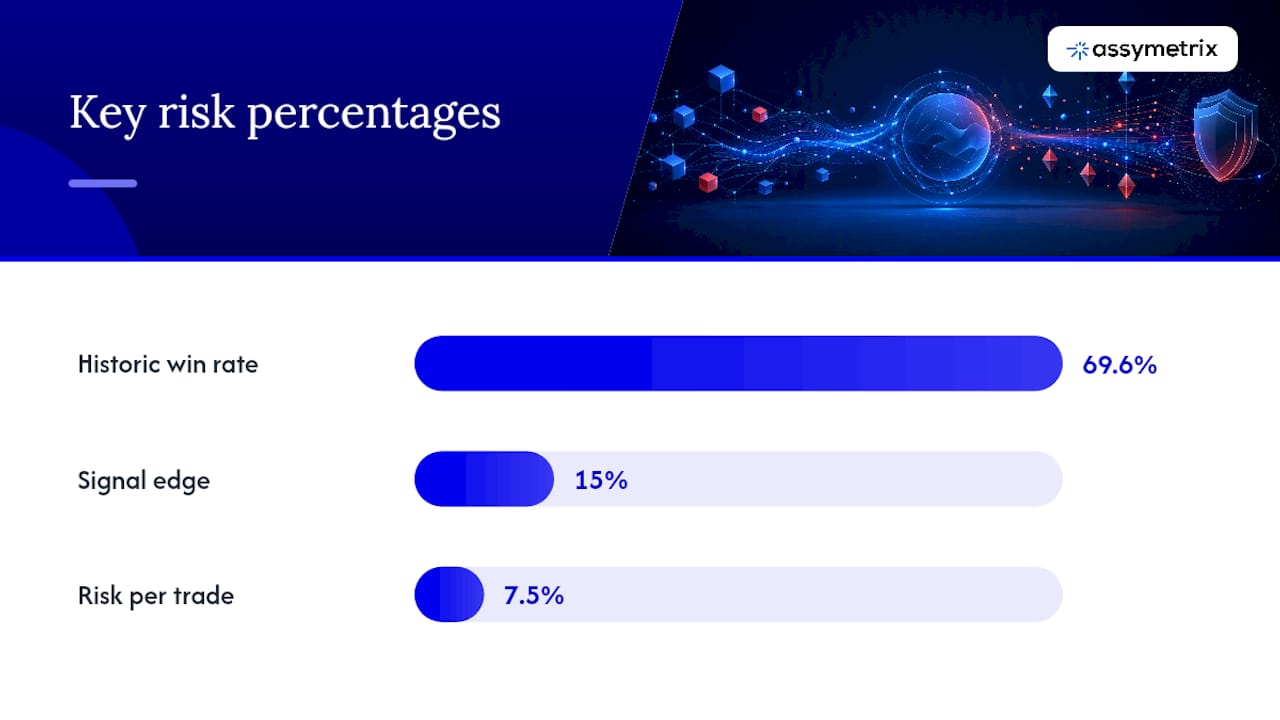
A risk engine without hard numeric limits is decoration, not protection. The minimum enforced rule set: a per-wallet max position size, a per-market exposure cap, daily and weekly loss halt thresholds, a max on concurrent open orders, a global kill switch, and an automated pause triggered by RPC failures.
For sizing, fixed-fractional or half-Kelly both work better than fixed dollar amounts because they scale with your edge estimate. If your bankroll is $10,000 and your signal reports a 15% edge with half-Kelly sizing, you’d risk roughly $750 on that position, then convert that stake into token quantity using the current price tick before submission.
Cap any single order at a small fraction of best-ask liquidity to limit slippage
Default every deployment to paper mode unless
ENABLE_LIVE_TRADING=trueis explicitly setAuto-pause on unexpected fill rate spikes, abnormal slippage, or wallet balance mismatches
The documented case of a 69.6% win rate over 23 trades is a useful reminder that even a working edge needs strict position caps. A short winning streak on a small sample can tempt you into oversizing right before variance catches up.
Backtesting Before You Deploy Live
Simulate against historical order book snapshots, walk the book deterministically to model fills, apply a maker/taker fee schedule, and layer in a stochastic slippage overlay for stress testing. Skipping the resolution model is the single most common backtest error: a strategy that looks profitable under snapshot pricing can lose money once you model TWAP-based resolution correctly for the affected markets.
Assymetrix’s historical archive spans over 900 million rows of Polymarket trading activity, deep enough to test strategies across dozens of market cycles rather than a handful of lucky weeks. Pull /sdk/markets/:id/orderbook snapshots for the periods you want to test and feed them straight into your fill simulator.
Replay historical data through the same order manager and risk engine code paths you’ll run live
Calculate expected average fill price via deterministic book-walking, not last-traded price
Apply latency assumptions matched to your strategy type
Log every simulated trade individually for post-hoc analysis
Compare simulated win rate and average edge against your live paper-trading results before flipping the live flag
Never trust a backtest that used a different execution code path than production
Re-run backtests whenever you change signal thresholds, not just at initial development
Deploying and Operating a Live Bot
Host close to Polymarket’s CLOB endpoints to shave milliseconds off round-trip latency, particularly for sniper strategies targeting sub-200ms reaction windows; momentum strategies can tolerate more slack but still need tight debounce logic. Run under a process manager like systemd or Docker with automatic restart on crash, and add connection health checks that catch a silently dead WebSocket before it costs you a missed signal window.
Scale scanner pools horizontally with semaphore-limited concurrent fetches to avoid rate-limit bans
Shard markets across wallets or strategy instances to isolate blast radius from a single bad signal
Detect a stale WebSocket and re-seed the missing window from REST rather than assuming continuity
After any broken fill, reconcile positions against the exchange before resuming trading
Keep the global kill switch reachable from a single command, not buried in a config redeploy
Minimal Code and Config to Get Running
Set these environment variables before writing any strategy code:
Variable | Purpose |
|---|---|
| Signs orders for your wallet |
| Your trading proxy wallet address |
| CLOB V2 builder attribution field |
| Gasless relayer credentials |
| Assymetrix Data API authentication |
A minimal Python flow subscribes to the WebSocket feed, computes a threshold signal off an external price delta, calls risk.validate() before touching the order manager, and posts a maker order while paper_mode=True. Your config.yaml should define safe_address, clob.host, chain_id, builder credentials, a paper or live toggle, and per-wallet exposure limits, all in one place so switching environments never means hunting through code.
JS developers using the CLOB JS SDK follow the same async subscribe-and-evaluate pattern, though signature signing libraries differ from Python’s eth_account, so test your signing path independently before wiring it into the full order flow.
Why Unified Prediction Market Data Simplifies Bot Development
Building a Polymarket bot from raw sources means decoding Polygon events, reconciling Gamma metadata against CLOB state, and building your own wallet-cluster detection from scratch. Assymetrix’s Data API collapses that into three endpoints.
/sdk/markets returns normalized market discovery across Polymarket, Kalshi, and Limitless in one schema. /sdk/markets/:id/orderbook gives order book snapshots you can map directly onto your bot’s in-memory book. /sdk/markets/:id/pricing returns normalized live pricing ready for signal evaluation, plus bulk export options for historical backfill spanning the platform’s 900-million-row archive.
Treat Assymetrix as your canonical source for market state and Smart Money signals. Fall back to raw Gamma or CLOB calls only when you need to troubleshoot a discrepancy, not as your primary data path.
A request to /sdk/markets/:id/orderbook returns bid and ask levels you can load straight into the same schema your bot already uses for CLOB WebSocket updates, which means your signal engine doesn’t need separate code paths for “Assymetrix data” versus “native data.”
A Few Rules-of-Thumb From Building These Systems
Paper-first isn’t a suggestion, it’s the only way to catch a silent SDK bug before it costs real money. Log every event to a persistent database, not just stdout. Build your exit manager before your entry logic; a bot that can enter but can’t reliably exit is worse than no bot. Assume the SDK has at least one edge case you haven’t hit yet, and write tests that would catch it.
Get Unified Polymarket, Kalshi, and Limitless Data in One Integration
Every section above assumes you’re stitching together Gamma metadata, CLOB WebSocket state, and a separate external feed by hand. Assymetrix collapses that into one integration: real-time and historical data across Polymarket, Kalshi, and Limitless through a single SDK.
That means one normalized schema instead of three, Smart Money wallet tracking already scored and ready to feed your whale-detection signal, and a historical archive of over 900 million rows for backtesting before you flip anything to live. The SDK endpoints map directly onto the data layer this article describes: /sdk/markets for discovery, /sdk/markets/:id/orderbook for book state, /sdk/markets/:id/pricing for normalized pricing.
Start with the paper and backtest workflow using historical data before touching a live wallet. Check the Data API integration guide to see the exact request patterns and get an API key.
Sources
FAQ
How Do You Build a Trading Signal Bot for Polymarket?
Combine a real-time data feed (CLOB WebSocket or Assymetrix’s /sdk/markets/:id/pricing), a scoring function that outputs confidence and expected edge, and a risk-gated execution layer that only fires when the signal passes your position limits.
Can ChatGPT or Other AI Models Build a Trading Bot?
An LLM can generate a fair-value probability estimate per market for an AI fair-value strategy, but you still need to write the data ingestion, risk engine, and order execution code yourself with rate limits and fallback probabilities.
Do Polymarket Bots Actually Work?
Documented implementations show real edges, including a 69.6% win rate across 23 trades using cross-venue latency arbitrage, but small sample sizes mean results vary widely and strict risk limits matter more than the signal itself.
Are Prediction Market Trading Bots Really Profitable?
Profitability depends heavily on execution quality, position sizing, and avoiding silent integration bugs. Bots with disciplined risk engines and backtested fill models perform far more consistently than bots run without them.
What Data Does a Polymarket Bot Need to Start?
At minimum: market metadata from Gamma, live order book and trade data from the CLOB WebSocket, account state from CLOB REST, and a cross-venue price feed. Assymetrix’s SDK consolidates these into three endpoints instead of separate integrations.
How to Build a Polymarket Bot: Data, Signals, Execution
Run a three-layer system: data ingestion, signal generation, and execution, gated by paper mode and a hard kill switch. Skip any layer and you either trade blind or trade broke. That’s the whole architecture in one sentence, and everything below is how to build each piece without getting burned by the mistakes that already sank other bots.
The one-line version of the pipeline: Data → Signal → Risk → Execution, with a monitoring layer wrapped around all four. Before you write a single order function, confirm you have:
Python or JS with
py_clob_clientor the JS CLOB SDK installedEnvironment variables set for your wallet key, builder credentials, and API keys
Access to Assymetrix’s
/sdk/markets,/sdk/markets/:id/orderbook, and/sdk/markets/:id/pricingendpointsAn external feed like Binance for cross-venue comparison
ENABLE_LIVE_TRADING=falseas your default
Pro Tip: Never touch the live flag until your paper-mode bot has run a full week without a reconciliation mismatch. Silent state divergence is the most common way bots lose money without anyone noticing until the wallet balance doesn’t match the ledger.
Key Takeaways
A production Polymarket bot needs a data layer, a deterministic signal engine, and a risk-gated execution layer, tested in paper mode before any live capital moves.
Point | Details |
|---|---|
Separate your layers | Keep data ingestion, signal logic, and execution as independent modules you can test in isolation. |
Default to paper mode | Require an explicit |
Model resolution rules | Backtest with TWAP or snapshot resolution logic built in, not just last-traded price. |
Enforce hard risk limits | Set per-wallet caps, daily loss halts, and a global kill switch before writing strategy code. |
Use unified data feeds | Assymetrix’s |
This article is general information, not a substitute for advice from a qualified financial advisor. Consult a qualified financial professional about your own circumstances before acting on anything here.
Table of Contents
Data, Signals, and Execution: The Three-Layer Blueprint
What Data Does a Polymarket Bot Actually Need?
How Do You Generate Trading Signals From Polymarket Data?
Turning a Signal Into a Signed, Submitted Order
What Risk Rules Should Every Bot Enforce?
Backtesting Before You Deploy Live
Deploying and Operating a Live Bot
Minimal Code and Config to Get Running
Why Unified Prediction Market Data Simplifies Bot Development
Sources
Data, Signals, and Execution: The Three-Layer Blueprint
Every working Polymarket bot separates concerns into modules that don’t know about each other’s internals. The architecture pattern that holds up in production runs market discovery, real-time data ingestion, an in-memory order book, a strategy engine, a risk engine, an execution/order manager, a position manager, and monitoring, in that sequence.
Two things carry state: the in-memory order book and the position manager. Everything else, especially signal evaluation, should be stateless and deterministic so you can replay it in tests. Your responsibility map looks like this:
Data layer: guarantees freshness and de-duplication, not correctness of trading logic
Signal engine: guarantees determinism, given identical inputs it always produces identical output
Risk engine: guarantees hard limits are enforced before execution, no exceptions
Execution manager: guarantees idempotent order submission and full audit logging
Keep the strategy read path short. Fetch from local state, never make a network call inside signal evaluation. A signal engine that blocks on I/O is a signal engine that’s already too slow to matter.
Isolating strategy code from execution and risk means you can unit test a signal function with a mocked order book and never touch a live wallet.
What Data Does a Polymarket Bot Actually Need?
Your bot needs five distinct data inputs: market metadata from Gamma, live order book depth and trade flow from the CLOB WebSocket, position and order state from CLOB REST, settlement references from Chainlink oracles, and a correlated external price feed like Binance for cross-venue comparison.
Gamma covers market discovery, categories, and resolution details. The CLOB WebSocket streams book updates and trade prints in real time, while CLOB REST endpoints like /orders and /positions handle account state that doesn’t need sub-second freshness. Chainlink feeds matter specifically for markets that resolve on a TWAP basis rather than a snapshot, since your position manager needs to know which resolution method applies before it can price expected P&L correctly.
Assymetrix’s unified data API simplifies this considerably. /sdk/markets returns normalized market discovery data across venues. /sdk/markets/:id/orderbook gives you order book snapshots without decoding raw Polygon events. /sdk/markets/:id/pricing returns normalized live pricing you can drop straight into a signal function.
Data need | Best source | Access pattern |
|---|---|---|
Market discovery | Gamma or Assymetrix | Poll every few minutes |
Order book depth | CLOB WebSocket or Assymetrix orderbook endpoint | Persistent WebSocket subscription |
Trade flow | CLOB WebSocket | Persistent subscription |
Cross-venue price | Binance REST/WebSocket | Subscribe to relevant pairs |
Settlement reference | Chainlink oracle | Query at resolution window |
Account state | CLOB REST | Poll every 5–15s |
Subscribe over WebSocket for anything that changes faster than your polling interval; poll REST for anything where a few seconds of staleness is harmless. Normalize every event into one canonical market schema immediately on ingestion, then de-duplicate by event ID before it reaches your order book. For backfill, pull seven days of history to seed a scanner, then run incremental snapshots with checkpointing so a restart doesn’t force a full re-download.
How Do You Generate Trading Signals From Polymarket Data?
Five signal types cover most of what production bots run: cross-venue arbitrage, end-of-cycle sniping, short-lookback momentum, whale tracking, and AI fair-value scoring.
Cross-venue arbitrage compares Polymarket’s implied probability against a correlated external price. One documented implementation monitoring Binance spot moves against Polymarket’s 5-minute markets reported a 69.6% win rate across 23 trades, exploiting a 30 to 90 second repricing lag. That sample size is small enough that you should treat it as a proof of concept, not a guarantee, but the mechanism (external markets move faster than a low-liquidity prediction market can reprice) holds up structurally.
End-of-cycle sniping targets the final seconds of short-duration markets, where mispricing tends to concentrate. This needs sub-200ms reaction time and tight debounce logic to avoid firing on stale book states.
Momentum trades short-term directional moves in the order flow itself and can tolerate higher latency than sniping, but needs a well-tuned time-to-live on each signal.
Whale tracking flags large wallet entries and mirrors positions from historically profitable addresses, a pattern several open-source bots implement with dedicated wallet scoring.
AI fair-value calls an LLM to return a single probability estimate per market, then places limit orders when the market price sits meaningfully below that number.
Every signal that reaches your risk engine should carry the same metadata envelope: market_id, side, price, size_usd, expected_edge, confidence (0 to 1), and ttl_seconds. Add an idempotency key so a re-fired duplicate never becomes a duplicate order.
Debounce repeated triggers from the same market within a short window
Rate-limit signal dispatch per strategy to avoid flooding the execution queue
Sign every signal event for audit logs before it hits the order manager
Prefer Assymetrix’s Smart Money and cross-venue divergence feeds over building wallet-cluster detection from scratch, since aggregated signals eliminate the need to instrument every raw on-chain event yourself
Turning a Signal Into a Signed, Submitted Order
CLOB V2 changed the order format in ways that trip up bots migrated from older code. It added a builder attribution field, new timestamp and metadata requirements, and adjusted EIP-712 signing structures. You’ll need POLY_BUILDER_CODE set, plus POLY_BUILDER_API_KEY, POLY_BUILDER_SECRET, and POLY_BUILDER_PASSPHRASE if you’re routing through a gasless relayer flow.
The order lifecycle runs: create → sign → post → monitor fills over the user WebSocket → handle partial fills → run exit logic → reconcile against the position manager. Skip reconciliation and you’ll eventually find your local position state disagrees with the wallet’s actual holdings.
Watch for allowance and state-sync issues: an approval that looks successful on-chain doesn’t always mean the CLOB has registered it yet
Some RPC calls return success codes while producing unintended side effects; never trust a 200 response alone
Implement nonce management explicitly rather than relying on defaults
Use exponential backoff on retries, not fixed intervals
Pro Tip: Post as a maker whenever your strategy tolerates the wait. Walk the book to calculate expected fill price before dispatching any order sized above a thin slice of best-ask liquidity, since a market order into shallow depth can move the price against you before it fully fills.
What Risk Rules Should Every Bot Enforce?
A risk engine without hard numeric limits is decoration, not protection. The minimum enforced rule set: a per-wallet max position size, a per-market exposure cap, daily and weekly loss halt thresholds, a max on concurrent open orders, a global kill switch, and an automated pause triggered by RPC failures.
For sizing, fixed-fractional or half-Kelly both work better than fixed dollar amounts because they scale with your edge estimate. If your bankroll is $10,000 and your signal reports a 15% edge with half-Kelly sizing, you’d risk roughly $750 on that position, then convert that stake into token quantity using the current price tick before submission.
Cap any single order at a small fraction of best-ask liquidity to limit slippage
Default every deployment to paper mode unless
ENABLE_LIVE_TRADING=trueis explicitly setAuto-pause on unexpected fill rate spikes, abnormal slippage, or wallet balance mismatches
The documented case of a 69.6% win rate over 23 trades is a useful reminder that even a working edge needs strict position caps. A short winning streak on a small sample can tempt you into oversizing right before variance catches up.
Backtesting Before You Deploy Live
Simulate against historical order book snapshots, walk the book deterministically to model fills, apply a maker/taker fee schedule, and layer in a stochastic slippage overlay for stress testing. Skipping the resolution model is the single most common backtest error: a strategy that looks profitable under snapshot pricing can lose money once you model TWAP-based resolution correctly for the affected markets.
Assymetrix’s historical archive spans over 900 million rows of Polymarket trading activity, deep enough to test strategies across dozens of market cycles rather than a handful of lucky weeks. Pull /sdk/markets/:id/orderbook snapshots for the periods you want to test and feed them straight into your fill simulator.
Replay historical data through the same order manager and risk engine code paths you’ll run live
Calculate expected average fill price via deterministic book-walking, not last-traded price
Apply latency assumptions matched to your strategy type
Log every simulated trade individually for post-hoc analysis
Compare simulated win rate and average edge against your live paper-trading results before flipping the live flag
Never trust a backtest that used a different execution code path than production
Re-run backtests whenever you change signal thresholds, not just at initial development
Deploying and Operating a Live Bot
Host close to Polymarket’s CLOB endpoints to shave milliseconds off round-trip latency, particularly for sniper strategies targeting sub-200ms reaction windows; momentum strategies can tolerate more slack but still need tight debounce logic. Run under a process manager like systemd or Docker with automatic restart on crash, and add connection health checks that catch a silently dead WebSocket before it costs you a missed signal window.
Scale scanner pools horizontally with semaphore-limited concurrent fetches to avoid rate-limit bans
Shard markets across wallets or strategy instances to isolate blast radius from a single bad signal
Detect a stale WebSocket and re-seed the missing window from REST rather than assuming continuity
After any broken fill, reconcile positions against the exchange before resuming trading
Keep the global kill switch reachable from a single command, not buried in a config redeploy
Minimal Code and Config to Get Running
Set these environment variables before writing any strategy code:
Variable | Purpose |
|---|---|
| Signs orders for your wallet |
| Your trading proxy wallet address |
| CLOB V2 builder attribution field |
| Gasless relayer credentials |
| Assymetrix Data API authentication |
A minimal Python flow subscribes to the WebSocket feed, computes a threshold signal off an external price delta, calls risk.validate() before touching the order manager, and posts a maker order while paper_mode=True. Your config.yaml should define safe_address, clob.host, chain_id, builder credentials, a paper or live toggle, and per-wallet exposure limits, all in one place so switching environments never means hunting through code.
JS developers using the CLOB JS SDK follow the same async subscribe-and-evaluate pattern, though signature signing libraries differ from Python’s eth_account, so test your signing path independently before wiring it into the full order flow.
Why Unified Prediction Market Data Simplifies Bot Development
Building a Polymarket bot from raw sources means decoding Polygon events, reconciling Gamma metadata against CLOB state, and building your own wallet-cluster detection from scratch. Assymetrix’s Data API collapses that into three endpoints.
/sdk/markets returns normalized market discovery across Polymarket, Kalshi, and Limitless in one schema. /sdk/markets/:id/orderbook gives order book snapshots you can map directly onto your bot’s in-memory book. /sdk/markets/:id/pricing returns normalized live pricing ready for signal evaluation, plus bulk export options for historical backfill spanning the platform’s 900-million-row archive.
Treat Assymetrix as your canonical source for market state and Smart Money signals. Fall back to raw Gamma or CLOB calls only when you need to troubleshoot a discrepancy, not as your primary data path.
A request to /sdk/markets/:id/orderbook returns bid and ask levels you can load straight into the same schema your bot already uses for CLOB WebSocket updates, which means your signal engine doesn’t need separate code paths for “Assymetrix data” versus “native data.”
A Few Rules-of-Thumb From Building These Systems
Paper-first isn’t a suggestion, it’s the only way to catch a silent SDK bug before it costs real money. Log every event to a persistent database, not just stdout. Build your exit manager before your entry logic; a bot that can enter but can’t reliably exit is worse than no bot. Assume the SDK has at least one edge case you haven’t hit yet, and write tests that would catch it.
Get Unified Polymarket, Kalshi, and Limitless Data in One Integration
Every section above assumes you’re stitching together Gamma metadata, CLOB WebSocket state, and a separate external feed by hand. Assymetrix collapses that into one integration: real-time and historical data across Polymarket, Kalshi, and Limitless through a single SDK.
That means one normalized schema instead of three, Smart Money wallet tracking already scored and ready to feed your whale-detection signal, and a historical archive of over 900 million rows for backtesting before you flip anything to live. The SDK endpoints map directly onto the data layer this article describes: /sdk/markets for discovery, /sdk/markets/:id/orderbook for book state, /sdk/markets/:id/pricing for normalized pricing.
Start with the paper and backtest workflow using historical data before touching a live wallet. Check the Data API integration guide to see the exact request patterns and get an API key.
Sources
FAQ
How Do You Build a Trading Signal Bot for Polymarket?
Combine a real-time data feed (CLOB WebSocket or Assymetrix’s /sdk/markets/:id/pricing), a scoring function that outputs confidence and expected edge, and a risk-gated execution layer that only fires when the signal passes your position limits.
Can ChatGPT or Other AI Models Build a Trading Bot?
An LLM can generate a fair-value probability estimate per market for an AI fair-value strategy, but you still need to write the data ingestion, risk engine, and order execution code yourself with rate limits and fallback probabilities.
Do Polymarket Bots Actually Work?
Documented implementations show real edges, including a 69.6% win rate across 23 trades using cross-venue latency arbitrage, but small sample sizes mean results vary widely and strict risk limits matter more than the signal itself.
Are Prediction Market Trading Bots Really Profitable?
Profitability depends heavily on execution quality, position sizing, and avoiding silent integration bugs. Bots with disciplined risk engines and backtested fill models perform far more consistently than bots run without them.
What Data Does a Polymarket Bot Need to Start?
At minimum: market metadata from Gamma, live order book and trade data from the CLOB WebSocket, account state from CLOB REST, and a cross-venue price feed. Assymetrix’s SDK consolidates these into three endpoints instead of separate integrations.
Other Blog


