Polymarket Order Book: Fetch, Parse, and Integrate It
Polymarket Order Book: Fetch, Parse, and Integrate It
Polymarket Order Book: Fetch, Parse, and Integrate It
Discover how to fetch, parse, and integrate the Polymarket order book to streamline your trading strategy and access real-time data.

Polymarket Order Book: Fetch, Parse, and Integrate It
Polymarket’s order book is the Central Limit Order Book (CLOB) behind every market. Prices sit between 0 and 1, read as implied probability, and you pull the live book with GET /v1/orderbook/{symbol} for the full L2 snapshot or GET /v1/orderbook/{symbol}/bbo for just the best bid and offer, both documented in Polymarket’s order book API overview. For production trading, use the gRPC Market Data Stream instead of polling REST. Your first move: find the market’s token ID, then make an authenticated call against one of those endpoints.
Key Takeaways
Reliable Polymarket order book integration requires the right endpoint, correct field parsing, a solid reconciliation strategy, and, for production systems, a normalized feed over raw CLOB reconstruction.
Point | Details |
|---|---|
Use the right endpoint | Call |
Parse fields as strings first | Cast |
Reconcile, don’t assume | Combine an initial snapshot with delta events and periodic full re-syncs to prevent silent drift. |
Depth beats a single price | Cumulative size and imbalance reveal position sizing risk and Smart Money concentration that price alone can’t show. |
Consider a normalized feed | Assymetrix’s |
Official docs and useful developer links
Start with Polymarket’s order book API overview for endpoint reference, the conceptual explainer on limit orders and spreads for background, the Polymarket GitHub organization for client tooling, and a working fetch example for quick prototyping.
Table of Contents
What Is the Polymarket Order Book and How Does It Price Risk?
How Do You Fetch a Polymarket Order Book Programmatically?
What Fields Are in the Order Book Schema?
What Goes Wrong When You Build This Yourself?
How Do Quants Use Order Book Depth for Trading Decisions?
How Does the Assymetrix Data API Simplify Order Book Access?
What Should Your Integration Checklist Look Like?
If You Need Production-Ready Polymarket Order Books
Sources
What Is the Polymarket Order Book and How Does It Price Risk?
The Polymarket CLOB holds resting bid and ask orders for each outcome token, the same architecture as an equities exchange, except the traded instrument is a probability rather than a share price. A price of 0.63 means the market currently implies a 63% chance of that outcome resolving “yes.”
The best bid and best offer define the spread; the midpoint between them is what most dashboards display as “the price,” even though it’s really an average of two competing quotes. Limit orders rest on the book and wait to be matched. Market orders sweep through whatever resting liquidity exists at the best available prices, and if the book is thin, that sweep moves the price hard. This is why raw depth matters more than a single number: cumulative size at each level, and the imbalance between bid-side and ask-side volume, tell you how much size you can move before your own order becomes the market. A single price feed can’t show you that. An order book can.
How Do You Fetch a Polymarket Order Book Programmatically?
Three tools matter here: the L2 snapshot endpoint, the BBO endpoint, and the gRPC stream for anything latency-sensitive. Authenticated calls typically require an Auth0 JWT with read:marketdata scope. Read-only market data access does not require participant KYC.
A practical sequence looks like this:
Resolve the market and outcome to a token ID (each outcome trades as a separate instrument with its own book).
Call
GET /v1/orderbook/{symbol}for full depth, or/bboif you only need top-of-book.Parse the response, paying attention to
transactTimeso you can sequence updates correctly, especially if you’re polling multiple markets on a loop.
A minimal curl call looks like curl -H "Authorization: Bearer $TOKEN" https://docs.polymarket.us/institutional/orderbook/overview/{symbol}, and the same logic ports easily to a Python requests call or a JavaScript fetch. Community-maintained example scripts show working HTTP calls and JSON parsing if you want a faster starting point than writing the client from scratch. If you’re pulling books across many markets simultaneously, watch your rate limits. Some third-party services poll the CLOB roughly every 60 seconds with change detection to avoid redundant calls, which is a reasonable pattern for display purposes but too slow for execution logic.
What Fields Are in the Order Book Schema?
The L2 response returns bids[] and offers[] arrays, each entry carrying a price (px) and quantity (qty) at that level. The bestBid and bestOffer objects give you top-of-book without parsing the full array. A stats block typically carries last-trade price and OHLC context, and transactTime timestamps the snapshot so you know exactly how fresh it is. Some responses include an optional state field flagging whether a market is active, paused, or resolved.
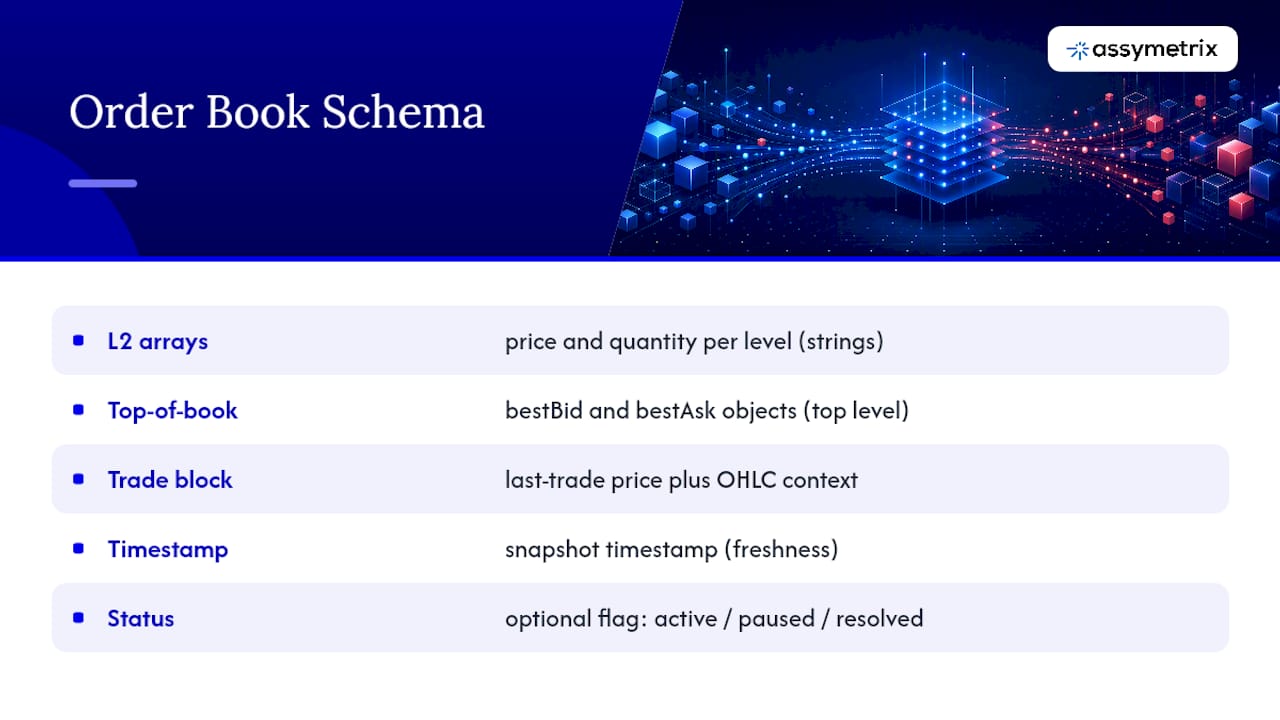
A simplified fragment looks roughly like:
{
  "symbol": "WILL-X-HAPPEN-YES",
  "bids": [{"px": "0.62", "qty": "1500"}, {"px": "0.61", "qty": "2200"}],
  "offers": [{"px": "0.64", "qty": "1100"}],
  "transactTime": 1732012345000
}
{
  "symbol": "WILL-X-HAPPEN-YES",
  "bids": [{"px": "0.62", "qty": "1500"}, {"px": "0.61", "qty": "2200"}],
  "offers": [{"px": "0.64", "qty": "1100"}],
  "transactTime": 1732012345000
}
Treat px and qty as strings, not floats, until you cast them deliberately. Numeric precision errors compound fast in a loop that runs every few seconds. From this fragment, spread is bestOffer - bestBid (0.02 here), mid price is the average (0.63), and cumulative depth per side is a running sum down the array.
What Goes Wrong When You Build This Yourself?
Reconstructing a clean, reliable book from raw CLOB data is harder than the schema suggests. Rate limits throttle you if you poll too aggressively, and each poll only gives you a point-in-time snapshot, not a guarantee that nothing changed between calls. Partial fills and cancellations need to be applied correctly or your local book state drifts from reality within minutes. If you’re decoding on-chain settlement events directly on Polygon, you also inherit chain reorg risk and inconsistent timestamps between the chain and the API layer.
A more durable approach: pull an initial full snapshot, apply delta events idempotently as they arrive, and periodically re-pull a full snapshot to catch drift before it compounds. Build monitoring for anomalies like a spread that suddenly triples or a book that goes silent.
Pro Tip: Log every raw snapshot with its transactTime before you apply any transformation. When your reconciliation logic breaks at 2 a.m., that raw log is the only way to tell whether the bug is in your parsing or in the upstream feed.
How Do Quants Use Order Book Depth for Trading Decisions?
Position sizing gets real once you can see cumulative size at each price level instead of guessing at slippage. If you need to fill $10,000 of exposure and the top three levels only hold $3,000, you already know your average fill price will be worse than the quoted mid, before you send a single order.
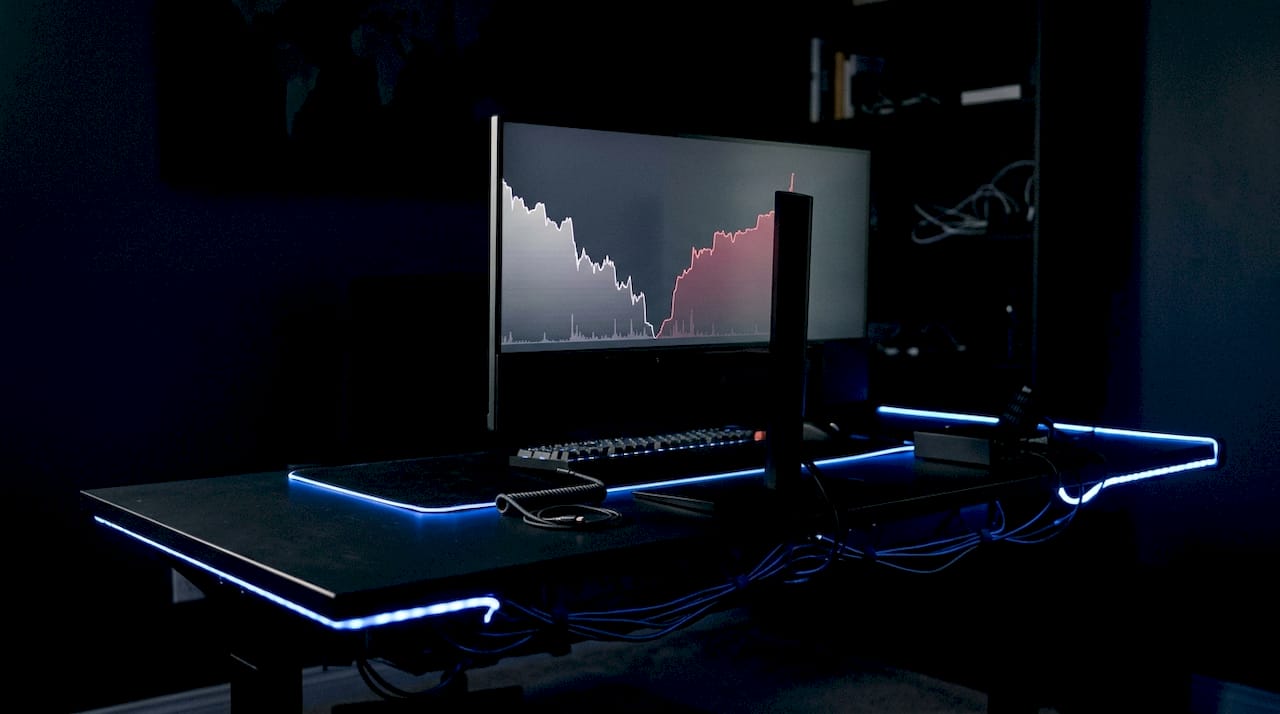
Depth also reveals where liquidity concentrates, which is often where informed capital sits. A large resting order that persists across snapshots, sitting well above typical size at a specific probability level, is a common tell for concentrated conviction. Sudden depth withdrawal on one side, without a corresponding price move, often precedes volatility.
For market making, quoting rules should respect minimum depth thresholds and widen spreads when the book thins out, to avoid adverse selection against faster participants. A useful signal checklist for automated systems: depth at the top five levels per side, the slope of price versus cumulative size, recent large-fill events, and how often the book turns over per hour. Building these signals systematically is the core of quant research on prediction markets, and the same depth signals feed directly into bot execution logic.
How Does the Assymetrix Data API Simplify Order Book Access?
Assymetrix normalizes this entire pipeline through a single endpoint: /sdk/markets/:id/orderbook. It streams L2 depth directly from the CLOB with no scraping and no derived or estimated depth.
The difference from building your own pipeline shows up in a few concrete places:
Schema normalization: fields arrive typed and consistent, no per-market quirks to special-case.
Deduplication and sequencing: delta events are applied server-side, so you’re not reconciling partial fills and cancellations yourself.
Streaming support: production-grade updates without hand-rolling a gRPC client against the raw feed.
Historical backfill: query past order book states for backtesting, not just the live book.
That combination matters most in market making, where a single missed cancellation event can leave you quoting against a book that no longer exists, and in latency-sensitive arbitrage, where cross-venue signal comparisons depend on both sides of the trade being current at the same instant. It also underpins Smart Money tracking and longer-horizon historical analysis, where consistent schema matters more than raw speed.
What Should Your Integration Checklist Look Like?
Stream, don’t poll, for anything execution-facing; reserve REST polling for dashboards or low-frequency checks. Reconcile with an initial snapshot, apply deltas, and re-verify with a full snapshot on an interval matched to your strategy’s latency tolerance. Build backoff logic that respects rate limits, align timestamps across sources, and alert on abnormal spread widening or missing price levels before they corrupt a live strategy.
Author perspective: why direct orderbook access matters for quants and devs
A single price number tells you what the market thinks. Depth and imbalance tell you how confident that price actually is, and how much it will cost to challenge it. Assymetrix earns its place in a production stack precisely because it treats that depth as first-class data, not an afterthought bolted onto a price feed.
If You Need Production-Ready Polymarket Order Books
Building a reconciliation layer for raw CLOB data is a real engineering project, not a weekend script, and every hour spent debugging partial fills is an hour not spent on strategy logic. Assymetrix delivers normalized, deduplicated L2 depth streamed straight from the CLOB, with no scraping and no derived approximations standing between you and the real book.
That means schema consistency across every market you query, plus historical backfill for backtesting strategies before you risk live capital. Two things worth checking before you commit engineering time to any feed: what SLA it guarantees during high-volume events, and whether historical backfill actually goes back far enough for your backtest window. Assymetrix’s real-time and historical data feed covers both.
Pro Tip: Ask any data provider, Assymetrix included, exactly how they handle a dropped connection mid-stream. The answer tells you more about production readiness than any list of features.
Start by reviewing the Python integration guide and requesting access to the orderbook endpoint at Data.
Sources
FAQ
How does an order book work?
An order book lists resting buy orders (bids) and sell orders (asks) at various price levels; a trade executes when an incoming order matches a resting one, and the gap between the best bid and best ask is the spread.
How do I see the order book for a Polymarket market?
Call GET /v1/orderbook/{symbol} for the full L2 book or /bbo for just the best bid and offer, using the Polymarket institutional API, or query a normalized feed like Assymetrix’s /sdk/markets/:id/orderbook endpoint.
Is Polymarket still invite-only?
No, Polymarket’s core trading platform is publicly accessible; institutional order book API access requires authentication with a scoped JWT rather than an invite.
What order types does Polymarket support?
Polymarket supports limit orders, which rest on the book at a chosen price, and market orders, which execute immediately against existing resting liquidity at the best available prices.
What’s the difference between polling and streaming the order book?
Polling returns a point-in-time snapshot and is subject to rate limits, while the gRPC Market Data Stream pushes real-time updates with lower latency, which the official docs recommend for production use.
Polymarket Order Book: Fetch, Parse, and Integrate It
Polymarket’s order book is the Central Limit Order Book (CLOB) behind every market. Prices sit between 0 and 1, read as implied probability, and you pull the live book with GET /v1/orderbook/{symbol} for the full L2 snapshot or GET /v1/orderbook/{symbol}/bbo for just the best bid and offer, both documented in Polymarket’s order book API overview. For production trading, use the gRPC Market Data Stream instead of polling REST. Your first move: find the market’s token ID, then make an authenticated call against one of those endpoints.
Key Takeaways
Reliable Polymarket order book integration requires the right endpoint, correct field parsing, a solid reconciliation strategy, and, for production systems, a normalized feed over raw CLOB reconstruction.
Point | Details |
|---|---|
Use the right endpoint | Call |
Parse fields as strings first | Cast |
Reconcile, don’t assume | Combine an initial snapshot with delta events and periodic full re-syncs to prevent silent drift. |
Depth beats a single price | Cumulative size and imbalance reveal position sizing risk and Smart Money concentration that price alone can’t show. |
Consider a normalized feed | Assymetrix’s |
Official docs and useful developer links
Start with Polymarket’s order book API overview for endpoint reference, the conceptual explainer on limit orders and spreads for background, the Polymarket GitHub organization for client tooling, and a working fetch example for quick prototyping.
Table of Contents
What Is the Polymarket Order Book and How Does It Price Risk?
How Do You Fetch a Polymarket Order Book Programmatically?
What Fields Are in the Order Book Schema?
What Goes Wrong When You Build This Yourself?
How Do Quants Use Order Book Depth for Trading Decisions?
How Does the Assymetrix Data API Simplify Order Book Access?
What Should Your Integration Checklist Look Like?
If You Need Production-Ready Polymarket Order Books
Sources
What Is the Polymarket Order Book and How Does It Price Risk?
The Polymarket CLOB holds resting bid and ask orders for each outcome token, the same architecture as an equities exchange, except the traded instrument is a probability rather than a share price. A price of 0.63 means the market currently implies a 63% chance of that outcome resolving “yes.”
The best bid and best offer define the spread; the midpoint between them is what most dashboards display as “the price,” even though it’s really an average of two competing quotes. Limit orders rest on the book and wait to be matched. Market orders sweep through whatever resting liquidity exists at the best available prices, and if the book is thin, that sweep moves the price hard. This is why raw depth matters more than a single number: cumulative size at each level, and the imbalance between bid-side and ask-side volume, tell you how much size you can move before your own order becomes the market. A single price feed can’t show you that. An order book can.
How Do You Fetch a Polymarket Order Book Programmatically?
Three tools matter here: the L2 snapshot endpoint, the BBO endpoint, and the gRPC stream for anything latency-sensitive. Authenticated calls typically require an Auth0 JWT with read:marketdata scope. Read-only market data access does not require participant KYC.
A practical sequence looks like this:
Resolve the market and outcome to a token ID (each outcome trades as a separate instrument with its own book).
Call
GET /v1/orderbook/{symbol}for full depth, or/bboif you only need top-of-book.Parse the response, paying attention to
transactTimeso you can sequence updates correctly, especially if you’re polling multiple markets on a loop.
A minimal curl call looks like curl -H "Authorization: Bearer $TOKEN" https://docs.polymarket.us/institutional/orderbook/overview/{symbol}, and the same logic ports easily to a Python requests call or a JavaScript fetch. Community-maintained example scripts show working HTTP calls and JSON parsing if you want a faster starting point than writing the client from scratch. If you’re pulling books across many markets simultaneously, watch your rate limits. Some third-party services poll the CLOB roughly every 60 seconds with change detection to avoid redundant calls, which is a reasonable pattern for display purposes but too slow for execution logic.
What Fields Are in the Order Book Schema?
The L2 response returns bids[] and offers[] arrays, each entry carrying a price (px) and quantity (qty) at that level. The bestBid and bestOffer objects give you top-of-book without parsing the full array. A stats block typically carries last-trade price and OHLC context, and transactTime timestamps the snapshot so you know exactly how fresh it is. Some responses include an optional state field flagging whether a market is active, paused, or resolved.
A simplified fragment looks roughly like:
{
  "symbol": "WILL-X-HAPPEN-YES",
  "bids": [{"px": "0.62", "qty": "1500"}, {"px": "0.61", "qty": "2200"}],
  "offers": [{"px": "0.64", "qty": "1100"}],
  "transactTime": 1732012345000
}
Treat px and qty as strings, not floats, until you cast them deliberately. Numeric precision errors compound fast in a loop that runs every few seconds. From this fragment, spread is bestOffer - bestBid (0.02 here), mid price is the average (0.63), and cumulative depth per side is a running sum down the array.
What Goes Wrong When You Build This Yourself?
Reconstructing a clean, reliable book from raw CLOB data is harder than the schema suggests. Rate limits throttle you if you poll too aggressively, and each poll only gives you a point-in-time snapshot, not a guarantee that nothing changed between calls. Partial fills and cancellations need to be applied correctly or your local book state drifts from reality within minutes. If you’re decoding on-chain settlement events directly on Polygon, you also inherit chain reorg risk and inconsistent timestamps between the chain and the API layer.
A more durable approach: pull an initial full snapshot, apply delta events idempotently as they arrive, and periodically re-pull a full snapshot to catch drift before it compounds. Build monitoring for anomalies like a spread that suddenly triples or a book that goes silent.
Pro Tip: Log every raw snapshot with its transactTime before you apply any transformation. When your reconciliation logic breaks at 2 a.m., that raw log is the only way to tell whether the bug is in your parsing or in the upstream feed.
How Do Quants Use Order Book Depth for Trading Decisions?
Position sizing gets real once you can see cumulative size at each price level instead of guessing at slippage. If you need to fill $10,000 of exposure and the top three levels only hold $3,000, you already know your average fill price will be worse than the quoted mid, before you send a single order.
Depth also reveals where liquidity concentrates, which is often where informed capital sits. A large resting order that persists across snapshots, sitting well above typical size at a specific probability level, is a common tell for concentrated conviction. Sudden depth withdrawal on one side, without a corresponding price move, often precedes volatility.
For market making, quoting rules should respect minimum depth thresholds and widen spreads when the book thins out, to avoid adverse selection against faster participants. A useful signal checklist for automated systems: depth at the top five levels per side, the slope of price versus cumulative size, recent large-fill events, and how often the book turns over per hour. Building these signals systematically is the core of quant research on prediction markets, and the same depth signals feed directly into bot execution logic.
How Does the Assymetrix Data API Simplify Order Book Access?
Assymetrix normalizes this entire pipeline through a single endpoint: /sdk/markets/:id/orderbook. It streams L2 depth directly from the CLOB with no scraping and no derived or estimated depth.
The difference from building your own pipeline shows up in a few concrete places:
Schema normalization: fields arrive typed and consistent, no per-market quirks to special-case.
Deduplication and sequencing: delta events are applied server-side, so you’re not reconciling partial fills and cancellations yourself.
Streaming support: production-grade updates without hand-rolling a gRPC client against the raw feed.
Historical backfill: query past order book states for backtesting, not just the live book.
That combination matters most in market making, where a single missed cancellation event can leave you quoting against a book that no longer exists, and in latency-sensitive arbitrage, where cross-venue signal comparisons depend on both sides of the trade being current at the same instant. It also underpins Smart Money tracking and longer-horizon historical analysis, where consistent schema matters more than raw speed.
What Should Your Integration Checklist Look Like?
Stream, don’t poll, for anything execution-facing; reserve REST polling for dashboards or low-frequency checks. Reconcile with an initial snapshot, apply deltas, and re-verify with a full snapshot on an interval matched to your strategy’s latency tolerance. Build backoff logic that respects rate limits, align timestamps across sources, and alert on abnormal spread widening or missing price levels before they corrupt a live strategy.
Author perspective: why direct orderbook access matters for quants and devs
A single price number tells you what the market thinks. Depth and imbalance tell you how confident that price actually is, and how much it will cost to challenge it. Assymetrix earns its place in a production stack precisely because it treats that depth as first-class data, not an afterthought bolted onto a price feed.
If You Need Production-Ready Polymarket Order Books
Building a reconciliation layer for raw CLOB data is a real engineering project, not a weekend script, and every hour spent debugging partial fills is an hour not spent on strategy logic. Assymetrix delivers normalized, deduplicated L2 depth streamed straight from the CLOB, with no scraping and no derived approximations standing between you and the real book.
That means schema consistency across every market you query, plus historical backfill for backtesting strategies before you risk live capital. Two things worth checking before you commit engineering time to any feed: what SLA it guarantees during high-volume events, and whether historical backfill actually goes back far enough for your backtest window. Assymetrix’s real-time and historical data feed covers both.
Pro Tip: Ask any data provider, Assymetrix included, exactly how they handle a dropped connection mid-stream. The answer tells you more about production readiness than any list of features.
Start by reviewing the Python integration guide and requesting access to the orderbook endpoint at Data.
Sources
FAQ
How does an order book work?
An order book lists resting buy orders (bids) and sell orders (asks) at various price levels; a trade executes when an incoming order matches a resting one, and the gap between the best bid and best ask is the spread.
How do I see the order book for a Polymarket market?
Call GET /v1/orderbook/{symbol} for the full L2 book or /bbo for just the best bid and offer, using the Polymarket institutional API, or query a normalized feed like Assymetrix’s /sdk/markets/:id/orderbook endpoint.
Is Polymarket still invite-only?
No, Polymarket’s core trading platform is publicly accessible; institutional order book API access requires authentication with a scoped JWT rather than an invite.
What order types does Polymarket support?
Polymarket supports limit orders, which rest on the book at a chosen price, and market orders, which execute immediately against existing resting liquidity at the best available prices.
What’s the difference between polling and streaming the order book?
Polling returns a point-in-time snapshot and is subject to rate limits, while the gRPC Market Data Stream pushes real-time updates with lower latency, which the official docs recommend for production use.
Other Blog


