Prediction Market Developers: Detect Microsecond Latency Arbitrage
Prediction Market Developers: Detect Microsecond Latency Arbitrage
Prediction Market Developers: Detect Microsecond Latency Arbitrage
Technical guide for prediction market developers and algorithmic traders on measuring microsecond feed gaps, detecting NBBO divergence, and mitigating...
Prediction Market Developers: Detect Microsecond Latency Arbitrage
Latency arbitrage is the practice of exploiting microsecond differences in price or quote dissemination to trade ahead of slower participants, and it transfers value from liquidity providers and slower traders to whichever actor processes and acts on information fastest. Gains concentrate among low-latency firms with direct feeds and co-located infrastructure; costs land on market makers and anyone trading through consolidated or delayed data. For algorithmic agents and data integrations, the immediate implication is simple: measure your feed latency and verify your timestamps before you trust any signal.
TL;DR:
Latency arbitrage profits can reach billions of dollars, but estimates vary widely depending on market data and the scope of analysis.
Strategies rely on microsecond delays between exchange feeds, with co-location and network routing playing critical roles in advantage.
Implementing safeguards like cross-checking multiple feeds and verifying timestamps can help reduce exposure to latency-based trading risks.
Normalized, real-time cross-venue data and divergence measurement are essential for identifying opportunities and avoiding stale information.
Speed alone is not enough; trading models that interpret signals more accurately can outperform faster ones in high-frequency trading environments.
Assymetrixassymetrix.comBuild With Unified Market DataAssymetrix gives developers and algorithmic agents unified cross-venue prediction market data through a single Data API integration.Explore the Data API
Table of Contents
How Market Architecture Creates Latency Gaps
What the Research Says About Profits and Market Harm
How Latency Arbitrageurs Actually Operate
Exchange Protections and Developer-Side Defenses
Detecting Latency Divergence Across Prediction Market Venues
What Practitioners Should Prioritize
Trial the Assymetrix Data API for Cross-Venue Testing
Sources
How Market Architecture Creates Latency Gaps
Latency arbitrage exists because no market distributes price information instantly or uniformly. In US equities, the Securities Information Processor (SIP) aggregates quotes from every exchange and publishes a consolidated National Best Bid and Offer, but that aggregation step takes time. Direct feeds from individual exchanges reach co-located servers before the SIP ever recalculates NBBO, and that gap, often a few hundred microseconds to a few milliseconds, is where pickoff trades happen.
Several layers compound this delay:
Geographic and routing latency: physical distance between venues (the Albany-to-Chicago link cited in market design research is significant enough to create fixed, unavoidable propagation delay measured in the order of milliseconds) creates fixed, unavoidable propagation delay.
Co-location advantage: servers placed inside exchange data centers shave microseconds that remote participants cannot recover regardless of code quality.
Feed-processing pipelines: parsing, normalizing, and timestamping raw exchange messages introduces variable software latency that differs firm to firm.
Market fragmentation: the same asset trading across multiple venues (stock exchanges, or Polymarket, Kalshi, and Limitless in prediction markets) means price discovery never happens in one place at one instant.
Tactic taxonomy follows from these gaps. Pickoffs hit stale quotes before they update. Hedged cross-venue arbitrage buys on one venue and sells an equivalent position on another before prices converge. News-tick arbitrage races to trade on a headline or data release before slower feeds process it. Masking disguises order flow intent, often through order-splitting or iceberg orders, to avoid tipping off other latency-sensitive participants. Each tactic depends on the same underlying resource: knowing the true price before the rest of the market does.
What the Research Says About Profits and Market Harm
Published estimates of latency arbitrage profits vary enormously, which itself is a finding worth taking seriously. Aggregated historic estimates cited in the agent-based model literature on fragmented markets put cumulative figures as high as $21 billion, while other analyses covering narrower time windows conclude latency arbitrage is not a dominant profit source at all. The spread between these numbers comes down to methodology: what counts as an arbitrage trade, which venues are included, and over what period.
Agent-based modeling shows the answer depends on who you simulate. The same research comparing Zero Intelligence Constrained (ZIC) agents against Zero Intelligence Plus (ZIP) agents found that more adaptive trading agents can reverse conclusions drawn from simpler models about whether fragmentation helps or harms overall market efficiency.
Three metrics matter most for anyone trying to quantify exposure in their own market:
NBBO divergence time: how long a quote remains stale relative to the fastest available price.
Quote cancellation rates: a spike often signals market makers pulling back ahead of anticipated adverse selection.
Spread shifts: widening spreads around volatile events frequently reflect liquidity providers pricing in latency risk.
Regulatory filings add a narrower, more concrete data point: exchange analyses of targeted quote protections report activation windows measured in fractions of a percent of total trading time, a figure covered in the next section.
How Latency Arbitrageurs Actually Operate
Building a latency arbitrage strategy is an exercise in budgeting microseconds against decision quality, not just chasing raw speed.
Pickoff and hedge execution: the trader monitors a fast feed for a price move, fires an order against a stale quote on a slower venue, and simultaneously hedges the resulting position on a third venue, all within a latency budget typically under a few milliseconds end to end.
News-tick sequencing: the strategy parses a headline or data release, classifies its market impact, and routes an order before consolidated feeds or human traders can react, requiring tight coordination between parsing latency and order gateway latency.
Masking and obfuscation: orders are split across venues or sizes to avoid revealing the full position, reducing the risk that other latency-sensitive algorithms detect and front-run the strategy itself.
The operational risk in all three is real: masking can trigger exchange surveillance flags, and pickoff strategies that misjudge feed staleness can end up hedging against a price that has already moved again.
Pro Tip: Benchmark your strategy’s win rate against a naive “fastest feed wins” baseline before adding complexity. If a smarter but slower model beats raw speed, you have found your actual edge.
That last point matters more as AI agents enter latency-sensitive trading. Recent benchmark work on latency-quality tradeoffs in trading agents found that faster inference is not automatically better. An agent that trades a few milliseconds slower but interprets signals more accurately can outperform a faster, lower-quality model in simulated high-frequency conditions.
Exchange Protections and Developer-Side Defenses
Market design has produced several direct responses to latency arbitrage, each with measurable tradeoffs.
IEX’s D-Limit and ORP are formulaic indicators that temporarily protect displayed liquidity when the system detects a likely stale quote. Regulatory filings and SEC commentary on these order-type protections report that these protections activate during a vanishingly small fraction of trading time, in the range of 0.021% to 0.001% depending on the metric used, yet still meaningfully reduce adverse selection against resting orders.
A more structural proposal, examined in theoretical work on synchronized execution, lets traders specify an execution time T after order arrival, so competing orders land simultaneously rather than in a speed race. Simulation results show this can sharply reduce arbitrage incidence, though it requires coordinated adoption across venues to work.
Developers and algorithmic traders do not need to wait on exchange-level change:
Cross-check prices across at least two independent feeds before acting on any single data source.
Verify timestamp integrity with synchronized clocks (PTP or NTP) rather than trusting feed-reported times.
Add execution jittering to avoid predictable, exploitable order timing patterns.
Set adaptive thresholds that widen during detected high-divergence windows rather than using static spread limits.
Pro Tip: Log NBBO divergence time and quote cancellation rate as first-class telemetry in your execution pipeline, not just fill rate and P&L; they are the earliest warning signs of adverse selection. A practical orderbook integration checklist covers the timestamp and sequencing fields worth tracking from day one.
Detecting Latency Divergence Across Prediction Market Venues
Prediction markets fragment the same way equities do, just across a smaller set of venues. The same event can trade at meaningfully different implied probabilities on Polymarket, Kalshi, and Limitless at the same moment, and without canonical event IDs mapping equivalent markets across venues, a divergence signal is just noise.

Data APIs can normalize real-time and historical feeds across prediction market venues into a single schema, so a price gap between venues appears as a comparable, timestamped data point rather than three separate formats to reconcile by hand. Some platforms surface arbitrage signals and Smart Money wallet tracking directly on top of normalized data layers, which means a developer testing for latency-driven divergence does not need to build venue-specific parsers first.
A reasonable detection workflow looks like this:
Pull normalized order book snapshots across venues using canonical IDs to confirm you are comparing the same event.
Measure divergence duration and magnitude against historical baselines, following the backtest patterns in our quant strategy guide to prediction market arbitrage.
Feed arbitrage signals into agent decision logic as a confirmation layer, not a sole trigger, to avoid acting on stale or one-sided data, a pattern covered in our guide to feeding data into AI trading agents.
What Practitioners Should Prioritize
Measurement comes before optimization. Establish a reproducible backtest baseline on real cross-venue data before tuning any latency-sensitive strategy, because an unmeasured edge is indistinguishable from noise. Signal and model quality improvements tend to beat marginal speed gains once you are past the point of catastrophic feed staleness, and the research on agent latency-quality tradeoffs backs that judgment. Transparency between exchanges, data providers, and trading teams about feed timing is the cheapest risk reduction available.
— Dean
Trial the Assymetrix Data API for Cross-Venue Testing
Detecting latency-driven divergence requires normalized data you can trust, not three separate venue integrations to reconcile by hand. Some prediction market data APIs deliver canonical IDs, normalized real-time and historical feeds, and arbitrage signals across major prediction market venues through a single integration, built on substantial historical trading data.
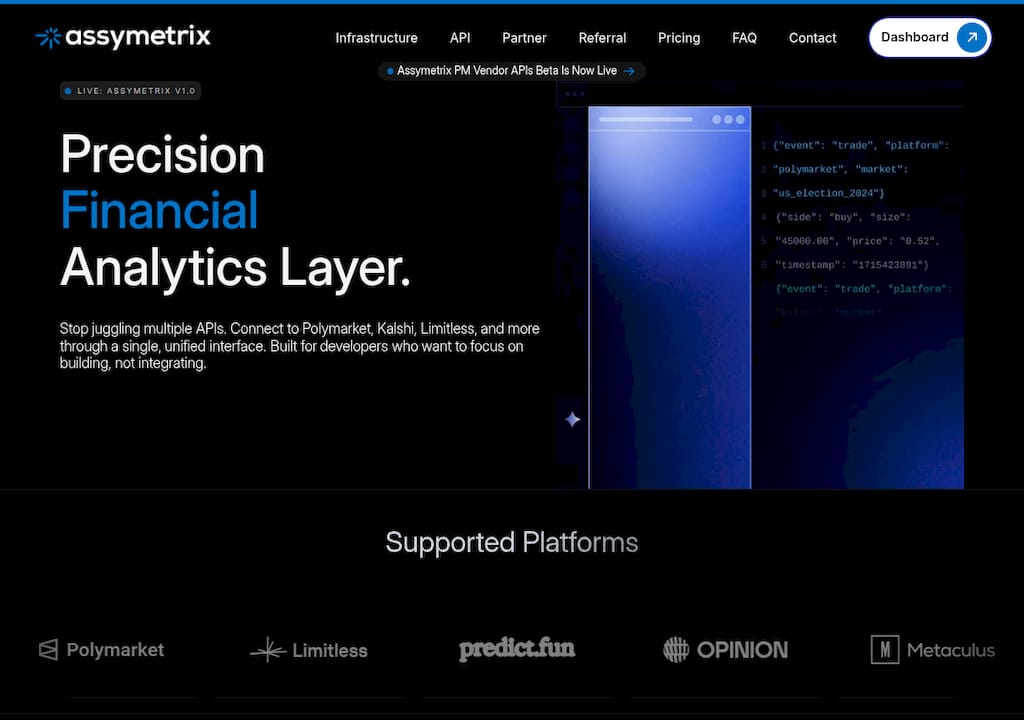
Start with the Data API landing page to see endpoint documentation and trial access, or review the cross-venue historical dataset guide for coverage details before you integrate.
FAQ
Is latency arbitrage illegal?
Latency arbitrage itself is generally legal in most regulated markets; it exploits publicly available market structure rather than privileged inside information. Regulators have instead focused on exchange-level countermeasures, such as IEX’s D-Limit order type, rather than banning the practice outright.
What is latency arbitrage trading?
Latency arbitrage trading means using faster data access or order execution to trade ahead of slower participants before quotes update across all venues. It typically relies on direct exchange feeds, co-location, and optimized processing pipelines rather than any informational advantage about the asset itself.
What is a good latency for trading?
There is no single universal benchmark since the “good” latency depends on the strategy and venue, but pickoff and hedge strategies generally need end-to-end execution budgets under a few milliseconds to remain competitive. Slower but higher-quality decision models can still outperform in latency-quality benchmark research, so raw speed is not the only variable worth optimizing.
What are the three types of arbitrage?
Common classifications include spatial arbitrage (the same asset priced differently across venues), temporal or statistical arbitrage (price relationships expected to converge over time), and latency arbitrage (speed-based exploitation of quote staleness). These categories overlap in practice, since a latency arbitrage trade is often also a spatial arbitrage trade executed before prices converge.
Does latency arbitrage increase trading costs for liquidity providers?
Evidence suggests latency arbitrage contributes to wider spreads and more cautious quoting from market makers who adjust pricing to account for adverse selection risk. The magnitude of this effect is contested in the agent-based modeling literature, where results depend heavily on how realistically the simulated trading agents behave.
Sources
Prediction Market Developers: Detect Microsecond Latency Arbitrage
Latency arbitrage is the practice of exploiting microsecond differences in price or quote dissemination to trade ahead of slower participants, and it transfers value from liquidity providers and slower traders to whichever actor processes and acts on information fastest. Gains concentrate among low-latency firms with direct feeds and co-located infrastructure; costs land on market makers and anyone trading through consolidated or delayed data. For algorithmic agents and data integrations, the immediate implication is simple: measure your feed latency and verify your timestamps before you trust any signal.
TL;DR:
Latency arbitrage profits can reach billions of dollars, but estimates vary widely depending on market data and the scope of analysis.
Strategies rely on microsecond delays between exchange feeds, with co-location and network routing playing critical roles in advantage.
Implementing safeguards like cross-checking multiple feeds and verifying timestamps can help reduce exposure to latency-based trading risks.
Normalized, real-time cross-venue data and divergence measurement are essential for identifying opportunities and avoiding stale information.
Speed alone is not enough; trading models that interpret signals more accurately can outperform faster ones in high-frequency trading environments.
Assymetrixassymetrix.comBuild With Unified Market DataAssymetrix gives developers and algorithmic agents unified cross-venue prediction market data through a single Data API integration.Explore the Data API
Table of Contents
How Market Architecture Creates Latency Gaps
What the Research Says About Profits and Market Harm
How Latency Arbitrageurs Actually Operate
Exchange Protections and Developer-Side Defenses
Detecting Latency Divergence Across Prediction Market Venues
What Practitioners Should Prioritize
Trial the Assymetrix Data API for Cross-Venue Testing
Sources
How Market Architecture Creates Latency Gaps
Latency arbitrage exists because no market distributes price information instantly or uniformly. In US equities, the Securities Information Processor (SIP) aggregates quotes from every exchange and publishes a consolidated National Best Bid and Offer, but that aggregation step takes time. Direct feeds from individual exchanges reach co-located servers before the SIP ever recalculates NBBO, and that gap, often a few hundred microseconds to a few milliseconds, is where pickoff trades happen.
Several layers compound this delay:
Geographic and routing latency: physical distance between venues (the Albany-to-Chicago link cited in market design research is significant enough to create fixed, unavoidable propagation delay measured in the order of milliseconds) creates fixed, unavoidable propagation delay.
Co-location advantage: servers placed inside exchange data centers shave microseconds that remote participants cannot recover regardless of code quality.
Feed-processing pipelines: parsing, normalizing, and timestamping raw exchange messages introduces variable software latency that differs firm to firm.
Market fragmentation: the same asset trading across multiple venues (stock exchanges, or Polymarket, Kalshi, and Limitless in prediction markets) means price discovery never happens in one place at one instant.
Tactic taxonomy follows from these gaps. Pickoffs hit stale quotes before they update. Hedged cross-venue arbitrage buys on one venue and sells an equivalent position on another before prices converge. News-tick arbitrage races to trade on a headline or data release before slower feeds process it. Masking disguises order flow intent, often through order-splitting or iceberg orders, to avoid tipping off other latency-sensitive participants. Each tactic depends on the same underlying resource: knowing the true price before the rest of the market does.
What the Research Says About Profits and Market Harm
Published estimates of latency arbitrage profits vary enormously, which itself is a finding worth taking seriously. Aggregated historic estimates cited in the agent-based model literature on fragmented markets put cumulative figures as high as $21 billion, while other analyses covering narrower time windows conclude latency arbitrage is not a dominant profit source at all. The spread between these numbers comes down to methodology: what counts as an arbitrage trade, which venues are included, and over what period.
Agent-based modeling shows the answer depends on who you simulate. The same research comparing Zero Intelligence Constrained (ZIC) agents against Zero Intelligence Plus (ZIP) agents found that more adaptive trading agents can reverse conclusions drawn from simpler models about whether fragmentation helps or harms overall market efficiency.
Three metrics matter most for anyone trying to quantify exposure in their own market:
NBBO divergence time: how long a quote remains stale relative to the fastest available price.
Quote cancellation rates: a spike often signals market makers pulling back ahead of anticipated adverse selection.
Spread shifts: widening spreads around volatile events frequently reflect liquidity providers pricing in latency risk.
Regulatory filings add a narrower, more concrete data point: exchange analyses of targeted quote protections report activation windows measured in fractions of a percent of total trading time, a figure covered in the next section.
How Latency Arbitrageurs Actually Operate
Building a latency arbitrage strategy is an exercise in budgeting microseconds against decision quality, not just chasing raw speed.
Pickoff and hedge execution: the trader monitors a fast feed for a price move, fires an order against a stale quote on a slower venue, and simultaneously hedges the resulting position on a third venue, all within a latency budget typically under a few milliseconds end to end.
News-tick sequencing: the strategy parses a headline or data release, classifies its market impact, and routes an order before consolidated feeds or human traders can react, requiring tight coordination between parsing latency and order gateway latency.
Masking and obfuscation: orders are split across venues or sizes to avoid revealing the full position, reducing the risk that other latency-sensitive algorithms detect and front-run the strategy itself.
The operational risk in all three is real: masking can trigger exchange surveillance flags, and pickoff strategies that misjudge feed staleness can end up hedging against a price that has already moved again.
Pro Tip: Benchmark your strategy’s win rate against a naive “fastest feed wins” baseline before adding complexity. If a smarter but slower model beats raw speed, you have found your actual edge.
That last point matters more as AI agents enter latency-sensitive trading. Recent benchmark work on latency-quality tradeoffs in trading agents found that faster inference is not automatically better. An agent that trades a few milliseconds slower but interprets signals more accurately can outperform a faster, lower-quality model in simulated high-frequency conditions.
Exchange Protections and Developer-Side Defenses
Market design has produced several direct responses to latency arbitrage, each with measurable tradeoffs.
IEX’s D-Limit and ORP are formulaic indicators that temporarily protect displayed liquidity when the system detects a likely stale quote. Regulatory filings and SEC commentary on these order-type protections report that these protections activate during a vanishingly small fraction of trading time, in the range of 0.021% to 0.001% depending on the metric used, yet still meaningfully reduce adverse selection against resting orders.
A more structural proposal, examined in theoretical work on synchronized execution, lets traders specify an execution time T after order arrival, so competing orders land simultaneously rather than in a speed race. Simulation results show this can sharply reduce arbitrage incidence, though it requires coordinated adoption across venues to work.
Developers and algorithmic traders do not need to wait on exchange-level change:
Cross-check prices across at least two independent feeds before acting on any single data source.
Verify timestamp integrity with synchronized clocks (PTP or NTP) rather than trusting feed-reported times.
Add execution jittering to avoid predictable, exploitable order timing patterns.
Set adaptive thresholds that widen during detected high-divergence windows rather than using static spread limits.
Pro Tip: Log NBBO divergence time and quote cancellation rate as first-class telemetry in your execution pipeline, not just fill rate and P&L; they are the earliest warning signs of adverse selection. A practical orderbook integration checklist covers the timestamp and sequencing fields worth tracking from day one.
Detecting Latency Divergence Across Prediction Market Venues
Prediction markets fragment the same way equities do, just across a smaller set of venues. The same event can trade at meaningfully different implied probabilities on Polymarket, Kalshi, and Limitless at the same moment, and without canonical event IDs mapping equivalent markets across venues, a divergence signal is just noise.
Data APIs can normalize real-time and historical feeds across prediction market venues into a single schema, so a price gap between venues appears as a comparable, timestamped data point rather than three separate formats to reconcile by hand. Some platforms surface arbitrage signals and Smart Money wallet tracking directly on top of normalized data layers, which means a developer testing for latency-driven divergence does not need to build venue-specific parsers first.
A reasonable detection workflow looks like this:
Pull normalized order book snapshots across venues using canonical IDs to confirm you are comparing the same event.
Measure divergence duration and magnitude against historical baselines, following the backtest patterns in our quant strategy guide to prediction market arbitrage.
Feed arbitrage signals into agent decision logic as a confirmation layer, not a sole trigger, to avoid acting on stale or one-sided data, a pattern covered in our guide to feeding data into AI trading agents.
What Practitioners Should Prioritize
Measurement comes before optimization. Establish a reproducible backtest baseline on real cross-venue data before tuning any latency-sensitive strategy, because an unmeasured edge is indistinguishable from noise. Signal and model quality improvements tend to beat marginal speed gains once you are past the point of catastrophic feed staleness, and the research on agent latency-quality tradeoffs backs that judgment. Transparency between exchanges, data providers, and trading teams about feed timing is the cheapest risk reduction available.
— Dean
Trial the Assymetrix Data API for Cross-Venue Testing
Detecting latency-driven divergence requires normalized data you can trust, not three separate venue integrations to reconcile by hand. Some prediction market data APIs deliver canonical IDs, normalized real-time and historical feeds, and arbitrage signals across major prediction market venues through a single integration, built on substantial historical trading data.
Start with the Data API landing page to see endpoint documentation and trial access, or review the cross-venue historical dataset guide for coverage details before you integrate.
FAQ
Is latency arbitrage illegal?
Latency arbitrage itself is generally legal in most regulated markets; it exploits publicly available market structure rather than privileged inside information. Regulators have instead focused on exchange-level countermeasures, such as IEX’s D-Limit order type, rather than banning the practice outright.
What is latency arbitrage trading?
Latency arbitrage trading means using faster data access or order execution to trade ahead of slower participants before quotes update across all venues. It typically relies on direct exchange feeds, co-location, and optimized processing pipelines rather than any informational advantage about the asset itself.
What is a good latency for trading?
There is no single universal benchmark since the “good” latency depends on the strategy and venue, but pickoff and hedge strategies generally need end-to-end execution budgets under a few milliseconds to remain competitive. Slower but higher-quality decision models can still outperform in latency-quality benchmark research, so raw speed is not the only variable worth optimizing.
What are the three types of arbitrage?
Common classifications include spatial arbitrage (the same asset priced differently across venues), temporal or statistical arbitrage (price relationships expected to converge over time), and latency arbitrage (speed-based exploitation of quote staleness). These categories overlap in practice, since a latency arbitrage trade is often also a spatial arbitrage trade executed before prices converge.
Does latency arbitrage increase trading costs for liquidity providers?
Evidence suggests latency arbitrage contributes to wider spreads and more cautious quoting from market makers who adjust pricing to account for adverse selection risk. The magnitude of this effect is contested in the agent-based modeling literature, where results depend heavily on how realistically the simulated trading agents behave.
Sources
Other Blog


