1.5TB Cross Venue Prediction Market Data for Quants With Canonical IDs
1.5TB Cross Venue Prediction Market Data for Quants With Canonical IDs
1.5TB Cross Venue Prediction Market Data for Quants With Canonical IDs
Hands-on API checklist for quant traders. Learn canonical IDs, point-in-time snapshots, live streams, and how 1.5TB of cross-venue history enables...

1.5TB Cross Venue Prediction Market Data for Quants With Canonical IDs
Unified prediction market APIs now deliver the real-time trades, order books, wallet activity, and point-in-time historical snapshots that systematic strategies require. A data API can index cross-venue prediction market activity with documentation built for backtesting and live signal generation. Start with the API reference, pull a sample historical window, and confirm you can reconstruct a past order book before writing a single line of strategy code.
TL;DR:
Cross-venue prediction market data requires canonical IDs and point-in-time snapshots to ensure accurate backtesting and prevent duplicate or mismatched events.
Real-time streams provide live trades and quotes needed for execution, while historical archives supply the continuous data necessary for strategy backtesting.
Price in prediction markets reflects implied probability, with order book and trade data processed for label accuracy, slippage, and fee considerations.
Validation of historical data involves checking event coverage, snapshot density, ID stability, and reproducibility through sample pulls, rather than relying on claimed dataset size.
Using a unified prediction market API simplifies infrastructure by providing indexed historical data, real-time feeds, and cross-venue reconciliation, saving significant engineering effort.
AssymetrixUnify Your Prediction Market DataAssymetrix brings real-time and historical data from Polymarket, Kalshi, and Limitless into one unified intelligence layer.Explore Assymetrix
Table of Contents
What Does a Prediction Market Data API Return?
Real-Time Streams vs. Historical Archives: Which Do You Actually Need?
Why Canonical IDs Make or Break Cross-Venue Backtests
How Do Quants Turn Cross-Venue Data Into Trading Signals?
How Do You Integrate a Prediction Market API Into a Trading Pipeline?
What Should a Dataset Actually Deliver Before You Build On It?
Pricing Models and Market Mechanisms Unique to Prediction Markets
How Should Quants Handle Sentiment and Event Metadata?
What Legal and Compliance Issues Should Quants Know About?
What I’ve Learned Building Signals on This Kind of Data
Get Cross-Venue Prediction Market Data Without Building the Pipeline Yourself
Sources
What Does a Prediction Market Data API Return?
A prediction market API organizes data into a handful of canonical objects. Market metadata carries the question text, resolution criteria, outcome tokens, and expiration timestamp. Below that sit the transactional layers quants actually model against.
Market records: unique market ID, outcome set, creation and resolution timestamps, resolution source.
Trade records: price, size, taker/maker flag, collateral token, wallet address, block/event timestamp.
Quote and book data: top-of-book bid/ask, spread, depth at multiple price levels.
OHLCV candles: open, high, low, close, and volume aggregated into fixed intervals for time-series modeling.
Trade price in a prediction market doubles as implied probability. A trade printing at $0.62 reflects a 62% market-implied chance, a convention documented in Bitquery’s prediction market API reference, which lays out the PredictionManagements, PredictionTrades, and PredictionSettlements schema most cross-venue feeds mirror. Taker/maker flags matter because they separate aggressive flow from passive liquidity, a distinction factor models rely on. Timestamps and IDs typically arrive as ISO 8601 strings and decimal strings rather than floats, and normalizing those types consistently across venues is where most ingestion pipelines quietly break.
Real-Time Streams vs. Historical Archives: Which Do You Actually Need?
Both, and for different jobs. Real-time streaming feeds live trades and quotes through WebSocket or datastream connections, typically organized into subscription rooms keyed by exchange and market ID. That’s what a live signal or execution bot consumes. Historical archives, by contrast, hold the full trade tape and OHLCV snapshot history a backtest needs to simulate strategy performance across past market conditions.
Building a production pipeline generally means handling three distinct jobs:
Subscribe to live rooms for trades and top-of-book updates on the markets you’re actively trading.
Pull historical OHLCV and trade-level data for the lookback window your model requires, confirmed contiguous with no gaps.
Reconcile the two streams during backfill so a reconnect after downtime doesn’t create duplicate or missing bars.
Provider documentation for unified Kalshi and Polymarket coverage flags operational signals worth building alarms around: cache headers such as X-Cache: HIT, HIT-STALE, or MISS, and a SERVICE_BUSY response that behaves differently from a standard 429 rate limit, according to SolanaTracker’s prediction markets documentation. Treating SERVICE_BUSY as a retry-with-backoff case rather than a hard rate limit avoids needless circuit breaker trips.
Pro Tip: Log the X-Cache header on every historical pull during backtesting. A HIT-STALE response on data you assume is fresh can silently poison a lookback window without throwing an error.
Why Canonical IDs Make or Break Cross-Venue Backtests
Cross-venue quant work lives or dies on identifier hygiene. Polymarket and Kalshi assign their own internal market IDs with no shared namespace, so any strategy comparing prices across venues needs a canonical ID layer mapping “will the Fed cut rates in March” on one venue to its equivalent on another. Skipping this step is the single biggest reason cross-venue signal research turns into a deduplication mess months into a project.
A workable engineering checklist:
Assign a deterministic canonical ID per underlying event, independent of venue-specific market IDs.
Version your schema explicitly, and never silently rename or repurpose a field, since a quiet rename between provider versions breaks a backtest without an error message.
Store point-in-time snapshots of order book and OHLCV state rather than reconstructing history from a live-updated aggregate table.
Retain the metadata needed to reproduce a historical state exactly: snapshot timestamp, source venue, schema version.
Point-in-time accuracy deserves special weight. If your historical dataset only stores the current, continuously-updated version of a market’s OHLCV series, any backtest run today implicitly leaks information the market didn’t have at the time. Assymetrix’s own guidance on backtesting with point-in-time snapshots treats snapshot storage, not live aggregate reconstruction, as the baseline requirement for reproducible research. Canonical IDs and schema stability are, in practical terms, the biggest accelerant or the biggest tax on a cross-venue quant build, depending on whether you get them right early.
How Do Quants Turn Cross-Venue Data Into Trading Signals?
Retail traders check one venue’s price and decide. Quants build features across every venue simultaneously, because a probability shift confirmed simultaneously on both Polymarket and Kalshi carries more signal than the same move seen on just one. Single-venue price action can reflect thin liquidity or one large order; cross-venue confirmation filters that noise out.
Common patterns worth building into a research pipeline:
Divergence detection: flag when the same underlying event prices meaningfully differently across venues, adjusted for each venue’s liquidity depth.
Arbitrage measurement: quantify the cross-venue price gap in probability terms, then simulate realistic execution against posted depth to estimate net edge after slippage and fees.
TWAP-probability features: smooth noisy tick-level prices into a time-weighted probability series less sensitive to single-trade outliers.
Trader-skill-weighted signals: weight price moves by the historical accuracy of the wallets driving them, rather than treating all flow as equal.
A gap that looks profitable on paper often shrinks or disappears once you model realistic fill rates against actual order book depth rather than assuming full execution at the quoted price. Backtest discipline matters here: strip any information a live model wouldn’t have had at decision time, and be deliberate about which markets you sample, since survivorship bias toward well-known, high-volume markets can inflate apparent edge. Cross-venue confirmation is a design principle worth building into a signal generation pipeline like the one described in Assymetrix’s guide to cross-venue signal generation, not an afterthought bolted onto a single-venue model.
How Do You Integrate a Prediction Market API Into a Trading Pipeline?
Integration follows a predictable shape across most providers, though the details vary. Authentication runs through an API key passed in a request header, generally with separate scoped keys for read-only historical access versus live streaming, and rotation policies you should configure rather than hardcode.
Map the endpoints first: discovery/search, market metadata, trades, candlesticks, order book snapshots, and wallet activity typically live as distinct REST routes.
Choose a pagination strategy for bulk pulls: cursor-based pagination scales better than offset pagination for large historical exports and avoids the duplicate-row problem offset pagination creates when new data lands mid-pull.
Subscribe to WebSocket rooms named by exchange and market ID for live trades and quotes, and build reconnection logic that automatically backfills the gap window rather than assuming no data was missed.
Deduplicate on ingestion using trade ID and timestamp, since reconnects and retries will occasionally redeliver the same event.
Pro Tip: Run your backfill logic against a deliberately interrupted connection in a staging environment before going live. The bug in most production pipelines isn’t the happy path, it’s the reconnect.
Developers building this from scratch in Python can shortcut a fair amount of boilerplate using Assymetrix’s Python developer guide, which walks through authenticated requests and streaming consumption patterns directly.
What Should a Dataset Actually Deliver Before You Build On It?
Before committing engineering time to a provider, run a short validation pass rather than taking dataset-size claims at face value. Pull a sample historical window and confirm event counts, OHLCV coverage, and canonical ID consistency line up with what the documentation promises.
Check historic event count and confirm coverage extends back far enough for your intended lookback window.
Verify OHLCV snapshot density is fine-grained enough for your signal’s holding period, not just daily bars when you need hourly ones.
Confirm canonical IDs are stable across a sample of markets you already know span multiple venues.
Test average stream latency and reconnection behavior under a simulated dropout.
Run a small-sample reproducibility check: pull the same historical window twice, a day apart, and confirm identical results.
Assymetrix’s Data API indexes cross-venue Polymarket, Kalshi, and Limitless activity into roughly 1.5 terabytes of historical data spanning close to one billion rows, according to Assymetrix’s platform overview, alongside Smart Money wallet tracking and Trader Skill Scores built directly into the schema.
Checklist item | What to test | Why it matters for backtests |
|---|---|---|
Historic depth | Pull earliest available event per market | Determines your maximum lookback window |
OHLCV granularity | Compare candle interval to your signal’s holding period | Coarse candles hide intra-period volatility |
Canonical ID stability | Cross-reference the same event across venues | Prevents duplicate or mismatched signal rows |
Reproducibility | Re-pull the same window a day later | Confirms point-in-time snapshots aren’t silently mutating |
Pricing Models and Market Mechanisms Unique to Prediction Markets
Prediction market prices are not derivative valuations, and live feeds with crypto price predictions provide real-time scenarios to inform trading decisions. They are direct probability estimates, bounded between $0 and $1 (or $0 and $100 depending on venue convention), where the price itself is the market’s aggregate belief about an outcome’s likelihood. That single fact changes how a quant should model them relative to equities or futures.
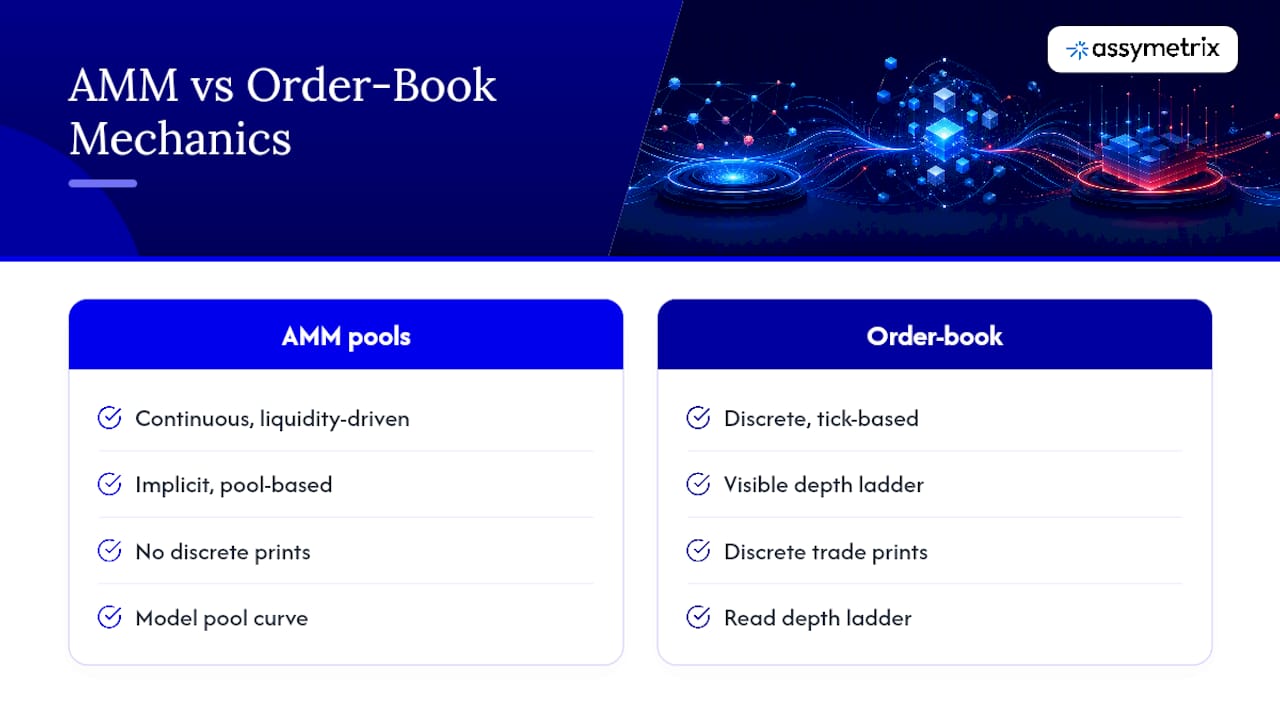
Most venues run either an automated market maker mechanism or a central limit order book, and the two produce meaningfully different microstructure. Order-book venues like Kalshi and Polymarket’s book-based markets generate discrete trade prints and visible depth at each level, closer to a traditional exchange. AMM-style pools instead move price continuously as a function of pool liquidity, which means slippage estimation requires modeling the pool’s curve rather than reading a static depth ladder.
Settlement mechanics add a wrinkle equities models don’t have to deal with: every market resolves to a binary or discrete payout at a fixed future date, based on an external resolution source. That terminal boundary condition means probability naturally converges toward 0 or 1 as resolution approaches, and volatility patterns near expiration look nothing like the volatility patterns mid-cycle. A factor model trained on mid-cycle price behavior alone will misprice risk near resolution unless time-to-resolution is an explicit feature.
Fee structures vary by venue too, typically charging either a flat percentage on winnings or a maker/taker spread on order-book trades, and that fee schedule needs to sit inside any arbitrage or edge calculation, not get bolted on afterward. A gap that looks like a 3% edge before fees can vanish entirely once maker/taker costs on both legs are subtracted.
How Should Quants Handle Sentiment and Event Metadata?
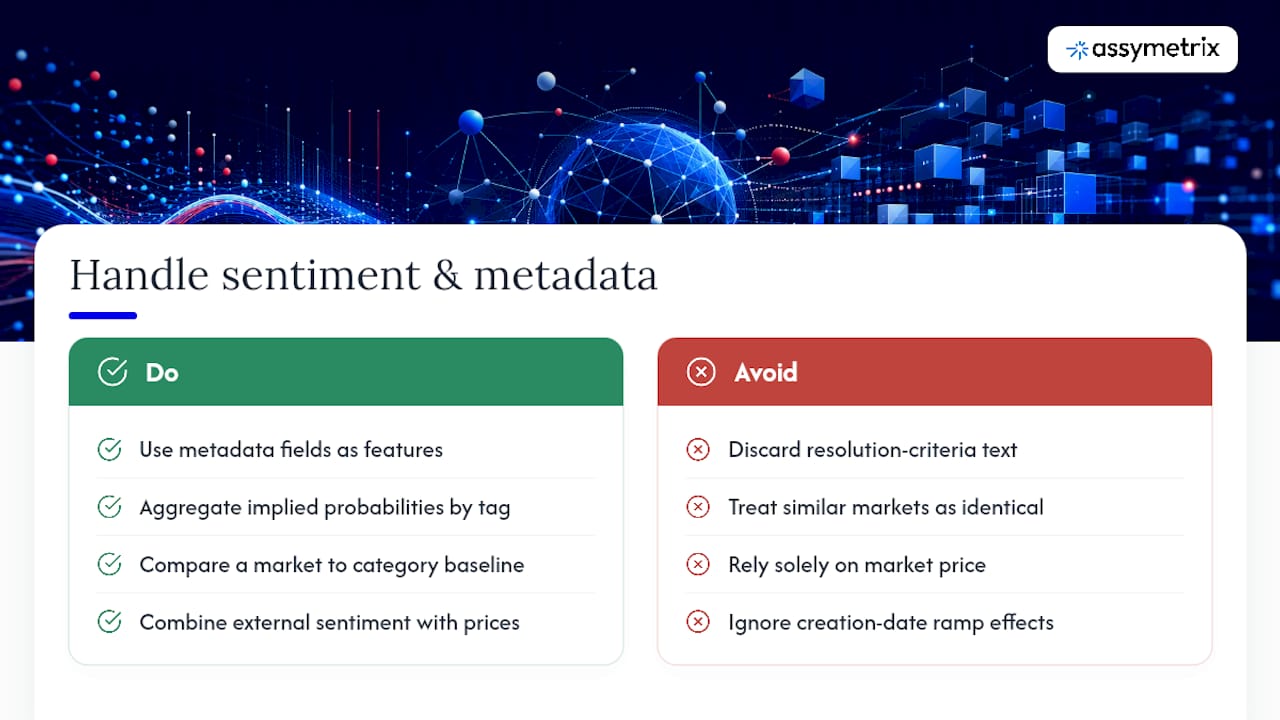
Prediction markets carry an alternative data layer beyond raw price: the event metadata itself. Market question text, resolution criteria, category tags, and creation timestamps all encode information a pure price series misses, and treating that metadata as a feature source rather than throwaway text opens up modeling angles retail traders rarely touch.
Category and tag fields let you build cohort-level features: aggregate implied probability across all markets tagged to a specific macro event, or compare a single market’s price trajectory against its category’s baseline volatility. Resolution criteria text, meanwhile, tells you exactly what triggers settlement, which matters when two superficially similar markets on different venues resolve on subtly different criteria and shouldn’t be treated as the same underlying event in a cross-venue signal.
Sentiment is a separate, trickier layer. Some quant teams pull external sentiment signals from news or social platforms and pair them with market price moves to test whether sentiment shifts lead or lag price. Forecasting platforms that publish structured probability outputs, such as Preseen’s AI forecasting models, illustrate the consumer side of this relationship: they ingest market-implied probabilities as one input among several rather than treating any single feed as ground truth. That’s a reasonable design principle for a quant pipeline too. Prediction market prices should function as one high-quality signal feeding a broader model, not the sole input, particularly for markets with thin liquidity where a handful of trades can move implied probability without any real information content behind the move.
Event metadata timestamps matter for a second reason: market creation date relative to the event it covers affects liquidity ramp patterns, and a feature engineered without accounting for that ramp will overweight early-market noise.
What Legal and Compliance Issues Should Quants Know About?
Regulatory treatment of prediction markets varies by jurisdiction and by the underlying event category, and that variation affects what data you can legally act on and how. In the United States, Kalshi operates as a CFTC-regulated exchange for certain event contracts, which places it under a different regulatory framework than offshore or decentralized prediction venues. Polymarket’s structure and regulatory posture has shifted over time and differs from Kalshi’s, so treating every venue’s data as interchangeable from a compliance standpoint is a mistake worth avoiding.
Trading on regulated event contracts based on material nonpublic information can raise the same categories of concern that apply in traditional derivatives markets, and the specific rules depend on the contract category and venue. Firms building automated trading systems on this data should get jurisdiction-specific legal guidance rather than assuming prediction market activity sits in a regulatory gray zone simply because the category is newer than equities or futures.
Data licensing terms matter separately from trading regulation. API terms of service typically restrict redistribution of raw data, cap commercial use under certain tiers, and distinguish academic or non-commercial access from institutional licensing. Before building a product or fund strategy on top of a vendor’s feed, read the specific commercial license terms that apply to your intended use, since a tier built for individual research access often prohibits the redistribution or bulk resale a fund operation would require.
None of this constitutes legal advice, and the regulatory landscape for event contracts continues to evolve. Treat compliance review as a standing item in any production deployment, not a one-time checkbox.
What I’ve Learned Building Signals on This Kind of Data
The most common mistake I see in prediction market quant research isn’t a bad model, it’s bad plumbing: mismatched timestamps, silently stale caches, or a canonical ID that quietly drifted between two data pulls. Cross-venue confirmation signals genuinely outperform single-venue ones in narrow, well-defined universes, but only once the underlying IDs are trustworthy enough that you’re actually comparing the same event twice. Start small: pick five markets you can verify by hand across two venues, build your reconciliation logic against those, then scale the universe. Production-grade signals come from boring engineering discipline, not clever features.
— Dean
Get Cross-Venue Prediction Market Data Without Building the Pipeline Yourself
Everything covered in this guide, canonical IDs, point-in-time snapshots, real-time streams, and cross-venue reconciliation, is engineering work most quant teams underestimate by months. A data API can be built to skip that build phase: indexing roughly 1.5 terabytes of historical Polymarket, Kalshi, and Limitless data spanning nearly one billion rows, with Smart Money wallet tracking and Trader Skill Scores computed into the schema rather than left for users to derive.
Getting started means pulling a sample historical window and confirming reproducibility before you commit engineering hours to a full integration. The API documentation walks through authentication, endpoint structure, and streaming setup, and the prediction market data feed guide covers realtime and historical patterns side by side. If arbitrage detection is your priority, the cross-venue price gap measurement guide shows how to quantify and simulate execution against posted depth. Start with the docs, run the reproducibility check from the checklist above, and see whether the schema fits your pipeline before writing a single ingestion script.
FAQ
What Data Does a Prediction Market API Provide?
A prediction market API returns market metadata, outcome records, trade-level data (price, size, taker/maker flag), order book snapshots, and OHLCV candles, with trade price functioning as implied probability.
How Is Prediction Market Data Different From Stock Market Data?
Prediction market prices are bounded probability estimates between $0 and $1 that converge toward a binary resolution at a fixed future date, unlike equity prices, which have no terminal settlement boundary.
Why Do Quants Need Cross-Venue Data Instead of a Single Venue?
A probability shift confirmed simultaneously on Polymarket and Kalshi carries stronger signal than the same move on one venue alone, since single-venue moves can reflect thin liquidity or one large order rather than genuine information.
What Makes Historical Prediction Market Data Backtestable?
Point-in-time snapshots stored separately from live-updated aggregates make historical data backtestable, since reconstructing history from a continuously updated table introduces lookahead bias.
Does Assymetrix Offer an API for Quant Trading Research?
Yes. Some data APIs provide unified cross-venue access to major prediction market data, including Smart Money wallet tracking, Trader Skill Scores, and extensive historical coverage.
1.5TB Cross Venue Prediction Market Data for Quants With Canonical IDs
Unified prediction market APIs now deliver the real-time trades, order books, wallet activity, and point-in-time historical snapshots that systematic strategies require. A data API can index cross-venue prediction market activity with documentation built for backtesting and live signal generation. Start with the API reference, pull a sample historical window, and confirm you can reconstruct a past order book before writing a single line of strategy code.
TL;DR:
Cross-venue prediction market data requires canonical IDs and point-in-time snapshots to ensure accurate backtesting and prevent duplicate or mismatched events.
Real-time streams provide live trades and quotes needed for execution, while historical archives supply the continuous data necessary for strategy backtesting.
Price in prediction markets reflects implied probability, with order book and trade data processed for label accuracy, slippage, and fee considerations.
Validation of historical data involves checking event coverage, snapshot density, ID stability, and reproducibility through sample pulls, rather than relying on claimed dataset size.
Using a unified prediction market API simplifies infrastructure by providing indexed historical data, real-time feeds, and cross-venue reconciliation, saving significant engineering effort.
AssymetrixUnify Your Prediction Market DataAssymetrix brings real-time and historical data from Polymarket, Kalshi, and Limitless into one unified intelligence layer.Explore Assymetrix
Table of Contents
What Does a Prediction Market Data API Return?
Real-Time Streams vs. Historical Archives: Which Do You Actually Need?
Why Canonical IDs Make or Break Cross-Venue Backtests
How Do Quants Turn Cross-Venue Data Into Trading Signals?
How Do You Integrate a Prediction Market API Into a Trading Pipeline?
What Should a Dataset Actually Deliver Before You Build On It?
Pricing Models and Market Mechanisms Unique to Prediction Markets
How Should Quants Handle Sentiment and Event Metadata?
What Legal and Compliance Issues Should Quants Know About?
What I’ve Learned Building Signals on This Kind of Data
Get Cross-Venue Prediction Market Data Without Building the Pipeline Yourself
Sources
What Does a Prediction Market Data API Return?
A prediction market API organizes data into a handful of canonical objects. Market metadata carries the question text, resolution criteria, outcome tokens, and expiration timestamp. Below that sit the transactional layers quants actually model against.
Market records: unique market ID, outcome set, creation and resolution timestamps, resolution source.
Trade records: price, size, taker/maker flag, collateral token, wallet address, block/event timestamp.
Quote and book data: top-of-book bid/ask, spread, depth at multiple price levels.
OHLCV candles: open, high, low, close, and volume aggregated into fixed intervals for time-series modeling.
Trade price in a prediction market doubles as implied probability. A trade printing at $0.62 reflects a 62% market-implied chance, a convention documented in Bitquery’s prediction market API reference, which lays out the PredictionManagements, PredictionTrades, and PredictionSettlements schema most cross-venue feeds mirror. Taker/maker flags matter because they separate aggressive flow from passive liquidity, a distinction factor models rely on. Timestamps and IDs typically arrive as ISO 8601 strings and decimal strings rather than floats, and normalizing those types consistently across venues is where most ingestion pipelines quietly break.
Real-Time Streams vs. Historical Archives: Which Do You Actually Need?
Both, and for different jobs. Real-time streaming feeds live trades and quotes through WebSocket or datastream connections, typically organized into subscription rooms keyed by exchange and market ID. That’s what a live signal or execution bot consumes. Historical archives, by contrast, hold the full trade tape and OHLCV snapshot history a backtest needs to simulate strategy performance across past market conditions.
Building a production pipeline generally means handling three distinct jobs:
Subscribe to live rooms for trades and top-of-book updates on the markets you’re actively trading.
Pull historical OHLCV and trade-level data for the lookback window your model requires, confirmed contiguous with no gaps.
Reconcile the two streams during backfill so a reconnect after downtime doesn’t create duplicate or missing bars.
Provider documentation for unified Kalshi and Polymarket coverage flags operational signals worth building alarms around: cache headers such as X-Cache: HIT, HIT-STALE, or MISS, and a SERVICE_BUSY response that behaves differently from a standard 429 rate limit, according to SolanaTracker’s prediction markets documentation. Treating SERVICE_BUSY as a retry-with-backoff case rather than a hard rate limit avoids needless circuit breaker trips.
Pro Tip: Log the X-Cache header on every historical pull during backtesting. A HIT-STALE response on data you assume is fresh can silently poison a lookback window without throwing an error.
Why Canonical IDs Make or Break Cross-Venue Backtests
Cross-venue quant work lives or dies on identifier hygiene. Polymarket and Kalshi assign their own internal market IDs with no shared namespace, so any strategy comparing prices across venues needs a canonical ID layer mapping “will the Fed cut rates in March” on one venue to its equivalent on another. Skipping this step is the single biggest reason cross-venue signal research turns into a deduplication mess months into a project.
A workable engineering checklist:
Assign a deterministic canonical ID per underlying event, independent of venue-specific market IDs.
Version your schema explicitly, and never silently rename or repurpose a field, since a quiet rename between provider versions breaks a backtest without an error message.
Store point-in-time snapshots of order book and OHLCV state rather than reconstructing history from a live-updated aggregate table.
Retain the metadata needed to reproduce a historical state exactly: snapshot timestamp, source venue, schema version.
Point-in-time accuracy deserves special weight. If your historical dataset only stores the current, continuously-updated version of a market’s OHLCV series, any backtest run today implicitly leaks information the market didn’t have at the time. Assymetrix’s own guidance on backtesting with point-in-time snapshots treats snapshot storage, not live aggregate reconstruction, as the baseline requirement for reproducible research. Canonical IDs and schema stability are, in practical terms, the biggest accelerant or the biggest tax on a cross-venue quant build, depending on whether you get them right early.
How Do Quants Turn Cross-Venue Data Into Trading Signals?
Retail traders check one venue’s price and decide. Quants build features across every venue simultaneously, because a probability shift confirmed simultaneously on both Polymarket and Kalshi carries more signal than the same move seen on just one. Single-venue price action can reflect thin liquidity or one large order; cross-venue confirmation filters that noise out.
Common patterns worth building into a research pipeline:
Divergence detection: flag when the same underlying event prices meaningfully differently across venues, adjusted for each venue’s liquidity depth.
Arbitrage measurement: quantify the cross-venue price gap in probability terms, then simulate realistic execution against posted depth to estimate net edge after slippage and fees.
TWAP-probability features: smooth noisy tick-level prices into a time-weighted probability series less sensitive to single-trade outliers.
Trader-skill-weighted signals: weight price moves by the historical accuracy of the wallets driving them, rather than treating all flow as equal.
A gap that looks profitable on paper often shrinks or disappears once you model realistic fill rates against actual order book depth rather than assuming full execution at the quoted price. Backtest discipline matters here: strip any information a live model wouldn’t have had at decision time, and be deliberate about which markets you sample, since survivorship bias toward well-known, high-volume markets can inflate apparent edge. Cross-venue confirmation is a design principle worth building into a signal generation pipeline like the one described in Assymetrix’s guide to cross-venue signal generation, not an afterthought bolted onto a single-venue model.
How Do You Integrate a Prediction Market API Into a Trading Pipeline?
Integration follows a predictable shape across most providers, though the details vary. Authentication runs through an API key passed in a request header, generally with separate scoped keys for read-only historical access versus live streaming, and rotation policies you should configure rather than hardcode.
Map the endpoints first: discovery/search, market metadata, trades, candlesticks, order book snapshots, and wallet activity typically live as distinct REST routes.
Choose a pagination strategy for bulk pulls: cursor-based pagination scales better than offset pagination for large historical exports and avoids the duplicate-row problem offset pagination creates when new data lands mid-pull.
Subscribe to WebSocket rooms named by exchange and market ID for live trades and quotes, and build reconnection logic that automatically backfills the gap window rather than assuming no data was missed.
Deduplicate on ingestion using trade ID and timestamp, since reconnects and retries will occasionally redeliver the same event.
Pro Tip: Run your backfill logic against a deliberately interrupted connection in a staging environment before going live. The bug in most production pipelines isn’t the happy path, it’s the reconnect.
Developers building this from scratch in Python can shortcut a fair amount of boilerplate using Assymetrix’s Python developer guide, which walks through authenticated requests and streaming consumption patterns directly.
What Should a Dataset Actually Deliver Before You Build On It?
Before committing engineering time to a provider, run a short validation pass rather than taking dataset-size claims at face value. Pull a sample historical window and confirm event counts, OHLCV coverage, and canonical ID consistency line up with what the documentation promises.
Check historic event count and confirm coverage extends back far enough for your intended lookback window.
Verify OHLCV snapshot density is fine-grained enough for your signal’s holding period, not just daily bars when you need hourly ones.
Confirm canonical IDs are stable across a sample of markets you already know span multiple venues.
Test average stream latency and reconnection behavior under a simulated dropout.
Run a small-sample reproducibility check: pull the same historical window twice, a day apart, and confirm identical results.
Assymetrix’s Data API indexes cross-venue Polymarket, Kalshi, and Limitless activity into roughly 1.5 terabytes of historical data spanning close to one billion rows, according to Assymetrix’s platform overview, alongside Smart Money wallet tracking and Trader Skill Scores built directly into the schema.
Checklist item | What to test | Why it matters for backtests |
|---|---|---|
Historic depth | Pull earliest available event per market | Determines your maximum lookback window |
OHLCV granularity | Compare candle interval to your signal’s holding period | Coarse candles hide intra-period volatility |
Canonical ID stability | Cross-reference the same event across venues | Prevents duplicate or mismatched signal rows |
Reproducibility | Re-pull the same window a day later | Confirms point-in-time snapshots aren’t silently mutating |
Pricing Models and Market Mechanisms Unique to Prediction Markets
Prediction market prices are not derivative valuations, and live feeds with crypto price predictions provide real-time scenarios to inform trading decisions. They are direct probability estimates, bounded between $0 and $1 (or $0 and $100 depending on venue convention), where the price itself is the market’s aggregate belief about an outcome’s likelihood. That single fact changes how a quant should model them relative to equities or futures.
Most venues run either an automated market maker mechanism or a central limit order book, and the two produce meaningfully different microstructure. Order-book venues like Kalshi and Polymarket’s book-based markets generate discrete trade prints and visible depth at each level, closer to a traditional exchange. AMM-style pools instead move price continuously as a function of pool liquidity, which means slippage estimation requires modeling the pool’s curve rather than reading a static depth ladder.
Settlement mechanics add a wrinkle equities models don’t have to deal with: every market resolves to a binary or discrete payout at a fixed future date, based on an external resolution source. That terminal boundary condition means probability naturally converges toward 0 or 1 as resolution approaches, and volatility patterns near expiration look nothing like the volatility patterns mid-cycle. A factor model trained on mid-cycle price behavior alone will misprice risk near resolution unless time-to-resolution is an explicit feature.
Fee structures vary by venue too, typically charging either a flat percentage on winnings or a maker/taker spread on order-book trades, and that fee schedule needs to sit inside any arbitrage or edge calculation, not get bolted on afterward. A gap that looks like a 3% edge before fees can vanish entirely once maker/taker costs on both legs are subtracted.
How Should Quants Handle Sentiment and Event Metadata?
Prediction markets carry an alternative data layer beyond raw price: the event metadata itself. Market question text, resolution criteria, category tags, and creation timestamps all encode information a pure price series misses, and treating that metadata as a feature source rather than throwaway text opens up modeling angles retail traders rarely touch.
Category and tag fields let you build cohort-level features: aggregate implied probability across all markets tagged to a specific macro event, or compare a single market’s price trajectory against its category’s baseline volatility. Resolution criteria text, meanwhile, tells you exactly what triggers settlement, which matters when two superficially similar markets on different venues resolve on subtly different criteria and shouldn’t be treated as the same underlying event in a cross-venue signal.
Sentiment is a separate, trickier layer. Some quant teams pull external sentiment signals from news or social platforms and pair them with market price moves to test whether sentiment shifts lead or lag price. Forecasting platforms that publish structured probability outputs, such as Preseen’s AI forecasting models, illustrate the consumer side of this relationship: they ingest market-implied probabilities as one input among several rather than treating any single feed as ground truth. That’s a reasonable design principle for a quant pipeline too. Prediction market prices should function as one high-quality signal feeding a broader model, not the sole input, particularly for markets with thin liquidity where a handful of trades can move implied probability without any real information content behind the move.
Event metadata timestamps matter for a second reason: market creation date relative to the event it covers affects liquidity ramp patterns, and a feature engineered without accounting for that ramp will overweight early-market noise.
What Legal and Compliance Issues Should Quants Know About?
Regulatory treatment of prediction markets varies by jurisdiction and by the underlying event category, and that variation affects what data you can legally act on and how. In the United States, Kalshi operates as a CFTC-regulated exchange for certain event contracts, which places it under a different regulatory framework than offshore or decentralized prediction venues. Polymarket’s structure and regulatory posture has shifted over time and differs from Kalshi’s, so treating every venue’s data as interchangeable from a compliance standpoint is a mistake worth avoiding.
Trading on regulated event contracts based on material nonpublic information can raise the same categories of concern that apply in traditional derivatives markets, and the specific rules depend on the contract category and venue. Firms building automated trading systems on this data should get jurisdiction-specific legal guidance rather than assuming prediction market activity sits in a regulatory gray zone simply because the category is newer than equities or futures.
Data licensing terms matter separately from trading regulation. API terms of service typically restrict redistribution of raw data, cap commercial use under certain tiers, and distinguish academic or non-commercial access from institutional licensing. Before building a product or fund strategy on top of a vendor’s feed, read the specific commercial license terms that apply to your intended use, since a tier built for individual research access often prohibits the redistribution or bulk resale a fund operation would require.
None of this constitutes legal advice, and the regulatory landscape for event contracts continues to evolve. Treat compliance review as a standing item in any production deployment, not a one-time checkbox.
What I’ve Learned Building Signals on This Kind of Data
The most common mistake I see in prediction market quant research isn’t a bad model, it’s bad plumbing: mismatched timestamps, silently stale caches, or a canonical ID that quietly drifted between two data pulls. Cross-venue confirmation signals genuinely outperform single-venue ones in narrow, well-defined universes, but only once the underlying IDs are trustworthy enough that you’re actually comparing the same event twice. Start small: pick five markets you can verify by hand across two venues, build your reconciliation logic against those, then scale the universe. Production-grade signals come from boring engineering discipline, not clever features.
— Dean
Get Cross-Venue Prediction Market Data Without Building the Pipeline Yourself
Everything covered in this guide, canonical IDs, point-in-time snapshots, real-time streams, and cross-venue reconciliation, is engineering work most quant teams underestimate by months. A data API can be built to skip that build phase: indexing roughly 1.5 terabytes of historical Polymarket, Kalshi, and Limitless data spanning nearly one billion rows, with Smart Money wallet tracking and Trader Skill Scores computed into the schema rather than left for users to derive.
Getting started means pulling a sample historical window and confirming reproducibility before you commit engineering hours to a full integration. The API documentation walks through authentication, endpoint structure, and streaming setup, and the prediction market data feed guide covers realtime and historical patterns side by side. If arbitrage detection is your priority, the cross-venue price gap measurement guide shows how to quantify and simulate execution against posted depth. Start with the docs, run the reproducibility check from the checklist above, and see whether the schema fits your pipeline before writing a single ingestion script.
FAQ
What Data Does a Prediction Market API Provide?
A prediction market API returns market metadata, outcome records, trade-level data (price, size, taker/maker flag), order book snapshots, and OHLCV candles, with trade price functioning as implied probability.
How Is Prediction Market Data Different From Stock Market Data?
Prediction market prices are bounded probability estimates between $0 and $1 that converge toward a binary resolution at a fixed future date, unlike equity prices, which have no terminal settlement boundary.
Why Do Quants Need Cross-Venue Data Instead of a Single Venue?
A probability shift confirmed simultaneously on Polymarket and Kalshi carries stronger signal than the same move on one venue alone, since single-venue moves can reflect thin liquidity or one large order rather than genuine information.
What Makes Historical Prediction Market Data Backtestable?
Point-in-time snapshots stored separately from live-updated aggregates make historical data backtestable, since reconstructing history from a continuously updated table introduces lookahead bias.
Does Assymetrix Offer an API for Quant Trading Research?
Yes. Some data APIs provide unified cross-venue access to major prediction market data, including Smart Money wallet tracking, Trader Skill Scores, and extensive historical coverage.
Other Blog


