Prediction Market Arbitrage: A 2026 Quant Strategy Guide
Prediction Market Arbitrage: A 2026 Quant Strategy Guide
Prediction Market Arbitrage: A 2026 Quant Strategy Guide
Discover how prediction market arbitrage can unlock guaranteed profits by exploiting price inconsistencies across different platforms.

Prediction Market Arbitrage: A 2026 Quant Strategy Guide
What is prediction market arbitrage and why does it exist?
Prediction market arbitrage captures price inconsistencies across venues by taking opposing positions on the same event simultaneously, locking in profit regardless of outcome. The core condition: when the sum of the cheapest YES contract on one platform and the cheapest NO contract on another falls below $1.00, a guaranteed pre-fee profit exists.
Three structural forces generate these gaps:
Liquidity asymmetry. Polymarket and Kalshi attract different trader populations, so identical events carry different order book depths and bid-ask spreads.
Resolution timing differences. Kalshi uses an internal resolution committee; Polymarket uses UMA’s optimistic oracle. Settlement can diverge by hours or days on the same real-world event.
Market maker lag. During fast-moving events, resolution rules and timing between venues create exploitable price gaps before market makers reprice.
Limitless adds a third venue with its own liquidity profile, widening the opportunity set for traders monitoring all three simultaneously. For quant traders, these inefficiencies are not random noise. They follow patterns tied to event category, volatility regime, and venue-specific fee structures.
Common arbitrage strategies across Polymarket, Kalshi, and Limitless
Cross-venue arbitrage is the most direct pattern. Buy YES on the platform pricing the event lower, buy NO on the platform pricing it higher. If the combined cost is $0.94, you collect $1.00 at resolution regardless of outcome, a gross edge of $0.06. In march, Kalshi priced Gavin Newsom’s 2028 Democratic primary odds at 29%, while Polymarket priced them at 24%. That 5-point gap, net of fees, was executable.
Intra-market rebalancing arbitrage operates entirely within Polymarket. Every condition has a YES and NO token that must sum to $1.00. When the sum deviates, profit is guaranteed. Long rebalancing: buy both tokens when YES + NO < $1.00, profit equals $1.00 minus the combined purchase price. Short rebalancing: call Polymarket’s Split function to mint a YES/NO pair from $1.00 USDC, then sell both at elevated prices when YES + NO > $1.00.
Combinatorial arbitrage spans dependent NegRisk markets on Polymarket. A realized estimate of $40 million in profit was extracted across both rebalancing and combinatorial strategies during the study period, with politics markets generating the largest individual opportunities around the 2024 election cycle.
Dutching across multi-outcome markets: construct a portfolio guaranteeing positive return when implied probabilities sum below 100%.
Dependency graph scanning: use topical similarity and mutual exclusivity heuristics to identify related NegRisk markets where aggregated prices diverge.
Fee structures determine which edges are worth taking. Kalshi’s winner fee demands a raw edge of several percent before a trade is worth executing. Polymarket’s lower fee sets a lower threshold accordingly.
Pro Tip: Before entering any cross-venue position, verify resolution rule text word-for-word on both platforms. “Will the Fed cut rates?” can mean a 25bps cut on one venue and 50bps+ on another. That wording difference can turn a hedged position into a directional loss on both legs.
What data infrastructure does real-time arbitrage detection require?
Detecting cross-venue gaps before they close requires unified, low-latency price feeds from all three venues simultaneously. A fragmented setup, where you maintain separate API connections to Polymarket’s CLOB API, Kalshi’s REST API, and Limitless independently, introduces synchronization lag and schema inconsistencies that erode edge.

The Assymetrix Data API at data.assymetrix.com consolidates all three venues into a single integration. It normalizes market schemas across venues, delivers real-time order book depth, and surfaces cross-venue arbitrage signals directly, built on approximately 1.5 terabytes of historical data spanning nearly one billion rows of trading activity. That eliminates the engineering overhead of maintaining three separate connections with mismatched data formats.
Infrastructure Layer | Requirement | Why It Matters |
|---|---|---|
Price feed | Sub-second cross-venue sync | Gaps close in seconds on liquid markets |
Order book depth | Level 2 data per venue | Slippage estimation before order submission |
Schema normalization | Unified market identifiers | Accurate event matching across venues |
Historical data | Multi-year tick data | Backtesting and signal calibration |
Alerting | Threshold-based triggers | Automated opportunity notification |
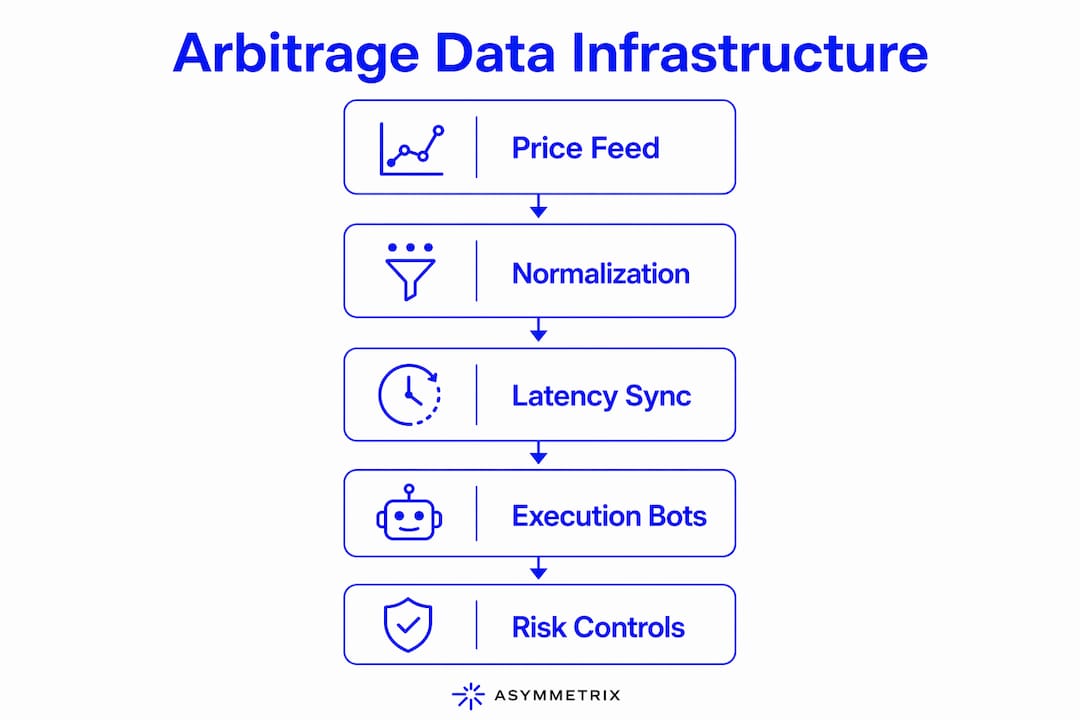
For execution, automated bots dominate in 2026, squeezing opportunities that once lasted minutes into sub-second windows. A bot built on Node.js with TypeScript, connecting to Polymarket’s CLOB API via Polygon and Kalshi’s REST API, can place both legs in parallel within milliseconds of detection. The open-source CrossArb implementation on GitHub demonstrates this architecture, including leg-timeout logic that cancels and unwinds if one side fails to fill within five seconds.
Pro Tip: Set a minimum net spread threshold of at least 1.8% after fees before executing. Below that, estimation error and slippage make the trade a near-coinflip. The arbitrage scanner tutorial from Assymetrix walks through building this filter in under 30 minutes.
Execution constraints and risk management you cannot ignore
Slippage is the first cost most models underweight. Thin order books on Kalshi or Limitless can move the fill price by several cents between detection and execution, erasing a 2% gross edge entirely. Setting a minimum market volume threshold (the CrossArb reference config uses $5,000 USDC) filters out the markets most likely to gap on entry.
Position sizing follows fractional Kelly logic. Full Kelly maximizes long-run growth in theory but produces drawdowns that are operationally unacceptable. Traders use quarter-Kelly or half-Kelly to reduce variance while maintaining positive expected value deployment across a portfolio of concurrent arb positions.
Resolution risk is the single largest source of unexpected loss in prediction market arbitrage. Even contracts with identical ticker names can carry different resolution criteria, different data sources, and different edge-case definitions. In the worst case, both legs resolve against you. Professionals verify resolution rule text programmatically before every trade, not just at strategy design time.
The expected profit formula for a two-leg cross-venue arb:
Net Profit = (1 - YES_price - NO_price) - Fee_venue_A - Fee_venue_B - Slippage_A - Slippage_B
Partial fills introduce atomicity risk. If leg A fills and leg B fails, you hold a naked directional position. Proper execution logic attempts to resubmit the failed leg at current market price, then unwinds the filled leg at market if the resubmission fails, and alerts immediately via Telegram or Discord.
Capital lock-up is a structural constraint, not just a liquidity consideration. Both positions tie up capital until resolution. A 4% gross edge on a 90-day contract annualizes attractively, but compare it against the opportunity cost of capital deployed elsewhere before sizing up.
Historical performance and documented arbitrage cases
The most rigorous empirical record comes from on-chain Polymarket data. Researchers found $40 million in realized arbitrage profit extracted across intra-market rebalancing and combinatorial strategies during their measurement period. Within single conditions, buying below $1.00 and selling above $1.00 generated multimillion-dollar profits. Sports markets showed the highest frequency of opportunities, with politics markets generating larger but less frequent gaps, particularly around the 2024 election cycle.
Cross-venue gaps between Polymarket and Kalshi on high-profile events have historically produced substantial gross edges during volatile repricing windows, when the two venues update at different speeds.
Legal and ethical considerations
Kalshi operates as a CFTC-regulated derivatives exchange, available only to eligible US participants. Polymarket’s availability varies by jurisdiction, and US traders face restrictions. Verify your eligibility on both platforms before building any automated execution system.
Arbitrage itself is legal and structurally beneficial. It improves price efficiency across venues and tightens spreads over time. The ethical boundary is market manipulation, placing orders with no intent to fill, or coordinating to move prices artificially. Pure arbitrage, taking genuine opposing positions at posted prices, falls well outside that line.
Regulatory treatment of prediction market profits as taxable income applies in the US. Kalshi reports winnings; Polymarket’s on-chain settlement creates its own tax reporting obligations. Consult a tax professional familiar with derivatives and digital asset settlement.
Machine learning and quantitative models in arbitrage strategy development
ML integration in prediction market arbitrage falls into three practical categories. First, event matching: LLM-assisted heuristics reduce the search space for combinatorial arbitrage from exponential to tractable by identifying topically similar and mutually exclusive market pairs across venues. The Saguillo et al. study used this approach to make dependency graph analysis scalable across thousands of Polymarket conditions.
Second, spread prediction: gradient boosting models trained on historical order book data, event category, time to resolution, and venue-specific liquidity metrics can estimate the probability that a detected gap will persist long enough to execute both legs profitably. This feeds directly into pre-trade sizing decisions.
Third, resolution risk scoring: NLP classifiers trained on resolution rule text can flag contracts where wording diverges across venues, surfacing the highest-risk pairs before a trader commits capital. Backtesting these models against historical strategy data from Assymetrix’s API, which covers nearly one billion rows of trading activity, provides the sample size needed for statistically meaningful validation.
How Polymarket, Kalshi, and Limitless compare for arbitrage opportunities
Each venue has a distinct profile that shapes which strategies are viable.
Polymarket offers the deepest liquidity on political and macro markets, on-chain order book transparency, and the intra-market rebalancing and combinatorial arbitrage opportunities unique to its NegRisk architecture. The approximately 2% fee on net profits sets a low minimum edge threshold. On-chain execution requires gas and atomic tooling; partial fills create naked exposure risk.
Kalshi is CFTC-regulated, settles in USD, and carries a 7% winner fee that demands larger raw edges. Its resolution committee introduces timing uncertainty relative to Polymarket’s oracle. The venue’s strength is its regulatory clarity for US traders and its growing liquidity on economic indicator markets. The 2026 platform landscape shows Kalshi expanding its market catalog aggressively, which increases cross-venue overlap with Polymarket.
Limitless adds a third data point for cross-venue scanning. Its liquidity profile differs from both Polymarket and Kalshi, creating occasional three-way pricing inconsistencies that two-venue scanners miss entirely. For traders running unified feeds through the Assymetrix Data API, Limitless coverage is included without additional integration work.
Fast execution hardware matters as much as software latency. For traders where milliseconds determine fill quality, execution speed at the hardware level is a real variable in the arbitrage stack.
How market liquidity and volume affect arbitrage feasibility
Liquidity is the gating variable for every arbitrage strategy. A 4% gross edge on a market with $500 in open interest is not executable at meaningful size without moving the price against yourself. The CrossArb reference configuration filters out markets below $5,000 USDC in volume for exactly this reason.
Thin markets also produce wider bid-ask spreads, which eat directly into the gross edge before fees are even applied. Sports markets on Polymarket show high frequency of rebalancing opportunities precisely because fast-moving odds create frequent mispricings, but the individual opportunity sizes are smaller. Politics markets have fewer but larger gaps, particularly during volatile periods when market makers lag repricing.
Volume concentration matters for timing. High-volatility events, election nights, surprise Fed decisions, major economic data releases, consistently produce the widest cross-venue spreads because the two venues reprice at different speeds. Monitoring volume spikes in real time, which the Assymetrix Data API surfaces as part of its market divergence intelligence layer, lets you position scanning resources where gaps are most likely to appear.
Key Takeaways
Prediction market arbitrage is executable in 2026, but only with unified data infrastructure, fee-aware sizing, and rigorous resolution risk analysis before every trade.
Point | Details |
|---|---|
Core condition | Buy YES and NO across venues when combined cost is below $1.00, guaranteeing pre-fee profit. |
Fee thresholds | Kalshi’s 7% winner fee requires roughly 3% raw edge; Polymarket’s ~2% fee sets the bar near 1.5%. |
Resolution risk | Contracts with identical names can resolve differently across venues, causing losses on both legs. |
Realized scale | On-chain research found $40 million in extracted arbitrage profit on Polymarket during the study period. |
Data infrastructure | Unified cross-venue feeds via the Assymetrix Data API eliminate schema mismatches and synchronization lag. |
FAQ
Is it possible to arbitrage prediction markets?
Yes. When the sum of the cheapest YES on one venue and the cheapest NO on another falls below $1.00, a guaranteed pre-fee profit exists. On-chain research documented $40 million in realized arbitrage profit on Polymarket alone.
Is prediction market arbitrage legal?
Cross-venue arbitrage is legal. Kalshi is CFTC-regulated and available to eligible US participants; Polymarket’s availability varies by jurisdiction. Verify your eligibility before building automated execution systems.
Can you realistically profit from prediction market arbitrage?
Yes, with the right infrastructure. Cross-venue trades typically present gross edges in the low single-digit percentage range per position, but Kalshi’s 7% winner fee and slippage on thin order books can eliminate net profit on smaller edges. Fractional Kelly sizing and a minimum net spread threshold of at least 1.8% after fees are standard risk controls.
How does resolution risk affect arbitrage trades?
Resolution risk is the primary source of unexpected loss. Polymarket uses UMA’s optimistic oracle; Kalshi uses an internal committee. The same real-world event can resolve differently on each platform, turning a hedged position into a loss on both legs. Always verify resolution rule text on both venues before entering a position.
What data tools do quantitative traders use for cross-venue arbitrage?
The Assymetrix Data API at data.assymetrix.com provides unified real-time and historical data across Polymarket, Kalshi, and Limitless through a single integration, with normalized schemas and built-in cross-venue arbitrage signals.
Prediction Market Arbitrage: A 2026 Quant Strategy Guide
What is prediction market arbitrage and why does it exist?
Prediction market arbitrage captures price inconsistencies across venues by taking opposing positions on the same event simultaneously, locking in profit regardless of outcome. The core condition: when the sum of the cheapest YES contract on one platform and the cheapest NO contract on another falls below $1.00, a guaranteed pre-fee profit exists.
Three structural forces generate these gaps:
Liquidity asymmetry. Polymarket and Kalshi attract different trader populations, so identical events carry different order book depths and bid-ask spreads.
Resolution timing differences. Kalshi uses an internal resolution committee; Polymarket uses UMA’s optimistic oracle. Settlement can diverge by hours or days on the same real-world event.
Market maker lag. During fast-moving events, resolution rules and timing between venues create exploitable price gaps before market makers reprice.
Limitless adds a third venue with its own liquidity profile, widening the opportunity set for traders monitoring all three simultaneously. For quant traders, these inefficiencies are not random noise. They follow patterns tied to event category, volatility regime, and venue-specific fee structures.
Common arbitrage strategies across Polymarket, Kalshi, and Limitless
Cross-venue arbitrage is the most direct pattern. Buy YES on the platform pricing the event lower, buy NO on the platform pricing it higher. If the combined cost is $0.94, you collect $1.00 at resolution regardless of outcome, a gross edge of $0.06. In march, Kalshi priced Gavin Newsom’s 2028 Democratic primary odds at 29%, while Polymarket priced them at 24%. That 5-point gap, net of fees, was executable.
Intra-market rebalancing arbitrage operates entirely within Polymarket. Every condition has a YES and NO token that must sum to $1.00. When the sum deviates, profit is guaranteed. Long rebalancing: buy both tokens when YES + NO < $1.00, profit equals $1.00 minus the combined purchase price. Short rebalancing: call Polymarket’s Split function to mint a YES/NO pair from $1.00 USDC, then sell both at elevated prices when YES + NO > $1.00.
Combinatorial arbitrage spans dependent NegRisk markets on Polymarket. A realized estimate of $40 million in profit was extracted across both rebalancing and combinatorial strategies during the study period, with politics markets generating the largest individual opportunities around the 2024 election cycle.
Dutching across multi-outcome markets: construct a portfolio guaranteeing positive return when implied probabilities sum below 100%.
Dependency graph scanning: use topical similarity and mutual exclusivity heuristics to identify related NegRisk markets where aggregated prices diverge.
Fee structures determine which edges are worth taking. Kalshi’s winner fee demands a raw edge of several percent before a trade is worth executing. Polymarket’s lower fee sets a lower threshold accordingly.
Pro Tip: Before entering any cross-venue position, verify resolution rule text word-for-word on both platforms. “Will the Fed cut rates?” can mean a 25bps cut on one venue and 50bps+ on another. That wording difference can turn a hedged position into a directional loss on both legs.
What data infrastructure does real-time arbitrage detection require?
Detecting cross-venue gaps before they close requires unified, low-latency price feeds from all three venues simultaneously. A fragmented setup, where you maintain separate API connections to Polymarket’s CLOB API, Kalshi’s REST API, and Limitless independently, introduces synchronization lag and schema inconsistencies that erode edge.
The Assymetrix Data API at data.assymetrix.com consolidates all three venues into a single integration. It normalizes market schemas across venues, delivers real-time order book depth, and surfaces cross-venue arbitrage signals directly, built on approximately 1.5 terabytes of historical data spanning nearly one billion rows of trading activity. That eliminates the engineering overhead of maintaining three separate connections with mismatched data formats.
Infrastructure Layer | Requirement | Why It Matters |
|---|---|---|
Price feed | Sub-second cross-venue sync | Gaps close in seconds on liquid markets |
Order book depth | Level 2 data per venue | Slippage estimation before order submission |
Schema normalization | Unified market identifiers | Accurate event matching across venues |
Historical data | Multi-year tick data | Backtesting and signal calibration |
Alerting | Threshold-based triggers | Automated opportunity notification |
For execution, automated bots dominate in 2026, squeezing opportunities that once lasted minutes into sub-second windows. A bot built on Node.js with TypeScript, connecting to Polymarket’s CLOB API via Polygon and Kalshi’s REST API, can place both legs in parallel within milliseconds of detection. The open-source CrossArb implementation on GitHub demonstrates this architecture, including leg-timeout logic that cancels and unwinds if one side fails to fill within five seconds.
Pro Tip: Set a minimum net spread threshold of at least 1.8% after fees before executing. Below that, estimation error and slippage make the trade a near-coinflip. The arbitrage scanner tutorial from Assymetrix walks through building this filter in under 30 minutes.
Execution constraints and risk management you cannot ignore
Slippage is the first cost most models underweight. Thin order books on Kalshi or Limitless can move the fill price by several cents between detection and execution, erasing a 2% gross edge entirely. Setting a minimum market volume threshold (the CrossArb reference config uses $5,000 USDC) filters out the markets most likely to gap on entry.
Position sizing follows fractional Kelly logic. Full Kelly maximizes long-run growth in theory but produces drawdowns that are operationally unacceptable. Traders use quarter-Kelly or half-Kelly to reduce variance while maintaining positive expected value deployment across a portfolio of concurrent arb positions.
Resolution risk is the single largest source of unexpected loss in prediction market arbitrage. Even contracts with identical ticker names can carry different resolution criteria, different data sources, and different edge-case definitions. In the worst case, both legs resolve against you. Professionals verify resolution rule text programmatically before every trade, not just at strategy design time.
The expected profit formula for a two-leg cross-venue arb:
Net Profit = (1 - YES_price - NO_price) - Fee_venue_A - Fee_venue_B - Slippage_A - Slippage_B
Partial fills introduce atomicity risk. If leg A fills and leg B fails, you hold a naked directional position. Proper execution logic attempts to resubmit the failed leg at current market price, then unwinds the filled leg at market if the resubmission fails, and alerts immediately via Telegram or Discord.
Capital lock-up is a structural constraint, not just a liquidity consideration. Both positions tie up capital until resolution. A 4% gross edge on a 90-day contract annualizes attractively, but compare it against the opportunity cost of capital deployed elsewhere before sizing up.
Historical performance and documented arbitrage cases
The most rigorous empirical record comes from on-chain Polymarket data. Researchers found $40 million in realized arbitrage profit extracted across intra-market rebalancing and combinatorial strategies during their measurement period. Within single conditions, buying below $1.00 and selling above $1.00 generated multimillion-dollar profits. Sports markets showed the highest frequency of opportunities, with politics markets generating larger but less frequent gaps, particularly around the 2024 election cycle.
Cross-venue gaps between Polymarket and Kalshi on high-profile events have historically produced substantial gross edges during volatile repricing windows, when the two venues update at different speeds.
Legal and ethical considerations
Kalshi operates as a CFTC-regulated derivatives exchange, available only to eligible US participants. Polymarket’s availability varies by jurisdiction, and US traders face restrictions. Verify your eligibility on both platforms before building any automated execution system.
Arbitrage itself is legal and structurally beneficial. It improves price efficiency across venues and tightens spreads over time. The ethical boundary is market manipulation, placing orders with no intent to fill, or coordinating to move prices artificially. Pure arbitrage, taking genuine opposing positions at posted prices, falls well outside that line.
Regulatory treatment of prediction market profits as taxable income applies in the US. Kalshi reports winnings; Polymarket’s on-chain settlement creates its own tax reporting obligations. Consult a tax professional familiar with derivatives and digital asset settlement.
Machine learning and quantitative models in arbitrage strategy development
ML integration in prediction market arbitrage falls into three practical categories. First, event matching: LLM-assisted heuristics reduce the search space for combinatorial arbitrage from exponential to tractable by identifying topically similar and mutually exclusive market pairs across venues. The Saguillo et al. study used this approach to make dependency graph analysis scalable across thousands of Polymarket conditions.
Second, spread prediction: gradient boosting models trained on historical order book data, event category, time to resolution, and venue-specific liquidity metrics can estimate the probability that a detected gap will persist long enough to execute both legs profitably. This feeds directly into pre-trade sizing decisions.
Third, resolution risk scoring: NLP classifiers trained on resolution rule text can flag contracts where wording diverges across venues, surfacing the highest-risk pairs before a trader commits capital. Backtesting these models against historical strategy data from Assymetrix’s API, which covers nearly one billion rows of trading activity, provides the sample size needed for statistically meaningful validation.
How Polymarket, Kalshi, and Limitless compare for arbitrage opportunities
Each venue has a distinct profile that shapes which strategies are viable.
Polymarket offers the deepest liquidity on political and macro markets, on-chain order book transparency, and the intra-market rebalancing and combinatorial arbitrage opportunities unique to its NegRisk architecture. The approximately 2% fee on net profits sets a low minimum edge threshold. On-chain execution requires gas and atomic tooling; partial fills create naked exposure risk.
Kalshi is CFTC-regulated, settles in USD, and carries a 7% winner fee that demands larger raw edges. Its resolution committee introduces timing uncertainty relative to Polymarket’s oracle. The venue’s strength is its regulatory clarity for US traders and its growing liquidity on economic indicator markets. The 2026 platform landscape shows Kalshi expanding its market catalog aggressively, which increases cross-venue overlap with Polymarket.
Limitless adds a third data point for cross-venue scanning. Its liquidity profile differs from both Polymarket and Kalshi, creating occasional three-way pricing inconsistencies that two-venue scanners miss entirely. For traders running unified feeds through the Assymetrix Data API, Limitless coverage is included without additional integration work.
Fast execution hardware matters as much as software latency. For traders where milliseconds determine fill quality, execution speed at the hardware level is a real variable in the arbitrage stack.
How market liquidity and volume affect arbitrage feasibility
Liquidity is the gating variable for every arbitrage strategy. A 4% gross edge on a market with $500 in open interest is not executable at meaningful size without moving the price against yourself. The CrossArb reference configuration filters out markets below $5,000 USDC in volume for exactly this reason.
Thin markets also produce wider bid-ask spreads, which eat directly into the gross edge before fees are even applied. Sports markets on Polymarket show high frequency of rebalancing opportunities precisely because fast-moving odds create frequent mispricings, but the individual opportunity sizes are smaller. Politics markets have fewer but larger gaps, particularly during volatile periods when market makers lag repricing.
Volume concentration matters for timing. High-volatility events, election nights, surprise Fed decisions, major economic data releases, consistently produce the widest cross-venue spreads because the two venues reprice at different speeds. Monitoring volume spikes in real time, which the Assymetrix Data API surfaces as part of its market divergence intelligence layer, lets you position scanning resources where gaps are most likely to appear.
Key Takeaways
Prediction market arbitrage is executable in 2026, but only with unified data infrastructure, fee-aware sizing, and rigorous resolution risk analysis before every trade.
Point | Details |
|---|---|
Core condition | Buy YES and NO across venues when combined cost is below $1.00, guaranteeing pre-fee profit. |
Fee thresholds | Kalshi’s 7% winner fee requires roughly 3% raw edge; Polymarket’s ~2% fee sets the bar near 1.5%. |
Resolution risk | Contracts with identical names can resolve differently across venues, causing losses on both legs. |
Realized scale | On-chain research found $40 million in extracted arbitrage profit on Polymarket during the study period. |
Data infrastructure | Unified cross-venue feeds via the Assymetrix Data API eliminate schema mismatches and synchronization lag. |
FAQ
Is it possible to arbitrage prediction markets?
Yes. When the sum of the cheapest YES on one venue and the cheapest NO on another falls below $1.00, a guaranteed pre-fee profit exists. On-chain research documented $40 million in realized arbitrage profit on Polymarket alone.
Is prediction market arbitrage legal?
Cross-venue arbitrage is legal. Kalshi is CFTC-regulated and available to eligible US participants; Polymarket’s availability varies by jurisdiction. Verify your eligibility before building automated execution systems.
Can you realistically profit from prediction market arbitrage?
Yes, with the right infrastructure. Cross-venue trades typically present gross edges in the low single-digit percentage range per position, but Kalshi’s 7% winner fee and slippage on thin order books can eliminate net profit on smaller edges. Fractional Kelly sizing and a minimum net spread threshold of at least 1.8% after fees are standard risk controls.
How does resolution risk affect arbitrage trades?
Resolution risk is the primary source of unexpected loss. Polymarket uses UMA’s optimistic oracle; Kalshi uses an internal committee. The same real-world event can resolve differently on each platform, turning a hedged position into a loss on both legs. Always verify resolution rule text on both venues before entering a position.
What data tools do quantitative traders use for cross-venue arbitrage?
The Assymetrix Data API at data.assymetrix.com provides unified real-time and historical data across Polymarket, Kalshi, and Limitless through a single integration, with normalized schemas and built-in cross-venue arbitrage signals.
Other Blog


