AI Agent Pipelines for Developers and Quants With One Canonical Feed
AI Agent Pipelines for Developers and Quants With One Canonical Feed
AI Agent Pipelines for Developers and Quants With One Canonical Feed
Developers and quants: build multi-agent AI pipelines to trade event markets using one canonical feed, deterministic replays, and safety validators.

AI Agent Pipelines for Developers and Quants With One Canonical Feed
Autonomous AI agents consume live event-market signals, price and odds movement, volume, order-book pressure, and cross-venue divergence, through a unified data feed, and then run them through a filter-and-enrich pipeline before acting. Causal or ensemble reasoning turns the filtered candidates into a position, and a deterministic validator checks that position against exchange state before an execution agent ever sends an order. Assymetrix’s Data API is one route developers use to source that unified signal layer across Polymarket, Kalshi, and Limitless, without stitching together three separate integrations.
TL;DR:
Autonomous agents primarily rely on price velocity, volume spikes, order-book imbalance, cross-venue divergence, and wallet flow signals to identify actionable opportunities.
Proper pipeline separation between discovery, screening, enrichment, causal analysis, and decisioning reduces computational costs and improves accuracy.
Use fractional Kelly sizing, strict order validation, and post-trade calibration to manage risk and avoid adverse effects in thin, illiquid prediction markets.
Assymetrix’s Data API streamlines cross-venue data integration with canonical IDs, enabling deterministic backtesting and real-time strategy validation.
Regulatory and manipulation risks require careful size caps, audit trails, and reduction of exposure in ambiguous or volatile markets to ensure compliance and survival.
Table of Contents
How AI Agents Use Event Market Signals Autonomously
What Do Event Market Signals Actually Look Like?
How Should the Agent Pipeline Be Structured?
Which APIs, Latency Targets, and Schemas Matter Most?
How Do You Keep Execution Safe in Thin Markets?
What Data and Tools Does Assymetrix Provide?
How Do Agents Learn From Market Feedback Over Time?
What Are the Regulatory and Ethical Limits on Autonomous Trading?
Author’s Field Notes on Deployment Priorities
Get the Cross-Venue Data Feed Behind This Architecture
Sources
How AI Agents Use Event Market Signals Autonomously
The mechanics are simpler than the marketing around “AI trading” suggests. An agent pipeline treats a prediction market price as a probability estimate, watches how fast that estimate moves, and cross-references it against what related markets are doing at the same moment. When enough of those signals line up, and pass a deterministic sanity check, the agent fires an order. Everything else, the LLM reasoning, the wallet tracking, the causal inference, exists to decide whether that alignment is signal or noise.
This matters because prediction markets punish sloppy signal handling faster than most asset classes. A market with $40,000 in daily volume can move 8 cents on a single $500 order. Treating that move as a strong directional signal without checking depth first is how naive bots lose money quickly. The PolySignal-Augmented-Polymarket-Prediction-Engine project handles this by combining price momentum with order-book imbalance and letting an LLM-based causal layer filter out moves that look mechanical rather than informational.
What Do Event Market Signals Actually Look Like?
Five signal families make up almost every serious agent’s feature set. Get the definitions wrong and everything downstream, backtests, sizing, execution, inherits the error.
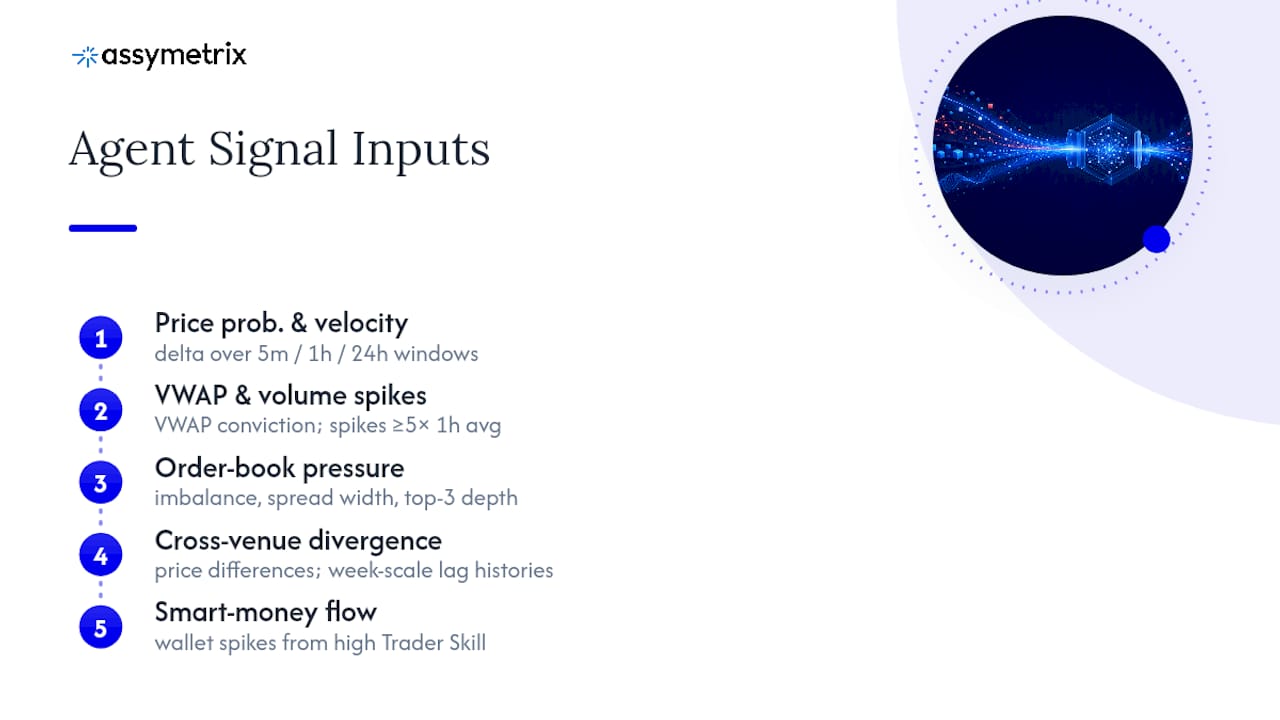
Price as probability, and its velocity. A Polymarket or Kalshi price of $0.63 on a YES contract is a direct probability estimate. What matters to an agent is not the level but the delta: how much that price moved over a 5 minute, 1 hour, and 24-hour window. A contract jumping from $0.55 to $0.68 in 20 minutes on rising volume reads very differently than the same move spread over three days.
VWAP and volume spikes. Volume-weighted average price gives a cleaner conviction read than last-trade price alone, especially in thin books. A sudden volume spike, say 5x the trailing 1-hour average, often precedes a real information event rather than random noise.
Order-book pressure. Imbalance (bid depth versus ask depth), spread width, and available depth at the top three levels all feed into slippage risk before an agent sizes a position.
Cross-venue divergence. The same event priced differently on two venues, with one lagging the other by hours or days, is the core signal behind arbitrage and lead-lag strategies. Lag windows of roughly a week show up often enough that price-lag histories are treated as a primary driver in mispricing models.
Smart Money indicators. Wallet-level flow, particularly a sudden position spike from wallets carrying strong historical Trader Skill Scores, functions as a leading signal that often front-runs the broader price move.
How Should the Agent Pipeline Be Structured?
The reliable pattern splits work across five roles instead of asking one model to do discovery, reasoning, and execution at once. This matches how PolySignal filters thousands of candidate markets down to a small enriched set before spending compute on deep analysis.
Discovery and ingestion. Pull live and historical data through canonical market IDs so the same event maps correctly across Polymarket, Kalshi, and Limitless, then cache aggressively to avoid redundant calls on markets nobody is trading.
Cheap screening. Filter on volume, market age, category, and price band before spending any compute on enrichment. Most candidate markets get dropped here; this is where cost control actually happens.
Enrichment. Pull 60-day and 7-day price histories, candlestick data, wallet-flow snapshots, and on-demand web evidence only for markets that survive screening.
Parallel causal analysis. Run a precedent-retrieval agent and a causal-inference agent side by side, then reconcile their outputs. This ensemble structure is what lets PolySignal turn raw co-movement into an actual causal chain rather than a coincidence.
Role-based decisioning. A decision agent proposes exposure targets. A deterministic validator checks those targets against live exchange state, buying power, and price limits. An execution agent, and only the execution agent, is allowed to touch the order book.
Pro Tip: Never let the same agent that generates the trading thesis also hold execution privileges. Separating decision from execution is the single cheapest safeguard against a bad LLM output turning into a bad order.
Which APIs, Latency Targets, and Schemas Matter Most?
Canonical IDs solve the hardest integration problem first: matching “will X happen by Y date” across three venues that phrase and structure the same event differently. Fuzzy string matching on market titles breaks constantly; a stable canonical ID layer, available across venues through Assymetrix’s data feed, avoids that failure mode entirely.
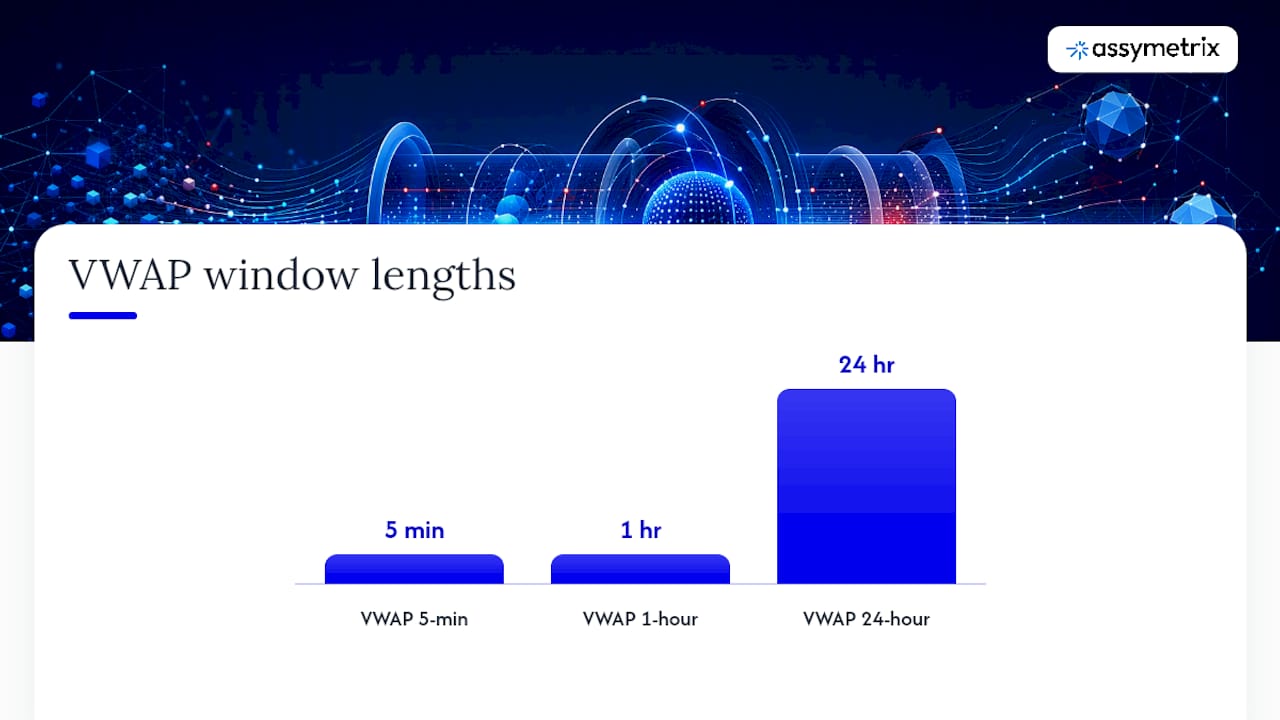
Transport choice depends on the strategy. News-driven agents that need sub-second to single-digit-second reaction time need a WebSocket stream; agents rebalancing a portfolio once an hour can live comfortably on REST polling. Store data at three levels of granularity: raw order-book snapshots at each tick, rolling VWAP windows, and normalized JSON event outputs that any downstream agent can consume without reparsing venue-specific formats.
Backtesting only means something if the replay is deterministic. That requires reconstructing exchange state, order book, fills, and account balance, from stored historical snapshots rather than replaying price alone. Practitioners building on thin, agent-hostile order books emphasize this kind of deterministic backtest against a large historical dataset before any live capital touches the strategy.
Component | What to store | Why it matters |
|---|---|---|
Order-book snapshots | Full depth at each tick, not just top-of-book | Slippage modeling needs real depth, not last price |
VWAP windows | Rolling 5-min, 1-hour, 24-hour | Conviction signal cleaner than raw price |
Event outputs | Normalized JSON per canonical ID | Lets any agent consume signals without re-parsing |
Fills and orders | Full audit record per execution | Required for deterministic replay and reconciliation |
A working developer checklist covers four things: replay tooling that reconstructs state exactly, a deterministic validator that runs identically in backtest and live mode, persistent audit logs per decision cycle, and a handful of sample queries you can run against the API to confirm normalization before writing a single line of strategy code.
How Do You Keep Execution Safe in Thin Markets?
Position sizing in prediction markets should almost never use full Kelly. Thin liquidity means a full-Kelly bet frequently exceeds what the book can absorb without moving the price against you. Fractional or half-Kelly sizing, with a hard per-trade cap and a daily loss limit, is the standard practitioner pattern; the polymarket-pipeline project defaults to quarter-Kelly specifically because it trades niche, low-volume markets where full-size bets would be self-defeating.
Gate every order through a validator that checks current exchange state, available buying power, a maximum price cap, and data freshness before allowing execution.
Run cancel-on-falsifier watchers. Attach an explicit falsifier condition to each thesis and cancel the resting order automatically if that condition triggers, which defends against adverse selection in fast-moving books.
Log a structured decision schema for every cycle, action, canonical market ID, side, quantity, price, thesis, and falsifier, so every trade is auditable after the fact.
Reconcile post-resolution. Compute Brier score and log-loss on every resolved market and route the lesson into a calibration record rather than discarding it.
Pro Tip: Keep calibration lessons scoped to the specific market category they came from before blending them into a global rule. Cross-contaminating a lesson learned in sports markets into political markets is a common way agents quietly get worse over time.
What Data and Tools Does Assymetrix Provide?
Deterministic backtesting requires volume most teams underestimate until they try to reconstruct three months of order-book history by hand. Assymetrix maintains a historical store built for exactly this problem.
Substantial historical data spanning extensive rows of trading activity for deterministic backtests across venues.
Smart Money wallet tracking and Trader Skill Scores as ready-made enrichment signals, rather than building wallet-scoring infrastructure from scratch.
Real-time and historical endpoints with canonical ID mapping, documented in the Data API integration guide, plus sample queries for fast validation.
A practical onboarding path: sandbox keys first, then the replay dataset for backtesting, then incremental live testing at low position caps.
How Do Agents Learn From Market Feedback Over Time?
An agent that never updates its priors is just a static rule set wearing an AI label. Real adaptation happens through calibration loops that score every resolved market and feed the result back into the decision process, not through vague “the model got smarter” claims.
The mechanism that works is boring and specific: record Brier score and log-loss on every market once it resolves, then route the lesson into a market-specific fact slot rather than a single global rule set. A political-market miscalibration and a sports-market miscalibration usually have different root causes, so blending them into one adjustment factor tends to make both worse. Category-scoped calibration avoids that trap.
Feedback also flows through sizing, not just thesis confidence. An agent that keeps overestimating its edge on a category should see its effective Kelly fraction shrink for that category automatically, rather than relying on a human to notice the pattern weeks later. This is where the classification-over-probability approach pays off again: it’s easier to track “the agent said bullish and materiality-high, and was wrong” as a discrete, countable event than to argue about whether a raw 71% probability estimate was “close enough.”
The practical takeaway for anyone building this layer: treat every resolved market as a labeled training example, store it with its original thesis and falsifier intact, and review the calibration record before touching sizing parameters again. Skipping this step is how agents drift silently for weeks before a drawdown makes the problem visible.
What Are the Regulatory and Ethical Limits on Autonomous Trading?
Autonomous agents trading event markets sit in a regulatory position that’s still being defined, and that ambiguity is itself an operational risk, not just a legal footnote. Kalshi operates as a CFTC-regulated exchange in the United States, which puts constraints on market types and reporting that a Polymarket-only strategy doesn’t face in the same way. An agent architecture that treats “cross-venue” as interchangeable without accounting for those structural differences is building on a false assumption.
The manipulation question deserves direct attention rather than a hand wave. An agent large enough to move a thin book, or several agents from the same operator working correlated positions across venues, can start to resemble the market-moving behavior regulators watch for in traditional markets. Oversight gaps around AI-driven market activity are a live concern precisely because detection tooling in prediction markets is younger and thinner than in equities or futures.
Practical guardrails matter more than philosophical positions here. Cap position size relative to visible book depth so a single agent can’t be the dominant driver of a price move. Keep a full audit trail, including the thesis and falsifier behind every order, so any review of trading activity has a paper trail rather than a black box. And treat any market where materiality is genuinely ambiguous, breaking news with conflicting sources, as a reason to reduce size rather than increase confidence. The agents that last are the ones built to survive scrutiny, not just to survive backtests.
Author’s Field Notes on Deployment Priorities
Replay full historical order-book snapshots before going live. Thin-liquidity failure modes almost never show up in a price-only backtest. Treat LLM outputs as classification and materiality signals, not raw probabilities, and start in niche, lower-competition markets to gather clean calibration data before scaling. Deterministic validators and small default sizes on the first live runs matter more than any single feature you add later.
— Dean
Get the Cross-Venue Data Feed Behind This Architecture
Building the pipeline described above means solving the same integration problem three times, once per venue, unless the data layer underneath is already normalized. Assymetrix’s Data API gives developers, quant traders, and agent builders one integration point across Polymarket, Kalshi, and Limitless, with canonical IDs already resolved and Smart Money and Trader Skill Score signals available as enrichment rather than something you build yourself.
The Data API guide covers endpoints and sample queries for both real-time streaming and historical pulls, and the backtesting store, built on that same 1.5 terabyte, near 1 billion row dataset, lets you validate a strategy deterministically before it touches live capital. Start with sandbox keys, run your pipeline against the historical replay set, then move to live testing at low caps once the validator layer holds up. Grab API access through the Data API landing page and check the arbitrage strategy guide if cross-venue divergence is your primary signal.
FAQ
What signals do AI agents use most for prediction market trading?
Price velocity, VWAP-based volume spikes, order-book imbalance, cross-venue divergence, and Smart Money wallet flow form the core signal set most agent pipelines rely on.
Should agents use raw LLM probability estimates for trading decisions?
No. Practitioner patterns favor asking LLMs for directional classification and materiality rather than raw percentages, then combining that classification with market-derived priors.
What position sizing do autonomous prediction market agents use?
Fractional or quarter-Kelly sizing with hard per-trade caps and daily loss limits is standard, since thin order books make full-Kelly bets prone to excessive slippage.
How do agents avoid competing with high-frequency bots?
Many pipelines deliberately target niche, lower-volume markets rather than the most liquid ones, reducing direct competition with faster, better-capitalized bots.
Does Assymetrix provide historical data for backtesting agent strategies?
Yes. Assymetrix maintains roughly 1.5 terabytes of historical trading data across nearly 1 billion rows, built specifically for deterministic backtests across Polymarket, Kalshi, and Limitless.
Why do canonical IDs matter for cross-venue agent pipelines?
Canonical IDs prevent fuzzy-matching errors when mapping the same event across venues that phrase market titles differently, which is essential for accurate divergence and arbitrage detection.
AI Agent Pipelines for Developers and Quants With One Canonical Feed
Autonomous AI agents consume live event-market signals, price and odds movement, volume, order-book pressure, and cross-venue divergence, through a unified data feed, and then run them through a filter-and-enrich pipeline before acting. Causal or ensemble reasoning turns the filtered candidates into a position, and a deterministic validator checks that position against exchange state before an execution agent ever sends an order. Assymetrix’s Data API is one route developers use to source that unified signal layer across Polymarket, Kalshi, and Limitless, without stitching together three separate integrations.
TL;DR:
Autonomous agents primarily rely on price velocity, volume spikes, order-book imbalance, cross-venue divergence, and wallet flow signals to identify actionable opportunities.
Proper pipeline separation between discovery, screening, enrichment, causal analysis, and decisioning reduces computational costs and improves accuracy.
Use fractional Kelly sizing, strict order validation, and post-trade calibration to manage risk and avoid adverse effects in thin, illiquid prediction markets.
Assymetrix’s Data API streamlines cross-venue data integration with canonical IDs, enabling deterministic backtesting and real-time strategy validation.
Regulatory and manipulation risks require careful size caps, audit trails, and reduction of exposure in ambiguous or volatile markets to ensure compliance and survival.
Table of Contents
How AI Agents Use Event Market Signals Autonomously
What Do Event Market Signals Actually Look Like?
How Should the Agent Pipeline Be Structured?
Which APIs, Latency Targets, and Schemas Matter Most?
How Do You Keep Execution Safe in Thin Markets?
What Data and Tools Does Assymetrix Provide?
How Do Agents Learn From Market Feedback Over Time?
What Are the Regulatory and Ethical Limits on Autonomous Trading?
Author’s Field Notes on Deployment Priorities
Get the Cross-Venue Data Feed Behind This Architecture
Sources
How AI Agents Use Event Market Signals Autonomously
The mechanics are simpler than the marketing around “AI trading” suggests. An agent pipeline treats a prediction market price as a probability estimate, watches how fast that estimate moves, and cross-references it against what related markets are doing at the same moment. When enough of those signals line up, and pass a deterministic sanity check, the agent fires an order. Everything else, the LLM reasoning, the wallet tracking, the causal inference, exists to decide whether that alignment is signal or noise.
This matters because prediction markets punish sloppy signal handling faster than most asset classes. A market with $40,000 in daily volume can move 8 cents on a single $500 order. Treating that move as a strong directional signal without checking depth first is how naive bots lose money quickly. The PolySignal-Augmented-Polymarket-Prediction-Engine project handles this by combining price momentum with order-book imbalance and letting an LLM-based causal layer filter out moves that look mechanical rather than informational.
What Do Event Market Signals Actually Look Like?
Five signal families make up almost every serious agent’s feature set. Get the definitions wrong and everything downstream, backtests, sizing, execution, inherits the error.
Price as probability, and its velocity. A Polymarket or Kalshi price of $0.63 on a YES contract is a direct probability estimate. What matters to an agent is not the level but the delta: how much that price moved over a 5 minute, 1 hour, and 24-hour window. A contract jumping from $0.55 to $0.68 in 20 minutes on rising volume reads very differently than the same move spread over three days.
VWAP and volume spikes. Volume-weighted average price gives a cleaner conviction read than last-trade price alone, especially in thin books. A sudden volume spike, say 5x the trailing 1-hour average, often precedes a real information event rather than random noise.
Order-book pressure. Imbalance (bid depth versus ask depth), spread width, and available depth at the top three levels all feed into slippage risk before an agent sizes a position.
Cross-venue divergence. The same event priced differently on two venues, with one lagging the other by hours or days, is the core signal behind arbitrage and lead-lag strategies. Lag windows of roughly a week show up often enough that price-lag histories are treated as a primary driver in mispricing models.
Smart Money indicators. Wallet-level flow, particularly a sudden position spike from wallets carrying strong historical Trader Skill Scores, functions as a leading signal that often front-runs the broader price move.
How Should the Agent Pipeline Be Structured?
The reliable pattern splits work across five roles instead of asking one model to do discovery, reasoning, and execution at once. This matches how PolySignal filters thousands of candidate markets down to a small enriched set before spending compute on deep analysis.
Discovery and ingestion. Pull live and historical data through canonical market IDs so the same event maps correctly across Polymarket, Kalshi, and Limitless, then cache aggressively to avoid redundant calls on markets nobody is trading.
Cheap screening. Filter on volume, market age, category, and price band before spending any compute on enrichment. Most candidate markets get dropped here; this is where cost control actually happens.
Enrichment. Pull 60-day and 7-day price histories, candlestick data, wallet-flow snapshots, and on-demand web evidence only for markets that survive screening.
Parallel causal analysis. Run a precedent-retrieval agent and a causal-inference agent side by side, then reconcile their outputs. This ensemble structure is what lets PolySignal turn raw co-movement into an actual causal chain rather than a coincidence.
Role-based decisioning. A decision agent proposes exposure targets. A deterministic validator checks those targets against live exchange state, buying power, and price limits. An execution agent, and only the execution agent, is allowed to touch the order book.
Pro Tip: Never let the same agent that generates the trading thesis also hold execution privileges. Separating decision from execution is the single cheapest safeguard against a bad LLM output turning into a bad order.
Which APIs, Latency Targets, and Schemas Matter Most?
Canonical IDs solve the hardest integration problem first: matching “will X happen by Y date” across three venues that phrase and structure the same event differently. Fuzzy string matching on market titles breaks constantly; a stable canonical ID layer, available across venues through Assymetrix’s data feed, avoids that failure mode entirely.
Transport choice depends on the strategy. News-driven agents that need sub-second to single-digit-second reaction time need a WebSocket stream; agents rebalancing a portfolio once an hour can live comfortably on REST polling. Store data at three levels of granularity: raw order-book snapshots at each tick, rolling VWAP windows, and normalized JSON event outputs that any downstream agent can consume without reparsing venue-specific formats.
Backtesting only means something if the replay is deterministic. That requires reconstructing exchange state, order book, fills, and account balance, from stored historical snapshots rather than replaying price alone. Practitioners building on thin, agent-hostile order books emphasize this kind of deterministic backtest against a large historical dataset before any live capital touches the strategy.
Component | What to store | Why it matters |
|---|---|---|
Order-book snapshots | Full depth at each tick, not just top-of-book | Slippage modeling needs real depth, not last price |
VWAP windows | Rolling 5-min, 1-hour, 24-hour | Conviction signal cleaner than raw price |
Event outputs | Normalized JSON per canonical ID | Lets any agent consume signals without re-parsing |
Fills and orders | Full audit record per execution | Required for deterministic replay and reconciliation |
A working developer checklist covers four things: replay tooling that reconstructs state exactly, a deterministic validator that runs identically in backtest and live mode, persistent audit logs per decision cycle, and a handful of sample queries you can run against the API to confirm normalization before writing a single line of strategy code.
How Do You Keep Execution Safe in Thin Markets?
Position sizing in prediction markets should almost never use full Kelly. Thin liquidity means a full-Kelly bet frequently exceeds what the book can absorb without moving the price against you. Fractional or half-Kelly sizing, with a hard per-trade cap and a daily loss limit, is the standard practitioner pattern; the polymarket-pipeline project defaults to quarter-Kelly specifically because it trades niche, low-volume markets where full-size bets would be self-defeating.
Gate every order through a validator that checks current exchange state, available buying power, a maximum price cap, and data freshness before allowing execution.
Run cancel-on-falsifier watchers. Attach an explicit falsifier condition to each thesis and cancel the resting order automatically if that condition triggers, which defends against adverse selection in fast-moving books.
Log a structured decision schema for every cycle, action, canonical market ID, side, quantity, price, thesis, and falsifier, so every trade is auditable after the fact.
Reconcile post-resolution. Compute Brier score and log-loss on every resolved market and route the lesson into a calibration record rather than discarding it.
Pro Tip: Keep calibration lessons scoped to the specific market category they came from before blending them into a global rule. Cross-contaminating a lesson learned in sports markets into political markets is a common way agents quietly get worse over time.
What Data and Tools Does Assymetrix Provide?
Deterministic backtesting requires volume most teams underestimate until they try to reconstruct three months of order-book history by hand. Assymetrix maintains a historical store built for exactly this problem.
Substantial historical data spanning extensive rows of trading activity for deterministic backtests across venues.
Smart Money wallet tracking and Trader Skill Scores as ready-made enrichment signals, rather than building wallet-scoring infrastructure from scratch.
Real-time and historical endpoints with canonical ID mapping, documented in the Data API integration guide, plus sample queries for fast validation.
A practical onboarding path: sandbox keys first, then the replay dataset for backtesting, then incremental live testing at low position caps.
How Do Agents Learn From Market Feedback Over Time?
An agent that never updates its priors is just a static rule set wearing an AI label. Real adaptation happens through calibration loops that score every resolved market and feed the result back into the decision process, not through vague “the model got smarter” claims.
The mechanism that works is boring and specific: record Brier score and log-loss on every market once it resolves, then route the lesson into a market-specific fact slot rather than a single global rule set. A political-market miscalibration and a sports-market miscalibration usually have different root causes, so blending them into one adjustment factor tends to make both worse. Category-scoped calibration avoids that trap.
Feedback also flows through sizing, not just thesis confidence. An agent that keeps overestimating its edge on a category should see its effective Kelly fraction shrink for that category automatically, rather than relying on a human to notice the pattern weeks later. This is where the classification-over-probability approach pays off again: it’s easier to track “the agent said bullish and materiality-high, and was wrong” as a discrete, countable event than to argue about whether a raw 71% probability estimate was “close enough.”
The practical takeaway for anyone building this layer: treat every resolved market as a labeled training example, store it with its original thesis and falsifier intact, and review the calibration record before touching sizing parameters again. Skipping this step is how agents drift silently for weeks before a drawdown makes the problem visible.
What Are the Regulatory and Ethical Limits on Autonomous Trading?
Autonomous agents trading event markets sit in a regulatory position that’s still being defined, and that ambiguity is itself an operational risk, not just a legal footnote. Kalshi operates as a CFTC-regulated exchange in the United States, which puts constraints on market types and reporting that a Polymarket-only strategy doesn’t face in the same way. An agent architecture that treats “cross-venue” as interchangeable without accounting for those structural differences is building on a false assumption.
The manipulation question deserves direct attention rather than a hand wave. An agent large enough to move a thin book, or several agents from the same operator working correlated positions across venues, can start to resemble the market-moving behavior regulators watch for in traditional markets. Oversight gaps around AI-driven market activity are a live concern precisely because detection tooling in prediction markets is younger and thinner than in equities or futures.
Practical guardrails matter more than philosophical positions here. Cap position size relative to visible book depth so a single agent can’t be the dominant driver of a price move. Keep a full audit trail, including the thesis and falsifier behind every order, so any review of trading activity has a paper trail rather than a black box. And treat any market where materiality is genuinely ambiguous, breaking news with conflicting sources, as a reason to reduce size rather than increase confidence. The agents that last are the ones built to survive scrutiny, not just to survive backtests.
Author’s Field Notes on Deployment Priorities
Replay full historical order-book snapshots before going live. Thin-liquidity failure modes almost never show up in a price-only backtest. Treat LLM outputs as classification and materiality signals, not raw probabilities, and start in niche, lower-competition markets to gather clean calibration data before scaling. Deterministic validators and small default sizes on the first live runs matter more than any single feature you add later.
— Dean
Get the Cross-Venue Data Feed Behind This Architecture
Building the pipeline described above means solving the same integration problem three times, once per venue, unless the data layer underneath is already normalized. Assymetrix’s Data API gives developers, quant traders, and agent builders one integration point across Polymarket, Kalshi, and Limitless, with canonical IDs already resolved and Smart Money and Trader Skill Score signals available as enrichment rather than something you build yourself.
The Data API guide covers endpoints and sample queries for both real-time streaming and historical pulls, and the backtesting store, built on that same 1.5 terabyte, near 1 billion row dataset, lets you validate a strategy deterministically before it touches live capital. Start with sandbox keys, run your pipeline against the historical replay set, then move to live testing at low caps once the validator layer holds up. Grab API access through the Data API landing page and check the arbitrage strategy guide if cross-venue divergence is your primary signal.
FAQ
What signals do AI agents use most for prediction market trading?
Price velocity, VWAP-based volume spikes, order-book imbalance, cross-venue divergence, and Smart Money wallet flow form the core signal set most agent pipelines rely on.
Should agents use raw LLM probability estimates for trading decisions?
No. Practitioner patterns favor asking LLMs for directional classification and materiality rather than raw percentages, then combining that classification with market-derived priors.
What position sizing do autonomous prediction market agents use?
Fractional or quarter-Kelly sizing with hard per-trade caps and daily loss limits is standard, since thin order books make full-Kelly bets prone to excessive slippage.
How do agents avoid competing with high-frequency bots?
Many pipelines deliberately target niche, lower-volume markets rather than the most liquid ones, reducing direct competition with faster, better-capitalized bots.
Does Assymetrix provide historical data for backtesting agent strategies?
Yes. Assymetrix maintains roughly 1.5 terabytes of historical trading data across nearly 1 billion rows, built specifically for deterministic backtests across Polymarket, Kalshi, and Limitless.
Why do canonical IDs matter for cross-venue agent pipelines?
Canonical IDs prevent fuzzy-matching errors when mapping the same event across venues that phrase market titles differently, which is essential for accurate divergence and arbitrage detection.
Other Blog


