Event Deduplication for Prediction Markets: Canonical IDs via API
Event Deduplication for Prediction Markets: Canonical IDs via API
Event Deduplication for Prediction Markets: Canonical IDs via API
Build prediction market event deduplication with candidate retrieval, layered matching, and trade evidence. Use canonical IDs with the Assymetrix Data API.

Event Deduplication for Prediction Markets: Canonical IDs via API
We recommend a layered retrieval-to-verification pipeline: blocking and candidate generation, then deterministic ID matching, fuzzy string comparison, embedding retrieval, and structured LLM verification, backed by trade-level evidence and calibrated accept, review, and reject bands with full audit metadata. We built our canonical ID system and normalized cross-venue feeds around exactly this approach.
TL;DR:
Use blocking by venue pair, currency, and outcome type before embeddings or language model checks; streaming needs subsecond candidate generation, while historical jobs prioritize correctness.
Similar titles can hide different payout rules, resolution sources, or cutoff times, so verify settlement semantics before merging even high similarity pairs.
Treat one matching trade as weak evidence; repeated executions at similar prices and times over several days can move an ambiguous pair into automatic acceptance.
Keep newly listed markets unresolved when counterpart venues have not published a match; replay recent history after connector outages and process repeats idempotently.
Set reject, review, and accept bands from labeled validation data, then audit autoaccepted pairs and track reviewer reversals to catch calibration drift.
Assymetrixdata.assymetrix.comUnify Prediction Market DataAssymetrix brings Polymarket, Kalshi, and Limitless data into one API, supporting cross-venue analysis and canonical market mapping.Explore the Data API
Table of Contents
Architecture: candidate retrieval then verification across streams and batch
Hierarchical matcher: deterministic IDs to fuzzy rules to embeddings to LLM verification
Trade-level evidence and probabilistic record linkage for confident mapping
Candidate generation and blocking strategies to avoid O(N×M) comparisons
Scoring, calibration, and operational controls for accept, review, and reject
Schema normalization, canonical market object, and API integration patterns
Testing, monitoring, and continuous validation for deduplication services
Integration of deduplication results into downstream predictive models and trading algorithms
Strategies for scaling deduplication with large-volume, high-velocity market data
Impact of event deduplication on prediction market analytics accuracy
Handling of real-time streaming data in deduplication processes
Author perspective: real tradeoffs from building cross-venue indexes
Assymetrix Data API: canonical IDs for deduplicated cross-venue feeds
Sources
Architecture: candidate retrieval then verification across streams and batch
A two-stage architecture keeps event deduplication markets tractable at venue scale. Stage one optimizes for recall at low cost: blocking rules, cheap token and field filters, inverted indexes, or vector approximate nearest neighbor (ANN) search narrow millions of possible pairs into short candidate lists. Stage two spends compute where it counts, building comparison vectors and running deterministic, fuzzy, and machine learning verification only on those shortlisted pairs. This split mirrors the approach described in the PolyEdge cross-venue pipeline, which pairs candidate retrieval with a verification stage that includes NLI and LLM passes to confirm semantic equivalence.
Operational placement depends on who consumes the output:
Streaming dedupe runs on new listings as WebSocket connectors ingest them, producing canonical mappings within seconds for live arbitrage scanners.
Batch dedupe runs against the full historical corpus on a schedule, reconciling backfills, catching mappings the streaming path missed, and feeding audit reports.
Hybrid systems route high-confidence streaming matches immediately while queuing ambiguous pairs for the next batch reconciliation pass.
Latency budgets differ sharply between the two. A streaming consumer building arbitrage signals needs sub-second candidate generation and a verification pass that completes before the next price tick matters. A batch job rebuilding canonical IDs across a full historical archive can afford minutes per million comparisons because correctness, not speed, is the constraint.
Hierarchical matcher: deterministic IDs to fuzzy rules to embeddings to LLM verification
Each layer in the hierarchy catches what the previous one misses, and ordering them by cost keeps compute spend proportional to difficulty.
Deterministic matching: when venues expose a strong external identifier, such as a shared resolution source reference, match on it directly and write the result into a canonical alias table that persists across runs.
Fuzzy string matching: normalize text first (uppercase, strip punctuation, standardize dates and currency notation), then score remaining candidates with Jaro-Winkler distance or token set ratio, accepting only above a validated threshold.
Embedding retrieval: encode market titles and descriptions as sentence embeddings, rank candidates by cosine similarity, and retrieve the nearest k neighbors rather than relying on lexical overlap alone.
LLM or NLI verification: run a structured comparison prompt that checks whether the implied YES region, resolution criteria, and settlement conditions actually align, not just the surface text.
That last step matters more than it sounds. Research on semantic non-fungibility shows that titles alone are frequently insufficient: equivalence depends on resolution semantics, payout definitions, and temporal boundaries, so two markets with near-identical titles can resolve differently. Curated alias tables still earn their place even once embeddings are in production, since entity resolution patterns from applied trading research show embeddings recover paraphrases and abbreviations that fuzzy methods miss, while renames and subsidiary relationships still need a maintained table.
Pro Tip: Run the LLM verification pass only on pairs that already cleared embedding similarity, never on the full candidate pool, or the cost curve breaks fast.
Trade-level evidence and probabilistic record linkage for confident mapping
Text similarity alone leaves too many false positives on the table. Trade-level evidence, repeated co-occurring executions across two venues at similar prices and times, gives a much stronger signal that two listings are the same underlying market.
Useful attributes include:
Execution timestamp proximity, weighted with a gaussian decay rather than a hard cutoff.
Price and quantity tolerances that account for venue-specific rounding and tick size.
Settlement date and resolution convention agreement.
Wallet or trader overlap across the two venues’ order flow.
The pipeline aggregates these into a probabilistic score using a Fellegi-Sunter model or a calibrated classifier, following the approach in statistical record linkage for instrument mapping, which treats blocking, comparison vectors, and score aggregation as a single calibrated chain rather than independent filters.
Repeated co-occurring trades across venues form one of the strongest verification signals available, according to the same record linkage research: a single matching trade is weak evidence, but a cluster of similar trades over several days moves a pair from “review” into “accept” territory without human intervention.
Candidate generation and blocking strategies to avoid O(N×M) comparisons
Comparing every market against every other market scales quadratically and becomes unworkable once a feed spans multiple venues and years of history. Blocking fields prune the search space before any expensive comparison runs.
Block first on venue pair, currency, and outcome type (binary versus multi-outcome), since cross-type matches are structurally impossible.
Narrow further with trading window overlap and normalized cutoff times, discarding pairs whose resolution dates cannot align.
Use coarse volume bands and token overlap counts as a cheap pre-filter before any embedding lookup runs.
Apply stream TTLs and connector reconnection backoff so a WebSocket drop does not reprocess the full candidate pool on reconnect.
The PolyEdge pipeline builds this as an explicit hierarchy: coarse blocks first, then time and volume buckets, then token overlap, then ANN retrieval for embeddings, which bounds compute while preserving recall for true duplicates.
Scoring, calibration, and operational controls for accept, review, and reject
Calibration decides how much human review a dedupe system actually needs. The goal is high precision at the auto-accept threshold, since a wrong automatic merge corrupts every downstream aggregate that touches it.
Set three bands from validation data: τ_low below which pairs are auto-rejected, τ_mid where pairs route to manual review, and τ_high above which pairs auto-merge.
Prefer interpretable models, Fellegi-Sunter, logistic regression, or gradient-boosted trees with inspectable feature weights, over opaque scoring for auditability.
Build a human adjudication interface that captures the reviewer’s decision and reasoning alongside the original score.
Retrain periodically on adjudicated labels so the review band shrinks as the model learns from disputed cases.
Pro Tip: Track the review-band flip rate, how often a reviewer overturns the model’s suggested label, as your primary signal that calibration has drifted.
Schema normalization, canonical market object, and API integration patterns
A canonical market object needs a fixed set of fields that every venue connector maps into, regardless of how the source venue structures its own schema: canonical_id, a source_ids map linking back to each venue’s native identifier, normalized_title, outcome_space, resolution_semantics, cutoff_time, resolution_source, and a provenance block recording how the mapping was produced.
API consumers typically need three delivery patterns:
Streaming canonical events, pushed as new cross-venue matches confirm in real time, for arbitrage scanners and trading bots that act on divergence.
Bulk exports with mapping snapshots, giving researchers a point-in-time view of which source IDs resolved to which canonical ID, useful for reproducible backtests.
Confidence and review-flag fields exposed on every record, so an AI agent or trading system can decide for itself whether to act on an auto-accepted match or wait for a human-reviewed one.
Our own canonical ID design follows this pattern across Polymarket, Kalshi, and Limitless feeds.
Testing, monitoring, and continuous validation for deduplication services
A dedupe pipeline degrades silently if nobody watches it. The first defense is a labeled validation set built from markets that have already resolved, supplemented by a human adjudication panel for pairs the model scored as ambiguous at the time.
Track auto-accept precision against the adjudicated set as the primary health metric.
Watch the review flip rate, false-positive incident count, mapping latency, and candidate coverage together, since any one metric alone can hide a regression in another.
Schedule periodic re-sampling of auto-accepted pairs for spot audit, not just the review-band pairs.
Keep a reproducible rollback path for any mapping change, since a bad model update can silently re-split canonical IDs that were previously merged.
An empirical matcher evaluation found that deterministic token-overlap matchers produced high false-positive rates, and that blind three-vote adjudication demoted to candidate generation improved precision substantially, a result worth treating as a baseline expectation rather than an edge case.
Integration of deduplication results into downstream predictive models and trading algorithms
A canonical market ID is only useful once downstream systems can trust it enough to act on it. Trading algorithms and predictive models that consume deduplicated feeds need two things the raw matching pipeline already produces: a stable identifier and a confidence score attached to it.
Arbitrage detection is the clearest case. A scanner comparing implied probabilities across venues needs to know it is comparing the same underlying event, not two superficially similar markets with different resolution criteria. Feeding raw, unmapped venue data into a spread calculation risks flagging false arbitrage on pairs that never actually converge, since their payout structures differ even when their titles look alike.
Predictive models built on historical price series face a related problem: training on fragmented, unmerged history from the same underlying event across three venues understates the effective sample size and can introduce look-ahead bias if a market’s historical records get merged after the fact during a backfill. Models trained on a stable canonical history, versioned by mapping snapshot, avoid this.
Confidence scores matter as much as the mapping itself here. A trading algorithm acting on live divergence should treat an auto-accepted, high-confidence pair differently from a review-band pair still awaiting adjudication, either by sizing positions down or excluding review-band pairs entirely until they clear. Our signal generation guide covers how arbitrage scanners typically consume these confidence fields alongside live odds, and our arbitrage scanner walkthrough shows the pattern applied end to end.
Strategies for scaling deduplication with large-volume, high-velocity market data
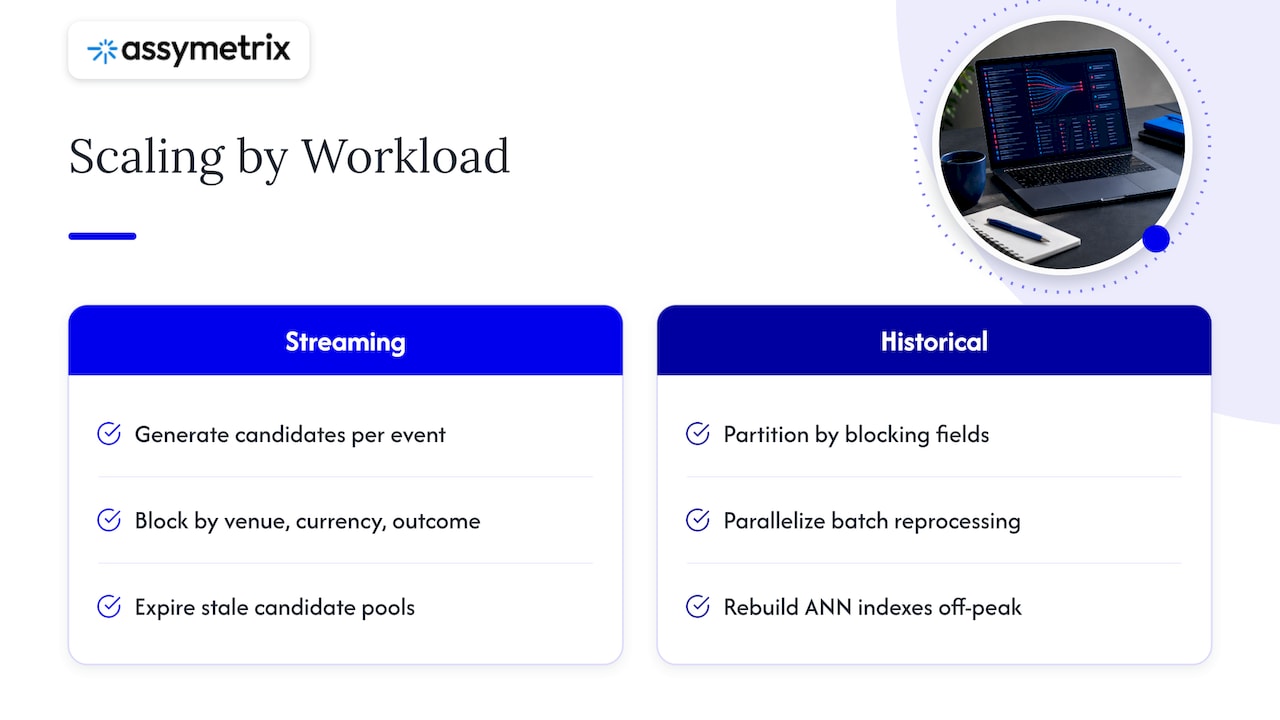
Scaling event deduplication across venues means scaling two different workloads at once: the steady-state stream of new listings and the much larger historical corpus that backfills and audits depend on.
For the streaming side, keep the candidate generation stage cheap enough to run per event rather than in batches. Blocking on venue, currency, and outcome type before any string or embedding comparison keeps per-event latency low even as listing volume grows, and stream TTLs that expire stale candidate pools prevent memory growth during connector reconnects or venue outages.
For the historical side, partition the corpus by the same blocking fields used in streaming, typically venue pair, outcome type, and time window, so batch reprocessing jobs can run those partitions in parallel rather than scanning the full archive sequentially. ANN indexes for embedding retrieval need periodic rebuilding as new markets accumulate, and that rebuild cost grows with corpus size, so scheduling it against off-peak windows rather than continuously keeps compute predictable.
Currency and unit normalization also becomes a scaling concern once a feed spans venues that settle in different denominations. Numeric comparison tolerances that work for same-currency pairs can produce false positives or false negatives once cross-currency pairs enter the candidate pool, and historical FX rate normalization practices from portfolio data infrastructure offer a useful reference point for handling that kind of multi-currency reconciliation at scale.
The underlying principle holds across both workloads: push expensive computation as far down the pipeline as possible, so the cheap stages absorb the volume growth and only a small, already-filtered candidate set ever reaches fuzzy matching, embeddings, or LLM verification.
Impact of event deduplication on prediction market analytics accuracy
Deduplication accuracy sets a ceiling on everything built on top of a cross-venue feed. An arbitrage scanner computing spread between two venues is only as reliable as the assumption that the two sides of the spread describe the same event, and a trader skill score aggregating a wallet’s performance across venues double-counts or under-counts outcomes whenever the same market appears twice under different canonical IDs.
Analytics built on fragmented, unmerged data tend to fail in a specific direction: they overstate volume and liquidity, since the same underlying interest gets counted once per venue instead of once per event, and they understate wallet-level performance consistency, since a trader’s positions on the “same” event across two venues get treated as unrelated bets rather than a single hedged or arbitraged position.
The deterministic token matchers many quick implementations reach for first compound this problem rather than solving it. An empirical matcher evaluation found that simple token-overlap matching produced high false-positive rates on real cross-venue data, which means analytics built on that kind of matcher inherit false merges on top of the missed merges from venues it never catches.
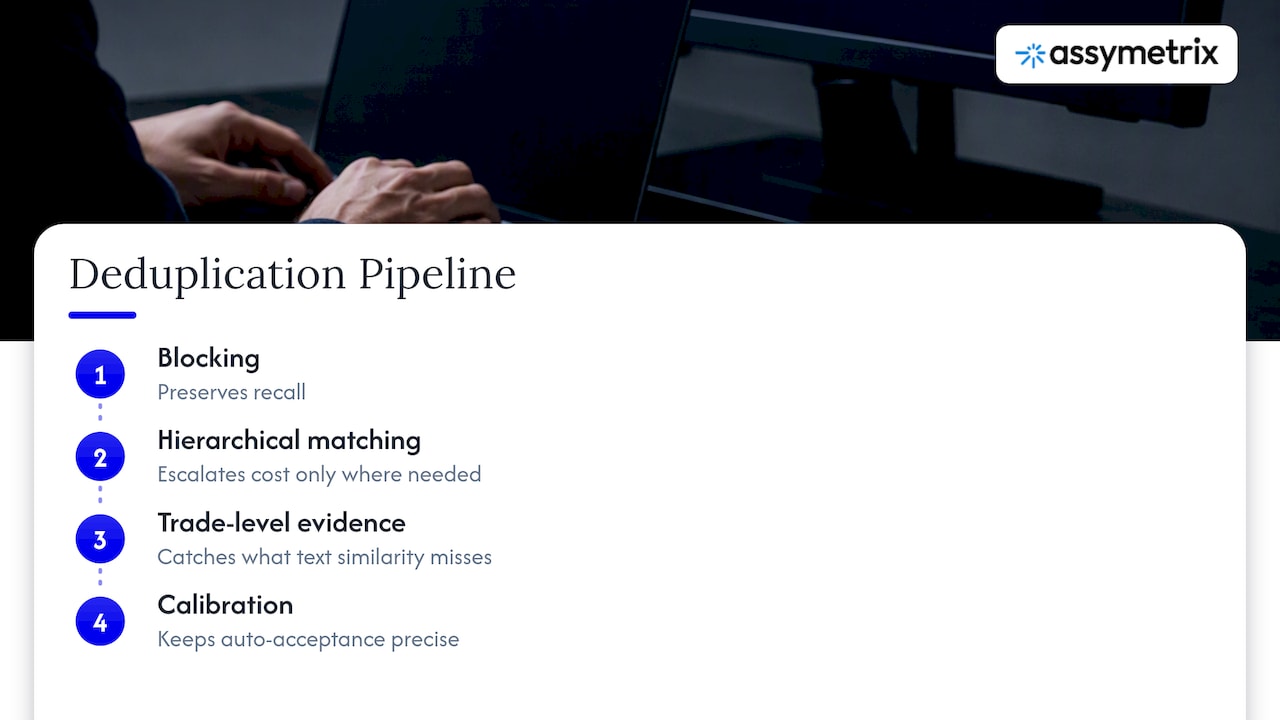
The fix is not a single better matcher but the layered pipeline this guide has walked through: blocking that preserves recall, hierarchical matching that escalates cost only where needed, trade-level evidence that catches what text similarity misses, and calibration that keeps the auto-accept band precise enough to trust downstream. Analytics accuracy is a downstream property of pipeline design, not a separate problem to solve after the fact.
Handling of real-time streaming data in deduplication processes
Real-time deduplication has a constraint batch processing never faces: a decision has to happen before the next relevant event arrives, and that decision often has to be made on incomplete information.
A new market listing on one venue may not have a matching listing on a second venue yet, simply because the second venue has not published it. Streaming dedupe has to tolerate this gracefully, holding a candidate in an unresolved state rather than forcing a premature accept or reject, and re-checking it against new listings as they arrive rather than only against the pool that existed at ingestion time.
WebSocket connector reliability matters more here than in batch processing. A dropped connection that silently misses a listing update can leave a canonical mapping stale, so reconnection logic needs to request a recent-history replay rather than resuming from the current tip, and the dedupe service needs idempotent processing so replayed events do not produce duplicate canonical IDs of their own.
Trade-level evidence, the strongest signal in the batch pipeline, arrives more slowly in real time: a single early trade is weak evidence, and the gaussian-decayed timestamp weighting described earlier in this guide needs enough trade volume to accumulate before it meaningfully strengthens a score. Many streaming systems handle this by auto-accepting high-confidence text and embedding matches immediately, then upgrading the confidence score as trade-level evidence accumulates over the following minutes or hours, rather than waiting for trade evidence before making any mapping decision at all. That staged confidence approach keeps a live feed useful immediately while still letting the mapping harden as more evidence arrives.
Author perspective: real tradeoffs from building cross-venue indexes
Precision matters more than recall when a trading algorithm acts on a match immediately; recall matters more when building a research index that a human will later audit. Threshold heuristics drift as venues change their listing conventions, so retrain on adjudicated labels on a fixed cadence rather than waiting for a visible accuracy drop, and route any pair the model itself scores near the review boundary to a human rather than trusting the tiebreak.
— Dean
Assymetrix Data API: canonical IDs for deduplicated cross-venue feeds
Building this pipeline in-house means maintaining venue connectors, blocking rules, an embedding index, an LLM verification layer, and a calibration loop indefinitely as Polymarket, Kalshi, and Limitless each change their schemas. Our Data API at Assymetrix gives developers, trading bots, and AI agents a single integration point for canonicalized, deduplicated cross-venue data instead.

Every record in the feed carries a canonical ID, a normalized schema, and provenance metadata, drawn from a large dataset spanning numerous rows of trading activity across venues. Confidence and review flags ship on every record, so a consuming system can decide for itself whether to act on a match automatically or wait.
To get started:
Request an API key through the Data API documentation.
Run a sample query against the canonical feed to inspect
source_ids,provenance, and confidence fields directly.Compare streaming and bulk export patterns against the architecture covered in this guide before wiring a production consumer.
FAQ
What is event deduplication in prediction markets?
Event deduplication identifies when the same underlying question or market is listed separately on two or more venues, such as Polymarket and Kalshi, and merges those listings under one canonical identifier. It matters because trading algorithms, arbitrage scanners, and analytics that treat duplicate listings as independent markets will overstate volume and miscalculate spread.
Why can’t title matching alone deduplicate markets reliably?
Titles are frequently similar or identical across venues even when the underlying resolution criteria differ, a pattern research on semantic non-fungibility describes as common across prediction market listings. Equivalence depends on resolution semantics, payout definitions, and temporal boundaries, which is why structured verification, not surface text, has to make the final call.
How accurate are simple token-matching approaches?
An empirical matcher evaluation found that deterministic token-overlap matchers produced high false-positive rates on real cross-venue prediction market data. Adjudicated, calibrated approaches that combine trade-level evidence with structured verification perform more reliably than token overlap alone.
What data does Assymetrix provide for deduplicated markets?
Our Data API provides canonical IDs, normalized schemas, and provenance metadata across Polymarket, Kalshi, and Limitless, built on extensive historical data spanning nearly one billion rows. Pricing for the Data API is available on request through our documentation.
When should ambiguous matches go to manual review instead of auto-accept?
A pair should route to manual review whenever its calibrated score falls between the reject and accept thresholds established from validation data, rather than being forced into either band. Tracking the review-band flip rate over time, how often a human reviewer overturns the suggested label, is a practical signal for deciding whether thresholds need recalibration.
Sources
Event Deduplication for Prediction Markets: Canonical IDs via API
We recommend a layered retrieval-to-verification pipeline: blocking and candidate generation, then deterministic ID matching, fuzzy string comparison, embedding retrieval, and structured LLM verification, backed by trade-level evidence and calibrated accept, review, and reject bands with full audit metadata. We built our canonical ID system and normalized cross-venue feeds around exactly this approach.
TL;DR:
Use blocking by venue pair, currency, and outcome type before embeddings or language model checks; streaming needs subsecond candidate generation, while historical jobs prioritize correctness.
Similar titles can hide different payout rules, resolution sources, or cutoff times, so verify settlement semantics before merging even high similarity pairs.
Treat one matching trade as weak evidence; repeated executions at similar prices and times over several days can move an ambiguous pair into automatic acceptance.
Keep newly listed markets unresolved when counterpart venues have not published a match; replay recent history after connector outages and process repeats idempotently.
Set reject, review, and accept bands from labeled validation data, then audit autoaccepted pairs and track reviewer reversals to catch calibration drift.
Assymetrixdata.assymetrix.comUnify Prediction Market DataAssymetrix brings Polymarket, Kalshi, and Limitless data into one API, supporting cross-venue analysis and canonical market mapping.Explore the Data API
Table of Contents
Architecture: candidate retrieval then verification across streams and batch
Hierarchical matcher: deterministic IDs to fuzzy rules to embeddings to LLM verification
Trade-level evidence and probabilistic record linkage for confident mapping
Candidate generation and blocking strategies to avoid O(N×M) comparisons
Scoring, calibration, and operational controls for accept, review, and reject
Schema normalization, canonical market object, and API integration patterns
Testing, monitoring, and continuous validation for deduplication services
Integration of deduplication results into downstream predictive models and trading algorithms
Strategies for scaling deduplication with large-volume, high-velocity market data
Impact of event deduplication on prediction market analytics accuracy
Handling of real-time streaming data in deduplication processes
Author perspective: real tradeoffs from building cross-venue indexes
Assymetrix Data API: canonical IDs for deduplicated cross-venue feeds
Sources
Architecture: candidate retrieval then verification across streams and batch
A two-stage architecture keeps event deduplication markets tractable at venue scale. Stage one optimizes for recall at low cost: blocking rules, cheap token and field filters, inverted indexes, or vector approximate nearest neighbor (ANN) search narrow millions of possible pairs into short candidate lists. Stage two spends compute where it counts, building comparison vectors and running deterministic, fuzzy, and machine learning verification only on those shortlisted pairs. This split mirrors the approach described in the PolyEdge cross-venue pipeline, which pairs candidate retrieval with a verification stage that includes NLI and LLM passes to confirm semantic equivalence.
Operational placement depends on who consumes the output:
Streaming dedupe runs on new listings as WebSocket connectors ingest them, producing canonical mappings within seconds for live arbitrage scanners.
Batch dedupe runs against the full historical corpus on a schedule, reconciling backfills, catching mappings the streaming path missed, and feeding audit reports.
Hybrid systems route high-confidence streaming matches immediately while queuing ambiguous pairs for the next batch reconciliation pass.
Latency budgets differ sharply between the two. A streaming consumer building arbitrage signals needs sub-second candidate generation and a verification pass that completes before the next price tick matters. A batch job rebuilding canonical IDs across a full historical archive can afford minutes per million comparisons because correctness, not speed, is the constraint.
Hierarchical matcher: deterministic IDs to fuzzy rules to embeddings to LLM verification
Each layer in the hierarchy catches what the previous one misses, and ordering them by cost keeps compute spend proportional to difficulty.
Deterministic matching: when venues expose a strong external identifier, such as a shared resolution source reference, match on it directly and write the result into a canonical alias table that persists across runs.
Fuzzy string matching: normalize text first (uppercase, strip punctuation, standardize dates and currency notation), then score remaining candidates with Jaro-Winkler distance or token set ratio, accepting only above a validated threshold.
Embedding retrieval: encode market titles and descriptions as sentence embeddings, rank candidates by cosine similarity, and retrieve the nearest k neighbors rather than relying on lexical overlap alone.
LLM or NLI verification: run a structured comparison prompt that checks whether the implied YES region, resolution criteria, and settlement conditions actually align, not just the surface text.
That last step matters more than it sounds. Research on semantic non-fungibility shows that titles alone are frequently insufficient: equivalence depends on resolution semantics, payout definitions, and temporal boundaries, so two markets with near-identical titles can resolve differently. Curated alias tables still earn their place even once embeddings are in production, since entity resolution patterns from applied trading research show embeddings recover paraphrases and abbreviations that fuzzy methods miss, while renames and subsidiary relationships still need a maintained table.
Pro Tip: Run the LLM verification pass only on pairs that already cleared embedding similarity, never on the full candidate pool, or the cost curve breaks fast.
Trade-level evidence and probabilistic record linkage for confident mapping
Text similarity alone leaves too many false positives on the table. Trade-level evidence, repeated co-occurring executions across two venues at similar prices and times, gives a much stronger signal that two listings are the same underlying market.
Useful attributes include:
Execution timestamp proximity, weighted with a gaussian decay rather than a hard cutoff.
Price and quantity tolerances that account for venue-specific rounding and tick size.
Settlement date and resolution convention agreement.
Wallet or trader overlap across the two venues’ order flow.
The pipeline aggregates these into a probabilistic score using a Fellegi-Sunter model or a calibrated classifier, following the approach in statistical record linkage for instrument mapping, which treats blocking, comparison vectors, and score aggregation as a single calibrated chain rather than independent filters.
Repeated co-occurring trades across venues form one of the strongest verification signals available, according to the same record linkage research: a single matching trade is weak evidence, but a cluster of similar trades over several days moves a pair from “review” into “accept” territory without human intervention.
Candidate generation and blocking strategies to avoid O(N×M) comparisons
Comparing every market against every other market scales quadratically and becomes unworkable once a feed spans multiple venues and years of history. Blocking fields prune the search space before any expensive comparison runs.
Block first on venue pair, currency, and outcome type (binary versus multi-outcome), since cross-type matches are structurally impossible.
Narrow further with trading window overlap and normalized cutoff times, discarding pairs whose resolution dates cannot align.
Use coarse volume bands and token overlap counts as a cheap pre-filter before any embedding lookup runs.
Apply stream TTLs and connector reconnection backoff so a WebSocket drop does not reprocess the full candidate pool on reconnect.
The PolyEdge pipeline builds this as an explicit hierarchy: coarse blocks first, then time and volume buckets, then token overlap, then ANN retrieval for embeddings, which bounds compute while preserving recall for true duplicates.
Scoring, calibration, and operational controls for accept, review, and reject
Calibration decides how much human review a dedupe system actually needs. The goal is high precision at the auto-accept threshold, since a wrong automatic merge corrupts every downstream aggregate that touches it.
Set three bands from validation data: τ_low below which pairs are auto-rejected, τ_mid where pairs route to manual review, and τ_high above which pairs auto-merge.
Prefer interpretable models, Fellegi-Sunter, logistic regression, or gradient-boosted trees with inspectable feature weights, over opaque scoring for auditability.
Build a human adjudication interface that captures the reviewer’s decision and reasoning alongside the original score.
Retrain periodically on adjudicated labels so the review band shrinks as the model learns from disputed cases.
Pro Tip: Track the review-band flip rate, how often a reviewer overturns the model’s suggested label, as your primary signal that calibration has drifted.
Schema normalization, canonical market object, and API integration patterns
A canonical market object needs a fixed set of fields that every venue connector maps into, regardless of how the source venue structures its own schema: canonical_id, a source_ids map linking back to each venue’s native identifier, normalized_title, outcome_space, resolution_semantics, cutoff_time, resolution_source, and a provenance block recording how the mapping was produced.
API consumers typically need three delivery patterns:
Streaming canonical events, pushed as new cross-venue matches confirm in real time, for arbitrage scanners and trading bots that act on divergence.
Bulk exports with mapping snapshots, giving researchers a point-in-time view of which source IDs resolved to which canonical ID, useful for reproducible backtests.
Confidence and review-flag fields exposed on every record, so an AI agent or trading system can decide for itself whether to act on an auto-accepted match or wait for a human-reviewed one.
Our own canonical ID design follows this pattern across Polymarket, Kalshi, and Limitless feeds.
Testing, monitoring, and continuous validation for deduplication services
A dedupe pipeline degrades silently if nobody watches it. The first defense is a labeled validation set built from markets that have already resolved, supplemented by a human adjudication panel for pairs the model scored as ambiguous at the time.
Track auto-accept precision against the adjudicated set as the primary health metric.
Watch the review flip rate, false-positive incident count, mapping latency, and candidate coverage together, since any one metric alone can hide a regression in another.
Schedule periodic re-sampling of auto-accepted pairs for spot audit, not just the review-band pairs.
Keep a reproducible rollback path for any mapping change, since a bad model update can silently re-split canonical IDs that were previously merged.
An empirical matcher evaluation found that deterministic token-overlap matchers produced high false-positive rates, and that blind three-vote adjudication demoted to candidate generation improved precision substantially, a result worth treating as a baseline expectation rather than an edge case.
Integration of deduplication results into downstream predictive models and trading algorithms
A canonical market ID is only useful once downstream systems can trust it enough to act on it. Trading algorithms and predictive models that consume deduplicated feeds need two things the raw matching pipeline already produces: a stable identifier and a confidence score attached to it.
Arbitrage detection is the clearest case. A scanner comparing implied probabilities across venues needs to know it is comparing the same underlying event, not two superficially similar markets with different resolution criteria. Feeding raw, unmapped venue data into a spread calculation risks flagging false arbitrage on pairs that never actually converge, since their payout structures differ even when their titles look alike.
Predictive models built on historical price series face a related problem: training on fragmented, unmerged history from the same underlying event across three venues understates the effective sample size and can introduce look-ahead bias if a market’s historical records get merged after the fact during a backfill. Models trained on a stable canonical history, versioned by mapping snapshot, avoid this.
Confidence scores matter as much as the mapping itself here. A trading algorithm acting on live divergence should treat an auto-accepted, high-confidence pair differently from a review-band pair still awaiting adjudication, either by sizing positions down or excluding review-band pairs entirely until they clear. Our signal generation guide covers how arbitrage scanners typically consume these confidence fields alongside live odds, and our arbitrage scanner walkthrough shows the pattern applied end to end.
Strategies for scaling deduplication with large-volume, high-velocity market data
Scaling event deduplication across venues means scaling two different workloads at once: the steady-state stream of new listings and the much larger historical corpus that backfills and audits depend on.
For the streaming side, keep the candidate generation stage cheap enough to run per event rather than in batches. Blocking on venue, currency, and outcome type before any string or embedding comparison keeps per-event latency low even as listing volume grows, and stream TTLs that expire stale candidate pools prevent memory growth during connector reconnects or venue outages.
For the historical side, partition the corpus by the same blocking fields used in streaming, typically venue pair, outcome type, and time window, so batch reprocessing jobs can run those partitions in parallel rather than scanning the full archive sequentially. ANN indexes for embedding retrieval need periodic rebuilding as new markets accumulate, and that rebuild cost grows with corpus size, so scheduling it against off-peak windows rather than continuously keeps compute predictable.
Currency and unit normalization also becomes a scaling concern once a feed spans venues that settle in different denominations. Numeric comparison tolerances that work for same-currency pairs can produce false positives or false negatives once cross-currency pairs enter the candidate pool, and historical FX rate normalization practices from portfolio data infrastructure offer a useful reference point for handling that kind of multi-currency reconciliation at scale.
The underlying principle holds across both workloads: push expensive computation as far down the pipeline as possible, so the cheap stages absorb the volume growth and only a small, already-filtered candidate set ever reaches fuzzy matching, embeddings, or LLM verification.
Impact of event deduplication on prediction market analytics accuracy
Deduplication accuracy sets a ceiling on everything built on top of a cross-venue feed. An arbitrage scanner computing spread between two venues is only as reliable as the assumption that the two sides of the spread describe the same event, and a trader skill score aggregating a wallet’s performance across venues double-counts or under-counts outcomes whenever the same market appears twice under different canonical IDs.
Analytics built on fragmented, unmerged data tend to fail in a specific direction: they overstate volume and liquidity, since the same underlying interest gets counted once per venue instead of once per event, and they understate wallet-level performance consistency, since a trader’s positions on the “same” event across two venues get treated as unrelated bets rather than a single hedged or arbitraged position.
The deterministic token matchers many quick implementations reach for first compound this problem rather than solving it. An empirical matcher evaluation found that simple token-overlap matching produced high false-positive rates on real cross-venue data, which means analytics built on that kind of matcher inherit false merges on top of the missed merges from venues it never catches.
The fix is not a single better matcher but the layered pipeline this guide has walked through: blocking that preserves recall, hierarchical matching that escalates cost only where needed, trade-level evidence that catches what text similarity misses, and calibration that keeps the auto-accept band precise enough to trust downstream. Analytics accuracy is a downstream property of pipeline design, not a separate problem to solve after the fact.
Handling of real-time streaming data in deduplication processes
Real-time deduplication has a constraint batch processing never faces: a decision has to happen before the next relevant event arrives, and that decision often has to be made on incomplete information.
A new market listing on one venue may not have a matching listing on a second venue yet, simply because the second venue has not published it. Streaming dedupe has to tolerate this gracefully, holding a candidate in an unresolved state rather than forcing a premature accept or reject, and re-checking it against new listings as they arrive rather than only against the pool that existed at ingestion time.
WebSocket connector reliability matters more here than in batch processing. A dropped connection that silently misses a listing update can leave a canonical mapping stale, so reconnection logic needs to request a recent-history replay rather than resuming from the current tip, and the dedupe service needs idempotent processing so replayed events do not produce duplicate canonical IDs of their own.
Trade-level evidence, the strongest signal in the batch pipeline, arrives more slowly in real time: a single early trade is weak evidence, and the gaussian-decayed timestamp weighting described earlier in this guide needs enough trade volume to accumulate before it meaningfully strengthens a score. Many streaming systems handle this by auto-accepting high-confidence text and embedding matches immediately, then upgrading the confidence score as trade-level evidence accumulates over the following minutes or hours, rather than waiting for trade evidence before making any mapping decision at all. That staged confidence approach keeps a live feed useful immediately while still letting the mapping harden as more evidence arrives.
Author perspective: real tradeoffs from building cross-venue indexes
Precision matters more than recall when a trading algorithm acts on a match immediately; recall matters more when building a research index that a human will later audit. Threshold heuristics drift as venues change their listing conventions, so retrain on adjudicated labels on a fixed cadence rather than waiting for a visible accuracy drop, and route any pair the model itself scores near the review boundary to a human rather than trusting the tiebreak.
— Dean
Assymetrix Data API: canonical IDs for deduplicated cross-venue feeds
Building this pipeline in-house means maintaining venue connectors, blocking rules, an embedding index, an LLM verification layer, and a calibration loop indefinitely as Polymarket, Kalshi, and Limitless each change their schemas. Our Data API at Assymetrix gives developers, trading bots, and AI agents a single integration point for canonicalized, deduplicated cross-venue data instead.
Every record in the feed carries a canonical ID, a normalized schema, and provenance metadata, drawn from a large dataset spanning numerous rows of trading activity across venues. Confidence and review flags ship on every record, so a consuming system can decide for itself whether to act on a match automatically or wait.
To get started:
Request an API key through the Data API documentation.
Run a sample query against the canonical feed to inspect
source_ids,provenance, and confidence fields directly.Compare streaming and bulk export patterns against the architecture covered in this guide before wiring a production consumer.
FAQ
What is event deduplication in prediction markets?
Event deduplication identifies when the same underlying question or market is listed separately on two or more venues, such as Polymarket and Kalshi, and merges those listings under one canonical identifier. It matters because trading algorithms, arbitrage scanners, and analytics that treat duplicate listings as independent markets will overstate volume and miscalculate spread.
Why can’t title matching alone deduplicate markets reliably?
Titles are frequently similar or identical across venues even when the underlying resolution criteria differ, a pattern research on semantic non-fungibility describes as common across prediction market listings. Equivalence depends on resolution semantics, payout definitions, and temporal boundaries, which is why structured verification, not surface text, has to make the final call.
How accurate are simple token-matching approaches?
An empirical matcher evaluation found that deterministic token-overlap matchers produced high false-positive rates on real cross-venue prediction market data. Adjudicated, calibrated approaches that combine trade-level evidence with structured verification perform more reliably than token overlap alone.
What data does Assymetrix provide for deduplicated markets?
Our Data API provides canonical IDs, normalized schemas, and provenance metadata across Polymarket, Kalshi, and Limitless, built on extensive historical data spanning nearly one billion rows. Pricing for the Data API is available on request through our documentation.
When should ambiguous matches go to manual review instead of auto-accept?
A pair should route to manual review whenever its calibrated score falls between the reject and accept thresholds established from validation data, rather than being forced into either band. Tracking the review-band flip rate over time, how often a human reviewer overturns the suggested label, is a practical signal for deciding whether thresholds need recalibration.
Sources
Other Blog


