Fix Order Book Drift: WebSocket Prediction Market Data for Devs
Fix Order Book Drift: WebSocket Prediction Market Data for Devs
Fix Order Book Drift: WebSocket Prediction Market Data for Devs
Developer runbook for WebSocket prediction market data: resync order books in 4 steps, secure auth, and a unified Assymetrix backed feed.
Fix Order Book Drift: WebSocket Prediction Market Data for Devs
Use authenticated WebSocket streams for any prediction market system that trades, alerts, or reasons in real time. REST polling cannot capture orderbook deltas or trade executions reliably at the speed markets move. For anything touching more than one venue, a unified, normalized WebSocket feed beats maintaining separate connections to Polymarket, Kalshi, and Limitless. The next decision is scope: pick your auth model and subscription depth before writing a single line of client code.
TL;DR:
Using a unified, normalized WebSocket feed reduces maintenance overhead and latency compared to managing multiple separate venue connections.
Full order book snapshots should be fetched via REST before subscribing to deltas, with continuous verification of delta sequence IDs to prevent data drift.
Authentication for account streams often involves signing payloads with API secrets or sending signed messages post-connection, and must be carefully synchronized with system clocks.
Rate limits are enforced with explicit error codes, so backoff strategies with exponential retries and jitter are essential to maintain stable connections.
Cross-venue data normalization that converts all prices to probabilities, timestamps to a standard format, and tags data source identifiers simplifies reconciliation and backtesting efforts.
Table of Contents
Why WebSocket Data Types Matter for Prediction Market Trading
How Do You Authenticate a Prediction Market WebSocket Connection?
How Do You Keep a Local Order Book in Sync?
How Should You Structure Subscriptions and Handle Rate Limits?
Why Multi-Venue Prediction Market Integration Is an Engineering Problem
What Are the Best Use Cases for Prediction Market WebSocket Streams?
Integration Checklist and Starter Code for WebSocket Clients
How Do You Troubleshoot Missed Messages and Reconnect Failures?
How Do You Handle Time Sync and Out-of-Order Messages?
How Do You Validate Streaming Data Integrity?
What Security Steps Go Beyond Authentication?
How Do You Manage Connection Lifecycle Events?
Best Practices for Scaling WebSocket Clients Under Load
Direct Integrations vs. a Unified Feed: What Actually Makes Sense
Get Real-Time Prediction Market Data Through One Connection
Sources
Why WebSocket Data Types Matter for Prediction Market Trading
Prediction market venues stream five categories of data that matter to a trading or analytics system, and each one maps to a different engineering job. Getting the field semantics wrong is the single most common source of bad backtests and mispriced bots.
Order book snapshots and deltas give you the full depth of a market at a point in time, followed by incremental changes. Polymarket’s Markets WebSocket delivers full order book state, price changes, and trade notifications, and it supports a “lite” subscription mode that trims the payload when you only need top-of-book pricing rather than full depth.
Best bid/ask ticks (often called bookTicker streams) give you the tightest, fastest signal for probability movement without the overhead of full depth. If your bot only cares about the spread and mid price, subscribing to book ticker instead of full depth cuts bandwidth substantially.
Trade execution events stream every fill as it happens. Fields typically include price, size, side, and a timestamp, letting you reconstruct the tape independently of the order book.
Market state and settlement events cover contract status changes: market open, paused, resolved, or settled. Gemini’s WebSocket streams illustrate this pattern with dedicated channels such as orders@account, balances@account, and settlements@account layered alongside market data channels like {symbol}@bookTicker.
A few field conventions recur across venues and are worth internalizing early:
Price is usually expressed as a probability between 0 and 1, not a dollar figure.
Quantity fields represent shares or contracts, not notional value.
Timestamps arrive in varying precision; normalize to a single standard before storing.
Payloads come as JSON in most cases, with some venues offering msgpack or compressed binary frames for lower bandwidth, per Alpaca’s streaming documentation on content-type and compression options.
Lite subscriptions exist specifically to reduce load for clients that don’t need full depth.
Choose lite subscriptions for dashboards and alerting. Reserve full-depth subscriptions for market-making bots or arbitrage engines that need to see every level of the book.
How Do You Authenticate a Prediction Market WebSocket Connection?
Public market data (order books, trades, price ticks) usually requires no authentication at all. Account-level streams, meaning your own orders, balances, and fills, are a different story, and getting the handshake wrong is the fastest way to get your connection dropped in production.
Two authentication patterns dominate. The first signs a payload with an HMAC using your API secret and sends it as a header or query parameter during the WebSocket upgrade request. The second sends a signed authentication message immediately after the connection opens, often bundled with a time-based nonce to prevent replay. Gemini’s implementation requires authentication during the upgrade itself for account channels, while other venues favor the post-connect auth message pattern. Read each venue’s spec carefully before assuming one pattern transfers to the next.
Browser-based clients complicate this further. Exposing an API secret in client-side JavaScript is a direct security failure, so any authenticated stream consumed by a browser app needs a backend proxy that holds the credentials and relays sanitized data downstream. Treat this as a hard architectural rule, not a nice-to-have.
Practical steps that keep authentication stable in production:
Start in a sandbox or test stream before pointing at production credentials, a pattern Alpaca’s real-time docs document explicitly for validating message handling.
Rotate API keys on a fixed schedule and store them in a secrets manager, never in source control.
Track your open connection count per venue; most platforms cap concurrent WebSocket connections per API key, and exceeding that cap returns a connection-limit error rather than queuing your request.
Build retry logic that distinguishes an auth failure from a rate limit; retrying a bad signature in a tight loop gets your key throttled or revoked.
Statistic: Streaming providers commonly document fixed per-connection subscription and message-rate ceilings, and enforce them with explicit error codes rather than silent throttling, according to Alpaca’s connection-limit documentation. Design your client to read and respect those codes instead of guessing at safe limits.
How Do You Keep a Local Order Book in Sync?
An order book that drifts from the venue’s true state is worse than no order book at all, because it produces confident, wrong signals. The fix is a four-step recipe that shows up, in some form, across every venue’s own integration guidance.
Fetch a REST snapshot first. Pull the full order book via REST and record its
lastUpdateId(or equivalent sequence marker) and timestamp before opening the WebSocket subscription.Buffer and apply deltas in order. Queue incoming WebSocket delta messages, discard any with an update ID at or below your snapshot’s ID, and apply the rest sequentially to your in-memory book.
Verify update continuity. Each delta typically carries a
U(first update ID in the batch) andu(last update ID). Confirm that each new message’sUis exactly one greater than the previous message’su. A mismatch means you dropped a message.Resync on any gap. If continuity breaks, discard the local book, pull a fresh REST snapshot, and rebuild. Don’t try to patch a broken book; a clean resync is cheaper than debugging a corrupted one mid-session.
This pattern isn’t unique to prediction markets. It’s the same snapshot-plus-delta discipline documented in Polymarket’s Markets WebSocket developer guide, which explicitly warns that gaps between a snapshot and the live delta stream require a full resync rather than a partial patch.
Two engineering details make this recipe fast in practice rather than just correct. First, make delta application idempotent: if you accidentally apply the same update twice, the resulting book state should be identical to applying it once. Second, use a sorted map or skip list for your in-memory book rather than a plain array. Order books need fast insertion, deletion, and top-of-book reads, and a naive array forces an expensive re-sort on every update during high-volatility windows, exactly when you can least afford the latency.
Pro Tip: Log every gap event with its update ID range, even after a successful resync. A venue that drops messages under load will show a pattern in your gap logs long before it shows up as a customer-facing outage, and that pattern is your best early warning signal.
How Should You Structure Subscriptions and Handle Rate Limits?
Subscription design is where bandwidth costs and reliability either compound or cancel each other out. The rule of thumb: subscribe to the narrowest channel that satisfies your use case, and batch aggressively.
Match channels to the job:
Market-making or arbitrage bots need full order book depth plus trade streams for every market they quote.
Dashboards and monitoring tools usually only need best bid/ask ticks and periodic trade summaries, not full depth.
Account-level automation (order fills, balance changes, settlements) needs its own authenticated channel, separate from public market data, and should run on a dedicated connection to isolate failures.
Settlement watchers only need the market-state channel, which is typically low volume and cheap to keep open continuously.
Most venues cap the number of markets or channels you can subscribe to per connection. When you’re tracking hundreds of markets, batch subscription requests into groups rather than sending one message per market, and use wildcard or “all markets” subscription modes where the venue offers them instead of enumerating every symbol by hand.
Debouncing matters just as much as batching. If your downstream consumer only needs updates every 250 milliseconds, don’t process every raw tick as it arrives. Buffer and flush on an interval instead. This single change often cuts CPU load on the consuming side by an order of magnitude without losing any decision-relevant signal.
Pro Tip: When you hit a rate limit, back off exponentially with jitter rather than retrying at a fixed interval. A fixed retry interval synchronizes your reconnect attempts with every other client that got rate-limited at the same moment, which just re-triggers the limit.
Why Multi-Venue Prediction Market Integration Is an Engineering Problem
Running direct WebSocket connections to Polymarket, Kalshi, and Limitless simultaneously sounds simple until you build it. Each venue has its own authentication scheme, its own message schema, its own reconnect semantics, and its own definition of “best bid.” None of that friction shows up in a single-venue proof of concept, and all of it shows up the moment you go to production across venues.
The friction points compound quickly:
Auth varies: header-signed HMAC for one venue, post-connect auth messages for another.
Schemas diverge: field names, price encodings, and timestamp formats rarely match across venues.
Message shapes differ: one venue nests trade data inside a market update; another sends it as a standalone event type.
Reconnect behavior isn’t standardized: some venues replay missed messages on reconnect, others expect you to resync from a fresh snapshot every time.
Each of those differences is a separate code path, a separate test suite, and a separate failure mode in production. Systems architects generally recommend normalizing schemas into a single source of truth rather than maintaining venue-specific pipelines, precisely because the maintenance cost of N separate integrations grows faster than N.
A normalized feed converts every price into a consistent 0 to 1 probability unit, standardizes timestamps to a single precision, and tags every event with a provenance identifier, so cross-venue reconciliation and latency attribution become a query instead of a reverse-engineering exercise.
This is the exact problem the Assymetrix Data API is built to solve: it centralizes real-time WebSocket streams from Polymarket, Kalshi, and Limitless into one connection with one schema, so you’re reconciling normalized data instead of debugging three different wire formats. Assymetrix’s data layer draws on roughly 1.5 terabytes of historical trading data spanning nearly one billion rows, which gives Smart Money wallet tracking and cross-venue arbitrage signals depth of context that a single-venue integration simply can’t reconstruct on its own. Fewer format adapters also mean fewer edge-case parsers, and standardized event timestamps make it far easier to keep backtests honest against live trading behavior. If you’re building the ingestion layer yourself, the Prediction Market API guide for Kalshi and Polymarket walks through the schema normalization work in more depth.
What Are the Best Use Cases for Prediction Market WebSocket Streams?
Different workloads pull from the same streams in different combinations, and matching the right channel set to the right job keeps both cost and complexity down.
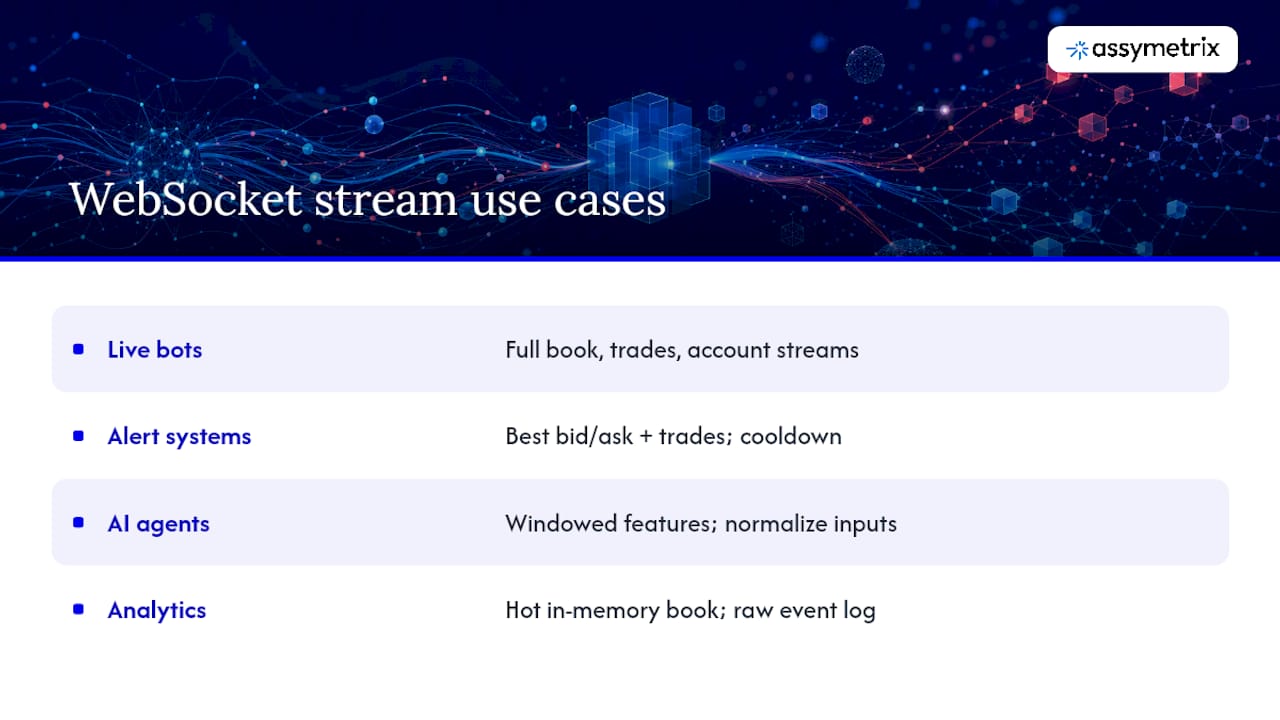
Live trading bots need full order book depth, trade execution events, and account streams for order status, all on separate connections where possible. Pre-trade checks should verify book freshness (no gap since last update) and confirm the market hasn’t moved to a paused or resolving state before an order goes out.
Alert systems run on lighter data: best bid/ask ticks and trade events are usually enough. The engineering challenge is deduplication, since a threshold crossed on one update and re-crossed on the next shouldn’t fire two identical alerts. Build a cooldown window per alert rule and deliver through a queue that can survive a downstream outage without dropping notifications.
AI agents consuming prediction market data agents typically need buffered, windowed features rather than raw ticks. An agent reasoning about a market every few seconds doesn’t need every trade individually; it needs a rolling summary of price, volume, and volatility over its decision window. Normalize inputs before they hit the model, since inconsistent price encodings across venues will silently corrupt a feature vector. The AI agents in prediction markets guide covers ingestion patterns specific to agent architectures, and general-purpose AI agent frameworks are worth reviewing if you’re choosing an orchestration layer.
Analytics pipelines should split hot and cold paths. Keep a low-latency in-memory book for live reads, and persist the raw event tape to an append-only log for backtesting. Retention policy depends on your research horizon, but keeping raw ticks for at least a full market cycle, from listing to settlement, prevents gaps in historical strategy validation.
Integration Checklist and Starter Code for WebSocket Clients
Before writing a production client, run through this checklist:
Provision sandbox API keys and confirm you can connect to a test stream before touching production credentials.
Design your snapshot-plus-delta plan: know which REST endpoint gives you the initial book state and which fields carry the sequence markers.
Write a message parser that normalizes every venue’s payload into one internal schema before it touches your business logic.
Instrument connection metrics: message latency, gap count, reconnect count, and subscription confirmation time.
Test disconnect and resync behavior deliberately, not just happy-path message handling; kill the connection mid-session and confirm your client recovers cleanly.
A minimal Node.js handshake and subscription skeleton looks like this:
const WebSocket = require('ws');
const ws = new WebSocket('wss://venue.example.com/stream');

ws.on('open', () => {
  ws.send(JSON.stringify({
    type: 'subscribe',
    channels: ['orderbook', 'trades'],
    markets: ['MARKET_ID_1', 'MARKET_ID_2']
  }));
});

ws.on('message', (data) => {
  const msg = JSON.parse(data);
  if (msg.type === 'orderbook_delta') applyDelta(msg);
  else if (msg.type === 'trade') handleTrade(msg);
});

ws.on('close', () => scheduleReconnect());
const WebSocket = require('ws');
const ws = new WebSocket('wss://venue.example.com/stream');

ws.on('open', () => {
  ws.send(JSON.stringify({
    type: 'subscribe',
    channels: ['orderbook', 'trades'],
    markets: ['MARKET_ID_1', 'MARKET_ID_2']
  }));
});

ws.on('message', (data) => {
  const msg = JSON.parse(data);
  if (msg.type === 'orderbook_delta') applyDelta(msg);
  else if (msg.type === 'trade') handleTrade(msg);
});

ws.on('close', () => scheduleReconnect());
The equivalent Python asyncio skeleton, with a basic reconnection loop:
import asyncio
import json
import websockets

async def stream(url):
    while True:
        try:
            async with websockets.connect(url) as ws:
                await ws.send(json.dumps({
                    "type": "subscribe",
                    "channels": ["orderbook", "trades"]
                }))
                async for message in ws:
                    msg = json.loads(message)
                    handle_message(msg)
        except websockets.ConnectionClosed:
            await asyncio.sleep(backoff_delay())
import asyncio
import json
import websockets

async def stream(url):
    while True:
        try:
            async with websockets.connect(url) as ws:
                await ws.send(json.dumps({
                    "type": "subscribe",
                    "channels": ["orderbook", "trades"]
                }))
                async for message in ws:
                    msg = json.loads(message)
                    handle_message(msg)
        except websockets.ConnectionClosed:
            await asyncio.sleep(backoff_delay())
Both skeletons leave the actual snapshot fetch and delta application as separate functions, which is deliberate. Keep synchronization logic independent of transport logic so you can unit test it without a live connection. The Prediction Market Data Feed API guide has a fuller version of this pattern adapted for a unified multi-venue feed.
How Do You Troubleshoot Missed Messages and Reconnect Failures?
Production WebSocket failures usually fall into three buckets, and each has a distinct signature.
Authentication errors show up immediately after the handshake, before any subscription confirmation arrives. If you see repeated auth failures after a key rotation, check clock skew first. Time-based nonces fail silently when your server clock drifts even a few seconds from the venue’s.
Subscription limit errors appear when you exceed a venue’s per-connection market or channel cap. The fix is architectural: split subscriptions across multiple connections rather than retrying the same oversized request.
Slow-client disconnects happen when your consumer can’t process messages fast enough and the venue’s buffer fills up, forcing a drop. This is a processing bottleneck, not a network problem, and the fix is debouncing or offloading processing to a separate thread, not a faster reconnect.
Detecting missed updates comes down to sequence discipline covered in the order book section: track U/u continuity and treat any gap as a mandatory resync trigger, never something to patch around.
Log every disconnect with its close code and the last successfully processed sequence ID.
Alert on gap frequency, not just gap occurrence; a rare gap is normal, a rising gap rate signals a venue-side or network problem.
After every resync, cross-check your rebuilt book’s top three levels against a fresh REST call to confirm reconciliation actually worked.
Monitor message latency separately from connection uptime; a connection can stay open while quietly falling behind.
How Do You Handle Time Sync and Out-of-Order Messages?
Prediction market WebSocket messages don’t always arrive in the order they were generated, especially under network jitter or when a venue batches updates before flushing them. Treating arrival order as generation order is a common and costly mistake.
The fix starts with the sequence markers already built into most feeds. Order book deltas carry monotonic update IDs specifically so a client can detect and correct ordering issues without depending on wall-clock time. Trust the sequence ID over the arrival timestamp whenever both are available.
For events without a sequence ID, such as some trade streams, buffer incoming messages for a short window (tens of milliseconds is usually enough) and sort by the venue-supplied event timestamp before processing. This trades a small amount of latency for correctness, a worthwhile exchange for anything feeding a trading decision.
Clock skew between your infrastructure and the venue’s servers is the other half of this problem. Normalize every incoming timestamp to RFC-3339 with the highest precision the venue offers, and periodically check your local clock against a reliable time source like NTP. A system that’s confident about ordering but wrong about absolute time will still misattribute latency and produce misleading backtests. Cross-venue systems have it worse: two venues’ timestamps aren’t directly comparable unless both are normalized to the same standard and skew-corrected first, which is one more reason a single normalized feed simplifies the problem rather than just relocating it.
How Do You Validate Streaming Data Integrity?
A WebSocket client that never crashes can still be silently wrong, which is more dangerous than an outage because nothing alerts you to it.
Validate at three layers. First, schema validation: confirm every incoming message matches the expected field types and required keys before it touches your business logic. A venue that changes an undocumented field type can otherwise corrupt your book without throwing an error. Second, sequence validation: the U/u continuity check from the order book section is your primary defense against silent gaps. Third, cross-check validation: periodically compare your local book’s top-of-book price against a fresh REST call, and compare your trade tape’s running volume against the venue’s own reported volume for the same window.
Build automated reconciliation into your pipeline rather than treating it as a manual debugging step. A scheduled job that pulls a REST snapshot every few minutes and diffs it against your live book catches drift long before a human would notice a pricing anomaly. Log every discrepancy with enough context, timestamp, market ID, and the specific field that diverged, to debug it after the fact without reproducing the exact conditions live.
Data quality issues also show up as statistically implausible values: a price outside the 0 to 1 probability range, a negative quantity, or a timestamp in the future. Reject and log these rather than silently passing them downstream. A single malformed message that slips through can cascade into a bad trading signal or a corrupted backtest that takes hours to trace back to its source.
What Security Steps Go Beyond Authentication?
Authentication gets the most attention, but it’s only one layer of a secure WebSocket integration. Encryption in transit is table stakes: always connect over wss://, never plain ws://, since an unencrypted connection exposes both your API credentials and your trading intent to anyone on the network path.
Data privacy matters most for account-level streams. Order data, balance updates, and position information should never be logged in plaintext in a shared logging system, and access to those logs should be restricted the same way you’d restrict access to the API keys themselves.
Data injection is the less obvious risk. A malicious or compromised intermediary could theoretically inject malformed messages into a stream your client trusts implicitly. Defend against this by validating message structure and sequence continuity on every incoming frame, treating the WebSocket connection as an untrusted input source rather than a guaranteed-clean pipe, and rejecting anything that doesn’t match your expected schema. Rate-limit your own message processing too. A flood of malformed or duplicate messages, whether malicious or the result of a venue-side bug, shouldn’t be able to overwhelm your parsing layer and cause a downstream outage.
Finally, isolate account-stream connections from public market-data connections at the infrastructure level. A compromise or bug in your public data handling shouldn’t have any code path that reaches your order execution logic.
How Do You Manage Connection Lifecycle Events?
Every WebSocket integration needs to handle three lifecycle events cleanly: initial connection, ongoing health checks, and reconnection after a drop.
Heartbeat, or ping-pong, keeps a connection alive and lets both sides detect a dead link before a timeout forces the issue. Most venues send a ping frame on a fixed interval and expect a pong response; failing to respond within a window typically triggers a server-side disconnect. Implement this on a timer independent of your message-processing loop, so a slow parser doesn’t accidentally starve your heartbeat response and get you disconnected for a reason unrelated to the actual connection health.
Reconnection needs a backoff strategy, not a fixed retry interval. Exponential backoff with jitter, doubling the wait time on each failed attempt up to a capped maximum, prevents a mass reconnect event from synchronizing across all your clients and re-triggering the same rate limit that caused the drop in the first place.
Error handling should distinguish between recoverable and unrecoverable failures. A rate-limit error is recoverable with backoff. An authentication failure after a credential rotation is not recoverable without fixing the credentials first, and retrying it in a loop just wastes cycles and risks a temporary IP ban. Build your reconnect logic to inspect the close code and error message before deciding whether to retry at all.
Best Practices for Scaling WebSocket Clients Under Load
A single connection handling a handful of markets behaves nothing like the same connection handling hundreds of markets during a volatile event. Scaling WebSocket clients for prediction market data workloads comes down to a few concrete practices.
Shard connections by workload, not just by venue. Keep order book and trade streams on one set of connections and account/order streams on another, so a burst of public market activity can’t starve your order management logic of processing time.
Use efficient data structures for your in-memory book, as covered earlier, and profile your message-handling path under simulated load before you hit it in production. A parser that’s fast enough for ten markets can fall over at two hundred if it allocates a new object on every message instead of reusing buffers.
Batch downstream writes. If you’re persisting every tick to a database, writing one row per message under high-frequency conditions will bottleneck your database long before your WebSocket client is the constraint. Buffer and batch-insert on an interval instead.
Monitor backpressure explicitly. If your consumer can’t keep up with the venue’s message rate, most WebSocket libraries will buffer messages in memory rather than drop them by default, which can silently grow your process’s memory footprint until it crashes. Set explicit buffer limits and drop or degrade gracefully (falling back to lite subscriptions, for instance) rather than letting memory grow unbounded.
Direct Integrations vs. a Unified Feed: What Actually Makes Sense
Direct venue integrations make sense when you’re trading a single market on a single venue and want full control over every wire-level detail. Beyond that, the maintenance math flips fast. A migration checklist: audit your current per-venue code paths, map each to a normalized schema, run the unified feed in parallel before cutting over, and validate reconciliation before retiring the old pipeline. The Prediction Market WebSocket API docs are a solid next stop for the technical detail.
— Dean
Get Real-Time Prediction Market Data Through One Connection
Building and maintaining three separate WebSocket clients, one per venue, each with its own auth scheme and message format, is real engineering overhead that compounds every time a venue changes its API. This is replaced with a single normalized WebSocket feed covering Polymarket, Kalshi, and Limitless, backed by a large volume of historical data across extensive trading activity.
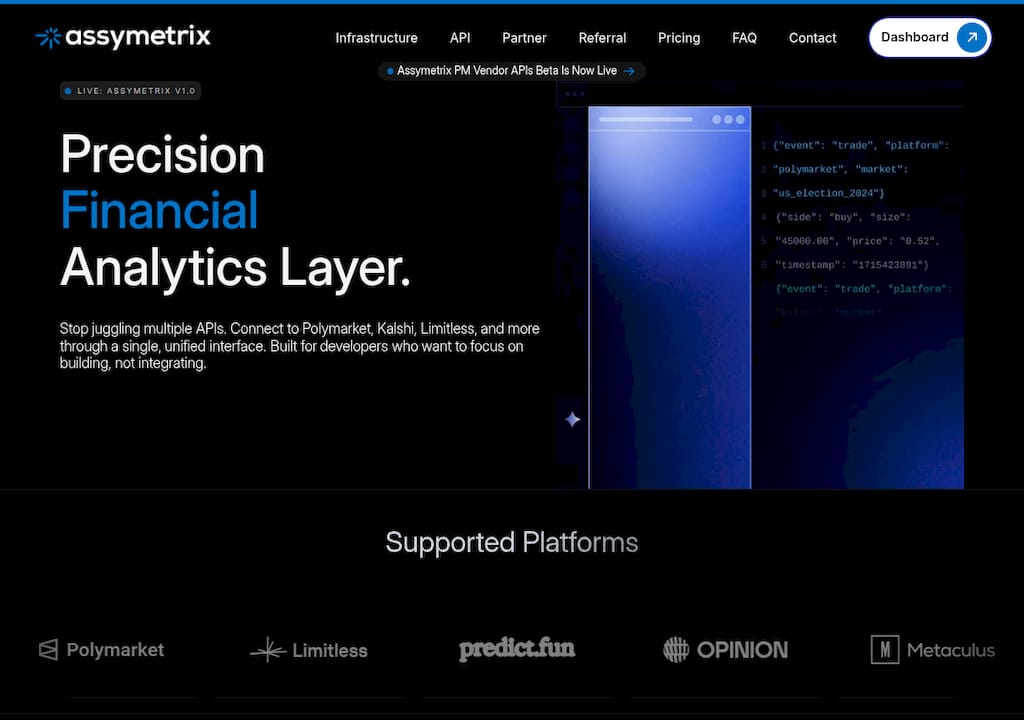
Beyond raw order book and trade data, the same connection exposes wallet tracking, trader skill scores, and cross-venue arbitrage signals, intelligence that would otherwise require building your own wallet-tracking pipeline on top of three separate data sources. For a sense of what that tracking layer looks like in practice, the whale wallet tracking setup guide covers the general technique from a different market angle.
Getting started means requesting sandbox API keys, testing your integration against the documented schema, and moving to production once your reconciliation checks pass. Start with the Assymetrix Data API documentation and get your keys provisioned today.
Sources
FAQ
Is WebSocket Better Than REST for Prediction Market Data?
Yes, for anything time-sensitive. REST polling introduces latency and can miss intermediate price or orderbook changes between requests, while WebSocket pushes every update as it happens.
Do Polymarket, Kalshi, and Limitless All Use the Same WebSocket Schema?
No. Each venue defines its own message format, channel names, and authentication pattern, which is why normalizing schemas into one internal format matters for any system tracking more than one venue.
What Happens if My WebSocket Connection Drops Mid-Session?
You lose any messages sent during the disconnect, so your client needs to detect the gap through sequence ID continuity and pull a fresh REST snapshot to resync the local order book.
Can I Get Cross-Venue Prediction Market Data From One WebSocket Connection?
Yes. The Assymetrix Data API aggregates real-time streams from Polymarket, Kalshi, and Limitless into a single normalized WebSocket connection, removing the need to manage separate per-venue clients.
Do I Need Authentication for Public Order Book Data?
Usually not. Public market data like order books and trades is typically open, while account-specific streams (orders, balances, settlements) require authentication during or right after the WebSocket handshake.
Fix Order Book Drift: WebSocket Prediction Market Data for Devs
Use authenticated WebSocket streams for any prediction market system that trades, alerts, or reasons in real time. REST polling cannot capture orderbook deltas or trade executions reliably at the speed markets move. For anything touching more than one venue, a unified, normalized WebSocket feed beats maintaining separate connections to Polymarket, Kalshi, and Limitless. The next decision is scope: pick your auth model and subscription depth before writing a single line of client code.
TL;DR:
Using a unified, normalized WebSocket feed reduces maintenance overhead and latency compared to managing multiple separate venue connections.
Full order book snapshots should be fetched via REST before subscribing to deltas, with continuous verification of delta sequence IDs to prevent data drift.
Authentication for account streams often involves signing payloads with API secrets or sending signed messages post-connection, and must be carefully synchronized with system clocks.
Rate limits are enforced with explicit error codes, so backoff strategies with exponential retries and jitter are essential to maintain stable connections.
Cross-venue data normalization that converts all prices to probabilities, timestamps to a standard format, and tags data source identifiers simplifies reconciliation and backtesting efforts.
Table of Contents
Why WebSocket Data Types Matter for Prediction Market Trading
How Do You Authenticate a Prediction Market WebSocket Connection?
How Do You Keep a Local Order Book in Sync?
How Should You Structure Subscriptions and Handle Rate Limits?
Why Multi-Venue Prediction Market Integration Is an Engineering Problem
What Are the Best Use Cases for Prediction Market WebSocket Streams?
Integration Checklist and Starter Code for WebSocket Clients
How Do You Troubleshoot Missed Messages and Reconnect Failures?
How Do You Handle Time Sync and Out-of-Order Messages?
How Do You Validate Streaming Data Integrity?
What Security Steps Go Beyond Authentication?
How Do You Manage Connection Lifecycle Events?
Best Practices for Scaling WebSocket Clients Under Load
Direct Integrations vs. a Unified Feed: What Actually Makes Sense
Get Real-Time Prediction Market Data Through One Connection
Sources
Why WebSocket Data Types Matter for Prediction Market Trading
Prediction market venues stream five categories of data that matter to a trading or analytics system, and each one maps to a different engineering job. Getting the field semantics wrong is the single most common source of bad backtests and mispriced bots.
Order book snapshots and deltas give you the full depth of a market at a point in time, followed by incremental changes. Polymarket’s Markets WebSocket delivers full order book state, price changes, and trade notifications, and it supports a “lite” subscription mode that trims the payload when you only need top-of-book pricing rather than full depth.
Best bid/ask ticks (often called bookTicker streams) give you the tightest, fastest signal for probability movement without the overhead of full depth. If your bot only cares about the spread and mid price, subscribing to book ticker instead of full depth cuts bandwidth substantially.
Trade execution events stream every fill as it happens. Fields typically include price, size, side, and a timestamp, letting you reconstruct the tape independently of the order book.
Market state and settlement events cover contract status changes: market open, paused, resolved, or settled. Gemini’s WebSocket streams illustrate this pattern with dedicated channels such as orders@account, balances@account, and settlements@account layered alongside market data channels like {symbol}@bookTicker.
A few field conventions recur across venues and are worth internalizing early:
Price is usually expressed as a probability between 0 and 1, not a dollar figure.
Quantity fields represent shares or contracts, not notional value.
Timestamps arrive in varying precision; normalize to a single standard before storing.
Payloads come as JSON in most cases, with some venues offering msgpack or compressed binary frames for lower bandwidth, per Alpaca’s streaming documentation on content-type and compression options.
Lite subscriptions exist specifically to reduce load for clients that don’t need full depth.
Choose lite subscriptions for dashboards and alerting. Reserve full-depth subscriptions for market-making bots or arbitrage engines that need to see every level of the book.
How Do You Authenticate a Prediction Market WebSocket Connection?
Public market data (order books, trades, price ticks) usually requires no authentication at all. Account-level streams, meaning your own orders, balances, and fills, are a different story, and getting the handshake wrong is the fastest way to get your connection dropped in production.
Two authentication patterns dominate. The first signs a payload with an HMAC using your API secret and sends it as a header or query parameter during the WebSocket upgrade request. The second sends a signed authentication message immediately after the connection opens, often bundled with a time-based nonce to prevent replay. Gemini’s implementation requires authentication during the upgrade itself for account channels, while other venues favor the post-connect auth message pattern. Read each venue’s spec carefully before assuming one pattern transfers to the next.
Browser-based clients complicate this further. Exposing an API secret in client-side JavaScript is a direct security failure, so any authenticated stream consumed by a browser app needs a backend proxy that holds the credentials and relays sanitized data downstream. Treat this as a hard architectural rule, not a nice-to-have.
Practical steps that keep authentication stable in production:
Start in a sandbox or test stream before pointing at production credentials, a pattern Alpaca’s real-time docs document explicitly for validating message handling.
Rotate API keys on a fixed schedule and store them in a secrets manager, never in source control.
Track your open connection count per venue; most platforms cap concurrent WebSocket connections per API key, and exceeding that cap returns a connection-limit error rather than queuing your request.
Build retry logic that distinguishes an auth failure from a rate limit; retrying a bad signature in a tight loop gets your key throttled or revoked.
Statistic: Streaming providers commonly document fixed per-connection subscription and message-rate ceilings, and enforce them with explicit error codes rather than silent throttling, according to Alpaca’s connection-limit documentation. Design your client to read and respect those codes instead of guessing at safe limits.
How Do You Keep a Local Order Book in Sync?
An order book that drifts from the venue’s true state is worse than no order book at all, because it produces confident, wrong signals. The fix is a four-step recipe that shows up, in some form, across every venue’s own integration guidance.
Fetch a REST snapshot first. Pull the full order book via REST and record its
lastUpdateId(or equivalent sequence marker) and timestamp before opening the WebSocket subscription.Buffer and apply deltas in order. Queue incoming WebSocket delta messages, discard any with an update ID at or below your snapshot’s ID, and apply the rest sequentially to your in-memory book.
Verify update continuity. Each delta typically carries a
U(first update ID in the batch) andu(last update ID). Confirm that each new message’sUis exactly one greater than the previous message’su. A mismatch means you dropped a message.Resync on any gap. If continuity breaks, discard the local book, pull a fresh REST snapshot, and rebuild. Don’t try to patch a broken book; a clean resync is cheaper than debugging a corrupted one mid-session.
This pattern isn’t unique to prediction markets. It’s the same snapshot-plus-delta discipline documented in Polymarket’s Markets WebSocket developer guide, which explicitly warns that gaps between a snapshot and the live delta stream require a full resync rather than a partial patch.
Two engineering details make this recipe fast in practice rather than just correct. First, make delta application idempotent: if you accidentally apply the same update twice, the resulting book state should be identical to applying it once. Second, use a sorted map or skip list for your in-memory book rather than a plain array. Order books need fast insertion, deletion, and top-of-book reads, and a naive array forces an expensive re-sort on every update during high-volatility windows, exactly when you can least afford the latency.
Pro Tip: Log every gap event with its update ID range, even after a successful resync. A venue that drops messages under load will show a pattern in your gap logs long before it shows up as a customer-facing outage, and that pattern is your best early warning signal.
How Should You Structure Subscriptions and Handle Rate Limits?
Subscription design is where bandwidth costs and reliability either compound or cancel each other out. The rule of thumb: subscribe to the narrowest channel that satisfies your use case, and batch aggressively.
Match channels to the job:
Market-making or arbitrage bots need full order book depth plus trade streams for every market they quote.
Dashboards and monitoring tools usually only need best bid/ask ticks and periodic trade summaries, not full depth.
Account-level automation (order fills, balance changes, settlements) needs its own authenticated channel, separate from public market data, and should run on a dedicated connection to isolate failures.
Settlement watchers only need the market-state channel, which is typically low volume and cheap to keep open continuously.
Most venues cap the number of markets or channels you can subscribe to per connection. When you’re tracking hundreds of markets, batch subscription requests into groups rather than sending one message per market, and use wildcard or “all markets” subscription modes where the venue offers them instead of enumerating every symbol by hand.
Debouncing matters just as much as batching. If your downstream consumer only needs updates every 250 milliseconds, don’t process every raw tick as it arrives. Buffer and flush on an interval instead. This single change often cuts CPU load on the consuming side by an order of magnitude without losing any decision-relevant signal.
Pro Tip: When you hit a rate limit, back off exponentially with jitter rather than retrying at a fixed interval. A fixed retry interval synchronizes your reconnect attempts with every other client that got rate-limited at the same moment, which just re-triggers the limit.
Why Multi-Venue Prediction Market Integration Is an Engineering Problem
Running direct WebSocket connections to Polymarket, Kalshi, and Limitless simultaneously sounds simple until you build it. Each venue has its own authentication scheme, its own message schema, its own reconnect semantics, and its own definition of “best bid.” None of that friction shows up in a single-venue proof of concept, and all of it shows up the moment you go to production across venues.
The friction points compound quickly:
Auth varies: header-signed HMAC for one venue, post-connect auth messages for another.
Schemas diverge: field names, price encodings, and timestamp formats rarely match across venues.
Message shapes differ: one venue nests trade data inside a market update; another sends it as a standalone event type.
Reconnect behavior isn’t standardized: some venues replay missed messages on reconnect, others expect you to resync from a fresh snapshot every time.
Each of those differences is a separate code path, a separate test suite, and a separate failure mode in production. Systems architects generally recommend normalizing schemas into a single source of truth rather than maintaining venue-specific pipelines, precisely because the maintenance cost of N separate integrations grows faster than N.
A normalized feed converts every price into a consistent 0 to 1 probability unit, standardizes timestamps to a single precision, and tags every event with a provenance identifier, so cross-venue reconciliation and latency attribution become a query instead of a reverse-engineering exercise.
This is the exact problem the Assymetrix Data API is built to solve: it centralizes real-time WebSocket streams from Polymarket, Kalshi, and Limitless into one connection with one schema, so you’re reconciling normalized data instead of debugging three different wire formats. Assymetrix’s data layer draws on roughly 1.5 terabytes of historical trading data spanning nearly one billion rows, which gives Smart Money wallet tracking and cross-venue arbitrage signals depth of context that a single-venue integration simply can’t reconstruct on its own. Fewer format adapters also mean fewer edge-case parsers, and standardized event timestamps make it far easier to keep backtests honest against live trading behavior. If you’re building the ingestion layer yourself, the Prediction Market API guide for Kalshi and Polymarket walks through the schema normalization work in more depth.
What Are the Best Use Cases for Prediction Market WebSocket Streams?
Different workloads pull from the same streams in different combinations, and matching the right channel set to the right job keeps both cost and complexity down.
Live trading bots need full order book depth, trade execution events, and account streams for order status, all on separate connections where possible. Pre-trade checks should verify book freshness (no gap since last update) and confirm the market hasn’t moved to a paused or resolving state before an order goes out.
Alert systems run on lighter data: best bid/ask ticks and trade events are usually enough. The engineering challenge is deduplication, since a threshold crossed on one update and re-crossed on the next shouldn’t fire two identical alerts. Build a cooldown window per alert rule and deliver through a queue that can survive a downstream outage without dropping notifications.
AI agents consuming prediction market data agents typically need buffered, windowed features rather than raw ticks. An agent reasoning about a market every few seconds doesn’t need every trade individually; it needs a rolling summary of price, volume, and volatility over its decision window. Normalize inputs before they hit the model, since inconsistent price encodings across venues will silently corrupt a feature vector. The AI agents in prediction markets guide covers ingestion patterns specific to agent architectures, and general-purpose AI agent frameworks are worth reviewing if you’re choosing an orchestration layer.
Analytics pipelines should split hot and cold paths. Keep a low-latency in-memory book for live reads, and persist the raw event tape to an append-only log for backtesting. Retention policy depends on your research horizon, but keeping raw ticks for at least a full market cycle, from listing to settlement, prevents gaps in historical strategy validation.
Integration Checklist and Starter Code for WebSocket Clients
Before writing a production client, run through this checklist:
Provision sandbox API keys and confirm you can connect to a test stream before touching production credentials.
Design your snapshot-plus-delta plan: know which REST endpoint gives you the initial book state and which fields carry the sequence markers.
Write a message parser that normalizes every venue’s payload into one internal schema before it touches your business logic.
Instrument connection metrics: message latency, gap count, reconnect count, and subscription confirmation time.
Test disconnect and resync behavior deliberately, not just happy-path message handling; kill the connection mid-session and confirm your client recovers cleanly.
A minimal Node.js handshake and subscription skeleton looks like this:
const WebSocket = require('ws');
const ws = new WebSocket('wss://venue.example.com/stream');

ws.on('open', () => {
  ws.send(JSON.stringify({
    type: 'subscribe',
    channels: ['orderbook', 'trades'],
    markets: ['MARKET_ID_1', 'MARKET_ID_2']
  }));
});

ws.on('message', (data) => {
  const msg = JSON.parse(data);
  if (msg.type === 'orderbook_delta') applyDelta(msg);
  else if (msg.type === 'trade') handleTrade(msg);
});

ws.on('close', () => scheduleReconnect());
The equivalent Python asyncio skeleton, with a basic reconnection loop:
import asyncio
import json
import websockets

async def stream(url):
    while True:
        try:
            async with websockets.connect(url) as ws:
                await ws.send(json.dumps({
                    "type": "subscribe",
                    "channels": ["orderbook", "trades"]
                }))
                async for message in ws:
                    msg = json.loads(message)
                    handle_message(msg)
        except websockets.ConnectionClosed:
            await asyncio.sleep(backoff_delay())
Both skeletons leave the actual snapshot fetch and delta application as separate functions, which is deliberate. Keep synchronization logic independent of transport logic so you can unit test it without a live connection. The Prediction Market Data Feed API guide has a fuller version of this pattern adapted for a unified multi-venue feed.
How Do You Troubleshoot Missed Messages and Reconnect Failures?
Production WebSocket failures usually fall into three buckets, and each has a distinct signature.
Authentication errors show up immediately after the handshake, before any subscription confirmation arrives. If you see repeated auth failures after a key rotation, check clock skew first. Time-based nonces fail silently when your server clock drifts even a few seconds from the venue’s.
Subscription limit errors appear when you exceed a venue’s per-connection market or channel cap. The fix is architectural: split subscriptions across multiple connections rather than retrying the same oversized request.
Slow-client disconnects happen when your consumer can’t process messages fast enough and the venue’s buffer fills up, forcing a drop. This is a processing bottleneck, not a network problem, and the fix is debouncing or offloading processing to a separate thread, not a faster reconnect.
Detecting missed updates comes down to sequence discipline covered in the order book section: track U/u continuity and treat any gap as a mandatory resync trigger, never something to patch around.
Log every disconnect with its close code and the last successfully processed sequence ID.
Alert on gap frequency, not just gap occurrence; a rare gap is normal, a rising gap rate signals a venue-side or network problem.
After every resync, cross-check your rebuilt book’s top three levels against a fresh REST call to confirm reconciliation actually worked.
Monitor message latency separately from connection uptime; a connection can stay open while quietly falling behind.
How Do You Handle Time Sync and Out-of-Order Messages?
Prediction market WebSocket messages don’t always arrive in the order they were generated, especially under network jitter or when a venue batches updates before flushing them. Treating arrival order as generation order is a common and costly mistake.
The fix starts with the sequence markers already built into most feeds. Order book deltas carry monotonic update IDs specifically so a client can detect and correct ordering issues without depending on wall-clock time. Trust the sequence ID over the arrival timestamp whenever both are available.
For events without a sequence ID, such as some trade streams, buffer incoming messages for a short window (tens of milliseconds is usually enough) and sort by the venue-supplied event timestamp before processing. This trades a small amount of latency for correctness, a worthwhile exchange for anything feeding a trading decision.
Clock skew between your infrastructure and the venue’s servers is the other half of this problem. Normalize every incoming timestamp to RFC-3339 with the highest precision the venue offers, and periodically check your local clock against a reliable time source like NTP. A system that’s confident about ordering but wrong about absolute time will still misattribute latency and produce misleading backtests. Cross-venue systems have it worse: two venues’ timestamps aren’t directly comparable unless both are normalized to the same standard and skew-corrected first, which is one more reason a single normalized feed simplifies the problem rather than just relocating it.
How Do You Validate Streaming Data Integrity?
A WebSocket client that never crashes can still be silently wrong, which is more dangerous than an outage because nothing alerts you to it.
Validate at three layers. First, schema validation: confirm every incoming message matches the expected field types and required keys before it touches your business logic. A venue that changes an undocumented field type can otherwise corrupt your book without throwing an error. Second, sequence validation: the U/u continuity check from the order book section is your primary defense against silent gaps. Third, cross-check validation: periodically compare your local book’s top-of-book price against a fresh REST call, and compare your trade tape’s running volume against the venue’s own reported volume for the same window.
Build automated reconciliation into your pipeline rather than treating it as a manual debugging step. A scheduled job that pulls a REST snapshot every few minutes and diffs it against your live book catches drift long before a human would notice a pricing anomaly. Log every discrepancy with enough context, timestamp, market ID, and the specific field that diverged, to debug it after the fact without reproducing the exact conditions live.
Data quality issues also show up as statistically implausible values: a price outside the 0 to 1 probability range, a negative quantity, or a timestamp in the future. Reject and log these rather than silently passing them downstream. A single malformed message that slips through can cascade into a bad trading signal or a corrupted backtest that takes hours to trace back to its source.
What Security Steps Go Beyond Authentication?
Authentication gets the most attention, but it’s only one layer of a secure WebSocket integration. Encryption in transit is table stakes: always connect over wss://, never plain ws://, since an unencrypted connection exposes both your API credentials and your trading intent to anyone on the network path.
Data privacy matters most for account-level streams. Order data, balance updates, and position information should never be logged in plaintext in a shared logging system, and access to those logs should be restricted the same way you’d restrict access to the API keys themselves.
Data injection is the less obvious risk. A malicious or compromised intermediary could theoretically inject malformed messages into a stream your client trusts implicitly. Defend against this by validating message structure and sequence continuity on every incoming frame, treating the WebSocket connection as an untrusted input source rather than a guaranteed-clean pipe, and rejecting anything that doesn’t match your expected schema. Rate-limit your own message processing too. A flood of malformed or duplicate messages, whether malicious or the result of a venue-side bug, shouldn’t be able to overwhelm your parsing layer and cause a downstream outage.
Finally, isolate account-stream connections from public market-data connections at the infrastructure level. A compromise or bug in your public data handling shouldn’t have any code path that reaches your order execution logic.
How Do You Manage Connection Lifecycle Events?
Every WebSocket integration needs to handle three lifecycle events cleanly: initial connection, ongoing health checks, and reconnection after a drop.
Heartbeat, or ping-pong, keeps a connection alive and lets both sides detect a dead link before a timeout forces the issue. Most venues send a ping frame on a fixed interval and expect a pong response; failing to respond within a window typically triggers a server-side disconnect. Implement this on a timer independent of your message-processing loop, so a slow parser doesn’t accidentally starve your heartbeat response and get you disconnected for a reason unrelated to the actual connection health.
Reconnection needs a backoff strategy, not a fixed retry interval. Exponential backoff with jitter, doubling the wait time on each failed attempt up to a capped maximum, prevents a mass reconnect event from synchronizing across all your clients and re-triggering the same rate limit that caused the drop in the first place.
Error handling should distinguish between recoverable and unrecoverable failures. A rate-limit error is recoverable with backoff. An authentication failure after a credential rotation is not recoverable without fixing the credentials first, and retrying it in a loop just wastes cycles and risks a temporary IP ban. Build your reconnect logic to inspect the close code and error message before deciding whether to retry at all.
Best Practices for Scaling WebSocket Clients Under Load
A single connection handling a handful of markets behaves nothing like the same connection handling hundreds of markets during a volatile event. Scaling WebSocket clients for prediction market data workloads comes down to a few concrete practices.
Shard connections by workload, not just by venue. Keep order book and trade streams on one set of connections and account/order streams on another, so a burst of public market activity can’t starve your order management logic of processing time.
Use efficient data structures for your in-memory book, as covered earlier, and profile your message-handling path under simulated load before you hit it in production. A parser that’s fast enough for ten markets can fall over at two hundred if it allocates a new object on every message instead of reusing buffers.
Batch downstream writes. If you’re persisting every tick to a database, writing one row per message under high-frequency conditions will bottleneck your database long before your WebSocket client is the constraint. Buffer and batch-insert on an interval instead.
Monitor backpressure explicitly. If your consumer can’t keep up with the venue’s message rate, most WebSocket libraries will buffer messages in memory rather than drop them by default, which can silently grow your process’s memory footprint until it crashes. Set explicit buffer limits and drop or degrade gracefully (falling back to lite subscriptions, for instance) rather than letting memory grow unbounded.
Direct Integrations vs. a Unified Feed: What Actually Makes Sense
Direct venue integrations make sense when you’re trading a single market on a single venue and want full control over every wire-level detail. Beyond that, the maintenance math flips fast. A migration checklist: audit your current per-venue code paths, map each to a normalized schema, run the unified feed in parallel before cutting over, and validate reconciliation before retiring the old pipeline. The Prediction Market WebSocket API docs are a solid next stop for the technical detail.
— Dean
Get Real-Time Prediction Market Data Through One Connection
Building and maintaining three separate WebSocket clients, one per venue, each with its own auth scheme and message format, is real engineering overhead that compounds every time a venue changes its API. This is replaced with a single normalized WebSocket feed covering Polymarket, Kalshi, and Limitless, backed by a large volume of historical data across extensive trading activity.
Beyond raw order book and trade data, the same connection exposes wallet tracking, trader skill scores, and cross-venue arbitrage signals, intelligence that would otherwise require building your own wallet-tracking pipeline on top of three separate data sources. For a sense of what that tracking layer looks like in practice, the whale wallet tracking setup guide covers the general technique from a different market angle.
Getting started means requesting sandbox API keys, testing your integration against the documented schema, and moving to production once your reconciliation checks pass. Start with the Assymetrix Data API documentation and get your keys provisioned today.
Sources
FAQ
Is WebSocket Better Than REST for Prediction Market Data?
Yes, for anything time-sensitive. REST polling introduces latency and can miss intermediate price or orderbook changes between requests, while WebSocket pushes every update as it happens.
Do Polymarket, Kalshi, and Limitless All Use the Same WebSocket Schema?
No. Each venue defines its own message format, channel names, and authentication pattern, which is why normalizing schemas into one internal format matters for any system tracking more than one venue.
What Happens if My WebSocket Connection Drops Mid-Session?
You lose any messages sent during the disconnect, so your client needs to detect the gap through sequence ID continuity and pull a fresh REST snapshot to resync the local order book.
Can I Get Cross-Venue Prediction Market Data From One WebSocket Connection?
Yes. The Assymetrix Data API aggregates real-time streams from Polymarket, Kalshi, and Limitless into a single normalized WebSocket connection, removing the need to manage separate per-venue clients.
Do I Need Authentication for Public Order Book Data?
Usually not. Public market data like order books and trades is typically open, while account-specific streams (orders, balances, settlements) require authentication during or right after the WebSocket handshake.
Other Blog


