WebSocket Prediction Market Data: A Developer's Guide
WebSocket Prediction Market Data: A Developer's Guide
WebSocket Prediction Market Data: A Developer's Guide
How to stream prediction market data over WebSocket: event types, subscription patterns, REST backfill, reconnect logic, and cross-venue normalization.

WebSocket Prediction Market Data: A Developer’s Guide
WebSocket is the right transport for live prediction market data. It holds one persistent connection open and pushes order book changes, price updates and trades the moment they happen, so your bot or agent never waits for the next poll. The hard parts are not the connection. They are keeping a local order book correct, surviving reconnects without gaps or duplicates, and making streams from different venues comparable. This guide covers each of them.
AssymetrixBuild Across Prediction Market VenuesAssymetrix brings Polymarket, Kalshi, and Limitless data together through one API for developers building prediction market tools.Explore the Data API
TL;DR
Use WebSocket for live prices, order book deltas and trades. Use REST for history, market discovery and the starting snapshot.
The reliable pattern is snapshot first, then deltas, with sequence or hash checks and a resync path when something looks wrong.
Every venue differs in channel names, authentication, heartbeats and message shape. Normalize into one internal schema before any strategy code sees the data.
Cross-venue work, such as arbitrage research and Smart Money signals, only works if the same event carries one canonical ID across feeds.
Check connection limits, auth requirements and rate limits on each venue’s official documentation before you size a system.
Table of Contents
WebSocket vs. polling for prediction markets
What a prediction market stream carries
Subscribing and reading messages
Keeping the feed reliable
Normalizing streams across venues
What streaming enables
Constraints to check before you build
Build on one integration
Sources
WebSocket vs. polling for prediction markets
Polling asks a question on a timer: what is the price now? Between two requests the market can move several times, and you see none of it. A WebSocket connection is stateful. You subscribe once, and the server pushes each update as it occurs. Polling REST also burns rate-limit budget on responses that often contain nothing new, a trade-off described in this comparison of REST and WebSocket for market data.
That does not make REST obsolete. The same source recommends WebSocket where latency matters and REST for historical data, initial state snapshots and low-frequency monitoring. Prediction markets fit this split well:
Job | Best transport | Why |
|---|---|---|
Live order book and price tracking | WebSocket | Updates arrive as they happen |
Trade tape for a market | WebSocket | Every fill is an event you should not miss |
Market discovery and metadata | REST | Infrequent, request-shaped |
Initial book snapshot | REST or the stream’s first message | Gives your state a known starting point |
Backtesting and research | REST or bulk export | Large, bounded, replayable |
Slow dashboards (minutes) | REST | A socket adds complexity for no gain |
The strongest design combines both: REST to backfill history and starting state, WebSocket to keep that state current.
What a prediction market stream carries
Exact names differ by venue, but most feeds expose the same families of events.
Order book events. A full book on subscribe, then incremental changes to individual price levels. On Polymarket’s public market channel, for example, you send the outcome token IDs you want and receive a book event first, then price_change events in which a level size of zero removes that level, according to a developer guide to the Polymarket WebSocket channels.
Trades. Each executed trade with price, size, side where available, and a timestamp. This is the raw material for volume, flow and wallet analysis.
Price and ticker updates. Best bid, best ask and last price, usually lighter than a full book. Good enough for monitoring and alerts.
Lifecycle events. A market opens, pauses, resolves or settles. These matter more in prediction markets than in most asset classes, because a contract ends at a definite payout. A bot that misses a resolution event keeps quoting a dead market.
Private account events. Your own orders and fills. These need credentials and sit outside what a data pipeline needs, though execution bots will use them.
Prices on binary contracts sit between 0 and 1 (or 1 and 99 cents, depending on the venue) and are best read as implied probabilities. Keep that unit explicit in your schema, because venues differ in whether they quote dollars, cents or decimals.

Subscribing and reading messages
The subscription flow is similar everywhere:
Connect to the venue’s WebSocket endpoint, authenticating in the handshake where the venue requires it.
Send a subscribe message naming the channel and the market or token identifiers.
Receive an initial snapshot, then updates.
Answer the venue’s heartbeat rules, or the server drops you.
Parse each message by its event type, never by position or assumed fields.
Two details cause most first-day bugs. First, identifiers: Polymarket subscribes by outcome token ID, not by market slug, and the request field is spelled assets_ids with an “s” while events use asset_id, as the Polymarket guide points out. Second, heartbeats: some feeds expect an application-level text ping rather than a protocol-level one. Read the venue’s official documentation for the current rules before you build, since both can change.
A minimal Python consumer looks like this:
import asyncio, json, websockets

async def stream(url, subscribe_msg, handle):
    backoff = 1
    while True:
        try:
            async with websockets.connect(url) as ws:
                await ws.send(json.dumps(subscribe_msg))
                backoff = 1
                async for raw in ws:
                    handle(json.loads(raw))
        except (websockets.ConnectionClosed, OSError):
            await asyncio.sleep(backoff)
            backoff = min(backoff * 2, 30)
import asyncio, json, websockets

async def stream(url, subscribe_msg, handle):
    backoff = 1
    while True:
        try:
            async with websockets.connect(url) as ws:
                await ws.send(json.dumps(subscribe_msg))
                backoff = 1
                async for raw in ws:
                    handle(json.loads(raw))
        except (websockets.ConnectionClosed, OSError):
            await asyncio.sleep(backoff)
            backoff = min(backoff * 2, 30)
The skeleton matters more than the parsing: connect, subscribe, handle, and on any failure back off and start again from a fresh snapshot.
Keeping the feed reliable
A socket that stays open is not a socket that stays correct. Order book drift, where your local book slowly diverges from the venue’s, comes from dropped messages, out-of-order deltas or a missed resync. Our write-up on fixing order book drift with WebSocket prediction market data goes deeper. These are the habits that prevent it.
Snapshot, then deltas
Never apply deltas to an empty book. Take the snapshot, store it, then apply updates in order. If a delta arrives for a level you do not hold, or a venue-provided sequence number or hash disagrees with your state, discard the local book and resubscribe or refetch via REST.
Deduplicate on reconnect
After a reconnect you may receive events you already processed. Key each trade by the venue’s trade ID where one exists, or by a composite of market, price, size and timestamp where it does not. Make handlers idempotent so a replayed event changes nothing.
Watch for staleness, not just disconnects
A silent socket looks healthy. Track the time since the last message per market, and compare it with how active the market normally is. A thin market may legitimately be quiet for minutes. A busy election market going quiet for ten seconds is a problem. Stamp every event with your receive time as well as the venue timestamp, so you can measure feed lag instead of guessing at it.
Reconnect with backoff and jitter
Exponential backoff with a cap, plus random jitter, stops a fleet of bots from hammering a venue the moment it recovers. Resubscribe to everything you held and rebuild books from fresh snapshots.
Separate ingestion from strategy
Put the socket reader in its own process or task, write normalized events to a queue or log, and let strategy code consume from there. A slow strategy must never block the reader, because a blocked reader means a growing buffer and, eventually, a dropped connection.
Normalizing streams across venues
Polymarket, Kalshi and Limitless each describe the same kind of object in different ways. Identifiers, price units, tick sizes, outcome structures and timestamps all differ. If your strategy code touches venue-specific fields, every new venue means rewriting it.
Build one internal schema with at least these fields:
Field | Purpose |
|---|---|
| Source of the event |
| One ID for the same real-world question across venues |
| The venue’s own identifier, kept for execution and audit |
| Yes, no, or a named outcome, normalized |
| Implied probability as a decimal from 0 to 1 |
| Quantity in a stated unit |
| Book, trade, price, lifecycle |
| Venue time and your receive time |
The canonical ID is the hard part. Matching “Will X happen by date Y?” across venues by title strings fails quickly, since resolution wording and cutoff dates differ in ways that change the contract. Our guide to canonical IDs for cross-venue prediction market data covers the matching problem in detail.
What streaming enables
Once streams are normalized, three kinds of work open up.
Cross-venue monitoring. Track the same event on several venues and watch the spread between implied probabilities. A persistent gap may be an opportunity, or it may reflect different resolution rules, fees or liquidity. Measure it before you trade it; our quant guide to cross-venue price gaps shows how, and the prediction market arbitrage strategy guide covers the strategy side.
Smart Money signals. Trade events tied to wallets let you study which participants are consistently early or right, and watch what they do in near real time. That requires both a live feed and deep history to score participants against.
Agents and automation. AI agents benefit from a stable, typed event stream far more than from scraping pages. Our REST and WebSocket guide for developers and agents describes that setup.
Before you deploy any of this, test against history. A strategy that only works on live data you cannot replay is a strategy you cannot debug. See how to backtest prediction market strategies with price snapshots.

Constraints to check before you build
Do not size a system on blog posts, including this one. Before you commit, confirm on each venue’s official developer documentation:
Authentication. Whether market data channels are public or need keys, and how credentials attach to the handshake.
Connection limits. Maximum simultaneous connections and subscriptions per connection.
Rate limits. Both on the socket and on the REST calls you use for snapshots and resyncs. A reconnect storm can exhaust REST budget exactly when you need it.
Heartbeat rules. Who pings, how often, and what counts as a timeout.
Message ordering and delivery. Whether sequence numbers or hashes exist, and whether missed messages can be replayed.
Latency. Measure it yourself from your own host. Published latency numbers describe someone else’s network path.
If you run several venues, the cost of maintaining all of this multiplies. That is the case for a single normalized integration.
Our view: neutral infrastructure beats three bespoke feeds
Most teams we see start by wiring one venue’s socket directly, then discover that the second and third venues double the work and the bugs. The real cost is not the connection code. It is the reconciliation: IDs, units, resolution rules and gap handling.
We built Assymetrix as independent, venue-neutral infrastructure for that reason. We aggregate data across Polymarket, Kalshi and Limitless into one normalized layer, backed by roughly 1.5 terabytes of history spanning nearly one billion rows of trading activity. Live streams and deep history in the same schema mean the strategy you backtest is the strategy you run.
Our design goal is simple: you write strategy code once, and the venue plumbing stays out of it.
Dean
Build on one integration
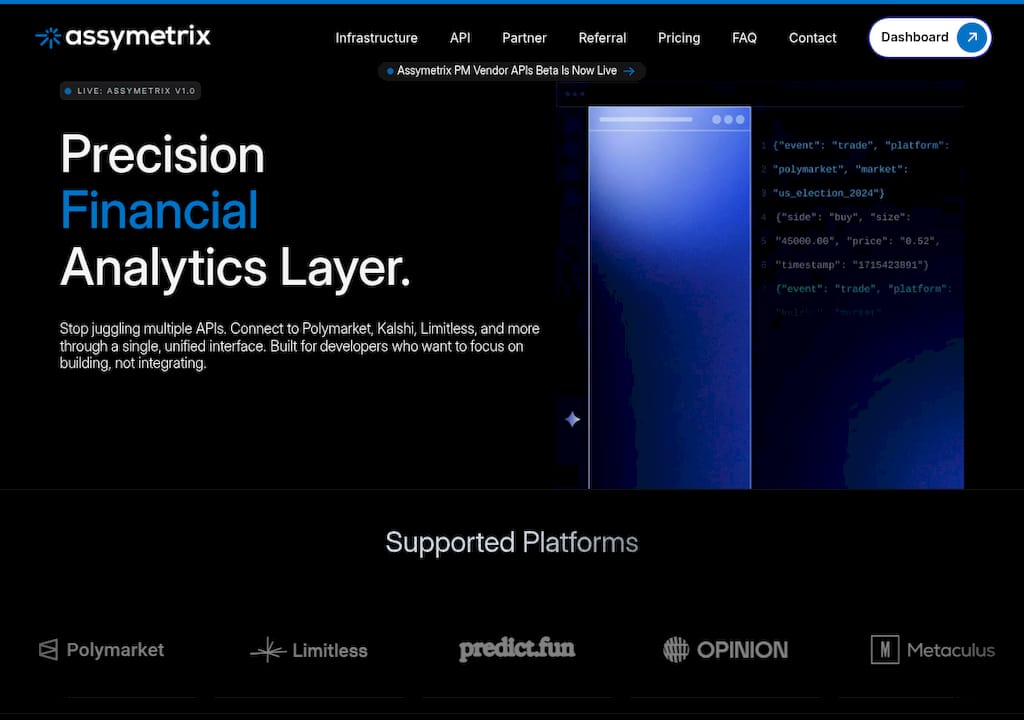
If you would rather not maintain three socket clients, our Data API gives developers, quants and agents unified access to cross-venue prediction market data through a single integration, with live and historical coverage in one normalized schema.
For the streaming specifics, start with our prediction market WebSocket API guide. For real-time use in automated systems, see real-time prediction market data for algorithmic systems.
FAQ
Is WebSocket better than REST for prediction market data?
For live data, yes. A pushed update arrives when the event happens, while polling only shows you the state at each request. Use REST alongside it for history, discovery and snapshots, since the two cover different jobs.
How do I avoid stale or duplicated data in a trading bot?
Start from a snapshot, apply deltas in order, and resync when a sequence or hash check fails. Deduplicate trades on reconnect with a stable key, and track time since the last message per market so a silent socket gets noticed.
Can I stream several prediction market venues through one connection?
Not directly from the venues, since each runs its own endpoint and protocol. A normalized aggregation layer lets you consume them through one integration. You still need canonical event IDs so the same question lines up across venues.
Do I need an API key to stream prediction market data?
It depends on the venue and channel. Some market data channels are public, while account-level channels need credentials. Check each venue’s current official documentation, because requirements change.
Sources
WebSocket Prediction Market Data: A Developer’s Guide
WebSocket is the right transport for live prediction market data. It holds one persistent connection open and pushes order book changes, price updates and trades the moment they happen, so your bot or agent never waits for the next poll. The hard parts are not the connection. They are keeping a local order book correct, surviving reconnects without gaps or duplicates, and making streams from different venues comparable. This guide covers each of them.
AssymetrixBuild Across Prediction Market VenuesAssymetrix brings Polymarket, Kalshi, and Limitless data together through one API for developers building prediction market tools.Explore the Data API
TL;DR
Use WebSocket for live prices, order book deltas and trades. Use REST for history, market discovery and the starting snapshot.
The reliable pattern is snapshot first, then deltas, with sequence or hash checks and a resync path when something looks wrong.
Every venue differs in channel names, authentication, heartbeats and message shape. Normalize into one internal schema before any strategy code sees the data.
Cross-venue work, such as arbitrage research and Smart Money signals, only works if the same event carries one canonical ID across feeds.
Check connection limits, auth requirements and rate limits on each venue’s official documentation before you size a system.
Table of Contents
WebSocket vs. polling for prediction markets
What a prediction market stream carries
Subscribing and reading messages
Keeping the feed reliable
Normalizing streams across venues
What streaming enables
Constraints to check before you build
Build on one integration
Sources
WebSocket vs. polling for prediction markets
Polling asks a question on a timer: what is the price now? Between two requests the market can move several times, and you see none of it. A WebSocket connection is stateful. You subscribe once, and the server pushes each update as it occurs. Polling REST also burns rate-limit budget on responses that often contain nothing new, a trade-off described in this comparison of REST and WebSocket for market data.
That does not make REST obsolete. The same source recommends WebSocket where latency matters and REST for historical data, initial state snapshots and low-frequency monitoring. Prediction markets fit this split well:
Job | Best transport | Why |
|---|---|---|
Live order book and price tracking | WebSocket | Updates arrive as they happen |
Trade tape for a market | WebSocket | Every fill is an event you should not miss |
Market discovery and metadata | REST | Infrequent, request-shaped |
Initial book snapshot | REST or the stream’s first message | Gives your state a known starting point |
Backtesting and research | REST or bulk export | Large, bounded, replayable |
Slow dashboards (minutes) | REST | A socket adds complexity for no gain |
The strongest design combines both: REST to backfill history and starting state, WebSocket to keep that state current.
What a prediction market stream carries
Exact names differ by venue, but most feeds expose the same families of events.
Order book events. A full book on subscribe, then incremental changes to individual price levels. On Polymarket’s public market channel, for example, you send the outcome token IDs you want and receive a book event first, then price_change events in which a level size of zero removes that level, according to a developer guide to the Polymarket WebSocket channels.
Trades. Each executed trade with price, size, side where available, and a timestamp. This is the raw material for volume, flow and wallet analysis.
Price and ticker updates. Best bid, best ask and last price, usually lighter than a full book. Good enough for monitoring and alerts.
Lifecycle events. A market opens, pauses, resolves or settles. These matter more in prediction markets than in most asset classes, because a contract ends at a definite payout. A bot that misses a resolution event keeps quoting a dead market.
Private account events. Your own orders and fills. These need credentials and sit outside what a data pipeline needs, though execution bots will use them.
Prices on binary contracts sit between 0 and 1 (or 1 and 99 cents, depending on the venue) and are best read as implied probabilities. Keep that unit explicit in your schema, because venues differ in whether they quote dollars, cents or decimals.
Subscribing and reading messages
The subscription flow is similar everywhere:
Connect to the venue’s WebSocket endpoint, authenticating in the handshake where the venue requires it.
Send a subscribe message naming the channel and the market or token identifiers.
Receive an initial snapshot, then updates.
Answer the venue’s heartbeat rules, or the server drops you.
Parse each message by its event type, never by position or assumed fields.
Two details cause most first-day bugs. First, identifiers: Polymarket subscribes by outcome token ID, not by market slug, and the request field is spelled assets_ids with an “s” while events use asset_id, as the Polymarket guide points out. Second, heartbeats: some feeds expect an application-level text ping rather than a protocol-level one. Read the venue’s official documentation for the current rules before you build, since both can change.
A minimal Python consumer looks like this:
import asyncio, json, websockets

async def stream(url, subscribe_msg, handle):
    backoff = 1
    while True:
        try:
            async with websockets.connect(url) as ws:
                await ws.send(json.dumps(subscribe_msg))
                backoff = 1
                async for raw in ws:
                    handle(json.loads(raw))
        except (websockets.ConnectionClosed, OSError):
            await asyncio.sleep(backoff)
            backoff = min(backoff * 2, 30)
The skeleton matters more than the parsing: connect, subscribe, handle, and on any failure back off and start again from a fresh snapshot.
Keeping the feed reliable
A socket that stays open is not a socket that stays correct. Order book drift, where your local book slowly diverges from the venue’s, comes from dropped messages, out-of-order deltas or a missed resync. Our write-up on fixing order book drift with WebSocket prediction market data goes deeper. These are the habits that prevent it.
Snapshot, then deltas
Never apply deltas to an empty book. Take the snapshot, store it, then apply updates in order. If a delta arrives for a level you do not hold, or a venue-provided sequence number or hash disagrees with your state, discard the local book and resubscribe or refetch via REST.
Deduplicate on reconnect
After a reconnect you may receive events you already processed. Key each trade by the venue’s trade ID where one exists, or by a composite of market, price, size and timestamp where it does not. Make handlers idempotent so a replayed event changes nothing.
Watch for staleness, not just disconnects
A silent socket looks healthy. Track the time since the last message per market, and compare it with how active the market normally is. A thin market may legitimately be quiet for minutes. A busy election market going quiet for ten seconds is a problem. Stamp every event with your receive time as well as the venue timestamp, so you can measure feed lag instead of guessing at it.
Reconnect with backoff and jitter
Exponential backoff with a cap, plus random jitter, stops a fleet of bots from hammering a venue the moment it recovers. Resubscribe to everything you held and rebuild books from fresh snapshots.
Separate ingestion from strategy
Put the socket reader in its own process or task, write normalized events to a queue or log, and let strategy code consume from there. A slow strategy must never block the reader, because a blocked reader means a growing buffer and, eventually, a dropped connection.
Normalizing streams across venues
Polymarket, Kalshi and Limitless each describe the same kind of object in different ways. Identifiers, price units, tick sizes, outcome structures and timestamps all differ. If your strategy code touches venue-specific fields, every new venue means rewriting it.
Build one internal schema with at least these fields:
Field | Purpose |
|---|---|
| Source of the event |
| One ID for the same real-world question across venues |
| The venue’s own identifier, kept for execution and audit |
| Yes, no, or a named outcome, normalized |
| Implied probability as a decimal from 0 to 1 |
| Quantity in a stated unit |
| Book, trade, price, lifecycle |
| Venue time and your receive time |
The canonical ID is the hard part. Matching “Will X happen by date Y?” across venues by title strings fails quickly, since resolution wording and cutoff dates differ in ways that change the contract. Our guide to canonical IDs for cross-venue prediction market data covers the matching problem in detail.
What streaming enables
Once streams are normalized, three kinds of work open up.
Cross-venue monitoring. Track the same event on several venues and watch the spread between implied probabilities. A persistent gap may be an opportunity, or it may reflect different resolution rules, fees or liquidity. Measure it before you trade it; our quant guide to cross-venue price gaps shows how, and the prediction market arbitrage strategy guide covers the strategy side.
Smart Money signals. Trade events tied to wallets let you study which participants are consistently early or right, and watch what they do in near real time. That requires both a live feed and deep history to score participants against.
Agents and automation. AI agents benefit from a stable, typed event stream far more than from scraping pages. Our REST and WebSocket guide for developers and agents describes that setup.
Before you deploy any of this, test against history. A strategy that only works on live data you cannot replay is a strategy you cannot debug. See how to backtest prediction market strategies with price snapshots.
Constraints to check before you build
Do not size a system on blog posts, including this one. Before you commit, confirm on each venue’s official developer documentation:
Authentication. Whether market data channels are public or need keys, and how credentials attach to the handshake.
Connection limits. Maximum simultaneous connections and subscriptions per connection.
Rate limits. Both on the socket and on the REST calls you use for snapshots and resyncs. A reconnect storm can exhaust REST budget exactly when you need it.
Heartbeat rules. Who pings, how often, and what counts as a timeout.
Message ordering and delivery. Whether sequence numbers or hashes exist, and whether missed messages can be replayed.
Latency. Measure it yourself from your own host. Published latency numbers describe someone else’s network path.
If you run several venues, the cost of maintaining all of this multiplies. That is the case for a single normalized integration.
Our view: neutral infrastructure beats three bespoke feeds
Most teams we see start by wiring one venue’s socket directly, then discover that the second and third venues double the work and the bugs. The real cost is not the connection code. It is the reconciliation: IDs, units, resolution rules and gap handling.
We built Assymetrix as independent, venue-neutral infrastructure for that reason. We aggregate data across Polymarket, Kalshi and Limitless into one normalized layer, backed by roughly 1.5 terabytes of history spanning nearly one billion rows of trading activity. Live streams and deep history in the same schema mean the strategy you backtest is the strategy you run.
Our design goal is simple: you write strategy code once, and the venue plumbing stays out of it.
Dean
Build on one integration
If you would rather not maintain three socket clients, our Data API gives developers, quants and agents unified access to cross-venue prediction market data through a single integration, with live and historical coverage in one normalized schema.
For the streaming specifics, start with our prediction market WebSocket API guide. For real-time use in automated systems, see real-time prediction market data for algorithmic systems.
FAQ
Is WebSocket better than REST for prediction market data?
For live data, yes. A pushed update arrives when the event happens, while polling only shows you the state at each request. Use REST alongside it for history, discovery and snapshots, since the two cover different jobs.
How do I avoid stale or duplicated data in a trading bot?
Start from a snapshot, apply deltas in order, and resync when a sequence or hash check fails. Deduplicate trades on reconnect with a stable key, and track time since the last message per market so a silent socket gets noticed.
Can I stream several prediction market venues through one connection?
Not directly from the venues, since each runs its own endpoint and protocol. A normalized aggregation layer lets you consume them through one integration. You still need canonical event IDs so the same question lines up across venues.
Do I need an API key to stream prediction market data?
It depends on the venue and channel. Some market data channels are public, while account-level channels need credentials. Check each venue’s current official documentation, because requirements change.
Sources
Other Blog


