5 Trader Reputation Metrics for Devs and Quants, Mapped to API Fields
5 Trader Reputation Metrics for Devs and Quants, Mapped to API Fields
5 Trader Reputation Metrics for Devs and Quants, Mapped to API Fields
Developer guide to trader reputation metrics. Maps five core metrics to API fields, shows 30/100/200+ sample size rules, and lists ingestion checks for...

5 Trader Reputation Metrics for Devs and Quants, Mapped to API Fields
Trader reputation metrics are wallet-level, outcome-based measures of skill and reliability, built from resolution accuracy, edge-adjusted hit rate, P&L consistency, timing, and sizing discipline. In prediction markets, every trade settles against a verifiable binary or scalar outcome, so these metrics can be computed directly from resolved history rather than inferred. That resolved-outcome data is what feeds Smart Money tracking and, giving algorithmic agents a real feature set, and the Assymetrix Data API is built to supply exactly that wallet-level trading history.
TL;DR:
Trader reputation metrics are most reliable when built on at least 200 resolved trades, with lower-confidence scores for fewer than 30 trades.
Combining risk-adjusted metrics like the adapted Sharpe ratio with informational metrics such as edge-adjusted hit rate helps differentiate skill from luck in prediction markets.
Cross-venue data normalization and inclusion of dormant wallets are essential to counter survivorship bias and improve score accuracy.
Detecting self-trading and manipulation requires probabilistic flags and transaction-graph heuristics rather than binary indicators.
The Assymetrix Data API supplies comprehensive, resolved wallet-level trade data across platforms necessary for accurate reputation scoring and Smart Money signals.
AssymetrixBuild Smarter Trader Reputation ScoresAssymetrix provides unified cross-venue wallet data for developers and quants building reputation metrics and Smart Money signals.Explore Assymetrix
Table of Contents
What Are the Core Trader Reputation Metrics?
Why Do Skill and Luck Get Confused in Trader Scoring?
How Do Reputation Metrics Become Smart Money Signals?
What Data Fields Does a Reputation Scoring Pipeline Need?
Building the Scoring Pipeline: A Validation Checklist
How Do Reputation Metrics Compare Across Prediction Market Platforms?
What Biases Limit Current Trader Reputation Metrics?
Where Is Trader Reputation Scoring Headed?
Author Perspective and Practical Takeaways
Build Reputation Scoring on Assymetrix Data
Sources
What Are the Core Trader Reputation Metrics?
Five metrics do most of the work in a production scoring pipeline, and each one catches a failure mode the others miss.
Edge-adjusted hit rate subtracts the average implied probability of a trader’s positions from their actual win rate: (wins / trades) − average entry price. Raw win rate rewards betting on favorites; edge-adjusted hit rate does not.
Adapted Sharpe ratio treats each resolved position as a return observation and divides mean return by its standard deviation, giving a risk-adjusted skill measure instead of a raw P&L number. Because prediction-market traders often have thin sample sizes, this ratio needs confidence shrinkage: pull the score toward the cohort median as trade count falls, so a trader with 12 lucky trades doesn’t outrank one with 400 consistent ones.
Rolling ROI with winsorization smooths P&L consistency by capping the influence of one outsized win or loss (typically via median absolute deviation, or MAD, thresholds) before computing a trailing return series.
Drawdown, time-to-recovery, and the Calmar ratio (return divided by max drawdown) expose traders who look profitable on average but carry brutal variance between resolutions.
Concentration, measured with the Herfindahl-Hirschman Index (HHI) across markets or categories, flags traders whose entire track record rests on one lucky call in one market.
Sample-size rule of thumb: scores built on fewer than 30 resolved trades should carry a low-confidence badge, 30 to 100 trades merits a moderate badge, and only 200-plus resolved trades justify full confidence weighting in a composite score.
Edge-adjusted hit rate: win rate minus average implied probability
Adapted Sharpe: mean return divided by return volatility, shrunk by sample size
Rolling ROI: winsorized trailing return series
Drawdown and Calmar ratio: downside severity and recovery speed
HHI concentration: how dependent the record is on one market or category
Why Do Skill and Luck Get Confused in Trader Scoring?
Separating skill from luck is the hardest problem in this discipline, and it’s worse in prediction markets than in traditional trading because sample sizes per wallet are often small and outcomes are binary rather than continuous.
A wallet with eight winning trades in a row could be a genuine specialist in a narrow category, or could be a coin flip that landed right eight times. Composite scoring mitigates this by blending metrics that fail independently, since a Sharpe ratio captures risk-adjusted return while edge-adjusted hit rate captures informational accuracy, and gaming one rarely games both. Shrinkage toward cohort medians as sample size drops is the standard fix, alongside hard minimum-trade filters before a wallet appears in any leaderboard.
Survivorship bias is the quieter problem. If a scoring system only tracks wallets that are still active, it silently drops every trader who blew up and stopped trading, inflating the apparent average skill of the surviving population. Cohort-level baselines should include dormant and closed-out wallets, not just currently active ones.
Outlier-driven scores get suppressed with winsorization or MAD-based Hampel filtering, which caps the influence of any single extreme trade before it dominates a rolling metric. Self-trading and wallet clustering are a separate manipulation risk: two or three wallets trading against each other to fabricate a track record. Transaction-graph heuristics, looking at counterparty overlap, funding-source overlap, and timing correlation, catch most of these patterns, though threshold calibration always trades detection sensitivity against false positives.
Pro Tip: Treat any rare-event detector (self-trade flags, wash-trade flags) as probabilistic, not binary. Log the confidence score alongside the flag so downstream models can discount it rather than discard the wallet outright.
Minimum-trade filters before a wallet enters any ranked leaderboard
Cohort-median shrinkage scaled to inverse sample size
Include dormant wallets in baseline statistics to counter survivorship bias
MAD/Hampel winsorization to cap single-trade influence
Transaction-graph clustering to flag coordinated or self-trading wallets
How Do Reputation Metrics Become Smart Money Signals?
A single wallet’s score is a data point. A Smart Money signal is what happens when several independently profiled wallets converge on the same position before the market has repriced.
Score the early-entry component. Measure how far before a major price move or resolution event a wallet took its position, relative to that wallet’s own historical entry-timing distribution.
Compute a sizing-conviction ratio. Compare position size against that wallet’s typical bet size. A trader who normally risks 2% of their bankroll suddenly deploying 20% is signaling something.
Weight by category specialization. A wallet with a strong edge-adjusted hit rate concentrated in geopolitical markets carries more weight in a geopolitical market than a generalist with the same aggregate score.
Aggregate consensus across wallets. Weight each contributing wallet by its own composite score and sample-size confidence, then compute a consensus probability shift rather than a simple vote count.
Cross-validate against an independent model. Agreement between an internally profiled wallet’s implied view and a separately computed probability model is a high-value confirmation, precisely because the two failure modes are largely uncorrelated.
A practical alert threshold might fire when three or more wallets with composite scores above the 80th percentile enter the same market within a short window, sized at least twice their historical median, with consensus confidence above a set floor. The signal payload should carry wallet IDs, entry timestamps, sizing ratios, and the cross-validation delta, not just a binary “buy” flag. Wallet profiling frameworks that add temporal and order-flow dimensions can generate these payloads directly from resolved-trade histories.
What Data Fields Does a Reputation Scoring Pipeline Need?
Building any of the metrics above requires a specific, unglamorous set of fields, and missing one of them quietly breaks the math downstream.
At minimum, every trade record needs a wallet ID, a UTC timestamp, side (buy/sell), size, execution price, market ID, contract or outcome identifier, and settlement/resolution status once the market closes. Historical coverage should extend far enough back that active wallets clear the 200-trade confidence threshold; for most traders that means six to twelve months of history, sometimes longer in low-volume categories. Canonical IDs matter more than they sound: a wallet trading the same event on two venues needs to map to one identity across both, or cross-venue consensus scoring silently double-counts or misses agreement entirely.
Ingestion strategy depends on what you’re detecting. Rank and score updates tolerate polling every few hours. Microstructure detection, the kind that flags TWAP or ladder-style execution, needs streaming or near-real-time ingestion, since the signal decays within minutes.
Requirement | Why it matters |
|---|---|
Per-trade timestamp, wallet ID, side, size, price | Base unit for every derived metric |
Resolution/settlement status | Required to compute realized P&L, not just paper positions |
Canonical cross-venue market ID | Prevents double-counting the same event on two platforms |
Historical depth (6-12+ months) | Needed to clear 200-trade confidence thresholds |
Streaming or bulk-export access | Streaming for microstructure detection, bulk for backtests |
Wallet ID and UTC timestamp on every row
Resolved outcome and settlement price, not just entry price
Canonical market and contract IDs normalized across venues
Per-wallet endpoints alongside raw event streams for efficient scoring jobs
Building the Scoring Pipeline: A Validation Checklist
Run data-health checks on ingestion (missing fields, duplicate trades, clock skew) before any scoring runs.
Apply winsorization and minimum-trade filters, then compute the composite score.
Backtest by replaying resolved markets and checking whether high-scoring wallets actually beat the market-implied probability.
Monitor rank stability between refreshes using Spearman’s ρ, with a target above 0.92 for the top 100 wallets and a warning banner if it drops below 0.85 during volatile resolution waves.
Alert on sample-size collapse, data gaps, or sudden rank volatility spikes.
Pro Tip: The most common engineering mistake is over-weighting trade volume as a proxy for skill. Volume correlates with activity, not accuracy, and a high-frequency wallet with a mediocre edge-adjusted hit rate will out-rank a sharper, quieter trader unless volume is capped in the composite formula.
How Do Reputation Metrics Compare Across Prediction Market Platforms?
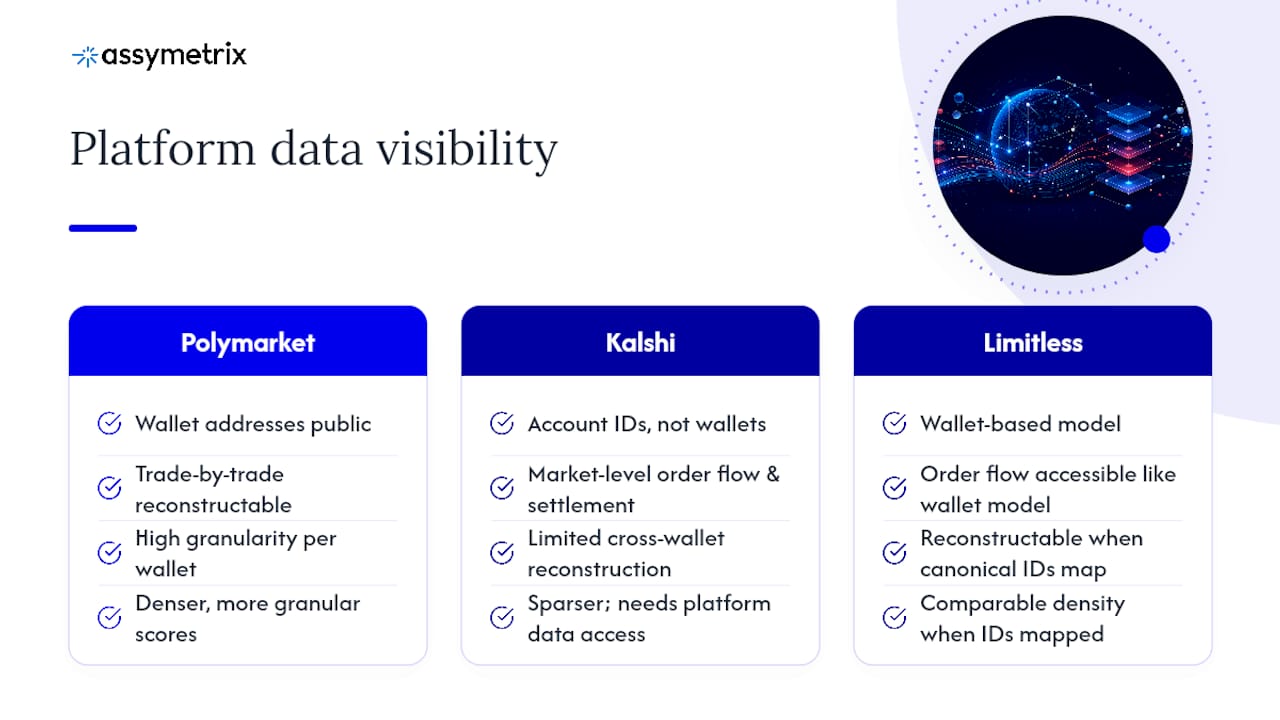
Wallet transparency isn’t uniform across venues, and that changes what’s computable. On Polymarket, every position ties to a public wallet address, so resolution accuracy, sizing, and timing can be reconstructed trade by trade with no cooperation from the trader. Kalshi, as a regulated exchange, exposes market-level order flow and settlement data but ties activity to account identifiers rather than openly traceable wallets, which limits how far third-party cross-wallet consensus scoring can go without platform-side data access. Limitless follows a wallet-based model closer to Polymarket’s, which makes cross-venue normalization possible when canonical IDs map the same trader’s activity across platforms.
The practical effect: a reputation score built purely from Polymarket history can be denser and more granular than one attempting the same on venues with less open wallet-level data. Cross-venue scoring systems need to normalize for this asymmetry rather than assume identical data depth everywhere, weighting confidence differently depending on how much resolved history each venue actually exposes per wallet. This is also why cross-venue agreement, when it’s available, carries outsized signal value: a wallet showing consistent edge on both an open venue and a more opaque one is harder to explain as coincidence than a strong score on a single platform.
What Biases Limit Current Trader Reputation Metrics?
Every scoring system inherits blind spots from what the underlying data can and cannot see.
Category difficulty isn’t normalized by default.
Recency bias cuts the other way: markets, liquidity, and even trader behavior shift over months, so a score built on a year-old sample can overstate current skill for a wallet that has since drifted into worse habits, or understate one that has improved. Rolling windows help but never fully solve this.
Microstructure detectors compound the problem when misapplied. Execution-shape flags like absorption or TWAP patterns are descriptive of order-flow geometry, not proof of algorithmic sophistication or informational edge, and treating them as directional skill signals invites false confidence. One detector run found absorption patterns in a large share of flagged wallets, a base rate high enough that the flag alone says little about any individual trader’s intent.
Finally, wallet clustering and proxy accounts remain a structural limitation. A sophisticated actor running capital across five wallets to avoid detection can still fragment their footprint below clustering thresholds, meaning current reputation systems catch the obvious cases and miss the careful ones.
Where Is Trader Reputation Scoring Headed?
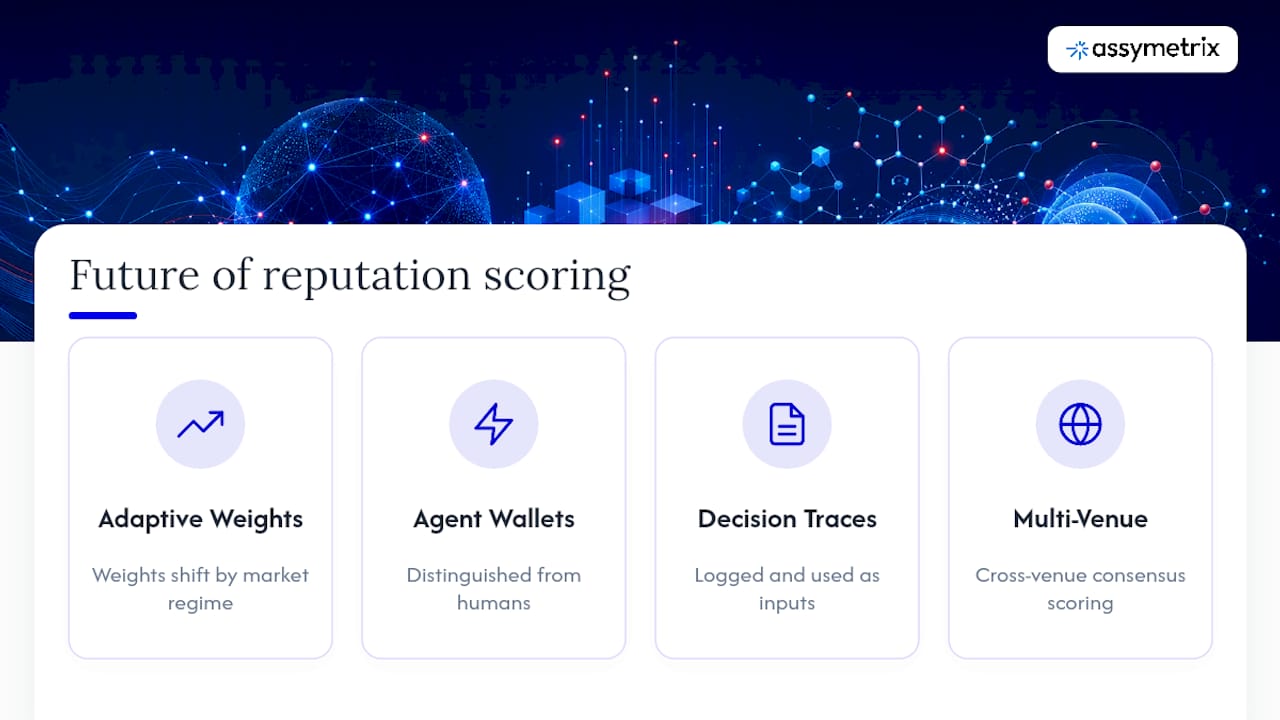
Composite scoring will likely move from static weighted formulas toward adaptive weighting, where the contribution of Sharpe, edge-adjusted hit rate, and concentration shifts based on market regime rather than staying fixed. A calm, high-liquidity period rewards consistency metrics more; a volatile resolution wave rewards timing and conviction metrics more.
Autonomous agents are already a live use case for this data, not a future one, especially with tools like the Shurq MCP Server for Claude & ChatGPT that enable managed model hosting and monitoring. Agent architectures that poll live markets, generate probability estimates, and size positions with Kelly-style rules are operating today, logging full decision traces that could themselves become reputation inputs once agent wallets accumulate enough resolved history to score. Expect reputation systems to eventually distinguish human wallets from agent wallets, since the two populations likely have structurally different edge and timing profiles.
Cross-venue canonical identity resolution will keep improving as more platforms adopt wallet-transparent models, which expands the population of wallets eligible for dense, multi-venue consensus scoring rather than single-venue estimates. Expect finer-grained category specialization scores, too, since a trader’s edge in geopolitical markets and their edge in sports markets are different skills that a single aggregate number currently blurs together.
Author Perspective and Practical Takeaways
The teams that get this right prioritize three things: sample-size discipline, cohort-relative shrinkage, and cross-validation against an independent model before trusting any single wallet’s score. Aggressive detectors tuned for maximum sensitivity look impressive in a demo and generate garbage signals in thin markets, where a handful of coincidental trades can masquerade as skill. Conservative confidence measures cost you some early signals. They also keep you from building a trading strategy on noise.
— Dean
Build Reputation Scoring on Assymetrix Data
Everything described above, edge-adjusted hit rate, Sharpe shrinkage, HHI concentration, cross-venue consensus, depends on having clean, resolved, wallet-level trade history at scale, and that’s the specific gap the Assymetrix Data API fills. Some platforms unify wallet histories across multiple prediction market venues using canonical IDs and extensive historical data, providing coverage deep enough to clear confidence thresholds for most active wallets rather than relying on thin samples.

Beyond raw trade data, some platforms offer computed Trader Skill Scores and Smart Money wallet tracking as references to help validate scoring formulas. Bulk exports handle backtesting and rank-stability replay; streaming endpoints handle live microstructure detection. If you’re integrating from scratch, start with the Data Feed API guide to pull a sample wallet history, then work through the canonical ID strategy before you attempt cross-venue consensus scoring. Request API access, pull one wallet’s resolved history, and run it through the confidence-shrinkage checklist above before you scale to a full leaderboard.
Sources
FAQ
What Is a Good Sample Size for Trader Reputation Scores?
Most scoring frameworks treat 30 resolved trades as a minimum floor, 100 as moderate confidence, and 200 or more as full confidence, with scores below those thresholds shrunk toward the cohort median.
How Is Edge-Adjusted Hit Rate Different From Win Rate?
Edge-adjusted hit rate subtracts the average implied probability of a trader’s entries from their win rate, so it rewards finding mispriced contracts rather than just betting on favorites.
Can Reputation Metrics Detect Self-Trading or Wash Trading?
Transaction-graph heuristics looking at counterparty overlap, funding-source overlap, and timing correlation catch many self-trading patterns, though these detectors are probabilistic and carry real false-positive rates.
Why Does Polymarket Enable Better Trader Scoring Than Traditional Markets?
Every position on Polymarket ties to a public wallet address, so resolution accuracy, timing, and sizing can be reconstructed directly from resolved trades without needing the trader’s cooperation or a broker’s internal records.
Where Can Developers Get Wallet-Level Prediction Market Data?
The Assymetrix Data API provides cross-venue wallet histories, canonical IDs, and Smart Money wallet tracking across Polymarket, Kalshi, and Limitless for building trader reputation scoring pipelines.
5 Trader Reputation Metrics for Devs and Quants, Mapped to API Fields
Trader reputation metrics are wallet-level, outcome-based measures of skill and reliability, built from resolution accuracy, edge-adjusted hit rate, P&L consistency, timing, and sizing discipline. In prediction markets, every trade settles against a verifiable binary or scalar outcome, so these metrics can be computed directly from resolved history rather than inferred. That resolved-outcome data is what feeds Smart Money tracking and, giving algorithmic agents a real feature set, and the Assymetrix Data API is built to supply exactly that wallet-level trading history.
TL;DR:
Trader reputation metrics are most reliable when built on at least 200 resolved trades, with lower-confidence scores for fewer than 30 trades.
Combining risk-adjusted metrics like the adapted Sharpe ratio with informational metrics such as edge-adjusted hit rate helps differentiate skill from luck in prediction markets.
Cross-venue data normalization and inclusion of dormant wallets are essential to counter survivorship bias and improve score accuracy.
Detecting self-trading and manipulation requires probabilistic flags and transaction-graph heuristics rather than binary indicators.
The Assymetrix Data API supplies comprehensive, resolved wallet-level trade data across platforms necessary for accurate reputation scoring and Smart Money signals.
AssymetrixBuild Smarter Trader Reputation ScoresAssymetrix provides unified cross-venue wallet data for developers and quants building reputation metrics and Smart Money signals.Explore Assymetrix
Table of Contents
What Are the Core Trader Reputation Metrics?
Why Do Skill and Luck Get Confused in Trader Scoring?
How Do Reputation Metrics Become Smart Money Signals?
What Data Fields Does a Reputation Scoring Pipeline Need?
Building the Scoring Pipeline: A Validation Checklist
How Do Reputation Metrics Compare Across Prediction Market Platforms?
What Biases Limit Current Trader Reputation Metrics?
Where Is Trader Reputation Scoring Headed?
Author Perspective and Practical Takeaways
Build Reputation Scoring on Assymetrix Data
Sources
What Are the Core Trader Reputation Metrics?
Five metrics do most of the work in a production scoring pipeline, and each one catches a failure mode the others miss.
Edge-adjusted hit rate subtracts the average implied probability of a trader’s positions from their actual win rate: (wins / trades) − average entry price. Raw win rate rewards betting on favorites; edge-adjusted hit rate does not.
Adapted Sharpe ratio treats each resolved position as a return observation and divides mean return by its standard deviation, giving a risk-adjusted skill measure instead of a raw P&L number. Because prediction-market traders often have thin sample sizes, this ratio needs confidence shrinkage: pull the score toward the cohort median as trade count falls, so a trader with 12 lucky trades doesn’t outrank one with 400 consistent ones.
Rolling ROI with winsorization smooths P&L consistency by capping the influence of one outsized win or loss (typically via median absolute deviation, or MAD, thresholds) before computing a trailing return series.
Drawdown, time-to-recovery, and the Calmar ratio (return divided by max drawdown) expose traders who look profitable on average but carry brutal variance between resolutions.
Concentration, measured with the Herfindahl-Hirschman Index (HHI) across markets or categories, flags traders whose entire track record rests on one lucky call in one market.
Sample-size rule of thumb: scores built on fewer than 30 resolved trades should carry a low-confidence badge, 30 to 100 trades merits a moderate badge, and only 200-plus resolved trades justify full confidence weighting in a composite score.
Edge-adjusted hit rate: win rate minus average implied probability
Adapted Sharpe: mean return divided by return volatility, shrunk by sample size
Rolling ROI: winsorized trailing return series
Drawdown and Calmar ratio: downside severity and recovery speed
HHI concentration: how dependent the record is on one market or category
Why Do Skill and Luck Get Confused in Trader Scoring?
Separating skill from luck is the hardest problem in this discipline, and it’s worse in prediction markets than in traditional trading because sample sizes per wallet are often small and outcomes are binary rather than continuous.
A wallet with eight winning trades in a row could be a genuine specialist in a narrow category, or could be a coin flip that landed right eight times. Composite scoring mitigates this by blending metrics that fail independently, since a Sharpe ratio captures risk-adjusted return while edge-adjusted hit rate captures informational accuracy, and gaming one rarely games both. Shrinkage toward cohort medians as sample size drops is the standard fix, alongside hard minimum-trade filters before a wallet appears in any leaderboard.
Survivorship bias is the quieter problem. If a scoring system only tracks wallets that are still active, it silently drops every trader who blew up and stopped trading, inflating the apparent average skill of the surviving population. Cohort-level baselines should include dormant and closed-out wallets, not just currently active ones.
Outlier-driven scores get suppressed with winsorization or MAD-based Hampel filtering, which caps the influence of any single extreme trade before it dominates a rolling metric. Self-trading and wallet clustering are a separate manipulation risk: two or three wallets trading against each other to fabricate a track record. Transaction-graph heuristics, looking at counterparty overlap, funding-source overlap, and timing correlation, catch most of these patterns, though threshold calibration always trades detection sensitivity against false positives.
Pro Tip: Treat any rare-event detector (self-trade flags, wash-trade flags) as probabilistic, not binary. Log the confidence score alongside the flag so downstream models can discount it rather than discard the wallet outright.
Minimum-trade filters before a wallet enters any ranked leaderboard
Cohort-median shrinkage scaled to inverse sample size
Include dormant wallets in baseline statistics to counter survivorship bias
MAD/Hampel winsorization to cap single-trade influence
Transaction-graph clustering to flag coordinated or self-trading wallets
How Do Reputation Metrics Become Smart Money Signals?
A single wallet’s score is a data point. A Smart Money signal is what happens when several independently profiled wallets converge on the same position before the market has repriced.
Score the early-entry component. Measure how far before a major price move or resolution event a wallet took its position, relative to that wallet’s own historical entry-timing distribution.
Compute a sizing-conviction ratio. Compare position size against that wallet’s typical bet size. A trader who normally risks 2% of their bankroll suddenly deploying 20% is signaling something.
Weight by category specialization. A wallet with a strong edge-adjusted hit rate concentrated in geopolitical markets carries more weight in a geopolitical market than a generalist with the same aggregate score.
Aggregate consensus across wallets. Weight each contributing wallet by its own composite score and sample-size confidence, then compute a consensus probability shift rather than a simple vote count.
Cross-validate against an independent model. Agreement between an internally profiled wallet’s implied view and a separately computed probability model is a high-value confirmation, precisely because the two failure modes are largely uncorrelated.
A practical alert threshold might fire when three or more wallets with composite scores above the 80th percentile enter the same market within a short window, sized at least twice their historical median, with consensus confidence above a set floor. The signal payload should carry wallet IDs, entry timestamps, sizing ratios, and the cross-validation delta, not just a binary “buy” flag. Wallet profiling frameworks that add temporal and order-flow dimensions can generate these payloads directly from resolved-trade histories.
What Data Fields Does a Reputation Scoring Pipeline Need?
Building any of the metrics above requires a specific, unglamorous set of fields, and missing one of them quietly breaks the math downstream.
At minimum, every trade record needs a wallet ID, a UTC timestamp, side (buy/sell), size, execution price, market ID, contract or outcome identifier, and settlement/resolution status once the market closes. Historical coverage should extend far enough back that active wallets clear the 200-trade confidence threshold; for most traders that means six to twelve months of history, sometimes longer in low-volume categories. Canonical IDs matter more than they sound: a wallet trading the same event on two venues needs to map to one identity across both, or cross-venue consensus scoring silently double-counts or misses agreement entirely.
Ingestion strategy depends on what you’re detecting. Rank and score updates tolerate polling every few hours. Microstructure detection, the kind that flags TWAP or ladder-style execution, needs streaming or near-real-time ingestion, since the signal decays within minutes.
Requirement | Why it matters |
|---|---|
Per-trade timestamp, wallet ID, side, size, price | Base unit for every derived metric |
Resolution/settlement status | Required to compute realized P&L, not just paper positions |
Canonical cross-venue market ID | Prevents double-counting the same event on two platforms |
Historical depth (6-12+ months) | Needed to clear 200-trade confidence thresholds |
Streaming or bulk-export access | Streaming for microstructure detection, bulk for backtests |
Wallet ID and UTC timestamp on every row
Resolved outcome and settlement price, not just entry price
Canonical market and contract IDs normalized across venues
Per-wallet endpoints alongside raw event streams for efficient scoring jobs
Building the Scoring Pipeline: A Validation Checklist
Run data-health checks on ingestion (missing fields, duplicate trades, clock skew) before any scoring runs.
Apply winsorization and minimum-trade filters, then compute the composite score.
Backtest by replaying resolved markets and checking whether high-scoring wallets actually beat the market-implied probability.
Monitor rank stability between refreshes using Spearman’s ρ, with a target above 0.92 for the top 100 wallets and a warning banner if it drops below 0.85 during volatile resolution waves.
Alert on sample-size collapse, data gaps, or sudden rank volatility spikes.
Pro Tip: The most common engineering mistake is over-weighting trade volume as a proxy for skill. Volume correlates with activity, not accuracy, and a high-frequency wallet with a mediocre edge-adjusted hit rate will out-rank a sharper, quieter trader unless volume is capped in the composite formula.
How Do Reputation Metrics Compare Across Prediction Market Platforms?
Wallet transparency isn’t uniform across venues, and that changes what’s computable. On Polymarket, every position ties to a public wallet address, so resolution accuracy, sizing, and timing can be reconstructed trade by trade with no cooperation from the trader. Kalshi, as a regulated exchange, exposes market-level order flow and settlement data but ties activity to account identifiers rather than openly traceable wallets, which limits how far third-party cross-wallet consensus scoring can go without platform-side data access. Limitless follows a wallet-based model closer to Polymarket’s, which makes cross-venue normalization possible when canonical IDs map the same trader’s activity across platforms.
The practical effect: a reputation score built purely from Polymarket history can be denser and more granular than one attempting the same on venues with less open wallet-level data. Cross-venue scoring systems need to normalize for this asymmetry rather than assume identical data depth everywhere, weighting confidence differently depending on how much resolved history each venue actually exposes per wallet. This is also why cross-venue agreement, when it’s available, carries outsized signal value: a wallet showing consistent edge on both an open venue and a more opaque one is harder to explain as coincidence than a strong score on a single platform.
What Biases Limit Current Trader Reputation Metrics?
Every scoring system inherits blind spots from what the underlying data can and cannot see.
Category difficulty isn’t normalized by default.
Recency bias cuts the other way: markets, liquidity, and even trader behavior shift over months, so a score built on a year-old sample can overstate current skill for a wallet that has since drifted into worse habits, or understate one that has improved. Rolling windows help but never fully solve this.
Microstructure detectors compound the problem when misapplied. Execution-shape flags like absorption or TWAP patterns are descriptive of order-flow geometry, not proof of algorithmic sophistication or informational edge, and treating them as directional skill signals invites false confidence. One detector run found absorption patterns in a large share of flagged wallets, a base rate high enough that the flag alone says little about any individual trader’s intent.
Finally, wallet clustering and proxy accounts remain a structural limitation. A sophisticated actor running capital across five wallets to avoid detection can still fragment their footprint below clustering thresholds, meaning current reputation systems catch the obvious cases and miss the careful ones.
Where Is Trader Reputation Scoring Headed?
Composite scoring will likely move from static weighted formulas toward adaptive weighting, where the contribution of Sharpe, edge-adjusted hit rate, and concentration shifts based on market regime rather than staying fixed. A calm, high-liquidity period rewards consistency metrics more; a volatile resolution wave rewards timing and conviction metrics more.
Autonomous agents are already a live use case for this data, not a future one, especially with tools like the Shurq MCP Server for Claude & ChatGPT that enable managed model hosting and monitoring. Agent architectures that poll live markets, generate probability estimates, and size positions with Kelly-style rules are operating today, logging full decision traces that could themselves become reputation inputs once agent wallets accumulate enough resolved history to score. Expect reputation systems to eventually distinguish human wallets from agent wallets, since the two populations likely have structurally different edge and timing profiles.
Cross-venue canonical identity resolution will keep improving as more platforms adopt wallet-transparent models, which expands the population of wallets eligible for dense, multi-venue consensus scoring rather than single-venue estimates. Expect finer-grained category specialization scores, too, since a trader’s edge in geopolitical markets and their edge in sports markets are different skills that a single aggregate number currently blurs together.
Author Perspective and Practical Takeaways
The teams that get this right prioritize three things: sample-size discipline, cohort-relative shrinkage, and cross-validation against an independent model before trusting any single wallet’s score. Aggressive detectors tuned for maximum sensitivity look impressive in a demo and generate garbage signals in thin markets, where a handful of coincidental trades can masquerade as skill. Conservative confidence measures cost you some early signals. They also keep you from building a trading strategy on noise.
— Dean
Build Reputation Scoring on Assymetrix Data
Everything described above, edge-adjusted hit rate, Sharpe shrinkage, HHI concentration, cross-venue consensus, depends on having clean, resolved, wallet-level trade history at scale, and that’s the specific gap the Assymetrix Data API fills. Some platforms unify wallet histories across multiple prediction market venues using canonical IDs and extensive historical data, providing coverage deep enough to clear confidence thresholds for most active wallets rather than relying on thin samples.
Beyond raw trade data, some platforms offer computed Trader Skill Scores and Smart Money wallet tracking as references to help validate scoring formulas. Bulk exports handle backtesting and rank-stability replay; streaming endpoints handle live microstructure detection. If you’re integrating from scratch, start with the Data Feed API guide to pull a sample wallet history, then work through the canonical ID strategy before you attempt cross-venue consensus scoring. Request API access, pull one wallet’s resolved history, and run it through the confidence-shrinkage checklist above before you scale to a full leaderboard.
Sources
FAQ
What Is a Good Sample Size for Trader Reputation Scores?
Most scoring frameworks treat 30 resolved trades as a minimum floor, 100 as moderate confidence, and 200 or more as full confidence, with scores below those thresholds shrunk toward the cohort median.
How Is Edge-Adjusted Hit Rate Different From Win Rate?
Edge-adjusted hit rate subtracts the average implied probability of a trader’s entries from their win rate, so it rewards finding mispriced contracts rather than just betting on favorites.
Can Reputation Metrics Detect Self-Trading or Wash Trading?
Transaction-graph heuristics looking at counterparty overlap, funding-source overlap, and timing correlation catch many self-trading patterns, though these detectors are probabilistic and carry real false-positive rates.
Why Does Polymarket Enable Better Trader Scoring Than Traditional Markets?
Every position on Polymarket ties to a public wallet address, so resolution accuracy, timing, and sizing can be reconstructed directly from resolved trades without needing the trader’s cooperation or a broker’s internal records.
Where Can Developers Get Wallet-Level Prediction Market Data?
The Assymetrix Data API provides cross-venue wallet histories, canonical IDs, and Smart Money wallet tracking across Polymarket, Kalshi, and Limitless for building trader reputation scoring pipelines.
Other Blog


