S3 Prediction Market Data: Sources, Schemas, and Pipelines
S3 Prediction Market Data: Sources, Schemas, and Pipelines
S3 Prediction Market Data: Sources, Schemas, and Pipelines
Discover how S3 prediction market data enhances historical analysis and live trading through strategic use of exports and APIs.

S3 Prediction Market Data: Sources, Schemas, and Pipelines
Public S3 and Parquet exports for prediction market data exist today, mostly as venue public buckets (Kalshi) and community dataset mirrors on platforms like HuggingFace. These exports are the right tool for full-history backfills and batch research, but they update in daily or hourly cycles, not milliseconds. Live signal generation and order execution require WebSocket or REST access instead.
The pragmatic pattern most engineering teams land on:
Use S3/Parquet dumps for historical backfill, backtesting, and cold storage.
Use venue WebSocket feeds or REST APIs for live orderbook state and trade prints.
For production systems spanning multiple venues, use a unified API that normalizes both S3 history and streaming data under one schema, cutting the integration work from three vendor connections to one.
Key Takeaways
Production on prediction market systems need S3 bulk exports for full-history backfill and a normalized streaming feed for live signals, and the two must reconcile against each other continuously.
Point | Details |
|---|---|
S3 exports suit backfill, not live trading | Daily or hourly Parquet dumps are cost-effective for history but too stale for live signal generation. |
Cross-venue ID mapping is the hard problem | Venue-native market IDs don’t align across Polymarket, Kalshi, and Limitless, so canonical mapping needs real engineering time. |
Resolution metadata affects P&L directly | Stale or unnormalized settlement fields, per CFTC guidance on event contracts, can cause mis-settlement in automated systems. |
Hybrid architecture is the pragmatic default | Backfill from S3, stream for deltas, and reconcile the two on a fixed schedule rather than trusting either blindly. |
Assymetrix unifies both layers under one schema | The Data API combines very large historical data volumes with live streaming and resolved cross-venue IDs in a single integration. |
Table of Contents
Where Does S3 Prediction Market Data Come From?
What Do S3 Parquet Files for Prediction Markets Look Like?
Should You Use S3 Bulk Exports or Live APIs?
How Do You Build a Production Pipeline From S3 Parquet Data?
What Should a Production API Integration Checklist Include?
How Assymetrix Unifies S3 History With Real-Time Feeds
Editorial Take: Batch and Streaming Are Not Rivals
Get Unified Cross-Venue Data Without the Multi-API Maintenance
Sources
Where Does S3 Prediction Market Data Come From?
Three distinct source types feed the current ecosystem, and each carries different tradeoffs for a production pipeline. Venue public buckets are the most direct: Kalshi publishes Parquet exports that community projects mirror and republish, as documented in the Kalshi Parquet dataset on HuggingFace, which lays out schema fields and date ranges pulled straight from the bucket. Community-maintained directories like Awesome-Prediction-Market-Tools catalog these buckets alongside scripts and aggregator references, functioning as a map of where the raw files actually live.
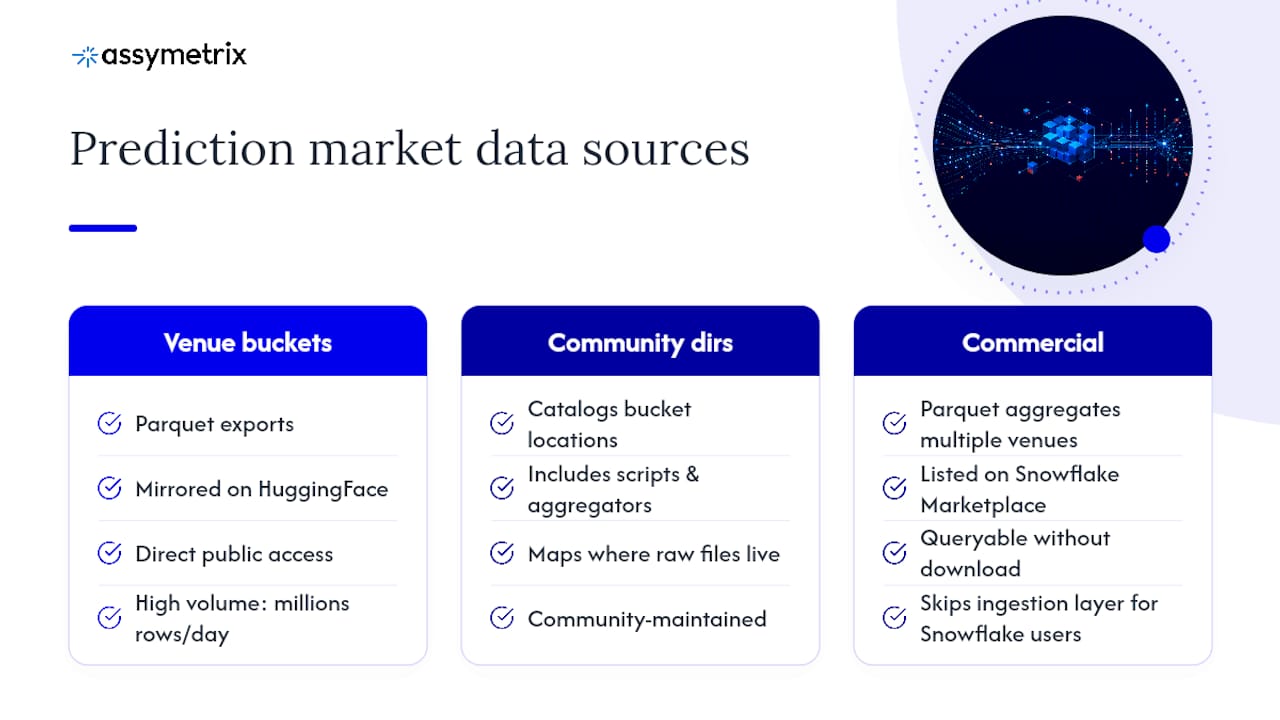
Commercial marketplaces are the third channel. Snowflake Marketplace lists a Prediction Market Data provider that aggregates multiple venue trade histories in Parquet format, queryable directly without a download step. This matters for teams already running a Snowflake warehouse, since it skips the ingestion layer entirely.
Regulatory context changes how you treat this data. The CFTC frames event contracts and prediction markets around transparent resolution criteria and settlement mechanics. That is not a compliance footnote for a data pipeline. It is an engineering requirement: automated systems that ingest stale or non-normalized resolution metadata risk mis-settling positions and generating P&L errors that have nothing to do with the trade itself.
Volume matters too. A single venue’s daily Parquet export can run into millions of rows once you include full orderbook depth across active markets, and multi-venue history compounds that fast, which is why storage and query engine choice belongs in the design conversation from day one, not as an afterthought once ingestion is already running.
What Do S3 Parquet Files for Prediction Markets Look Like?
Raw exports vary by venue, but a workable canonical schema converges on a consistent set of fields regardless of source.
Field | Purpose |
|---|---|
| Venue-native identifier, not stable across venues |
| Human-readable market question |
| Binary, categorical, or scalar contract structure |
| Open, closed, resolved, disputed |
| Scheduled resolution timestamp |
| Event timestamp for the specific row (trade, quote, snapshot) |
| Implied probability, typically 0 to 1 or cents |
| Cumulative or interval trade volume |
| Top-of-book quotes where orderbook data is included |
| Outstanding contract exposure |
Files typically land partitioned by date, sometimes further split by hour for high-activity markets. That partitioning scheme drives your read pattern: a query scanning a single day of trades across one market should hit one or two files, not a full-table scan. File sizes range from a few megabytes for a slow market’s daily slice to hundreds of megabytes for active election or macro contracts during high-volume windows.
The hardest engineering problem is not the schema. It is identity. Every venue mints its own market_id, and those IDs share no relationship across Polymarket, Kalshi, or Limitless even when the underlying question is functionally identical. Building a canonical cross-venue ID means matching on title similarity, resolution source, and end time, then maintaining that mapping as new markets launch daily.
A few things worth handling before anything else touches your models:
Normalize all timestamps to UTC before joining across files, since venue exports mix time zone conventions.
Deduplicate on
(market_id, ts, trade_id)rather than assuming exports are dedupe-safe out of the box.Treat
belief/priceas a probability estimate, not a settled fact, per the framing in Fidelity’s explainer on event-contract mechanics.
Should You Use S3 Bulk Exports or Live APIs?
The choice is not binary. It is a question of which failure mode you can tolerate, and the answer usually points to using both.
Bulk S3 exports are cheap to store and simple to reprocess. A full year of history across venues costs a fraction of what equivalent REST API calls would cost in rate-limit overhead and compute time. The tradeoff is freshness: daily dumps mean your data is, at best, hours old, which is a nonstarter for any strategy reacting to live order flow.
WebSocket and REST APIs deliver sub-second updates but come with real operational weight: connection management, authentication token rotation, reconnect logic, and handling three different rate-limit regimes if you connect to three venues natively.
Hybrid architecture backfills full history from S3, then switches to streaming for the delta once your pipeline catches up to present time. This is the pattern that shows up repeatedly in community ingestion pipelines, including the approach documented in the Kalshi Parquet dataset project.
The reconciliation step is where most homegrown pipelines break. Your streaming layer and your batch layer will disagree on some subset of records, usually near partition boundaries, and you need a deterministic tiebreak rule (last-write-wins by exchange timestamp is the common default) before you trust either source blindly.
Pro Tip: Run your S3 backfill and your live stream in parallel for at least 48 hours before cutting over. The overlap window is where you catch silent schema drift, not after you’re already trading on it.
How Do You Build a Production Pipeline From S3 Parquet Data?
A repeatable ingestion pipeline follows a consistent sequence, whether you’re pulling from a venue’s public bucket or a marketplace listing.
Discover and verify. Locate the bucket manifest or dataset index, confirm file checksums where available, and log the date range each file actually covers rather than trusting the filename.
Choose read-in-place or download. Query engines like Athena or Presto let you run SQL directly against S3 Parquet without moving data, which is fast for exploratory analysis. For iterative model development, pulling files locally and reading them with DuckDB or Spark gives you tighter control over caching and joins.
Normalize the schema. Map every venue’s native field names to your canonical schema, convert all timestamps to UTC, and resolve
market_idvalues into your cross-venue ID system.Deduplicate and compute derived series. Collapse duplicate trade records, then roll raw ticks into OHLCV bars or belief-price snapshots at whatever interval your models consume.
Materialize a queryable store. Write the normalized output back out as partitioned Parquet, or into a table format like Iceberg or Delta Lake, so backfills are replayable and you’re not reprocessing raw files on every query.
Community frameworks like the prediction market analysis repo from Jon Becker demonstrate this pattern concretely: indexers pull raw data, a normalization layer maps it to consistent fields, and the output lands in Parquet ready for backtesting. The core lesson from any of these projects is the same: raw exports are a starting material, not an analytics-ready dataset. Budget real engineering time for the normalization layer, because that is where most of the actual work lives, not in the download step.
What Should a Production API Integration Checklist Include?
Live systems fail in different ways than batch pipelines. A checklist worth running before you trust an integration with real capital:
Unified schema across venues, so a strategy written against one market type doesn’t need a rewrite when you add a second venue.
Documented endpoints and field definitions, not just a Swagger stub with unexplained enum values.
WebSocket connections with heartbeats, so silent disconnects get caught in seconds, not discovered when your position sizing goes stale.
Bulk export endpoints or direct S3 URIs alongside the live feed, so backfill and streaming pull from the same underlying source of truth.
Clearly published rate limits, ideally with response headers indicating remaining quota, not a support ticket you file after getting throttled.
Operationally, token rotation needs to happen without downtime, reconnect logic needs exponential backoff rather than a hard retry loop, and every stream should write to a replay log so a crashed process can rebuild state without re-querying the venue. Reconciliation between your streaming and batch data should run on a schedule, not just when something looks wrong. The demand for this kind of consolidated access is visible even outside pure trading systems. The AIsa agent skill for prediction market data exists specifically because AI agents need one consistent set of endpoints instead of three separate integrations to reason over.
Pro Tip: Set up alerting specifically on resolution and settlement field changes, not just on price movement. A market flipping from “open” to “disputed” without your system noticing is a far more expensive failure than a missed price tick.
How Assymetrix Unifies S3 History With Real-Time Feeds
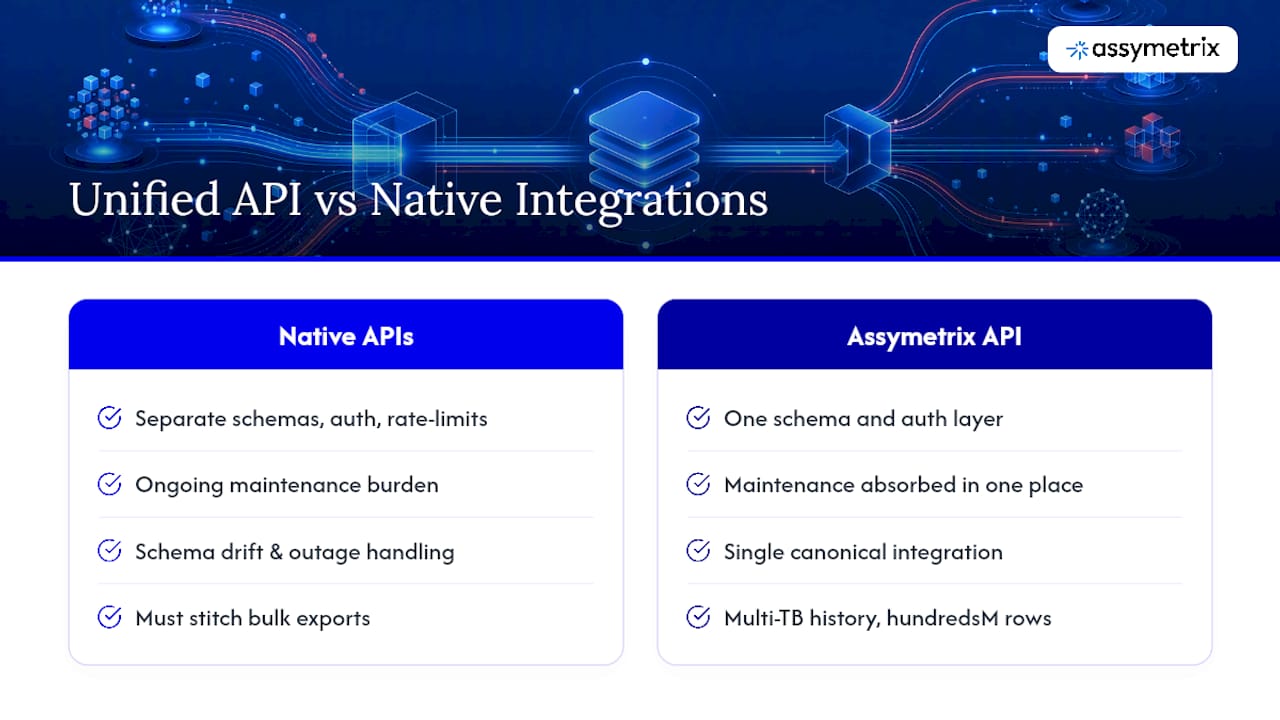
Assymetrix’s Data API exists to remove the exact maintenance burden the checklist above describes. Instead of separate schemas, auth systems, and rate-limit regimes for Polymarket, Kalshi, and Limitless, developers work against one schema and one authentication layer covering all three venues.
The historical depth behind that single integration runs to a very large dataset encompassing multiple terabytes of data and hundreds of millions of rows of trading activity, enough to backfill a multi-venue backtest without stitching together three separate bulk exports yourself. On top of the raw feed, the platform layers Smart Money wallet tracking, Trader Skill Scores, and cross-venue arbitrage signals, features that require the canonical ID mapping problem described earlier to already be solved.
The engineering cost of connecting to three venue-native APIs isn’t the initial integration. It’s the ongoing maintenance: schema drift when a venue changes a field name, auth token formats shifting without notice, and outage handling that differs by provider. A unified schema absorbs that churn in one place instead of three.
For a production pattern, treat the Assymetrix API as your canonical source for both live and historical reads, and keep raw S3 dumps as a cold-storage duplicate for independent verification or offline research. That gives you a single point of failure to monitor instead of three, without giving up the ability to audit against raw venue exports when something looks off.
Editorial Take: Batch and Streaming Are Not Rivals
The instinct to pick one data strategy, either “just use the S3 dumps” or “just build against the live APIs,” misreads the actual problem. Batch and streaming solve different failure modes, and treating them as competing choices is where most homegrown pipelines waste engineering time.
The conventional advice in developer forums tends to undersell the identity problem. Schema mapping gets plenty of attention because it’s visible and mechanical. Cross-venue ID resolution gets far less, because it’s messy, ongoing, and never fully finished as new markets launch. That’s the piece worth prioritizing first, before optimizing query performance or picking a table format.
If there’s one judgment this research supports clearly, it’s this: the maintenance cost of three venue-native integrations compounds in ways a single upfront integration decision doesn’t fully capture until six months in, when a venue changes an auth flow and you’re debugging it at 2 a.m. Build your backfill logic against S3 sources because they’re cheap and complete. Build your live logic against a normalized feed because schema drift across three vendors is a recurring tax, not a one-time cost.
— Dean
Get Unified Cross-Venue Data Without the Multi-API Maintenance
Building separate connections to Polymarket, Kalshi, and Limitless means maintaining three schemas, three auth systems, and three sets of rate limits, on top of the S3 backfill work covered above. Assymetrix collapses that into a single integration: one schema, one auth flow, and roughly 1.5 terabytes of historical depth across nearly a billion rows, available through the same endpoints whether you’re pulling cold history or live orderbook state.
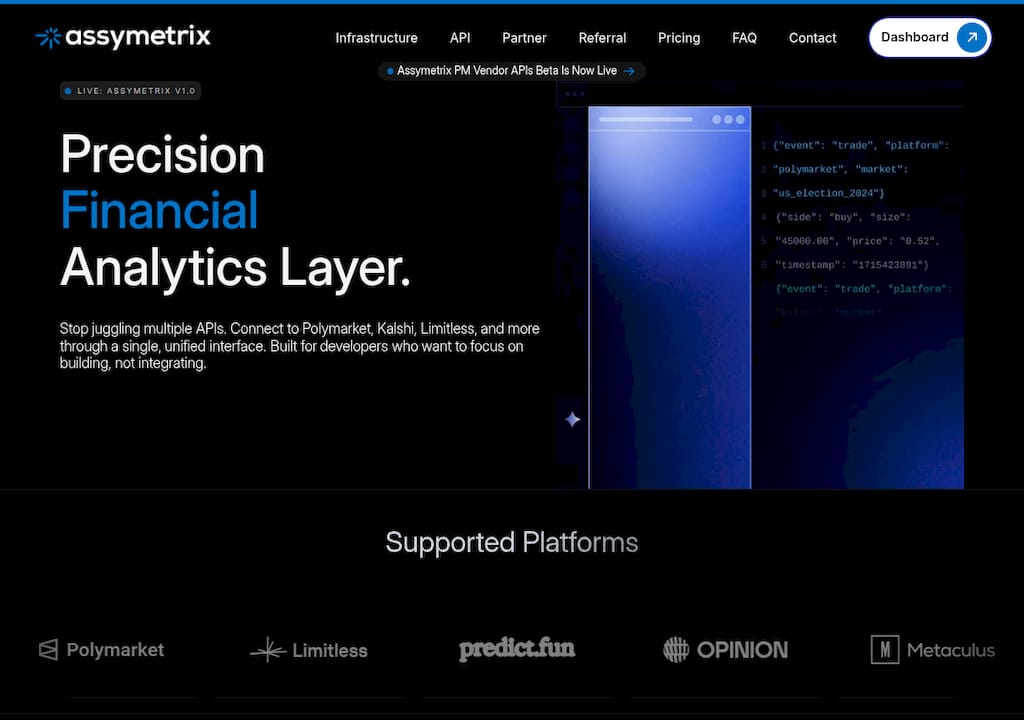
The Data API covers markets, trades, and orderbook data across all three venues, with stable cross-venue IDs already resolved, so you skip the identity-matching work described earlier in this piece. Smart Money tracking and Trader Skill Scores come built into the same feed, useful whether you’re building a trading bot, a research pipeline, or an AI agent that needs to reason over cross-venue divergence. If your current setup involves separate venue integrations breaking every time a provider changes an auth format, start by checking the API documentation and running a test query against the unified schema.
Sources
This article is general information, not a substitute for advice from a qualified financial advisor. Consult a qualified financial professional about your own circumstances before acting on anything here.
FAQ
What Are the Top Prediction Markets for Data Access?
Polymarket, Kalshi, and Limitless are the primary venues with usable data access, each offering native APIs with distinct schemas and, in Kalshi’s case, public S3 bucket exports for historical Parquet files.
What Is the Most Accurate Prediction Market?
Accuracy depends on liquidity and question specificity rather than any single venue being uniformly better, and treating market prices as calibrated probabilities, as Fidelity’s explainer frames it, works best on high-volume, well-resolved contracts.
How Fresh Is S3 Prediction Market Data Compared to Live APIs?
S3 bulk exports typically update daily or hourly, while WebSocket feeds deliver sub-second updates, which is why production systems generally use S3 for backfill and streaming APIs for live signals.
Can You Actually Make Money Trading on Prediction Markets?
Profitability depends on execution speed, data quality, and edge detection like cross-venue arbitrage, and traders relying on stale or unnormalized data face real settlement and mis-pricing risk regardless of strategy.
Why Use a Unified API Instead of Connecting to Each Venue Directly?
Venue-native integrations mean maintaining three separate schemas, auth systems, and rate limits that drift independently over time, while a unified option like the Assymetrix Data API normalizes all three under one schema and one authentication flow.
S3 Prediction Market Data: Sources, Schemas, and Pipelines
Public S3 and Parquet exports for prediction market data exist today, mostly as venue public buckets (Kalshi) and community dataset mirrors on platforms like HuggingFace. These exports are the right tool for full-history backfills and batch research, but they update in daily or hourly cycles, not milliseconds. Live signal generation and order execution require WebSocket or REST access instead.
The pragmatic pattern most engineering teams land on:
Use S3/Parquet dumps for historical backfill, backtesting, and cold storage.
Use venue WebSocket feeds or REST APIs for live orderbook state and trade prints.
For production systems spanning multiple venues, use a unified API that normalizes both S3 history and streaming data under one schema, cutting the integration work from three vendor connections to one.
Key Takeaways
Production on prediction market systems need S3 bulk exports for full-history backfill and a normalized streaming feed for live signals, and the two must reconcile against each other continuously.
Point | Details |
|---|---|
S3 exports suit backfill, not live trading | Daily or hourly Parquet dumps are cost-effective for history but too stale for live signal generation. |
Cross-venue ID mapping is the hard problem | Venue-native market IDs don’t align across Polymarket, Kalshi, and Limitless, so canonical mapping needs real engineering time. |
Resolution metadata affects P&L directly | Stale or unnormalized settlement fields, per CFTC guidance on event contracts, can cause mis-settlement in automated systems. |
Hybrid architecture is the pragmatic default | Backfill from S3, stream for deltas, and reconcile the two on a fixed schedule rather than trusting either blindly. |
Assymetrix unifies both layers under one schema | The Data API combines very large historical data volumes with live streaming and resolved cross-venue IDs in a single integration. |
Table of Contents
Where Does S3 Prediction Market Data Come From?
What Do S3 Parquet Files for Prediction Markets Look Like?
Should You Use S3 Bulk Exports or Live APIs?
How Do You Build a Production Pipeline From S3 Parquet Data?
What Should a Production API Integration Checklist Include?
How Assymetrix Unifies S3 History With Real-Time Feeds
Editorial Take: Batch and Streaming Are Not Rivals
Get Unified Cross-Venue Data Without the Multi-API Maintenance
Sources
Where Does S3 Prediction Market Data Come From?
Three distinct source types feed the current ecosystem, and each carries different tradeoffs for a production pipeline. Venue public buckets are the most direct: Kalshi publishes Parquet exports that community projects mirror and republish, as documented in the Kalshi Parquet dataset on HuggingFace, which lays out schema fields and date ranges pulled straight from the bucket. Community-maintained directories like Awesome-Prediction-Market-Tools catalog these buckets alongside scripts and aggregator references, functioning as a map of where the raw files actually live.
Commercial marketplaces are the third channel. Snowflake Marketplace lists a Prediction Market Data provider that aggregates multiple venue trade histories in Parquet format, queryable directly without a download step. This matters for teams already running a Snowflake warehouse, since it skips the ingestion layer entirely.
Regulatory context changes how you treat this data. The CFTC frames event contracts and prediction markets around transparent resolution criteria and settlement mechanics. That is not a compliance footnote for a data pipeline. It is an engineering requirement: automated systems that ingest stale or non-normalized resolution metadata risk mis-settling positions and generating P&L errors that have nothing to do with the trade itself.
Volume matters too. A single venue’s daily Parquet export can run into millions of rows once you include full orderbook depth across active markets, and multi-venue history compounds that fast, which is why storage and query engine choice belongs in the design conversation from day one, not as an afterthought once ingestion is already running.
What Do S3 Parquet Files for Prediction Markets Look Like?
Raw exports vary by venue, but a workable canonical schema converges on a consistent set of fields regardless of source.
Field | Purpose |
|---|---|
| Venue-native identifier, not stable across venues |
| Human-readable market question |
| Binary, categorical, or scalar contract structure |
| Open, closed, resolved, disputed |
| Scheduled resolution timestamp |
| Event timestamp for the specific row (trade, quote, snapshot) |
| Implied probability, typically 0 to 1 or cents |
| Cumulative or interval trade volume |
| Top-of-book quotes where orderbook data is included |
| Outstanding contract exposure |
Files typically land partitioned by date, sometimes further split by hour for high-activity markets. That partitioning scheme drives your read pattern: a query scanning a single day of trades across one market should hit one or two files, not a full-table scan. File sizes range from a few megabytes for a slow market’s daily slice to hundreds of megabytes for active election or macro contracts during high-volume windows.
The hardest engineering problem is not the schema. It is identity. Every venue mints its own market_id, and those IDs share no relationship across Polymarket, Kalshi, or Limitless even when the underlying question is functionally identical. Building a canonical cross-venue ID means matching on title similarity, resolution source, and end time, then maintaining that mapping as new markets launch daily.
A few things worth handling before anything else touches your models:
Normalize all timestamps to UTC before joining across files, since venue exports mix time zone conventions.
Deduplicate on
(market_id, ts, trade_id)rather than assuming exports are dedupe-safe out of the box.Treat
belief/priceas a probability estimate, not a settled fact, per the framing in Fidelity’s explainer on event-contract mechanics.
Should You Use S3 Bulk Exports or Live APIs?
The choice is not binary. It is a question of which failure mode you can tolerate, and the answer usually points to using both.
Bulk S3 exports are cheap to store and simple to reprocess. A full year of history across venues costs a fraction of what equivalent REST API calls would cost in rate-limit overhead and compute time. The tradeoff is freshness: daily dumps mean your data is, at best, hours old, which is a nonstarter for any strategy reacting to live order flow.
WebSocket and REST APIs deliver sub-second updates but come with real operational weight: connection management, authentication token rotation, reconnect logic, and handling three different rate-limit regimes if you connect to three venues natively.
Hybrid architecture backfills full history from S3, then switches to streaming for the delta once your pipeline catches up to present time. This is the pattern that shows up repeatedly in community ingestion pipelines, including the approach documented in the Kalshi Parquet dataset project.
The reconciliation step is where most homegrown pipelines break. Your streaming layer and your batch layer will disagree on some subset of records, usually near partition boundaries, and you need a deterministic tiebreak rule (last-write-wins by exchange timestamp is the common default) before you trust either source blindly.
Pro Tip: Run your S3 backfill and your live stream in parallel for at least 48 hours before cutting over. The overlap window is where you catch silent schema drift, not after you’re already trading on it.
How Do You Build a Production Pipeline From S3 Parquet Data?
A repeatable ingestion pipeline follows a consistent sequence, whether you’re pulling from a venue’s public bucket or a marketplace listing.
Discover and verify. Locate the bucket manifest or dataset index, confirm file checksums where available, and log the date range each file actually covers rather than trusting the filename.
Choose read-in-place or download. Query engines like Athena or Presto let you run SQL directly against S3 Parquet without moving data, which is fast for exploratory analysis. For iterative model development, pulling files locally and reading them with DuckDB or Spark gives you tighter control over caching and joins.
Normalize the schema. Map every venue’s native field names to your canonical schema, convert all timestamps to UTC, and resolve
market_idvalues into your cross-venue ID system.Deduplicate and compute derived series. Collapse duplicate trade records, then roll raw ticks into OHLCV bars or belief-price snapshots at whatever interval your models consume.
Materialize a queryable store. Write the normalized output back out as partitioned Parquet, or into a table format like Iceberg or Delta Lake, so backfills are replayable and you’re not reprocessing raw files on every query.
Community frameworks like the prediction market analysis repo from Jon Becker demonstrate this pattern concretely: indexers pull raw data, a normalization layer maps it to consistent fields, and the output lands in Parquet ready for backtesting. The core lesson from any of these projects is the same: raw exports are a starting material, not an analytics-ready dataset. Budget real engineering time for the normalization layer, because that is where most of the actual work lives, not in the download step.
What Should a Production API Integration Checklist Include?
Live systems fail in different ways than batch pipelines. A checklist worth running before you trust an integration with real capital:
Unified schema across venues, so a strategy written against one market type doesn’t need a rewrite when you add a second venue.
Documented endpoints and field definitions, not just a Swagger stub with unexplained enum values.
WebSocket connections with heartbeats, so silent disconnects get caught in seconds, not discovered when your position sizing goes stale.
Bulk export endpoints or direct S3 URIs alongside the live feed, so backfill and streaming pull from the same underlying source of truth.
Clearly published rate limits, ideally with response headers indicating remaining quota, not a support ticket you file after getting throttled.
Operationally, token rotation needs to happen without downtime, reconnect logic needs exponential backoff rather than a hard retry loop, and every stream should write to a replay log so a crashed process can rebuild state without re-querying the venue. Reconciliation between your streaming and batch data should run on a schedule, not just when something looks wrong. The demand for this kind of consolidated access is visible even outside pure trading systems. The AIsa agent skill for prediction market data exists specifically because AI agents need one consistent set of endpoints instead of three separate integrations to reason over.
Pro Tip: Set up alerting specifically on resolution and settlement field changes, not just on price movement. A market flipping from “open” to “disputed” without your system noticing is a far more expensive failure than a missed price tick.
How Assymetrix Unifies S3 History With Real-Time Feeds
Assymetrix’s Data API exists to remove the exact maintenance burden the checklist above describes. Instead of separate schemas, auth systems, and rate-limit regimes for Polymarket, Kalshi, and Limitless, developers work against one schema and one authentication layer covering all three venues.
The historical depth behind that single integration runs to a very large dataset encompassing multiple terabytes of data and hundreds of millions of rows of trading activity, enough to backfill a multi-venue backtest without stitching together three separate bulk exports yourself. On top of the raw feed, the platform layers Smart Money wallet tracking, Trader Skill Scores, and cross-venue arbitrage signals, features that require the canonical ID mapping problem described earlier to already be solved.
The engineering cost of connecting to three venue-native APIs isn’t the initial integration. It’s the ongoing maintenance: schema drift when a venue changes a field name, auth token formats shifting without notice, and outage handling that differs by provider. A unified schema absorbs that churn in one place instead of three.
For a production pattern, treat the Assymetrix API as your canonical source for both live and historical reads, and keep raw S3 dumps as a cold-storage duplicate for independent verification or offline research. That gives you a single point of failure to monitor instead of three, without giving up the ability to audit against raw venue exports when something looks off.
Editorial Take: Batch and Streaming Are Not Rivals
The instinct to pick one data strategy, either “just use the S3 dumps” or “just build against the live APIs,” misreads the actual problem. Batch and streaming solve different failure modes, and treating them as competing choices is where most homegrown pipelines waste engineering time.
The conventional advice in developer forums tends to undersell the identity problem. Schema mapping gets plenty of attention because it’s visible and mechanical. Cross-venue ID resolution gets far less, because it’s messy, ongoing, and never fully finished as new markets launch. That’s the piece worth prioritizing first, before optimizing query performance or picking a table format.
If there’s one judgment this research supports clearly, it’s this: the maintenance cost of three venue-native integrations compounds in ways a single upfront integration decision doesn’t fully capture until six months in, when a venue changes an auth flow and you’re debugging it at 2 a.m. Build your backfill logic against S3 sources because they’re cheap and complete. Build your live logic against a normalized feed because schema drift across three vendors is a recurring tax, not a one-time cost.
— Dean
Get Unified Cross-Venue Data Without the Multi-API Maintenance
Building separate connections to Polymarket, Kalshi, and Limitless means maintaining three schemas, three auth systems, and three sets of rate limits, on top of the S3 backfill work covered above. Assymetrix collapses that into a single integration: one schema, one auth flow, and roughly 1.5 terabytes of historical depth across nearly a billion rows, available through the same endpoints whether you’re pulling cold history or live orderbook state.
The Data API covers markets, trades, and orderbook data across all three venues, with stable cross-venue IDs already resolved, so you skip the identity-matching work described earlier in this piece. Smart Money tracking and Trader Skill Scores come built into the same feed, useful whether you’re building a trading bot, a research pipeline, or an AI agent that needs to reason over cross-venue divergence. If your current setup involves separate venue integrations breaking every time a provider changes an auth format, start by checking the API documentation and running a test query against the unified schema.
Sources
This article is general information, not a substitute for advice from a qualified financial advisor. Consult a qualified financial professional about your own circumstances before acting on anything here.
FAQ
What Are the Top Prediction Markets for Data Access?
Polymarket, Kalshi, and Limitless are the primary venues with usable data access, each offering native APIs with distinct schemas and, in Kalshi’s case, public S3 bucket exports for historical Parquet files.
What Is the Most Accurate Prediction Market?
Accuracy depends on liquidity and question specificity rather than any single venue being uniformly better, and treating market prices as calibrated probabilities, as Fidelity’s explainer frames it, works best on high-volume, well-resolved contracts.
How Fresh Is S3 Prediction Market Data Compared to Live APIs?
S3 bulk exports typically update daily or hourly, while WebSocket feeds deliver sub-second updates, which is why production systems generally use S3 for backfill and streaming APIs for live signals.
Can You Actually Make Money Trading on Prediction Markets?
Profitability depends on execution speed, data quality, and edge detection like cross-venue arbitrage, and traders relying on stale or unnormalized data face real settlement and mis-pricing risk regardless of strategy.
Why Use a Unified API Instead of Connecting to Each Venue Directly?
Venue-native integrations mean maintaining three separate schemas, auth systems, and rate limits that drift independently over time, while a unified option like the Assymetrix Data API normalizes all three under one schema and one authentication flow.
Other Blog


