Developers: 3 CFTC Moves That Shape US Prediction Market Legality
Developers: 3 CFTC Moves That Shape US Prediction Market Legality
Developers: 3 CFTC Moves That Shape US Prediction Market Legality
Developer legal brief: 3 CFTC moves in 2026 shape US prediction market legality, plus API checks like audit logs and canonical IDs.

Developers: 3 CFTC Moves That Shape US Prediction Market Legality
Federally regulated event contracts traded on CFTC-registered exchanges are lawful nationwide under the Commodity Exchange Act, and the CFTC asserts exclusive jurisdiction over them even as several states contest that position in court. The practical answer for traders and bot builders: confirm your venue is CFTC-registered, verify it accepts users from your state, and keep a complete audit log of every order.
TL;DR:
Prediction markets traded on CFTC-registered exchanges are federally lawful nationwide, but state-level restrictions can still temporarily block access for residents.
The CFTC’s public-interest exception is the primary tool for banning certain contracts, with proposed rule changes expected to clarify its application by 2026.
Traders must verify that venues are CFTC-registered, accept users from their state, and maintain detailed logs of all trades and API calls to ensure compliance.
State actions vary from being unresolved, temporarily contested, to enforceable restrictions, so always check venue terms and geofencing updates before trading.
The legal distinction between contracts with actual economic consequences and entertainment-based contracts drives enforcement focus and court rulings.
AssymetrixBuild On Unified Market DataTrack prediction market activity across Polymarket, Kalshi, and Limitless through one structured data integration.Explore Assymetrix
Table of Contents
1. How federal law and the CFTC regulate event contracts
2. State-by-state status and what it means for US residents
3. Key cases, judicial reasoning, and enforcement developments to watch
4. Operational checklist for individuals, algorithmic traders, and AI agents
5. How Assymetrix data and API features help manage legal risk
6. Historical overview of prediction market legality and regulatory evolution in the US
7. Comparison with other countries’ prediction market legal frameworks to provide context
8. How prediction markets intersect with gambling laws under US law
9. Types of prediction markets and legal distinctions among them
10. Legal implications for operators versus participants
11. Tax treatment and reporting requirements for prediction market winnings
12. Short expert read: likely near-term regulatory outcomes
Assymetrix Data API: developer resources for monitoring this landscape
Sources
1. How federal law and the CFTC regulate event contracts
The Commodity Exchange Act, amended by Dodd-Frank, gives the CFTC authority over swaps and designated contract markets (DCMs). Event contracts, the legal term for what most people call prediction markets, fall under this framework when they trade on a registered exchange. The CFTC’s own explainer states that event contracts have existed in the United States since 1988 and have been regulated since 2004, which cuts against the idea that this is a novel legal gray zone. What has changed is volume, visibility, and the sophistication of the participants, not the underlying statute.
New contracts reach the market through self-certification: an exchange certifies that a proposed contract complies with the CEA and the CFTC’s core principles, and the contract can list unless the Commission objects. The Special Rule gives the CFTC a narrower, separate power: it can still prohibit a contract after the fact if the Commission determines listing it would be contrary to the public interest, a standard tied to factors like gaming, terrorism, war, and similarly sensitive events rather than ordinary economic or political outcomes.
The CEA and Dodd-Frank amendments establish CFTC authority over swaps and DCMs, the statutory base for every argument the agency makes in court.
Self-certification lets exchanges list new event contracts without pre-approval, subject to after-the-fact CFTC review.
The Special Rule’s public-interest exception is the Commission’s main tool for blocking a specific contract category.
A March 2026 advance notice of proposed rulemaking and June 2026 proposed amendments both aim to sharpen how that public-interest test gets applied.
The CFTC describes federally regulated prediction markets as able to operate broadly under federal law, even though state-law disputes remain active. The Federal Register notice from June 12, 2026 proposes clarifying exactly which categories of event contracts the Commission would treat as contrary to the public interest and what process it would follow to make that call, a direct response to the wave of state pushback discussed below.
For algorithmic traders and AI agents, the compliance weight falls on exchange-side surveillance obligations: registered venues must monitor for manipulation and maintain market integrity, which means the data trail a trading system generates, order timestamps, fill confirmations, canonical contract identifiers, becomes the raw material regulators and exchanges both rely on when questions arise.
2. State-by-state status and what it means for US residents
No single map stays accurate for long in this area, so it helps to think in three operational categories rather than a fixed list of states.
Available: the state has not restricted federally regulated event contracts, and CFTC-registered venues generally accept residents without added friction.
Contested: a state has issued an order, filed suit, or attempted licensing or tax rules against prediction markets, but no binding restriction is currently in force, often because of a court injunction or ongoing litigation.
Restricted: a state action is currently enforceable, meaning a registered venue may geofence residents of that state out of some or all contracts while the dispute proceeds.
Status category | What it means operationally | Example driver |
|---|---|---|
Available | Residents can typically trade on CFTC-registered venues without state-level blocks | No active state order or statute in force |
Contested | State action exists but is paused, enjoined, or unresolved | Minnesota preliminary injunction blocking enforcement |
Restricted | A state order or statute is currently being enforced against the venue or contract type | State emergency orders or cease-and-desist actions |
State legislatures have tried several approaches: outright bans, gaming-style licensing requirements, and excise taxes modeled on sports betting law. The Congressional Research Service notes that maps of state-by-state availability are snapshots, subject to change from a single court ruling, a new CFTC rule, or a state legislative session. NCSL and CRS trackers list multiple pending 2026 bills addressing prediction markets directly, including New York’s ORACLE Act and separate efforts in Kentucky and Illinois.
For a reader or a bot, the operational checks are the same regardless of which state you’re in:
Confirm the venue’s terms of service explicitly list your state as supported, not just the country.
Watch for geofencing changes tied to a new state order, since these can take effect with little notice.
Check whether any state has attempted an excise tax or licensing fee on the contracts you trade, since that can signal upcoming restriction.
Treat any venue that accepts US residents without CFTC registration as outside the framework entirely, regardless of its marketing.
3. Key cases, judicial reasoning, and enforcement developments to watch
Several fronts are moving at once, and each answers a slightly different legal question.
The CFTC’s 2026 lawsuits against Arizona, Connecticut, and Illinois seek to reaffirm that federal jurisdiction over event contracts on registered DCMs is exclusive, preempting state attempts to ban or separately license the same products. The agency’s framing is consistent: it treats these contracts as derivatives that support hedging and price discovery, which is the legal basis for wanting one national regime instead of fifty different ones.
A federal court in Minnesota issued a preliminary injunction blocking the state’s attempted ban, reasoning that many event contracts likely qualify as swaps under the CEA, which would make them subject to federal preemption, while some entertainment-style contracts might not meet that test. That distinction, swap versus non-swap, is now the central fault line courts are drawing, and it will keep mattering more than any single state’s political posture.
On enforcement, the CFTC has already acted against market abuse in event-contract markets. One reported 2026 matter resulted in a financial penalty of $20,397.58 and a two-year suspension, a modest dollar figure that nonetheless signals the agency is actively policing manipulation and insider-style trading on these venues, not just writing policy papers about them.
The common thread across the litigation is that contract design, not platform branding, decides the outcome. A contract tied to an event with real financial or commercial consequence reads as a swap; a purely entertainment-based outcome is more likely to fall outside that definition and into contested territory where state law might still apply.
4. Operational checklist for individuals, algorithmic traders, and AI agents
Reducing legal exposure here is mostly a matter of discipline, not legal expertise.
Confirm the venue holds active CFTC registration as a designated contract market before routing any order to it.
Check, at order time, that the venue’s terms explicitly accept users from your state, since this can change faster than any public tracker updates.
Log every trade and every API call with timestamps and contract identifiers, building an audit trail you can reproduce on request.
Avoid offshore or unregistered venues entirely; the Congressional Research Service is explicit that accepting US users does not create a legal safe harbor for a platform operating outside CFTC registration.
Before building out a contract type in your trading logic, apply a simple test: does the event have a plausible financial, economic, or commercial consequence? If yes, treat it as a likely swap subject to the full federal framework. If the outcome is purely entertainment, assume more state-level uncertainty applies.
For bots and AI agents, add throttles on order frequency, build surveillance triggers for anomalous fill patterns, and write a clear internal procedure for what happens if a system flags a position that might rely on material nonpublic information; practical guidance on how to build a trading bot can support implementing these safeguards.
Pro Tip: Treat your trade log as a compliance artifact, not just a debugging tool. Store canonical contract IDs, venue timestamps, and state-acceptance confirmations together so a single query reconstructs your full activity history if a regulator or exchange ever asks.
5. How Assymetrix data and API features help manage legal risk
Normalized, cross-venue data is what turns a compliance question into a query instead of a research project. When an audit trail needs to span multiple exchanges, the value of a unified schema and canonical contract identifiers becomes obvious, since reconstructing an order history across separately formatted venue feeds by hand is slow and error-prone.
Canonical IDs make it possible to trace a single contract’s activity across venues without manual reconciliation, useful if an enforcement inquiry asks for a full trading history.
Cross-venue divergence detection can surface pricing gaps that sometimes indicate manipulation rather than ordinary arbitrage, a signal worth flagging before a regulator does.
Smart Money wallet tracking gives an early read on unusual position-building, functioning as an informal surveillance layer for bot operators watching their own exposure.
Historical data spanning approximately 1.5 terabytes and nearly one billion rows lets a team reconstruct past market conditions for any specific contract under review.
Developers integrating these signals into existing trading systems can start with the Data API documentation or review the arbitrage detection guide for patterns on instrumenting bots to catch risky trades before they execute.
Pro Tip: Build your surveillance triggers on the same canonical schema you use for trading logic. Two separate data models for “what my bot does” and “what compliance reviews” tend to drift apart exactly when you need them aligned.
6. Historical overview of prediction market legality and regulatory evolution in the US
Event contracts are not a recent invention. The CFTC traces their regulated history back to 2004, with contracts of this general type existing in some form since 1988. For most of that period, the market was small and the regulatory question mostly academic: a handful of exchanges listed a narrow set of contracts, and the Special Rule’s public-interest exception rarely came into play.
The shift came as prediction markets grew in volume and expanded into politics, economics, and current events, categories that generate far more public attention than the commodity and financial benchmarks that dominated earlier event-contract listings. That growth pulled state regulators into a space they had largely ignored, partly because some contracts resemble sports betting or other gaming products that states traditionally regulate themselves.
The current period, marked by CFTC litigation against multiple states and a formal rulemaking process aimed at clarifying the public-interest standard, represents the most active regulatory stretch this market has seen. Rather than a settled body of law, what exists today is a statutory framework from the 1930s-era CEA and its Dodd-Frank amendments, being applied and re-tested against a product category that did not exist in anything like its current form when most of that law was written. The direction of travel, based on the CFTC’s own litigation posture, points toward federal preemption prevailing for contracts that meet the swap definition, with narrower state authority persisting only for contracts outside it.
7. Comparison with other countries’ prediction market legal frameworks to provide context
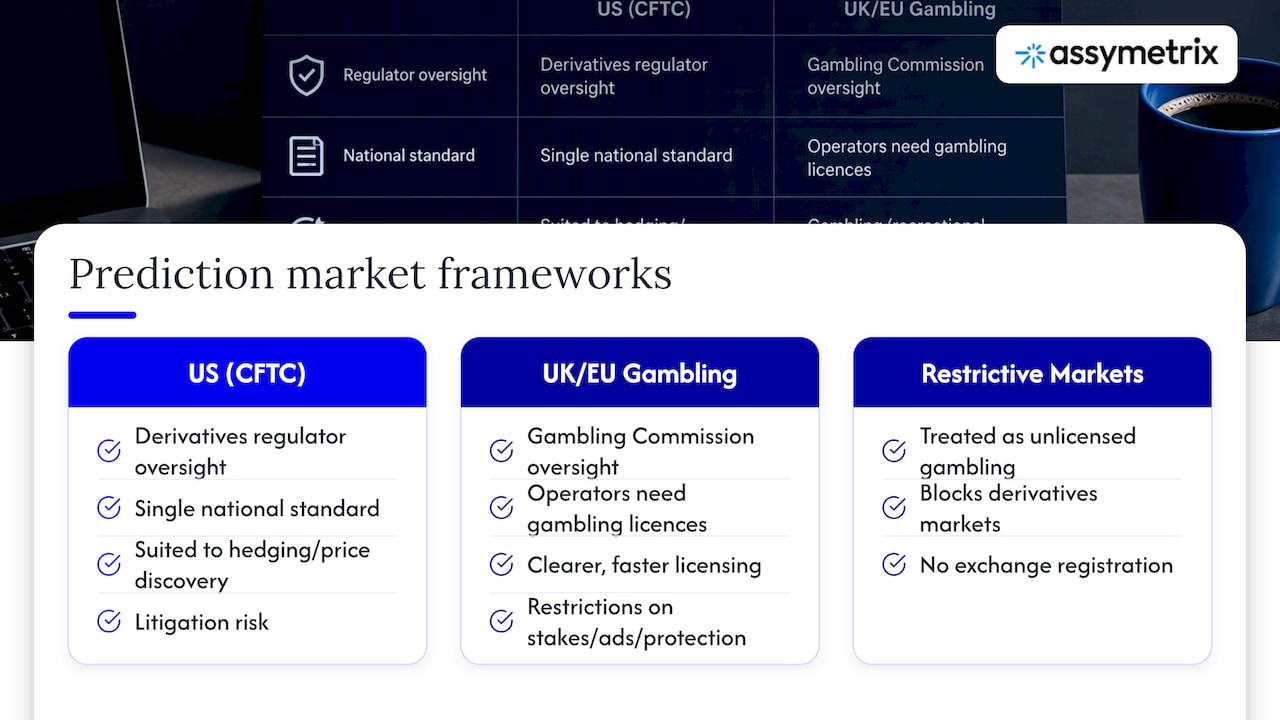
The United States is unusual in routing prediction market oversight through a derivatives regulator rather than a gambling commission or a dedicated betting law. The United Kingdom treats most comparable products under gambling regulation administered by the Gambling Commission, meaning operators need gambling licenses rather than derivatives-exchange registration. That framing shapes everything from tax treatment to advertising rules differently than the US derivatives model.
Several European jurisdictions similarly fold event-outcome betting into existing gambling law, which tends to produce clearer, faster licensing processes but also subjects operators to gambling-specific restrictions on stakes, advertising, and consumer protection that a derivatives framework does not impose. The tradeoff cuts both ways: gambling regulation is often more predictable in outcome but less suited to products meant to serve price discovery or hedging functions, which is the CFTC’s stated rationale for keeping event contracts inside derivatives law rather than ceding them to a gambling framework.
Other markets have taken a more restrictive approach, treating most event-outcome contracts as unlicensed gambling regardless of the economic framing an exchange might offer, which forecloses the kind of CFTC-registered, derivatives-style market structure that exists domestically. The US approach, whatever its current litigation turbulence, is distinctive in trying to preserve a single national standard for contracts the CFTC deems to have genuine economic or commercial stakes, rather than leaving that line-drawing to subnational governments or treating the entire category as betting by default.
8. How prediction markets intersect with gambling laws under US law
This is the legal question underneath most of the state litigation: is a given event contract a derivative or a bet? The CFTC’s position is that contracts traded on registered exchanges, meeting the swap definition under the CEA, are derivatives subject to federal commodities law, not state gambling law. That position is exactly what the Minnesota injunction addressed: the court found many such contracts likely qualify as swaps, which would place them outside state gambling authority through federal preemption.
The distinguishing test courts keep returning to is economic or commercial consequence. A contract tied to an interest-rate decision, an election outcome with policy stakes, or an economic indicator plausibly has that kind of consequence, supporting the derivatives classification. A contract built purely around entertainment, with no underlying economic or commercial stake, sits closer to a wager in the traditional gambling sense, and some courts have signaled those contracts may not enjoy the same federal preemption.
States retain their traditional authority over gambling that falls outside this federal derivatives framework, which is why several have tried licensing regimes, excise taxes, or outright bans aimed specifically at prediction markets. Whether those efforts survive depends almost entirely on how a court classifies the specific contracts at issue, not on how the state or the platform chooses to describe the product.
9. Types of prediction markets and legal distinctions among them
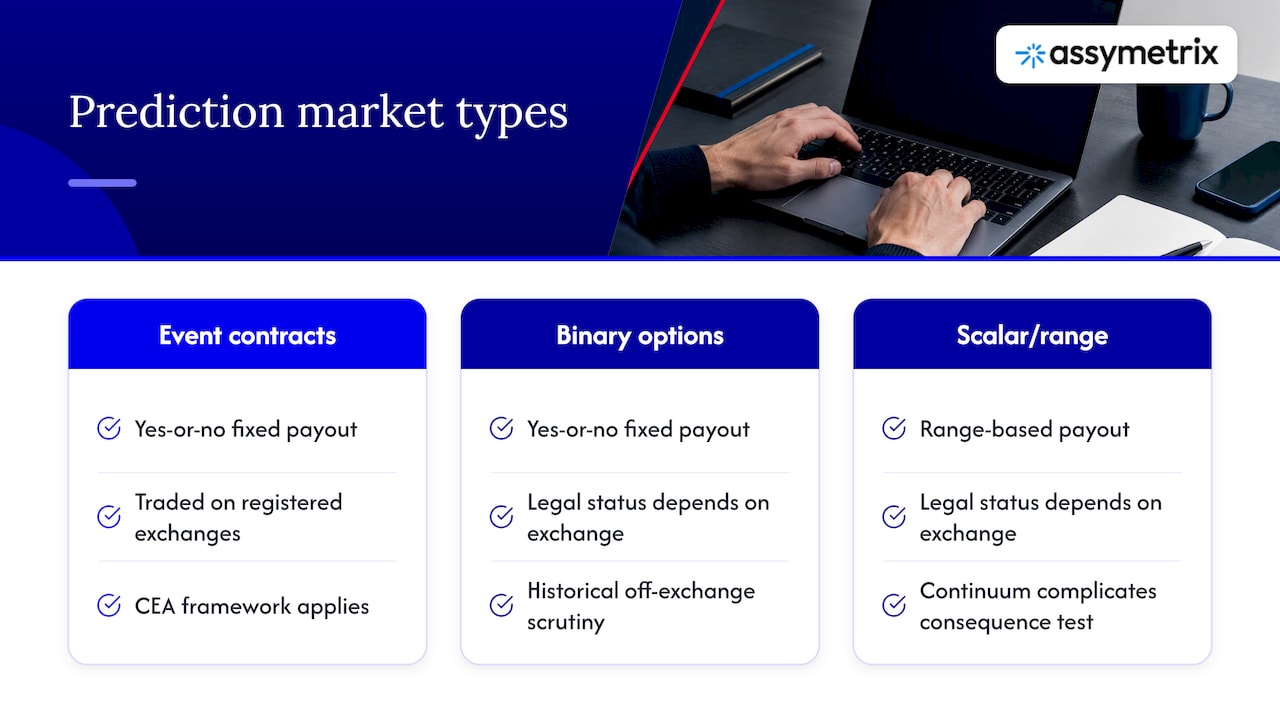
Not all prediction markets are built the same way, and the differences matter legally as well as technically. Event contracts are the term the CFTC uses for yes-or-no outcome products traded on registered exchanges: a buyer pays a price reflecting the market’s implied probability of an outcome, and the contract settles at a fixed value if the event occurs. These are the products most directly addressed by the CEA framework discussed above.
Binary options are structurally similar, a fixed payout tied to a yes-or-no condition, but the term carries a distinct regulatory history. Off-exchange binary options have drawn separate CFTC and SEC scrutiny over the years, largely tied to unregistered platforms offering products that looked like event contracts but operated outside any exchange oversight. That history is one reason the self-certification and DCM registration requirements matter so much: the legal status of a binary-style product depends heavily on whether it trades on a registered exchange at all.
Scalar or range-based contracts, where payout depends on where an outcome falls within a range rather than a strict yes-or-no result, add another layer of complexity to the swap-versus-bet analysis, since the economic-consequence test has to be applied to a continuum of outcomes rather than a binary one. For a trading system choosing which contract types to support, the practical distinction is less about terminology and more about two questions: is the venue a registered DCM, and does the specific contract have a plausible economic or commercial consequence? Those two answers do more to determine legal footing than any label attached to the product.
10. Legal implications for operators versus participants
The regulatory weight falls overwhelmingly on operators, not on individual traders. A CFTC-registered exchange carries direct obligations: self-certifying new contracts, monitoring for manipulation and insider trading, maintaining market-integrity safeguards, and responding to Special Rule public-interest challenges. The enforcement actions and lawsuits described earlier target exchanges and, in the state litigation, the states themselves, not individual account holders placing routine trades.
For participants, the exposure looks different. Trading on a properly registered venue that accepts your state carries minimal direct legal risk from the federal framework itself: you are participating in a product the CFTC treats as lawful. The risk shifts when a participant trades on an unregistered offshore platform, where the CRS is explicit that accepting US users creates no safe harbor for the platform, and a participant there has far less clarity about which legal protections, if any, apply to their funds or trades.
Participant-level risk also rises sharply around specific behaviors rather than the product category itself: trading on material nonpublic information, coordinating manipulative price action across venues, or running wash-trading patterns through automated systems. These are the behaviors the CFTC’s enforcement actions have targeted, and they apply to individual and algorithmic traders alike. Operators bear the registration and surveillance burden; participants bear the burden of trading cleanly within whatever venue they choose and documenting that they did.
11. Tax treatment and reporting requirements for prediction market winnings
Winnings from event contracts are taxable income, consistent with the general principle that gains from derivatives and wagering-adjacent products are reportable regardless of the specific legal classification of the underlying contract. The practical reporting mechanics depend on how your venue classifies the activity and what tax forms it issues, since a registered exchange treating contracts as derivatives may report activity differently than a platform treating them as gaming winnings.
Keeping your own records matters regardless of what a venue reports, particularly for active or algorithmic traders generating high transaction volume. A complete log of trade dates, contract identifiers, entry and exit prices, and realized gains or losses gives you the documentation needed to reconcile against whatever tax forms a venue issues, and it protects you if a venue’s own reporting is incomplete or delayed. For anyone running a bot across multiple venues, consolidating that record into a single normalized ledger, rather than relying on each platform’s separate export format, makes year-end reconciliation considerably more manageable. None of this guidance substitutes for advice from a tax professional familiar with derivatives and gaming income, especially given how unsettled the broader legal classification of some contracts remains.
12. Short expert read: likely near-term regulatory outcomes
The most probable path forward has the federal government winning most of its preemption arguments for contracts that meet the swap definition, while narrow state authority survives for purely entertainment-style contracts that fall outside that test. A congressional fix remains possible but is not guaranteed on any near-term timeline.
Three feeds are worth watching directly: Federal Register notices tracking the CFTC’s rulemaking progress, the CFTC press room for enforcement and litigation updates, and state attorney general orders or legal dockets that could shift the state-by-state map with little warning.
— Dean
Assymetrix Data API: developer resources for monitoring this landscape
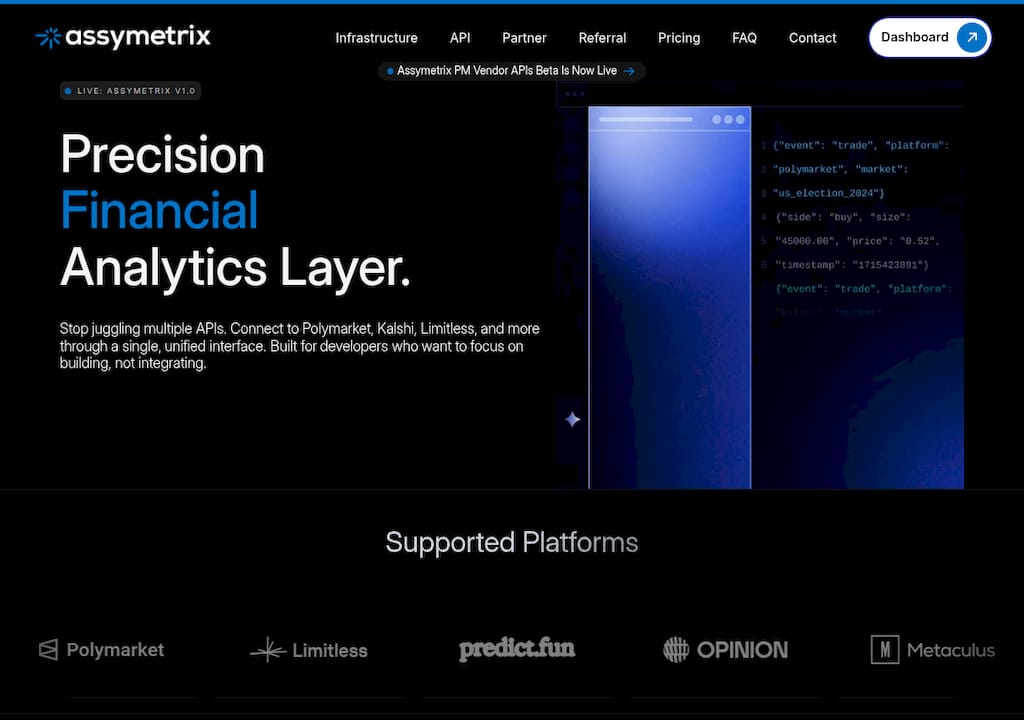
Tracking venue status, contract activity, and cross-venue pricing by hand does not scale once you’re running automated strategies across multiple exchanges. The Assymetrix Data API gives developers a single, normalized feed across major venues, built for exactly this kind of audit and monitoring work.
Review the API documentation for integration details and canonical schema structure.
Check the arbitrage strategy guide for examples of cross-venue divergence monitoring.
Request a demo to see normalized historical and real-time data in your own environment.
FAQ
Is there a ban on prediction markets in the United States?
No nationwide ban exists. The CFTC’s own guidance treats federally regulated event contracts as lawful on registered exchanges across all 50 states, though individual states have attempted their own restrictions, some of which remain contested in court.
What states don’t allow prediction markets?
No state currently has a binding, enforced ban in effect nationwide, since efforts like Minnesota’s were blocked by a federal preliminary injunction. State restrictions are shifting and venue-specific, so checking a platform’s own terms at the time you trade is more reliable than any static list.
Which states have sued prediction markets?
The dynamic has largely run the other direction: the CFTC sued Arizona, Connecticut, and Illinois in 2026 to reaffirm exclusive federal jurisdiction after those states took action against event-contract platforms. Kentucky has also been involved in related litigation over state-level restrictions.
Are prediction markets going to be regulated?
They already are, under the CFTC’s existing Commodity Exchange Act authority, and that framework is actively being refined. The Federal Register’s June 2026 proposed amendments aim to clarify exactly which event contracts the Commission can restrict under its public-interest standard.
Sources
Developers: 3 CFTC Moves That Shape US Prediction Market Legality
Federally regulated event contracts traded on CFTC-registered exchanges are lawful nationwide under the Commodity Exchange Act, and the CFTC asserts exclusive jurisdiction over them even as several states contest that position in court. The practical answer for traders and bot builders: confirm your venue is CFTC-registered, verify it accepts users from your state, and keep a complete audit log of every order.
TL;DR:
Prediction markets traded on CFTC-registered exchanges are federally lawful nationwide, but state-level restrictions can still temporarily block access for residents.
The CFTC’s public-interest exception is the primary tool for banning certain contracts, with proposed rule changes expected to clarify its application by 2026.
Traders must verify that venues are CFTC-registered, accept users from their state, and maintain detailed logs of all trades and API calls to ensure compliance.
State actions vary from being unresolved, temporarily contested, to enforceable restrictions, so always check venue terms and geofencing updates before trading.
The legal distinction between contracts with actual economic consequences and entertainment-based contracts drives enforcement focus and court rulings.
AssymetrixBuild On Unified Market DataTrack prediction market activity across Polymarket, Kalshi, and Limitless through one structured data integration.Explore Assymetrix
Table of Contents
1. How federal law and the CFTC regulate event contracts
2. State-by-state status and what it means for US residents
3. Key cases, judicial reasoning, and enforcement developments to watch
4. Operational checklist for individuals, algorithmic traders, and AI agents
5. How Assymetrix data and API features help manage legal risk
6. Historical overview of prediction market legality and regulatory evolution in the US
7. Comparison with other countries’ prediction market legal frameworks to provide context
8. How prediction markets intersect with gambling laws under US law
9. Types of prediction markets and legal distinctions among them
10. Legal implications for operators versus participants
11. Tax treatment and reporting requirements for prediction market winnings
12. Short expert read: likely near-term regulatory outcomes
Assymetrix Data API: developer resources for monitoring this landscape
Sources
1. How federal law and the CFTC regulate event contracts
The Commodity Exchange Act, amended by Dodd-Frank, gives the CFTC authority over swaps and designated contract markets (DCMs). Event contracts, the legal term for what most people call prediction markets, fall under this framework when they trade on a registered exchange. The CFTC’s own explainer states that event contracts have existed in the United States since 1988 and have been regulated since 2004, which cuts against the idea that this is a novel legal gray zone. What has changed is volume, visibility, and the sophistication of the participants, not the underlying statute.
New contracts reach the market through self-certification: an exchange certifies that a proposed contract complies with the CEA and the CFTC’s core principles, and the contract can list unless the Commission objects. The Special Rule gives the CFTC a narrower, separate power: it can still prohibit a contract after the fact if the Commission determines listing it would be contrary to the public interest, a standard tied to factors like gaming, terrorism, war, and similarly sensitive events rather than ordinary economic or political outcomes.
The CEA and Dodd-Frank amendments establish CFTC authority over swaps and DCMs, the statutory base for every argument the agency makes in court.
Self-certification lets exchanges list new event contracts without pre-approval, subject to after-the-fact CFTC review.
The Special Rule’s public-interest exception is the Commission’s main tool for blocking a specific contract category.
A March 2026 advance notice of proposed rulemaking and June 2026 proposed amendments both aim to sharpen how that public-interest test gets applied.
The CFTC describes federally regulated prediction markets as able to operate broadly under federal law, even though state-law disputes remain active. The Federal Register notice from June 12, 2026 proposes clarifying exactly which categories of event contracts the Commission would treat as contrary to the public interest and what process it would follow to make that call, a direct response to the wave of state pushback discussed below.
For algorithmic traders and AI agents, the compliance weight falls on exchange-side surveillance obligations: registered venues must monitor for manipulation and maintain market integrity, which means the data trail a trading system generates, order timestamps, fill confirmations, canonical contract identifiers, becomes the raw material regulators and exchanges both rely on when questions arise.
2. State-by-state status and what it means for US residents
No single map stays accurate for long in this area, so it helps to think in three operational categories rather than a fixed list of states.
Available: the state has not restricted federally regulated event contracts, and CFTC-registered venues generally accept residents without added friction.
Contested: a state has issued an order, filed suit, or attempted licensing or tax rules against prediction markets, but no binding restriction is currently in force, often because of a court injunction or ongoing litigation.
Restricted: a state action is currently enforceable, meaning a registered venue may geofence residents of that state out of some or all contracts while the dispute proceeds.
Status category | What it means operationally | Example driver |
|---|---|---|
Available | Residents can typically trade on CFTC-registered venues without state-level blocks | No active state order or statute in force |
Contested | State action exists but is paused, enjoined, or unresolved | Minnesota preliminary injunction blocking enforcement |
Restricted | A state order or statute is currently being enforced against the venue or contract type | State emergency orders or cease-and-desist actions |
State legislatures have tried several approaches: outright bans, gaming-style licensing requirements, and excise taxes modeled on sports betting law. The Congressional Research Service notes that maps of state-by-state availability are snapshots, subject to change from a single court ruling, a new CFTC rule, or a state legislative session. NCSL and CRS trackers list multiple pending 2026 bills addressing prediction markets directly, including New York’s ORACLE Act and separate efforts in Kentucky and Illinois.
For a reader or a bot, the operational checks are the same regardless of which state you’re in:
Confirm the venue’s terms of service explicitly list your state as supported, not just the country.
Watch for geofencing changes tied to a new state order, since these can take effect with little notice.
Check whether any state has attempted an excise tax or licensing fee on the contracts you trade, since that can signal upcoming restriction.
Treat any venue that accepts US residents without CFTC registration as outside the framework entirely, regardless of its marketing.
3. Key cases, judicial reasoning, and enforcement developments to watch
Several fronts are moving at once, and each answers a slightly different legal question.
The CFTC’s 2026 lawsuits against Arizona, Connecticut, and Illinois seek to reaffirm that federal jurisdiction over event contracts on registered DCMs is exclusive, preempting state attempts to ban or separately license the same products. The agency’s framing is consistent: it treats these contracts as derivatives that support hedging and price discovery, which is the legal basis for wanting one national regime instead of fifty different ones.
A federal court in Minnesota issued a preliminary injunction blocking the state’s attempted ban, reasoning that many event contracts likely qualify as swaps under the CEA, which would make them subject to federal preemption, while some entertainment-style contracts might not meet that test. That distinction, swap versus non-swap, is now the central fault line courts are drawing, and it will keep mattering more than any single state’s political posture.
On enforcement, the CFTC has already acted against market abuse in event-contract markets. One reported 2026 matter resulted in a financial penalty of $20,397.58 and a two-year suspension, a modest dollar figure that nonetheless signals the agency is actively policing manipulation and insider-style trading on these venues, not just writing policy papers about them.
The common thread across the litigation is that contract design, not platform branding, decides the outcome. A contract tied to an event with real financial or commercial consequence reads as a swap; a purely entertainment-based outcome is more likely to fall outside that definition and into contested territory where state law might still apply.
4. Operational checklist for individuals, algorithmic traders, and AI agents
Reducing legal exposure here is mostly a matter of discipline, not legal expertise.
Confirm the venue holds active CFTC registration as a designated contract market before routing any order to it.
Check, at order time, that the venue’s terms explicitly accept users from your state, since this can change faster than any public tracker updates.
Log every trade and every API call with timestamps and contract identifiers, building an audit trail you can reproduce on request.
Avoid offshore or unregistered venues entirely; the Congressional Research Service is explicit that accepting US users does not create a legal safe harbor for a platform operating outside CFTC registration.
Before building out a contract type in your trading logic, apply a simple test: does the event have a plausible financial, economic, or commercial consequence? If yes, treat it as a likely swap subject to the full federal framework. If the outcome is purely entertainment, assume more state-level uncertainty applies.
For bots and AI agents, add throttles on order frequency, build surveillance triggers for anomalous fill patterns, and write a clear internal procedure for what happens if a system flags a position that might rely on material nonpublic information; practical guidance on how to build a trading bot can support implementing these safeguards.
Pro Tip: Treat your trade log as a compliance artifact, not just a debugging tool. Store canonical contract IDs, venue timestamps, and state-acceptance confirmations together so a single query reconstructs your full activity history if a regulator or exchange ever asks.
5. How Assymetrix data and API features help manage legal risk
Normalized, cross-venue data is what turns a compliance question into a query instead of a research project. When an audit trail needs to span multiple exchanges, the value of a unified schema and canonical contract identifiers becomes obvious, since reconstructing an order history across separately formatted venue feeds by hand is slow and error-prone.
Canonical IDs make it possible to trace a single contract’s activity across venues without manual reconciliation, useful if an enforcement inquiry asks for a full trading history.
Cross-venue divergence detection can surface pricing gaps that sometimes indicate manipulation rather than ordinary arbitrage, a signal worth flagging before a regulator does.
Smart Money wallet tracking gives an early read on unusual position-building, functioning as an informal surveillance layer for bot operators watching their own exposure.
Historical data spanning approximately 1.5 terabytes and nearly one billion rows lets a team reconstruct past market conditions for any specific contract under review.
Developers integrating these signals into existing trading systems can start with the Data API documentation or review the arbitrage detection guide for patterns on instrumenting bots to catch risky trades before they execute.
Pro Tip: Build your surveillance triggers on the same canonical schema you use for trading logic. Two separate data models for “what my bot does” and “what compliance reviews” tend to drift apart exactly when you need them aligned.
6. Historical overview of prediction market legality and regulatory evolution in the US
Event contracts are not a recent invention. The CFTC traces their regulated history back to 2004, with contracts of this general type existing in some form since 1988. For most of that period, the market was small and the regulatory question mostly academic: a handful of exchanges listed a narrow set of contracts, and the Special Rule’s public-interest exception rarely came into play.
The shift came as prediction markets grew in volume and expanded into politics, economics, and current events, categories that generate far more public attention than the commodity and financial benchmarks that dominated earlier event-contract listings. That growth pulled state regulators into a space they had largely ignored, partly because some contracts resemble sports betting or other gaming products that states traditionally regulate themselves.
The current period, marked by CFTC litigation against multiple states and a formal rulemaking process aimed at clarifying the public-interest standard, represents the most active regulatory stretch this market has seen. Rather than a settled body of law, what exists today is a statutory framework from the 1930s-era CEA and its Dodd-Frank amendments, being applied and re-tested against a product category that did not exist in anything like its current form when most of that law was written. The direction of travel, based on the CFTC’s own litigation posture, points toward federal preemption prevailing for contracts that meet the swap definition, with narrower state authority persisting only for contracts outside it.
7. Comparison with other countries’ prediction market legal frameworks to provide context
The United States is unusual in routing prediction market oversight through a derivatives regulator rather than a gambling commission or a dedicated betting law. The United Kingdom treats most comparable products under gambling regulation administered by the Gambling Commission, meaning operators need gambling licenses rather than derivatives-exchange registration. That framing shapes everything from tax treatment to advertising rules differently than the US derivatives model.
Several European jurisdictions similarly fold event-outcome betting into existing gambling law, which tends to produce clearer, faster licensing processes but also subjects operators to gambling-specific restrictions on stakes, advertising, and consumer protection that a derivatives framework does not impose. The tradeoff cuts both ways: gambling regulation is often more predictable in outcome but less suited to products meant to serve price discovery or hedging functions, which is the CFTC’s stated rationale for keeping event contracts inside derivatives law rather than ceding them to a gambling framework.
Other markets have taken a more restrictive approach, treating most event-outcome contracts as unlicensed gambling regardless of the economic framing an exchange might offer, which forecloses the kind of CFTC-registered, derivatives-style market structure that exists domestically. The US approach, whatever its current litigation turbulence, is distinctive in trying to preserve a single national standard for contracts the CFTC deems to have genuine economic or commercial stakes, rather than leaving that line-drawing to subnational governments or treating the entire category as betting by default.
8. How prediction markets intersect with gambling laws under US law
This is the legal question underneath most of the state litigation: is a given event contract a derivative or a bet? The CFTC’s position is that contracts traded on registered exchanges, meeting the swap definition under the CEA, are derivatives subject to federal commodities law, not state gambling law. That position is exactly what the Minnesota injunction addressed: the court found many such contracts likely qualify as swaps, which would place them outside state gambling authority through federal preemption.
The distinguishing test courts keep returning to is economic or commercial consequence. A contract tied to an interest-rate decision, an election outcome with policy stakes, or an economic indicator plausibly has that kind of consequence, supporting the derivatives classification. A contract built purely around entertainment, with no underlying economic or commercial stake, sits closer to a wager in the traditional gambling sense, and some courts have signaled those contracts may not enjoy the same federal preemption.
States retain their traditional authority over gambling that falls outside this federal derivatives framework, which is why several have tried licensing regimes, excise taxes, or outright bans aimed specifically at prediction markets. Whether those efforts survive depends almost entirely on how a court classifies the specific contracts at issue, not on how the state or the platform chooses to describe the product.
9. Types of prediction markets and legal distinctions among them
Not all prediction markets are built the same way, and the differences matter legally as well as technically. Event contracts are the term the CFTC uses for yes-or-no outcome products traded on registered exchanges: a buyer pays a price reflecting the market’s implied probability of an outcome, and the contract settles at a fixed value if the event occurs. These are the products most directly addressed by the CEA framework discussed above.
Binary options are structurally similar, a fixed payout tied to a yes-or-no condition, but the term carries a distinct regulatory history. Off-exchange binary options have drawn separate CFTC and SEC scrutiny over the years, largely tied to unregistered platforms offering products that looked like event contracts but operated outside any exchange oversight. That history is one reason the self-certification and DCM registration requirements matter so much: the legal status of a binary-style product depends heavily on whether it trades on a registered exchange at all.
Scalar or range-based contracts, where payout depends on where an outcome falls within a range rather than a strict yes-or-no result, add another layer of complexity to the swap-versus-bet analysis, since the economic-consequence test has to be applied to a continuum of outcomes rather than a binary one. For a trading system choosing which contract types to support, the practical distinction is less about terminology and more about two questions: is the venue a registered DCM, and does the specific contract have a plausible economic or commercial consequence? Those two answers do more to determine legal footing than any label attached to the product.
10. Legal implications for operators versus participants
The regulatory weight falls overwhelmingly on operators, not on individual traders. A CFTC-registered exchange carries direct obligations: self-certifying new contracts, monitoring for manipulation and insider trading, maintaining market-integrity safeguards, and responding to Special Rule public-interest challenges. The enforcement actions and lawsuits described earlier target exchanges and, in the state litigation, the states themselves, not individual account holders placing routine trades.
For participants, the exposure looks different. Trading on a properly registered venue that accepts your state carries minimal direct legal risk from the federal framework itself: you are participating in a product the CFTC treats as lawful. The risk shifts when a participant trades on an unregistered offshore platform, where the CRS is explicit that accepting US users creates no safe harbor for the platform, and a participant there has far less clarity about which legal protections, if any, apply to their funds or trades.
Participant-level risk also rises sharply around specific behaviors rather than the product category itself: trading on material nonpublic information, coordinating manipulative price action across venues, or running wash-trading patterns through automated systems. These are the behaviors the CFTC’s enforcement actions have targeted, and they apply to individual and algorithmic traders alike. Operators bear the registration and surveillance burden; participants bear the burden of trading cleanly within whatever venue they choose and documenting that they did.
11. Tax treatment and reporting requirements for prediction market winnings
Winnings from event contracts are taxable income, consistent with the general principle that gains from derivatives and wagering-adjacent products are reportable regardless of the specific legal classification of the underlying contract. The practical reporting mechanics depend on how your venue classifies the activity and what tax forms it issues, since a registered exchange treating contracts as derivatives may report activity differently than a platform treating them as gaming winnings.
Keeping your own records matters regardless of what a venue reports, particularly for active or algorithmic traders generating high transaction volume. A complete log of trade dates, contract identifiers, entry and exit prices, and realized gains or losses gives you the documentation needed to reconcile against whatever tax forms a venue issues, and it protects you if a venue’s own reporting is incomplete or delayed. For anyone running a bot across multiple venues, consolidating that record into a single normalized ledger, rather than relying on each platform’s separate export format, makes year-end reconciliation considerably more manageable. None of this guidance substitutes for advice from a tax professional familiar with derivatives and gaming income, especially given how unsettled the broader legal classification of some contracts remains.
12. Short expert read: likely near-term regulatory outcomes
The most probable path forward has the federal government winning most of its preemption arguments for contracts that meet the swap definition, while narrow state authority survives for purely entertainment-style contracts that fall outside that test. A congressional fix remains possible but is not guaranteed on any near-term timeline.
Three feeds are worth watching directly: Federal Register notices tracking the CFTC’s rulemaking progress, the CFTC press room for enforcement and litigation updates, and state attorney general orders or legal dockets that could shift the state-by-state map with little warning.
— Dean
Assymetrix Data API: developer resources for monitoring this landscape
Tracking venue status, contract activity, and cross-venue pricing by hand does not scale once you’re running automated strategies across multiple exchanges. The Assymetrix Data API gives developers a single, normalized feed across major venues, built for exactly this kind of audit and monitoring work.
Review the API documentation for integration details and canonical schema structure.
Check the arbitrage strategy guide for examples of cross-venue divergence monitoring.
Request a demo to see normalized historical and real-time data in your own environment.
FAQ
Is there a ban on prediction markets in the United States?
No nationwide ban exists. The CFTC’s own guidance treats federally regulated event contracts as lawful on registered exchanges across all 50 states, though individual states have attempted their own restrictions, some of which remain contested in court.
What states don’t allow prediction markets?
No state currently has a binding, enforced ban in effect nationwide, since efforts like Minnesota’s were blocked by a federal preliminary injunction. State restrictions are shifting and venue-specific, so checking a platform’s own terms at the time you trade is more reliable than any static list.
Which states have sued prediction markets?
The dynamic has largely run the other direction: the CFTC sued Arizona, Connecticut, and Illinois in 2026 to reaffirm exclusive federal jurisdiction after those states took action against event-contract platforms. Kentucky has also been involved in related litigation over state-level restrictions.
Are prediction markets going to be regulated?
They already are, under the CFTC’s existing Commodity Exchange Act authority, and that framework is actively being refined. The Federal Register’s June 2026 proposed amendments aim to clarify exactly which event contracts the Commission can restrict under its public-interest standard.
Sources
Other Blog


