Choosing a Prediction Market Data Provider for Production Systems
Choosing a Prediction Market Data Provider for Production Systems
Choosing a Prediction Market Data Provider for Production Systems
Learn how to choose the right prediction market data provider to ensure reliable feeds and improved backtest accuracy for your trading strategies.

Choosing a Prediction Market Data Provider for Production Systems
Pick a provider that delivers unified cross-venue coverage, a normalized schema, production-grade real-time feeds with documented p95 latency, and multi-year tick-level historical depth. Anything short of that combination will eventually break a backtest, misprice an arbitrage signal, or drop a trade during a venue outage. The Assymetrix Data API meets this bar with a vast indexed dataset dating back to September 2020, a single normalized schema across Polymarket, Kalshi, and Limitless, and stable IDs that survive venue-side changes.
Before signing anything, request three things from any provider under evaluation:
A sample historical backfill covering at least one contested market resolution.
Documented p50/p95/p99 latency figures measured end-to-end, not just at the server.
A written explanation of what happens to your feed during a venue outage.
Key Takeaways
A production-grade prediction market data provider must combine unified cross-venue coverage, a normalized schema with stable IDs, documented p95 latency, and multi-year tick-level historical depth.
Point | Details |
|---|---|
Prioritize cross-venue coverage | Single-venue depth cannot support arbitrage or divergence signals that depend on comparing prices across exchanges. |
Test the latency tail, not the average | Measure p50/p95/p99 end-to-end, since tail latency during volatility drives execution slippage. |
Demand order-book depth in historical data | Simple price series can’t reproduce depth-aware fills needed for backtesting execution costs. |
Verify schema stability before integrating | Request a versioned schema spec and stable contract IDs to avoid silent pipeline breaks from venue changes. |
Assymetrix meets the production checklist | Its Data API offers 900M+ indexed events since September 2020, unified schema across Polymarket, Kalshi, and Limitless, and stable IDs. |
Table of Contents
Prediction Market Data Provider: How to Choose One
What Should an Integration Checklist Look Like?
Common Pitfalls in Choosing a Prediction Market Data Provider
Which Proof Points Should You Verify Before Committing?
What Security and Compliance Standards Should a Provider Follow?
Can the Provider Handle High-Frequency Throughput?
How Responsive Is Technical Support When Something Breaks?
How Do Update Schedules Affect Data Availability?
What Questions Should You Ask Before Signing a Contract?
How Do Providers Monitor Data Quality and Error Rates?
What Formats and Client Libraries Should You Expect?
When Should You Choose an Aggregated Provider Over Direct Venue Feeds?
Start Your Trial With Real Artifacts, Not a Sales Deck
Sources
Prediction Market Data Provider: How to Choose One
The decision comes down to six measurable criteria, and each one has an objective test you can run during a trial rather than take on faith.
Venue coverage is the first filter. If your strategy trades correlated markets on Polymarket and Kalshi, a provider that only covers one venue can’t support it, full stop. Cross-venue coverage isn’t a nice-to-have for arbitrage or divergence research. It’s the entire premise. A single-venue feed can’t tell you when the same event is priced 4 cents apart on two exchanges, which is exactly the signal quant desks build strategies around.
Data freshness and latency separate production feeds from hobbyist scrapers. A provider pushing updates over WebSocket streaming gives you sub-second tick-to-display latency; one relying on polling every 30 or 60 seconds hands you stale odds during exactly the moments that matter, like a resolution announcement. Ask for p50/p95/p99 latency numbers measured client to provider to client, not internal server metrics. Redis’s engineering team notes that p95 is the practical number production teams should test, since it captures the tail behavior that actually causes slippage, not the comfortable average.
Historical depth needs to go beyond a daily close price. For backtesting market-making or execution-cost models, you need timestamped bid/ask ladders, both source and receive timestamps, and documented resolution fields. QuantConnect’s research documentation is explicit that a simple price series can’t reproduce depth-aware fills, and historical order-book depth often can’t be reconstructed after the fact if a provider didn’t capture it at the time.
Schema normalization and stable IDs determine whether your pipeline survives a venue’s API redesign. A market on Kalshi and a market on Polymarket describing the same event will have different field names, different timestamp formats, and different resolution semantics unless a provider normalizes them into one model.
API reliability and failover cover throughput limits, documented behavior during upstream outages, and whether you can replay missed events instead of losing them permanently.
Pricing and licensing need scrutiny for rate limits and export rights, especially if your use case involves high-frequency ingestion or reselling derived signals.
Confirm venue coverage matches your strategy’s universe.
Test p95 latency under realistic load, not a quiet Sunday.
Request a historical extract with full order-book depth.
Verify schema and ID stability across at least two venues.
Read the failover documentation before you read the pricing page.
Map rate limits against your peak query volume.
Pro Tip: Run your p95 latency test during a high-volatility window, like an election night or a Fed announcement, not during a quiet Tuesday afternoon. Tail latency during volatility is the number that actually determines whether your bot gets filled or gets picked off.
What Should an Integration Checklist Look Like?
A proof-of-concept trial should follow a fixed sequence, not an ad hoc exploration of the documentation.
Authentication and key model. Determine whether the provider issues its own API keys or proxies direct venue credentials. A proxy model isolates you from venue-side key rotations and rate-limit changes, which matters more than it sounds once you’re running production infrastructure.
Latency budgeting. Run a p95 test end-to-end under the throughput you actually expect in production, not a single test call. A feed that looks fast at ten requests a minute can degrade badly at ten thousand.
Backfill and replay checks. Request a tick-level historical extract for a market you already know the outcome of, then replay a small window to confirm the fills you’d get match reality.
Schema migration and contract testing. Ask for a versioned, signed schema spec and write a contract test against it. If the provider can’t produce one, that’s a signal their own internal schema isn’t stable either.
Operational runbook and monitoring. Test how the provider alerts you to missed events, and validate that your reconciliation flow catches gaps rather than silently propagating them downstream.
For quick smoke tests, keep it simple:
Pull one week of data and parse it end-to-end without errors.
Spot-check resolution tagging against the venue’s own published outcome.
Replay that same week and confirm identical results on a second run.
If you’re deploying ingestion logic on constrained runtimes like edge workers, Cloudflare’s guidance on fetch and runtime limits is worth reading before you write a single line. The typical “fetch everything, then process” pattern will crash on memory limits with large order-book snapshots; stream and discard incrementally instead.
Common Pitfalls in Choosing a Prediction Market Data Provider
Most failures trace back to a handful of repeatable mistakes.
Incomplete historical backfill. A provider that only started capturing data recently can’t give you multi-year depth no matter how good their real-time feed looks. This makes backtests irreproducible and quietly over-optimistic.
Schema drift from scraped or wrapped data. Aggregators built on top of scraping or thin API wrappers break the moment an upstream venue changes a field name. Engineering guides on pipeline reliability warn this creates a single point of failure that’s invisible until it takes down your production system.
Naive cross-venue aggregation. Averaging prices across venues without accounting for copy trading or correlated flow can amplify a shared signal rather than reveal a genuine arbitrage. Bias-reduction frameworks built specifically for prediction market convergence exist precisely because naive averaging misleads.
Testing mean latency instead of the distribution. A feed with a fast average but a fat latency tail will cost you fills exactly when volatility spikes.
Vendor lock-in with opaque export policies. If you can’t export your own historical data in raw form, you don’t actually own your research pipeline.
Pro Tip: Before committing to any provider, ask them directly how they’d handle a scenario where a venue changes its API mid-week without notice. Their answer, or lack of one, tells you more than their pricing page ever will.
Which Proof Points Should You Verify Before Committing?
Vendor claims are cheap. Artifacts are not. Here’s what to request from any provider, including Assymetrix, before treating a claim as fact.
Dataset size and start date. Assymetrix indexes a very large number of events dating back to September 2020, spanning a substantial volume of historical trading activity. Ask for a sample extract covering that range to confirm density, not just a headline number.
Unified schema across venues. A single normalized model spanning Polymarket, Kalshi, and Limitless means one integration instead of three. Request the schema spec itself, not a marketing description of it.
AI-enriched metadata and stable IDs. Contract IDs that persist across venue-side changes, plus enriched metadata like category tagging and resolution sourcing, reduce the normalization work your own team would otherwise build from scratch.
Smart Money and trader-skill signals. Ask for example output on wallet-level tracking and skill scoring, since this is exactly the kind of derived signal that’s hard to verify without seeing real data.
Map each artifact directly to a line item on your evaluation checklist. If a provider can’t produce the artifact, that’s your answer regardless of what the sales page says. Industry reporting on institutional data adoption points to data quality and standardization, not raw availability, as the actual barrier institutional teams face.
What Security and Compliance Standards Should a Provider Follow?
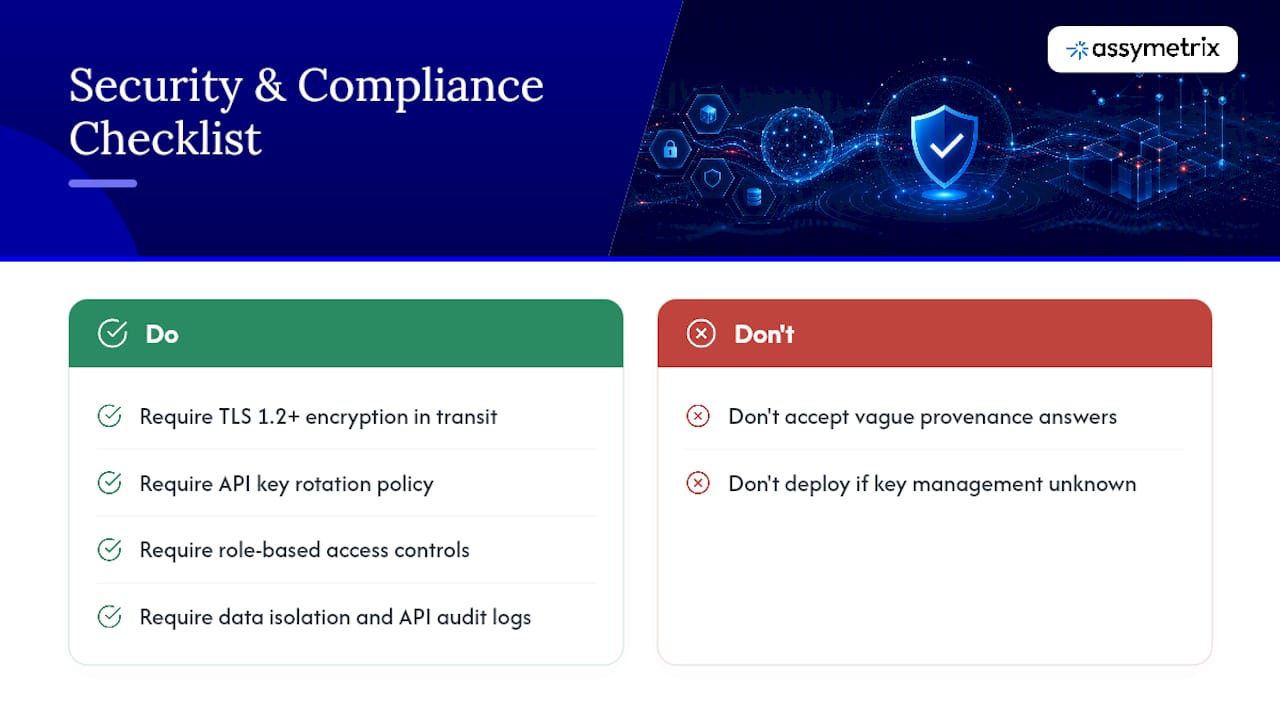
Security expectations for prediction market data providers mirror those of any financial data infrastructure vendor, even though prediction markets sit outside traditional securities regulation in most jurisdictions. At minimum, ask for details on encryption in transit (TLS 1.2 or higher), API key rotation policies, and role-based access controls if multiple team members will query the same account.
Institutional data consumers should also ask how a provider isolates customer data and whether audit logs exist for API usage, particularly if the data feeds into a regulated trading operation. A provider that can’t answer basic questions about key management or access logging isn’t ready for institutional deployment, regardless of how complete its dataset looks.
Data provenance matters here too. Since prediction markets resolve based on real-world outcomes, a provider’s resolution tagging needs a clear, auditable trail back to the source used to settle each market. This isn’t a regulatory requirement in the way securities settlement is, but it’s a practical one: if your trading logic depends on resolution data and you can’t trace where that resolution came from, you have no way to dispute or debug a bad fill after the fact. Ask providers directly how they document and version their resolution sources, and treat vague answers as a red flag rather than an oversight.
Can the Provider Handle High-Frequency Throughput?
Scalability questions matter most the moment your system moves from research to production. A feed that comfortably serves a single quant researcher pulling data for offline analysis can behave very differently under the concurrent load of a live trading bot polling multiple markets every few hundred milliseconds.
Ask providers directly about published rate limits, concurrent connection caps, and whether pricing tiers gate throughput or just query volume. A provider architected around a normalized, indexed schema, rather than a live scrape-and-transform pipeline, tends to scale more predictably because the heavy lifting of aggregation and normalization happens before your request arrives, not during it.
For AI agents and algorithmic bots querying continuously across multiple markets, WebSocket streaming architectures generally scale better than repeated REST polling, since they push updates rather than forcing your system to ask for them repeatedly. If your use case involves running dozens of bot instances against the same feed, confirm whether the provider’s pricing and infrastructure account for that multiplication in query volume, since a per-seat pricing model built for individual researchers can get expensive fast at bot-fleet scale.
How Responsive Is Technical Support When Something Breaks?
Support responsiveness only matters in the moments it’s tested: a schema change nobody warned you about, a latency spike during a market resolution, or an authentication failure at 2 AM before a major event settles. Ask a prospective provider what their actual response time commitment looks like for production-tier accounts, not just what’s listed on a pricing page.
Technical documentation quality is a leading indicator here. A provider with clear API references, versioned changelogs, and example code for common integration patterns has usually already solved the support burden that comes from vague or outdated docs. Ask whether support channels include direct access to engineers, or whether every ticket routes through a generic queue. For teams running latency-sensitive bots, the difference between a same-day engineer response and a 48-hour ticket cycle can mean days of downtime on a production strategy.
How Do Update Schedules Affect Data Availability?
Every provider has maintenance windows, and how they’re communicated determines whether they cause you problems. Ask for a published maintenance schedule and whether updates happen during low-volume windows or without regard to market activity.
More important than the schedule itself is what happens to your data access during an update. A provider that queues and replays events after a maintenance window preserves continuity; one that simply drops data during the update leaves gaps in your feed that can quietly corrupt a backtest or, worse, a live trading signal. Ask specifically whether schema updates are versioned and backward compatible, since a breaking schema change pushed without notice is one of the more common ways integrations fail in production. A provider that documents both its update cadence and its backward-compatibility policy is signaling operational maturity that a support page alone can’t demonstrate.
What Questions Should You Ask Before Signing a Contract?
Four questions separate a serious evaluation from a rushed one.
How far back does your historical data go, and is it continuous? A provider might advertise multi-year coverage but have gaps during periods when a venue changed its API and the provider’s ingestion broke silently. Ask for a continuity report, not just a start date.
How is cross-venue normalization handled, specifically? Get the actual schema spec. If the answer is vague, or if normalization happens through a third-party wrapper the provider doesn’t control, treat that as a structural risk rather than a minor detail. Academic work on cross-platform normalization shows that prediction market event semantics are informal and platform-specific, which means normalization requires deliberate engineering, not a simple field mapping.
What happens during a venue outage? Does the feed queue and replay, or does data simply vanish for that window? This single question reveals more about a provider’s engineering maturity than almost any other.
Are resolution sources tagged and auditable? If a market resolves based on a news event or an official data feed, you need to know what source the provider used to determine that outcome, and whether that source is documented per market or assumed.
How Do Providers Monitor Data Quality and Error Rates?
Data quality monitoring separates a provider you can trust in production from one you’ll eventually have to build workarounds for. Ask what automated checks run against incoming data: schema validation on ingestion, anomaly detection for price spikes that don’t match order flow, and reconciliation checks against the venue’s own published state.
Error rate transparency matters as much as the monitoring itself. A provider willing to share their own internal error rate, even an approximate one, is demonstrating a level of confidence that vague reassurances can’t match. Ask whether they maintain a status page or incident history, and whether past incidents included a written postmortem. A provider with a public incident history you can review is generally more trustworthy than one whose reliability claims can’t be checked at all, since it gives you a way to independently verify actual uptime rather than a stated one.
What Formats and Client Libraries Should You Expect?
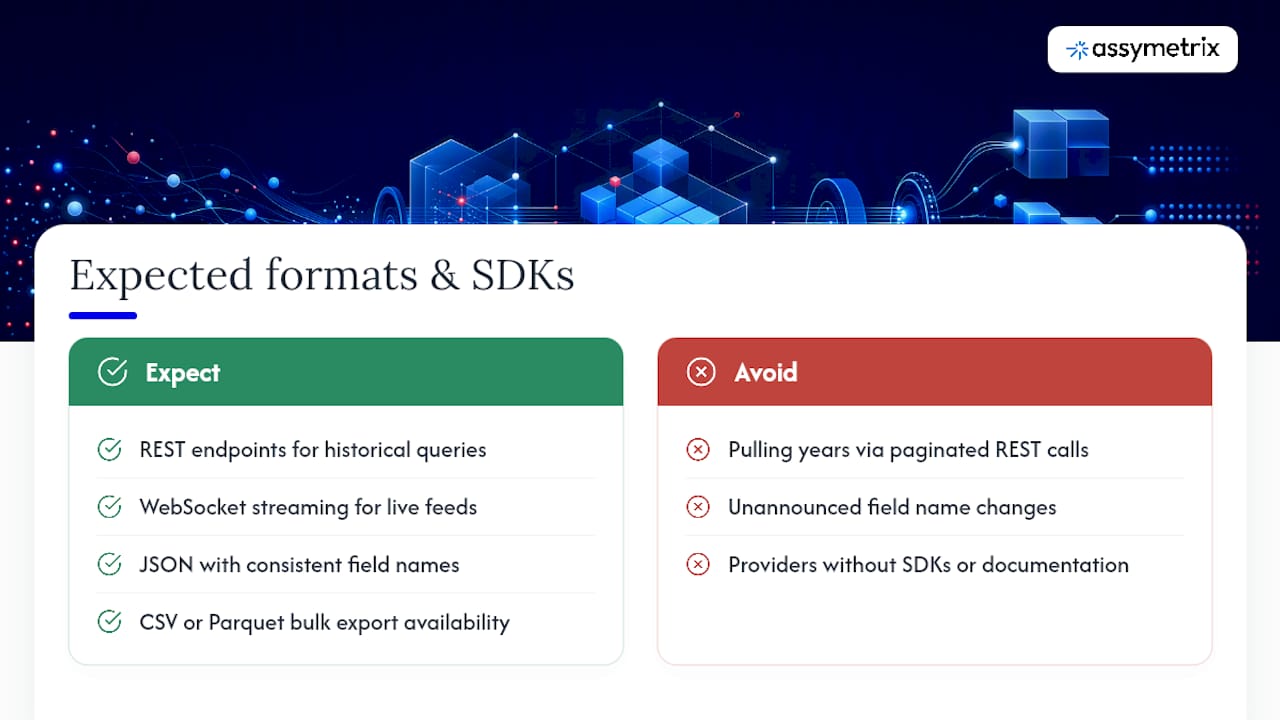
Integration friction usually comes down to format compatibility. Look for REST endpoints for historical queries, WebSocket streaming for live feeds, and JSON payloads with consistent field naming across every endpoint the provider exposes. If you’re backtesting at scale, ask whether bulk export formats like CSV or Parquet are available, since pulling years of tick data through paginated REST calls is impractical for most research workflows.
Client libraries reduce integration time meaningfully. A provider offering SDKs in Python, given its dominance in quant research, and JavaScript or TypeScript, common for bot and agent frameworks, saves your team from writing boilerplate authentication and pagination logic from scratch. Even without an official SDK, well-documented OpenAPI specs let you generate client code automatically in most modern languages.
For teams building AI agents that consume this data programmatically, structured JSON with consistent, predictable field names matters more than it might for a human-read dashboard, since an agent’s parsing logic will break on any unannounced field change. Teams validating historical dataset requirements against their own backtesting infrastructure may find it useful to cross-reference format expectations with resources like BacktestMarket’s technical blog, which covers minute-bar and historical data structuring in adjacent markets.
When Should You Choose an Aggregated Provider Over Direct Venue Feeds?
Aggregated, normalized providers make sense the moment your strategy touches more than one venue or your research needs multi-year depth a single exchange’s API won’t give you. Direct venue feeds still have a place for teams building venue-specific execution logic where every field-level nuance matters, but that’s a narrowing use case, not a growing one. Standardization, not raw proximity to the source, is what actually determines whether a pipeline survives contact with production.
— Dean
Start Your Trial With Real Artifacts, Not a Sales Deck
Assymetrix gives developers, quants, and institutional data teams one integration point for cross-venue prediction market data: over 900 million indexed events since September 2020, a unified schema across Polymarket, Kalshi, and Limitless, AI-enriched metadata, and stable contract IDs that hold up across venue-side changes. Smart Money wallet tracking and trader-skill scoring sit on top of the same normalized layer, so signals are built on data that’s already been reconciled, not scraped and hoped for.
Before you commit to any provider, request a sample historical extract, actual p95 latency logs, a written schema spec, and example Smart Money output. Assymetrix will hand over all four. Start by reviewing the Data API documentation at data.assymetrix.com and request trial access to pull your own sample extract.
Sources
FAQ
How Far Back Should Historical Data Go?
For serious backtesting, look for multi-year, continuous coverage with tick-level order-book depth. Assymetrix’s Data API indexes events back to September 2020 across Polymarket, Kalshi, and Limitless.
What Happens if a Venue Goes Down?
A production-grade provider should queue and replay missed events rather than silently dropping data during the outage window. Always ask for the provider’s written failover documentation before committing.
Why Does Schema Normalization Matter So Much?
Different venues use different field names, timestamp formats, and resolution semantics for economically identical events, so without normalization your pipeline breaks the moment you add a second venue. Assymetrix normalizes Polymarket, Kalshi, and Limitless into one unified schema with stable IDs.
Is Scraped Data Reliable for Production Trading?
Scraped or thinly wrapped data breaks whenever an upstream venue changes its interface, creating a single point of failure that’s often invisible until it takes your pipeline down. A dedicated API with documented schema contracts and versioning is more resilient for production use.
What Latency Metric Actually Matters for Bots?
p95 latency, not the average, since the tail of the distribution is what determines whether your bot gets filled during volatility. Test it end-to-end under realistic throughput before trusting any provider’s stated numbers.
Choosing a Prediction Market Data Provider for Production Systems
Pick a provider that delivers unified cross-venue coverage, a normalized schema, production-grade real-time feeds with documented p95 latency, and multi-year tick-level historical depth. Anything short of that combination will eventually break a backtest, misprice an arbitrage signal, or drop a trade during a venue outage. The Assymetrix Data API meets this bar with a vast indexed dataset dating back to September 2020, a single normalized schema across Polymarket, Kalshi, and Limitless, and stable IDs that survive venue-side changes.
Before signing anything, request three things from any provider under evaluation:
A sample historical backfill covering at least one contested market resolution.
Documented p50/p95/p99 latency figures measured end-to-end, not just at the server.
A written explanation of what happens to your feed during a venue outage.
Key Takeaways
A production-grade prediction market data provider must combine unified cross-venue coverage, a normalized schema with stable IDs, documented p95 latency, and multi-year tick-level historical depth.
Point | Details |
|---|---|
Prioritize cross-venue coverage | Single-venue depth cannot support arbitrage or divergence signals that depend on comparing prices across exchanges. |
Test the latency tail, not the average | Measure p50/p95/p99 end-to-end, since tail latency during volatility drives execution slippage. |
Demand order-book depth in historical data | Simple price series can’t reproduce depth-aware fills needed for backtesting execution costs. |
Verify schema stability before integrating | Request a versioned schema spec and stable contract IDs to avoid silent pipeline breaks from venue changes. |
Assymetrix meets the production checklist | Its Data API offers 900M+ indexed events since September 2020, unified schema across Polymarket, Kalshi, and Limitless, and stable IDs. |
Table of Contents
Prediction Market Data Provider: How to Choose One
What Should an Integration Checklist Look Like?
Common Pitfalls in Choosing a Prediction Market Data Provider
Which Proof Points Should You Verify Before Committing?
What Security and Compliance Standards Should a Provider Follow?
Can the Provider Handle High-Frequency Throughput?
How Responsive Is Technical Support When Something Breaks?
How Do Update Schedules Affect Data Availability?
What Questions Should You Ask Before Signing a Contract?
How Do Providers Monitor Data Quality and Error Rates?
What Formats and Client Libraries Should You Expect?
When Should You Choose an Aggregated Provider Over Direct Venue Feeds?
Start Your Trial With Real Artifacts, Not a Sales Deck
Sources
Prediction Market Data Provider: How to Choose One
The decision comes down to six measurable criteria, and each one has an objective test you can run during a trial rather than take on faith.
Venue coverage is the first filter. If your strategy trades correlated markets on Polymarket and Kalshi, a provider that only covers one venue can’t support it, full stop. Cross-venue coverage isn’t a nice-to-have for arbitrage or divergence research. It’s the entire premise. A single-venue feed can’t tell you when the same event is priced 4 cents apart on two exchanges, which is exactly the signal quant desks build strategies around.
Data freshness and latency separate production feeds from hobbyist scrapers. A provider pushing updates over WebSocket streaming gives you sub-second tick-to-display latency; one relying on polling every 30 or 60 seconds hands you stale odds during exactly the moments that matter, like a resolution announcement. Ask for p50/p95/p99 latency numbers measured client to provider to client, not internal server metrics. Redis’s engineering team notes that p95 is the practical number production teams should test, since it captures the tail behavior that actually causes slippage, not the comfortable average.
Historical depth needs to go beyond a daily close price. For backtesting market-making or execution-cost models, you need timestamped bid/ask ladders, both source and receive timestamps, and documented resolution fields. QuantConnect’s research documentation is explicit that a simple price series can’t reproduce depth-aware fills, and historical order-book depth often can’t be reconstructed after the fact if a provider didn’t capture it at the time.
Schema normalization and stable IDs determine whether your pipeline survives a venue’s API redesign. A market on Kalshi and a market on Polymarket describing the same event will have different field names, different timestamp formats, and different resolution semantics unless a provider normalizes them into one model.
API reliability and failover cover throughput limits, documented behavior during upstream outages, and whether you can replay missed events instead of losing them permanently.
Pricing and licensing need scrutiny for rate limits and export rights, especially if your use case involves high-frequency ingestion or reselling derived signals.
Confirm venue coverage matches your strategy’s universe.
Test p95 latency under realistic load, not a quiet Sunday.
Request a historical extract with full order-book depth.
Verify schema and ID stability across at least two venues.
Read the failover documentation before you read the pricing page.
Map rate limits against your peak query volume.
Pro Tip: Run your p95 latency test during a high-volatility window, like an election night or a Fed announcement, not during a quiet Tuesday afternoon. Tail latency during volatility is the number that actually determines whether your bot gets filled or gets picked off.
What Should an Integration Checklist Look Like?
A proof-of-concept trial should follow a fixed sequence, not an ad hoc exploration of the documentation.
Authentication and key model. Determine whether the provider issues its own API keys or proxies direct venue credentials. A proxy model isolates you from venue-side key rotations and rate-limit changes, which matters more than it sounds once you’re running production infrastructure.
Latency budgeting. Run a p95 test end-to-end under the throughput you actually expect in production, not a single test call. A feed that looks fast at ten requests a minute can degrade badly at ten thousand.
Backfill and replay checks. Request a tick-level historical extract for a market you already know the outcome of, then replay a small window to confirm the fills you’d get match reality.
Schema migration and contract testing. Ask for a versioned, signed schema spec and write a contract test against it. If the provider can’t produce one, that’s a signal their own internal schema isn’t stable either.
Operational runbook and monitoring. Test how the provider alerts you to missed events, and validate that your reconciliation flow catches gaps rather than silently propagating them downstream.
For quick smoke tests, keep it simple:
Pull one week of data and parse it end-to-end without errors.
Spot-check resolution tagging against the venue’s own published outcome.
Replay that same week and confirm identical results on a second run.
If you’re deploying ingestion logic on constrained runtimes like edge workers, Cloudflare’s guidance on fetch and runtime limits is worth reading before you write a single line. The typical “fetch everything, then process” pattern will crash on memory limits with large order-book snapshots; stream and discard incrementally instead.
Common Pitfalls in Choosing a Prediction Market Data Provider
Most failures trace back to a handful of repeatable mistakes.
Incomplete historical backfill. A provider that only started capturing data recently can’t give you multi-year depth no matter how good their real-time feed looks. This makes backtests irreproducible and quietly over-optimistic.
Schema drift from scraped or wrapped data. Aggregators built on top of scraping or thin API wrappers break the moment an upstream venue changes a field name. Engineering guides on pipeline reliability warn this creates a single point of failure that’s invisible until it takes down your production system.
Naive cross-venue aggregation. Averaging prices across venues without accounting for copy trading or correlated flow can amplify a shared signal rather than reveal a genuine arbitrage. Bias-reduction frameworks built specifically for prediction market convergence exist precisely because naive averaging misleads.
Testing mean latency instead of the distribution. A feed with a fast average but a fat latency tail will cost you fills exactly when volatility spikes.
Vendor lock-in with opaque export policies. If you can’t export your own historical data in raw form, you don’t actually own your research pipeline.
Pro Tip: Before committing to any provider, ask them directly how they’d handle a scenario where a venue changes its API mid-week without notice. Their answer, or lack of one, tells you more than their pricing page ever will.
Which Proof Points Should You Verify Before Committing?
Vendor claims are cheap. Artifacts are not. Here’s what to request from any provider, including Assymetrix, before treating a claim as fact.
Dataset size and start date. Assymetrix indexes a very large number of events dating back to September 2020, spanning a substantial volume of historical trading activity. Ask for a sample extract covering that range to confirm density, not just a headline number.
Unified schema across venues. A single normalized model spanning Polymarket, Kalshi, and Limitless means one integration instead of three. Request the schema spec itself, not a marketing description of it.
AI-enriched metadata and stable IDs. Contract IDs that persist across venue-side changes, plus enriched metadata like category tagging and resolution sourcing, reduce the normalization work your own team would otherwise build from scratch.
Smart Money and trader-skill signals. Ask for example output on wallet-level tracking and skill scoring, since this is exactly the kind of derived signal that’s hard to verify without seeing real data.
Map each artifact directly to a line item on your evaluation checklist. If a provider can’t produce the artifact, that’s your answer regardless of what the sales page says. Industry reporting on institutional data adoption points to data quality and standardization, not raw availability, as the actual barrier institutional teams face.
What Security and Compliance Standards Should a Provider Follow?
Security expectations for prediction market data providers mirror those of any financial data infrastructure vendor, even though prediction markets sit outside traditional securities regulation in most jurisdictions. At minimum, ask for details on encryption in transit (TLS 1.2 or higher), API key rotation policies, and role-based access controls if multiple team members will query the same account.
Institutional data consumers should also ask how a provider isolates customer data and whether audit logs exist for API usage, particularly if the data feeds into a regulated trading operation. A provider that can’t answer basic questions about key management or access logging isn’t ready for institutional deployment, regardless of how complete its dataset looks.
Data provenance matters here too. Since prediction markets resolve based on real-world outcomes, a provider’s resolution tagging needs a clear, auditable trail back to the source used to settle each market. This isn’t a regulatory requirement in the way securities settlement is, but it’s a practical one: if your trading logic depends on resolution data and you can’t trace where that resolution came from, you have no way to dispute or debug a bad fill after the fact. Ask providers directly how they document and version their resolution sources, and treat vague answers as a red flag rather than an oversight.
Can the Provider Handle High-Frequency Throughput?
Scalability questions matter most the moment your system moves from research to production. A feed that comfortably serves a single quant researcher pulling data for offline analysis can behave very differently under the concurrent load of a live trading bot polling multiple markets every few hundred milliseconds.
Ask providers directly about published rate limits, concurrent connection caps, and whether pricing tiers gate throughput or just query volume. A provider architected around a normalized, indexed schema, rather than a live scrape-and-transform pipeline, tends to scale more predictably because the heavy lifting of aggregation and normalization happens before your request arrives, not during it.
For AI agents and algorithmic bots querying continuously across multiple markets, WebSocket streaming architectures generally scale better than repeated REST polling, since they push updates rather than forcing your system to ask for them repeatedly. If your use case involves running dozens of bot instances against the same feed, confirm whether the provider’s pricing and infrastructure account for that multiplication in query volume, since a per-seat pricing model built for individual researchers can get expensive fast at bot-fleet scale.
How Responsive Is Technical Support When Something Breaks?
Support responsiveness only matters in the moments it’s tested: a schema change nobody warned you about, a latency spike during a market resolution, or an authentication failure at 2 AM before a major event settles. Ask a prospective provider what their actual response time commitment looks like for production-tier accounts, not just what’s listed on a pricing page.
Technical documentation quality is a leading indicator here. A provider with clear API references, versioned changelogs, and example code for common integration patterns has usually already solved the support burden that comes from vague or outdated docs. Ask whether support channels include direct access to engineers, or whether every ticket routes through a generic queue. For teams running latency-sensitive bots, the difference between a same-day engineer response and a 48-hour ticket cycle can mean days of downtime on a production strategy.
How Do Update Schedules Affect Data Availability?
Every provider has maintenance windows, and how they’re communicated determines whether they cause you problems. Ask for a published maintenance schedule and whether updates happen during low-volume windows or without regard to market activity.
More important than the schedule itself is what happens to your data access during an update. A provider that queues and replays events after a maintenance window preserves continuity; one that simply drops data during the update leaves gaps in your feed that can quietly corrupt a backtest or, worse, a live trading signal. Ask specifically whether schema updates are versioned and backward compatible, since a breaking schema change pushed without notice is one of the more common ways integrations fail in production. A provider that documents both its update cadence and its backward-compatibility policy is signaling operational maturity that a support page alone can’t demonstrate.
What Questions Should You Ask Before Signing a Contract?
Four questions separate a serious evaluation from a rushed one.
How far back does your historical data go, and is it continuous? A provider might advertise multi-year coverage but have gaps during periods when a venue changed its API and the provider’s ingestion broke silently. Ask for a continuity report, not just a start date.
How is cross-venue normalization handled, specifically? Get the actual schema spec. If the answer is vague, or if normalization happens through a third-party wrapper the provider doesn’t control, treat that as a structural risk rather than a minor detail. Academic work on cross-platform normalization shows that prediction market event semantics are informal and platform-specific, which means normalization requires deliberate engineering, not a simple field mapping.
What happens during a venue outage? Does the feed queue and replay, or does data simply vanish for that window? This single question reveals more about a provider’s engineering maturity than almost any other.
Are resolution sources tagged and auditable? If a market resolves based on a news event or an official data feed, you need to know what source the provider used to determine that outcome, and whether that source is documented per market or assumed.
How Do Providers Monitor Data Quality and Error Rates?
Data quality monitoring separates a provider you can trust in production from one you’ll eventually have to build workarounds for. Ask what automated checks run against incoming data: schema validation on ingestion, anomaly detection for price spikes that don’t match order flow, and reconciliation checks against the venue’s own published state.
Error rate transparency matters as much as the monitoring itself. A provider willing to share their own internal error rate, even an approximate one, is demonstrating a level of confidence that vague reassurances can’t match. Ask whether they maintain a status page or incident history, and whether past incidents included a written postmortem. A provider with a public incident history you can review is generally more trustworthy than one whose reliability claims can’t be checked at all, since it gives you a way to independently verify actual uptime rather than a stated one.
What Formats and Client Libraries Should You Expect?
Integration friction usually comes down to format compatibility. Look for REST endpoints for historical queries, WebSocket streaming for live feeds, and JSON payloads with consistent field naming across every endpoint the provider exposes. If you’re backtesting at scale, ask whether bulk export formats like CSV or Parquet are available, since pulling years of tick data through paginated REST calls is impractical for most research workflows.
Client libraries reduce integration time meaningfully. A provider offering SDKs in Python, given its dominance in quant research, and JavaScript or TypeScript, common for bot and agent frameworks, saves your team from writing boilerplate authentication and pagination logic from scratch. Even without an official SDK, well-documented OpenAPI specs let you generate client code automatically in most modern languages.
For teams building AI agents that consume this data programmatically, structured JSON with consistent, predictable field names matters more than it might for a human-read dashboard, since an agent’s parsing logic will break on any unannounced field change. Teams validating historical dataset requirements against their own backtesting infrastructure may find it useful to cross-reference format expectations with resources like BacktestMarket’s technical blog, which covers minute-bar and historical data structuring in adjacent markets.
When Should You Choose an Aggregated Provider Over Direct Venue Feeds?
Aggregated, normalized providers make sense the moment your strategy touches more than one venue or your research needs multi-year depth a single exchange’s API won’t give you. Direct venue feeds still have a place for teams building venue-specific execution logic where every field-level nuance matters, but that’s a narrowing use case, not a growing one. Standardization, not raw proximity to the source, is what actually determines whether a pipeline survives contact with production.
— Dean
Start Your Trial With Real Artifacts, Not a Sales Deck
Assymetrix gives developers, quants, and institutional data teams one integration point for cross-venue prediction market data: over 900 million indexed events since September 2020, a unified schema across Polymarket, Kalshi, and Limitless, AI-enriched metadata, and stable contract IDs that hold up across venue-side changes. Smart Money wallet tracking and trader-skill scoring sit on top of the same normalized layer, so signals are built on data that’s already been reconciled, not scraped and hoped for.
Before you commit to any provider, request a sample historical extract, actual p95 latency logs, a written schema spec, and example Smart Money output. Assymetrix will hand over all four. Start by reviewing the Data API documentation at data.assymetrix.com and request trial access to pull your own sample extract.
Sources
FAQ
How Far Back Should Historical Data Go?
For serious backtesting, look for multi-year, continuous coverage with tick-level order-book depth. Assymetrix’s Data API indexes events back to September 2020 across Polymarket, Kalshi, and Limitless.
What Happens if a Venue Goes Down?
A production-grade provider should queue and replay missed events rather than silently dropping data during the outage window. Always ask for the provider’s written failover documentation before committing.
Why Does Schema Normalization Matter So Much?
Different venues use different field names, timestamp formats, and resolution semantics for economically identical events, so without normalization your pipeline breaks the moment you add a second venue. Assymetrix normalizes Polymarket, Kalshi, and Limitless into one unified schema with stable IDs.
Is Scraped Data Reliable for Production Trading?
Scraped or thinly wrapped data breaks whenever an upstream venue changes its interface, creating a single point of failure that’s often invisible until it takes your pipeline down. A dedicated API with documented schema contracts and versioning is more resilient for production use.
What Latency Metric Actually Matters for Bots?
p95 latency, not the average, since the tail of the distribution is what determines whether your bot gets filled during volatility. Test it end-to-end under realistic throughput before trusting any provider’s stated numbers.
Other Blog


