A Practical Guide to Prediction Market Data Licensing
A Practical Guide to Prediction Market Data Licensing
A Practical Guide to Prediction Market Data Licensing
Unlock the power of prediction market data licensing with access to real-time feeds and historical trade data for your trading strategies.

A Practical Guide to Prediction Market Data Licensing
A commercial Market Data License Agreement (MDLA) paired with a production API gives developers and traders the real-time feeds, historical trade data, and normalized schemas needed to backtest strategies, run algorithmic bots, and train models legally. Free or read-only access rarely covers commercial use, redistribution, or model training. Getting this right means understanding exactly what a license unlocks and what to request before you sign anything.
A properly scoped license typically includes:
Real-time trade and quote streams across venues
Historical order book snapshots and settlement data
Normalized schemas so market IDs match across sources
Commercial rights covering redistribution and model training
Documented SLAs and support channels
If you need licensed access now, the fastest path is requesting trial API credentials directly from a provider like Assymetrix’s Data API rather than piecing together scraped feeds from individual venues.
Key Takeaways
Licensed cross-venue prediction market data, backed by a proper MDLA, is what turns a promising trading model into a production system that survives contact with real markets.
Point | Details |
|---|---|
Confirm your license type | Match your use case (research, trading, resale) to an EULA or MDLA before building anything commercial. |
Demand full data depth | Require trade ticks, order books, settlement events, and historical exports, not just live quotes. |
Test the tier honestly | Free tiers forbid resale and cap history; validate pro and enterprise limits under real load. |
Run a real trial | Validate latency, sequencing, and schema consistency for two to four weeks before signing. |
Consider a unified provider | Assymetrix offers licensed real-time and historical data across Kalshi, Polymarket, and Limitless through one API. |
Table of Contents
What Does Prediction Market Data Licensing Actually Cover?
What Data Should You Demand in a Licensed Feed?
How Do Free, Pro, and Enterprise Tiers Actually Differ?
What Should You Test Before Signing a License?
Why Cross-Venue Licensed Data Beats Single-Venue Access
How Assymetrix Delivers Licensed Cross-Venue Data
Assymetrix: A Single Path to Licensed, Cross-Venue Data
Sources
What Does Prediction Market Data Licensing Actually Cover?
Most prediction market platforms offer two distinct access tiers, and confusing them is the single most common mistake institutional buyers make. A standard end-user license agreement (EULA) grants read-only access for personal dashboards or research. It typically forbids redistribution, commercial resale, and using the data to train models you intend to sell or deploy commercially. A Market Data License Agreement (MDLA) is a different contract entirely, built for exactly those commercial cases.
The clauses that separate the two matter more than the price tag attached to them.
Redistribution and resale rights determine whether you can pass data downstream to clients or embed it in a paid product.
Commercial onward use covers whether you can run the data through a trading algorithm that generates revenue.
AI and model training rights specify whether historical data can feed a model you later sell or license.
Attribution requirements dictate whether you must credit the source on public-facing charts or dashboards, and whether that requirement can be waived at a higher tier.
Audit rights let the licensor verify usage matches the contract, which institutional legal teams almost always require before signing off.
SLA and uptime guarantees define what recourse you have when a feed goes down mid-trading session.
Pro Tip: Read the model-training clause twice before you assume it covers your use case. Some agreements permit internal research training but explicitly bar training any model that gets deployed externally or sold as a product.
Get these clauses wrong and you end up with a legally exposed trading system, not a functioning one.
What Data Should You Demand in a Licensed Feed?
Production-grade backtesting and live trading both depend on data that goes far beyond a simple price ticker. Institutional buyers should treat the following as non-negotiable requirements rather than nice-to-haves.
Trade ticks and quote streams. Every executed trade and quote update, timestamped at the source, not batched or delayed.
Full order book snapshots. Depth data, not just best bid/ask, since arbitrage and liquidity modeling both require the full book.
Settlement and resolution events. How and when a market resolved, with enough detail to reconcile against your own records.
Market metadata. Category, venue, contract terms, and resolution criteria, normalized into a consistent schema.
Historical exports in analysis-ready formats. Complete trade history in CSV or Parquet, with timestamp accuracy tight enough for millisecond-level backtests.
Provenance fields. A canonical
venue_id,market_id, and outcome identifier for every record, plus a clear timestamp source (exchange time versus ingestion time).
Institutional consumers care most about historical data integrity. Accessing full historical trades and order book snapshots, not just live quotes, is what makes a quantitative backtest trustworthy rather than decorative.
Beyond raw feeds, derived analytics separate a basic data vendor from an intelligence layer worth paying for: Smart Money wallet tracking, trader skill scoring, and cross-venue divergence signals all require the raw data above as a foundation. Without clean provenance fields, none of that analysis holds up under scrutiny.
How Do Free, Pro, and Enterprise Tiers Actually Differ?
Pricing pages for prediction market data rarely spell out the practical consequences of each tier, so you have to read between the lines of the rate limits and license terms.
Free tiers typically allow low-frequency polling, forbid resale outright, and cap historical lookback to a few weeks. Fine for prototyping, useless for production.
Pro tiers raise rate limits meaningfully, but often still require attribution on any public embed and limit historical exports to a rolling window rather than the full archive.
Enterprise tiers add SLA-backed uptime, high-throughput API keys, origin allowlisting, and negotiated redistribution rights, along with dedicated support rather than a ticket queue.
Vendor documentation across the space consistently shows this same tiering pattern: free access allows low-rate polling with attribution requirements, while paid tiers remove those restrictions and add throughput.
Map the tier to your actual use case before you commit. Internal research and academic work rarely need more than a pro tier. Production algorithms trading real capital need enterprise-grade SLAs. Reselling data or a model built on it needs explicit redistribution rights that almost never exist below enterprise pricing.
What Should You Test Before Signing a License?
A trial period is your only chance to catch integration problems before they become contractual disputes. Run through this checklist with production-representative traffic, not a handful of test calls.
Authentication and key hygiene. Confirm the provider supports key rotation and origin allowlisting, and that secrets never appear in client-side code.
Transport coverage. Test the WebSocket stream for real-time needs, REST endpoints for point-in-time snapshots, and bulk export formats like CSV or Parquet for historical loads.
Latency and sequencing. Measure end-to-end latency under load, and confirm sequence IDs and timestamp precision hold up during high-volume periods, not just quiet ones.
Schema normalization. Verify venue and market IDs stay consistent across every endpoint, and that canonical market types don’t drift between real-time and historical data.
Backtest readiness. Pull a representative historical slice, confirm timestamps reconcile against known settlement events, and check for gaps.
Rate limits and key-management controls like origin allowlisting and rotation tend to be where enterprise tiers actually earn their price, so stress-test them rather than taking the spec sheet at face value.
Pro Tip: Run your trial during a known high-volatility event window, like an election night or a major economic data release. Rate limits and latency problems that never show up during quiet trading almost always surface under real load.
Why Cross-Venue Licensed Data Beats Single-Venue Access
Traders who built strategies on a single venue, or who migrated off platforms like PredictIt after running into withdrawal delays, thin markets, or regulatory uncertainty, quickly discover that one feed isn’t enough. Kalshi offers CFTC-regulated markets with strong legal footing in the US. Polymarket carries the deepest liquidity and the widest global market variety. Limitless is smaller but experiments with market structures the larger venues haven’t touched yet. No single one of these venues gives you the full picture.
Arbitrage and divergence detection depend on synchronized data across venues with consistent resolution logic. If Kalshi and Polymarket price the same event differently and your feeds arrive on different clocks or with inconsistent market IDs, the opportunity disappears before you can act on it or, worse, you misprice the spread entirely.
Smart Money wallet tracking runs into the same wall. Correlating a wallet’s behavior across venues, and matching that against historical depth, only works when the underlying data is normalized to a shared schema from the start. A unified API layer that normalizes schemas across venues is specifically built to cut this engineering overhead out of the equation.
Backtest robustness improves the same way. Single-venue sampling bias understates real liquidity and resolution risk, while multi-venue historical depth gives you a truer read on strategy performance. There’s also a practical operations upside: redundancy across venues means one API outage doesn’t take your entire trading system offline, and centralized provenance makes audits far less painful.
How Assymetrix Delivers Licensed Cross-Venue Data
Assymetrix built its Data API around the exact requirements outlined above: a unified real-time and historical feed spanning Kalshi, Polymarket, and Limitless through one integration, with normalized schemas so market and venue IDs stay consistent across every source.
The platform backs that claim with real scale: roughly 1.5 terabytes of historical data spanning a vast dataset of trading activity, along with public developer guides covering both WebSocket streaming and REST endpoints. A backtesting case study using more than 200 million price snapshots demonstrates the historical depth in practice rather than just on paper.
Beyond raw feeds, Assymetrix surfaces the derived analytics quant teams actually build on: Smart Money wallet tracking, Trader Skill Scores, and cross-venue arbitrage signals. Building these internally means solving the same identity-matching and historical-depth problems the platform already handles, since Smart Money analytics require cross-venue identity signals and deep historical data as a foundation.
To start, request trial API credentials at Data and run it through the integration checklist above before committing to a production license.
When Should You Actually License Prediction Market Data?
Upgrade from free or scraped access the moment you need production reliability, model-training rights, or you’re running arbitrage strategies where timing gaps cost money. The most common mistake I see is skipping timestamp validation entirely, then wondering why a backtest doesn’t match live results. Run a two to four week trial against representative traffic, and backtest a real historical slice before signing anything longer.
Assymetrix: A Single Path to Licensed, Cross-Venue Data
Piecing together separate licenses from Kalshi, Polymarket, and Limitless individually means three sets of contracts, three schemas to reconcile, and three points of failure. Assymetrix consolidates that into a single integration.
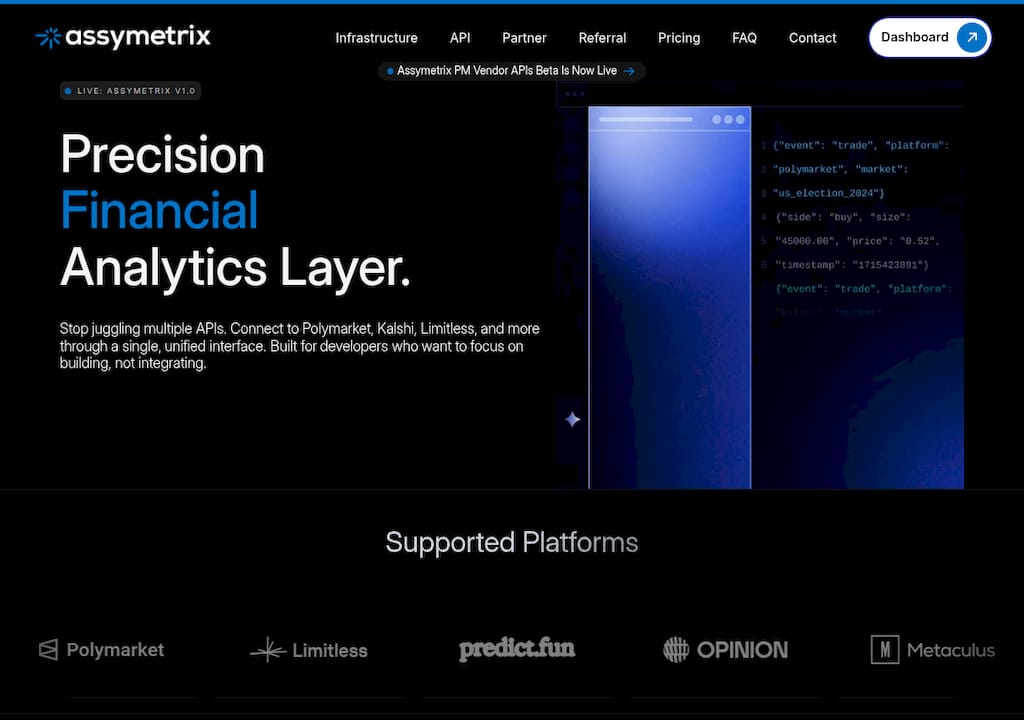
The platform suits developers building trading bots, quant researchers running backtests, and AI agent developers who need a data source that won’t fall apart under production load. Its normalized schemas mean you don’t spend engineering time reconciling market IDs across venues before you can even start analyzing arbitrage spreads. Its historical archive, close to one billion rows across roughly 1.5 terabytes of trading activity, gives backtests the depth that single-venue sampling can’t match.
If you came to this guide trying to figure out which license clauses matter and what a trial should actually test, the next step is straightforward: request trial credentials at the Assymetrix Data API and run your own integration against the checklist above. From there, explore Python integration guides or the arbitrage strategy guide to see how the same data feeds a live strategy.
Sources
Prediction market API: one data layer for the future of event markets — APIBricks blog
FAQ
What Is a Market Data License Agreement (MDLA)?
An MDLA is a commercial contract that grants rights beyond standard read-only access, typically covering redistribution, commercial trading use, and model training on the licensed data.
Do I Need a Commercial License to Backtest a Trading Strategy?
Internal research and backtesting often fall under lighter licensing terms, but deploying that strategy live or selling the resulting model almost always requires an MDLA with explicit commercial and model-training rights.
Why Does Cross-Venue Data Matter More Than Single-Venue Feeds?
Arbitrage and Smart Money signals depend on synchronized, normalized data across venues; a single-venue feed misses the price divergences and wallet correlations that make those signals useful.
What Should I Test During a Data API Trial?
Validate authentication and key rotation, WebSocket and REST transport reliability, timestamp precision, schema consistency across venues, and a backtest against a real historical data slice.
Does Assymetrix Offer Licensed Access to Multiple Prediction Market Venues?
Yes. Assymetrix’s Data API provides unified real-time and historical access across Kalshi, Polymarket, and Limitless through a single integration, backed by roughly 1.5 terabytes of historical trading data.
A Practical Guide to Prediction Market Data Licensing
A commercial Market Data License Agreement (MDLA) paired with a production API gives developers and traders the real-time feeds, historical trade data, and normalized schemas needed to backtest strategies, run algorithmic bots, and train models legally. Free or read-only access rarely covers commercial use, redistribution, or model training. Getting this right means understanding exactly what a license unlocks and what to request before you sign anything.
A properly scoped license typically includes:
Real-time trade and quote streams across venues
Historical order book snapshots and settlement data
Normalized schemas so market IDs match across sources
Commercial rights covering redistribution and model training
Documented SLAs and support channels
If you need licensed access now, the fastest path is requesting trial API credentials directly from a provider like Assymetrix’s Data API rather than piecing together scraped feeds from individual venues.
Key Takeaways
Licensed cross-venue prediction market data, backed by a proper MDLA, is what turns a promising trading model into a production system that survives contact with real markets.
Point | Details |
|---|---|
Confirm your license type | Match your use case (research, trading, resale) to an EULA or MDLA before building anything commercial. |
Demand full data depth | Require trade ticks, order books, settlement events, and historical exports, not just live quotes. |
Test the tier honestly | Free tiers forbid resale and cap history; validate pro and enterprise limits under real load. |
Run a real trial | Validate latency, sequencing, and schema consistency for two to four weeks before signing. |
Consider a unified provider | Assymetrix offers licensed real-time and historical data across Kalshi, Polymarket, and Limitless through one API. |
Table of Contents
What Does Prediction Market Data Licensing Actually Cover?
What Data Should You Demand in a Licensed Feed?
How Do Free, Pro, and Enterprise Tiers Actually Differ?
What Should You Test Before Signing a License?
Why Cross-Venue Licensed Data Beats Single-Venue Access
How Assymetrix Delivers Licensed Cross-Venue Data
Assymetrix: A Single Path to Licensed, Cross-Venue Data
Sources
What Does Prediction Market Data Licensing Actually Cover?
Most prediction market platforms offer two distinct access tiers, and confusing them is the single most common mistake institutional buyers make. A standard end-user license agreement (EULA) grants read-only access for personal dashboards or research. It typically forbids redistribution, commercial resale, and using the data to train models you intend to sell or deploy commercially. A Market Data License Agreement (MDLA) is a different contract entirely, built for exactly those commercial cases.
The clauses that separate the two matter more than the price tag attached to them.
Redistribution and resale rights determine whether you can pass data downstream to clients or embed it in a paid product.
Commercial onward use covers whether you can run the data through a trading algorithm that generates revenue.
AI and model training rights specify whether historical data can feed a model you later sell or license.
Attribution requirements dictate whether you must credit the source on public-facing charts or dashboards, and whether that requirement can be waived at a higher tier.
Audit rights let the licensor verify usage matches the contract, which institutional legal teams almost always require before signing off.
SLA and uptime guarantees define what recourse you have when a feed goes down mid-trading session.
Pro Tip: Read the model-training clause twice before you assume it covers your use case. Some agreements permit internal research training but explicitly bar training any model that gets deployed externally or sold as a product.
Get these clauses wrong and you end up with a legally exposed trading system, not a functioning one.
What Data Should You Demand in a Licensed Feed?
Production-grade backtesting and live trading both depend on data that goes far beyond a simple price ticker. Institutional buyers should treat the following as non-negotiable requirements rather than nice-to-haves.
Trade ticks and quote streams. Every executed trade and quote update, timestamped at the source, not batched or delayed.
Full order book snapshots. Depth data, not just best bid/ask, since arbitrage and liquidity modeling both require the full book.
Settlement and resolution events. How and when a market resolved, with enough detail to reconcile against your own records.
Market metadata. Category, venue, contract terms, and resolution criteria, normalized into a consistent schema.
Historical exports in analysis-ready formats. Complete trade history in CSV or Parquet, with timestamp accuracy tight enough for millisecond-level backtests.
Provenance fields. A canonical
venue_id,market_id, and outcome identifier for every record, plus a clear timestamp source (exchange time versus ingestion time).
Institutional consumers care most about historical data integrity. Accessing full historical trades and order book snapshots, not just live quotes, is what makes a quantitative backtest trustworthy rather than decorative.
Beyond raw feeds, derived analytics separate a basic data vendor from an intelligence layer worth paying for: Smart Money wallet tracking, trader skill scoring, and cross-venue divergence signals all require the raw data above as a foundation. Without clean provenance fields, none of that analysis holds up under scrutiny.
How Do Free, Pro, and Enterprise Tiers Actually Differ?
Pricing pages for prediction market data rarely spell out the practical consequences of each tier, so you have to read between the lines of the rate limits and license terms.
Free tiers typically allow low-frequency polling, forbid resale outright, and cap historical lookback to a few weeks. Fine for prototyping, useless for production.
Pro tiers raise rate limits meaningfully, but often still require attribution on any public embed and limit historical exports to a rolling window rather than the full archive.
Enterprise tiers add SLA-backed uptime, high-throughput API keys, origin allowlisting, and negotiated redistribution rights, along with dedicated support rather than a ticket queue.
Vendor documentation across the space consistently shows this same tiering pattern: free access allows low-rate polling with attribution requirements, while paid tiers remove those restrictions and add throughput.
Map the tier to your actual use case before you commit. Internal research and academic work rarely need more than a pro tier. Production algorithms trading real capital need enterprise-grade SLAs. Reselling data or a model built on it needs explicit redistribution rights that almost never exist below enterprise pricing.
What Should You Test Before Signing a License?
A trial period is your only chance to catch integration problems before they become contractual disputes. Run through this checklist with production-representative traffic, not a handful of test calls.
Authentication and key hygiene. Confirm the provider supports key rotation and origin allowlisting, and that secrets never appear in client-side code.
Transport coverage. Test the WebSocket stream for real-time needs, REST endpoints for point-in-time snapshots, and bulk export formats like CSV or Parquet for historical loads.
Latency and sequencing. Measure end-to-end latency under load, and confirm sequence IDs and timestamp precision hold up during high-volume periods, not just quiet ones.
Schema normalization. Verify venue and market IDs stay consistent across every endpoint, and that canonical market types don’t drift between real-time and historical data.
Backtest readiness. Pull a representative historical slice, confirm timestamps reconcile against known settlement events, and check for gaps.
Rate limits and key-management controls like origin allowlisting and rotation tend to be where enterprise tiers actually earn their price, so stress-test them rather than taking the spec sheet at face value.
Pro Tip: Run your trial during a known high-volatility event window, like an election night or a major economic data release. Rate limits and latency problems that never show up during quiet trading almost always surface under real load.
Why Cross-Venue Licensed Data Beats Single-Venue Access
Traders who built strategies on a single venue, or who migrated off platforms like PredictIt after running into withdrawal delays, thin markets, or regulatory uncertainty, quickly discover that one feed isn’t enough. Kalshi offers CFTC-regulated markets with strong legal footing in the US. Polymarket carries the deepest liquidity and the widest global market variety. Limitless is smaller but experiments with market structures the larger venues haven’t touched yet. No single one of these venues gives you the full picture.
Arbitrage and divergence detection depend on synchronized data across venues with consistent resolution logic. If Kalshi and Polymarket price the same event differently and your feeds arrive on different clocks or with inconsistent market IDs, the opportunity disappears before you can act on it or, worse, you misprice the spread entirely.
Smart Money wallet tracking runs into the same wall. Correlating a wallet’s behavior across venues, and matching that against historical depth, only works when the underlying data is normalized to a shared schema from the start. A unified API layer that normalizes schemas across venues is specifically built to cut this engineering overhead out of the equation.
Backtest robustness improves the same way. Single-venue sampling bias understates real liquidity and resolution risk, while multi-venue historical depth gives you a truer read on strategy performance. There’s also a practical operations upside: redundancy across venues means one API outage doesn’t take your entire trading system offline, and centralized provenance makes audits far less painful.
How Assymetrix Delivers Licensed Cross-Venue Data
Assymetrix built its Data API around the exact requirements outlined above: a unified real-time and historical feed spanning Kalshi, Polymarket, and Limitless through one integration, with normalized schemas so market and venue IDs stay consistent across every source.
The platform backs that claim with real scale: roughly 1.5 terabytes of historical data spanning a vast dataset of trading activity, along with public developer guides covering both WebSocket streaming and REST endpoints. A backtesting case study using more than 200 million price snapshots demonstrates the historical depth in practice rather than just on paper.
Beyond raw feeds, Assymetrix surfaces the derived analytics quant teams actually build on: Smart Money wallet tracking, Trader Skill Scores, and cross-venue arbitrage signals. Building these internally means solving the same identity-matching and historical-depth problems the platform already handles, since Smart Money analytics require cross-venue identity signals and deep historical data as a foundation.
To start, request trial API credentials at Data and run it through the integration checklist above before committing to a production license.
When Should You Actually License Prediction Market Data?
Upgrade from free or scraped access the moment you need production reliability, model-training rights, or you’re running arbitrage strategies where timing gaps cost money. The most common mistake I see is skipping timestamp validation entirely, then wondering why a backtest doesn’t match live results. Run a two to four week trial against representative traffic, and backtest a real historical slice before signing anything longer.
Assymetrix: A Single Path to Licensed, Cross-Venue Data
Piecing together separate licenses from Kalshi, Polymarket, and Limitless individually means three sets of contracts, three schemas to reconcile, and three points of failure. Assymetrix consolidates that into a single integration.
The platform suits developers building trading bots, quant researchers running backtests, and AI agent developers who need a data source that won’t fall apart under production load. Its normalized schemas mean you don’t spend engineering time reconciling market IDs across venues before you can even start analyzing arbitrage spreads. Its historical archive, close to one billion rows across roughly 1.5 terabytes of trading activity, gives backtests the depth that single-venue sampling can’t match.
If you came to this guide trying to figure out which license clauses matter and what a trial should actually test, the next step is straightforward: request trial credentials at the Assymetrix Data API and run your own integration against the checklist above. From there, explore Python integration guides or the arbitrage strategy guide to see how the same data feeds a live strategy.
Sources
Prediction market API: one data layer for the future of event markets — APIBricks blog
FAQ
What Is a Market Data License Agreement (MDLA)?
An MDLA is a commercial contract that grants rights beyond standard read-only access, typically covering redistribution, commercial trading use, and model training on the licensed data.
Do I Need a Commercial License to Backtest a Trading Strategy?
Internal research and backtesting often fall under lighter licensing terms, but deploying that strategy live or selling the resulting model almost always requires an MDLA with explicit commercial and model-training rights.
Why Does Cross-Venue Data Matter More Than Single-Venue Feeds?
Arbitrage and Smart Money signals depend on synchronized, normalized data across venues; a single-venue feed misses the price divergences and wallet correlations that make those signals useful.
What Should I Test During a Data API Trial?
Validate authentication and key rotation, WebSocket and REST transport reliability, timestamp precision, schema consistency across venues, and a backtest against a real historical data slice.
Does Assymetrix Offer Licensed Access to Multiple Prediction Market Venues?
Yes. Assymetrix’s Data API provides unified real-time and historical access across Kalshi, Polymarket, and Limitless through a single integration, backed by roughly 1.5 terabytes of historical trading data.
Other Blog


