Prediction Market Data Feed: Real-Time and Historical API Guide
Prediction Market Data Feed: Real-Time and Historical API Guide
Prediction Market Data Feed: Real-Time and Historical API Guide
Discover how a unified prediction market data feed streamlines real-time and historical API access, optimizing your integration efforts.

Prediction Market Data Feed: Real-Time and Historical API Guide
The single best integration path for prediction market data is a unified cross-venue feed that normalizes Polymarket, Kalshi, and Limitless into one schema, served through both REST and WebSocket. Building three separate venue integrations wastes engineering time on the same reconciliation work: mapping outcome tokens, handling settlement quirks, and de-duplicating trade events across inconsistent timestamp formats.
Two facts back that recommendation. First, cross-venue coverage at scale already exists: production feeds index hundreds of millions of on-chain events and price snapshots spanning multiple years, which means a backtest or a live bot doesn’t need to stitch together its own historical archive from scratch. Second, a single schema with both access methods (REST for point-in-time and bulk queries, WebSocket for streaming deltas) removes an entire category of integration bugs that come from three venues returning three different field names for the same concept.
Here’s what to do right now, in order:
Request a sandbox API key from a unified provider like Assymetrix’s Data API and confirm it authenticates against a test environment before touching production data.
Run a market-discovery REST query against all three venues (Polymarket, Kalshi, Limitless) using the same request shape, and verify the response schema matches field-for-field.
Open a WebSocket connection and subscribe to a live orderbook channel for one active market, then confirm you’re receiving sequenced delta frames rather than periodic full snapshots.
Complete that checklist and you’ll know within an hour whether a given feed can actually support production trading, backtesting, or an AI agent’s data layer, rather than finding out during a live incident three weeks later.
Key Takeaways
A unified cross-venue feed with normalized schema, REST for historical queries, and WebSocket for live streams is the correct architecture for prediction market trading systems, backtests, and AI agents.
Point | Details |
|---|---|
Choose one unified integration | Normalize Polymarket, Kalshi, and Limitless into a single schema instead of building three separate integrations. |
Match access method to use case | Use REST for historical, bulk, and discovery queries; use WebSocket for live trades, quotes, and orderbook deltas. |
Persist the eight canonical objects | Store Market, Outcome, Quote, Trade, OrderbookSnapshot, PriceBar, Settlement, and WalletActivity with nanosecond timestamps. |
Build in operational resilience | Use sequence numbers for deduplication, exponential backoff with jitter for reconnects, and cursor-based pagination for full syncs. |
Onboard with a scaled provider | Assymetrix indexes hundreds of millions of on-chain events and price snapshots spanning multiple years, available via sandbox key today. |
Table of Contents
What Does a Complete Prediction Market Data Feed Include?
Which Prediction Market Venues Does a Unified Feed Cover?
When Should You Use REST vs. WebSocket for Prediction Market Data?
How Do You Quick-Start a Prediction Market API Integration?
What Operational Details Matter for Production Ingestion?
What Schema Fields Should You Persist From a Prediction Market API?
Which Architecture Fits Your Use Case: Trading Bot, Backtest, or AI Agent?
How Does the Assymetrix Data API Deliver a Single Integration?
What Do Practitioners Get Wrong About Running This in Production?
Get Started With a Unified Prediction Market Data API
Sources
What Does a Complete Prediction Market Data Feed Include?
A production-grade feed needs to expose ten distinct data types, not just “current price.” Skip any of these and you’ll eventually hit a wall, usually the moment you try to reconcile a settlement or explain a gap in your backtest.
Market metadata: market ID, slug, question text, end time, resolution rules, tick size, and fee structure.
Outcomes: the discrete tokens or contracts a market resolves into (Yes/No, or multi-outcome sets).
Real-time prices: best bid and offer (the prediction-market equivalent of NBBO) updated on every book change.
Trades: executed fills with price, size, side, and a timestamp precise enough to sequence against other trades.
Quotes: standing bid/ask levels, distinct from trades.
Full orderbook snapshots: depth beyond the top of book, needed for slippage modeling and liquidity analysis.
OHLCV bars: aggregated open/high/low/close/volume at fixed intervals for charting and feature generation.
Settlement and resolution history: how and when a market resolved, and what evidence backs that resolution.
Wallet activity: on-chain address-level trading behavior, the raw material for smart-money tracking.
Derived signals: no-vig reference prices and cross-venue arbitrage flags computed from the raw feed.
Metadata fields matter more than they seem to at first glance. A market_id alone isn’t enough. You need the token_id for each outcome, the venue identifier, and a normalized venue mapping so your pipeline doesn’t have to special-case Polymarket slugs against Kalshi tickers every time it looks up a market.
Data-quality details separate a usable feed from a fragile one: settlement provenance (was this resolved by the venue directly, or verified against an on-chain oracle), canonical timestamps in nanoseconds or ISO 8601 with explicit timezone handling, and sequence numbers on every message so your consumer can detect gaps and duplicates. Historical archives supporting serious backtesting research routinely run into the hundreds of millions of rows across multi-year horizons, which is the volume needed to make statistical model validation meaningful rather than anecdotal.
As a rule of thumb: REST resources should carry historical snapshots, bulk exports, and anything you’d query on demand. WebSocket frames should carry the deltas, trade-by-trade and quote-by-quote, that no REST poll could keep up with.
Which Prediction Market Venues Does a Unified Feed Cover?
A unified feed needs to normalize three venues: Polymarket, Kalshi, and Limitless. Each has genuinely different plumbing under the hood, and pretending otherwise is how integrations break in production.
Polymarket markets resolve through a combination of UMA-style dispute mechanisms and, for certain crypto price markets, Chainlink price curves that anchor the settlement to an on-chain oracle feed. Kalshi, as a CFTC-regulated exchange, settles through its own regulatory reporting chain and orders its market listings by different conventions than Polymarket’s volume-based sort. Limitless brings its own settlement and liquidity structure on top of that. None of these differences are cosmetic. They change how you validate a resolution and how confident you can be in a settlement timestamp.
What normalizes cleanly across venues: universal primitives like quote, trades, price_history, stream, and orders can accept either a Kalshi ticker or a Polymarket slug interchangeably, with a shared venue parameter switching behavior underneath. What stays venue-specific: settlement channels, fee models, and tick-size conventions, which is exactly why your pipeline needs venue-aware flags even inside a normalized schema.
Practical mapping matters here. A slug or ticker resolves to a canonical token_id, and that resolution step should happen once, at ingestion, not scattered across every downstream service that touches market data. Before trusting a unified feed, run this checklist against it:
Confirm Kalshi’s cursor-based pagination and Polymarket’s volume-based ordering both map to a consistent sort behavior in the unified API.
Verify settlement events carry a provenance field distinguishing venue-reported resolutions from oracle-verified ones.
Check that outcome expansion (
expand=outcomes) returns binary and multi-outcome markets in the same shape.Test that a market discovery query against Limitless returns metadata with the same field names as Polymarket and Kalshi.
When Should You Use REST vs. WebSocket for Prediction Market Data?
Use REST for anything historical, bulk, or ad hoc; use WebSocket for anything live, continuous, or latency-sensitive. That’s the whole rule, and almost every integration mistake comes from violating it in one direction or the other.
REST is built for point-in-time queries: pulling price history for a backtest, paginating through a market catalog, or exporting a bulk dataset for model training. WebSocket exists because polling REST endpoints for live trade and orderbook data introduces delay that a real trading loop can’t tolerate — enterprise-tier REST rate limits can reach 100,000 requests per hour, but even at that ceiling, polling still means checking a value that’s already stale by the time you read it.
Dimension | REST | WebSocket |
|---|---|---|
Best for | Historical queries, bulk export, discovery | Live trades, quotes, orderbook deltas |
Latency | Seconds (bound by polling interval) | Sub-second, event-driven |
Rate limits | Tiered (Free, Pro, Enterprise) | Connection-based, not request-counted |
Failure mode | Retry with backoff | Reconnect + resync from snapshot |
Typical consumer | Backtest engine, research pipeline | Live trading bot, AI agent execution loop |
Reconnection is where most WebSocket integrations quietly fail. A resilient pattern combines a heartbeat to detect dead connections, sequence numbers on every frame to catch drops, and a resumable snapshot-plus-delta model: pull a fresh REST snapshot on connect, then apply incoming WS deltas on top of it. Add exponential backoff with jitter on reconnect attempts, and respect any server-provided replay window so you can request missed messages instead of re-fetching a full snapshot every time a connection blips.
A typical WebSocket trade frame carries a seq number, an observed_at_ns timestamp, a type field (trade, quote, orderbook_delta), and the payload itself. Check all three of the first fields on every message before you touch the payload. A skipped seq means you missed a message and need to resync.
Pro Tip: Pair every instrument subscription with a guaranteed initial REST snapshot before opening the WebSocket stream. If you subscribe first and snapshot second, there’s a race window where deltas can arrive before you have a baseline to apply them to, and your local orderbook silently drifts out of sync.
How Do You Quick-Start a Prediction Market API Integration?
Getting from zero to a working pipeline takes four steps, and the order matters.
Request a sandbox key. Sandbox and production keys should never share rate limits or write access, and testing against sandbox first catches schema surprises before they hit a live trading loop.
Call market discovery.
GET /markets?venue=polymarket&limit=50&cursor=returns a paginated list of active markets. Addexpand=outcomesto get outcome tokens inline instead of making a second call per market.Pull price history.
GET /price_history?token_id={id}&venue=kalshireturns OHLCV bars or tick-level history depending on the interval parameter. Use the returned cursor to page through the full history rather than assuming a single response covers it.Open a WebSocket stream. Connect, authenticate if the venue requires it, then subscribe to the channels you need:
trades,quotes,orderbook,new_markets, andmarket_resolvedare the standard set.
In pseudocode, a Python quick-start looks like this: request a sandbox key, call GET /markets and store the returned token_id values, call GET /price_history for each token to backfill your local store, then open a WebSocket client and reconcile the first incoming delta against your REST snapshot’s last known state. A TypeScript client follows the identical sequence: fetch, fetch, connect, reconcile.
Validation matters as much as the calls themselves:
Confirm sandbox keys are rejected on production endpoints and vice versa.
Set up origin allowlisting before deploying to any Enterprise-tier environment.
Check that a known-resolved market returns matching settlement IDs between your REST call and your WebSocket’s
market_resolvedevent.On an idle market, verify the WebSocket still emits a periodic heartbeat frame, so you can distinguish “quiet market” from “dead connection.”
What Operational Details Matter for Production Ingestion?
Authentication, rate limits, and timestamp discipline are where prediction market data pipelines quietly break in production, not in the initial integration.
Most providers authenticate through an API key header for standard requests, though bulk CSV downloads sometimes require a query-string key instead, since browser-triggered downloads can’t always set custom headers. Enterprise tiers typically add origin allowlisting, restricting which domains can make authenticated requests, which is worth setting up before you go live rather than after a key leaks.
Rate limits follow a tiered structure across most prediction market data providers: free tiers cap around 60 requests per hour per IP address, Pro tiers around 5,000 requests per hour per key, and Enterprise tiers up to 100,000 per hour per key. Responses typically carry X-RateLimit headers showing your remaining quota, and a Retry-After header on 429 responses tells you exactly how long to back off. Caching responses using the provided cache-control headers cuts unnecessary quota consumption dramatically, especially for endpoints like market metadata that don’t change every second.
Pagination for exhaustive catalog walks should always use cursor-based iteration rather than offset-based paging, since offsets drift when new markets are created mid-walk. Top-N queries can skip cursors entirely, but full catalog syncs cannot.
Operational checklist for a reliable ingestion pipeline:
Store all timestamps in nanosecond precision with explicit timezone (UTC) to avoid subtle off-by-one-hour bugs during daylight saving transitions.
Deduplicate incoming WebSocket messages using sequence numbers, not timestamps, since two events can share a timestamp.
Reconcile settlement data against the venue’s dedicated settlement endpoint, and where applicable, cross-check Chainlink-anchored price curves for crypto Up/Down markets.
Update positions atomically on settlement, never in two separate writes that could leave a system in a partial state during a crash.
Respect the WebSocket replay window: if your connection drops for under that window, request replay instead of a full resync.
Pro Tip: A solid retry policy for both REST calls and WebSocket reconnects is exponential backoff with jitter, capped at a maximum retry count. Without jitter, a brief provider-side outage causes every one of your clients to reconnect at the exact same moment, which just recreates the outage as a self-inflicted thundering herd.
What Schema Fields Should You Persist From a Prediction Market API?
Eight canonical objects cover everything a trading system or research pipeline needs to persist.
Normalization rules matter more than any single field name. A venue_id maps to a normalized_venue enum shared across the whole schema. A raw slug or ticker resolves to a canonical token_id at ingestion time, once, so nothing downstream needs venue-specific lookup logic. Outcome IDs get assigned canonically so a Yes/No market on Polymarket and a Yes/No market on Kalshi both use the same outcome schema shape.
A single trade record, illustrated conceptually, carries a trade_id, a market_id, a token_id, a price in USD cents, a size, a side, a seq number, and an observed_at_ns timestamp. A market metadata row carries market_id, slug, venue, question, end_time in ISO 8601, and resolution_rules as free text.
When a client encounters a field it doesn’t recognize in a schema update, the correct behavior is to ignore the field, log it, and flag the payload for a schema migration review, not to reject the whole message. Schema versioning that breaks on unknown fields turns every provider-side addition into a client-side outage.
Which Architecture Fits Your Use Case: Trading Bot, Backtest, or AI Agent?
Three architectures cover almost every serious use case for prediction market data, and each one implies different storage choices.
Architecture A: Low-latency live trading bot. WebSocket feed maintains an in-memory Level 2 orderbook, which feeds directly into an execution engine. No database round-trip sits in the hot path. Persistence happens asynchronously, after the trading decision, not before it.
Architecture B: Backtest and research pipeline. Bulk REST export pulls historical trades and price bars into a normalized OLAP store (columnar formats work well here), followed by a feature-generation layer that computes derived signals like no-vig reference prices and cross-venue spreads.
Architecture C: AI agent data layer. A hybrid approach: long-term historical data lives in cheap object storage, while a short-term live stream feeds a feature store that the agent queries in near real time. This pattern shows up repeatedly in how AI agents consume prediction market data for autonomous trading decisions, where the agent needs both deep historical context and current market state without paying the latency cost of querying cold storage on every decision.
Storage recommendations by architecture:
Use columnar stores for long-term OHLCV bars and computed features, since analytical queries over years of data benefit from column-oriented compression.
Use time-series databases for high-resolution orderbook snapshots, where write throughput and time-range queries matter more than joins.
Use in-memory caches strictly for best-bid/offer state inside a trading loop, kept separate from your durable storage layer.
Sample at 15-minute resolution for most feature-generation work, but retain sub-second trade-level resolution wherever slippage or execution-quality modeling requires it.
For each architecture, snapshot reconciliation, retention policy, and indexing strategy need explicit decisions before launch, not after the first data gap surfaces in production. Feature freshness for a live agent typically means an offline backfill flow for historical training plus an online refresh for current features, with experiment reproducibility maintained by pinning the exact data snapshot used for a given training run. Quantitative researchers are increasingly applying deep learning architectures like GRUs to time-series market data of this kind, which makes reproducible snapshot pinning a real requirement, not an afterthought.
How Does the Assymetrix Data API Deliver a Single Integration?
Assymetrix provides a unified cross-venue feed across Polymarket, Kalshi, and Limitless through one production REST and WebSocket integration, with a normalized schema and enterprise-grade operational controls built in.
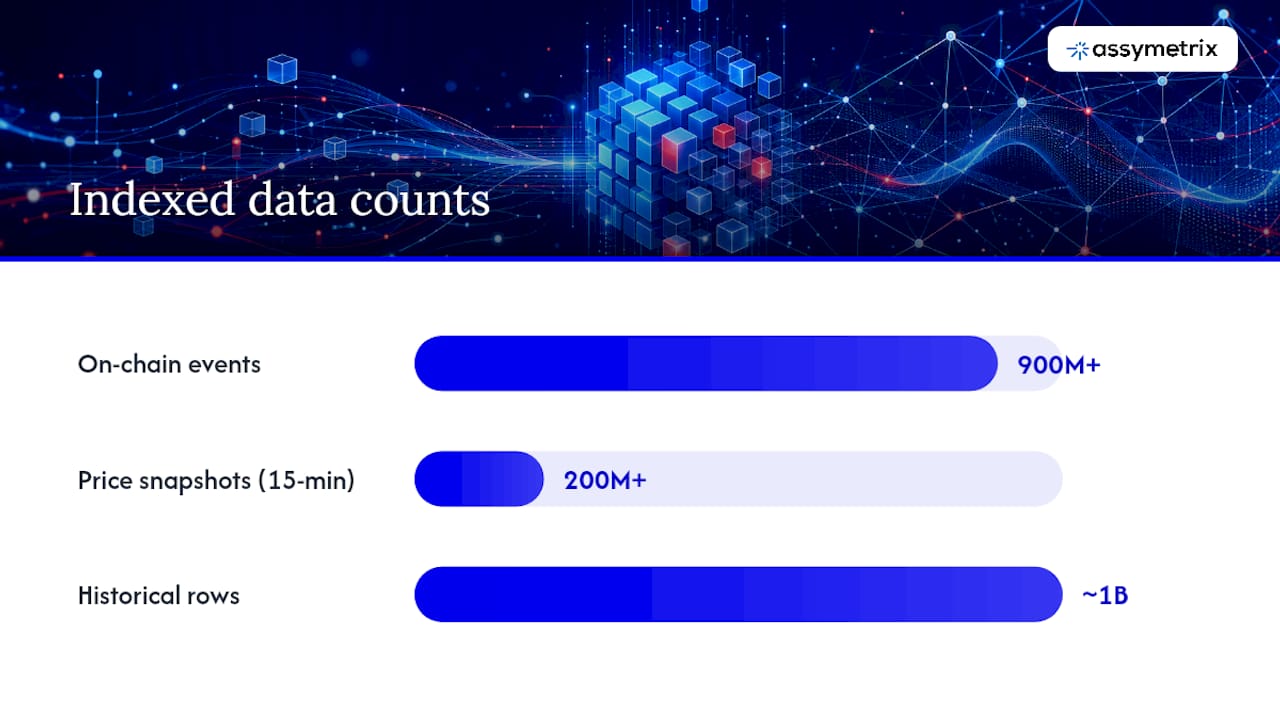
The scale behind that feed is substantial: the Data API indexes more than 900 million on-chain events, maintains over 200 million price snapshots at 15-minute resolution, and spans more than five years of history dating back to September 2020. That combination, roughly 1.5 terabytes of historical data across close to a billion rows, gives a backtest engine or research pipeline enough depth to validate a strategy across multiple market cycles rather than a handful of recent months.
Feature coverage maps directly onto the checklist built through this guide:
Trades, quotes, and full orderbook depth across all three supported venues, delivered through the same schema regardless of source.
OHLCV bars at multiple intervals for charting and feature generation.
Settlement and resolution data, including provenance tracking for Chainlink-anchored crypto markets where applicable.
Wallet-level Smart Money tracking that surfaces address-level trading patterns and Trader Skill Scores.
Cross-venue arbitrage signals and no-vig reference pricing computed directly from the normalized feed, detailed further in the guide to generating cross-venue trading signals.
Onboarding follows the same four-step quick-start covered earlier: request a sandbox key, run a sample market-discovery call, open a WebSocket stream, and request a bulk export for backtesting once you’re ready to move past sandbox data. SDKs are available for Python and TypeScript, and the platform documents a public change log and schema-versioning policy so unknown-field handling (covered above) doesn’t catch integrators off guard. Enterprise customers get dedicated support channels and SLA-backed uptime, on top of the same core developer documentation every tier uses.
What Do Practitioners Get Wrong About Running This in Production?
Reconnect storms are the failure mode that catches most teams off guard the first time a provider has even a brief outage. If your retry logic doesn’t include jitter, every client you run reconnects in the same half-second window, and you end up hammering the provider right as it’s trying to recover. Clock skew is the second one: a trading system running on a server with drifted NTP sync will misorder trades against its local clock even when the feed’s sequence numbers are perfectly correct, and that’s a much harder bug to spot because nothing looks broken until a backtest produces results that don’t match live performance.
One tactical habit worth adopting for any strategy that runs longer than a few weeks: store compacted daily snapshots for anything older than your active lookback window, and keep full minute-level or tick-level retention only for the recent window your strategy actually touches. Retaining full-resolution history indefinitely sounds safer, but it turns storage costs and query latency into a slow-growing tax on every backtest you run, long after the marginal value of that resolution has disappeared.
The deeper issue is organizational, not technical. Settlement drift and, in some venues, on-chain reorganizations mean a resolved market’s outcome can, in rare cases, need reconciliation after the fact. Trading systems and data engineering teams that don’t talk to each other regularly tend to discover this the hard way, usually when a position doesn’t match what the strategy expected. Treat settlement reconciliation as a shared responsibility between the people writing execution logic and the people running the data pipeline, not as something either side assumes the other has handled.
Get Started With a Unified Prediction Market Data API
Everything in this guide points to the same conclusion: stitching together three separate venue integrations costs engineering time you don’t need to spend. Assymetrix’s Data API gives you Polymarket, Kalshi, and Limitless through one REST and WebSocket integration, with a normalized schema so a market on one venue looks structurally identical to a market on another.
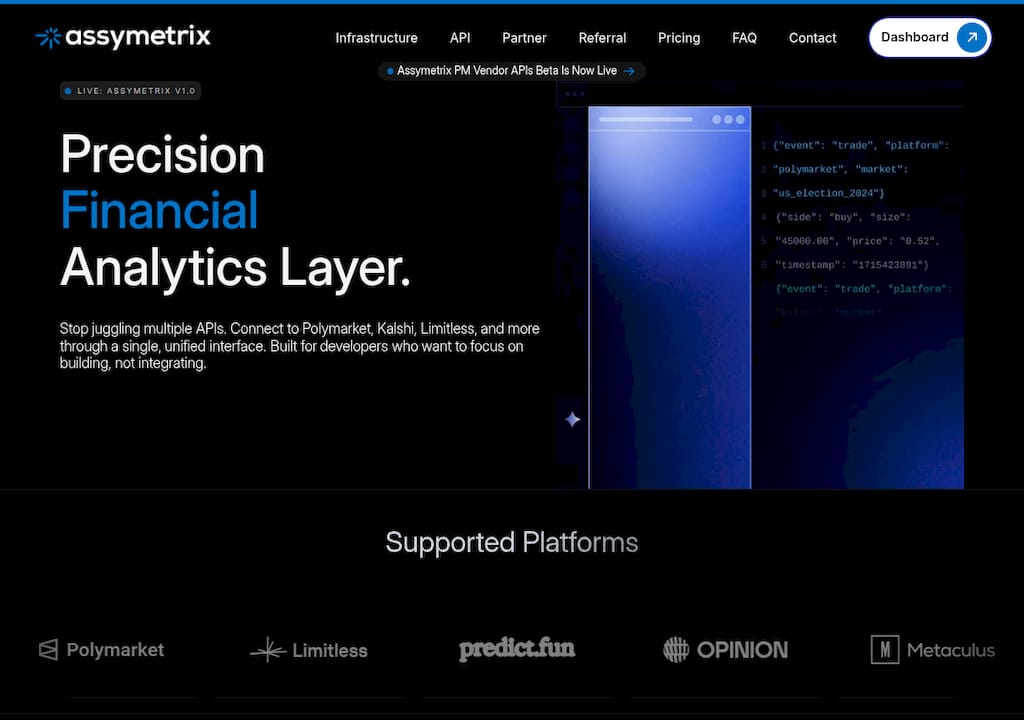
That single integration covers the full checklist from this guide: trades, quotes, orderbook depth, OHLCV, settlement data with provenance tracking, wallet-level Smart Money tracking, and cross-venue arbitrage signals, all backed by more than five years of historical data and bulk export options for backtesting. SDKs for Python and TypeScript mean you can go from sandbox key to a working pipeline in an afternoon rather than a sprint.
To get started: create an account, request a sandbox API key, run a market-discovery REST call against all three venues, open a sample WebSocket stream on a live market, and request a bulk export once you’re ready to backtest against the full historical archive. Pricing runs across free, Pro, and Enterprise tiers, with developer support available at every level. Start by exploring the data feed integration guide and requesting sandbox access from there.
Sources
FAQ
What Is a Prediction Market Data Feed?
A prediction market data feed is a structured stream of market metadata, prices, trades, orderbook depth, and settlement history from venues like Polymarket, Kalshi, and Limitless, delivered through REST and WebSocket APIs.
Should I Use REST or WebSocket for Live Trading Bots?
Use WebSocket for live trading bots, since it delivers trade and orderbook updates as events happen rather than on a polling delay; reserve REST for historical backfills and periodic reconciliation checks.
Why Use a Unified Feed Instead of Separate Venue APIs?
A unified feed normalizes field names, timestamps, and settlement provenance across venues, which eliminates the reconciliation work every team otherwise repeats when integrating Polymarket, Kalshi, and Limitless separately.
How Much Historical Data Does Assymetrix Provide?
Assymetrix’s Data API indexes over 900 million on-chain events and more than 200 million price snapshots at 15-minute resolution, spanning over five years of history starting September 2020.
How Do I Handle Rate Limits on a Prediction Market API?
Cache responses using the provider’s cache-control headers, honor Retry-After on 429 responses, and choose a tier (Free, Pro, or Enterprise) matched to your expected request volume, since limits typically range from 60 to 100,000 requests per hour.
Prediction Market Data Feed: Real-Time and Historical API Guide
The single best integration path for prediction market data is a unified cross-venue feed that normalizes Polymarket, Kalshi, and Limitless into one schema, served through both REST and WebSocket. Building three separate venue integrations wastes engineering time on the same reconciliation work: mapping outcome tokens, handling settlement quirks, and de-duplicating trade events across inconsistent timestamp formats.
Two facts back that recommendation. First, cross-venue coverage at scale already exists: production feeds index hundreds of millions of on-chain events and price snapshots spanning multiple years, which means a backtest or a live bot doesn’t need to stitch together its own historical archive from scratch. Second, a single schema with both access methods (REST for point-in-time and bulk queries, WebSocket for streaming deltas) removes an entire category of integration bugs that come from three venues returning three different field names for the same concept.
Here’s what to do right now, in order:
Request a sandbox API key from a unified provider like Assymetrix’s Data API and confirm it authenticates against a test environment before touching production data.
Run a market-discovery REST query against all three venues (Polymarket, Kalshi, Limitless) using the same request shape, and verify the response schema matches field-for-field.
Open a WebSocket connection and subscribe to a live orderbook channel for one active market, then confirm you’re receiving sequenced delta frames rather than periodic full snapshots.
Complete that checklist and you’ll know within an hour whether a given feed can actually support production trading, backtesting, or an AI agent’s data layer, rather than finding out during a live incident three weeks later.
Key Takeaways
A unified cross-venue feed with normalized schema, REST for historical queries, and WebSocket for live streams is the correct architecture for prediction market trading systems, backtests, and AI agents.
Point | Details |
|---|---|
Choose one unified integration | Normalize Polymarket, Kalshi, and Limitless into a single schema instead of building three separate integrations. |
Match access method to use case | Use REST for historical, bulk, and discovery queries; use WebSocket for live trades, quotes, and orderbook deltas. |
Persist the eight canonical objects | Store Market, Outcome, Quote, Trade, OrderbookSnapshot, PriceBar, Settlement, and WalletActivity with nanosecond timestamps. |
Build in operational resilience | Use sequence numbers for deduplication, exponential backoff with jitter for reconnects, and cursor-based pagination for full syncs. |
Onboard with a scaled provider | Assymetrix indexes hundreds of millions of on-chain events and price snapshots spanning multiple years, available via sandbox key today. |
Table of Contents
What Does a Complete Prediction Market Data Feed Include?
Which Prediction Market Venues Does a Unified Feed Cover?
When Should You Use REST vs. WebSocket for Prediction Market Data?
How Do You Quick-Start a Prediction Market API Integration?
What Operational Details Matter for Production Ingestion?
What Schema Fields Should You Persist From a Prediction Market API?
Which Architecture Fits Your Use Case: Trading Bot, Backtest, or AI Agent?
How Does the Assymetrix Data API Deliver a Single Integration?
What Do Practitioners Get Wrong About Running This in Production?
Get Started With a Unified Prediction Market Data API
Sources
What Does a Complete Prediction Market Data Feed Include?
A production-grade feed needs to expose ten distinct data types, not just “current price.” Skip any of these and you’ll eventually hit a wall, usually the moment you try to reconcile a settlement or explain a gap in your backtest.
Market metadata: market ID, slug, question text, end time, resolution rules, tick size, and fee structure.
Outcomes: the discrete tokens or contracts a market resolves into (Yes/No, or multi-outcome sets).
Real-time prices: best bid and offer (the prediction-market equivalent of NBBO) updated on every book change.
Trades: executed fills with price, size, side, and a timestamp precise enough to sequence against other trades.
Quotes: standing bid/ask levels, distinct from trades.
Full orderbook snapshots: depth beyond the top of book, needed for slippage modeling and liquidity analysis.
OHLCV bars: aggregated open/high/low/close/volume at fixed intervals for charting and feature generation.
Settlement and resolution history: how and when a market resolved, and what evidence backs that resolution.
Wallet activity: on-chain address-level trading behavior, the raw material for smart-money tracking.
Derived signals: no-vig reference prices and cross-venue arbitrage flags computed from the raw feed.
Metadata fields matter more than they seem to at first glance. A market_id alone isn’t enough. You need the token_id for each outcome, the venue identifier, and a normalized venue mapping so your pipeline doesn’t have to special-case Polymarket slugs against Kalshi tickers every time it looks up a market.
Data-quality details separate a usable feed from a fragile one: settlement provenance (was this resolved by the venue directly, or verified against an on-chain oracle), canonical timestamps in nanoseconds or ISO 8601 with explicit timezone handling, and sequence numbers on every message so your consumer can detect gaps and duplicates. Historical archives supporting serious backtesting research routinely run into the hundreds of millions of rows across multi-year horizons, which is the volume needed to make statistical model validation meaningful rather than anecdotal.
As a rule of thumb: REST resources should carry historical snapshots, bulk exports, and anything you’d query on demand. WebSocket frames should carry the deltas, trade-by-trade and quote-by-quote, that no REST poll could keep up with.
Which Prediction Market Venues Does a Unified Feed Cover?
A unified feed needs to normalize three venues: Polymarket, Kalshi, and Limitless. Each has genuinely different plumbing under the hood, and pretending otherwise is how integrations break in production.
Polymarket markets resolve through a combination of UMA-style dispute mechanisms and, for certain crypto price markets, Chainlink price curves that anchor the settlement to an on-chain oracle feed. Kalshi, as a CFTC-regulated exchange, settles through its own regulatory reporting chain and orders its market listings by different conventions than Polymarket’s volume-based sort. Limitless brings its own settlement and liquidity structure on top of that. None of these differences are cosmetic. They change how you validate a resolution and how confident you can be in a settlement timestamp.
What normalizes cleanly across venues: universal primitives like quote, trades, price_history, stream, and orders can accept either a Kalshi ticker or a Polymarket slug interchangeably, with a shared venue parameter switching behavior underneath. What stays venue-specific: settlement channels, fee models, and tick-size conventions, which is exactly why your pipeline needs venue-aware flags even inside a normalized schema.
Practical mapping matters here. A slug or ticker resolves to a canonical token_id, and that resolution step should happen once, at ingestion, not scattered across every downstream service that touches market data. Before trusting a unified feed, run this checklist against it:
Confirm Kalshi’s cursor-based pagination and Polymarket’s volume-based ordering both map to a consistent sort behavior in the unified API.
Verify settlement events carry a provenance field distinguishing venue-reported resolutions from oracle-verified ones.
Check that outcome expansion (
expand=outcomes) returns binary and multi-outcome markets in the same shape.Test that a market discovery query against Limitless returns metadata with the same field names as Polymarket and Kalshi.
When Should You Use REST vs. WebSocket for Prediction Market Data?
Use REST for anything historical, bulk, or ad hoc; use WebSocket for anything live, continuous, or latency-sensitive. That’s the whole rule, and almost every integration mistake comes from violating it in one direction or the other.
REST is built for point-in-time queries: pulling price history for a backtest, paginating through a market catalog, or exporting a bulk dataset for model training. WebSocket exists because polling REST endpoints for live trade and orderbook data introduces delay that a real trading loop can’t tolerate — enterprise-tier REST rate limits can reach 100,000 requests per hour, but even at that ceiling, polling still means checking a value that’s already stale by the time you read it.
Dimension | REST | WebSocket |
|---|---|---|
Best for | Historical queries, bulk export, discovery | Live trades, quotes, orderbook deltas |
Latency | Seconds (bound by polling interval) | Sub-second, event-driven |
Rate limits | Tiered (Free, Pro, Enterprise) | Connection-based, not request-counted |
Failure mode | Retry with backoff | Reconnect + resync from snapshot |
Typical consumer | Backtest engine, research pipeline | Live trading bot, AI agent execution loop |
Reconnection is where most WebSocket integrations quietly fail. A resilient pattern combines a heartbeat to detect dead connections, sequence numbers on every frame to catch drops, and a resumable snapshot-plus-delta model: pull a fresh REST snapshot on connect, then apply incoming WS deltas on top of it. Add exponential backoff with jitter on reconnect attempts, and respect any server-provided replay window so you can request missed messages instead of re-fetching a full snapshot every time a connection blips.
A typical WebSocket trade frame carries a seq number, an observed_at_ns timestamp, a type field (trade, quote, orderbook_delta), and the payload itself. Check all three of the first fields on every message before you touch the payload. A skipped seq means you missed a message and need to resync.
Pro Tip: Pair every instrument subscription with a guaranteed initial REST snapshot before opening the WebSocket stream. If you subscribe first and snapshot second, there’s a race window where deltas can arrive before you have a baseline to apply them to, and your local orderbook silently drifts out of sync.
How Do You Quick-Start a Prediction Market API Integration?
Getting from zero to a working pipeline takes four steps, and the order matters.
Request a sandbox key. Sandbox and production keys should never share rate limits or write access, and testing against sandbox first catches schema surprises before they hit a live trading loop.
Call market discovery.
GET /markets?venue=polymarket&limit=50&cursor=returns a paginated list of active markets. Addexpand=outcomesto get outcome tokens inline instead of making a second call per market.Pull price history.
GET /price_history?token_id={id}&venue=kalshireturns OHLCV bars or tick-level history depending on the interval parameter. Use the returned cursor to page through the full history rather than assuming a single response covers it.Open a WebSocket stream. Connect, authenticate if the venue requires it, then subscribe to the channels you need:
trades,quotes,orderbook,new_markets, andmarket_resolvedare the standard set.
In pseudocode, a Python quick-start looks like this: request a sandbox key, call GET /markets and store the returned token_id values, call GET /price_history for each token to backfill your local store, then open a WebSocket client and reconcile the first incoming delta against your REST snapshot’s last known state. A TypeScript client follows the identical sequence: fetch, fetch, connect, reconcile.
Validation matters as much as the calls themselves:
Confirm sandbox keys are rejected on production endpoints and vice versa.
Set up origin allowlisting before deploying to any Enterprise-tier environment.
Check that a known-resolved market returns matching settlement IDs between your REST call and your WebSocket’s
market_resolvedevent.On an idle market, verify the WebSocket still emits a periodic heartbeat frame, so you can distinguish “quiet market” from “dead connection.”
What Operational Details Matter for Production Ingestion?
Authentication, rate limits, and timestamp discipline are where prediction market data pipelines quietly break in production, not in the initial integration.
Most providers authenticate through an API key header for standard requests, though bulk CSV downloads sometimes require a query-string key instead, since browser-triggered downloads can’t always set custom headers. Enterprise tiers typically add origin allowlisting, restricting which domains can make authenticated requests, which is worth setting up before you go live rather than after a key leaks.
Rate limits follow a tiered structure across most prediction market data providers: free tiers cap around 60 requests per hour per IP address, Pro tiers around 5,000 requests per hour per key, and Enterprise tiers up to 100,000 per hour per key. Responses typically carry X-RateLimit headers showing your remaining quota, and a Retry-After header on 429 responses tells you exactly how long to back off. Caching responses using the provided cache-control headers cuts unnecessary quota consumption dramatically, especially for endpoints like market metadata that don’t change every second.
Pagination for exhaustive catalog walks should always use cursor-based iteration rather than offset-based paging, since offsets drift when new markets are created mid-walk. Top-N queries can skip cursors entirely, but full catalog syncs cannot.
Operational checklist for a reliable ingestion pipeline:
Store all timestamps in nanosecond precision with explicit timezone (UTC) to avoid subtle off-by-one-hour bugs during daylight saving transitions.
Deduplicate incoming WebSocket messages using sequence numbers, not timestamps, since two events can share a timestamp.
Reconcile settlement data against the venue’s dedicated settlement endpoint, and where applicable, cross-check Chainlink-anchored price curves for crypto Up/Down markets.
Update positions atomically on settlement, never in two separate writes that could leave a system in a partial state during a crash.
Respect the WebSocket replay window: if your connection drops for under that window, request replay instead of a full resync.
Pro Tip: A solid retry policy for both REST calls and WebSocket reconnects is exponential backoff with jitter, capped at a maximum retry count. Without jitter, a brief provider-side outage causes every one of your clients to reconnect at the exact same moment, which just recreates the outage as a self-inflicted thundering herd.
What Schema Fields Should You Persist From a Prediction Market API?
Eight canonical objects cover everything a trading system or research pipeline needs to persist.
Normalization rules matter more than any single field name. A venue_id maps to a normalized_venue enum shared across the whole schema. A raw slug or ticker resolves to a canonical token_id at ingestion time, once, so nothing downstream needs venue-specific lookup logic. Outcome IDs get assigned canonically so a Yes/No market on Polymarket and a Yes/No market on Kalshi both use the same outcome schema shape.
A single trade record, illustrated conceptually, carries a trade_id, a market_id, a token_id, a price in USD cents, a size, a side, a seq number, and an observed_at_ns timestamp. A market metadata row carries market_id, slug, venue, question, end_time in ISO 8601, and resolution_rules as free text.
When a client encounters a field it doesn’t recognize in a schema update, the correct behavior is to ignore the field, log it, and flag the payload for a schema migration review, not to reject the whole message. Schema versioning that breaks on unknown fields turns every provider-side addition into a client-side outage.
Which Architecture Fits Your Use Case: Trading Bot, Backtest, or AI Agent?
Three architectures cover almost every serious use case for prediction market data, and each one implies different storage choices.
Architecture A: Low-latency live trading bot. WebSocket feed maintains an in-memory Level 2 orderbook, which feeds directly into an execution engine. No database round-trip sits in the hot path. Persistence happens asynchronously, after the trading decision, not before it.
Architecture B: Backtest and research pipeline. Bulk REST export pulls historical trades and price bars into a normalized OLAP store (columnar formats work well here), followed by a feature-generation layer that computes derived signals like no-vig reference prices and cross-venue spreads.
Architecture C: AI agent data layer. A hybrid approach: long-term historical data lives in cheap object storage, while a short-term live stream feeds a feature store that the agent queries in near real time. This pattern shows up repeatedly in how AI agents consume prediction market data for autonomous trading decisions, where the agent needs both deep historical context and current market state without paying the latency cost of querying cold storage on every decision.
Storage recommendations by architecture:
Use columnar stores for long-term OHLCV bars and computed features, since analytical queries over years of data benefit from column-oriented compression.
Use time-series databases for high-resolution orderbook snapshots, where write throughput and time-range queries matter more than joins.
Use in-memory caches strictly for best-bid/offer state inside a trading loop, kept separate from your durable storage layer.
Sample at 15-minute resolution for most feature-generation work, but retain sub-second trade-level resolution wherever slippage or execution-quality modeling requires it.
For each architecture, snapshot reconciliation, retention policy, and indexing strategy need explicit decisions before launch, not after the first data gap surfaces in production. Feature freshness for a live agent typically means an offline backfill flow for historical training plus an online refresh for current features, with experiment reproducibility maintained by pinning the exact data snapshot used for a given training run. Quantitative researchers are increasingly applying deep learning architectures like GRUs to time-series market data of this kind, which makes reproducible snapshot pinning a real requirement, not an afterthought.
How Does the Assymetrix Data API Deliver a Single Integration?
Assymetrix provides a unified cross-venue feed across Polymarket, Kalshi, and Limitless through one production REST and WebSocket integration, with a normalized schema and enterprise-grade operational controls built in.
The scale behind that feed is substantial: the Data API indexes more than 900 million on-chain events, maintains over 200 million price snapshots at 15-minute resolution, and spans more than five years of history dating back to September 2020. That combination, roughly 1.5 terabytes of historical data across close to a billion rows, gives a backtest engine or research pipeline enough depth to validate a strategy across multiple market cycles rather than a handful of recent months.
Feature coverage maps directly onto the checklist built through this guide:
Trades, quotes, and full orderbook depth across all three supported venues, delivered through the same schema regardless of source.
OHLCV bars at multiple intervals for charting and feature generation.
Settlement and resolution data, including provenance tracking for Chainlink-anchored crypto markets where applicable.
Wallet-level Smart Money tracking that surfaces address-level trading patterns and Trader Skill Scores.
Cross-venue arbitrage signals and no-vig reference pricing computed directly from the normalized feed, detailed further in the guide to generating cross-venue trading signals.
Onboarding follows the same four-step quick-start covered earlier: request a sandbox key, run a sample market-discovery call, open a WebSocket stream, and request a bulk export for backtesting once you’re ready to move past sandbox data. SDKs are available for Python and TypeScript, and the platform documents a public change log and schema-versioning policy so unknown-field handling (covered above) doesn’t catch integrators off guard. Enterprise customers get dedicated support channels and SLA-backed uptime, on top of the same core developer documentation every tier uses.
What Do Practitioners Get Wrong About Running This in Production?
Reconnect storms are the failure mode that catches most teams off guard the first time a provider has even a brief outage. If your retry logic doesn’t include jitter, every client you run reconnects in the same half-second window, and you end up hammering the provider right as it’s trying to recover. Clock skew is the second one: a trading system running on a server with drifted NTP sync will misorder trades against its local clock even when the feed’s sequence numbers are perfectly correct, and that’s a much harder bug to spot because nothing looks broken until a backtest produces results that don’t match live performance.
One tactical habit worth adopting for any strategy that runs longer than a few weeks: store compacted daily snapshots for anything older than your active lookback window, and keep full minute-level or tick-level retention only for the recent window your strategy actually touches. Retaining full-resolution history indefinitely sounds safer, but it turns storage costs and query latency into a slow-growing tax on every backtest you run, long after the marginal value of that resolution has disappeared.
The deeper issue is organizational, not technical. Settlement drift and, in some venues, on-chain reorganizations mean a resolved market’s outcome can, in rare cases, need reconciliation after the fact. Trading systems and data engineering teams that don’t talk to each other regularly tend to discover this the hard way, usually when a position doesn’t match what the strategy expected. Treat settlement reconciliation as a shared responsibility between the people writing execution logic and the people running the data pipeline, not as something either side assumes the other has handled.
Get Started With a Unified Prediction Market Data API
Everything in this guide points to the same conclusion: stitching together three separate venue integrations costs engineering time you don’t need to spend. Assymetrix’s Data API gives you Polymarket, Kalshi, and Limitless through one REST and WebSocket integration, with a normalized schema so a market on one venue looks structurally identical to a market on another.
That single integration covers the full checklist from this guide: trades, quotes, orderbook depth, OHLCV, settlement data with provenance tracking, wallet-level Smart Money tracking, and cross-venue arbitrage signals, all backed by more than five years of historical data and bulk export options for backtesting. SDKs for Python and TypeScript mean you can go from sandbox key to a working pipeline in an afternoon rather than a sprint.
To get started: create an account, request a sandbox API key, run a market-discovery REST call against all three venues, open a sample WebSocket stream on a live market, and request a bulk export once you’re ready to backtest against the full historical archive. Pricing runs across free, Pro, and Enterprise tiers, with developer support available at every level. Start by exploring the data feed integration guide and requesting sandbox access from there.
Sources
FAQ
What Is a Prediction Market Data Feed?
A prediction market data feed is a structured stream of market metadata, prices, trades, orderbook depth, and settlement history from venues like Polymarket, Kalshi, and Limitless, delivered through REST and WebSocket APIs.
Should I Use REST or WebSocket for Live Trading Bots?
Use WebSocket for live trading bots, since it delivers trade and orderbook updates as events happen rather than on a polling delay; reserve REST for historical backfills and periodic reconciliation checks.
Why Use a Unified Feed Instead of Separate Venue APIs?
A unified feed normalizes field names, timestamps, and settlement provenance across venues, which eliminates the reconciliation work every team otherwise repeats when integrating Polymarket, Kalshi, and Limitless separately.
How Much Historical Data Does Assymetrix Provide?
Assymetrix’s Data API indexes over 900 million on-chain events and more than 200 million price snapshots at 15-minute resolution, spanning over five years of history starting September 2020.
How Do I Handle Rate Limits on a Prediction Market API?
Cache responses using the provider’s cache-control headers, honor Retry-After on 429 responses, and choose a tier (Free, Pro, or Enterprise) matched to your expected request volume, since limits typically range from 60 to 100,000 requests per hour.
Other Blog


