Avoid Paper Winners: 5 Backtesting Rules for Prediction Market Engineers
Avoid Paper Winners: 5 Backtesting Rules for Prediction Market Engineers
Avoid Paper Winners: 5 Backtesting Rules for Prediction Market Engineers
Engineer focused framework to stop paper winners in prediction market backtests. Learn deterministic event replay, queue-aware fills, venue fee modeling,...

Avoid Paper Winners: 5 Backtesting Rules for Prediction Market Engineers
A rigorous prediction market backtest requires deterministic, event-driven replay of orderbook and trade data with explicit fee and settlement modeling built in from the start. Point-in-time historical feeds, like the ones Assymetrix’s Data API supplies, matter because naive backtests built on end-of-day or mid-price snapshots routinely overstate strategy performance, sometimes turning a losing strategy into a paper winner.
TL;DR:
Accurate backtesting requires point-in-time trade, orderbook, and resolution data separated to prevent look-ahead bias and overestimated performance.
Fee modeling must reflect each venue’s specific fee curve, especially near 50% probability, where fees peak and can erase apparent profits.
Implementing strict event ordering and realistic fill assumptions, such as queue-based fills and slippage functions, prevents inflated results caused by oversimplified simulations.
Avoid common mistakes like using end-of-day prices, neglecting liquidity limits, or ignoring delisted markets, which lead to unreliable backtest outcomes.
Reproducible experiments depend on detailed schemas, structured manifests, and staged validation from statistical to out-of-sample testing before live deployment.
Table of Contents
Why Prediction Market Backtesting Breaks Traditional Quant Models
What Building Blocks Does a Rigorous Backtest Need?
Which Execution Rules Prevent Inflated Backtest Results?
What Mistakes Undermine Prediction Market Backtests?
How Do You Run a Reproducible Backtest Experiment?
How Assymetrix Supplies Point-In-Time Data for Backtests
An Engineer’s Take on What Actually Matters
Get Point-In-Time Feeds Through the Assymetrix Data API
Sources
Why Prediction Market Backtesting Breaks Traditional Quant Models
Traditional equity or futures backtesting assumes continuous price discovery and largely uniform microstructure. Prediction markets don’t work that way. Contracts settle to a binary payoff of 0 or 1, and the price you’re modeling the whole time is really a probability estimate bounded between 0 and 1. That changes the P&L math entirely: a position’s expected value depends on both the entry price and the true resolution probability, not just directional movement.
Fee structures compound the problem. Kalshi and Polymarket both apply fee curves that scale roughly with p*(1-p), meaning fees peak near 50% probability and shrink toward the extremes. A strategy that looks profitable on raw price movement can evaporate once fee-at-risk is applied correctly.
Then there’s look-ahead bias from resolution data. Settlement records often carry timestamps or metadata that leak the outcome into your training window unless resolution events are decoupled from the price stream. Add liquidity fragmentation, thinner books than you’d find in equities or FX, and you get a domain where standard financial metrics fall short.
Sharpe ratio alone misses forecast quality; you need Brier score alongside P&L and drawdown.
Fill ratio matters more here than in liquid tradfi markets because resting orders frequently go unfilled.
Fee-at-risk, not just fee-paid, needs its own line item in every episode’s accounting.
The Federal Reserve’s own research on Kalshi’s macro markets notes that these venues generate high-frequency, distributionally rich forecasts under CFTC oversight, which makes them genuinely useful for research, but only if you model venue-specific fee and settlement mechanics rather than treating every market as generic.
What Building Blocks Does a Rigorous Backtest Need?
Five components separate an execution-realistic framework from a toy simulation.
Point-in-time data assembly. You need trade prints, orderbook snapshots, and resolution metadata stored separately, then joined into discrete episodes, one per market or contract lifecycle, so no resolution information contaminates the training window. Open datasets built around Polymarket and Kalshi collection scripts show workable Parquet schemas for this exact separation.
A deterministic event-driven replay engine. Every trade, quote update, and cancellation gets a sequence id and processes in strict chronological order. This is the same design principle behind PredictionMarketBench, which uses seeded, sequence-ordered replay specifically to make agent performance reproducible across runs.
Per-venue fee and settlement models. Maker/taker splits, curved fee formulas, and settlement timing differ across Polymarket, Kalshi, and Limitless. Hardcoding one fee schedule across venues is a fast way to misprice everything.
A fill engine that respects queue position. Market orders hit the visible ask or bid; resting limit orders fill via queue position or pro-rata allocation depending on venue rules, and partial fills need explicit handling rather than being rounded away.
Accounting and risk infrastructure. Track gross cash-at-risk (not just net exposure), enforce position limits, and log run artifacts, seed values, timestamps, config hashes, so every backtest run is auditable after the fact.
Skip any one of these and you’re not backtesting a strategy. You’re backtesting a fantasy version of the market that happened to move in your favor.
Which Execution Rules Prevent Inflated Backtest Results?
The fill engine is where most inflated backtests get built, usually by accident. A handful of implementation choices determine whether your simulator reflects reality or just flatters your strategy.
Enforce strict event ordering with sequence ids, not wall-clock timestamps alone, since two events can share a timestamp but arrive in a specific order that changes who gets filled first.
Model market orders as filling against the visible ask or bid, and resting limit orders as filling only when queue position or pro-rata share justifies it, never assuming top-of-book access by default.
Decide explicitly between bar-delay latency (apply a fixed lag per bar) and per-event injection (a variable delay per message), and document which one you chose and why, since they produce meaningfully different fill prices in thin books.
Attach a configurable slippage or price-impact function to every fill rather than a single flat spread assumption across all order sizes.
Apply fees per fill, not per trade batch, since fee-at-risk shifts the optimal maker/taker balance for anything resting near 50% probability.
Pro Tip: When orderbook depth is missing for a stretch of history, fall back to trade-level fills with a conservative spread proxy, and flag those episodes in your logs. Never let a fallback fill silently masquerade as a book-based fill in your results.
What Mistakes Undermine Prediction Market Backtests?
Most failed backtests trace back to five repeatable errors, and each has a specific fix.
Using end-of-day or midpoint prices instead of trade-level data. Fix: replay actual trade prints and book snapshots at native resolution, not daily aggregates.
Letting resolution data bleed into the price stream. Fix: store settlement records in a separate table and join them only after the episode’s price window closes.
Assuming infinite liquidity at top-of-book. Fix: model queue depth and cap fill size to available volume at each price level.
Ignoring survivorship and delisting bias. Fix: keep records for markets that closed early or were delisted, and include those episodes in your test set rather than only backtesting on markets that survived to a clean resolution.
Under-modeling fees and settlement costs. Fix: apply venue-specific fee-at-risk formulas per fill, not a flat percentage estimate applied at the end.
Open-source frameworks built around these exact failure modes, including the prediction market backtesting toolkit from apex-dao, consistently emphasize decoupling settlement events and preserving delisted-market history as the two highest-leverage fixes.
How Do You Run a Reproducible Backtest Experiment?
A reproducible experiment comes down to schema discipline, a documented manifest, and clear gates before anything touches real capital.
Define an episode schema. Store three record types per market: trade prints, orderbook/snapshot state, and resolution records. Parquet works well for snapshots and trades; ndjson suits event logs you want to stream or diff.
Write an experiment manifest. Record instrument id, fee model version, latency model choice, random seed, and start/end timestamps in ISO 8601 format for every run.
Generate structured outputs. Every run should produce a trade log, an equity curve, and per-episode metrics: P&L, drawdown, Brier score, fill ratio, and total fees paid.
Apply validation gates before deployment. Move from statistical research validation, to execution-realistic replay, to out-of-sample paper trading, with explicit GO/NO-GO criteria at each stage.
Stage | Question it answers | Failure signal |
|---|---|---|
Statistical validation | Is the edge real in aggregate? | Edge disappears outside the sample window |
Execution-realistic replay | Does the edge survive fees and fills? | P&L collapses once fees/slippage applied |
Out-of-sample paper trading | Does it hold on unseen, live data? | Fill ratio or Brier score degrades sharply |
This staged pipeline mirrors standard guidance from QuantConnect’s developer documentation, and the same GO/NO-GO discipline shows up in runnable form in the Quentin-Piot prediction market backtester, which ships CLI examples for exactly this kind of staged validation.
How Assymetrix Supplies Point-In-Time Data for Backtests
Building the episode structures above requires historical coverage deep enough to include delisted markets, thin-liquidity periods, and full resolution metadata, not just clean survivors.
Assymetrix aggregates a very large quantity of normalized historical data spanning many millions of on-chain events across Polymarket, Kalshi, and Limitless.
The dataset includes a very large number of price snapshots, with sufficient density to reconstruct orderbook state at native resolution rather than interpolating between sparse points, as detailed in Assymetrix’s own backtesting analysis.
Historical snapshot and realtime WebSocket endpoints share a common timestamp convention, which simplifies joining resolution records to price history without introducing look-ahead leakage.
Episode-ready exports let you pull a single market’s full lifecycle, trades, snapshots, and resolution, in one query rather than stitching three separate data sources together.
Combined with a cross-venue signal guide for building Smart Money and arbitrage features, this gives researchers a data foundation that matches the execution-realistic replay standard the rest of this framework depends on.
An Engineer’s Take on What Actually Matters
Get deterministic replay and conservative fill assumptions right before you touch optimization. Gate any live deployment behind out-of-sample paper trading that mirrors your replay engine’s exact assumptions. Most backtest failures trace back to sloppy resolution-event handling, not bad strategy logic.
*— Dean
Get Point-In-Time Feeds Through the Assymetrix Data API
Everything in this framework depends on data that preserves execution reality: normalized schemas across venues, episode-ready exports, and resolution records kept separate from price history. Assymetrix’s Data API was built around exactly that requirement, giving developers a single integration point for cross-venue historical snapshots, Smart Money wallet tracking, and and trader skill scoring instead of stitching together three separate venue feeds by hand.
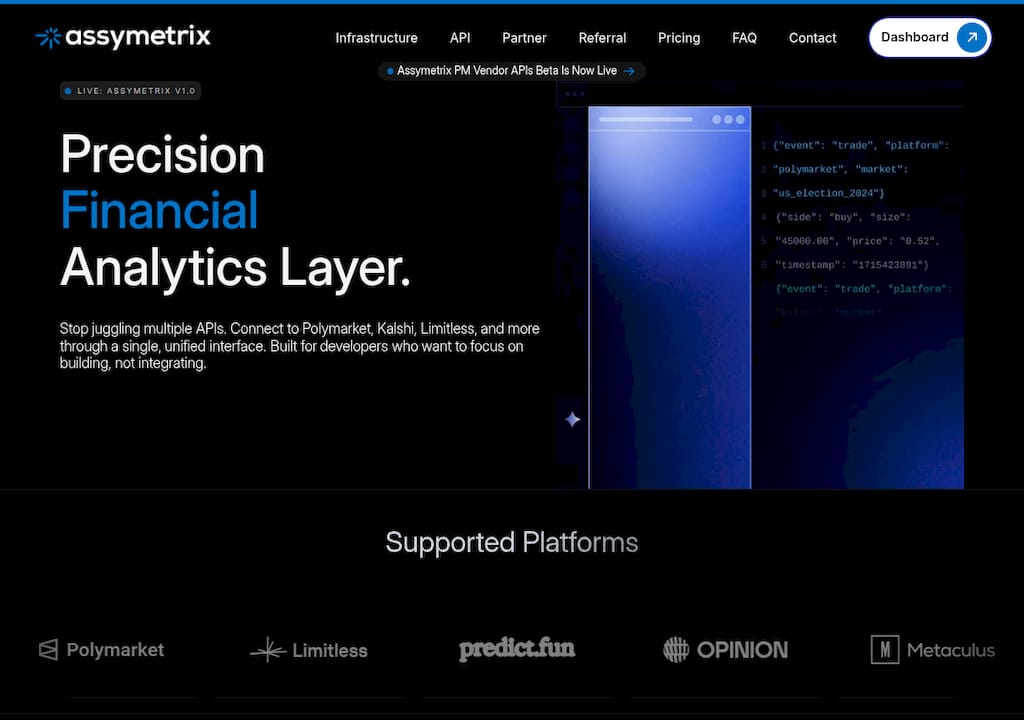
If you’re assembling episodes for a backtester right now, start with the Data API developer guide for endpoint references and sample queries, or go straight to Data to review available tiers and pull a sample historical export for your next validation run.
Sources
FAQ
What Makes Prediction Market Backtesting Different From Equity Backtesting?
Contracts resolve to a binary 0 or 1 payoff and trade as bounded probability estimates, which changes P&L math, fee structures, and requires forecast-quality metrics like Brier score alongside standard financial metrics.
Why Is End-Of-Day Pricing a Problem for Prediction Markets?
EOD prices smooth over the thin, fast-moving liquidity typical of prediction market orderbooks, which overstates achievable fill prices and hides the slippage a real execution would incur.
How Does Look-Ahead Bias Enter a Prediction Market Backtest?
It happens when resolution metadata or settlement timestamps stay mixed into the price data stream instead of being stored and joined separately, letting future outcome information leak into the training window.
What Data Does Assymetrix Provide for Backtesting Infrastructure?
Assymetrix aggregates a very large quantity of normalized historical data spanning many millions of on-chain events across Polymarket, Kalshi, and Limitless, structured for episode-based backtest construction.
What Validation Stage Should Come Before Live Deployment?
Out-of-sample paper trading that mirrors the exact fee, latency, and fill assumptions used in the execution-realistic replay stage, with explicit GO/NO-GO criteria before capital is committed.
Avoid Paper Winners: 5 Backtesting Rules for Prediction Market Engineers
A rigorous prediction market backtest requires deterministic, event-driven replay of orderbook and trade data with explicit fee and settlement modeling built in from the start. Point-in-time historical feeds, like the ones Assymetrix’s Data API supplies, matter because naive backtests built on end-of-day or mid-price snapshots routinely overstate strategy performance, sometimes turning a losing strategy into a paper winner.
TL;DR:
Accurate backtesting requires point-in-time trade, orderbook, and resolution data separated to prevent look-ahead bias and overestimated performance.
Fee modeling must reflect each venue’s specific fee curve, especially near 50% probability, where fees peak and can erase apparent profits.
Implementing strict event ordering and realistic fill assumptions, such as queue-based fills and slippage functions, prevents inflated results caused by oversimplified simulations.
Avoid common mistakes like using end-of-day prices, neglecting liquidity limits, or ignoring delisted markets, which lead to unreliable backtest outcomes.
Reproducible experiments depend on detailed schemas, structured manifests, and staged validation from statistical to out-of-sample testing before live deployment.
Table of Contents
Why Prediction Market Backtesting Breaks Traditional Quant Models
What Building Blocks Does a Rigorous Backtest Need?
Which Execution Rules Prevent Inflated Backtest Results?
What Mistakes Undermine Prediction Market Backtests?
How Do You Run a Reproducible Backtest Experiment?
How Assymetrix Supplies Point-In-Time Data for Backtests
An Engineer’s Take on What Actually Matters
Get Point-In-Time Feeds Through the Assymetrix Data API
Sources
Why Prediction Market Backtesting Breaks Traditional Quant Models
Traditional equity or futures backtesting assumes continuous price discovery and largely uniform microstructure. Prediction markets don’t work that way. Contracts settle to a binary payoff of 0 or 1, and the price you’re modeling the whole time is really a probability estimate bounded between 0 and 1. That changes the P&L math entirely: a position’s expected value depends on both the entry price and the true resolution probability, not just directional movement.
Fee structures compound the problem. Kalshi and Polymarket both apply fee curves that scale roughly with p*(1-p), meaning fees peak near 50% probability and shrink toward the extremes. A strategy that looks profitable on raw price movement can evaporate once fee-at-risk is applied correctly.
Then there’s look-ahead bias from resolution data. Settlement records often carry timestamps or metadata that leak the outcome into your training window unless resolution events are decoupled from the price stream. Add liquidity fragmentation, thinner books than you’d find in equities or FX, and you get a domain where standard financial metrics fall short.
Sharpe ratio alone misses forecast quality; you need Brier score alongside P&L and drawdown.
Fill ratio matters more here than in liquid tradfi markets because resting orders frequently go unfilled.
Fee-at-risk, not just fee-paid, needs its own line item in every episode’s accounting.
The Federal Reserve’s own research on Kalshi’s macro markets notes that these venues generate high-frequency, distributionally rich forecasts under CFTC oversight, which makes them genuinely useful for research, but only if you model venue-specific fee and settlement mechanics rather than treating every market as generic.
What Building Blocks Does a Rigorous Backtest Need?
Five components separate an execution-realistic framework from a toy simulation.
Point-in-time data assembly. You need trade prints, orderbook snapshots, and resolution metadata stored separately, then joined into discrete episodes, one per market or contract lifecycle, so no resolution information contaminates the training window. Open datasets built around Polymarket and Kalshi collection scripts show workable Parquet schemas for this exact separation.
A deterministic event-driven replay engine. Every trade, quote update, and cancellation gets a sequence id and processes in strict chronological order. This is the same design principle behind PredictionMarketBench, which uses seeded, sequence-ordered replay specifically to make agent performance reproducible across runs.
Per-venue fee and settlement models. Maker/taker splits, curved fee formulas, and settlement timing differ across Polymarket, Kalshi, and Limitless. Hardcoding one fee schedule across venues is a fast way to misprice everything.
A fill engine that respects queue position. Market orders hit the visible ask or bid; resting limit orders fill via queue position or pro-rata allocation depending on venue rules, and partial fills need explicit handling rather than being rounded away.
Accounting and risk infrastructure. Track gross cash-at-risk (not just net exposure), enforce position limits, and log run artifacts, seed values, timestamps, config hashes, so every backtest run is auditable after the fact.
Skip any one of these and you’re not backtesting a strategy. You’re backtesting a fantasy version of the market that happened to move in your favor.
Which Execution Rules Prevent Inflated Backtest Results?
The fill engine is where most inflated backtests get built, usually by accident. A handful of implementation choices determine whether your simulator reflects reality or just flatters your strategy.
Enforce strict event ordering with sequence ids, not wall-clock timestamps alone, since two events can share a timestamp but arrive in a specific order that changes who gets filled first.
Model market orders as filling against the visible ask or bid, and resting limit orders as filling only when queue position or pro-rata share justifies it, never assuming top-of-book access by default.
Decide explicitly between bar-delay latency (apply a fixed lag per bar) and per-event injection (a variable delay per message), and document which one you chose and why, since they produce meaningfully different fill prices in thin books.
Attach a configurable slippage or price-impact function to every fill rather than a single flat spread assumption across all order sizes.
Apply fees per fill, not per trade batch, since fee-at-risk shifts the optimal maker/taker balance for anything resting near 50% probability.
Pro Tip: When orderbook depth is missing for a stretch of history, fall back to trade-level fills with a conservative spread proxy, and flag those episodes in your logs. Never let a fallback fill silently masquerade as a book-based fill in your results.
What Mistakes Undermine Prediction Market Backtests?
Most failed backtests trace back to five repeatable errors, and each has a specific fix.
Using end-of-day or midpoint prices instead of trade-level data. Fix: replay actual trade prints and book snapshots at native resolution, not daily aggregates.
Letting resolution data bleed into the price stream. Fix: store settlement records in a separate table and join them only after the episode’s price window closes.
Assuming infinite liquidity at top-of-book. Fix: model queue depth and cap fill size to available volume at each price level.
Ignoring survivorship and delisting bias. Fix: keep records for markets that closed early or were delisted, and include those episodes in your test set rather than only backtesting on markets that survived to a clean resolution.
Under-modeling fees and settlement costs. Fix: apply venue-specific fee-at-risk formulas per fill, not a flat percentage estimate applied at the end.
Open-source frameworks built around these exact failure modes, including the prediction market backtesting toolkit from apex-dao, consistently emphasize decoupling settlement events and preserving delisted-market history as the two highest-leverage fixes.
How Do You Run a Reproducible Backtest Experiment?
A reproducible experiment comes down to schema discipline, a documented manifest, and clear gates before anything touches real capital.
Define an episode schema. Store three record types per market: trade prints, orderbook/snapshot state, and resolution records. Parquet works well for snapshots and trades; ndjson suits event logs you want to stream or diff.
Write an experiment manifest. Record instrument id, fee model version, latency model choice, random seed, and start/end timestamps in ISO 8601 format for every run.
Generate structured outputs. Every run should produce a trade log, an equity curve, and per-episode metrics: P&L, drawdown, Brier score, fill ratio, and total fees paid.
Apply validation gates before deployment. Move from statistical research validation, to execution-realistic replay, to out-of-sample paper trading, with explicit GO/NO-GO criteria at each stage.
Stage | Question it answers | Failure signal |
|---|---|---|
Statistical validation | Is the edge real in aggregate? | Edge disappears outside the sample window |
Execution-realistic replay | Does the edge survive fees and fills? | P&L collapses once fees/slippage applied |
Out-of-sample paper trading | Does it hold on unseen, live data? | Fill ratio or Brier score degrades sharply |
This staged pipeline mirrors standard guidance from QuantConnect’s developer documentation, and the same GO/NO-GO discipline shows up in runnable form in the Quentin-Piot prediction market backtester, which ships CLI examples for exactly this kind of staged validation.
How Assymetrix Supplies Point-In-Time Data for Backtests
Building the episode structures above requires historical coverage deep enough to include delisted markets, thin-liquidity periods, and full resolution metadata, not just clean survivors.
Assymetrix aggregates a very large quantity of normalized historical data spanning many millions of on-chain events across Polymarket, Kalshi, and Limitless.
The dataset includes a very large number of price snapshots, with sufficient density to reconstruct orderbook state at native resolution rather than interpolating between sparse points, as detailed in Assymetrix’s own backtesting analysis.
Historical snapshot and realtime WebSocket endpoints share a common timestamp convention, which simplifies joining resolution records to price history without introducing look-ahead leakage.
Episode-ready exports let you pull a single market’s full lifecycle, trades, snapshots, and resolution, in one query rather than stitching three separate data sources together.
Combined with a cross-venue signal guide for building Smart Money and arbitrage features, this gives researchers a data foundation that matches the execution-realistic replay standard the rest of this framework depends on.
An Engineer’s Take on What Actually Matters
Get deterministic replay and conservative fill assumptions right before you touch optimization. Gate any live deployment behind out-of-sample paper trading that mirrors your replay engine’s exact assumptions. Most backtest failures trace back to sloppy resolution-event handling, not bad strategy logic.
*— Dean
Get Point-In-Time Feeds Through the Assymetrix Data API
Everything in this framework depends on data that preserves execution reality: normalized schemas across venues, episode-ready exports, and resolution records kept separate from price history. Assymetrix’s Data API was built around exactly that requirement, giving developers a single integration point for cross-venue historical snapshots, Smart Money wallet tracking, and and trader skill scoring instead of stitching together three separate venue feeds by hand.
If you’re assembling episodes for a backtester right now, start with the Data API developer guide for endpoint references and sample queries, or go straight to Data to review available tiers and pull a sample historical export for your next validation run.
Sources
FAQ
What Makes Prediction Market Backtesting Different From Equity Backtesting?
Contracts resolve to a binary 0 or 1 payoff and trade as bounded probability estimates, which changes P&L math, fee structures, and requires forecast-quality metrics like Brier score alongside standard financial metrics.
Why Is End-Of-Day Pricing a Problem for Prediction Markets?
EOD prices smooth over the thin, fast-moving liquidity typical of prediction market orderbooks, which overstates achievable fill prices and hides the slippage a real execution would incur.
How Does Look-Ahead Bias Enter a Prediction Market Backtest?
It happens when resolution metadata or settlement timestamps stay mixed into the price data stream instead of being stored and joined separately, letting future outcome information leak into the training window.
What Data Does Assymetrix Provide for Backtesting Infrastructure?
Assymetrix aggregates a very large quantity of normalized historical data spanning many millions of on-chain events across Polymarket, Kalshi, and Limitless, structured for episode-based backtest construction.
What Validation Stage Should Come Before Live Deployment?
Out-of-sample paper trading that mirrors the exact fee, latency, and fill assumptions used in the execution-realistic replay stage, with explicit GO/NO-GO criteria before capital is committed.
Other Blog


