Prediction Market API: Real-Time Kalshi and Polymarket Data
Prediction Market API: Real-Time Kalshi and Polymarket Data
Prediction Market API: Real-Time Kalshi and Polymarket Data
Unlock real-time insights with the Prediction Market API. Access Kalshi and Polymarket data seamlessly with a single unified endpoint.

Prediction Market API: Real-Time Kalshi and Polymarket Data
The fastest path to real-time Kalshi and Polymarket data is a unified prediction market API that normalizes both platforms into a single endpoint. Instead of maintaining two separate codebases with incompatible authentication schemes, data schemas, and rate limit logic, you query one base URL and receive consistent JSON across both venues. Assymetrix delivers exactly this at data.assymetrix.com), built on a large historical dataset spanning substantial trading activity.
Key capabilities you get from a unified prediction market API:
Single API key across Kalshi and Polymarket with no per-platform credential management
Normalized JSON schemas covering order books, price history, wallet activity, volume, and resolution data
WebSocket streaming for sub-second order book updates without REST polling overhead
Cross-venue market discovery mapping natural-language queries to venue-specific market IDs
Smart Money wallet tracking and Trader Skill Scores sourced from on-chain Polymarket data
Historical depth for backtesting pipelines and quant research workflows
Table of Contents
What does the Kalshi API give you?
What does the Polymarket API give you?
Why integrating Kalshi and Polymarket separately is painful
How a unified prediction market API solves the integration problem
How to get started with the Assymetrix prediction market data API
What can you build with real-time prediction market data?
Assymetrix: unified prediction market intelligence for developers
Key Takeaways
What does the Kalshi API give you?
Kalshi operates as a CFTC-regulated exchange settling in USD, which means its API architecture looks like a traditional financial exchange rather than a blockchain protocol. The REST and WebSocket endpoints live under a single base URL: https://api.elections.kalshi.com/trade-api/v2. Despite the subdomain name, this endpoint covers all Kalshi markets including economics, weather, sports, and technology.
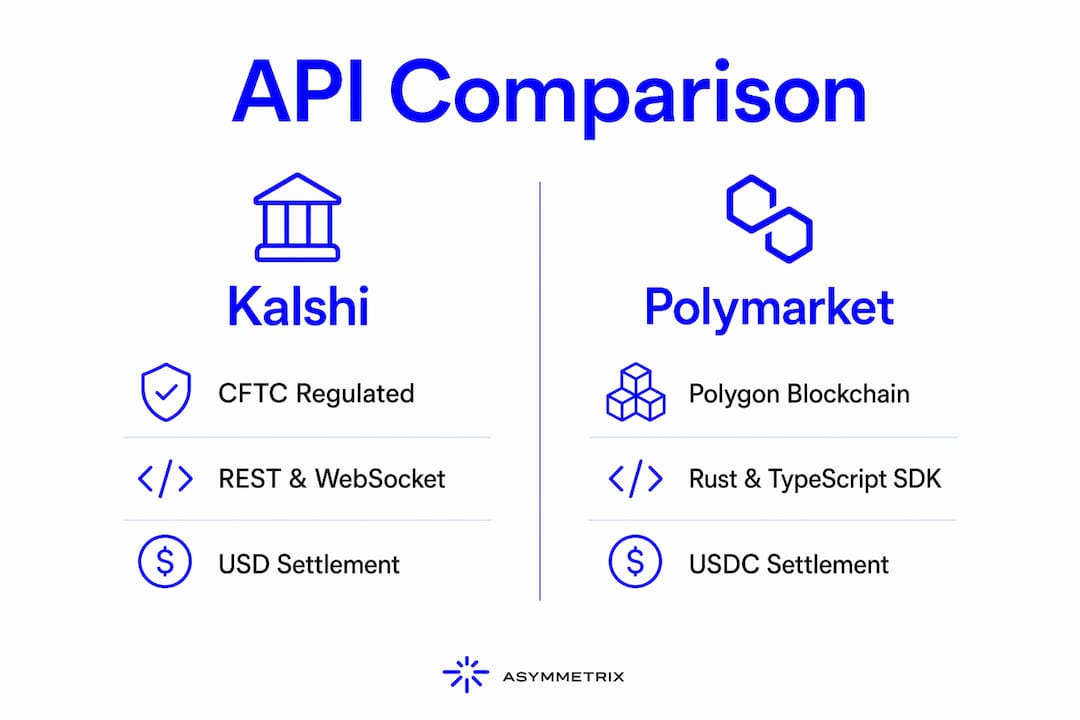
Authentication uses API keys signed with RSA signatures for trading operations. Read-only market data requires no authentication at all, which makes initial exploration straightforward. For testing, Kalshi provides a dedicated demo environment at https://demo-api.kalshi.co/trade-api/v2 before you touch production.
Key data features available through the Kalshi API:
Market and series data: events, market metadata, resolution dates, and series structure for multi-contract markets like CPI outcome ranges
Order book: live snapshots via WebSocket on the
orderbookchannel;tickerandtradeschannels for price and volume updatesPortfolio endpoints: order placement via authenticated POST to
/portfolio/orders, position tracking, and fill historyHistorical data: trade history and settlement data accessible through REST
Rate limits: approximately 10 requests per second for market data endpoints, with stricter limits on order placement; WebSocket requires heartbeat and reconnect logic
Fees: 0% fees on all trades as of 2026
The WebSocket base URL is wss://api.elections.kalshi.com/trade-api/ws/v2, supporting channels for orderbook, ticker, trades, fills, market_lifecycle, and order_group_updates. Kalshi’s Python SDK (kalshi_python_sync) and TypeScript SDK (kalshi-typescript) are both officially maintained.
What does the Polymarket API give you?
Polymarket’s architecture is fundamentally different. It runs on the Polygon blockchain (Chain ID: 137) with USDC settlement and EIP-712 typed-data signing for order execution. There is no centralized matching engine. Orders are submitted to a Central Limit Order Book (CLOB) API that interacts with on-chain smart contracts, and gas costs are covered by Polymarket via meta-transactions.

Market discovery and trading are split across two separate domains. The Gamma API at https://gamma-api.polymarket.com handles browsing, keyword search, and market metadata. The CLOB API at https://clob.polymarket.com handles live order books and order placement. This separation adds a routing layer that developers must account for from the start.
Key data features available through the Polymarket API:
Market discovery: Gamma API for listing active markets, filtering by category, and fetching event details
Order book: WebSocket stream at
wss://ws-subscriptions-clob.polymarket.com/ws/with incremental book updates on themarketchannelWallet analytics: on-chain transparency enables public wallet tracking, trader profiling, and position history unavailable on centralized venues
Historical data: REST endpoints for trade history plus downloadable daily snapshots
Authentication: EIP-712 wallet signatures for trading; read-only market data requires no auth
Rate limits: up to 15,000 requests per 10 seconds for general endpoints, with per-endpoint variation
Fees: taker fees by category since March 30, 2026 (Crypto 1.80%, Sports 0.75%, Politics 1.00%, among others); maker rebates range 20–50% by category
Polymarket also provides a Rust-based CLI tool installable via Homebrew, a Python SDK (py-clob-client-v2), and a TypeScript SDK (@polymarket/clob-client-v2). US residents face access restrictions on most contracts. A separate US platform at api.polymarket.us requires KYC and uses Ed25519 authentication.
Why integrating Kalshi and Polymarket separately is painful
The core problem is architectural divergence. Kalshi is a centralized exchange with standard REST/WebSocket patterns and API key authentication. Polymarket is a decentralized protocol requiring Ethereum wallet management, on-chain order signing, and blockchain confirmation awareness. These are not minor differences in endpoint naming. They require fundamentally different client implementations.
Maintaining two codebases compounds quickly:
Dual authentication systems: RSA-signed API keys for Kalshi; EIP-712 wallet signatures and smart contract interaction for Polymarket
Schema mismatches: Kalshi prices contracts in cents (1–99); Polymarket prices in USDC per share (0.00–1.00). Aggregating these without normalization produces nonsense
Split market discovery: Polymarket separates browsing from trading across two domains; Kalshi integrates both in one API, so cross-platform market matching requires custom mapping logic
Latency asymmetry: Polymarket’s on-chain settlement introduces blockchain confirmation delays; Kalshi’s centralized engine does not. Handling both in one trading loop requires separate latency budgets
Rate limit management: Kalshi’s ~10 req/sec REST limit and Polymarket’s per-endpoint variation mean separate backoff and retry logic for each platform
Error handling: 429 responses, WebSocket disconnects, and reconnect logic differ between platforms and must be handled independently
The discovery problem alone is underestimated. Finding matching markets across both venues requires mapping natural-language queries like “Will the Fed cut rates?” to venue-specific market IDs. Without a semantic search layer, this is a manual process that breaks every time either platform restructures its event taxonomy.

How a unified prediction market API solves the integration problem
A unified prediction market API abstracts all of the above behind a single interface. You authenticate once, query one base URL, and receive normalized JSON regardless of whether the underlying data originated from Kalshi or Polymarket. The platform handles routing, schema translation, and platform-specific edge cases on its side.
The practical gains are concrete. Unified APIs normalize endpoints from multiple platforms into one base URL, eliminating the need to parse two different response formats. A single API key replaces per-platform credential management. Cross-venue market discovery becomes a single search call rather than parallel queries with custom ID mapping.
Feature | Kalshi native API | Polymarket native API | Unified API (Assymetrix) |
|---|---|---|---|
Authentication | API key + RSA signature | EIP-712 wallet signature | Single API key |
Data schema | Platform-specific JSON | Platform-specific JSON | Normalized JSON across venues |
Market discovery | Single REST endpoint | Gamma API + CLOB API (two domains) | One search endpoint, cross-venue |
Order book access | WebSocket snapshots | WebSocket incremental updates | Unified WebSocket stream |
Wallet analytics | Not available | On-chain, public | Available via unified endpoint |
Historical data | REST trade history | REST + daily snapshots | Consolidated, normalized |
Rate limit handling | Managed by developer | Managed by developer | Abstracted by platform |
Pricing | Free with verified account | Free (read); fees on trades | Subscription tiers |
Beyond normalization, a unified layer adds intelligence that neither native API provides. Assymetrix surfaces Smart Money wallet tracking and Trader Skill Scores derived from Polymarket’s on-chain data. These signals feed directly into AI forecasting models and quant research pipelines without requiring developers to build their own on-chain indexers.
Pro Tip: When evaluating any unified prediction market API, check whether wallet analytics are available for both platforms or only Polymarket. Kalshi operates as a regulated centralized exchange and does not expose individual account data publicly, so any provider claiming full wallet analytics on Kalshi is overstating their coverage.
How to get started with the Assymetrix prediction market data API
The Assymetrix Data API at data.assymetrix.com provides unified access to Kalshi and Polymarket data through a single integration. The setup process follows a straightforward progression from registration to live streaming.
Register and retrieve your API key. Create an account at data.assymetrix.com. Your API key is available in the dashboard immediately after account verification. No per-platform credentials are required.
Configure your request headers. Pass your API key in the
X-API-Keyheader on every request. All endpoints return JSON with a consistent structure regardless of the source platform.Discover markets. Query the market discovery endpoint with optional filters for platform, category, status, and sort order. The response includes normalized market IDs, current prices, volume, and closing times for both Kalshi and Polymarket markets in a single call.
GET https://data.assymetrix.com/markets?platform=kalshi&status=active&limit=10
X-API-Key: your-api-key
GET https://data.assymetrix.com/markets?platform=kalshi&status=active&limit=10
X-API-Key: your-api-key
Pull real-time order book data. Use the REST order book endpoint for snapshots, or connect to the WebSocket feed for live updates. Professional trading bot developers use WebSocket streams for sub-second order book data and reserve REST calls for authentication and initial data fetches.
import requests

headers = {"X-API-Key": "your-api-key"}
r = requests.get(
    "https://data.assymetrix.com/markets/{market_id}/orderbook",
    params={"depth": 10},
    headers=headers
)
print(r.json())
import requests

headers = {"X-API-Key": "your-api-key"}
r = requests.get(
    "https://data.assymetrix.com/markets/{market_id}/orderbook",
    params={"depth": 10},
    headers=headers
)
print(r.json())
Connect to the WebSocket stream. Subscribe to live order book and trade data by passing your API key during the handshake. The stream pushes updates as they occur, eliminating polling overhead entirely.
Handle rate limits gracefully. Implement exponential backoff with jitter on 429 responses. Cache market metadata locally and refresh infrequently. Use circuit breakers that halt trading if error rates exceed a defined threshold. Log all requests and responses for debugging and audit purposes.
Access historical data. The historical endpoint returns OHL CV-format candles and trade-level data across both platforms in a consistent schema, ready for backtesting pipelines without additional normalization.
What can you build with real-time prediction market data?
The data layer unlocks a range of applications that would require months of custom infrastructure to build against native APIs individually.
Automated trading bots are the most direct application. A bot consuming unified WebSocket order book data from both Kalshi and Polymarket can execute on price signals without managing two separate connection pools or parsing two response formats. Fault-tolerant connections with retry logic and local caching are standard practice for production bots on either platform.
Cross-venue arbitrage scanners depend entirely on the ability to match equivalent markets across venues and compare prices in real time. The prediction market stack at the data layer is what makes this possible without building a custom semantic matching engine. Assymetrix surfaces arbitrage signals directly, so developers can focus on execution logic rather than data plumbing. You can also build an arbitrage scanner in under 30 minutes using the unified API.
AI forecasting agents need structured, reliable probability data as input. Prediction market prices are crowd-sourced probability estimates, and feeding them into language model pipelines or forecasting models requires consistent schemas and low-latency delivery. On-chain Polymarket data enables Smart Money tracking and trader skill scoring that centralized venues cannot replicate, giving AI agents a signal layer beyond raw price feeds.
Quant research and backtesting workflows benefit from the nearly one billion rows of historical trading activity in the Assymetrix data layer. Researchers can run backtesting strategies against 200M+ price snapshots without building their own data warehouse. Normalized historical data across both platforms also enables cross-venue strategy comparison that is otherwise impossible when schemas differ.
Proprietary dashboards and signal platforms can pull live odds, volume, and wallet analytics through a single integration. Tracking liquidity shifts across venues alongside prediction market probability movements gives traders a fuller picture of where informed money is moving.
Assymetrix: unified prediction market intelligence for developers
Developers and quant traders who need real-time Kalshi and Polymarket data without the overhead of two separate integrations have a direct path at data.assymetrix.com.
Assymetrix consolidates both platforms into a single API key, normalized JSON schemas, and WebSocket streams built on approximately 1.5 terabytes of historical data. Beyond raw market data, the platform surfaces Smart Money wallet tracking, Trader Skill Scores, cross-venue arbitrage signals, and market divergence intelligence. The 2026 prediction market accuracy guide covers how to evaluate data quality and use these signals in production workflows. Start querying live Kalshi and Polymarket data at data.assymetrix.com.
Key Takeaways
A unified prediction market API is the most efficient way to access real-time Kalshi and Polymarket data, eliminating dual authentication, schema mismatches, and split market discovery in a single integration.
Point | Details |
|---|---|
Kalshi API structure | REST and WebSocket under one base URL; enforces rate limits; no trading fees reported; demo environment available |
Polymarket API structure | Decentralized CLOB on Polygon; EIP-712 wallet auth; market discovery split across Gamma and CLOB domains |
Integration pain points | Dual auth schemes, incompatible schemas, separate rate limit logic, and cross-venue market ID mapping all require custom code |
Unified API advantage | Single API key and normalized JSON across both platforms; wallet analytics, arbitrage signals, and historical data included |
Assymetrix Data API | Unified access at data.assymetrix.com, built on extensive historical data and large trading datasets |
FAQ
What is a unified prediction market API?
A unified prediction market API consolidates data from multiple venues like Kalshi and Polymarket into a single endpoint with normalized schemas, so developers query one base URL instead of maintaining separate integrations for each platform.
Does Kalshi or Polymarket offer free API access?
Both platforms provide free read-only market data access. Kalshi requires a verified account for trading endpoints; Polymarket requires a connected Ethereum wallet and USDC on Polygon for order placement.
What are Kalshi’s API rate limits?
Kalshi’s REST API enforces rate limits on requests per second for market data endpoints, with stricter limits on order placement. Exceeding limits returns a 429 status code; exponential backoff with jitter is the standard mitigation.
Can I track Smart Money wallets through a prediction market API?
Smart Money wallet tracking is available for Polymarket because all trading activity is publicly recorded on the Polygon blockchain. Kalshi operates as a centralized regulated exchange and does not expose individual account data publicly. Assymetrix surfaces Polymarket wallet analytics and Trader Skill Scores through its unified API.
How do I start accessing real-time Kalshi and Polymarket data together?
Register at data.assymetrix.com, retrieve your API key, and query the unified market discovery endpoint. The platform normalizes data from both venues into consistent JSON, with WebSocket streaming available for real-time order book updates.
Prediction Market API: Real-Time Kalshi and Polymarket Data
The fastest path to real-time Kalshi and Polymarket data is a unified prediction market API that normalizes both platforms into a single endpoint. Instead of maintaining two separate codebases with incompatible authentication schemes, data schemas, and rate limit logic, you query one base URL and receive consistent JSON across both venues. Assymetrix delivers exactly this at data.assymetrix.com), built on a large historical dataset spanning substantial trading activity.
Key capabilities you get from a unified prediction market API:
Single API key across Kalshi and Polymarket with no per-platform credential management
Normalized JSON schemas covering order books, price history, wallet activity, volume, and resolution data
WebSocket streaming for sub-second order book updates without REST polling overhead
Cross-venue market discovery mapping natural-language queries to venue-specific market IDs
Smart Money wallet tracking and Trader Skill Scores sourced from on-chain Polymarket data
Historical depth for backtesting pipelines and quant research workflows
Table of Contents
What does the Kalshi API give you?
What does the Polymarket API give you?
Why integrating Kalshi and Polymarket separately is painful
How a unified prediction market API solves the integration problem
How to get started with the Assymetrix prediction market data API
What can you build with real-time prediction market data?
Assymetrix: unified prediction market intelligence for developers
Key Takeaways
What does the Kalshi API give you?
Kalshi operates as a CFTC-regulated exchange settling in USD, which means its API architecture looks like a traditional financial exchange rather than a blockchain protocol. The REST and WebSocket endpoints live under a single base URL: https://api.elections.kalshi.com/trade-api/v2. Despite the subdomain name, this endpoint covers all Kalshi markets including economics, weather, sports, and technology.
Authentication uses API keys signed with RSA signatures for trading operations. Read-only market data requires no authentication at all, which makes initial exploration straightforward. For testing, Kalshi provides a dedicated demo environment at https://demo-api.kalshi.co/trade-api/v2 before you touch production.
Key data features available through the Kalshi API:
Market and series data: events, market metadata, resolution dates, and series structure for multi-contract markets like CPI outcome ranges
Order book: live snapshots via WebSocket on the
orderbookchannel;tickerandtradeschannels for price and volume updatesPortfolio endpoints: order placement via authenticated POST to
/portfolio/orders, position tracking, and fill historyHistorical data: trade history and settlement data accessible through REST
Rate limits: approximately 10 requests per second for market data endpoints, with stricter limits on order placement; WebSocket requires heartbeat and reconnect logic
Fees: 0% fees on all trades as of 2026
The WebSocket base URL is wss://api.elections.kalshi.com/trade-api/ws/v2, supporting channels for orderbook, ticker, trades, fills, market_lifecycle, and order_group_updates. Kalshi’s Python SDK (kalshi_python_sync) and TypeScript SDK (kalshi-typescript) are both officially maintained.
What does the Polymarket API give you?
Polymarket’s architecture is fundamentally different. It runs on the Polygon blockchain (Chain ID: 137) with USDC settlement and EIP-712 typed-data signing for order execution. There is no centralized matching engine. Orders are submitted to a Central Limit Order Book (CLOB) API that interacts with on-chain smart contracts, and gas costs are covered by Polymarket via meta-transactions.
Market discovery and trading are split across two separate domains. The Gamma API at https://gamma-api.polymarket.com handles browsing, keyword search, and market metadata. The CLOB API at https://clob.polymarket.com handles live order books and order placement. This separation adds a routing layer that developers must account for from the start.
Key data features available through the Polymarket API:
Market discovery: Gamma API for listing active markets, filtering by category, and fetching event details
Order book: WebSocket stream at
wss://ws-subscriptions-clob.polymarket.com/ws/with incremental book updates on themarketchannelWallet analytics: on-chain transparency enables public wallet tracking, trader profiling, and position history unavailable on centralized venues
Historical data: REST endpoints for trade history plus downloadable daily snapshots
Authentication: EIP-712 wallet signatures for trading; read-only market data requires no auth
Rate limits: up to 15,000 requests per 10 seconds for general endpoints, with per-endpoint variation
Fees: taker fees by category since March 30, 2026 (Crypto 1.80%, Sports 0.75%, Politics 1.00%, among others); maker rebates range 20–50% by category
Polymarket also provides a Rust-based CLI tool installable via Homebrew, a Python SDK (py-clob-client-v2), and a TypeScript SDK (@polymarket/clob-client-v2). US residents face access restrictions on most contracts. A separate US platform at api.polymarket.us requires KYC and uses Ed25519 authentication.
Why integrating Kalshi and Polymarket separately is painful
The core problem is architectural divergence. Kalshi is a centralized exchange with standard REST/WebSocket patterns and API key authentication. Polymarket is a decentralized protocol requiring Ethereum wallet management, on-chain order signing, and blockchain confirmation awareness. These are not minor differences in endpoint naming. They require fundamentally different client implementations.
Maintaining two codebases compounds quickly:
Dual authentication systems: RSA-signed API keys for Kalshi; EIP-712 wallet signatures and smart contract interaction for Polymarket
Schema mismatches: Kalshi prices contracts in cents (1–99); Polymarket prices in USDC per share (0.00–1.00). Aggregating these without normalization produces nonsense
Split market discovery: Polymarket separates browsing from trading across two domains; Kalshi integrates both in one API, so cross-platform market matching requires custom mapping logic
Latency asymmetry: Polymarket’s on-chain settlement introduces blockchain confirmation delays; Kalshi’s centralized engine does not. Handling both in one trading loop requires separate latency budgets
Rate limit management: Kalshi’s ~10 req/sec REST limit and Polymarket’s per-endpoint variation mean separate backoff and retry logic for each platform
Error handling: 429 responses, WebSocket disconnects, and reconnect logic differ between platforms and must be handled independently
The discovery problem alone is underestimated. Finding matching markets across both venues requires mapping natural-language queries like “Will the Fed cut rates?” to venue-specific market IDs. Without a semantic search layer, this is a manual process that breaks every time either platform restructures its event taxonomy.
How a unified prediction market API solves the integration problem
A unified prediction market API abstracts all of the above behind a single interface. You authenticate once, query one base URL, and receive normalized JSON regardless of whether the underlying data originated from Kalshi or Polymarket. The platform handles routing, schema translation, and platform-specific edge cases on its side.
The practical gains are concrete. Unified APIs normalize endpoints from multiple platforms into one base URL, eliminating the need to parse two different response formats. A single API key replaces per-platform credential management. Cross-venue market discovery becomes a single search call rather than parallel queries with custom ID mapping.
Feature | Kalshi native API | Polymarket native API | Unified API (Assymetrix) |
|---|---|---|---|
Authentication | API key + RSA signature | EIP-712 wallet signature | Single API key |
Data schema | Platform-specific JSON | Platform-specific JSON | Normalized JSON across venues |
Market discovery | Single REST endpoint | Gamma API + CLOB API (two domains) | One search endpoint, cross-venue |
Order book access | WebSocket snapshots | WebSocket incremental updates | Unified WebSocket stream |
Wallet analytics | Not available | On-chain, public | Available via unified endpoint |
Historical data | REST trade history | REST + daily snapshots | Consolidated, normalized |
Rate limit handling | Managed by developer | Managed by developer | Abstracted by platform |
Pricing | Free with verified account | Free (read); fees on trades | Subscription tiers |
Beyond normalization, a unified layer adds intelligence that neither native API provides. Assymetrix surfaces Smart Money wallet tracking and Trader Skill Scores derived from Polymarket’s on-chain data. These signals feed directly into AI forecasting models and quant research pipelines without requiring developers to build their own on-chain indexers.
Pro Tip: When evaluating any unified prediction market API, check whether wallet analytics are available for both platforms or only Polymarket. Kalshi operates as a regulated centralized exchange and does not expose individual account data publicly, so any provider claiming full wallet analytics on Kalshi is overstating their coverage.
How to get started with the Assymetrix prediction market data API
The Assymetrix Data API at data.assymetrix.com provides unified access to Kalshi and Polymarket data through a single integration. The setup process follows a straightforward progression from registration to live streaming.
Register and retrieve your API key. Create an account at data.assymetrix.com. Your API key is available in the dashboard immediately after account verification. No per-platform credentials are required.
Configure your request headers. Pass your API key in the
X-API-Keyheader on every request. All endpoints return JSON with a consistent structure regardless of the source platform.Discover markets. Query the market discovery endpoint with optional filters for platform, category, status, and sort order. The response includes normalized market IDs, current prices, volume, and closing times for both Kalshi and Polymarket markets in a single call.
GET https://data.assymetrix.com/markets?platform=kalshi&status=active&limit=10
X-API-Key: your-api-key
Pull real-time order book data. Use the REST order book endpoint for snapshots, or connect to the WebSocket feed for live updates. Professional trading bot developers use WebSocket streams for sub-second order book data and reserve REST calls for authentication and initial data fetches.
import requests

headers = {"X-API-Key": "your-api-key"}
r = requests.get(
    "https://data.assymetrix.com/markets/{market_id}/orderbook",
    params={"depth": 10},
    headers=headers
)
print(r.json())
Connect to the WebSocket stream. Subscribe to live order book and trade data by passing your API key during the handshake. The stream pushes updates as they occur, eliminating polling overhead entirely.
Handle rate limits gracefully. Implement exponential backoff with jitter on 429 responses. Cache market metadata locally and refresh infrequently. Use circuit breakers that halt trading if error rates exceed a defined threshold. Log all requests and responses for debugging and audit purposes.
Access historical data. The historical endpoint returns OHL CV-format candles and trade-level data across both platforms in a consistent schema, ready for backtesting pipelines without additional normalization.
What can you build with real-time prediction market data?
The data layer unlocks a range of applications that would require months of custom infrastructure to build against native APIs individually.
Automated trading bots are the most direct application. A bot consuming unified WebSocket order book data from both Kalshi and Polymarket can execute on price signals without managing two separate connection pools or parsing two response formats. Fault-tolerant connections with retry logic and local caching are standard practice for production bots on either platform.
Cross-venue arbitrage scanners depend entirely on the ability to match equivalent markets across venues and compare prices in real time. The prediction market stack at the data layer is what makes this possible without building a custom semantic matching engine. Assymetrix surfaces arbitrage signals directly, so developers can focus on execution logic rather than data plumbing. You can also build an arbitrage scanner in under 30 minutes using the unified API.
AI forecasting agents need structured, reliable probability data as input. Prediction market prices are crowd-sourced probability estimates, and feeding them into language model pipelines or forecasting models requires consistent schemas and low-latency delivery. On-chain Polymarket data enables Smart Money tracking and trader skill scoring that centralized venues cannot replicate, giving AI agents a signal layer beyond raw price feeds.
Quant research and backtesting workflows benefit from the nearly one billion rows of historical trading activity in the Assymetrix data layer. Researchers can run backtesting strategies against 200M+ price snapshots without building their own data warehouse. Normalized historical data across both platforms also enables cross-venue strategy comparison that is otherwise impossible when schemas differ.
Proprietary dashboards and signal platforms can pull live odds, volume, and wallet analytics through a single integration. Tracking liquidity shifts across venues alongside prediction market probability movements gives traders a fuller picture of where informed money is moving.
Assymetrix: unified prediction market intelligence for developers
Developers and quant traders who need real-time Kalshi and Polymarket data without the overhead of two separate integrations have a direct path at data.assymetrix.com.
Assymetrix consolidates both platforms into a single API key, normalized JSON schemas, and WebSocket streams built on approximately 1.5 terabytes of historical data. Beyond raw market data, the platform surfaces Smart Money wallet tracking, Trader Skill Scores, cross-venue arbitrage signals, and market divergence intelligence. The 2026 prediction market accuracy guide covers how to evaluate data quality and use these signals in production workflows. Start querying live Kalshi and Polymarket data at data.assymetrix.com.
Key Takeaways
A unified prediction market API is the most efficient way to access real-time Kalshi and Polymarket data, eliminating dual authentication, schema mismatches, and split market discovery in a single integration.
Point | Details |
|---|---|
Kalshi API structure | REST and WebSocket under one base URL; enforces rate limits; no trading fees reported; demo environment available |
Polymarket API structure | Decentralized CLOB on Polygon; EIP-712 wallet auth; market discovery split across Gamma and CLOB domains |
Integration pain points | Dual auth schemes, incompatible schemas, separate rate limit logic, and cross-venue market ID mapping all require custom code |
Unified API advantage | Single API key and normalized JSON across both platforms; wallet analytics, arbitrage signals, and historical data included |
Assymetrix Data API | Unified access at data.assymetrix.com, built on extensive historical data and large trading datasets |
FAQ
What is a unified prediction market API?
A unified prediction market API consolidates data from multiple venues like Kalshi and Polymarket into a single endpoint with normalized schemas, so developers query one base URL instead of maintaining separate integrations for each platform.
Does Kalshi or Polymarket offer free API access?
Both platforms provide free read-only market data access. Kalshi requires a verified account for trading endpoints; Polymarket requires a connected Ethereum wallet and USDC on Polygon for order placement.
What are Kalshi’s API rate limits?
Kalshi’s REST API enforces rate limits on requests per second for market data endpoints, with stricter limits on order placement. Exceeding limits returns a 429 status code; exponential backoff with jitter is the standard mitigation.
Can I track Smart Money wallets through a prediction market API?
Smart Money wallet tracking is available for Polymarket because all trading activity is publicly recorded on the Polygon blockchain. Kalshi operates as a centralized regulated exchange and does not expose individual account data publicly. Assymetrix surfaces Polymarket wallet analytics and Trader Skill Scores through its unified API.
How do I start accessing real-time Kalshi and Polymarket data together?
Register at data.assymetrix.com, retrieve your API key, and query the unified market discovery endpoint. The platform normalizes data from both venues into consistent JSON, with WebSocket streaming available for real-time order book updates.
Other Blog


