Polymarket Trading Bots in 2026: The Developer's Guide
Polymarket Trading Bots in 2026: The Developer's Guide
Polymarket Trading Bots in 2026: The Developer's Guide
Discover the best Polymarket trading bots of 2026. Learn which tools to enhance your trading strategy and capture market inefficiencies!

Polymarket Trading Bots in 2026: The Developer’s Guide
What are the best Polymarket trading bots right now?
The leading Polymarket trading bots in 2026 span three distinct categories: sniping bots (PolyCop, PolyGun), modular strategy platforms (PredictEngine, Stand), arbitrage and market-making engines (TurbineFi, Fireplace, FORS, PolyClaw), and data intelligence layers (Assymetrix Data API). Each targets a different inefficiency in Polymarket’s CLOB-based prediction markets.
The bots that consistently outperform treat Polymarket like a high-frequency trading venue. Uptime, RPC reliability, and execution latency matter more than model complexity. A bot that fires 50ms faster than the next one captures the arbitrage window. One that goes offline for 90 seconds misses the resolution snipe entirely.
Tool | Bot Type | Key Features | Best For |
|---|---|---|---|
Data intelligence | Cross-venue unified API, Smart Money tracking, ~1B rows indexed, arbitrage signals | Developers needing consolidated multi-venue market intelligence | |
PolyCop | Sniping | Sub-second wallet replication, Telegram interface | Wallet follow and real-time trade mirroring |
PolyGun | Sniping | Rapid order placement, minimal user intervention | Automated sniping with low latency |
PredictEngine | Modular strategy | multiple strategies, live dashboard, AI forecast module | Quants needing diverse strategies and monitoring |
TurbineFi | Arbitrage/market making | Configurable risk controls, local dashboard, liquidity filters | Hedged trades and exposure management |
Stand | Multi-market monitoring | Wallet monitoring, broad market coverage, API integration | Advanced signal filtering across markets |
Fireplace | Market making | Spread capture, optimized order placement | Liquidity providers targeting bid/ask spreads |
FORS | Risk-managed automation | Kill switches, fractional Kelly sizing, drawdown limits | Strict risk management in automation |
PolyClaw | Cross-market arbitrage | Real-time price scanning, hedged order execution | Multi-market arbitrage across correlated markets |
PolyCop and PolyGun are Telegram-based sniping bots that replicate wallet trades with sub-second execution. They require no coding knowledge and suit traders who want to follow profitable wallets without building infrastructure. The tradeoff is opacity: you are trusting their execution logic and latency claims without visibility into the order routing.

PredictEngine is the most feature-complete modular platform, offering seven concurrent strategies including arbitrage, convergence, AI forecast, and whale tracking with a copy-trade simulator. Its real-time dashboard runs wallet isolation per strategy, with independent capital and configurable risk limits per wallet.
TurbineFi and Fireplace occupy the market-making and arbitrage tier. TurbineFi focuses on hedged positions with fine-tuned liquidity filters; Fireplace targets spread capture through optimized bid/ask order placement. FORS sits in the risk-management-first category, with fractional Kelly sizing and hard drawdown caps as its defining feature. PolyClaw scans correlated markets in real time for price dislocations and executes hedged orders across them.

Assymetrix Data API is a different class of tool. It does not execute trades. It feeds bots. With nearly one billion rows of indexed cross-venue trading activity, it gives any of the above bots a unified data layer covering Polymarket, Kalshi, and Limitless through a single integration.
Table of Contents
How do Polymarket trading bots compare on technical features?
How does a Polymarket trading bot actually work?
How do you build and integrate a custom Polymarket bot?
How does the Assymetrix Data API improve bot performance?
What performance factors actually determine bot profitability?
How do you evaluate a Polymarket trading bot before using it?
What are the risks and legal considerations for Polymarket bots?
How do you benchmark a Polymarket bot’s performance?
Assymetrix gives your bot a unified data layer
Key Takeaways
How do Polymarket trading bots compare on technical features?
The canonical comparison table above covers the full field. What it cannot show is how these tools differ in practice at the integration layer.
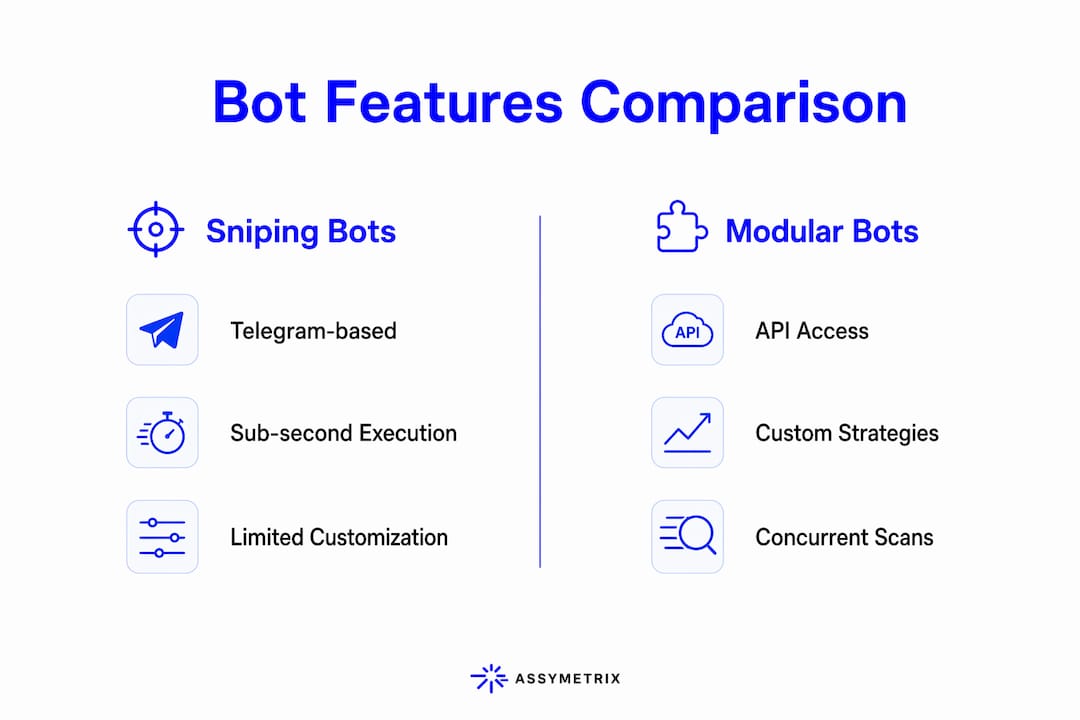
PolyCop and PolyGun operate entirely through Telegram, which means no direct API access and no custom strategy logic. Speed is their edge. For developers building custom bots, they are reference points for latency benchmarking, not integration targets.
PredictEngine’s open-source TypeScript codebase runs 16 parallel market scans per cycle using semaphore-based concurrency. Its whale tracking engine scores wallets across six dimensions: profitability, timing skill, slippage, consistency, market selection, and recency. That scoring model is worth studying even if you build your own stack.
FORS implements circuit breakers that halt trading after configurable daily loss thresholds, with fractional Kelly Criterion for position sizing. Gas price volatility on Polygon is a real execution risk, and FORS accounts for it explicitly.
PolyClaw and TurbineFi both integrate deeply with Polymarket’s CLOB API for arbitrage detection. PolyClaw scans for price dislocations across correlated markets and executes hedged orders; TurbineFi adds configurable slippage and cooldown controls on top of its market-making logic.
Pro Tip: Before choosing a pre-built bot, map your strategy type first. Sniping bots (PolyCop, PolyGun) and arbitrage engines (PolyClaw, TurbineFi) have fundamentally different latency and data requirements. Mixing the wrong tool with the wrong strategy is the most common deployment mistake.
How does a Polymarket trading bot actually work?
Every production bot shares four modular components, regardless of strategy:
Market Scanner: Queries Polymarket’s Gamma API and CLOB API to filter traceable markets by volume, liquidity, and expiry. Most scanners filter thousands of markets down to a watchlist of 15–50.
Signal Generator: Applies strategy logic to the watchlist. Common strategies include threshold deviation (buy when price diverges from its recent average), sum-to-one arbitrage (buy both outcomes when YES + NO < $1), and momentum (ride short-term price trends with a 15-minute lookback).
Execution Engine: Translates signals into signed CLOB orders via
py_clob_clientor the Node.js@polymarket/clob-client. Limit orders placed one cent inside the best bid/ask give higher fill rates than Fill-or-Kill market orders in thin liquidity.Risk Manager: The most critical component. It enforces position limits, daily loss halts, and kill switches before any trade reaches the execution layer.
Modular architecture matters because it decouples strategy from execution. You can swap a momentum signal generator for an AI forecast module without touching the execution engine or risk rules. That separation is what makes a bot maintainable at scale.
The data inputs a bot needs: order book depth (best bid/ask, spread, liquidity at each level), price history (for mean reversion and momentum signals), wallet activity (for copy-trading and Smart Money detection), and market resolution data (for late-sniper and convergence strategies).
How do you build and integrate a custom Polymarket bot?
Start with the official Python SDK, py_clob_client, combined with web3.py for wallet signing and websocket-client for real-time order book streaming. The CLOB API base URL is https://clob.polymarket.com; Polygon mainnet is Chain ID 137.
Authentication setup:
from py_clob_client.client import ClobClient

client = ClobClient(
    host="https://clob.polymarket.com",
    chain_id=137,
    key=os.environ["POLYMARKET_PRIVATE_KEY"],
)
client.set_api_creds(client.create_or_derive_api_key())
from py_clob_client.client import ClobClient

client = ClobClient(
    host="https://clob.polymarket.com",
    chain_id=137,
    key=os.environ["POLYMARKET_PRIVATE_KEY"],
)
client.set_api_creds(client.create_or_derive_api_key())
Your bot needs two credential layers: the wallet private key (L1) for on-chain signing, and API credentials (L2, comprising key, secret, and passphrase) for CLOB order submission. Never hardcode either; use environment variables only.
Core scanner configuration:
scanner = MarketScanner(min_volume=10_000, min_liquidity=5_000)
signal_gen = ThresholdSignalGenerator(lookback=20, buy_threshold=-0.05)
executor = ExecutionEngine(client, funder=FUNDER_ADDRESS, default_size=5.0)
risk = RiskManager(
    max_position_size=50.0,
    max_total_exposure=200.0,
    max_drawdown_pct=0.10,
)
scanner = MarketScanner(min_volume=10_000, min_liquidity=5_000)
signal_gen = ThresholdSignalGenerator(lookback=20, buy_threshold=-0.05)
executor = ExecutionEngine(client, funder=FUNDER_ADDRESS, default_size=5.0)
risk = RiskManager(
    max_position_size=50.0,
    max_total_exposure=200.0,
    max_drawdown_pct=0.10,
)
Run in paper trading mode for at least one week before going live. Polymarket has no official testnet, so paper mode means running the full pipeline but logging trades to a local database instead of submitting them. If paper P&L is consistently negative, the strategy needs work, not more capital.
For production deployment, run the bot as a PM2 process on a VPS for crash recovery and log rotation. Polygon gas is typically under $0.01 per transaction, so gas costs are negligible. The bigger risk is RPC reliability: use a dedicated Polygon RPC endpoint, not the public default.
Common pitfalls:
Polling REST endpoints instead of subscribing to the CLOB WebSocket (
wss://ws-subscriptions-clob.polymarket.com/ws/) causes latency that kills time-sensitive strategies.Syncing positions from the API on every loop iteration burns rate limit budget. Cache positions locally and sync every few minutes.
Circuit breakers should halt trading after configurable daily loss thresholds. Without them, a bad signal cascade can drain a wallet in one session.
How does the Assymetrix Data API improve bot performance?
The core problem with building a Polymarket bot from scratch is data fragmentation. Connecting to Polymarket, Kalshi, and Limitless separately means three authentication flows, three data schemas, and three WebSocket connections to maintain. The Assymetrix Data API at data.assymetrix.com collapses that into one.
The platform indexes nearly one billion rows of cross-venue trading activity, normalized into a single schema. For a bot developer, that means one integration gives you price history, order book snapshots, and wallet activity across all three major prediction market venues.
The highest-value features for bot developers:
Smart Money wallet tracking: The API surfaces wallet addresses with statistically strong track records, scored across profitability, timing, and market selection. A bot consuming these signals can weight its own positions toward markets where Smart Money is active.
Cross-venue arbitrage signals: When the same underlying event trades at different implied probabilities on Polymarket and Kalshi, the API flags the divergence. A bot can act on that signal without building its own cross-venue price comparison logic.
Trader Skill Scores: Normalized scores across the trader population let a bot distinguish noise from informed flow in wallet activity data.
Pro Tip: Use the Assymetrix API’s historical data layer for backtesting prediction market strategies before deploying live. Nearly one billion rows of indexed trades gives you the sample size to validate edge across market regimes, not just recent conditions.
What performance factors actually determine bot profitability?
Latency and security are the two variables that separate bots that capture opportunities from bots that log them after the fact.
On latency: the CLOB WebSocket delivers order book updates in milliseconds. REST polling at 15-second intervals misses every fast-moving arbitrage window. For sniping strategies, the difference between a WebSocket-connected bot and a polling bot is the difference between a fill and a missed trade. Run your VPS in a region geographically close to Polymarket’s infrastructure, and use a dedicated RPC endpoint for Polygon order submission.
On security: your private key never leaves your process. Use environment variables, not config files checked into version control. The two-layer credential model (L1 private key, L2 API credentials) means your bot can sign orders without exposing the root wallet key on every request. For high-frequency bots, a Gnosis Safe wallet supports gasless transactions and batched operations through Polymarket’s relayer.
How do you evaluate a Polymarket trading bot before using it?
Three criteria separate production-grade tools from demos:
Strategy transparency. Can you inspect the signal logic? Closed-source bots like PolyCop and PolyGun offer speed but zero auditability. Open-source platforms like PredictEngine and the FORS-style arbitrage bots let you verify that the risk controls actually fire when they should.
Risk control depth. Look for fractional Kelly sizing, per-market exposure caps, daily loss halts, and a global kill switch. A bot without a kill switch is not a production tool. PredictEngine caps maximum loss exposure at 5% per market and 15% total; FORS implements hard drawdown limits with configurable thresholds.
Data quality and freshness. A bot is only as good as its data inputs. Stale order book data produces stale signals. Evaluate whether the bot uses WebSocket feeds or REST polling, and whether it has access to cross-venue data for arbitrage detection. This is where the Assymetrix Data API creates a measurable edge over bots relying solely on Polymarket’s own endpoints.
What are the risks and legal considerations for Polymarket bots?
Polymarket geo-blocks US IP addresses. Bots deployed on US-based servers will be blocked at the API level. Production deployments run on non-US VPS instances. This is a compliance reality, not a workaround: Polymarket’s terms of service govern what automated activity is permitted, and traders should review those terms before deploying any bot.
On the financial risk side: prediction market edges are transient. A strategy with a strong backtest can degrade within weeks as other bots adapt. Position sizing discipline matters more than signal quality. Start with small position sizes, validate edge over 50+ live trades, and scale only after the live results confirm the backtest. The prediction market landscape in 2026 is more competitive than it was 18 months ago; the easy arbitrage windows close faster.
Smart contract risk on Polygon is real but manageable. Gas price spikes can cause transaction failures during peak network traffic. Set gas price moderately above the current rate for reliable order inclusion.
How do you benchmark a Polymarket bot’s performance?
The metrics that matter: win rate, average edge per trade, maximum drawdown, Sharpe ratio on daily P&L, and fill rate (orders placed vs. orders filled). Win rate alone is misleading. An 81% win rate with poor position sizing still produces a negative expected value if the losing 19% of trades are sized too large.
Benchmark against paper trading first. Run the full pipeline in simulation mode for at least one week, tracking simulated P&L against real market prices. Compare fill rate between paper and live: a significant gap indicates slippage or latency problems in the execution layer.
For cross-strategy comparison, use the same capital base and time window. A momentum strategy and an arbitrage strategy have different risk profiles; comparing raw P&L without normalizing for exposure is not informative. Sharpe ratio on daily returns gives a more honest comparison across strategy types.
Assymetrix gives your bot a unified data layer
Every bot in this comparison relies on data quality for its edge. PolyClaw needs real-time cross-market prices. PredictEngine’s whale tracker needs wallet history. FORS needs accurate position data to fire its kill switch at the right threshold.
The Assymetrix Data API at data.assymetrix.com gives bot developers a single integration point for all of it: unified cross-venue market data, Smart Money wallet signals, Trader Skill Scores, and arbitrage divergence alerts, built on approximately 1.5 terabytes of historical data. Instead of maintaining separate connections to Polymarket, Kalshi, and Limitless, your bot queries one API and gets normalized data across all three venues. For developers who want to validate strategies before deploying capital, the prediction market accuracy data available through Assymetrix provides the historical depth to test edge across multiple market regimes. Free and paid tiers are available at data.assymetrix.com.
Key Takeaways
The strongest Polymarket bots in 2026 combine modular architecture, WebSocket-based data feeds, and disciplined risk controls — not complex prediction models.
Point | Details |
|---|---|
Architecture is the foundation | Every production bot needs four components: Market Scanner, Signal Generator, Execution Engine, and Risk Manager. |
Latency determines capture rate | WebSocket feeds beat REST polling for any time-sensitive strategy; VPS proximity to Polymarket’s infrastructure matters. |
Risk controls are non-negotiable | Risk controls like fractional Kelly sizing, loss halts, and kill switches separate profitable bots from accounts that blow up. |
Data quality drives signal quality | Cross-venue data and Smart Money wallet signals give bots an edge that single-venue polling cannot replicate. |
Assymetrix Data API | Indexes nearly one billion rows of cross-venue trading activity, giving bots unified access to Polymarket, Kalshi, and Limitless data through one integration. |
FAQ
What Python libraries do you need to build a Polymarket bot?
The core stack is py_clob_client for CLOB API communication, web3.py for wallet signing, and websocket-client for real-time order book streaming. Combine these with environment-variable-based credential management and a process manager like PM2 for production uptime.
How does Smart Money tracking work in a Polymarket bot?
A bot tracks wallet addresses with strong historical performance, then mirrors or weights positions toward markets where those wallets are active. The Assymetrix Data API surfaces these signals directly, scoring wallets across profitability, timing, and market selection without requiring you to build the detection logic yourself.
Can US-based developers legally run Polymarket bots?
Polymarket geo-blocks US IP addresses at the API level, so bots must run on non-US VPS instances. Developers should review Polymarket’s current terms of service before deploying any automated trading system, as permitted activity can change.
What is the minimum viable risk management setup for a Polymarket bot?
At minimum: a per-market position cap, a maximum total exposure limit, a daily loss halt, and a global kill switch. Fractional Kelly Criterion for position sizing prevents any single trade from being oversized relative to your bankroll.
How does the Assymetrix Data API differ from querying Polymarket directly?
Querying Polymarket directly gives you data from one venue. The Assymetrix Data API gives you normalized data across Polymarket, Kalshi, and Limitless through a single integration, plus Smart Money signals and cross-venue arbitrage alerts that require multi-venue data to generate.
Polymarket Trading Bots in 2026: The Developer’s Guide
What are the best Polymarket trading bots right now?
The leading Polymarket trading bots in 2026 span three distinct categories: sniping bots (PolyCop, PolyGun), modular strategy platforms (PredictEngine, Stand), arbitrage and market-making engines (TurbineFi, Fireplace, FORS, PolyClaw), and data intelligence layers (Assymetrix Data API). Each targets a different inefficiency in Polymarket’s CLOB-based prediction markets.
The bots that consistently outperform treat Polymarket like a high-frequency trading venue. Uptime, RPC reliability, and execution latency matter more than model complexity. A bot that fires 50ms faster than the next one captures the arbitrage window. One that goes offline for 90 seconds misses the resolution snipe entirely.
Tool | Bot Type | Key Features | Best For |
|---|---|---|---|
Data intelligence | Cross-venue unified API, Smart Money tracking, ~1B rows indexed, arbitrage signals | Developers needing consolidated multi-venue market intelligence | |
PolyCop | Sniping | Sub-second wallet replication, Telegram interface | Wallet follow and real-time trade mirroring |
PolyGun | Sniping | Rapid order placement, minimal user intervention | Automated sniping with low latency |
PredictEngine | Modular strategy | multiple strategies, live dashboard, AI forecast module | Quants needing diverse strategies and monitoring |
TurbineFi | Arbitrage/market making | Configurable risk controls, local dashboard, liquidity filters | Hedged trades and exposure management |
Stand | Multi-market monitoring | Wallet monitoring, broad market coverage, API integration | Advanced signal filtering across markets |
Fireplace | Market making | Spread capture, optimized order placement | Liquidity providers targeting bid/ask spreads |
FORS | Risk-managed automation | Kill switches, fractional Kelly sizing, drawdown limits | Strict risk management in automation |
PolyClaw | Cross-market arbitrage | Real-time price scanning, hedged order execution | Multi-market arbitrage across correlated markets |
PolyCop and PolyGun are Telegram-based sniping bots that replicate wallet trades with sub-second execution. They require no coding knowledge and suit traders who want to follow profitable wallets without building infrastructure. The tradeoff is opacity: you are trusting their execution logic and latency claims without visibility into the order routing.
PredictEngine is the most feature-complete modular platform, offering seven concurrent strategies including arbitrage, convergence, AI forecast, and whale tracking with a copy-trade simulator. Its real-time dashboard runs wallet isolation per strategy, with independent capital and configurable risk limits per wallet.
TurbineFi and Fireplace occupy the market-making and arbitrage tier. TurbineFi focuses on hedged positions with fine-tuned liquidity filters; Fireplace targets spread capture through optimized bid/ask order placement. FORS sits in the risk-management-first category, with fractional Kelly sizing and hard drawdown caps as its defining feature. PolyClaw scans correlated markets in real time for price dislocations and executes hedged orders across them.
Assymetrix Data API is a different class of tool. It does not execute trades. It feeds bots. With nearly one billion rows of indexed cross-venue trading activity, it gives any of the above bots a unified data layer covering Polymarket, Kalshi, and Limitless through a single integration.
Table of Contents
How do Polymarket trading bots compare on technical features?
How does a Polymarket trading bot actually work?
How do you build and integrate a custom Polymarket bot?
How does the Assymetrix Data API improve bot performance?
What performance factors actually determine bot profitability?
How do you evaluate a Polymarket trading bot before using it?
What are the risks and legal considerations for Polymarket bots?
How do you benchmark a Polymarket bot’s performance?
Assymetrix gives your bot a unified data layer
Key Takeaways
How do Polymarket trading bots compare on technical features?
The canonical comparison table above covers the full field. What it cannot show is how these tools differ in practice at the integration layer.
PolyCop and PolyGun operate entirely through Telegram, which means no direct API access and no custom strategy logic. Speed is their edge. For developers building custom bots, they are reference points for latency benchmarking, not integration targets.
PredictEngine’s open-source TypeScript codebase runs 16 parallel market scans per cycle using semaphore-based concurrency. Its whale tracking engine scores wallets across six dimensions: profitability, timing skill, slippage, consistency, market selection, and recency. That scoring model is worth studying even if you build your own stack.
FORS implements circuit breakers that halt trading after configurable daily loss thresholds, with fractional Kelly Criterion for position sizing. Gas price volatility on Polygon is a real execution risk, and FORS accounts for it explicitly.
PolyClaw and TurbineFi both integrate deeply with Polymarket’s CLOB API for arbitrage detection. PolyClaw scans for price dislocations across correlated markets and executes hedged orders; TurbineFi adds configurable slippage and cooldown controls on top of its market-making logic.
Pro Tip: Before choosing a pre-built bot, map your strategy type first. Sniping bots (PolyCop, PolyGun) and arbitrage engines (PolyClaw, TurbineFi) have fundamentally different latency and data requirements. Mixing the wrong tool with the wrong strategy is the most common deployment mistake.
How does a Polymarket trading bot actually work?
Every production bot shares four modular components, regardless of strategy:
Market Scanner: Queries Polymarket’s Gamma API and CLOB API to filter traceable markets by volume, liquidity, and expiry. Most scanners filter thousands of markets down to a watchlist of 15–50.
Signal Generator: Applies strategy logic to the watchlist. Common strategies include threshold deviation (buy when price diverges from its recent average), sum-to-one arbitrage (buy both outcomes when YES + NO < $1), and momentum (ride short-term price trends with a 15-minute lookback).
Execution Engine: Translates signals into signed CLOB orders via
py_clob_clientor the Node.js@polymarket/clob-client. Limit orders placed one cent inside the best bid/ask give higher fill rates than Fill-or-Kill market orders in thin liquidity.Risk Manager: The most critical component. It enforces position limits, daily loss halts, and kill switches before any trade reaches the execution layer.
Modular architecture matters because it decouples strategy from execution. You can swap a momentum signal generator for an AI forecast module without touching the execution engine or risk rules. That separation is what makes a bot maintainable at scale.
The data inputs a bot needs: order book depth (best bid/ask, spread, liquidity at each level), price history (for mean reversion and momentum signals), wallet activity (for copy-trading and Smart Money detection), and market resolution data (for late-sniper and convergence strategies).
How do you build and integrate a custom Polymarket bot?
Start with the official Python SDK, py_clob_client, combined with web3.py for wallet signing and websocket-client for real-time order book streaming. The CLOB API base URL is https://clob.polymarket.com; Polygon mainnet is Chain ID 137.
Authentication setup:
from py_clob_client.client import ClobClient

client = ClobClient(
    host="https://clob.polymarket.com",
    chain_id=137,
    key=os.environ["POLYMARKET_PRIVATE_KEY"],
)
client.set_api_creds(client.create_or_derive_api_key())
Your bot needs two credential layers: the wallet private key (L1) for on-chain signing, and API credentials (L2, comprising key, secret, and passphrase) for CLOB order submission. Never hardcode either; use environment variables only.
Core scanner configuration:
scanner = MarketScanner(min_volume=10_000, min_liquidity=5_000)
signal_gen = ThresholdSignalGenerator(lookback=20, buy_threshold=-0.05)
executor = ExecutionEngine(client, funder=FUNDER_ADDRESS, default_size=5.0)
risk = RiskManager(
    max_position_size=50.0,
    max_total_exposure=200.0,
    max_drawdown_pct=0.10,
)
Run in paper trading mode for at least one week before going live. Polymarket has no official testnet, so paper mode means running the full pipeline but logging trades to a local database instead of submitting them. If paper P&L is consistently negative, the strategy needs work, not more capital.
For production deployment, run the bot as a PM2 process on a VPS for crash recovery and log rotation. Polygon gas is typically under $0.01 per transaction, so gas costs are negligible. The bigger risk is RPC reliability: use a dedicated Polygon RPC endpoint, not the public default.
Common pitfalls:
Polling REST endpoints instead of subscribing to the CLOB WebSocket (
wss://ws-subscriptions-clob.polymarket.com/ws/) causes latency that kills time-sensitive strategies.Syncing positions from the API on every loop iteration burns rate limit budget. Cache positions locally and sync every few minutes.
Circuit breakers should halt trading after configurable daily loss thresholds. Without them, a bad signal cascade can drain a wallet in one session.
How does the Assymetrix Data API improve bot performance?
The core problem with building a Polymarket bot from scratch is data fragmentation. Connecting to Polymarket, Kalshi, and Limitless separately means three authentication flows, three data schemas, and three WebSocket connections to maintain. The Assymetrix Data API at data.assymetrix.com collapses that into one.
The platform indexes nearly one billion rows of cross-venue trading activity, normalized into a single schema. For a bot developer, that means one integration gives you price history, order book snapshots, and wallet activity across all three major prediction market venues.
The highest-value features for bot developers:
Smart Money wallet tracking: The API surfaces wallet addresses with statistically strong track records, scored across profitability, timing, and market selection. A bot consuming these signals can weight its own positions toward markets where Smart Money is active.
Cross-venue arbitrage signals: When the same underlying event trades at different implied probabilities on Polymarket and Kalshi, the API flags the divergence. A bot can act on that signal without building its own cross-venue price comparison logic.
Trader Skill Scores: Normalized scores across the trader population let a bot distinguish noise from informed flow in wallet activity data.
Pro Tip: Use the Assymetrix API’s historical data layer for backtesting prediction market strategies before deploying live. Nearly one billion rows of indexed trades gives you the sample size to validate edge across market regimes, not just recent conditions.
What performance factors actually determine bot profitability?
Latency and security are the two variables that separate bots that capture opportunities from bots that log them after the fact.
On latency: the CLOB WebSocket delivers order book updates in milliseconds. REST polling at 15-second intervals misses every fast-moving arbitrage window. For sniping strategies, the difference between a WebSocket-connected bot and a polling bot is the difference between a fill and a missed trade. Run your VPS in a region geographically close to Polymarket’s infrastructure, and use a dedicated RPC endpoint for Polygon order submission.
On security: your private key never leaves your process. Use environment variables, not config files checked into version control. The two-layer credential model (L1 private key, L2 API credentials) means your bot can sign orders without exposing the root wallet key on every request. For high-frequency bots, a Gnosis Safe wallet supports gasless transactions and batched operations through Polymarket’s relayer.
How do you evaluate a Polymarket trading bot before using it?
Three criteria separate production-grade tools from demos:
Strategy transparency. Can you inspect the signal logic? Closed-source bots like PolyCop and PolyGun offer speed but zero auditability. Open-source platforms like PredictEngine and the FORS-style arbitrage bots let you verify that the risk controls actually fire when they should.
Risk control depth. Look for fractional Kelly sizing, per-market exposure caps, daily loss halts, and a global kill switch. A bot without a kill switch is not a production tool. PredictEngine caps maximum loss exposure at 5% per market and 15% total; FORS implements hard drawdown limits with configurable thresholds.
Data quality and freshness. A bot is only as good as its data inputs. Stale order book data produces stale signals. Evaluate whether the bot uses WebSocket feeds or REST polling, and whether it has access to cross-venue data for arbitrage detection. This is where the Assymetrix Data API creates a measurable edge over bots relying solely on Polymarket’s own endpoints.
What are the risks and legal considerations for Polymarket bots?
Polymarket geo-blocks US IP addresses. Bots deployed on US-based servers will be blocked at the API level. Production deployments run on non-US VPS instances. This is a compliance reality, not a workaround: Polymarket’s terms of service govern what automated activity is permitted, and traders should review those terms before deploying any bot.
On the financial risk side: prediction market edges are transient. A strategy with a strong backtest can degrade within weeks as other bots adapt. Position sizing discipline matters more than signal quality. Start with small position sizes, validate edge over 50+ live trades, and scale only after the live results confirm the backtest. The prediction market landscape in 2026 is more competitive than it was 18 months ago; the easy arbitrage windows close faster.
Smart contract risk on Polygon is real but manageable. Gas price spikes can cause transaction failures during peak network traffic. Set gas price moderately above the current rate for reliable order inclusion.
How do you benchmark a Polymarket bot’s performance?
The metrics that matter: win rate, average edge per trade, maximum drawdown, Sharpe ratio on daily P&L, and fill rate (orders placed vs. orders filled). Win rate alone is misleading. An 81% win rate with poor position sizing still produces a negative expected value if the losing 19% of trades are sized too large.
Benchmark against paper trading first. Run the full pipeline in simulation mode for at least one week, tracking simulated P&L against real market prices. Compare fill rate between paper and live: a significant gap indicates slippage or latency problems in the execution layer.
For cross-strategy comparison, use the same capital base and time window. A momentum strategy and an arbitrage strategy have different risk profiles; comparing raw P&L without normalizing for exposure is not informative. Sharpe ratio on daily returns gives a more honest comparison across strategy types.
Assymetrix gives your bot a unified data layer
Every bot in this comparison relies on data quality for its edge. PolyClaw needs real-time cross-market prices. PredictEngine’s whale tracker needs wallet history. FORS needs accurate position data to fire its kill switch at the right threshold.
The Assymetrix Data API at data.assymetrix.com gives bot developers a single integration point for all of it: unified cross-venue market data, Smart Money wallet signals, Trader Skill Scores, and arbitrage divergence alerts, built on approximately 1.5 terabytes of historical data. Instead of maintaining separate connections to Polymarket, Kalshi, and Limitless, your bot queries one API and gets normalized data across all three venues. For developers who want to validate strategies before deploying capital, the prediction market accuracy data available through Assymetrix provides the historical depth to test edge across multiple market regimes. Free and paid tiers are available at data.assymetrix.com.
Key Takeaways
The strongest Polymarket bots in 2026 combine modular architecture, WebSocket-based data feeds, and disciplined risk controls — not complex prediction models.
Point | Details |
|---|---|
Architecture is the foundation | Every production bot needs four components: Market Scanner, Signal Generator, Execution Engine, and Risk Manager. |
Latency determines capture rate | WebSocket feeds beat REST polling for any time-sensitive strategy; VPS proximity to Polymarket’s infrastructure matters. |
Risk controls are non-negotiable | Risk controls like fractional Kelly sizing, loss halts, and kill switches separate profitable bots from accounts that blow up. |
Data quality drives signal quality | Cross-venue data and Smart Money wallet signals give bots an edge that single-venue polling cannot replicate. |
Assymetrix Data API | Indexes nearly one billion rows of cross-venue trading activity, giving bots unified access to Polymarket, Kalshi, and Limitless data through one integration. |
FAQ
What Python libraries do you need to build a Polymarket bot?
The core stack is py_clob_client for CLOB API communication, web3.py for wallet signing, and websocket-client for real-time order book streaming. Combine these with environment-variable-based credential management and a process manager like PM2 for production uptime.
How does Smart Money tracking work in a Polymarket bot?
A bot tracks wallet addresses with strong historical performance, then mirrors or weights positions toward markets where those wallets are active. The Assymetrix Data API surfaces these signals directly, scoring wallets across profitability, timing, and market selection without requiring you to build the detection logic yourself.
Can US-based developers legally run Polymarket bots?
Polymarket geo-blocks US IP addresses at the API level, so bots must run on non-US VPS instances. Developers should review Polymarket’s current terms of service before deploying any automated trading system, as permitted activity can change.
What is the minimum viable risk management setup for a Polymarket bot?
At minimum: a per-market position cap, a maximum total exposure limit, a daily loss halt, and a global kill switch. Fractional Kelly Criterion for position sizing prevents any single trade from being oversized relative to your bankroll.
How does the Assymetrix Data API differ from querying Polymarket directly?
Querying Polymarket directly gives you data from one venue. The Assymetrix Data API gives you normalized data across Polymarket, Kalshi, and Limitless through a single integration, plus Smart Money signals and cross-venue arbitrage alerts that require multi-venue data to generate.
Other Blog


