Ship Production Grade Polymarket Data API with 900M+ Events Indexed
Ship Production Grade Polymarket Data API with 900M+ Events Indexed
Ship Production Grade Polymarket Data API with 900M+ Events Indexed
Access production grade Polymarket real time and historical data via a normalized API that indexes 900M+ events and removes Polygon parsing to speed time...

Ship Production Grade Polymarket Data API with 900M+ Events Indexed
Developers can access Polymarket data through on-chain parsing, official SDKs, or a normalized Data API, and each path trades off completeness against engineering cost. Direct blockchain queries give raw completeness but demand heavy decoding work. For production trading systems, backtests, or AI agents, a normalized Data API removes the Polygon parsing burden and gets you to reliable data faster.
TL;DR:
Using Polymarket data directly from on-chain logs requires extensive decoding and maintenance, especially as contract structures evolve.
Normalized Data APIs like Assymetrix provide stable IDs, consistent schema, and pre-computed signals, simplifying backtests and cross-venue analysis.
For live trading or AI agents, WebSocket streams offer the lowest latency, whereas REST endpoints are better suited for historical bulk data pulls.
Developers should map markets to canonical IDs early and validate partial fills against settled markets to prevent inaccuracies.
Building a custom Polygon indexer is only justified for large teams with long-term infrastructure; most should leverage normalized APIs for faster deployment.
Assymetrixassymetrix.comBuild With Unified Market DataAssymetrix gives developers and AI agents unified access to structured Polymarket data through a single Data API integration.Explore the Data API
Table of Contents
What Data Does Polymarket Actually Expose?
Why Is Raw Polymarket On-Chain Data Hard to Use?
What Do Quants and Developers Build With This Data?
Direct On-Chain, SDKs, REST, or WebSocket: Which Fits Your Build?
How Does a Normalized Data API Remove This Friction?
How Should You Start Integrating Polymarket Data?
Try the Assymetrix Prediction Market Data API
Engineering Trade-Offs: One Editor’s Take
Sources
What Data Does Polymarket Actually Expose?
Polymarket generates several distinct data streams, and most trading models need more than one of them working together. Understanding what each artifact actually contains matters before you architect anything.
Real-time price ticks arrive alongside trade events, each carrying size, side, and a timestamp tied to block confirmation. The CLOB (central limit order book) publishes live snapshots, but partial fills complicate any naive read of “filled” versus “open” quantity. On top of that, every transaction lives on Polygon as a raw contract log, which is where wallet-level activity, the kind Smart Money tracking depends on, gets extracted.
Here’s the core inventory a developer typically needs:
Price and trade events — tick-level fills with amount, side, and timestamp
Order book snapshots — CLOB depth and partial-fill states
On-chain wallet activity — transfers and positions tied to specific addresses
Resolution metadata — settlement outcomes, condition IDs, and payout data
Derived OHLCV bars — minute-level open/high/low/close/volume for backtesting and VWAP calculations
None of this is exotic in concept. Stock market data APIs have offered comparable real-time and historical structures for years. What makes Polymarket different is how that data gets from the chain into a usable schema.
Why Is Raw Polymarket On-Chain Data Hard to Use?
Polygon contract logs were not designed for analytics convenience. Getting from a raw transaction hash to a clean “Team A won, $4,200 traded at 62 cents” record takes real engineering, and most teams underestimate how much.
The friction shows up in five recurring places:
ABI decoding and drift — contract interfaces change, and a decoder built for one market structure silently breaks on another.
Condition ID mapping — every market resolves through a condition ID that has to be joined back to human-readable market semantics; get this join wrong and your backtest references the wrong outcome.
NegRisk contract semantics — negative-risk markets bundle multiple outcomes into one settlement structure, and treating them like simple binary trade logs produces bad P&L.
Partial fills and reorgs — a single order can execute across multiple blocks, and chain reorganizations force you to reconcile trades that briefly looked final.
Bulk pagination at scale — pulling years of history for backtesting means managing rate limits, cursor state, and retry logic across millions of events.
Each of these is solvable individually. Solving all five, then keeping the solution correct as Polymarket’s contracts evolve, is a maintenance job, not a weekend project.
Pro Tip: Before trusting any backtest, run a point-in-time reconciliation pass against a known settled market. If your resolved outcome and payout don’t match Polymarket’s own settlement record exactly, your condition ID mapping has a bug, not your strategy.
What Do Quants and Developers Build With This Data?
Once the data is clean, the use cases split into a handful of well-defined categories, each with different latency and completeness requirements.
Trading bots and market-making need low-latency tick and order book streams, often sub-second, making best tools for real-time trade analysis essential for success.
Backtesting runs against historical event-level data and OHLCV bars, prioritizing completeness over speed.
Smart Money tracking follows wallet-level position changes to build predictive signals from traders with strong historical accuracy.
Cross-venue arbitrage compares Polymarket pricing against Kalshi or Limitless to flag divergence before it closes.
AI agents consume structured feeds as decision inputs, requiring consistent schema more than raw speed.
Prediction markets differ from equities in one structural way that matters for all five: every market has a hard resolution date and binary or categorical payout, which makes wallet-level skill scoring a cleaner signal than in continuous markets. A trader who called five election markets correctly leaves a much more legible track record than one who day-traded a stock for a month.
Direct On-Chain, SDKs, REST, or WebSocket: Which Fits Your Build?
The right integration pattern depends on what you’re optimizing for: completeness, speed to prototype, or operational stability once you’re in production.
Direct on-chain parsing gives you full completeness with no vendor dependency, but you absorb every decoding and reorg-handling cost described above. It’s the right call only if your team has ongoing capacity to maintain a Polygon indexer.
Official SDKs, like the Polymarket py-sdk, offer async and sync client interfaces that simplify pagination and WebSocket subscriptions for fast experimentation. The repo itself flags beta status, which is a fair warning: it’s built for prototyping, not for an SLA-backed production pipeline.
REST endpoints suit bulk historical pulls, while WebSocket streams handle live consumption where every extra second of latency costs you an edge.
A rough decision matrix:
Prototyping a strategy this week → SDK or REST
Running a live bot that needs uptime guarantees → normalized streaming API
Backtesting years of history → bulk REST with a clean event index, not raw chain replay
Building an AI agent that needs stable schema across venues → normalized API, full stop
Authentication, rate limits, and pagination style all shape which pattern survives contact with production traffic.
How Does a Normalized Data API Remove This Friction?
This is where a purpose-built Data API changes the calculus. Assymetrix indexes 900 million-plus on-chain events going back to September 2020, which means the condition ID mapping, ABI decoding, and NegRisk interpretation work described above has already been done once, correctly, instead of once per team.
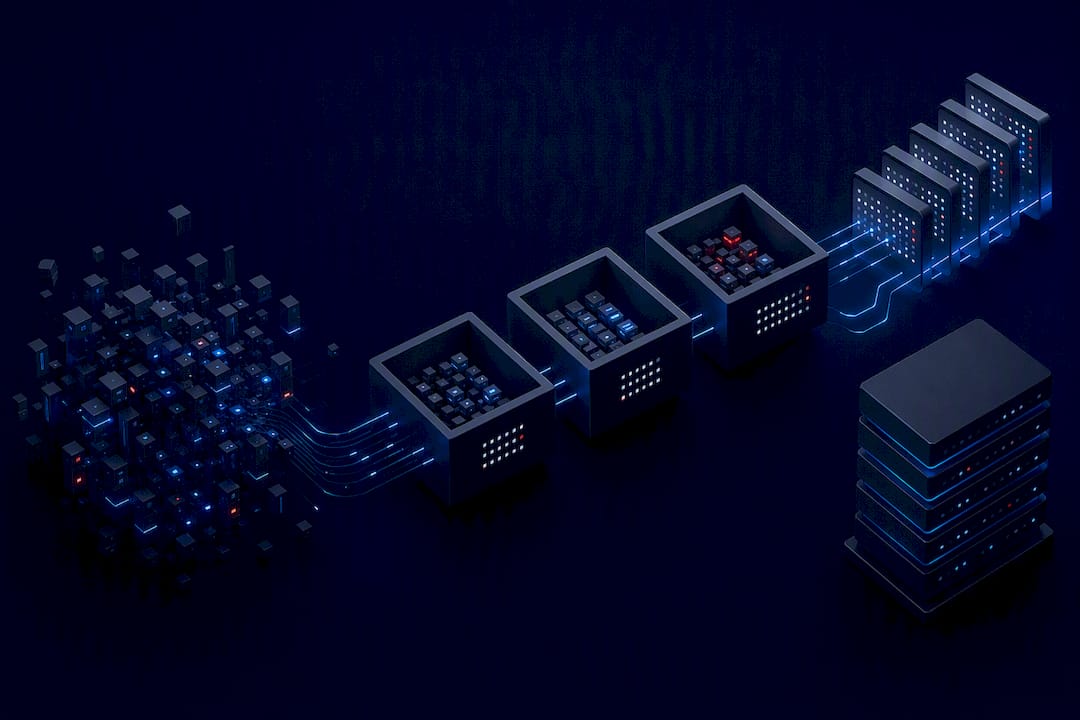
That indexing depth matters directly for backtest quality. Point-in-time historical archives are the standard for reliable backtesting in traditional markets precisely because they preserve trade and quote state exactly as it existed at each timestamp, and the same principle applies to prediction market replay testing.
What a normalized feed actually delivers:
Stable canonical IDs across markets, so joins don’t break when Polymarket updates a contract
Consistent schema for prices, trades, order book state, and resolutions
REST and WebSocket delivery, so bulk history and live streams use the same data model
Smart Money tracking and Trader Skill Scores as pre-computed signals, not raw wallet dumps you have to score yourself
Cross-venue arbitrage and divergence detection spanning Polymarket, Kalshi, and Limitless in one query
Pro Tip: A canonical ID scheme that stays stable across venues is what actually lets you build cross-venue arbitrage logic without maintaining three separate reconciliation layers, one per exchange.
Export and licensing options exist for institutional consumers running research pipelines at volume, on top of the standard API tiers.
How Should You Start Integrating Polymarket Data?
A short, ordered checklist gets most developers from zero to a working pipeline without the usual false starts:
Decide your access mode first: real-time streaming, historical bulk pull, or a hybrid of both.
Provision API credentials and read the rate limit documentation before writing your first request loop.
Map every market to a canonical ID early. Retrofitting ID mapping after your pipeline is live is far more painful than doing it upfront.
Validate partial-fill reconciliation against a small known dataset before trusting aggregate volume numbers.
Prototype with the Polymarket py-sdk for quick experiments, then move to a normalized API when you need production reliability.
Run historical replay tests in CI, checking point-in-time accuracy against settled markets, not just live data.
That sequence, prototype fast, validate hard, then swap to a production feed, saves most teams from shipping a bot that looks fine in testing and breaks on its first reorg.
Try the Assymetrix Prediction Market Data API
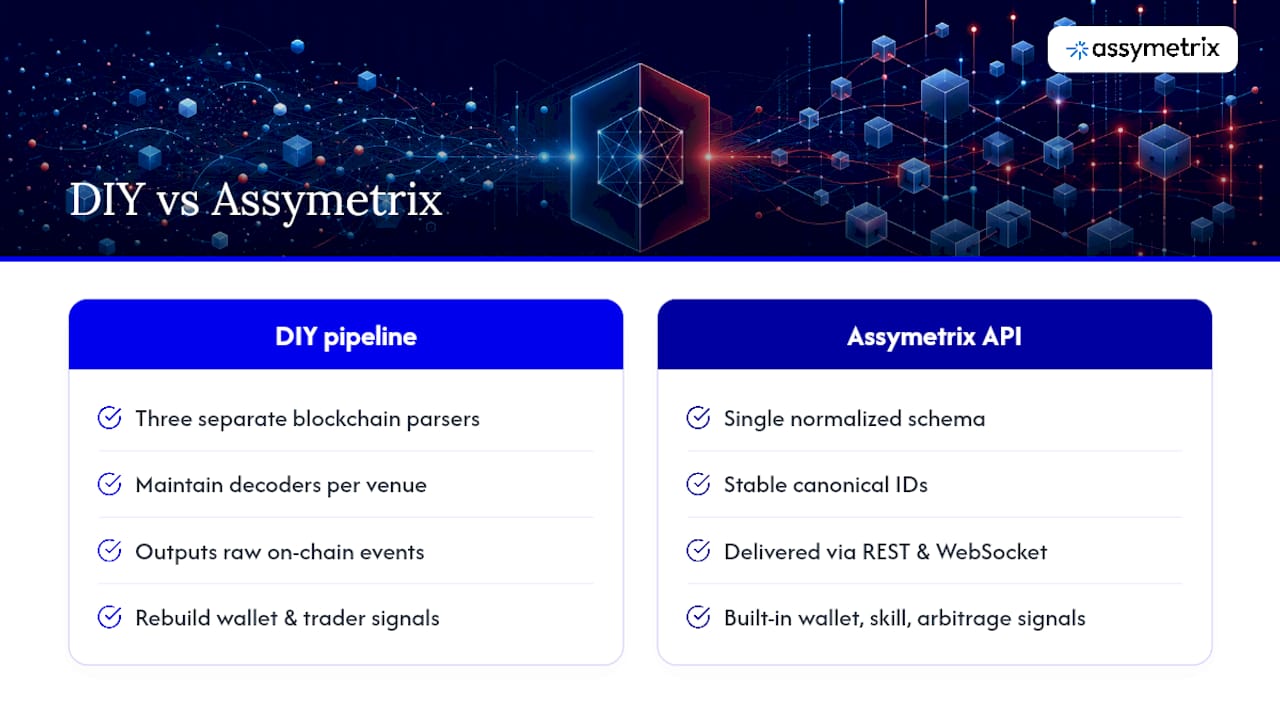
Assymetrix gives you one integration instead of three separate blockchain parsers. Where a DIY pipeline means building and maintaining decoders for Polymarket, Kalshi, and Limitless independently, the Assymetrix Data API normalizes all three into a single schema with stable canonical IDs, delivered over REST and WebSocket.
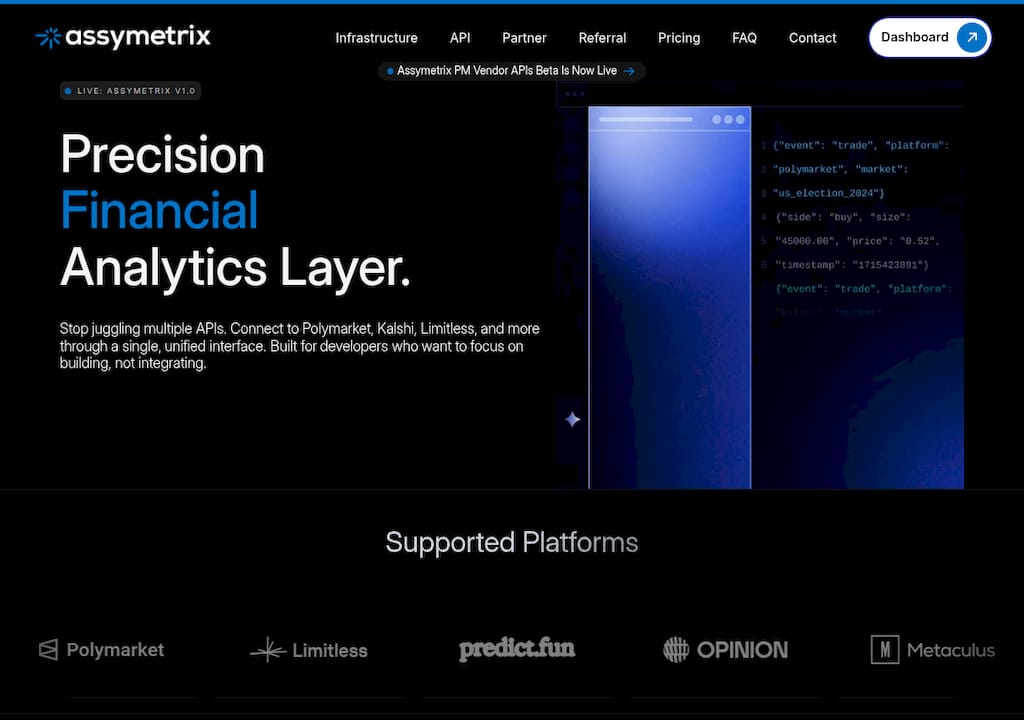
The API is built for quant researchers backtesting strategies, trading systems running live bots, and AI agents that need consistent structured input rather than raw chain events. It ships with Smart Money wallet tracking, Trader Skill Scores, and cross-venue arbitrage signals already computed, so you’re not rebuilding those pipelines from scratch.
Free and paid tiers cover everything from early prototyping to institutional-scale licensing. Review the API documentation, request trial access, or contact the team directly for institutional data licensing terms.
Engineering Trade-Offs: One Editor’s Take
Build your own Polygon indexer if you have a dedicated infrastructure team and years of runway. Everyone else is better off treating in-house parsing as a tax on time-to-market, not a badge of engineering rigor. The real question isn’t whether you can decode NegRisk contracts yourself. It’s whether that work moves your strategy forward or just delays the day you actually start trading.
— Dean
Sources
FAQ
Is Polymarket Data Available via API?
Yes. Polymarket exposes on-chain data that developers can access through direct blockchain parsing, the official py-sdk, or a normalized third-party Data API like Assymetrix.
What’s the Difference Between REST and WebSocket Access?
REST endpoints suit bulk historical pulls and one-off queries, while WebSocket connections stream live price, trade, and order book updates for low-latency applications.
Why Do Condition IDs Matter for Polymarket Data?
Condition IDs link raw on-chain settlement records to human-readable market outcomes. Mapping them incorrectly produces wrong resolution data and broken backtests.
Can I Use Polymarket Data for Cross-Venue Arbitrage?
Yes, if the data uses consistent canonical IDs across venues. Assymetrix normalizes Polymarket, Kalshi, and Limitless data specifically to support divergence detection between markets.
Is the Polymarket py-sdk Suitable for Production Trading Systems?
The py-sdk works well for prototyping and experimentation, but its beta status makes it a weaker fit for production systems that need SLA-backed reliability at scale.
Ship Production Grade Polymarket Data API with 900M+ Events Indexed
Developers can access Polymarket data through on-chain parsing, official SDKs, or a normalized Data API, and each path trades off completeness against engineering cost. Direct blockchain queries give raw completeness but demand heavy decoding work. For production trading systems, backtests, or AI agents, a normalized Data API removes the Polygon parsing burden and gets you to reliable data faster.
TL;DR:
Using Polymarket data directly from on-chain logs requires extensive decoding and maintenance, especially as contract structures evolve.
Normalized Data APIs like Assymetrix provide stable IDs, consistent schema, and pre-computed signals, simplifying backtests and cross-venue analysis.
For live trading or AI agents, WebSocket streams offer the lowest latency, whereas REST endpoints are better suited for historical bulk data pulls.
Developers should map markets to canonical IDs early and validate partial fills against settled markets to prevent inaccuracies.
Building a custom Polygon indexer is only justified for large teams with long-term infrastructure; most should leverage normalized APIs for faster deployment.
Assymetrixassymetrix.comBuild With Unified Market DataAssymetrix gives developers and AI agents unified access to structured Polymarket data through a single Data API integration.Explore the Data API
Table of Contents
What Data Does Polymarket Actually Expose?
Why Is Raw Polymarket On-Chain Data Hard to Use?
What Do Quants and Developers Build With This Data?
Direct On-Chain, SDKs, REST, or WebSocket: Which Fits Your Build?
How Does a Normalized Data API Remove This Friction?
How Should You Start Integrating Polymarket Data?
Try the Assymetrix Prediction Market Data API
Engineering Trade-Offs: One Editor’s Take
Sources
What Data Does Polymarket Actually Expose?
Polymarket generates several distinct data streams, and most trading models need more than one of them working together. Understanding what each artifact actually contains matters before you architect anything.
Real-time price ticks arrive alongside trade events, each carrying size, side, and a timestamp tied to block confirmation. The CLOB (central limit order book) publishes live snapshots, but partial fills complicate any naive read of “filled” versus “open” quantity. On top of that, every transaction lives on Polygon as a raw contract log, which is where wallet-level activity, the kind Smart Money tracking depends on, gets extracted.
Here’s the core inventory a developer typically needs:
Price and trade events — tick-level fills with amount, side, and timestamp
Order book snapshots — CLOB depth and partial-fill states
On-chain wallet activity — transfers and positions tied to specific addresses
Resolution metadata — settlement outcomes, condition IDs, and payout data
Derived OHLCV bars — minute-level open/high/low/close/volume for backtesting and VWAP calculations
None of this is exotic in concept. Stock market data APIs have offered comparable real-time and historical structures for years. What makes Polymarket different is how that data gets from the chain into a usable schema.
Why Is Raw Polymarket On-Chain Data Hard to Use?
Polygon contract logs were not designed for analytics convenience. Getting from a raw transaction hash to a clean “Team A won, $4,200 traded at 62 cents” record takes real engineering, and most teams underestimate how much.
The friction shows up in five recurring places:
ABI decoding and drift — contract interfaces change, and a decoder built for one market structure silently breaks on another.
Condition ID mapping — every market resolves through a condition ID that has to be joined back to human-readable market semantics; get this join wrong and your backtest references the wrong outcome.
NegRisk contract semantics — negative-risk markets bundle multiple outcomes into one settlement structure, and treating them like simple binary trade logs produces bad P&L.
Partial fills and reorgs — a single order can execute across multiple blocks, and chain reorganizations force you to reconcile trades that briefly looked final.
Bulk pagination at scale — pulling years of history for backtesting means managing rate limits, cursor state, and retry logic across millions of events.
Each of these is solvable individually. Solving all five, then keeping the solution correct as Polymarket’s contracts evolve, is a maintenance job, not a weekend project.
Pro Tip: Before trusting any backtest, run a point-in-time reconciliation pass against a known settled market. If your resolved outcome and payout don’t match Polymarket’s own settlement record exactly, your condition ID mapping has a bug, not your strategy.
What Do Quants and Developers Build With This Data?
Once the data is clean, the use cases split into a handful of well-defined categories, each with different latency and completeness requirements.
Trading bots and market-making need low-latency tick and order book streams, often sub-second, making best tools for real-time trade analysis essential for success.
Backtesting runs against historical event-level data and OHLCV bars, prioritizing completeness over speed.
Smart Money tracking follows wallet-level position changes to build predictive signals from traders with strong historical accuracy.
Cross-venue arbitrage compares Polymarket pricing against Kalshi or Limitless to flag divergence before it closes.
AI agents consume structured feeds as decision inputs, requiring consistent schema more than raw speed.
Prediction markets differ from equities in one structural way that matters for all five: every market has a hard resolution date and binary or categorical payout, which makes wallet-level skill scoring a cleaner signal than in continuous markets. A trader who called five election markets correctly leaves a much more legible track record than one who day-traded a stock for a month.
Direct On-Chain, SDKs, REST, or WebSocket: Which Fits Your Build?
The right integration pattern depends on what you’re optimizing for: completeness, speed to prototype, or operational stability once you’re in production.
Direct on-chain parsing gives you full completeness with no vendor dependency, but you absorb every decoding and reorg-handling cost described above. It’s the right call only if your team has ongoing capacity to maintain a Polygon indexer.
Official SDKs, like the Polymarket py-sdk, offer async and sync client interfaces that simplify pagination and WebSocket subscriptions for fast experimentation. The repo itself flags beta status, which is a fair warning: it’s built for prototyping, not for an SLA-backed production pipeline.
REST endpoints suit bulk historical pulls, while WebSocket streams handle live consumption where every extra second of latency costs you an edge.
A rough decision matrix:
Prototyping a strategy this week → SDK or REST
Running a live bot that needs uptime guarantees → normalized streaming API
Backtesting years of history → bulk REST with a clean event index, not raw chain replay
Building an AI agent that needs stable schema across venues → normalized API, full stop
Authentication, rate limits, and pagination style all shape which pattern survives contact with production traffic.
How Does a Normalized Data API Remove This Friction?
This is where a purpose-built Data API changes the calculus. Assymetrix indexes 900 million-plus on-chain events going back to September 2020, which means the condition ID mapping, ABI decoding, and NegRisk interpretation work described above has already been done once, correctly, instead of once per team.
That indexing depth matters directly for backtest quality. Point-in-time historical archives are the standard for reliable backtesting in traditional markets precisely because they preserve trade and quote state exactly as it existed at each timestamp, and the same principle applies to prediction market replay testing.
What a normalized feed actually delivers:
Stable canonical IDs across markets, so joins don’t break when Polymarket updates a contract
Consistent schema for prices, trades, order book state, and resolutions
REST and WebSocket delivery, so bulk history and live streams use the same data model
Smart Money tracking and Trader Skill Scores as pre-computed signals, not raw wallet dumps you have to score yourself
Cross-venue arbitrage and divergence detection spanning Polymarket, Kalshi, and Limitless in one query
Pro Tip: A canonical ID scheme that stays stable across venues is what actually lets you build cross-venue arbitrage logic without maintaining three separate reconciliation layers, one per exchange.
Export and licensing options exist for institutional consumers running research pipelines at volume, on top of the standard API tiers.
How Should You Start Integrating Polymarket Data?
A short, ordered checklist gets most developers from zero to a working pipeline without the usual false starts:
Decide your access mode first: real-time streaming, historical bulk pull, or a hybrid of both.
Provision API credentials and read the rate limit documentation before writing your first request loop.
Map every market to a canonical ID early. Retrofitting ID mapping after your pipeline is live is far more painful than doing it upfront.
Validate partial-fill reconciliation against a small known dataset before trusting aggregate volume numbers.
Prototype with the Polymarket py-sdk for quick experiments, then move to a normalized API when you need production reliability.
Run historical replay tests in CI, checking point-in-time accuracy against settled markets, not just live data.
That sequence, prototype fast, validate hard, then swap to a production feed, saves most teams from shipping a bot that looks fine in testing and breaks on its first reorg.
Try the Assymetrix Prediction Market Data API
Assymetrix gives you one integration instead of three separate blockchain parsers. Where a DIY pipeline means building and maintaining decoders for Polymarket, Kalshi, and Limitless independently, the Assymetrix Data API normalizes all three into a single schema with stable canonical IDs, delivered over REST and WebSocket.
The API is built for quant researchers backtesting strategies, trading systems running live bots, and AI agents that need consistent structured input rather than raw chain events. It ships with Smart Money wallet tracking, Trader Skill Scores, and cross-venue arbitrage signals already computed, so you’re not rebuilding those pipelines from scratch.
Free and paid tiers cover everything from early prototyping to institutional-scale licensing. Review the API documentation, request trial access, or contact the team directly for institutional data licensing terms.
Engineering Trade-Offs: One Editor’s Take
Build your own Polygon indexer if you have a dedicated infrastructure team and years of runway. Everyone else is better off treating in-house parsing as a tax on time-to-market, not a badge of engineering rigor. The real question isn’t whether you can decode NegRisk contracts yourself. It’s whether that work moves your strategy forward or just delays the day you actually start trading.
— Dean
Sources
FAQ
Is Polymarket Data Available via API?
Yes. Polymarket exposes on-chain data that developers can access through direct blockchain parsing, the official py-sdk, or a normalized third-party Data API like Assymetrix.
What’s the Difference Between REST and WebSocket Access?
REST endpoints suit bulk historical pulls and one-off queries, while WebSocket connections stream live price, trade, and order book updates for low-latency applications.
Why Do Condition IDs Matter for Polymarket Data?
Condition IDs link raw on-chain settlement records to human-readable market outcomes. Mapping them incorrectly produces wrong resolution data and broken backtests.
Can I Use Polymarket Data for Cross-Venue Arbitrage?
Yes, if the data uses consistent canonical IDs across venues. Assymetrix normalizes Polymarket, Kalshi, and Limitless data specifically to support divergence detection between markets.
Is the Polymarket py-sdk Suitable for Production Trading Systems?
The py-sdk works well for prototyping and experimentation, but its beta status makes it a weaker fit for production systems that need SLA-backed reliability at scale.
Other Blog


