Political Event Data API: Access Election Market Data
Political Event Data API: Access Election Market Data
Political Event Data API: Access Election Market Data
Unlock insights with the Political Event Data API. Access Election and Policy Market Data effortlessly for real-time predictions and analysis.

Political Event Data API: Access Election Market Data
TL;DR:
The Assymetrix Data API provides a unified, normalized feed of real-time and historical political market data from Polymarket, Kalshi, and Limitless. It offers detailed trade, order book, wallet, and market metadata to support prediction, backtesting, and arbitrage strategies. The API’s comprehensive coverage and tooling enable quick, reliable integration for quant teams and AI agents.
The fastest path to unified U.S. political prediction market data is the Assymetrix Data API at data.assymetrix.com. One integration exposes normalized feeds from Polymarket, Kalshi, and Limitless, covering real-time WebSocket streaming, REST snapshots, and bulk Parquet exports for backtesting. Canonical market IDs eliminate the venue-matching overhead that otherwise consumes weeks of engineering time. Smart Money wallet signals and Trader Skill Scores ship in the same feed. Get your API key at data.assymetrix.com and run the quick-start below.
Table of Contents
Why do political markets produce the highest-quality prediction data?
What data types can you ingest from political event markets?
What does the Assymetrix Data API give you?
How do you integrate the API in under an hour?
How do bots and AI agents detect political market dislocations?
How do you normalize and validate cross-venue political data?
What are the operational parameters you need to plan around?
What engineering practices keep production agents reliable?
What security and compliance requirements apply?
What are the most common integration pitfalls?
How does API versioning affect long-term maintenance?
Key Takeaways
Why unified political feeds are the infrastructure layer that most quant teams skip
The Assymetrix Data API is ready when you are
Useful sources
Why do political markets produce the highest-quality prediction data?
Political markets concentrate informed order flow in a way most other prediction categories cannot match. High-stakes events, institutional participation, and long resolution windows combine to produce price series that are both deep and verifiable.
Institutional participation and event stakes. Senate control, gubernatorial races, and presidential markets attract professional traders whose positions reflect genuine information, not noise.
Concentrated liquidity. Core political markets on Polymarket and Kalshi consistently rank among the highest-volume contracts on each platform, reducing bid-ask spread and improving signal quality.
Multi-platform coverage. Matching the same event across Polymarket, Kalshi, and Limitless increases trade coverage and surfaces cross-venue divergence, a primary arbitrage and signal-quality indicator.
Long resolution windows. A Senate race that resolves in November gives a model months of labeled training data, enabling rigorous backtests that short-horizon markets cannot support.
Assymetrix’s historical archive spans approximately 1.5 TB and nearly 1 billion rows of trading activity across these venues, giving quant teams the depth needed for statistically meaningful strategy development.
Pro Tip: Prioritize cross-venue matched markets using canonical tickers when building training datasets. Venue-specific artifacts, such as platform-native liquidity gaps, wash out when you compute combined VWAP across matched trades rather than relying on a single venue’s price series.
What data types can you ingest from political event markets?
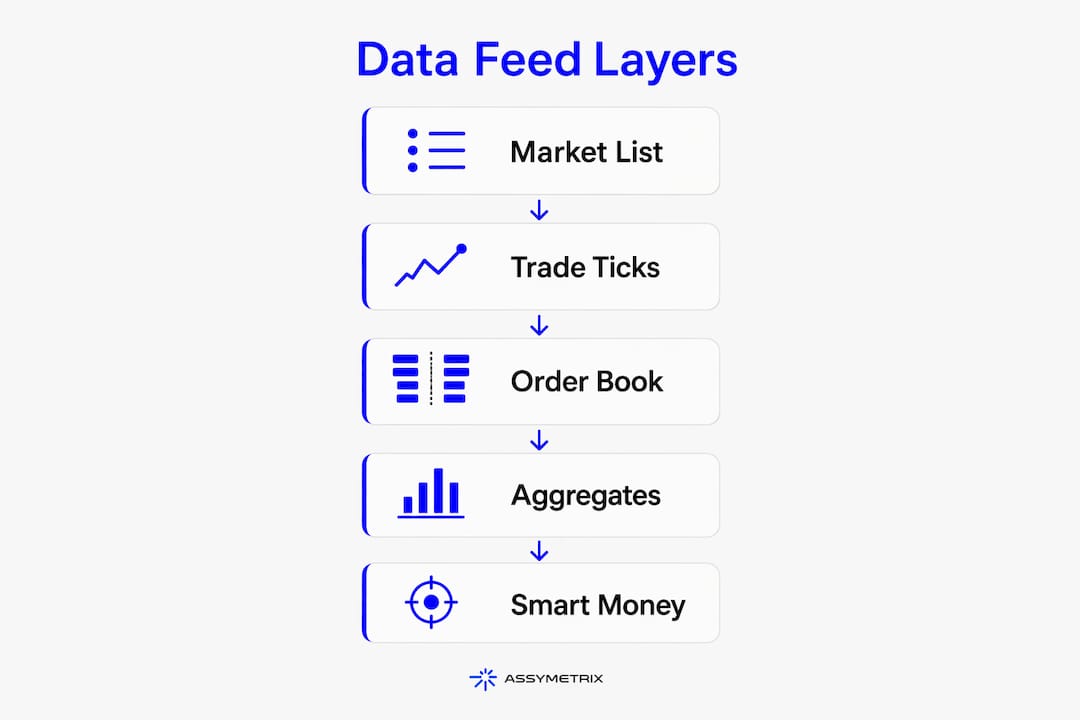
Every feed exposes several distinct data layers. Knowing which endpoint maps to which use case prevents over-fetching and keeps ingestion pipelines lean.
Data Type | Typical Fields | Primary Use Case |
|---|---|---|
Market list | market_id, canonical_ticker, venue, resolution_date, status | Market discovery, canonical ID mapping |
Trade tick | timestamp, price, size, trader_id, venue | Event-driven signal generation, tick replay |
OHLC / VWAP | open, high, low, close, vwap, volume, window | Momentum features, backtesting aggregates |
Order book snapshot | bids[ ], asks[ ], mid, spread, cost_to_move_5c | Slippage estimation, liquidity gating |
Wallet trace | wallet_id, cluster_id, smart_money_flag, entry_rate | Smart Money tracking, copy-trade signals |
Venue metadata | resolution_mechanism, deadline, reportability | Normalization, label generation |
A minimal trade tick object looks like this:
{
  "market_id": "ASSY-US-SEN-2026-AZ",
  "timestamp": "2026-06-14T18:32:11.204Z",
  "price": 0.61,
  "size": 450,
  "trader_id": "0xabc...def",
  "venue": "polymarket"
}
{
  "market_id": "ASSY-US-SEN-2026-AZ",
  "timestamp": "2026-06-14T18:32:11.204Z",
  "price": 0.61,
  "size": 450,
  "trader_id": "0xabc...def",
  "venue": "polymarket"
}
And a condensed order book snapshot:
{
  "market_id": "ASSY-US-SEN-2026-AZ",
  "ts": "2026-06-14T18:32:12.001Z",
  "bids": [[0.60, 1200], [0.59, 3400]],
  "asks": [[0.62, 800], [0.63, 2100]],
  "cost_to_move_5c": 0.0042
}
{
  "market_id": "ASSY-US-SEN-2026-AZ",
  "ts": "2026-06-14T18:32:12.001Z",
  "bids": [[0.60, 1200], [0.59, 3400]],
  "asks": [[0.62, 800], [0.63, 2100]],
  "cost_to_move_5c": 0.0042
}
Use cases that map directly to these layers: backtesting on OHLC/VWAP aggregates, live agent signal feeds on trade ticks and order book snapshots, cross-venue arbitrage scanning on combined VWAP divergence, and Trader Skill Score training datasets on wallet traces.
What does the Assymetrix Data API give you?
Assymetrix provides a single normalized feed covering Polymarket, Kalshi, and Limitless with canonical market IDs, cross-venue matching, wallet clustering, and trader-skill intelligence. The unified data layer removes the need to maintain separate connectors for each venue.
The schema centers on a canonical market object that maps each venue’s native ID to a stable ASSY-* ticker. Outcome fields are normalized across binary and multi-outcome contracts. Price sources carry a price_tier quality label so automated execution logic can gate orders to tier-1 markets only. Trade tick format is consistent across venues. Wallet analytic fields, including smart_money_flag and cluster_id, attach directly to each trade record.

Feature | Description |
|---|---|
Live WebSocket streaming | Sub-second trade and order book ticks across all covered venues |
REST historical endpoints | Paginated tick history, OHLC aggregates, wallet traces |
Bulk Parquet / CSV export | Full historical snapshots for backtesting; ~1.5 TB total archive |
Smart Money tracking | Wallet clustering, entry-rate signals, cluster-level P&L |
Trader Skill Scores | Ranked leaderboard with calibration and edge metrics |
Cross-venue arbitrage signals | Combined VWAP divergence flags and spread alerts |
The ~1 billion rows of trading activity in the archive span resolved and active political markets, giving replay pipelines enough labeled history to validate strategies across multiple election cycles.
How do you integrate the API in under an hour?
Two calls get you to live data. First, fetch the canonical market list. Second, open a WebSocket for trade ticks and order book updates. Use bulk export for backtests.
Authenticate. Attach your API key as an
Authorization: Bearer <key>header on every request. For paid-tier endpoints, some routes return HTTP 402 and require an x402 micropayment header before the server returns data.Fetch the market list.
Open a WebSocket stream.
Download Parquet exports for backtests.
import requests, json, websocket

API_KEY = "your_key_here"
BASE    = "https://data.assymetrix.com/v1"
HEADERS = {"Authorization": f"Bearer {API_KEY}"}

# Step 1 — canonical market list (keyset pagination)
resp = requests.get(f"{BASE}/markets",
                    params={"category": "politics", "limit": 100},
                    headers=HEADERS)
markets = resp.json()["markets"]

# Step 2 — WebSocket stream
def on_message(ws, msg):
    tick = json.loads(msg)
    print(tick["market_id"], tick["price"], tick["size"])

ws = websocket.WebSocketApp(
    f"wss://data.assymetrix.com/v1/stream?category=politics",
    header=[f"Authorization: Bearer {API_KEY}"],
    on_message=on_message)
ws.run_forever(ping_interval=30)

# Step 3 — bulk Parquet export for backtesting
import pandas as pd
r = requests.get(f"{BASE}/export/parquet",
                 params={"market_id": "ASSY-US-SEN-2026-AZ",
                         "from": "2025-01-01"},
                 headers=HEADERS, stream=True)
with open("az_senate.parquet", "wb") as f:
    for chunk in r.iter_content(65536):
        f.write(chunk)
df = pd.read_parquet("az_senate.parquet")
import requests, json, websocket

API_KEY = "your_key_here"
BASE    = "https://data.assymetrix.com/v1"
HEADERS = {"Authorization": f"Bearer {API_KEY}"}

# Step 1 — canonical market list (keyset pagination)
resp = requests.get(f"{BASE}/markets",
                    params={"category": "politics", "limit": 100},
                    headers=HEADERS)
markets = resp.json()["markets"]

# Step 2 — WebSocket stream
def on_message(ws, msg):
    tick = json.loads(msg)
    print(tick["market_id"], tick["price"], tick["size"])

ws = websocket.WebSocketApp(
    f"wss://data.assymetrix.com/v1/stream?category=politics",
    header=[f"Authorization: Bearer {API_KEY}"],
    on_message=on_message)
ws.run_forever(ping_interval=30)

# Step 3 — bulk Parquet export for backtesting
import pandas as pd
r = requests.get(f"{BASE}/export/parquet",
                 params={"market_id": "ASSY-US-SEN-2026-AZ",
                         "from": "2025-01-01"},
                 headers=HEADERS, stream=True)
with open("az_senate.parquet", "wb") as f:
    for chunk in r.iter_content(65536):
        f.write(chunk)
df = pd.read_parquet("az_senate.parquet")
See the Python developer guide for extended examples covering cursor-based pagination and reconnect logic.
Pro Tip: Implement exponential backoff starting at 1 second on any 429 or 503 response. For WebSocket reconnects, store the last received sequence number and pass it as a cursor query parameter on reconnect to avoid replaying duplicate ticks.
How do bots and AI agents detect political market dislocations?
Event-driven agents use four primary triggers: price jumps, volume spikes, cross-venue divergence, and Smart Money wallet surges. Streaming order book snapshots plus short-window VWAP deltas are the most reliable immediate indicators of news-driven price discovery in political markets.
The detection pipeline runs as follows: ingest the live stream, compute a short-window (60-second) VWAP and a volume z-score against a 24-hour rolling baseline, check cross-venue divergence by comparing the Assymetrix combined VWAP against each venue’s native mid, then trigger execution rules only when the divergence exceeds a threshold and cost_to_move_5c confirms sufficient liquidity.
Signal checklist to compute in real time:
VWAP delta: current 60-second VWAP minus 24-hour VWAP, normalized by spread
Volume z-score: current 5-minute volume versus rolling 24-hour mean and standard deviation
Order book imbalance: (bid depth minus ask depth) / total depth at top 3 levels
Wallet-cluster entry rate: new Smart Money wallet entries per 10-minute window
Cross-venue spread: Polymarket mid minus Kalshi mid on the same canonical ticker
Polymarket’s House and Senate control markets for the 2026 midterms show rapid price moves around polls and early vote data, making them high-priority targets for event-driven signal pipelines.
Pro Tip: Use cost_to_move_5c to size orders conservatively near resolution deadlines. Liquidity thins sharply in the final 48 hours of a political market, and a position that looked cheap to enter can carry 10x the slippage cost at expiry.
How do you normalize and validate cross-venue political data?
Run provenance checks, time-sync validation, canonical ID mapping, and price-source tiering before feeding data into any model.
Canonical ticker mapping. Map each venue’s native contract ID to an
ASSY-*ticker. Treat “projected” and “certified” resolution mechanisms as equivalent when building labels, per normalization rules that decompose tickers into AGENT, ACTION, TARGET, MECHANISM, THRESHOLD, and TIMEFRAME components.Timezone normalization. Convert all timestamps to UTC at ingestion. Kalshi and Polymarket use different epoch conventions; a one-hour offset silently corrupts VWAP windows.
Trade deduplication. Assign a deterministic
trade_hash(venue + native_trade_id + timestamp) and deduplicate before writing to your feature store.Price-source tiering. Gate automated execution to
price_tier=1markets. A combined VWAP computed across matched trades in the same time window is more reliable than any single-venue mid.Stale VWAP detection. Flag any VWAP window where trade count is below a minimum threshold as stale; exclude it from model features.
Pro Tip: Run a daily gap-detection query against your tick store. A 30-minute gap in a high-volume political market during market hours almost always indicates a missed reconnect, not a genuine trading halt.
What are the operational parameters you need to plan around?
Expect three distinct latency profiles depending on access mode: WebSocket streaming delivers sub-second ticks, REST endpoints return near-real-time snapshots (typically under 500ms), and bulk Parquet exports are batch-oriented for backtest ingestion. Live trackers that rely on hourly API refreshes miss intra-hour moves entirely, which is why streaming is non-negotiable for event-driven agents.
Rate limits. Free and academic tiers carry lower request-per-minute caps; commercial tiers support higher throughput with burst allowances. Exact limits are documented at data.assymetrix.com.
Export sizes. A single high-volume political market (e.g., Senate control) generates roughly tens of millions of rows per election cycle. The full archive covers all venues and event categories with a substantial amount of historical data.
Storage formats. Parquet with Snappy compression is the recommended format for analytical workloads; CSV is available for compatibility.
SLA and pricing tiers. Free and academic tiers cover historical access and limited streaming. Commercial tiers add higher rate limits, enterprise SLAs, and priority support. The x402 micropayment model applies to select paid endpoints.
Versioning. API versions are pinned (e.g.,
/v1/). Breaking changes ship under a new version path with a deprecation notice period; subscribe to the changelog at data.assymetrix.com.
What engineering practices keep production agents reliable?
Combine disciplined rate control, deterministic replay testing, robust feature engineering, and continuous monitoring to run production agents on political markets without silent failures.
Replay and backtesting:
Replay trade ticks with original arrival timestamps; reconstruct order book state from historical snapshots rather than end-of-day aggregates, which obscure latency-sensitive logic.
Use a deterministic replay pipeline that produces identical outputs for identical inputs. Any randomness in feature computation invalidates cross-run comparisons.
Apply time-series cross-validation with a forward gap between train and test windows sized to the resolution horizon of the target market.
Feature engineering:
Short-window (60s) and medium-window (1h) VWAP momentum as separate features
Volume z-score over 24-hour rolling baseline
Cross-venue spread on matched canonical tickers
Smart-money-adjusted returns: weight trade returns by
smart_money_flag
Monitoring metrics to instrument:
Message lag (stream timestamp minus local receipt timestamp)
Trade-drop rate (gaps in sequence numbers per minute)
Synthetic order book cost-to-move drift (flag when
cost_to_move_5cdoubles versus prior session)Model calibration drift (Brier score on resolved markets, computed weekly)
For bot-specific patterns, the Polymarket trading bot guide covers execution primitives and live order management in detail. For agent architectures, see how AI agents consume prediction market data.
What security and compliance requirements apply?
Political prediction market data sits at the intersection of financial data handling and U.S. regulatory constraints. Kalshi operates as a CFTC-regulated designated contract market; Polymarket’s U.S. access is governed by separate regulatory status. Neither platform’s data constitutes investment advice, and any system consuming this data for automated trading must comply with applicable CFTC rules and the platform’s own terms of service.
On the data-handling side: store API keys in environment variables or a secrets manager, never in source code. Rotate keys on a defined schedule. Wallet trace data contains pseudonymous on-chain identifiers; treat it with the same care as any PII-adjacent dataset under your organization’s data governance policy. Transmit all API calls over TLS 1.2 or higher. Log access at the application layer for audit trails.
This article is general technical information, not legal or financial advice. Confirm current regulatory requirements with a qualified professional and review each platform’s terms of service for your specific use case.
What are the most common integration pitfalls?
Venue ID drift. Native contract IDs on Polymarket and Kalshi change between market versions. Always resolve to canonical ASSY-* tickers at ingestion, never store venue-native IDs as primary keys in your feature store.
Missed reconnects. A WebSocket that silently drops during a high-volatility news event is the single most common cause of missing the exact ticks that matter. Implement a heartbeat check every 30 seconds and treat any gap over 60 seconds as a reconnect trigger.
VWAP window misalignment. Computing VWAP across venues without first normalizing timestamps to UTC produces phantom divergence signals. Fix timezone normalization before any cross-venue computation.
Over-fetching on REST. Polling the full market list every second wastes quota. Use keyset pagination with a since cursor and subscribe to the stream for updates; poll REST only for initial state hydration.
Label leakage. Including post-resolution price data in training features is the most common modeling error on political markets. Enforce a strict cutoff at the market’s resolution_date field when constructing labels.
How does API versioning affect long-term maintenance?
The Assymetrix Data API uses explicit version paths (/v1/, /v2/) so breaking changes never silently corrupt existing integrations. When a new version ships, the prior version remains available for a documented deprecation window, giving engineering teams time to migrate without emergency patches.
Pin your integration to a specific version path from day one. Subscribe to the changelog at data.assymetrix.com to receive advance notice of schema changes, new fields, and deprecation timelines. When a new field appears in a response, treat it as additive and non-breaking; when a field is removed or renamed, that signals a version increment.
For long-lived research pipelines, store the API version alongside each exported dataset. A Parquet file labeled with its source version and export timestamp is fully reproducible; one without that metadata is not.
Key Takeaways
Assymetrix’s unified political event data API gives developers, quants, and AI agents a single integration point for normalized real-time and historical data across Polymarket, Kalshi, and Limitless, backed by a substantial multi-terabyte dataset and hundreds of millions of rows of trading activity.
Point | Details |
|---|---|
Use a unified API | Assymetrix canonical market IDs eliminate per-venue connector maintenance and normalize schema across Polymarket, Kalshi, and Limitless. |
Prioritize matched markets | Cross-venue combined VWAP on canonical tickers produces stronger signals and reduces venue-specific noise in model training. |
Run normalization checks | Validate timezone alignment, deduplicate trades, and gate execution to price_tier=1 markets before any live deployment. |
Build replay-first pipelines | Replay ticks with original arrival timestamps and reconstruct order book state; never use end-of-day aggregates for latency-sensitive logic. |
Instrument live monitoring | Track message lag, trade-drop rate, and cost-to-move drift to catch silent feed failures before they corrupt model outputs. |
Why unified political feeds are the infrastructure layer that most quant teams skip
The conventional approach to political market data is to build direct connectors to each venue, normalize the data manually, and hope the schemas stay stable across election cycles. Most teams underestimate how much that maintenance compounds. A schema change on Kalshi two weeks before a major election is not a theoretical risk; it has happened. The teams that absorb it cleanly are the ones who pinned to a normalized abstraction layer from the start.
What Assymetrix built is that abstraction layer, applied specifically to the data category where the signal quality is highest: political markets. The Smart Money and Trader Skill features are not decorative. They exist because wallet-level analysis of who is trading a political market, and how consistently they have been right, is a materially different signal than price alone. Most quant teams building on political data ignore the wallet layer entirely and leave that edge on the table; traders and quants looking to rapidly prototype such strategies may benefit from a no-code trading algorithm platform that integrates model outputs with execution.
The teams that succeed with political market data share one pattern: they treat data provenance as a first-class engineering concern from day one, not a cleanup task after the model is already in production.
The Assymetrix Data API is ready when you are
Political prediction markets are the highest-signal category in the prediction market universe, and the infrastructure to access them at scale now exists in a single integration. Assymetrix gives you real-time and historical political market data across Polymarket, Kalshi, and Limitless, normalized to a canonical schema, with Smart Money signals and Trader Skill Scores included.
Free and academic tiers cover historical bulk access and limited streaming. Commercial tiers add enterprise SLAs, higher rate limits, and priority support. Get your API key and run the quick-start at data.assymetrix.com. For Python integration examples, the developer guide has copy-ready code for every endpoint covered here.
Useful sources
Assymetrix Data API and intelligence platform — primary API home, Smart Money features, and dataset provenance
Prediction Market Data Feed: Real-Time and Historical API Guide — streaming vs bulk export formats
Python Prediction Market Data: Developer API Guide — Python integration examples
Bellwether canonical ticker and VWAP documentation — normalization rules, cost_to_move, price_tier fields
BlockRun Prediction Markets API reference — x402 micropayment header model, endpoint patterns
Polymarket 2026 Midterms market data — venue behavior, volume patterns, Smart Money signals
AP Elections API — authoritative official election results and race call data
Democracy Works Elections API — comprehensive civic election data for voter guidance and ballot information
ElectionMarkets live market hub — active political market lists and resolved market archives
FAQ
What is a political event data API?
A political event data API provides programmatic access to prediction market prices, trade ticks, order book depth, and wallet analytics for political events such as elections and legislative outcomes. Assymetrix’s Data API at data.assymetrix.com unifies this data across Polymarket, Kalshi, and Limitless in a single normalized feed.
How do I access real-time election market data?
Open a WebSocket connection to the Assymetrix streaming endpoint with your API key and subscribe to the politics category. The stream delivers sub-second trade ticks and order book snapshots; REST endpoints cover near-real-time snapshots and paginated historical queries.
What historical data depth is available for backtesting?
Assymetrix’s archive spans approximately 1.5 TB and nearly 1 billion rows of trading activity across covered venues, covering multiple election cycles and sufficient resolved markets for statistically meaningful strategy validation.
How does Smart Money tracking work in political markets?
Assymetrix clusters wallets by historical accuracy and trade timing, then attaches a smart_money_flag and cluster_id to each trade tick. Monitoring the entry rate of high-accuracy wallet clusters ahead of major political events surfaces positioning shifts before they fully reflect in price.
What is the x402 payment header and when do I need it?
Some paid-tier API endpoints return HTTP 402 until you attach an x402 micropayment header authorizing the charge. This applies to select premium data routes; the Assymetrix developer documentation at data.assymetrix.com specifies which endpoints require it and how to construct the header.
Political Event Data API: Access Election Market Data
TL;DR:
The Assymetrix Data API provides a unified, normalized feed of real-time and historical political market data from Polymarket, Kalshi, and Limitless. It offers detailed trade, order book, wallet, and market metadata to support prediction, backtesting, and arbitrage strategies. The API’s comprehensive coverage and tooling enable quick, reliable integration for quant teams and AI agents.
The fastest path to unified U.S. political prediction market data is the Assymetrix Data API at data.assymetrix.com. One integration exposes normalized feeds from Polymarket, Kalshi, and Limitless, covering real-time WebSocket streaming, REST snapshots, and bulk Parquet exports for backtesting. Canonical market IDs eliminate the venue-matching overhead that otherwise consumes weeks of engineering time. Smart Money wallet signals and Trader Skill Scores ship in the same feed. Get your API key at data.assymetrix.com and run the quick-start below.
Table of Contents
Why do political markets produce the highest-quality prediction data?
What data types can you ingest from political event markets?
What does the Assymetrix Data API give you?
How do you integrate the API in under an hour?
How do bots and AI agents detect political market dislocations?
How do you normalize and validate cross-venue political data?
What are the operational parameters you need to plan around?
What engineering practices keep production agents reliable?
What security and compliance requirements apply?
What are the most common integration pitfalls?
How does API versioning affect long-term maintenance?
Key Takeaways
Why unified political feeds are the infrastructure layer that most quant teams skip
The Assymetrix Data API is ready when you are
Useful sources
Why do political markets produce the highest-quality prediction data?
Political markets concentrate informed order flow in a way most other prediction categories cannot match. High-stakes events, institutional participation, and long resolution windows combine to produce price series that are both deep and verifiable.
Institutional participation and event stakes. Senate control, gubernatorial races, and presidential markets attract professional traders whose positions reflect genuine information, not noise.
Concentrated liquidity. Core political markets on Polymarket and Kalshi consistently rank among the highest-volume contracts on each platform, reducing bid-ask spread and improving signal quality.
Multi-platform coverage. Matching the same event across Polymarket, Kalshi, and Limitless increases trade coverage and surfaces cross-venue divergence, a primary arbitrage and signal-quality indicator.
Long resolution windows. A Senate race that resolves in November gives a model months of labeled training data, enabling rigorous backtests that short-horizon markets cannot support.
Assymetrix’s historical archive spans approximately 1.5 TB and nearly 1 billion rows of trading activity across these venues, giving quant teams the depth needed for statistically meaningful strategy development.
Pro Tip: Prioritize cross-venue matched markets using canonical tickers when building training datasets. Venue-specific artifacts, such as platform-native liquidity gaps, wash out when you compute combined VWAP across matched trades rather than relying on a single venue’s price series.
What data types can you ingest from political event markets?
Every feed exposes several distinct data layers. Knowing which endpoint maps to which use case prevents over-fetching and keeps ingestion pipelines lean.
Data Type | Typical Fields | Primary Use Case |
|---|---|---|
Market list | market_id, canonical_ticker, venue, resolution_date, status | Market discovery, canonical ID mapping |
Trade tick | timestamp, price, size, trader_id, venue | Event-driven signal generation, tick replay |
OHLC / VWAP | open, high, low, close, vwap, volume, window | Momentum features, backtesting aggregates |
Order book snapshot | bids[ ], asks[ ], mid, spread, cost_to_move_5c | Slippage estimation, liquidity gating |
Wallet trace | wallet_id, cluster_id, smart_money_flag, entry_rate | Smart Money tracking, copy-trade signals |
Venue metadata | resolution_mechanism, deadline, reportability | Normalization, label generation |
A minimal trade tick object looks like this:
{
  "market_id": "ASSY-US-SEN-2026-AZ",
  "timestamp": "2026-06-14T18:32:11.204Z",
  "price": 0.61,
  "size": 450,
  "trader_id": "0xabc...def",
  "venue": "polymarket"
}
And a condensed order book snapshot:
{
  "market_id": "ASSY-US-SEN-2026-AZ",
  "ts": "2026-06-14T18:32:12.001Z",
  "bids": [[0.60, 1200], [0.59, 3400]],
  "asks": [[0.62, 800], [0.63, 2100]],
  "cost_to_move_5c": 0.0042
}
Use cases that map directly to these layers: backtesting on OHLC/VWAP aggregates, live agent signal feeds on trade ticks and order book snapshots, cross-venue arbitrage scanning on combined VWAP divergence, and Trader Skill Score training datasets on wallet traces.
What does the Assymetrix Data API give you?
Assymetrix provides a single normalized feed covering Polymarket, Kalshi, and Limitless with canonical market IDs, cross-venue matching, wallet clustering, and trader-skill intelligence. The unified data layer removes the need to maintain separate connectors for each venue.
The schema centers on a canonical market object that maps each venue’s native ID to a stable ASSY-* ticker. Outcome fields are normalized across binary and multi-outcome contracts. Price sources carry a price_tier quality label so automated execution logic can gate orders to tier-1 markets only. Trade tick format is consistent across venues. Wallet analytic fields, including smart_money_flag and cluster_id, attach directly to each trade record.
Feature | Description |
|---|---|
Live WebSocket streaming | Sub-second trade and order book ticks across all covered venues |
REST historical endpoints | Paginated tick history, OHLC aggregates, wallet traces |
Bulk Parquet / CSV export | Full historical snapshots for backtesting; ~1.5 TB total archive |
Smart Money tracking | Wallet clustering, entry-rate signals, cluster-level P&L |
Trader Skill Scores | Ranked leaderboard with calibration and edge metrics |
Cross-venue arbitrage signals | Combined VWAP divergence flags and spread alerts |
The ~1 billion rows of trading activity in the archive span resolved and active political markets, giving replay pipelines enough labeled history to validate strategies across multiple election cycles.
How do you integrate the API in under an hour?
Two calls get you to live data. First, fetch the canonical market list. Second, open a WebSocket for trade ticks and order book updates. Use bulk export for backtests.
Authenticate. Attach your API key as an
Authorization: Bearer <key>header on every request. For paid-tier endpoints, some routes return HTTP 402 and require an x402 micropayment header before the server returns data.Fetch the market list.
Open a WebSocket stream.
Download Parquet exports for backtests.
import requests, json, websocket

API_KEY = "your_key_here"
BASE    = "https://data.assymetrix.com/v1"
HEADERS = {"Authorization": f"Bearer {API_KEY}"}

# Step 1 — canonical market list (keyset pagination)
resp = requests.get(f"{BASE}/markets",
                    params={"category": "politics", "limit": 100},
                    headers=HEADERS)
markets = resp.json()["markets"]

# Step 2 — WebSocket stream
def on_message(ws, msg):
    tick = json.loads(msg)
    print(tick["market_id"], tick["price"], tick["size"])

ws = websocket.WebSocketApp(
    f"wss://data.assymetrix.com/v1/stream?category=politics",
    header=[f"Authorization: Bearer {API_KEY}"],
    on_message=on_message)
ws.run_forever(ping_interval=30)

# Step 3 — bulk Parquet export for backtesting
import pandas as pd
r = requests.get(f"{BASE}/export/parquet",
                 params={"market_id": "ASSY-US-SEN-2026-AZ",
                         "from": "2025-01-01"},
                 headers=HEADERS, stream=True)
with open("az_senate.parquet", "wb") as f:
    for chunk in r.iter_content(65536):
        f.write(chunk)
df = pd.read_parquet("az_senate.parquet")
See the Python developer guide for extended examples covering cursor-based pagination and reconnect logic.
Pro Tip: Implement exponential backoff starting at 1 second on any 429 or 503 response. For WebSocket reconnects, store the last received sequence number and pass it as a cursor query parameter on reconnect to avoid replaying duplicate ticks.
How do bots and AI agents detect political market dislocations?
Event-driven agents use four primary triggers: price jumps, volume spikes, cross-venue divergence, and Smart Money wallet surges. Streaming order book snapshots plus short-window VWAP deltas are the most reliable immediate indicators of news-driven price discovery in political markets.
The detection pipeline runs as follows: ingest the live stream, compute a short-window (60-second) VWAP and a volume z-score against a 24-hour rolling baseline, check cross-venue divergence by comparing the Assymetrix combined VWAP against each venue’s native mid, then trigger execution rules only when the divergence exceeds a threshold and cost_to_move_5c confirms sufficient liquidity.
Signal checklist to compute in real time:
VWAP delta: current 60-second VWAP minus 24-hour VWAP, normalized by spread
Volume z-score: current 5-minute volume versus rolling 24-hour mean and standard deviation
Order book imbalance: (bid depth minus ask depth) / total depth at top 3 levels
Wallet-cluster entry rate: new Smart Money wallet entries per 10-minute window
Cross-venue spread: Polymarket mid minus Kalshi mid on the same canonical ticker
Polymarket’s House and Senate control markets for the 2026 midterms show rapid price moves around polls and early vote data, making them high-priority targets for event-driven signal pipelines.
Pro Tip: Use cost_to_move_5c to size orders conservatively near resolution deadlines. Liquidity thins sharply in the final 48 hours of a political market, and a position that looked cheap to enter can carry 10x the slippage cost at expiry.
How do you normalize and validate cross-venue political data?
Run provenance checks, time-sync validation, canonical ID mapping, and price-source tiering before feeding data into any model.
Canonical ticker mapping. Map each venue’s native contract ID to an
ASSY-*ticker. Treat “projected” and “certified” resolution mechanisms as equivalent when building labels, per normalization rules that decompose tickers into AGENT, ACTION, TARGET, MECHANISM, THRESHOLD, and TIMEFRAME components.Timezone normalization. Convert all timestamps to UTC at ingestion. Kalshi and Polymarket use different epoch conventions; a one-hour offset silently corrupts VWAP windows.
Trade deduplication. Assign a deterministic
trade_hash(venue + native_trade_id + timestamp) and deduplicate before writing to your feature store.Price-source tiering. Gate automated execution to
price_tier=1markets. A combined VWAP computed across matched trades in the same time window is more reliable than any single-venue mid.Stale VWAP detection. Flag any VWAP window where trade count is below a minimum threshold as stale; exclude it from model features.
Pro Tip: Run a daily gap-detection query against your tick store. A 30-minute gap in a high-volume political market during market hours almost always indicates a missed reconnect, not a genuine trading halt.
What are the operational parameters you need to plan around?
Expect three distinct latency profiles depending on access mode: WebSocket streaming delivers sub-second ticks, REST endpoints return near-real-time snapshots (typically under 500ms), and bulk Parquet exports are batch-oriented for backtest ingestion. Live trackers that rely on hourly API refreshes miss intra-hour moves entirely, which is why streaming is non-negotiable for event-driven agents.
Rate limits. Free and academic tiers carry lower request-per-minute caps; commercial tiers support higher throughput with burst allowances. Exact limits are documented at data.assymetrix.com.
Export sizes. A single high-volume political market (e.g., Senate control) generates roughly tens of millions of rows per election cycle. The full archive covers all venues and event categories with a substantial amount of historical data.
Storage formats. Parquet with Snappy compression is the recommended format for analytical workloads; CSV is available for compatibility.
SLA and pricing tiers. Free and academic tiers cover historical access and limited streaming. Commercial tiers add higher rate limits, enterprise SLAs, and priority support. The x402 micropayment model applies to select paid endpoints.
Versioning. API versions are pinned (e.g.,
/v1/). Breaking changes ship under a new version path with a deprecation notice period; subscribe to the changelog at data.assymetrix.com.
What engineering practices keep production agents reliable?
Combine disciplined rate control, deterministic replay testing, robust feature engineering, and continuous monitoring to run production agents on political markets without silent failures.
Replay and backtesting:
Replay trade ticks with original arrival timestamps; reconstruct order book state from historical snapshots rather than end-of-day aggregates, which obscure latency-sensitive logic.
Use a deterministic replay pipeline that produces identical outputs for identical inputs. Any randomness in feature computation invalidates cross-run comparisons.
Apply time-series cross-validation with a forward gap between train and test windows sized to the resolution horizon of the target market.
Feature engineering:
Short-window (60s) and medium-window (1h) VWAP momentum as separate features
Volume z-score over 24-hour rolling baseline
Cross-venue spread on matched canonical tickers
Smart-money-adjusted returns: weight trade returns by
smart_money_flag
Monitoring metrics to instrument:
Message lag (stream timestamp minus local receipt timestamp)
Trade-drop rate (gaps in sequence numbers per minute)
Synthetic order book cost-to-move drift (flag when
cost_to_move_5cdoubles versus prior session)Model calibration drift (Brier score on resolved markets, computed weekly)
For bot-specific patterns, the Polymarket trading bot guide covers execution primitives and live order management in detail. For agent architectures, see how AI agents consume prediction market data.
What security and compliance requirements apply?
Political prediction market data sits at the intersection of financial data handling and U.S. regulatory constraints. Kalshi operates as a CFTC-regulated designated contract market; Polymarket’s U.S. access is governed by separate regulatory status. Neither platform’s data constitutes investment advice, and any system consuming this data for automated trading must comply with applicable CFTC rules and the platform’s own terms of service.
On the data-handling side: store API keys in environment variables or a secrets manager, never in source code. Rotate keys on a defined schedule. Wallet trace data contains pseudonymous on-chain identifiers; treat it with the same care as any PII-adjacent dataset under your organization’s data governance policy. Transmit all API calls over TLS 1.2 or higher. Log access at the application layer for audit trails.
This article is general technical information, not legal or financial advice. Confirm current regulatory requirements with a qualified professional and review each platform’s terms of service for your specific use case.
What are the most common integration pitfalls?
Venue ID drift. Native contract IDs on Polymarket and Kalshi change between market versions. Always resolve to canonical ASSY-* tickers at ingestion, never store venue-native IDs as primary keys in your feature store.
Missed reconnects. A WebSocket that silently drops during a high-volatility news event is the single most common cause of missing the exact ticks that matter. Implement a heartbeat check every 30 seconds and treat any gap over 60 seconds as a reconnect trigger.
VWAP window misalignment. Computing VWAP across venues without first normalizing timestamps to UTC produces phantom divergence signals. Fix timezone normalization before any cross-venue computation.
Over-fetching on REST. Polling the full market list every second wastes quota. Use keyset pagination with a since cursor and subscribe to the stream for updates; poll REST only for initial state hydration.
Label leakage. Including post-resolution price data in training features is the most common modeling error on political markets. Enforce a strict cutoff at the market’s resolution_date field when constructing labels.
How does API versioning affect long-term maintenance?
The Assymetrix Data API uses explicit version paths (/v1/, /v2/) so breaking changes never silently corrupt existing integrations. When a new version ships, the prior version remains available for a documented deprecation window, giving engineering teams time to migrate without emergency patches.
Pin your integration to a specific version path from day one. Subscribe to the changelog at data.assymetrix.com to receive advance notice of schema changes, new fields, and deprecation timelines. When a new field appears in a response, treat it as additive and non-breaking; when a field is removed or renamed, that signals a version increment.
For long-lived research pipelines, store the API version alongside each exported dataset. A Parquet file labeled with its source version and export timestamp is fully reproducible; one without that metadata is not.
Key Takeaways
Assymetrix’s unified political event data API gives developers, quants, and AI agents a single integration point for normalized real-time and historical data across Polymarket, Kalshi, and Limitless, backed by a substantial multi-terabyte dataset and hundreds of millions of rows of trading activity.
Point | Details |
|---|---|
Use a unified API | Assymetrix canonical market IDs eliminate per-venue connector maintenance and normalize schema across Polymarket, Kalshi, and Limitless. |
Prioritize matched markets | Cross-venue combined VWAP on canonical tickers produces stronger signals and reduces venue-specific noise in model training. |
Run normalization checks | Validate timezone alignment, deduplicate trades, and gate execution to price_tier=1 markets before any live deployment. |
Build replay-first pipelines | Replay ticks with original arrival timestamps and reconstruct order book state; never use end-of-day aggregates for latency-sensitive logic. |
Instrument live monitoring | Track message lag, trade-drop rate, and cost-to-move drift to catch silent feed failures before they corrupt model outputs. |
Why unified political feeds are the infrastructure layer that most quant teams skip
The conventional approach to political market data is to build direct connectors to each venue, normalize the data manually, and hope the schemas stay stable across election cycles. Most teams underestimate how much that maintenance compounds. A schema change on Kalshi two weeks before a major election is not a theoretical risk; it has happened. The teams that absorb it cleanly are the ones who pinned to a normalized abstraction layer from the start.
What Assymetrix built is that abstraction layer, applied specifically to the data category where the signal quality is highest: political markets. The Smart Money and Trader Skill features are not decorative. They exist because wallet-level analysis of who is trading a political market, and how consistently they have been right, is a materially different signal than price alone. Most quant teams building on political data ignore the wallet layer entirely and leave that edge on the table; traders and quants looking to rapidly prototype such strategies may benefit from a no-code trading algorithm platform that integrates model outputs with execution.
The teams that succeed with political market data share one pattern: they treat data provenance as a first-class engineering concern from day one, not a cleanup task after the model is already in production.
The Assymetrix Data API is ready when you are
Political prediction markets are the highest-signal category in the prediction market universe, and the infrastructure to access them at scale now exists in a single integration. Assymetrix gives you real-time and historical political market data across Polymarket, Kalshi, and Limitless, normalized to a canonical schema, with Smart Money signals and Trader Skill Scores included.
Free and academic tiers cover historical bulk access and limited streaming. Commercial tiers add enterprise SLAs, higher rate limits, and priority support. Get your API key and run the quick-start at data.assymetrix.com. For Python integration examples, the developer guide has copy-ready code for every endpoint covered here.
Useful sources
Assymetrix Data API and intelligence platform — primary API home, Smart Money features, and dataset provenance
Prediction Market Data Feed: Real-Time and Historical API Guide — streaming vs bulk export formats
Python Prediction Market Data: Developer API Guide — Python integration examples
Bellwether canonical ticker and VWAP documentation — normalization rules, cost_to_move, price_tier fields
BlockRun Prediction Markets API reference — x402 micropayment header model, endpoint patterns
Polymarket 2026 Midterms market data — venue behavior, volume patterns, Smart Money signals
AP Elections API — authoritative official election results and race call data
Democracy Works Elections API — comprehensive civic election data for voter guidance and ballot information
ElectionMarkets live market hub — active political market lists and resolved market archives
FAQ
What is a political event data API?
A political event data API provides programmatic access to prediction market prices, trade ticks, order book depth, and wallet analytics for political events such as elections and legislative outcomes. Assymetrix’s Data API at data.assymetrix.com unifies this data across Polymarket, Kalshi, and Limitless in a single normalized feed.
How do I access real-time election market data?
Open a WebSocket connection to the Assymetrix streaming endpoint with your API key and subscribe to the politics category. The stream delivers sub-second trade ticks and order book snapshots; REST endpoints cover near-real-time snapshots and paginated historical queries.
What historical data depth is available for backtesting?
Assymetrix’s archive spans approximately 1.5 TB and nearly 1 billion rows of trading activity across covered venues, covering multiple election cycles and sufficient resolved markets for statistically meaningful strategy validation.
How does Smart Money tracking work in political markets?
Assymetrix clusters wallets by historical accuracy and trade timing, then attaches a smart_money_flag and cluster_id to each trade tick. Monitoring the entry rate of high-accuracy wallet clusters ahead of major political events surfaces positioning shifts before they fully reflect in price.
What is the x402 payment header and when do I need it?
Some paid-tier API endpoints return HTTP 402 until you attach an x402 micropayment header authorizing the charge. This applies to select premium data routes; the Assymetrix developer documentation at data.assymetrix.com specifies which endpoints require it and how to construct the header.
Other Blog


