Execution Aware Market Divergence Signals for Prediction Market Quants
Execution Aware Market Divergence Signals for Prediction Market Quants
Execution Aware Market Divergence Signals for Prediction Market Quants
A developer and quant playbook for execution aware market divergence signals. Covers real time detector components, ranking rules, execution risk, and API...

Execution Aware Market Divergence Signals for Prediction Market Quants
Market divergence signals are normalized cross-venue price and microstructure discrepancies across prediction markets that flag arbitrage or Smart Money movement for automated systems. They surface when correlated contracts on Polymarket, Kalshi, and Limitless disagree on price, when spreads widen unexpectedly, or when one venue reprices before another catches up. Reading these signals well requires conditioning them on market domain, time to resolution, and trade size before ranking them.
TL;DR:
Cross-venue divergence signals are strongest when adjusted for market domain, trade size, and time to resolution, requiring careful calibration.
Detecting genuine arbitrage involves confirming outcome, cutoff, settlement source, and matching market criteria, not just raw price gaps.
Liquidity and order-book depth significantly impact the tradability of detected gaps and should be modeled to avoid execution risk.
Using a unified API simplifies real-time detection, enabling matching contract IDs, streaming data, and incorporating Smart Money tags for better signal ranking.
Most false positives result from resolution mismatches, clock drift, or insufficient depth modeling, so logging and backtesting are critical for accurate divergence detection.
AssymetrixUnify Your Market Divergence DataAssymetrix brings Polymarket, Kalshi, and Limitless data into one intelligence layer for traders, researchers, developers, and AI agents.Explore Assymetrix
Table of Contents
1. What cross-venue market divergence signals actually measure
2. Why divergence signals are among the strongest edges in prediction markets
How to Detect Divergence in Real Time
Execution risk hiding inside a real divergence
Integrating divergence signals with the Assymetrix Data API
Case studies in cross-venue divergence detection
How divergence signals compare with other predictive indicators
Tools and platforms used for monitoring divergence
Lessons from building cross-venue divergence detection
Assymetrix Data API: unified pricing for divergence detection
Research and docs to read next
Sources
1. What cross-venue market divergence signals actually measure
A divergence signal is a normalized gap between the implied probabilities of two contracts that reference the same underlying event, adjusted for known differences in fee structure and settlement timing. Four patterns show up repeatedly in cross-venue data. A persistent gap holds for minutes or hours because one venue’s order book is thin and slow to absorb new information. Transient spread widening appears around news events, when market makers pull quotes and bid-ask spreads blow out on one venue while the other stays tight. Order-book repricing happens when a large trade on one venue moves its midpoint and the correlated market on another venue has not adjusted yet. Smart Money lead-lag is the pattern where a wallet with a strong historical track record takes a position on one venue minutes or hours before the other venue’s price moves toward it.
Before any of these patterns can be computed, the two markets have to be confirmed as the same underlying event. That means checking outcome text, resolution cutoff, timezone, and settlement source, since two contracts with similar titles can resolve on different criteria.
The minimal data set for computing these signals includes:
Timestamped last-trade and quote prices for both sides of the contract.
Best bid and ask with depth at each level.
Individual trade size and direction.
Wallet or account tags where available, to identify recurring high-skill participants.
Without depth and trade size, a gap is just a number. With them, it becomes a signal you can size a position against.
2. Why divergence signals are among the strongest edges in prediction markets
Raw price gaps are noisy. A domain-specific calibration study across 353 million trades on Kalshi and Polymarket found that calibration accuracy varies systematically by event domain, time to resolution, and trade size, with political contracts showing persistent underconfidence toward 50%. A gap that looks large in a political market can be structurally normal, while the same size gap in a sports or weather contract can be a genuine mispricing.
One of the clearest findings in cross-venue research is that calibration error is domain-conditional rather than uniform, which means a single global threshold for divergence will systematically misrank alerts. (Decomposing crowd wisdom, arXiv 2602.19520)
The same paper notes that Polymarket’s on-chain, pseudonymous structure and Kalshi’s regulated central limit order book produce platform-specific calibration patterns, so a model trained on one venue’s history will misprice the other’s baseline. Maker and taker roles add another layer: transaction-level analysis of Kalshi trades shows that prices improve toward closing but still carry a favorite-longshot bias, meaning the price a maker quotes and the price a taker can actually execute are not the same thing.
The practical translation: rank alerts by conditioned surprise, not raw gap size. Weight each signal by inverse liquidity, apply a domain-horizon calibration factor, and treat trade size as a feature rather than a filter.
How to Detect Divergence in Real Time
A production detector has five components working in sequence. Streaming ingestion pulls live order-book and trade data over websocket connections from each venue, since REST polling introduces latency that erases the edge before you can act on it. Canonical ID mapping assigns a single internal identifier to each contract regardless of venue-specific naming. Normalization converts each venue’s price convention, fee schedule, and settlement rule into a common schema. Time alignment stamps every event to a shared clock, correcting for venue-side clock drift. Deduplication drops repeated snapshots so smoothing calculations do not double-count static periods.
Semantic matching is where most detectors fail quietly. A checklist that catches the common errors:
Confirm the outcome definition is identical, not just similarly worded.
Confirm the resolution cutoff date and time, including timezone.
Confirm the settlement source both markets will use to resolve.
Confirm cancellation or void conditions match.
Confirm there is no partial-outcome or multi-way structure on one side only.
Pro Tip: Log every rejected match with its failure reason. A month of rejected-match logs is the fastest way to see which fields cause the most false negatives in your matcher.
Once a pair is confirmed, compute the normalized gap as the absolute difference in implied probability, then apply a spread filter that discards gaps smaller than the combined bid-ask spread of both venues, since those are not executable. Smooth the gap over a short rolling window to filter out single-tick noise, and weight the result by an event-horizon factor since gaps close faster near resolution.
A workable alert score looks like:
score = (normalized_gap / combined_spread) * liquidity_weight * calibration_factor
where liquidity weight rises as available depth falls and the calibration factor comes from domain and horizon conditioning as described above. Clock synchronization matters more than most teams expect: a 200-millisecond drift between two venue feeds can manufacture a phantom divergence that disappears the moment both feeds catch up.
Execution risk hiding inside a real divergence
A gap that looks tradable on screen often is not tradable at the price shown. The Kalshi transaction-level analysis found that taker-executed trades carry systematic loss patterns on low-price contracts, which means the quoted midpoint and the price a taker actually clears at diverge most exactly where divergence signals tend to cluster.
Resolution and settlement mismatches are the first thing to rule out. Two contracts can look identical in title and still resolve on different data sources, different rounding rules, or different cutoff times, and a gap driven by that mismatch is not an arbitrage, it is uncompensated risk. Checking settlement source and cutoff before sizing a position catches most of these.
Liquidity modeling comes next:
Pull the top-N order-book depth on both venues before estimating executable size, not just the top-of-book quote.
Model expected price impact as a function of order size against that depth curve.
Build in a slippage buffer sized to historical fill quality, not the theoretical spread.
Set a minimum actionable depth below which the signal is informational only.
Maker and taker economics change the math further. A quoted price assumes you can trade at the passive side; a taker order pays the spread plus any per-trade fee, so the real edge is the gap minus spread minus fees on both legs. Position sizing should scale down as combined-venue depth thins, and every filled position needs a reconciliation check comparing expected fill price against realized fill price to catch execution leakage before it compounds across many trades.
Integrating divergence signals with the Assymetrix Data API
The Assymetrix Data API gives developers unified access to Polymarket, Kalshi, and Limitless through one integration, backed by approximately 1.5 terabytes of historical trading data. That backfill matters for divergence work because thresholds calibrated on live data alone tend to overfit to whatever volatility regime happened to be active that week.
A minimal integration plan:
Subscribe to the streaming endpoint for live price and depth updates across all three venues.
Use canonical IDs to match contracts without building your own semantic matcher from scratch.
Pull Smart Money wallet tags and cross-venue arbitrage flags as additional ranking features alongside your own gap calculations.
Persist raw and normalized data to a local store for replay-based backtesting.
Run historical replay against the 1.5 terabyte archive to calibrate spread thresholds before going live.
For Polymarket-specific contract structures and on-chain data quirks, the Polymarket resource hub covers the details that matter for canonical matching on that venue.
Case studies in cross-venue divergence detection
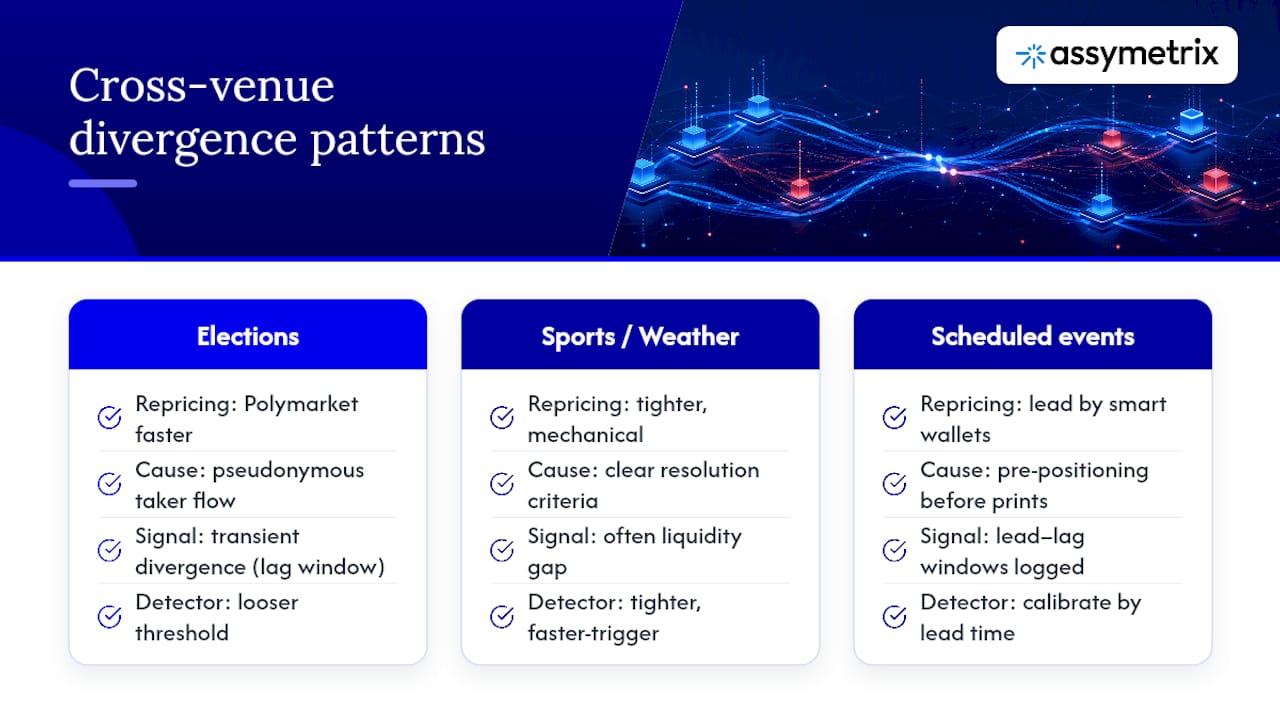
A recurring pattern in cross-venue monitoring involves election contracts where Polymarket’s on-chain order book reprices faster on breaking news, since its taker flow is dominated by pseudonymous wallets that can move size without an intermediary approval step, while Kalshi’s regulated structure introduces a short lag as market makers adjust quotes under compliance constraints. A detector watching both venues catches the lag window as a transient divergence, and the size of that window tends to compress as the resolution date approaches, consistent with the horizon-dependent calibration pattern described in the domain-specific calibration research.
Sports and weather contracts show a different shape. These markets tend to have tighter, more mechanical calibration since the resolution criteria are less contestable than political outcomes, so a gap that appears here is more often a genuine liquidity gap than a disagreement about how to interpret the underlying event. A detector tuned with one threshold for political markets and a tighter, faster-triggering threshold for sports and weather markets catches more real signals in both domains than a single global setting.
Smart Money lead-lag shows up most clearly around scheduled events, such as economic data releases, where a wallet with a strong historical resolution record positions ahead of the release and the correlated market on the second venue reprices only after the data prints. Logging these lead-lag windows over time builds a practical calibration set for how much lead time a given domain typically offers before the edge closes.
How divergence signals compare with other predictive indicators
Divergence signals sit alongside a handful of other tools quants use to read prediction markets, and each answers a different question. Implied-probability trend tracking shows where a single market’s belief is heading over time, which is useful for directional positioning but says nothing about whether that belief is priced consistently elsewhere. Order flow analysis, covered in more depth in Assymetrix’s order flow guide, reveals who is trading and in what size, which helps interpret a divergence once you have found one but does not find it for you. Trader skill scoring, built from historical resolution accuracy, tells you whose positioning is worth weighting more heavily inside a Smart Money signal.
Divergence signals are distinct because they compare two markets rather than describing one, which makes them structurally harder to compute but also harder to arbitrage away once found, since closing the gap requires liquidity on both venues simultaneously. A single-venue indicator can be replicated by anyone watching that venue. A cross-venue divergence requires the infrastructure to watch both venues in sync, match the contracts correctly, and execute before the gap closes, which is a meaningfully higher bar and part of why the edge persists longer than single-venue signals tend to.
Tools and platforms used for monitoring divergence
Most teams building divergence detectors combine a few categories of infrastructure rather than relying on one tool. Direct venue APIs from Polymarket and Kalshi provide raw feeds but require building normalization, canonical matching, and cross-venue synchronization from scratch, which is where most in-house projects spend the bulk of their engineering time. Generic charting and analytics dashboards built for single-venue monitoring can track one market’s price history well but were not designed to compute a cross-venue gap or align two independent clocks. Unified data layers such as the Assymetrix Data API handle the ingestion, canonical ID mapping, and normalization layer directly, which shifts engineering effort toward signal design and execution logic instead of feed plumbing. Order-book depth tools, discussed in the liquidity metrics guide, are a necessary companion to any divergence tool since a gap without depth context cannot be sized safely. Backtesting frameworks that replay historical trade and order-book data at realistic latency are the fourth category, and they are the one most teams underinvest in relative to how much they change live performance once thresholds are calibrated against real fill data rather than theoretical spreads.
Lessons from building cross-venue divergence detection
The hardest trade-off is latency against precision. A detector that waits for three confirming ticks before alerting misses the fastest-closing gaps, while one that fires on the first tick drowns you in false positives from clock jitter alone.
Strict semantic matching feels safe until it quietly excludes half your addressable market. Loosening the matcher without a validation step just moves the false positives from missed matches to bad matches, so validate every loosened rule against a labeled historical set before trusting it live.
The most common deployment pitfall is treating the alert score as the end of the pipeline rather than the start of a reconciliation loop. Every fired alert should log its expected edge, and every executed trade should log its realized edge, or you will not know your detector is drifting until the losses show up.
For an early build, prioritize signal-to-noise over coverage, get the execution and reconciliation pipeline working end to end on a small contract set, and only then expand matching scope.
— Dean
Assymetrix Data API: unified pricing for divergence detection
Building a cross-venue detector from scratch means maintaining three separate integrations, three normalization layers, and a matching engine you have to keep updated as contracts roll over. The Assymetrix Data API replaces that with one feed covering Polymarket, Kalshi, and Limitless, built on canonical IDs so matched contracts arrive already aligned.
Outputs worth wiring directly into a divergence pipeline:
Canonical contract IDs matched across all three venues.
Streaming price and quote updates alongside historical backfill for calibration.
Order-book depth at multiple levels for slippage modeling.
Smart Money wallet tags and cross-venue arbitrage flags as ranking features.
Capability | What it gives a divergence pipeline |
|---|---|
Canonical IDs | Removes manual semantic matching between venues |
Streaming and historical feeds | Live detection plus threshold calibration against past data |
Smart Money tags | An additional ranking signal beyond raw price gap |
Arbitrage flags | Pre-computed candidates to validate against your own scoring |
Pricing for the Data API is available on request. Start by requesting developer access and running a replay against the historical archive before pointing any live capital at the feed.
Research and docs to read next
Decomposing crowd wisdom: domain-specific calibration dynamics, the calibration study behind the horizon and domain conditioning covered above.
Makers and takers: the economics of the Kalshi prediction market, the maker/taker microstructure paper.
Assymetrix Data API docs for endpoint and streaming details.
How to detect price divergence between Polymarket and Kalshi for a narrower implementation walkthrough.
Sources
Makers and takers: The economics of the Kalshi prediction market (CESifo working paper)
Makers and takers: The economics of the Kalshi prediction market (econstor PDF)
FAQ
What causes market divergence signals across prediction market venues?
Divergence signals appear when correlated contracts on different venues price the same event differently, usually because one venue’s order book absorbs new information faster than the other’s. Structural differences between an on-chain venue like Polymarket and a regulated order book like Kalshi mean some of this lag is platform-specific rather than a pure mispricing.
How do I avoid false divergence signals from resolution mismatches?
Confirm outcome definition, resolution cutoff, timezone, and settlement source before treating two contracts as the same market. A gap driven by a settlement mismatch is not arbitrage, it is uncompensated risk that a matching checklist catches before execution.
Why does trade size matter when ranking a divergence signal?
Calibration accuracy varies with trade size as well as domain and time to resolution, so a large gap driven by a single small trade ranks differently than the same gap backed by sustained volume. Domain-specific calibration research treats trade size as a conditioning variable rather than a simple filter for this reason.
What is the difference between a maker quote and a taker-executable price?
A maker quote is the passive price sitting in the order book, while a taker-executable price includes the spread the taker pays plus any transaction fee to cross it. Transaction-level Kalshi analysis shows taker-executed trades can carry systematic loss patterns on low-price contracts, so pipelines should model the two prices separately.
Does Assymetrix provide real-time divergence detection across venues?
The Assymetrix Data API provides unified streaming and historical pricing across Polymarket, Kalshi, and Limitless with canonical IDs, which developers use to build their own divergence detection rather than a packaged detector. Pricing for API access is available on request.
Execution Aware Market Divergence Signals for Prediction Market Quants
Market divergence signals are normalized cross-venue price and microstructure discrepancies across prediction markets that flag arbitrage or Smart Money movement for automated systems. They surface when correlated contracts on Polymarket, Kalshi, and Limitless disagree on price, when spreads widen unexpectedly, or when one venue reprices before another catches up. Reading these signals well requires conditioning them on market domain, time to resolution, and trade size before ranking them.
TL;DR:
Cross-venue divergence signals are strongest when adjusted for market domain, trade size, and time to resolution, requiring careful calibration.
Detecting genuine arbitrage involves confirming outcome, cutoff, settlement source, and matching market criteria, not just raw price gaps.
Liquidity and order-book depth significantly impact the tradability of detected gaps and should be modeled to avoid execution risk.
Using a unified API simplifies real-time detection, enabling matching contract IDs, streaming data, and incorporating Smart Money tags for better signal ranking.
Most false positives result from resolution mismatches, clock drift, or insufficient depth modeling, so logging and backtesting are critical for accurate divergence detection.
AssymetrixUnify Your Market Divergence DataAssymetrix brings Polymarket, Kalshi, and Limitless data into one intelligence layer for traders, researchers, developers, and AI agents.Explore Assymetrix
Table of Contents
1. What cross-venue market divergence signals actually measure
2. Why divergence signals are among the strongest edges in prediction markets
How to Detect Divergence in Real Time
Execution risk hiding inside a real divergence
Integrating divergence signals with the Assymetrix Data API
Case studies in cross-venue divergence detection
How divergence signals compare with other predictive indicators
Tools and platforms used for monitoring divergence
Lessons from building cross-venue divergence detection
Assymetrix Data API: unified pricing for divergence detection
Research and docs to read next
Sources
1. What cross-venue market divergence signals actually measure
A divergence signal is a normalized gap between the implied probabilities of two contracts that reference the same underlying event, adjusted for known differences in fee structure and settlement timing. Four patterns show up repeatedly in cross-venue data. A persistent gap holds for minutes or hours because one venue’s order book is thin and slow to absorb new information. Transient spread widening appears around news events, when market makers pull quotes and bid-ask spreads blow out on one venue while the other stays tight. Order-book repricing happens when a large trade on one venue moves its midpoint and the correlated market on another venue has not adjusted yet. Smart Money lead-lag is the pattern where a wallet with a strong historical track record takes a position on one venue minutes or hours before the other venue’s price moves toward it.
Before any of these patterns can be computed, the two markets have to be confirmed as the same underlying event. That means checking outcome text, resolution cutoff, timezone, and settlement source, since two contracts with similar titles can resolve on different criteria.
The minimal data set for computing these signals includes:
Timestamped last-trade and quote prices for both sides of the contract.
Best bid and ask with depth at each level.
Individual trade size and direction.
Wallet or account tags where available, to identify recurring high-skill participants.
Without depth and trade size, a gap is just a number. With them, it becomes a signal you can size a position against.
2. Why divergence signals are among the strongest edges in prediction markets
Raw price gaps are noisy. A domain-specific calibration study across 353 million trades on Kalshi and Polymarket found that calibration accuracy varies systematically by event domain, time to resolution, and trade size, with political contracts showing persistent underconfidence toward 50%. A gap that looks large in a political market can be structurally normal, while the same size gap in a sports or weather contract can be a genuine mispricing.
One of the clearest findings in cross-venue research is that calibration error is domain-conditional rather than uniform, which means a single global threshold for divergence will systematically misrank alerts. (Decomposing crowd wisdom, arXiv 2602.19520)
The same paper notes that Polymarket’s on-chain, pseudonymous structure and Kalshi’s regulated central limit order book produce platform-specific calibration patterns, so a model trained on one venue’s history will misprice the other’s baseline. Maker and taker roles add another layer: transaction-level analysis of Kalshi trades shows that prices improve toward closing but still carry a favorite-longshot bias, meaning the price a maker quotes and the price a taker can actually execute are not the same thing.
The practical translation: rank alerts by conditioned surprise, not raw gap size. Weight each signal by inverse liquidity, apply a domain-horizon calibration factor, and treat trade size as a feature rather than a filter.
How to Detect Divergence in Real Time
A production detector has five components working in sequence. Streaming ingestion pulls live order-book and trade data over websocket connections from each venue, since REST polling introduces latency that erases the edge before you can act on it. Canonical ID mapping assigns a single internal identifier to each contract regardless of venue-specific naming. Normalization converts each venue’s price convention, fee schedule, and settlement rule into a common schema. Time alignment stamps every event to a shared clock, correcting for venue-side clock drift. Deduplication drops repeated snapshots so smoothing calculations do not double-count static periods.
Semantic matching is where most detectors fail quietly. A checklist that catches the common errors:
Confirm the outcome definition is identical, not just similarly worded.
Confirm the resolution cutoff date and time, including timezone.
Confirm the settlement source both markets will use to resolve.
Confirm cancellation or void conditions match.
Confirm there is no partial-outcome or multi-way structure on one side only.
Pro Tip: Log every rejected match with its failure reason. A month of rejected-match logs is the fastest way to see which fields cause the most false negatives in your matcher.
Once a pair is confirmed, compute the normalized gap as the absolute difference in implied probability, then apply a spread filter that discards gaps smaller than the combined bid-ask spread of both venues, since those are not executable. Smooth the gap over a short rolling window to filter out single-tick noise, and weight the result by an event-horizon factor since gaps close faster near resolution.
A workable alert score looks like:
score = (normalized_gap / combined_spread) * liquidity_weight * calibration_factor
where liquidity weight rises as available depth falls and the calibration factor comes from domain and horizon conditioning as described above. Clock synchronization matters more than most teams expect: a 200-millisecond drift between two venue feeds can manufacture a phantom divergence that disappears the moment both feeds catch up.
Execution risk hiding inside a real divergence
A gap that looks tradable on screen often is not tradable at the price shown. The Kalshi transaction-level analysis found that taker-executed trades carry systematic loss patterns on low-price contracts, which means the quoted midpoint and the price a taker actually clears at diverge most exactly where divergence signals tend to cluster.
Resolution and settlement mismatches are the first thing to rule out. Two contracts can look identical in title and still resolve on different data sources, different rounding rules, or different cutoff times, and a gap driven by that mismatch is not an arbitrage, it is uncompensated risk. Checking settlement source and cutoff before sizing a position catches most of these.
Liquidity modeling comes next:
Pull the top-N order-book depth on both venues before estimating executable size, not just the top-of-book quote.
Model expected price impact as a function of order size against that depth curve.
Build in a slippage buffer sized to historical fill quality, not the theoretical spread.
Set a minimum actionable depth below which the signal is informational only.
Maker and taker economics change the math further. A quoted price assumes you can trade at the passive side; a taker order pays the spread plus any per-trade fee, so the real edge is the gap minus spread minus fees on both legs. Position sizing should scale down as combined-venue depth thins, and every filled position needs a reconciliation check comparing expected fill price against realized fill price to catch execution leakage before it compounds across many trades.
Integrating divergence signals with the Assymetrix Data API
The Assymetrix Data API gives developers unified access to Polymarket, Kalshi, and Limitless through one integration, backed by approximately 1.5 terabytes of historical trading data. That backfill matters for divergence work because thresholds calibrated on live data alone tend to overfit to whatever volatility regime happened to be active that week.
A minimal integration plan:
Subscribe to the streaming endpoint for live price and depth updates across all three venues.
Use canonical IDs to match contracts without building your own semantic matcher from scratch.
Pull Smart Money wallet tags and cross-venue arbitrage flags as additional ranking features alongside your own gap calculations.
Persist raw and normalized data to a local store for replay-based backtesting.
Run historical replay against the 1.5 terabyte archive to calibrate spread thresholds before going live.
For Polymarket-specific contract structures and on-chain data quirks, the Polymarket resource hub covers the details that matter for canonical matching on that venue.
Case studies in cross-venue divergence detection
A recurring pattern in cross-venue monitoring involves election contracts where Polymarket’s on-chain order book reprices faster on breaking news, since its taker flow is dominated by pseudonymous wallets that can move size without an intermediary approval step, while Kalshi’s regulated structure introduces a short lag as market makers adjust quotes under compliance constraints. A detector watching both venues catches the lag window as a transient divergence, and the size of that window tends to compress as the resolution date approaches, consistent with the horizon-dependent calibration pattern described in the domain-specific calibration research.
Sports and weather contracts show a different shape. These markets tend to have tighter, more mechanical calibration since the resolution criteria are less contestable than political outcomes, so a gap that appears here is more often a genuine liquidity gap than a disagreement about how to interpret the underlying event. A detector tuned with one threshold for political markets and a tighter, faster-triggering threshold for sports and weather markets catches more real signals in both domains than a single global setting.
Smart Money lead-lag shows up most clearly around scheduled events, such as economic data releases, where a wallet with a strong historical resolution record positions ahead of the release and the correlated market on the second venue reprices only after the data prints. Logging these lead-lag windows over time builds a practical calibration set for how much lead time a given domain typically offers before the edge closes.
How divergence signals compare with other predictive indicators
Divergence signals sit alongside a handful of other tools quants use to read prediction markets, and each answers a different question. Implied-probability trend tracking shows where a single market’s belief is heading over time, which is useful for directional positioning but says nothing about whether that belief is priced consistently elsewhere. Order flow analysis, covered in more depth in Assymetrix’s order flow guide, reveals who is trading and in what size, which helps interpret a divergence once you have found one but does not find it for you. Trader skill scoring, built from historical resolution accuracy, tells you whose positioning is worth weighting more heavily inside a Smart Money signal.
Divergence signals are distinct because they compare two markets rather than describing one, which makes them structurally harder to compute but also harder to arbitrage away once found, since closing the gap requires liquidity on both venues simultaneously. A single-venue indicator can be replicated by anyone watching that venue. A cross-venue divergence requires the infrastructure to watch both venues in sync, match the contracts correctly, and execute before the gap closes, which is a meaningfully higher bar and part of why the edge persists longer than single-venue signals tend to.
Tools and platforms used for monitoring divergence
Most teams building divergence detectors combine a few categories of infrastructure rather than relying on one tool. Direct venue APIs from Polymarket and Kalshi provide raw feeds but require building normalization, canonical matching, and cross-venue synchronization from scratch, which is where most in-house projects spend the bulk of their engineering time. Generic charting and analytics dashboards built for single-venue monitoring can track one market’s price history well but were not designed to compute a cross-venue gap or align two independent clocks. Unified data layers such as the Assymetrix Data API handle the ingestion, canonical ID mapping, and normalization layer directly, which shifts engineering effort toward signal design and execution logic instead of feed plumbing. Order-book depth tools, discussed in the liquidity metrics guide, are a necessary companion to any divergence tool since a gap without depth context cannot be sized safely. Backtesting frameworks that replay historical trade and order-book data at realistic latency are the fourth category, and they are the one most teams underinvest in relative to how much they change live performance once thresholds are calibrated against real fill data rather than theoretical spreads.
Lessons from building cross-venue divergence detection
The hardest trade-off is latency against precision. A detector that waits for three confirming ticks before alerting misses the fastest-closing gaps, while one that fires on the first tick drowns you in false positives from clock jitter alone.
Strict semantic matching feels safe until it quietly excludes half your addressable market. Loosening the matcher without a validation step just moves the false positives from missed matches to bad matches, so validate every loosened rule against a labeled historical set before trusting it live.
The most common deployment pitfall is treating the alert score as the end of the pipeline rather than the start of a reconciliation loop. Every fired alert should log its expected edge, and every executed trade should log its realized edge, or you will not know your detector is drifting until the losses show up.
For an early build, prioritize signal-to-noise over coverage, get the execution and reconciliation pipeline working end to end on a small contract set, and only then expand matching scope.
— Dean
Assymetrix Data API: unified pricing for divergence detection
Building a cross-venue detector from scratch means maintaining three separate integrations, three normalization layers, and a matching engine you have to keep updated as contracts roll over. The Assymetrix Data API replaces that with one feed covering Polymarket, Kalshi, and Limitless, built on canonical IDs so matched contracts arrive already aligned.
Outputs worth wiring directly into a divergence pipeline:
Canonical contract IDs matched across all three venues.
Streaming price and quote updates alongside historical backfill for calibration.
Order-book depth at multiple levels for slippage modeling.
Smart Money wallet tags and cross-venue arbitrage flags as ranking features.
Capability | What it gives a divergence pipeline |
|---|---|
Canonical IDs | Removes manual semantic matching between venues |
Streaming and historical feeds | Live detection plus threshold calibration against past data |
Smart Money tags | An additional ranking signal beyond raw price gap |
Arbitrage flags | Pre-computed candidates to validate against your own scoring |
Pricing for the Data API is available on request. Start by requesting developer access and running a replay against the historical archive before pointing any live capital at the feed.
Research and docs to read next
Decomposing crowd wisdom: domain-specific calibration dynamics, the calibration study behind the horizon and domain conditioning covered above.
Makers and takers: the economics of the Kalshi prediction market, the maker/taker microstructure paper.
Assymetrix Data API docs for endpoint and streaming details.
How to detect price divergence between Polymarket and Kalshi for a narrower implementation walkthrough.
Sources
Makers and takers: The economics of the Kalshi prediction market (CESifo working paper)
Makers and takers: The economics of the Kalshi prediction market (econstor PDF)
FAQ
What causes market divergence signals across prediction market venues?
Divergence signals appear when correlated contracts on different venues price the same event differently, usually because one venue’s order book absorbs new information faster than the other’s. Structural differences between an on-chain venue like Polymarket and a regulated order book like Kalshi mean some of this lag is platform-specific rather than a pure mispricing.
How do I avoid false divergence signals from resolution mismatches?
Confirm outcome definition, resolution cutoff, timezone, and settlement source before treating two contracts as the same market. A gap driven by a settlement mismatch is not arbitrage, it is uncompensated risk that a matching checklist catches before execution.
Why does trade size matter when ranking a divergence signal?
Calibration accuracy varies with trade size as well as domain and time to resolution, so a large gap driven by a single small trade ranks differently than the same gap backed by sustained volume. Domain-specific calibration research treats trade size as a conditioning variable rather than a simple filter for this reason.
What is the difference between a maker quote and a taker-executable price?
A maker quote is the passive price sitting in the order book, while a taker-executable price includes the spread the taker pays plus any transaction fee to cross it. Transaction-level Kalshi analysis shows taker-executed trades can carry systematic loss patterns on low-price contracts, so pipelines should model the two prices separately.
Does Assymetrix provide real-time divergence detection across venues?
The Assymetrix Data API provides unified streaming and historical pricing across Polymarket, Kalshi, and Limitless with canonical IDs, which developers use to build their own divergence detection rather than a packaged detector. Pricing for API access is available on request.
Other Blog


