Kalshi vs Polymarket: Best Data for Algorithmic Trading
Kalshi vs Polymarket: Best Data for Algorithmic Trading
Kalshi vs Polymarket: Best Data for Algorithmic Trading
Uncover the truth in Kalshi vs Polymarket. Which Platform Has Better Data for Algorithmic Trading? Discover unmatched insights and benefits.

Kalshi vs Polymarket: Best Data for Algorithmic Trading
For algorithmic trading, neither venue dominates outright. Polymarket delivers superior data for wallet-level analytics, smart-money tracking, and order-book reconstruction because every trade is on-chain and publicly verifiable. Kalshi produces cleaner, more deterministic signals for macro-focused strategies because its CFTC-regulated economic markets — CPI, FOMC, GDP — carry concentrated liquidity and predictable settlement. For production systems, the strongest architecture uses both simultaneously.
Three reasons drive that verdict:
Data transparency: Polymarket’s on-chain CLOB enables exact trade reconstruction and wallet clustering. Kalshi’s centralized logs are reliable but opaque at the wallet level.
Coverage: Kalshi holds the only regulated economic indicator contracts in the US market. Polymarket lists 1,200+ markets with deeper liquidity on major global events.
Integration friction: Building a cross-venue normalizer from scratch carries significant engineering overhead. When both venues are required, a unified feed from Assymetrix’s Data API at data.assymetrix.com removes that cost entirely.
Use raw Kalshi feeds when your strategy is purely macro. Use raw Polymarket feeds when wallet analytics are the core signal. Use Assymetrix when you need both, plus Limitless, in a single normalized schema.
Table of Contents
How do Kalshi and Polymarket compare for algorithmic trading data?
What structural differences in data quality actually matter for your algo?
How should you architect the API integration for production?
Which strategies work better on Polymarket data vs Kalshi data?
Assymetrix gives you both venues through one integration
Key Takeaways
How do Kalshi and Polymarket compare for algorithmic trading data?
Dimension | Polymarket | Kalshi | Limitless | |
|---|---|---|---|---|
Best for | Cross-venue quant systems needing normalized production data | Wallet analytics, smart-money, on-chain replay | Macro indicators, regulated economic contracts | Niche event coverage, supplemental streams |
Data transparency | Normalized cross-venue; preserves on-chain wallet IDs | On-chain (Polygon); cryptographically verifiable | Centralized logs; no public wallet addresses | Centralized; limited public transparency |
Historical depth | ~1.5 TB, ~1B rows, cross-venue | Full on-chain history (unlimited reads) | REST-accessible history; retention not publicly specified | Limited public historical archive |
Data granularity | Tick-level, order-book depth, trade-level across venues | Tick/trade-level; full order-book snapshots | Trade-level; order-book snapshots via REST/WebSocket | Aggregated; limited tick granularity |
Market creation frequency | Aggregated from all venues | High; 1,200+ active markets | Moderate; structured economic/event contracts | Low to moderate; specialty topics |
Resolution determinism | Inherits per-venue; normalized settlement field | On-chain resolution; potential dispute lag | CFTC-style deterministic settlement | Varies by market |
API capabilities | REST, WebSocket, bulk export, canonical schema | Gamma API, Data API, CLOB API, WebSocket, SDKs | REST + WebSocket; well-documented | REST; limited streaming |
Latency & rate limits | Managed; rate-limiting handled by the platform | Moderate; unlimited on-chain reads | Stricter rate limits; conventional REST constraints | Not publicly specified |
Pricing model | Free tier + commercial/enterprise tiers | Free (on-chain); no API subscription fee | Free tier; commercial data packages available | Not publicly listed |
Smart-money / arbitrage signals | Native: wallet tracking, Trader Skill Scores, arb alerts | Strong: wallet clustering, leaderboard reconstruction | Weak: no public wallet data | Minimal |
Key production implications from this table:
Kalshi’s deterministic CFTC settlement means your P&L realization timestamps are predictable. Federal Reserve researchers used Kalshi CPI and FOMC data in January 2026 for forecasting comparisons, which signals the data quality floor for macro signals.
Polymarket’s on-chain CLOB lets you replay exact order-book states, which is rare in prediction markets and invaluable for microstructure research.
Limitless contributes coverage in topical areas neither larger venue serves well. As a standalone data source it is thin; as a third stream in a cross-venue pipeline it fills gaps.
What structural differences in data quality actually matter for your algo?
Order-book depth and liquidity
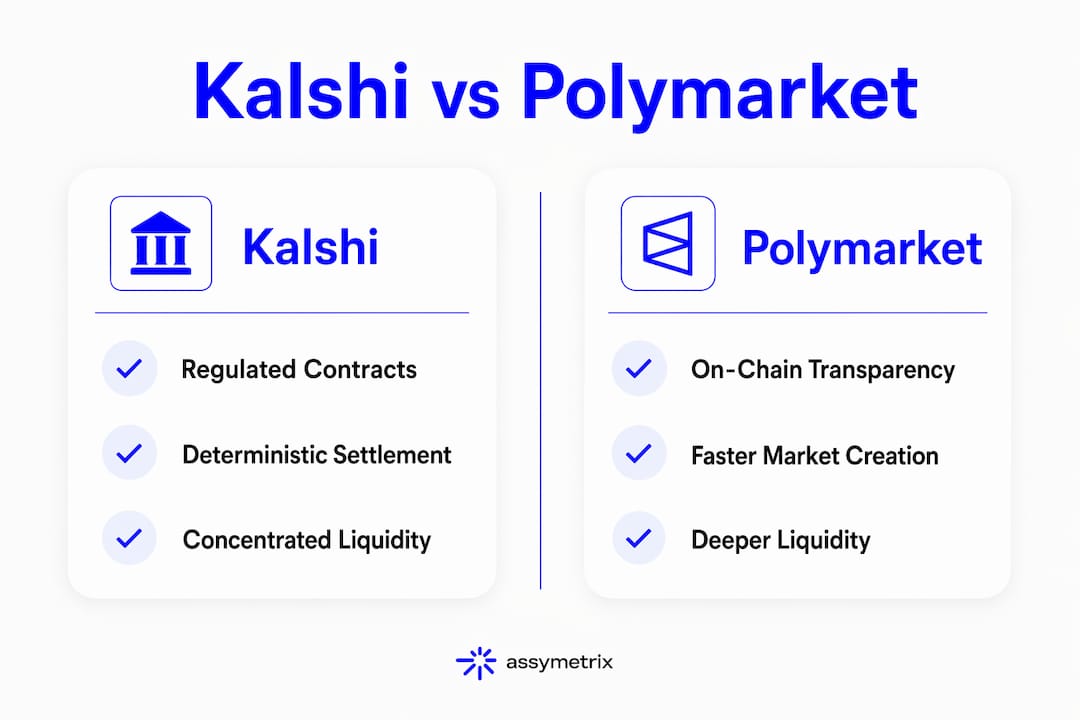
Polymarket’s on-chain CLOB publishes every order and fill publicly. You can reconstruct the full book at any historical timestamp, model slippage precisely, and detect aggressive liquidity moves without any special data agreement. Kalshi’s order book is accessible via REST and WebSocket snapshots, but the underlying account-level data stays private. Slippage modeling on Kalshi requires inferring depth from price impact rather than reading raw book state.
On aggregate volume, Polymarket carries deeper liquidity on most major event markets, with tighter spreads and lower effective execution costs. Kalshi concentrates liquidity on its regulated economic indicator contracts, where it has no direct competitor. For a macro-focused algo, that concentration is an asset, not a limitation.
Tick granularity and historical coverage
Polymarket’s on-chain architecture means every trade is permanently indexed on Polygon. There is no retention policy to worry about, and tick-level data is available from market inception. Kalshi’s historical data is accessible through its REST API, but retention depth is not publicly specified, which creates a real backtest risk: gaps in the historical record bias strategy validation.
Assymetrix addresses this directly. The platform has indexed nearly one billion rows of cross-venue trading activity into a canonical schema, covering approximately 1.5 terabytes of historical data. That depth makes backtests on Assymetrix feeds materially more reliable than single-venue pulls.
Coverage stat: Assymetrix reports ~1.5 TB of historical prediction market data and ~1B rows of trading activity normalized across Polymarket, Kalshi, and Limitless.
Market creation cadence and resolution speed
Polymarket creates new markets faster and covers a broader topical range. For event-discovery strategies that trade newly listed markets before consensus forms, Polymarket’s cadence is an advantage. Kalshi’s market creation is slower but more structured: each contract follows a defined specification, which makes automated parsing and signal extraction more consistent.
Resolution speed differs structurally. Kalshi’s CFTC-regulated settlement is deterministic: the resolution source, timing, and payout are specified in the contract. Polymarket’s on-chain resolution can involve a dispute window, which introduces settlement lag that affects time-to-signal calculations and P&L accounting.
Pro Tip: During integration smoke testing, submit a small test order on each venue and measure the round-trip time from order submission to confirmed fill appearing in the data feed. Any gap above your latency budget signals a buffering or polling-interval problem before it hits production.
Data quality metrics to monitor
Completeness rate: percentage of expected ticks received per market per hour
Duplicate trades: on-chain replays can produce duplicate event emissions; deduplicate by transaction hash
Timestamp drift: Polymarket block timestamps vs. wall-clock time can diverge by seconds; normalize to ISO 8601 UTC
Reconciliation: cross-check settlement prices against official resolution sources at market close
How should you architect the API integration for production?
API surface mapping
Polymarket’s API is organized across three specialized endpoints: the Gamma API for market metadata, the Data API for historical fills, and the CLOB API for live order-book interaction. Official SDKs and WebSocket streaming are available. Kalshi offers a conventional REST API plus WebSocket for real-time data, with stricter rate limits and a more traditional authentication model. For developers coming from a finance background, Kalshi’s API is lower friction. For developers already working with on-chain data, Polymarket’s architecture is familiar.
Endpoint type | Polymarket | Kalshi | Assymetrix |
|---|---|---|---|
Market metadata | Gamma API (REST) | REST | Unified REST |
Historical fills | Data API (REST) | REST | Bulk export + REST |
Live order book | CLOB API + WebSocket | WebSocket | WebSocket stream |
Bulk historical export | On-chain (Polygon) | Not publicly listed | Native bulk export |
Recommended poll cadence | Push (WebSocket) | polling or WebSocket | Push (WebSocket) |
Ingestion architecture
Structure your pipeline into a hot path and a cold path. The hot path handles real-time WebSocket streams from each venue, normalizes timestamps to UTC, and writes to a low-latency store. The cold path handles historical backfill via REST or bulk export, runs reconciliation checks against the hot path, and feeds the backtesting environment.

For cross-venue systems, the engineering overhead of maintaining two separate normalizers, handling rate limits independently, and reconciling schema differences is substantial. A conceptual streamer pattern looks like this:
On reconnect, replay from the last confirmed checkpoint sequence ID. Never assume the stream is gap-free.
Reconciliation checklist:
Sequence/timestamp monotonicity check per market
Fill-rate monitoring: alert if completeness drops below threshold
Out-of-order trade detection: buffer and re-sort by sequence before writing
Settlement price reconciliation at market close against official resolution source
Which strategies work better on Polymarket data vs Kalshi data?
Smart-money tracking and wallet analytics
Polymarket’s public wallet addresses make smart-money identification tractable. You can cluster wallets by behavior, build leaderboards by historical P&L, and detect when high-skill traders take large positions before consensus shifts. None of this is possible on Kalshi, where account data is private. For copy-trading signals and alpha detection on event markets, Polymarket’s on-chain transparency is a structural advantage with no equivalent on the regulated side.
Macro signals and economic indicator strategies
Kalshi is the only venue with CFTC-approved CPI, FOMC, and GDP contracts. The concentrated liquidity on those markets produces tighter spreads and more reliable probability estimates for macro strategies. Federal Reserve researchers found Kalshi’s CPI and FOMC market data useful for forecasting comparisons, which reflects the signal quality available to quant teams running macro models.
Cross-venue arbitrage
The same event sometimes trades at materially different probabilities across venues. Fee structures affect arb profitability: Polymarket’s US taker fee reaches a maximum of approximately $1.50 per 100 contracts, while Kalshi’s taker fee reaches approximately $1.75 per 100 contracts, with maker rebates on Polymarket improving economics for liquidity providers. Safe arb execution requires monitoring both venues simultaneously, accounting for settlement timing differences, and sizing positions to clear fees on both legs.
Recommended strategy-to-venue mapping:
Wallet clustering / copy-trading signals: Polymarket (on-chain wallet history required)
Macro indicator trading (CPI, FOMC, GDP): Kalshi (only regulated venue for these contracts)
Cross-venue arb: both venues simultaneously, via a normalized feed
Backtesting with deep tick history: Assymetrix (cross-venue, ~1B rows, 200M+ price snapshots)
Event discovery / new market alpha: Polymarket (faster market creation cadence)
AI agent data consumption: Assymetrix (canonical schema simplifies agent integration)
For ecosystem tooling, Kalshi’s developer community provides Python starter packages and open-source backtesting utilities. Polymarket’s community has produced wallet analytics tools and CLOB replay libraries. Both ecosystems are active but fragmented across venues.
Assymetrix gives you both venues through one integration
Building a cross-venue normalizer in-house means maintaining two separate API clients, two schema translators, two reconciliation pipelines, and two sets of rate-limit logic. The canonical schema Assymetrix publishes maps venue-specific fields into a single normalized model: canonical_market_id, canonical_outcome_id, timestamp (ISO 8601 UTC), standardized order types, normalized fee fields, and a wallet_id abstraction that preserves Polymarket’s on-chain addresses while assigning anonymous identifiers for Kalshi’s custodial accounts.
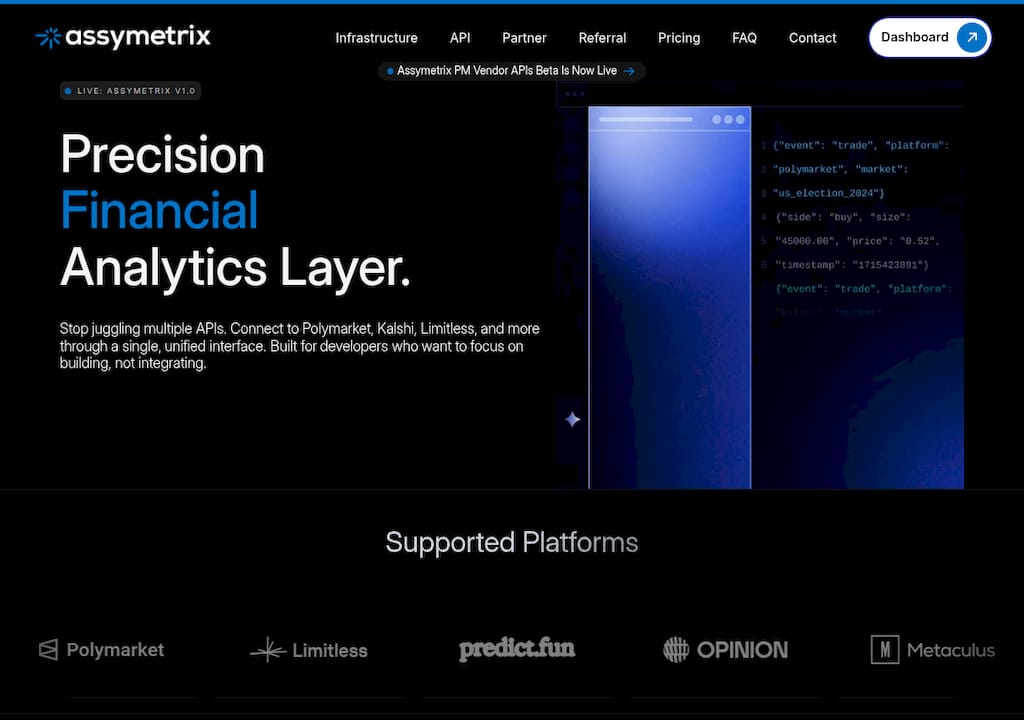
Getting started takes three steps. Sign up at data.assymetrix.com and generate your stream keys. Connect to the WebSocket feed or pull historical data via the REST bulk export endpoint. Run a replay backfill against your target date range to validate completeness before going live. Most teams complete a working integration within a day.
The free tier covers research and strategy validation. Commercial tiers unlock production-grade streaming, higher rate limits, and enterprise bulk exports. For teams running live algos, the commercial tier removes the throughput constraints that would otherwise require custom rate-limit management per venue. Start at assymetrix.com to review tier options and connect to the Data API.
FAQ
Which venue has better data for smart-money tracking?
Polymarket, because every trade is on-chain with a public wallet address, enabling wallet clustering and leaderboard reconstruction. Kalshi’s custodial model keeps account data private.
Does Kalshi or Polymarket have more reliable settlement for algos?
Kalshi’s CFTC-regulated settlement is deterministic: the resolution source and timing are specified in each contract. Polymarket’s on-chain resolution can include a dispute window that introduces settlement lag.
What is the Assymetrix canonical schema?
Assymetrix normalizes cross-venue data into a single format with fields including canonical_market_id, canonical_outcome_id, ISO 8601 UTC timestamps, standardized order types, and a wallet_id abstraction covering both on-chain and custodial venues.
Is it worth building a cross-venue aggregator in-house?
For most teams, no. Maintaining separate API clients, schema translators, and reconciliation logic for Polymarket and Kalshi carries ongoing engineering cost. Assymetrix provides a unified data feed covering both venues plus Limitless through a single integration.
Which venue is better for backtesting prediction market strategies?
Cross-venue data from Assymetrix produces the most reliable backtests, with approximately 1.5 TB and nearly one billion rows of normalized historical data. Single-venue backtests on either Kalshi or Polymarket alone introduce selection bias and coverage gaps.
Key Takeaways
For algorithmic trading, Polymarket’s on-chain transparency and Kalshi’s regulated economic contracts serve different signal types, and production systems that normalize both venues through Assymetrix outperform single-venue architectures on coverage, signal diversity, and engineering efficiency.
Point | Details |
|---|---|
Polymarket for wallet signals | On-chain trade history enables smart-money tracking and wallet clustering unavailable on any custodial venue. |
Kalshi for macro indicators | CFTC-approved CPI, FOMC, and GDP contracts carry concentrated liquidity and deterministic settlement for macro strategies. |
Cross-venue arb requires both | Fee differences (Polymarket ~$1.50 vs Kalshi ~$1.75 per 100 contracts) affect arb profitability; monitoring both simultaneously is required. |
Single-venue backtests are biased | Coverage gaps and limited retention on individual venues skew strategy validation; cross-venue historical depth reduces that risk. |
Assymetrix normalizes all three | Approximately 1.5 TB and ~1B rows of cross-venue data in a canonical schema, covering Polymarket, Kalshi, and Limitless through one API. |
Kalshi vs Polymarket: Best Data for Algorithmic Trading
For algorithmic trading, neither venue dominates outright. Polymarket delivers superior data for wallet-level analytics, smart-money tracking, and order-book reconstruction because every trade is on-chain and publicly verifiable. Kalshi produces cleaner, more deterministic signals for macro-focused strategies because its CFTC-regulated economic markets — CPI, FOMC, GDP — carry concentrated liquidity and predictable settlement. For production systems, the strongest architecture uses both simultaneously.
Three reasons drive that verdict:
Data transparency: Polymarket’s on-chain CLOB enables exact trade reconstruction and wallet clustering. Kalshi’s centralized logs are reliable but opaque at the wallet level.
Coverage: Kalshi holds the only regulated economic indicator contracts in the US market. Polymarket lists 1,200+ markets with deeper liquidity on major global events.
Integration friction: Building a cross-venue normalizer from scratch carries significant engineering overhead. When both venues are required, a unified feed from Assymetrix’s Data API at data.assymetrix.com removes that cost entirely.
Use raw Kalshi feeds when your strategy is purely macro. Use raw Polymarket feeds when wallet analytics are the core signal. Use Assymetrix when you need both, plus Limitless, in a single normalized schema.
Table of Contents
How do Kalshi and Polymarket compare for algorithmic trading data?
What structural differences in data quality actually matter for your algo?
How should you architect the API integration for production?
Which strategies work better on Polymarket data vs Kalshi data?
Assymetrix gives you both venues through one integration
Key Takeaways
How do Kalshi and Polymarket compare for algorithmic trading data?
Dimension | Polymarket | Kalshi | Limitless | |
|---|---|---|---|---|
Best for | Cross-venue quant systems needing normalized production data | Wallet analytics, smart-money, on-chain replay | Macro indicators, regulated economic contracts | Niche event coverage, supplemental streams |
Data transparency | Normalized cross-venue; preserves on-chain wallet IDs | On-chain (Polygon); cryptographically verifiable | Centralized logs; no public wallet addresses | Centralized; limited public transparency |
Historical depth | ~1.5 TB, ~1B rows, cross-venue | Full on-chain history (unlimited reads) | REST-accessible history; retention not publicly specified | Limited public historical archive |
Data granularity | Tick-level, order-book depth, trade-level across venues | Tick/trade-level; full order-book snapshots | Trade-level; order-book snapshots via REST/WebSocket | Aggregated; limited tick granularity |
Market creation frequency | Aggregated from all venues | High; 1,200+ active markets | Moderate; structured economic/event contracts | Low to moderate; specialty topics |
Resolution determinism | Inherits per-venue; normalized settlement field | On-chain resolution; potential dispute lag | CFTC-style deterministic settlement | Varies by market |
API capabilities | REST, WebSocket, bulk export, canonical schema | Gamma API, Data API, CLOB API, WebSocket, SDKs | REST + WebSocket; well-documented | REST; limited streaming |
Latency & rate limits | Managed; rate-limiting handled by the platform | Moderate; unlimited on-chain reads | Stricter rate limits; conventional REST constraints | Not publicly specified |
Pricing model | Free tier + commercial/enterprise tiers | Free (on-chain); no API subscription fee | Free tier; commercial data packages available | Not publicly listed |
Smart-money / arbitrage signals | Native: wallet tracking, Trader Skill Scores, arb alerts | Strong: wallet clustering, leaderboard reconstruction | Weak: no public wallet data | Minimal |
Key production implications from this table:
Kalshi’s deterministic CFTC settlement means your P&L realization timestamps are predictable. Federal Reserve researchers used Kalshi CPI and FOMC data in January 2026 for forecasting comparisons, which signals the data quality floor for macro signals.
Polymarket’s on-chain CLOB lets you replay exact order-book states, which is rare in prediction markets and invaluable for microstructure research.
Limitless contributes coverage in topical areas neither larger venue serves well. As a standalone data source it is thin; as a third stream in a cross-venue pipeline it fills gaps.
What structural differences in data quality actually matter for your algo?
Order-book depth and liquidity
Polymarket’s on-chain CLOB publishes every order and fill publicly. You can reconstruct the full book at any historical timestamp, model slippage precisely, and detect aggressive liquidity moves without any special data agreement. Kalshi’s order book is accessible via REST and WebSocket snapshots, but the underlying account-level data stays private. Slippage modeling on Kalshi requires inferring depth from price impact rather than reading raw book state.
On aggregate volume, Polymarket carries deeper liquidity on most major event markets, with tighter spreads and lower effective execution costs. Kalshi concentrates liquidity on its regulated economic indicator contracts, where it has no direct competitor. For a macro-focused algo, that concentration is an asset, not a limitation.
Tick granularity and historical coverage
Polymarket’s on-chain architecture means every trade is permanently indexed on Polygon. There is no retention policy to worry about, and tick-level data is available from market inception. Kalshi’s historical data is accessible through its REST API, but retention depth is not publicly specified, which creates a real backtest risk: gaps in the historical record bias strategy validation.
Assymetrix addresses this directly. The platform has indexed nearly one billion rows of cross-venue trading activity into a canonical schema, covering approximately 1.5 terabytes of historical data. That depth makes backtests on Assymetrix feeds materially more reliable than single-venue pulls.
Coverage stat: Assymetrix reports ~1.5 TB of historical prediction market data and ~1B rows of trading activity normalized across Polymarket, Kalshi, and Limitless.
Market creation cadence and resolution speed
Polymarket creates new markets faster and covers a broader topical range. For event-discovery strategies that trade newly listed markets before consensus forms, Polymarket’s cadence is an advantage. Kalshi’s market creation is slower but more structured: each contract follows a defined specification, which makes automated parsing and signal extraction more consistent.
Resolution speed differs structurally. Kalshi’s CFTC-regulated settlement is deterministic: the resolution source, timing, and payout are specified in the contract. Polymarket’s on-chain resolution can involve a dispute window, which introduces settlement lag that affects time-to-signal calculations and P&L accounting.
Pro Tip: During integration smoke testing, submit a small test order on each venue and measure the round-trip time from order submission to confirmed fill appearing in the data feed. Any gap above your latency budget signals a buffering or polling-interval problem before it hits production.
Data quality metrics to monitor
Completeness rate: percentage of expected ticks received per market per hour
Duplicate trades: on-chain replays can produce duplicate event emissions; deduplicate by transaction hash
Timestamp drift: Polymarket block timestamps vs. wall-clock time can diverge by seconds; normalize to ISO 8601 UTC
Reconciliation: cross-check settlement prices against official resolution sources at market close
How should you architect the API integration for production?
API surface mapping
Polymarket’s API is organized across three specialized endpoints: the Gamma API for market metadata, the Data API for historical fills, and the CLOB API for live order-book interaction. Official SDKs and WebSocket streaming are available. Kalshi offers a conventional REST API plus WebSocket for real-time data, with stricter rate limits and a more traditional authentication model. For developers coming from a finance background, Kalshi’s API is lower friction. For developers already working with on-chain data, Polymarket’s architecture is familiar.
Endpoint type | Polymarket | Kalshi | Assymetrix |
|---|---|---|---|
Market metadata | Gamma API (REST) | REST | Unified REST |
Historical fills | Data API (REST) | REST | Bulk export + REST |
Live order book | CLOB API + WebSocket | WebSocket | WebSocket stream |
Bulk historical export | On-chain (Polygon) | Not publicly listed | Native bulk export |
Recommended poll cadence | Push (WebSocket) | polling or WebSocket | Push (WebSocket) |
Ingestion architecture
Structure your pipeline into a hot path and a cold path. The hot path handles real-time WebSocket streams from each venue, normalizes timestamps to UTC, and writes to a low-latency store. The cold path handles historical backfill via REST or bulk export, runs reconciliation checks against the hot path, and feeds the backtesting environment.
For cross-venue systems, the engineering overhead of maintaining two separate normalizers, handling rate limits independently, and reconciling schema differences is substantial. A conceptual streamer pattern looks like this:
On reconnect, replay from the last confirmed checkpoint sequence ID. Never assume the stream is gap-free.
Reconciliation checklist:
Sequence/timestamp monotonicity check per market
Fill-rate monitoring: alert if completeness drops below threshold
Out-of-order trade detection: buffer and re-sort by sequence before writing
Settlement price reconciliation at market close against official resolution source
Which strategies work better on Polymarket data vs Kalshi data?
Smart-money tracking and wallet analytics
Polymarket’s public wallet addresses make smart-money identification tractable. You can cluster wallets by behavior, build leaderboards by historical P&L, and detect when high-skill traders take large positions before consensus shifts. None of this is possible on Kalshi, where account data is private. For copy-trading signals and alpha detection on event markets, Polymarket’s on-chain transparency is a structural advantage with no equivalent on the regulated side.
Macro signals and economic indicator strategies
Kalshi is the only venue with CFTC-approved CPI, FOMC, and GDP contracts. The concentrated liquidity on those markets produces tighter spreads and more reliable probability estimates for macro strategies. Federal Reserve researchers found Kalshi’s CPI and FOMC market data useful for forecasting comparisons, which reflects the signal quality available to quant teams running macro models.
Cross-venue arbitrage
The same event sometimes trades at materially different probabilities across venues. Fee structures affect arb profitability: Polymarket’s US taker fee reaches a maximum of approximately $1.50 per 100 contracts, while Kalshi’s taker fee reaches approximately $1.75 per 100 contracts, with maker rebates on Polymarket improving economics for liquidity providers. Safe arb execution requires monitoring both venues simultaneously, accounting for settlement timing differences, and sizing positions to clear fees on both legs.
Recommended strategy-to-venue mapping:
Wallet clustering / copy-trading signals: Polymarket (on-chain wallet history required)
Macro indicator trading (CPI, FOMC, GDP): Kalshi (only regulated venue for these contracts)
Cross-venue arb: both venues simultaneously, via a normalized feed
Backtesting with deep tick history: Assymetrix (cross-venue, ~1B rows, 200M+ price snapshots)
Event discovery / new market alpha: Polymarket (faster market creation cadence)
AI agent data consumption: Assymetrix (canonical schema simplifies agent integration)
For ecosystem tooling, Kalshi’s developer community provides Python starter packages and open-source backtesting utilities. Polymarket’s community has produced wallet analytics tools and CLOB replay libraries. Both ecosystems are active but fragmented across venues.
Assymetrix gives you both venues through one integration
Building a cross-venue normalizer in-house means maintaining two separate API clients, two schema translators, two reconciliation pipelines, and two sets of rate-limit logic. The canonical schema Assymetrix publishes maps venue-specific fields into a single normalized model: canonical_market_id, canonical_outcome_id, timestamp (ISO 8601 UTC), standardized order types, normalized fee fields, and a wallet_id abstraction that preserves Polymarket’s on-chain addresses while assigning anonymous identifiers for Kalshi’s custodial accounts.
Getting started takes three steps. Sign up at data.assymetrix.com and generate your stream keys. Connect to the WebSocket feed or pull historical data via the REST bulk export endpoint. Run a replay backfill against your target date range to validate completeness before going live. Most teams complete a working integration within a day.
The free tier covers research and strategy validation. Commercial tiers unlock production-grade streaming, higher rate limits, and enterprise bulk exports. For teams running live algos, the commercial tier removes the throughput constraints that would otherwise require custom rate-limit management per venue. Start at assymetrix.com to review tier options and connect to the Data API.
FAQ
Which venue has better data for smart-money tracking?
Polymarket, because every trade is on-chain with a public wallet address, enabling wallet clustering and leaderboard reconstruction. Kalshi’s custodial model keeps account data private.
Does Kalshi or Polymarket have more reliable settlement for algos?
Kalshi’s CFTC-regulated settlement is deterministic: the resolution source and timing are specified in each contract. Polymarket’s on-chain resolution can include a dispute window that introduces settlement lag.
What is the Assymetrix canonical schema?
Assymetrix normalizes cross-venue data into a single format with fields including canonical_market_id, canonical_outcome_id, ISO 8601 UTC timestamps, standardized order types, and a wallet_id abstraction covering both on-chain and custodial venues.
Is it worth building a cross-venue aggregator in-house?
For most teams, no. Maintaining separate API clients, schema translators, and reconciliation logic for Polymarket and Kalshi carries ongoing engineering cost. Assymetrix provides a unified data feed covering both venues plus Limitless through a single integration.
Which venue is better for backtesting prediction market strategies?
Cross-venue data from Assymetrix produces the most reliable backtests, with approximately 1.5 TB and nearly one billion rows of normalized historical data. Single-venue backtests on either Kalshi or Polymarket alone introduce selection bias and coverage gaps.
Key Takeaways
For algorithmic trading, Polymarket’s on-chain transparency and Kalshi’s regulated economic contracts serve different signal types, and production systems that normalize both venues through Assymetrix outperform single-venue architectures on coverage, signal diversity, and engineering efficiency.
Point | Details |
|---|---|
Polymarket for wallet signals | On-chain trade history enables smart-money tracking and wallet clustering unavailable on any custodial venue. |
Kalshi for macro indicators | CFTC-approved CPI, FOMC, and GDP contracts carry concentrated liquidity and deterministic settlement for macro strategies. |
Cross-venue arb requires both | Fee differences (Polymarket ~$1.50 vs Kalshi ~$1.75 per 100 contracts) affect arb profitability; monitoring both simultaneously is required. |
Single-venue backtests are biased | Coverage gaps and limited retention on individual venues skew strategy validation; cross-venue historical depth reduces that risk. |
Assymetrix normalizes all three | Approximately 1.5 TB and ~1B rows of cross-venue data in a canonical schema, covering Polymarket, Kalshi, and Limitless through one API. |
Other Blog


