Kalshi Trading Bot: 2026 Developer and Quant Guide
Kalshi Trading Bot: 2026 Developer and Quant Guide
Kalshi Trading Bot: 2026 Developer and Quant Guide
Discover how to build a Kalshi trading bot with our 2026 developer guide. Automate event trading efficiently and navigate regulations.

Kalshi Trading Bot: 2026 Developer and Quant Guide
A Kalshi trading bot is an automated program that connects to Kalshi’s official REST and WebSocket APIs to scan event contracts, size positions, and execute orders without manual intervention. Unlike crypto-native prediction venues, Kalshi operates as a CFTC-designated contract market, which means your bot must handle RSA-signed API authentication, respect hard position limits, and stay within documented rate limits at all times. The regulatory structure is not a constraint to work around. It is the architecture your bot must be built on.
Getting started requires four concrete steps: generate an API key from your Kalshi account dashboard, store credentials in a .env or credentials.env file, configure your market filters and risk parameters in a config.yaml or settings.py, and authenticate via signed REST requests before streaming live market data. Kalshi also provides a demo environment with mock funds, so you can validate your logic before touching real capital.
Every production-grade Kalshi bot depends on the same core components:
Authenticated API client with RSA signature verification and exponential backoff retry logic
Market data ingestion pulling live order book snapshots, contract metadata, and settlement history
Position manager tracking open contracts, unrealized P&L, and exposure limits in real time
Risk engine enforcing per-market position caps, daily loss limits, and emergency exit logic
SQLite persistence layer logging every trade, AI decision, and cost metric locally for audit and backtesting
Alerting layer pushing fill notifications and error reports to Telegram or Discord webhooks
Backtesting module replaying historical market data against your strategy configuration before live deployment
You need a Kalshi account with completed KYC verification, Python 3.12+ or Node.js 22.5+, and a clear understanding of Kalshi’s trading conduct rules before writing a single line of bot logic.
Which Kalshi trading bot platforms lead in 2026?
The four platforms worth evaluating differ sharply in architecture, data access, and who they actually serve. TurbineFi, PredictEngine, and Bot for Kalshi each take a distinct approach to the execution and analytics stack, while Assymetrix operates at a different layer entirely.
Platform | Best For | Core Workflow | Backtesting | API Key Custody | Pricing/Tradeoffs |
|---|---|---|---|---|---|
Developers and traders wanting a cohesive strategy ecosystem | Integrated strategy builder with stable API performance and workflow orchestration | Full backtesting support with historical replay | Managed within platform | Subscription; tiered plans not publicly listed | |
PredictEngine | Quant traders needing deep analytics and signal refinement | AI-assisted signal processing pipeline with advanced market analytics | Signal backtesting and model validation tools | Managed within platform | Subscription; pricing not publicly listed |
Developers wanting an extendable open codebase with risk controls | Modular open-source architecture with AI probability modeling and arbitrage scanning | Demo mode and historical data replay | Self-custodied; user holds keys locally | Open-source core; premium tiers available | |
Developers and quant traders needing unified cross-venue data for bot intelligence | Unified REST API aggregating Kalshi, Polymarket, and Limitless data with Smart Money and arbitrage signals | ~1.5TB of normalized historical data across nearly one billion rows of trading activity | API key held by user; no order execution | Free and paid tiers; commercial and academic licenses |
TurbineFi targets developers who want a complete, tested environment rather than assembling components themselves. Its workflow integration is the platform’s clearest differentiator: strategy configuration, execution, and monitoring live inside a single interface, which reduces the surface area for integration errors. Backtesting is built in, not bolted on.
PredictEngine goes deeper on the analytics side. Its signal processing pipeline is built for quant traders who need to refine probability estimates before committing capital, with AI-assisted tools that evaluate market mispricing against external data sources. The platform suits traders who treat signal quality as the primary variable.
Bot for Kalshi is the open-source option. Its modular codebase ships with an arbitrage scanner, an AI probability engine, a market-making module, and a full risk engine with per-market position caps and daily loss limits. Because you hold your own API keys locally and can extend any module, it fits developers who want full control over the execution path.
Assymetrix is not an execution platform. It is the data and intelligence layer that makes the other three sharper. Its Data API at data.assymetrix.com provides unified access to Kalshi, Polymarket, and Limitless data through a single integration, with Smart Money wallet tracking, Trader Skill Scores, and cross-venue arbitrage signals built in. For a quant trader backtesting a Kalshi strategy or a developer building a signal-driven bot, Assymetrix is the data substrate, not a competitor to the execution platforms above.
How to architect a Kalshi bot and what data it actually needs
The architecture that works in production follows a multi-stage pipeline: data ingestion, fair-value estimation, decision logic, risk-aware position sizing, and signed order execution with error handling at every stage. Each stage has specific data requirements that differ from what you would build for a crypto-native venue.
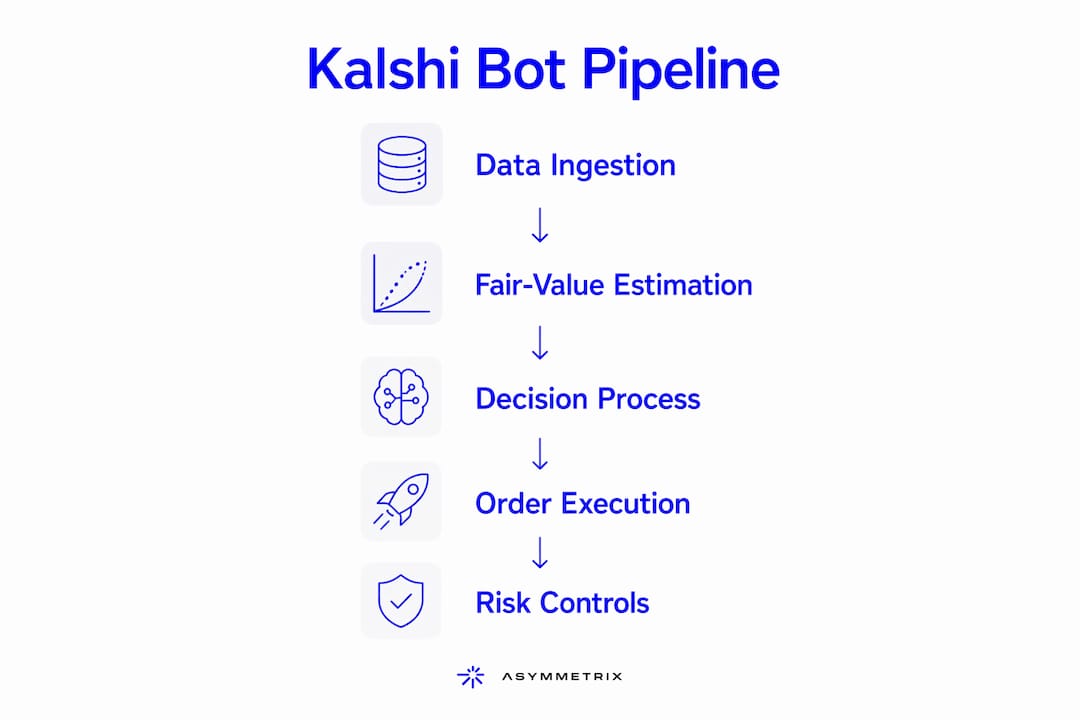
Data ingestion
Your bot needs four live data streams from Kalshi’s API: real-time market prices, order book depth (bid/ask at each level), volume and open interest, and contract metadata including settlement timelines and expiry windows. WebSocket streams handle ticker, trade, market lifecycle, and order book updates without hammering the REST API on every cycle. REST endpoints cover historical candlestick data, portfolio state, and account balances. Bots commonly persist this data to SQLite for telemetry, decision logs, and backtesting replay, with a Streamlit dashboard for real-time portfolio monitoring.
Execution environment
Cloud versus local hosting comes down to latency requirements. For arbitrage strategies that exploit update latency between CME spot prices and Kalshi contracts, sub-50ms reaction speed is the target, which typically means a VPS co-located near Kalshi’s infrastructure rather than a home machine. For longer-duration event contracts, local hosting is adequate. Either way, your API client must implement exponential backoff retry logic and pause gracefully when rate limits are hit, sending an alert rather than crashing.
Position sizing and risk controls
The Kelly Criterion is the standard sizing framework for Kalshi bots. Fractional Kelly at 25–60% of full Kelly is the practical default, combined with per-market position caps, a daily loss limit, and a maximum open-positions constraint. A graduated drawdown throttle that scales sizing down before a hard halt is more capital-efficient than a binary stop. The risk engine should also enforce minimum confidence thresholds so the bot never places a coin-flip trade.
The core data inputs your bot requires:
Live order book depth at each price level
Contract settlement schedule and expiry window
Historical resolution data for the same contract type
Cross-market price correlations (e.g., CME spot vs. Kalshi contract)
Volume and open interest for liquidity filtering
Account balance and current exposure for Kelly sizing
Pro Tip: Set dry_run: true or LIVE_TRADING_ENABLED=false as your default configuration. Promote to live only after replaying enough historical cycles to trust the decision path. Paper trading with real market data is the only honest validation.
How do you generate signals for Kalshi bot strategies?
Signal generation on Kalshi splits into two categories: internal market signals derived from Kalshi’s own order flow, and cross-venue signals that compare Kalshi prices against correlated external markets. Both require structured data at scale to be actionable.
Smart Money tracking
Smart Money tracking identifies wallets with above-average success rates, larger trade sizes, or access to superior information, then flags when those wallets open or increase positions. On Kalshi, this means monitoring which accounts consistently trade ahead of contract resolution at favorable prices. A bot that detects a cluster of large, well-timed trades on a specific contract can treat that activity as a directional signal before the broader market reprices.
Cross-venue arbitrage
Kalshi and Polymarket often list correlated event contracts with different implied probabilities. Cross-venue arbitrage bots analyze these price discrepancies and execute hedged positions when the spread exceeds transaction costs. The edge comes from update latency: when a news event moves the Polymarket price on a Fed rate decision contract, the Kalshi equivalent may lag by seconds, creating a transient window.
Key analytics metrics
Metric | What It Measures | Signal Use |
|---|---|---|
Probability differential | Kalshi implied prob vs. Polymarket implied prob on same event | Cross-venue arbitrage entry trigger |
Volume spike ratio | Current volume vs. rolling average | Smart Money activity detection |
Order book imbalance | Bid depth vs. ask depth at top 3 levels | Short-term directional lean |
Expected value (EV) | (Prob × payout) minus cost | Contract mispricing filter |
Settlement-adjusted edge | EV net of Kalshi maker/taker fees | Live trade go/no-go gate |
Expected value is the core filter. A contract trading at 35¢ with a modeled fair-value probability of 45% has a positive EV before fees. After applying Kalshi’s fee structure (taker fee of 7% of the contract price times quantity, maker fee of 1.75%), the net edge determines whether the trade clears the minimum threshold. Bots that skip this calculation and trade on raw probability alone consistently underperform.
For arbitrage specifically, treating Kalshi as a secondary liquidity venue relative to CME or Polymarket is the sophisticated market approach: the primary market sets the fair value, and Kalshi’s lag creates the entry window.
How the Assymetrix Data API gives your bot a unified data layer
The core problem for any developer building a Kalshi bot is data fragmentation. Kalshi’s own API covers its markets well, but the moment your strategy depends on cross-venue signals or requires deep historical backtesting, you are stitching together multiple schemas, rate limits, and authentication systems. The Assymetrix Data API solves that with a single integration point covering Kalshi, Polymarket, and Limitless simultaneously.
The API exposes unified REST endpoints for live and historical data, normalizing disparate market schemas so your bot consumes one data format regardless of venue. The historical dataset spans approximately 1.5 terabytes across nearly one billion rows of trading activity, which is the depth required for reliable backtesting simulation and algorithm refinement on Kalshi contract settlement timings.
A basic API call to retrieve Kalshi market data looks like this:
import requests

headers = {"Authorization": "Bearer YOUR_API_KEY"}
response = requests.get(
    "https://data.assymetrix.com/v1/markets",
    params={"venue": "kalshi", "status": "open"},
    headers=headers
)
markets = response.json()
import requests

headers = {"Authorization": "Bearer YOUR_API_KEY"}
response = requests.get(
    "https://data.assymetrix.com/v1/markets",
    params={"venue": "kalshi", "status": "open"},
    headers=headers
)
markets = response.json()
For cross-venue arbitrage signal detection, you query the same endpoint with venue=all and compare implied probabilities across matching event slugs. The API also surfaces Smart Money wallet analytics and Trader Skill Scores, which let your bot weight signals by the historical accuracy of the wallets generating them.
The strategic advantage is compounding. A bot that only reads Kalshi data can detect mispricing within Kalshi. A bot that reads Kalshi, Polymarket, and Limitless simultaneously through Assymetrix can detect cross-venue divergence, track which skilled wallets are moving first, and backtest that combined signal against nearly one billion rows of resolved trades. The prediction market infrastructure now supports this level of integration, and the bots that use it operate with a materially different information set than those that do not.
Institutional adoption is accelerating the need for this kind of unified data layer. Horizon Trading Solutions has added native Kalshi connectivity for professional market makers, and Kalshi’s annualized trading volume has tripled to $178 billion as more sophisticated traders enter the market. At that volume, the signal-to-noise ratio in raw order flow improves, but so does the competition for latency-sensitive edges.
Assymetrix gives your bot the data layer the execution platforms lack
The execution platforms covered above handle order routing well. What they do not provide is a unified, normalized view of prediction market data across venues, with the historical depth needed to validate a strategy before it goes live.
Assymetrix is built specifically for that gap. The Data API at data.assymetrix.com gives developers and quant traders access to Kalshi, Polymarket, and Limitless data through one integration, with Smart Money tracking, Trader Skill Scores, and cross-venue arbitrage signals included. The historical dataset covers nearly one billion rows of trading activity, which is the foundation for accurate prediction market backtesting and live signal refinement.
If you are building a Kalshi bot that needs to detect cross-venue divergence, track informed wallet activity, or backtest a strategy against real settlement data, Assymetrix is the data substrate your bot is missing. Free and paid tiers are available, with commercial licenses for production deployments and academic tiers for researchers.
FAQ
Is automated trading allowed on Kalshi?
Yes. Kalshi explicitly supports API-based automated trading and provides official REST API documentation, WebSocket streams, SDKs, and a demo environment for this purpose. Bots must use only documented endpoints and stay within Kalshi’s rate limits and trading conduct rules.
Which Kalshi trading bot is best for quant traders?
PredictEngine leads for quant traders who need deep signal analytics, while Bot for Kalshi suits developers who want an extendable open-source codebase with built-in risk controls. For cross-venue data and backtesting depth, Assymetrix is the strongest data layer to build on.
Are Kalshi trading bots actually profitable?
Profitability depends entirely on strategy quality, not the bot itself. Bots improve execution speed and remove emotional bias, but they also amplify bad strategy logic. Backtesting against real historical settlement data and starting in paper mode are the minimum requirements before deploying real capital.
Can AI help with Kalshi trading?
Yes. Several open-source Kalshi bots use LLM ensembles via OpenRouter to score directional confidence on event contracts, with Kelly-sized positions and hard daily cost caps. The multi-agent approach, where a forecaster, news analyst, bull researcher, bear researcher, and risk manager debate each market, produces more calibrated outputs than a single-prompt approach.
How does CFTC regulation affect Kalshi bot design?
Kalshi operates as a CFTC-designated contract market, which means bots must comply with KYC requirements, position limits, and trading conduct standards that do not apply on crypto-native venues. API authentication uses RSA signature verification, and all automated activity must stay within Kalshi’s documented rate limits and terms of service.
Key Takeaways
A Kalshi trading bot built on solid architecture, real historical data, and cross-venue signal intelligence operates with a fundamentally different edge than one reading only Kalshi’s own feed.
Point | Details |
|---|---|
Kalshi’s regulated structure shapes bot design | CFTC compliance, RSA authentication, and position limits are non-negotiable architectural constraints, not optional configurations. |
Fractional Kelly is the standard sizing method | Bots typically use fractional Kelly between 25% and 60% of the full Kelly size, combined with per-market position caps and a daily loss limit to manage risk across open contracts. |
Cross-venue signals outperform single-venue signals | Comparing Kalshi and Polymarket implied probabilities on correlated events surfaces arbitrage windows that single-venue bots cannot detect. |
Historical depth determines backtesting quality | Reliable strategy validation requires tick-level data synchronized with contract settlement schedules, not just price snapshots. |
Assymetrix unifies the data layer | The Assymetrix Data API provides a large volume of normalized historical data across Kalshi, Polymarket, and Limitless through a single integration for cross-venue bot intelligence. |
Kalshi Trading Bot: 2026 Developer and Quant Guide
A Kalshi trading bot is an automated program that connects to Kalshi’s official REST and WebSocket APIs to scan event contracts, size positions, and execute orders without manual intervention. Unlike crypto-native prediction venues, Kalshi operates as a CFTC-designated contract market, which means your bot must handle RSA-signed API authentication, respect hard position limits, and stay within documented rate limits at all times. The regulatory structure is not a constraint to work around. It is the architecture your bot must be built on.
Getting started requires four concrete steps: generate an API key from your Kalshi account dashboard, store credentials in a .env or credentials.env file, configure your market filters and risk parameters in a config.yaml or settings.py, and authenticate via signed REST requests before streaming live market data. Kalshi also provides a demo environment with mock funds, so you can validate your logic before touching real capital.
Every production-grade Kalshi bot depends on the same core components:
Authenticated API client with RSA signature verification and exponential backoff retry logic
Market data ingestion pulling live order book snapshots, contract metadata, and settlement history
Position manager tracking open contracts, unrealized P&L, and exposure limits in real time
Risk engine enforcing per-market position caps, daily loss limits, and emergency exit logic
SQLite persistence layer logging every trade, AI decision, and cost metric locally for audit and backtesting
Alerting layer pushing fill notifications and error reports to Telegram or Discord webhooks
Backtesting module replaying historical market data against your strategy configuration before live deployment
You need a Kalshi account with completed KYC verification, Python 3.12+ or Node.js 22.5+, and a clear understanding of Kalshi’s trading conduct rules before writing a single line of bot logic.
Which Kalshi trading bot platforms lead in 2026?
The four platforms worth evaluating differ sharply in architecture, data access, and who they actually serve. TurbineFi, PredictEngine, and Bot for Kalshi each take a distinct approach to the execution and analytics stack, while Assymetrix operates at a different layer entirely.
Platform | Best For | Core Workflow | Backtesting | API Key Custody | Pricing/Tradeoffs |
|---|---|---|---|---|---|
Developers and traders wanting a cohesive strategy ecosystem | Integrated strategy builder with stable API performance and workflow orchestration | Full backtesting support with historical replay | Managed within platform | Subscription; tiered plans not publicly listed | |
PredictEngine | Quant traders needing deep analytics and signal refinement | AI-assisted signal processing pipeline with advanced market analytics | Signal backtesting and model validation tools | Managed within platform | Subscription; pricing not publicly listed |
Developers wanting an extendable open codebase with risk controls | Modular open-source architecture with AI probability modeling and arbitrage scanning | Demo mode and historical data replay | Self-custodied; user holds keys locally | Open-source core; premium tiers available | |
Developers and quant traders needing unified cross-venue data for bot intelligence | Unified REST API aggregating Kalshi, Polymarket, and Limitless data with Smart Money and arbitrage signals | ~1.5TB of normalized historical data across nearly one billion rows of trading activity | API key held by user; no order execution | Free and paid tiers; commercial and academic licenses |
TurbineFi targets developers who want a complete, tested environment rather than assembling components themselves. Its workflow integration is the platform’s clearest differentiator: strategy configuration, execution, and monitoring live inside a single interface, which reduces the surface area for integration errors. Backtesting is built in, not bolted on.
PredictEngine goes deeper on the analytics side. Its signal processing pipeline is built for quant traders who need to refine probability estimates before committing capital, with AI-assisted tools that evaluate market mispricing against external data sources. The platform suits traders who treat signal quality as the primary variable.
Bot for Kalshi is the open-source option. Its modular codebase ships with an arbitrage scanner, an AI probability engine, a market-making module, and a full risk engine with per-market position caps and daily loss limits. Because you hold your own API keys locally and can extend any module, it fits developers who want full control over the execution path.
Assymetrix is not an execution platform. It is the data and intelligence layer that makes the other three sharper. Its Data API at data.assymetrix.com provides unified access to Kalshi, Polymarket, and Limitless data through a single integration, with Smart Money wallet tracking, Trader Skill Scores, and cross-venue arbitrage signals built in. For a quant trader backtesting a Kalshi strategy or a developer building a signal-driven bot, Assymetrix is the data substrate, not a competitor to the execution platforms above.
How to architect a Kalshi bot and what data it actually needs
The architecture that works in production follows a multi-stage pipeline: data ingestion, fair-value estimation, decision logic, risk-aware position sizing, and signed order execution with error handling at every stage. Each stage has specific data requirements that differ from what you would build for a crypto-native venue.
Data ingestion
Your bot needs four live data streams from Kalshi’s API: real-time market prices, order book depth (bid/ask at each level), volume and open interest, and contract metadata including settlement timelines and expiry windows. WebSocket streams handle ticker, trade, market lifecycle, and order book updates without hammering the REST API on every cycle. REST endpoints cover historical candlestick data, portfolio state, and account balances. Bots commonly persist this data to SQLite for telemetry, decision logs, and backtesting replay, with a Streamlit dashboard for real-time portfolio monitoring.
Execution environment
Cloud versus local hosting comes down to latency requirements. For arbitrage strategies that exploit update latency between CME spot prices and Kalshi contracts, sub-50ms reaction speed is the target, which typically means a VPS co-located near Kalshi’s infrastructure rather than a home machine. For longer-duration event contracts, local hosting is adequate. Either way, your API client must implement exponential backoff retry logic and pause gracefully when rate limits are hit, sending an alert rather than crashing.
Position sizing and risk controls
The Kelly Criterion is the standard sizing framework for Kalshi bots. Fractional Kelly at 25–60% of full Kelly is the practical default, combined with per-market position caps, a daily loss limit, and a maximum open-positions constraint. A graduated drawdown throttle that scales sizing down before a hard halt is more capital-efficient than a binary stop. The risk engine should also enforce minimum confidence thresholds so the bot never places a coin-flip trade.
The core data inputs your bot requires:
Live order book depth at each price level
Contract settlement schedule and expiry window
Historical resolution data for the same contract type
Cross-market price correlations (e.g., CME spot vs. Kalshi contract)
Volume and open interest for liquidity filtering
Account balance and current exposure for Kelly sizing
Pro Tip: Set dry_run: true or LIVE_TRADING_ENABLED=false as your default configuration. Promote to live only after replaying enough historical cycles to trust the decision path. Paper trading with real market data is the only honest validation.
How do you generate signals for Kalshi bot strategies?
Signal generation on Kalshi splits into two categories: internal market signals derived from Kalshi’s own order flow, and cross-venue signals that compare Kalshi prices against correlated external markets. Both require structured data at scale to be actionable.
Smart Money tracking
Smart Money tracking identifies wallets with above-average success rates, larger trade sizes, or access to superior information, then flags when those wallets open or increase positions. On Kalshi, this means monitoring which accounts consistently trade ahead of contract resolution at favorable prices. A bot that detects a cluster of large, well-timed trades on a specific contract can treat that activity as a directional signal before the broader market reprices.
Cross-venue arbitrage
Kalshi and Polymarket often list correlated event contracts with different implied probabilities. Cross-venue arbitrage bots analyze these price discrepancies and execute hedged positions when the spread exceeds transaction costs. The edge comes from update latency: when a news event moves the Polymarket price on a Fed rate decision contract, the Kalshi equivalent may lag by seconds, creating a transient window.
Key analytics metrics
Metric | What It Measures | Signal Use |
|---|---|---|
Probability differential | Kalshi implied prob vs. Polymarket implied prob on same event | Cross-venue arbitrage entry trigger |
Volume spike ratio | Current volume vs. rolling average | Smart Money activity detection |
Order book imbalance | Bid depth vs. ask depth at top 3 levels | Short-term directional lean |
Expected value (EV) | (Prob × payout) minus cost | Contract mispricing filter |
Settlement-adjusted edge | EV net of Kalshi maker/taker fees | Live trade go/no-go gate |
Expected value is the core filter. A contract trading at 35¢ with a modeled fair-value probability of 45% has a positive EV before fees. After applying Kalshi’s fee structure (taker fee of 7% of the contract price times quantity, maker fee of 1.75%), the net edge determines whether the trade clears the minimum threshold. Bots that skip this calculation and trade on raw probability alone consistently underperform.
For arbitrage specifically, treating Kalshi as a secondary liquidity venue relative to CME or Polymarket is the sophisticated market approach: the primary market sets the fair value, and Kalshi’s lag creates the entry window.
How the Assymetrix Data API gives your bot a unified data layer
The core problem for any developer building a Kalshi bot is data fragmentation. Kalshi’s own API covers its markets well, but the moment your strategy depends on cross-venue signals or requires deep historical backtesting, you are stitching together multiple schemas, rate limits, and authentication systems. The Assymetrix Data API solves that with a single integration point covering Kalshi, Polymarket, and Limitless simultaneously.
The API exposes unified REST endpoints for live and historical data, normalizing disparate market schemas so your bot consumes one data format regardless of venue. The historical dataset spans approximately 1.5 terabytes across nearly one billion rows of trading activity, which is the depth required for reliable backtesting simulation and algorithm refinement on Kalshi contract settlement timings.
A basic API call to retrieve Kalshi market data looks like this:
import requests

headers = {"Authorization": "Bearer YOUR_API_KEY"}
response = requests.get(
    "https://data.assymetrix.com/v1/markets",
    params={"venue": "kalshi", "status": "open"},
    headers=headers
)
markets = response.json()
For cross-venue arbitrage signal detection, you query the same endpoint with venue=all and compare implied probabilities across matching event slugs. The API also surfaces Smart Money wallet analytics and Trader Skill Scores, which let your bot weight signals by the historical accuracy of the wallets generating them.
The strategic advantage is compounding. A bot that only reads Kalshi data can detect mispricing within Kalshi. A bot that reads Kalshi, Polymarket, and Limitless simultaneously through Assymetrix can detect cross-venue divergence, track which skilled wallets are moving first, and backtest that combined signal against nearly one billion rows of resolved trades. The prediction market infrastructure now supports this level of integration, and the bots that use it operate with a materially different information set than those that do not.
Institutional adoption is accelerating the need for this kind of unified data layer. Horizon Trading Solutions has added native Kalshi connectivity for professional market makers, and Kalshi’s annualized trading volume has tripled to $178 billion as more sophisticated traders enter the market. At that volume, the signal-to-noise ratio in raw order flow improves, but so does the competition for latency-sensitive edges.
Assymetrix gives your bot the data layer the execution platforms lack
The execution platforms covered above handle order routing well. What they do not provide is a unified, normalized view of prediction market data across venues, with the historical depth needed to validate a strategy before it goes live.
Assymetrix is built specifically for that gap. The Data API at data.assymetrix.com gives developers and quant traders access to Kalshi, Polymarket, and Limitless data through one integration, with Smart Money tracking, Trader Skill Scores, and cross-venue arbitrage signals included. The historical dataset covers nearly one billion rows of trading activity, which is the foundation for accurate prediction market backtesting and live signal refinement.
If you are building a Kalshi bot that needs to detect cross-venue divergence, track informed wallet activity, or backtest a strategy against real settlement data, Assymetrix is the data substrate your bot is missing. Free and paid tiers are available, with commercial licenses for production deployments and academic tiers for researchers.
FAQ
Is automated trading allowed on Kalshi?
Yes. Kalshi explicitly supports API-based automated trading and provides official REST API documentation, WebSocket streams, SDKs, and a demo environment for this purpose. Bots must use only documented endpoints and stay within Kalshi’s rate limits and trading conduct rules.
Which Kalshi trading bot is best for quant traders?
PredictEngine leads for quant traders who need deep signal analytics, while Bot for Kalshi suits developers who want an extendable open-source codebase with built-in risk controls. For cross-venue data and backtesting depth, Assymetrix is the strongest data layer to build on.
Are Kalshi trading bots actually profitable?
Profitability depends entirely on strategy quality, not the bot itself. Bots improve execution speed and remove emotional bias, but they also amplify bad strategy logic. Backtesting against real historical settlement data and starting in paper mode are the minimum requirements before deploying real capital.
Can AI help with Kalshi trading?
Yes. Several open-source Kalshi bots use LLM ensembles via OpenRouter to score directional confidence on event contracts, with Kelly-sized positions and hard daily cost caps. The multi-agent approach, where a forecaster, news analyst, bull researcher, bear researcher, and risk manager debate each market, produces more calibrated outputs than a single-prompt approach.
How does CFTC regulation affect Kalshi bot design?
Kalshi operates as a CFTC-designated contract market, which means bots must comply with KYC requirements, position limits, and trading conduct standards that do not apply on crypto-native venues. API authentication uses RSA signature verification, and all automated activity must stay within Kalshi’s documented rate limits and terms of service.
Key Takeaways
A Kalshi trading bot built on solid architecture, real historical data, and cross-venue signal intelligence operates with a fundamentally different edge than one reading only Kalshi’s own feed.
Point | Details |
|---|---|
Kalshi’s regulated structure shapes bot design | CFTC compliance, RSA authentication, and position limits are non-negotiable architectural constraints, not optional configurations. |
Fractional Kelly is the standard sizing method | Bots typically use fractional Kelly between 25% and 60% of the full Kelly size, combined with per-market position caps and a daily loss limit to manage risk across open contracts. |
Cross-venue signals outperform single-venue signals | Comparing Kalshi and Polymarket implied probabilities on correlated events surfaces arbitrage windows that single-venue bots cannot detect. |
Historical depth determines backtesting quality | Reliable strategy validation requires tick-level data synchronized with contract settlement schedules, not just price snapshots. |
Assymetrix unifies the data layer | The Assymetrix Data API provides a large volume of normalized historical data across Kalshi, Polymarket, and Limitless through a single integration for cross-venue bot intelligence. |
Other Blog


