Kalshi Data API: 1.5TB Normalized Feeds for Developers & Quants
Kalshi Data API: 1.5TB Normalized Feeds for Developers & Quants
Kalshi Data API: 1.5TB Normalized Feeds for Developers & Quants
Get normalized Kalshi real time and historical feeds for developers and quants. One REST and WebSocket integration, canonical cross venue IDs, 1.5TB of...

Kalshi Data API: 1.5TB Normalized Feeds for Developers & Quants
Assymetrix’s Data API delivers Kalshi market data, real-time and historical, through a single REST and WebSocket integration with prices normalized to P(Yes) in [0,1] and canonical cross-venue IDs attached to every record. That means trades, orderbook depth, OHLCV candles, and settlement metadata arrive pre-cleaned, already joined to the same schema used for Polymarket and Limitless. For bots and AI agents, this removes the per-venue parsing and ID-mapping work that normally eats the first month of any cross-venue project.
TL;DR:
Kalshi prices are delivered in string format within a 0–1 range, requiring normalization before cross-venue comparisons or calculations.
Ingest cadences poll Kalshi approximately every two minutes, introducing slight but predictable delays in real-time data feeds.
Always join market data on a compound key of venue and market ID to prevent ID collisions and ensure accurate cross-venue integration.
Historical data covers nearly a billion rows since September 2020, useful for backtesting, calibration, and training AI models.
Access is tiered and rate-limited based on subscription level, with higher tiers supporting more requests, WebSocket connections, and historical data exports.
AssymetrixBuild With Unified Market DataAssymetrix brings Kalshi, Polymarket, and Limitless data together through one API for developers, quants, bots, and AI agents.Explore Assymetrix
Table of Contents
What Data Does the Kalshi Data API Cover?
Why Does Cross-Venue Normalization Matter for Kalshi Data?
How Do You Integrate Kalshi Data via REST and WebSocket?
What Do Developers Actually Build With This Data?
How Does Authentication and Rate Limiting Work?
How Do You Handle Errors and Troubleshoot Common Issues?
What Does It Cost to Access Kalshi Data Through the API?
What Security and Privacy Considerations Apply to API Access?
Assymetrix Turns Kalshi Into One Input, Not a Special Case
Get Your Kalshi Data API Access
Sources
What Data Does the Kalshi Data API Cover?
Kalshi’s native market structure produces five distinct data types, and each one maps to a different table in a well-designed ingestion pipeline. Getting the field-level details right up front saves you from rewriting your storage layer three months into a project.
The markets/series table carries the descriptive layer: series identifiers, human-readable tickers, market descriptions, open/close status, and resolution timestamps. This is where you look up what a market actually is before you touch pricing data.
The trades table holds per-fill activity: price expressed as a string in the 0–1 range, contract size, taker fill price when available, and maker/taker flags. Kalshi has moved several of these fields to a _dollars suffix convention (yes_bid_dollars, for example), and every value still arrives as a string that needs casting before you run any arithmetic on it, a detail confirmed in OddsPapi’s developer comparison of Kalshi and Polymarket.
Beyond trades, three more datasets round out the picture:
Orderbook depth: level arrays of price and size pairs on the yes/no sides, useful for liquidity-weighted mid calculations.
OHLCV candles: hourly or daily aggregates in normalized price space, distinct from raw per-fill trades because they smooth execution noise into a queryable time series.
Settlement and resolution metadata: a resolved flag, payout amount, and settlement timestamp, which you should store permanently for audit trails rather than overwriting.
Kalshi’s public ingest cadence runs approximately every couple of minutes in one documented pipeline, according to Eyewall Markets’ methodology page, so even “real-time” feeds carry a small, predictable lag you need to design around.
Why Does Cross-Venue Normalization Matter for Kalshi Data?
Kalshi is CFTC-regulated, runs a centralized limit orderbook, and identifies markets with readable tickers instead of on-chain token IDs. That structural difference from decentralized venues shapes everything downstream: settlement is handled by a regulated clearing process, liquidity tends to concentrate around scheduled economic and political events, and institutional participation shows up in orderbook depth that retail-only venues rarely match.
The friction shows up the moment you try to combine that data with anything else. Kalshi uses ticker-based IDs. Polymarket uses token IDs tied to on-chain contracts. Price fields arrive as strings in different formats across venues, and ingest cadences don’t align, which Eyewall Markets puts at around 90 seconds for Polymarket versus roughly 120 seconds for Kalshi in one public pipeline. Try to join these directly and you’ll spend more time reconciling schemas than building signals.
A normalized schema like the prediction_markets model documented by Dune’s data catalog solves this by giving every market a venue column and a venue-scoped market ID, joined as a compound key rather than forced into a single global ID space. Prices land in a consistent probability space. Venue provenance stays attached to every row instead of getting flattened away.
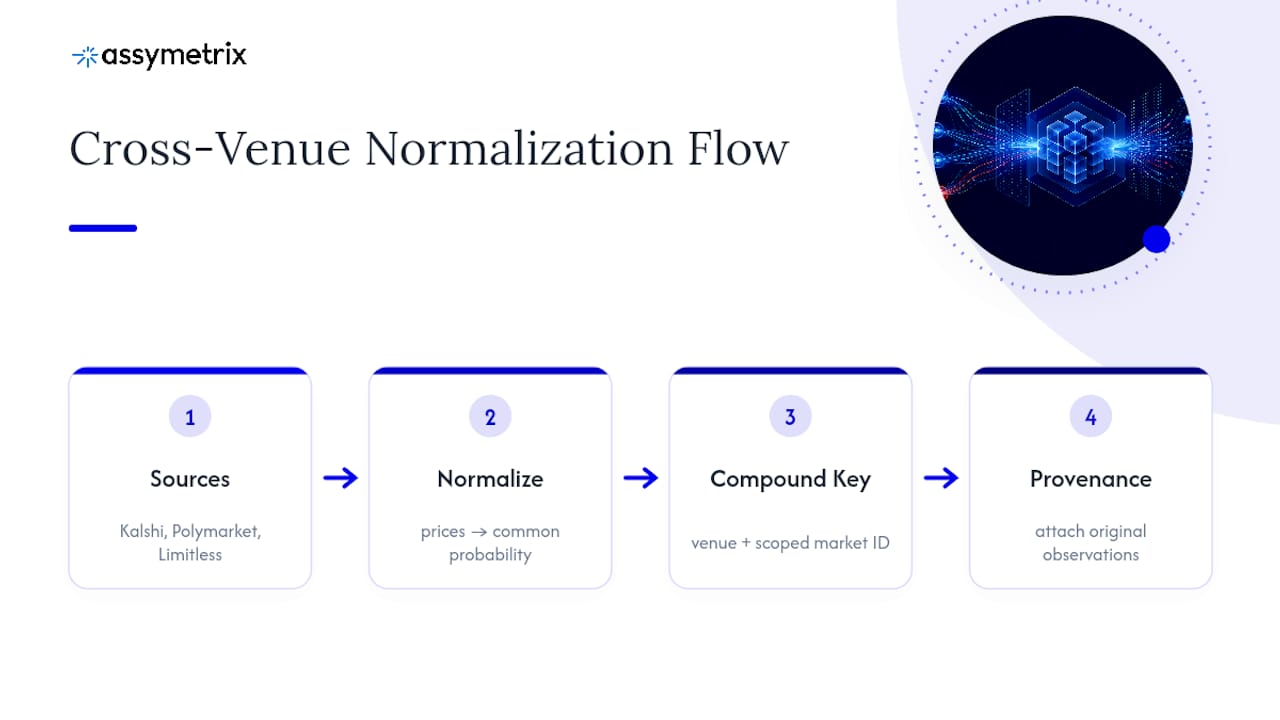
That last point matters more than it sounds. A canonical registry that weights venue midpoints by liquidity and freshness, as described in W.E.T.'s cross-venue standardization methodology, still needs to preserve each venue’s original observation. Suppress that provenance and you lose the ability to explain why a cross-venue probability moved.
Pro Tip: Always join on (venue, market_id) as a compound key, never on market_id alone. Two venues will eventually collide on the same integer or string, and that bug is brutal to trace after the fact.
How Do You Integrate Kalshi Data via REST and WebSocket?
Start with discovery, then move to streaming. Trying to build a live pipeline before you understand the market catalog is the most common mistake developers make on their first prediction market integration.
Query REST discovery endpoints first. Pull the full markets/series list and any historical exports before opening a live connection, so your local catalog of tickers and canonical event IDs is populated before trades start arriving.
Open a persistent WebSocket for live trades and orderbook updates once discovery is complete. Reconnect logic matters here: build exponential backoff into your client, because connections drop during high-volume events like election nights or Fed announcements.
Map every record to a canonical schema. At minimum, your
prediction_marketstable needs venue, market_id, canonical_event_id, normalized price, taker fill price, and anis_parlayboolean, since curated schemas flag multi-leg combo markets that need filtering out of single-market comparisons.Cast every price field on ingest. Treat string values in the
_dollarssuffix fields as probabilities in [0,1], not currency amounts, and convert to decimal odds only if your downstream models need that format.Design your ingest cadence around idempotent upserts. Use unique trade IDs to avoid duplicate rows, roll trades into hourly OHLCV aggregates on a schedule, and set a retention policy that matches your backtest window rather than storing everything indefinitely.
Pro Tip: Normalize types at the moment of ingest, not downstream in your analytics layer. OddsPapi’s developer notes point out that string/float mismatches are one of the most common sources of silent arithmetic bugs in prediction market pipelines, the kind that don’t throw an error, they just quietly corrupt a signal.
Keep provenance columns (source venue, raw field values, ingest timestamp) on every backfilled row so you can audit a signal months later without re-fetching from the exchange. For a walkthrough of the WebSocket message format specifically, the Kalshi API tutorial on Assymetrix covers connection handling in more depth.
What Do Developers Actually Build With This Data?
Normalized Kalshi data feeds four workflows that show up constantly in prediction market engineering, and each one follows a slightly different pattern.
Arbitrage scanners discover a canonical event, map it to its venue pairs, calculate a liquidity-weighted mid price on each side, then compute the edge net of fees and slippage before flagging a trade candidate.
Trading bots run a decision loop: ingest the normalized signal, size the position against a risk budget, hand execution off to the venue’s native order-entry API, then reconcile fills back into a PnL ledger.
AI agents consume streaming normalized data directly, look up canonical event IDs instead of parsing venue-specific tickers, and pull features from versioned tables built specifically for periodic model retraining.
Quant backtests build training sets from historical trades and OHLCV candles, run calibration checks against realized outcomes, and preserve venue provenance when splitting data into train and test sets.
A detailed build of the bot pattern, including position sizing logic, is covered in the Kalshi trading bot guide on Assymetrix. Historical data quality matters just as much for calibration work as it does for live signals, a point echoed in BetsyScore’s analysis of historical data in sports forecasting models, where the same principle, garbage historical inputs produce garbage backtests, applies just as directly to political and economic event markets.
How Does Authentication and Rate Limiting Work?
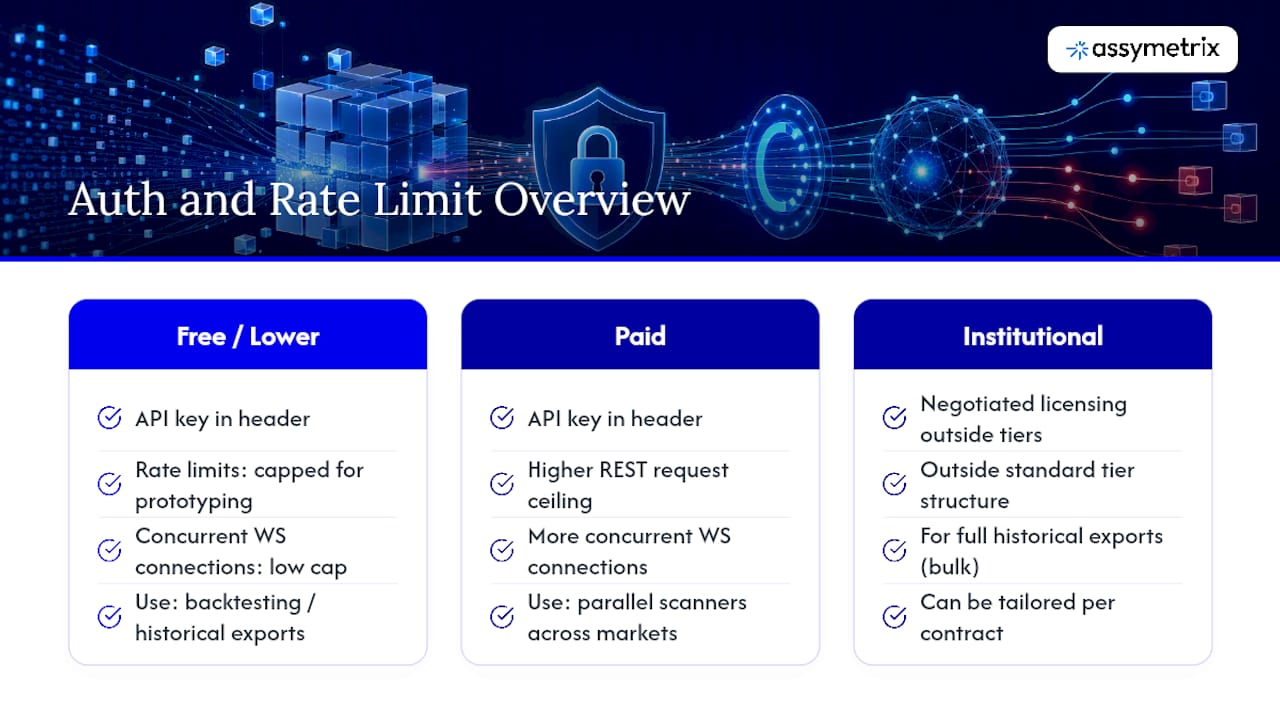
Access to normalized Kalshi data through Assymetrix runs on API keys tied to your account tier, generated from the developer dashboard once you sign up. Every request carries the key as a header rather than a query parameter, which keeps credentials out of logs and browser history.
Rate limits scale with your subscription tier. Free and lower tiers get capped request rates suited to prototyping and backtesting against historical exports. Paid tiers raise both the REST request ceiling and the number of concurrent WebSocket connections, which matters if you’re running parallel scanners across multiple market series simultaneously.
Hitting a rate limit returns a standard HTTP 429 response with a retry-after header. Build your client to respect that header rather than retrying immediately. A common mistake among bot builders is hardcoding a fixed retry interval that ignores the server’s actual guidance, which can get a key throttled further during high-traffic windows like major economic data releases.
WebSocket connections authenticate once at handshake and then stream without repeated credential checks, but they still count against your plan’s concurrent connection limit. If you’re running a fleet of market-specific listeners instead of one multiplexed connection subscribing to multiple tickers, you’ll burn through that limit fast. Subscribing to multiple markets over a single WebSocket connection is almost always the more efficient design, both for your rate limit budget and for reducing the number of reconnect events you have to handle during exchange maintenance windows.
Institutional and bulk data licensing sit outside the standard tier structure and get negotiated directly, which matters if your use case involves full historical exports rather than incremental streaming.
How Do You Handle Errors and Troubleshoot Common Issues?
Most integration problems trace back to three root causes: unhandled type mismatches, dropped WebSocket connections, and stale ID mappings. All three are preventable with a bit of defensive code up front.
Type errors top the list. A price field arriving as the string "0.6550" will silently break math operations in some languages if you don’t cast it to a float first. Build a normalization function that runs on every incoming record before it touches your business logic, not one you bolt on later when a signal starts producing nonsense values.
Connection drops happen more often around high-volume events, elections, Fed rate decisions, major economic releases, when exchange infrastructure gets stressed. Your WebSocket client needs exponential backoff on reconnect attempts, and it needs to resubscribe to every ticker it was previously watching, not just reopen the socket. A silent reconnect that forgets your subscription list is one of the more common bugs in home-grown bot code.
Stale ID mappings cause subtler failures. A market that resolves and gets replaced by a new series (common with recurring weekly or monthly Kalshi markets) can leave your canonical event mapping pointing at a dead ticker. Refresh your discovery catalog on a schedule, not just once at startup, so newly listed series get picked up automatically.
When an API call fails outright, check the HTTP status code before assuming a data problem: a 401 means your key is invalid or expired, a 429 means you’ve hit a rate limit, and a 5xx points to a transient server issue worth retrying with backoff rather than treating as fatal.
What Does It Cost to Access Kalshi Data Through the API?
Assymetrix runs a tiered subscription model rather than a single flat price, which matches how differently a solo bot builder and an institutional research desk actually consume this data.
A free tier exists for prototyping, testing schema mappings, and validating that your parsing logic handles the normalized format correctly before you commit to a paid plan. Paid tiers unlock higher rate limits, deeper historical backfills, and access to premium analytics layers like Smart Money wallet tracking and cross-venue arbitrage signals on top of the raw normalized feeds. Academic and non-commercial research use is supported under separate terms suited to that lower-stakes, non-production use case.
Institutional and bulk licensing, full historical exports, dedicated support, custom data delivery, get negotiated outside the standard subscription tiers entirely. If your use case involves ingesting the full historical archive rather than streaming incrementally, that’s the conversation to have directly rather than trying to force it through a standard API key.
The practical decision point for most developers is simple: prototype on the free tier against historical data, confirm your normalization and canonical ID logic works end to end, then upgrade once you’re ready to run live signals against real capital or a production AI agent pipeline.
What Security and Privacy Considerations Apply to API Access?
API keys are the primary security boundary, and treating them like any other production secret is non-negotiable. Never hardcode a key in client-side code, commit it to a public repository, or embed it in a mobile app binary where it can be extracted. Store keys in environment variables or a secrets manager, and rotate them if you suspect exposure.
Transport security matters at the connection level too. All REST and WebSocket traffic runs over encrypted channels, so credentials and market data in transit aren’t exposed to network-level interception, but that protection only holds if your own application handles the key correctly on your end.
Data privacy here looks different from consumer applications because prediction market data is inherently public market activity, trades, prices, and orderbook state, not personal information. There’s no user-level personal data flowing through the trade and orderbook feeds themselves. Where privacy does matter is on the account side: your usage patterns, API call volume, and billing information are handled under standard account privacy practices, separate from the market data itself.
If you’re building a multi-tenant application on top of this data, isolate customer-specific configuration, like which markets a given user’s bot watches, from the shared normalized data layer. Mixing the two creates unnecessary exposure if one tenant’s environment is compromised.
Assymetrix Turns Kalshi Into One Input, Not a Special Case
Most developers building cross-venue prediction market tools eventually hit the same wall: Kalshi’s ticker-based structure and CFTC-regulated settlement mechanics simply don’t map cleanly onto how Polymarket or Limitless expose data. Treating Kalshi as a special case, with its own parser, its own ID scheme, its own retry logic, is how integration projects quietly balloon from a two-week sprint into a two-month slog.
Assymetrix is a US-based prediction market intelligence platform built specifically to avoid that outcome, aggregating Kalshi alongside other major venues into one Data API backed by roughly 1.5 terabytes of historical data and close to a billion indexed rows dating back to September 2020. That scale means backtests against Kalshi’s earliest listed markets run through the same schema as this morning’s trades.
Beyond raw feeds, the platform layers in analytics quants actually use: Smart Money wallet tracking, Trader Skill Scores, and cross-venue arbitrage signals, all built on the same normalized data described above. The Kalshi API tutorial and Kalshi trading bot guide walk through both the raw integration and a full bot build on that foundation.
— Dean
Get Your Kalshi Data API Access
Assymetrix is the alternative to stitching together three separate exchange integrations. One key, one schema, one WebSocket connection gets you Kalshi, Polymarket, and Limitless data in the same normalized format, no separate parser for each venue’s string fields, no separate ID scheme to reconcile by hand.
Head to the Assymetrix Data API to request a key, pull REST and WebSocket examples, and run sample queries against the prediction_markets schema directly. If your use case involves full historical backfills or institutional-scale licensing beyond the standard tiers, reach out through Data to discuss bulk export terms. Developers who want to see the pattern applied to a real strategy should also check the cross-venue arbitrage guide, which walks through edge calculation using the same normalized price fields covered above.
Sources
FAQ
What Is the Kalshi Data API Through Assymetrix?
It’s normalized access to Kalshi’s real-time and historical market data through a single REST and WebSocket integration, with prices in probability space and canonical IDs shared across venues.
Does Kalshi Use the Same Price Format as Polymarket?
No. Kalshi exposes price fields as strings with a _dollars suffix in 0–1 format, while other venues use different string and array conventions, which is why normalization at ingest matters before running any cross-venue math.
How Fresh Is Real-Time Kalshi Data?
Public ingest pipelines poll Kalshi roughly every 120 seconds, so even “real-time” feeds carry a small, predictable lag that ingest strategies should account for.
Can I Backtest Strategies Against Historical Kalshi Data?
Yes. Historical trades and OHLCV candles support calibration checks and backtests, and Assymetrix’s index covers close to a billion rows of trading activity dating back to September 2020.
What’s the Difference Between Kalshi’s Native API and a Normalized Feed?
Kalshi’s native structure uses ticker-based IDs and venue-specific field formats; a normalized feed maps those to canonical cross-venue IDs and a consistent probability scale so the same query works across Kalshi, Polymarket, and Limitless.
Kalshi Data API: 1.5TB Normalized Feeds for Developers & Quants
Assymetrix’s Data API delivers Kalshi market data, real-time and historical, through a single REST and WebSocket integration with prices normalized to P(Yes) in [0,1] and canonical cross-venue IDs attached to every record. That means trades, orderbook depth, OHLCV candles, and settlement metadata arrive pre-cleaned, already joined to the same schema used for Polymarket and Limitless. For bots and AI agents, this removes the per-venue parsing and ID-mapping work that normally eats the first month of any cross-venue project.
TL;DR:
Kalshi prices are delivered in string format within a 0–1 range, requiring normalization before cross-venue comparisons or calculations.
Ingest cadences poll Kalshi approximately every two minutes, introducing slight but predictable delays in real-time data feeds.
Always join market data on a compound key of venue and market ID to prevent ID collisions and ensure accurate cross-venue integration.
Historical data covers nearly a billion rows since September 2020, useful for backtesting, calibration, and training AI models.
Access is tiered and rate-limited based on subscription level, with higher tiers supporting more requests, WebSocket connections, and historical data exports.
AssymetrixBuild With Unified Market DataAssymetrix brings Kalshi, Polymarket, and Limitless data together through one API for developers, quants, bots, and AI agents.Explore Assymetrix
Table of Contents
What Data Does the Kalshi Data API Cover?
Why Does Cross-Venue Normalization Matter for Kalshi Data?
How Do You Integrate Kalshi Data via REST and WebSocket?
What Do Developers Actually Build With This Data?
How Does Authentication and Rate Limiting Work?
How Do You Handle Errors and Troubleshoot Common Issues?
What Does It Cost to Access Kalshi Data Through the API?
What Security and Privacy Considerations Apply to API Access?
Assymetrix Turns Kalshi Into One Input, Not a Special Case
Get Your Kalshi Data API Access
Sources
What Data Does the Kalshi Data API Cover?
Kalshi’s native market structure produces five distinct data types, and each one maps to a different table in a well-designed ingestion pipeline. Getting the field-level details right up front saves you from rewriting your storage layer three months into a project.
The markets/series table carries the descriptive layer: series identifiers, human-readable tickers, market descriptions, open/close status, and resolution timestamps. This is where you look up what a market actually is before you touch pricing data.
The trades table holds per-fill activity: price expressed as a string in the 0–1 range, contract size, taker fill price when available, and maker/taker flags. Kalshi has moved several of these fields to a _dollars suffix convention (yes_bid_dollars, for example), and every value still arrives as a string that needs casting before you run any arithmetic on it, a detail confirmed in OddsPapi’s developer comparison of Kalshi and Polymarket.
Beyond trades, three more datasets round out the picture:
Orderbook depth: level arrays of price and size pairs on the yes/no sides, useful for liquidity-weighted mid calculations.
OHLCV candles: hourly or daily aggregates in normalized price space, distinct from raw per-fill trades because they smooth execution noise into a queryable time series.
Settlement and resolution metadata: a resolved flag, payout amount, and settlement timestamp, which you should store permanently for audit trails rather than overwriting.
Kalshi’s public ingest cadence runs approximately every couple of minutes in one documented pipeline, according to Eyewall Markets’ methodology page, so even “real-time” feeds carry a small, predictable lag you need to design around.
Why Does Cross-Venue Normalization Matter for Kalshi Data?
Kalshi is CFTC-regulated, runs a centralized limit orderbook, and identifies markets with readable tickers instead of on-chain token IDs. That structural difference from decentralized venues shapes everything downstream: settlement is handled by a regulated clearing process, liquidity tends to concentrate around scheduled economic and political events, and institutional participation shows up in orderbook depth that retail-only venues rarely match.
The friction shows up the moment you try to combine that data with anything else. Kalshi uses ticker-based IDs. Polymarket uses token IDs tied to on-chain contracts. Price fields arrive as strings in different formats across venues, and ingest cadences don’t align, which Eyewall Markets puts at around 90 seconds for Polymarket versus roughly 120 seconds for Kalshi in one public pipeline. Try to join these directly and you’ll spend more time reconciling schemas than building signals.
A normalized schema like the prediction_markets model documented by Dune’s data catalog solves this by giving every market a venue column and a venue-scoped market ID, joined as a compound key rather than forced into a single global ID space. Prices land in a consistent probability space. Venue provenance stays attached to every row instead of getting flattened away.
That last point matters more than it sounds. A canonical registry that weights venue midpoints by liquidity and freshness, as described in W.E.T.'s cross-venue standardization methodology, still needs to preserve each venue’s original observation. Suppress that provenance and you lose the ability to explain why a cross-venue probability moved.
Pro Tip: Always join on (venue, market_id) as a compound key, never on market_id alone. Two venues will eventually collide on the same integer or string, and that bug is brutal to trace after the fact.
How Do You Integrate Kalshi Data via REST and WebSocket?
Start with discovery, then move to streaming. Trying to build a live pipeline before you understand the market catalog is the most common mistake developers make on their first prediction market integration.
Query REST discovery endpoints first. Pull the full markets/series list and any historical exports before opening a live connection, so your local catalog of tickers and canonical event IDs is populated before trades start arriving.
Open a persistent WebSocket for live trades and orderbook updates once discovery is complete. Reconnect logic matters here: build exponential backoff into your client, because connections drop during high-volume events like election nights or Fed announcements.
Map every record to a canonical schema. At minimum, your
prediction_marketstable needs venue, market_id, canonical_event_id, normalized price, taker fill price, and anis_parlayboolean, since curated schemas flag multi-leg combo markets that need filtering out of single-market comparisons.Cast every price field on ingest. Treat string values in the
_dollarssuffix fields as probabilities in [0,1], not currency amounts, and convert to decimal odds only if your downstream models need that format.Design your ingest cadence around idempotent upserts. Use unique trade IDs to avoid duplicate rows, roll trades into hourly OHLCV aggregates on a schedule, and set a retention policy that matches your backtest window rather than storing everything indefinitely.
Pro Tip: Normalize types at the moment of ingest, not downstream in your analytics layer. OddsPapi’s developer notes point out that string/float mismatches are one of the most common sources of silent arithmetic bugs in prediction market pipelines, the kind that don’t throw an error, they just quietly corrupt a signal.
Keep provenance columns (source venue, raw field values, ingest timestamp) on every backfilled row so you can audit a signal months later without re-fetching from the exchange. For a walkthrough of the WebSocket message format specifically, the Kalshi API tutorial on Assymetrix covers connection handling in more depth.
What Do Developers Actually Build With This Data?
Normalized Kalshi data feeds four workflows that show up constantly in prediction market engineering, and each one follows a slightly different pattern.
Arbitrage scanners discover a canonical event, map it to its venue pairs, calculate a liquidity-weighted mid price on each side, then compute the edge net of fees and slippage before flagging a trade candidate.
Trading bots run a decision loop: ingest the normalized signal, size the position against a risk budget, hand execution off to the venue’s native order-entry API, then reconcile fills back into a PnL ledger.
AI agents consume streaming normalized data directly, look up canonical event IDs instead of parsing venue-specific tickers, and pull features from versioned tables built specifically for periodic model retraining.
Quant backtests build training sets from historical trades and OHLCV candles, run calibration checks against realized outcomes, and preserve venue provenance when splitting data into train and test sets.
A detailed build of the bot pattern, including position sizing logic, is covered in the Kalshi trading bot guide on Assymetrix. Historical data quality matters just as much for calibration work as it does for live signals, a point echoed in BetsyScore’s analysis of historical data in sports forecasting models, where the same principle, garbage historical inputs produce garbage backtests, applies just as directly to political and economic event markets.
How Does Authentication and Rate Limiting Work?
Access to normalized Kalshi data through Assymetrix runs on API keys tied to your account tier, generated from the developer dashboard once you sign up. Every request carries the key as a header rather than a query parameter, which keeps credentials out of logs and browser history.
Rate limits scale with your subscription tier. Free and lower tiers get capped request rates suited to prototyping and backtesting against historical exports. Paid tiers raise both the REST request ceiling and the number of concurrent WebSocket connections, which matters if you’re running parallel scanners across multiple market series simultaneously.
Hitting a rate limit returns a standard HTTP 429 response with a retry-after header. Build your client to respect that header rather than retrying immediately. A common mistake among bot builders is hardcoding a fixed retry interval that ignores the server’s actual guidance, which can get a key throttled further during high-traffic windows like major economic data releases.
WebSocket connections authenticate once at handshake and then stream without repeated credential checks, but they still count against your plan’s concurrent connection limit. If you’re running a fleet of market-specific listeners instead of one multiplexed connection subscribing to multiple tickers, you’ll burn through that limit fast. Subscribing to multiple markets over a single WebSocket connection is almost always the more efficient design, both for your rate limit budget and for reducing the number of reconnect events you have to handle during exchange maintenance windows.
Institutional and bulk data licensing sit outside the standard tier structure and get negotiated directly, which matters if your use case involves full historical exports rather than incremental streaming.
How Do You Handle Errors and Troubleshoot Common Issues?
Most integration problems trace back to three root causes: unhandled type mismatches, dropped WebSocket connections, and stale ID mappings. All three are preventable with a bit of defensive code up front.
Type errors top the list. A price field arriving as the string "0.6550" will silently break math operations in some languages if you don’t cast it to a float first. Build a normalization function that runs on every incoming record before it touches your business logic, not one you bolt on later when a signal starts producing nonsense values.
Connection drops happen more often around high-volume events, elections, Fed rate decisions, major economic releases, when exchange infrastructure gets stressed. Your WebSocket client needs exponential backoff on reconnect attempts, and it needs to resubscribe to every ticker it was previously watching, not just reopen the socket. A silent reconnect that forgets your subscription list is one of the more common bugs in home-grown bot code.
Stale ID mappings cause subtler failures. A market that resolves and gets replaced by a new series (common with recurring weekly or monthly Kalshi markets) can leave your canonical event mapping pointing at a dead ticker. Refresh your discovery catalog on a schedule, not just once at startup, so newly listed series get picked up automatically.
When an API call fails outright, check the HTTP status code before assuming a data problem: a 401 means your key is invalid or expired, a 429 means you’ve hit a rate limit, and a 5xx points to a transient server issue worth retrying with backoff rather than treating as fatal.
What Does It Cost to Access Kalshi Data Through the API?
Assymetrix runs a tiered subscription model rather than a single flat price, which matches how differently a solo bot builder and an institutional research desk actually consume this data.
A free tier exists for prototyping, testing schema mappings, and validating that your parsing logic handles the normalized format correctly before you commit to a paid plan. Paid tiers unlock higher rate limits, deeper historical backfills, and access to premium analytics layers like Smart Money wallet tracking and cross-venue arbitrage signals on top of the raw normalized feeds. Academic and non-commercial research use is supported under separate terms suited to that lower-stakes, non-production use case.
Institutional and bulk licensing, full historical exports, dedicated support, custom data delivery, get negotiated outside the standard subscription tiers entirely. If your use case involves ingesting the full historical archive rather than streaming incrementally, that’s the conversation to have directly rather than trying to force it through a standard API key.
The practical decision point for most developers is simple: prototype on the free tier against historical data, confirm your normalization and canonical ID logic works end to end, then upgrade once you’re ready to run live signals against real capital or a production AI agent pipeline.
What Security and Privacy Considerations Apply to API Access?
API keys are the primary security boundary, and treating them like any other production secret is non-negotiable. Never hardcode a key in client-side code, commit it to a public repository, or embed it in a mobile app binary where it can be extracted. Store keys in environment variables or a secrets manager, and rotate them if you suspect exposure.
Transport security matters at the connection level too. All REST and WebSocket traffic runs over encrypted channels, so credentials and market data in transit aren’t exposed to network-level interception, but that protection only holds if your own application handles the key correctly on your end.
Data privacy here looks different from consumer applications because prediction market data is inherently public market activity, trades, prices, and orderbook state, not personal information. There’s no user-level personal data flowing through the trade and orderbook feeds themselves. Where privacy does matter is on the account side: your usage patterns, API call volume, and billing information are handled under standard account privacy practices, separate from the market data itself.
If you’re building a multi-tenant application on top of this data, isolate customer-specific configuration, like which markets a given user’s bot watches, from the shared normalized data layer. Mixing the two creates unnecessary exposure if one tenant’s environment is compromised.
Assymetrix Turns Kalshi Into One Input, Not a Special Case
Most developers building cross-venue prediction market tools eventually hit the same wall: Kalshi’s ticker-based structure and CFTC-regulated settlement mechanics simply don’t map cleanly onto how Polymarket or Limitless expose data. Treating Kalshi as a special case, with its own parser, its own ID scheme, its own retry logic, is how integration projects quietly balloon from a two-week sprint into a two-month slog.
Assymetrix is a US-based prediction market intelligence platform built specifically to avoid that outcome, aggregating Kalshi alongside other major venues into one Data API backed by roughly 1.5 terabytes of historical data and close to a billion indexed rows dating back to September 2020. That scale means backtests against Kalshi’s earliest listed markets run through the same schema as this morning’s trades.
Beyond raw feeds, the platform layers in analytics quants actually use: Smart Money wallet tracking, Trader Skill Scores, and cross-venue arbitrage signals, all built on the same normalized data described above. The Kalshi API tutorial and Kalshi trading bot guide walk through both the raw integration and a full bot build on that foundation.
— Dean
Get Your Kalshi Data API Access
Assymetrix is the alternative to stitching together three separate exchange integrations. One key, one schema, one WebSocket connection gets you Kalshi, Polymarket, and Limitless data in the same normalized format, no separate parser for each venue’s string fields, no separate ID scheme to reconcile by hand.
Head to the Assymetrix Data API to request a key, pull REST and WebSocket examples, and run sample queries against the prediction_markets schema directly. If your use case involves full historical backfills or institutional-scale licensing beyond the standard tiers, reach out through Data to discuss bulk export terms. Developers who want to see the pattern applied to a real strategy should also check the cross-venue arbitrage guide, which walks through edge calculation using the same normalized price fields covered above.
Sources
FAQ
What Is the Kalshi Data API Through Assymetrix?
It’s normalized access to Kalshi’s real-time and historical market data through a single REST and WebSocket integration, with prices in probability space and canonical IDs shared across venues.
Does Kalshi Use the Same Price Format as Polymarket?
No. Kalshi exposes price fields as strings with a _dollars suffix in 0–1 format, while other venues use different string and array conventions, which is why normalization at ingest matters before running any cross-venue math.
How Fresh Is Real-Time Kalshi Data?
Public ingest pipelines poll Kalshi roughly every 120 seconds, so even “real-time” feeds carry a small, predictable lag that ingest strategies should account for.
Can I Backtest Strategies Against Historical Kalshi Data?
Yes. Historical trades and OHLCV candles support calibration checks and backtests, and Assymetrix’s index covers close to a billion rows of trading activity dating back to September 2020.
What’s the Difference Between Kalshi’s Native API and a Normalized Feed?
Kalshi’s native structure uses ticker-based IDs and venue-specific field formats; a normalized feed maps those to canonical cross-venue IDs and a consistent probability scale so the same query works across Kalshi, Polymarket, and Limitless.
Other Blog


