Java Prediction Market API: Build a Reliable Integration
Java Prediction Market API: Build a Reliable Integration
Java Prediction Market API: Build a Reliable Integration
How to connect Java to prediction market APIs: REST and WebSocket access, authentication, order-book data, multi-venue normalization and testing, with working code.

Java Prediction Market API: Build a Reliable Integration
A Java prediction market API integration comes down to three choices: which HTTP and WebSocket client you use, how you model markets and order books, and whether you connect to each venue separately or to one normalized feed. Java has no shortage of tooling for this (java.net.http, Jackson, a reactive stack), but most venue SDKs are not written for it, so you will mostly be writing thin clients against REST and WebSocket endpoints yourself. This guide covers what to build, what to check, and where Java teams usually get hurt.
AssymetrixUnify Prediction Market Data in JavaAssymetrix brings Polymarket, Kalshi, and Limitless data together through one API, giving Java teams a unified cross-venue integration.Explore the Data API
TL;DR
Plan on writing your own thin client. Venue-maintained SDKs tend to target TypeScript or Python, and they change often, so a small Java layer you own is safer than a stale wrapper.
Use REST for discovery, snapshots and history, and WebSocket for live updates. Reconcile every stream against a REST snapshot.
Decide early whether you integrate each venue on its own or consume one normalized, cross-venue feed with canonical market IDs.
Model prices as
BigDecimalor integer ticks, timestamps asInstant, and keep raw payloads so you can replay and debug.Test with recorded fixtures and contract tests, so a schema change fails a build rather than a trading session.
Table of Contents
Is there an official Java SDK?
What data a Java client should be able to retrieve
Connecting over REST in Java
Streaming real-time updates with WebSocket
Authentication, signing, rate limits and versioning
Combining venues in one Java pipeline
Reliability, latency and data quality
Testing and maintaining the integration
Our perspective: normalize first, trade second
Using Assymetrix from Java
Sources
Is there an official Java SDK?
Short answer: do not count on one. The best-known venue client libraries are aimed at other languages. Polymarket’s original TypeScript CLOB client, for instance, is now archived and marked as no longer functional, with users pointed to a newer unified SDK. That is a useful warning for any language: client libraries in this market are replaced faster than the underlying concepts change.
For Java, that leaves three practical routes:
Raw HTTP and WebSocket clients. The JDK’s
java.net.http.HttpClienthandles REST and WebSocket without extra dependencies. Add Jackson or another JSON mapper and you have a complete stack.A generated client. If a venue publishes an OpenAPI description, generate typed models from it and wrap them in your own interface. Never let generated types leak into your strategy code.
A normalized data API. One integration gives you every covered venue through a single schema. This is the route we recommend for research and data pipelines, and we come back to it below.
Whichever you choose, put a small interface of your own between the vendor and your code. Something like MarketDataSource with listMarkets(), snapshot(marketId), history(marketId, range) and subscribe(marketIds, handler) is enough. Swapping a client then costs one class, not a rewrite.
What data a Java client should be able to retrieve
Before you write any code, list the data classes you need. Market-data vendors in traditional finance split their products into tiers. ICE’s documentation, for example, separates Level 1 data (trades, best bid and offer, reference data) from Level 2 depth. That split is a handy checklist for prediction markets too.
Data class | What it contains | Typical use |
|---|---|---|
Reference data | Market ID, question, outcomes, resolution rules, close time, status | Discovery, filtering, mapping across venues |
Level 1 | Best bid, best ask, last trade, volume | Dashboards, alerting, simple signals |
Level 2 | Full order-book depth by price level | Slippage estimates, market making, microstructure work |
Trades | Executed trades with price, size, side, timestamp | Flow analysis, VWAP, backtests |
Candles | OHLCV at fixed intervals | Charting, feature engineering |
Settlement | Final outcome and resolution time | Labels for models, calibration studies |
Wallet or account activity | Positions and fills for public on-chain venues | Smart Money and skill analysis |
The distinction between top-of-book and depth matters more than it first appears. A last price on a thin contract tells you little about what you could actually buy. Real-time quote, trade and depth coverage is also what separates a toy script from something you can rely on for short-horizon decisions. For a deeper look at depth specifically, see our order-book integration guide.
Connecting over REST in Java
REST is where you discover markets, pull snapshots and fetch history. A minimal client on the JDK looks like this. The base URL and path are placeholders, so substitute the venue or data provider you use.
HttpClient http = HttpClient.newBuilder()
    .connectTimeout(Duration.ofSeconds(5))
    .build();

HttpRequest req = HttpRequest.newBuilder()
    .uri(URI.create(BASE_URL + "/markets?status=open&limit=200"))
    .header("Authorization", "Bearer " + apiKey)
    .header("Accept", "application/json")
    .timeout(Duration.ofSeconds(10))
    .GET()
    .build();

HttpResponse<String> res =
    http.send(req, HttpResponse.BodyHandlers.ofString());

if (res.statusCode() == 429) {
    // honor Retry-After, then back off
}
MarketPage page = mapper.readValue(res.body(), MarketPage.class);
A few habits pay off immediately:
Always set timeouts. The JDK client has no default request timeout, and a hung call on a polling thread is a silent outage.
Reuse one
HttpClient. It is thread-safe and pools connections.Parse leniently. Configure Jackson with
FAIL_ON_UNKNOWN_PROPERTIESdisabled so a new field does not crash production, but log unknown fields so you notice.Paginate with cursors, not offsets, where the API supports it. Offsets drift while markets are being created.
Use virtual threads (Java 21 and later) for fan-out across many markets. Blocking calls become cheap, and the code stays readable.
For language-neutral detail on request patterns and history endpoints, our real-time and historical feed guide walks through them, and the Python data guide is a useful companion if your research team prototypes in notebooks before Java ports the pipeline.
Streaming real-time updates with WebSocket
Polling works for discovery and slow signals. For quotes, trades and order-book changes you want a push connection. The JDK’s java.net.http.WebSocket supports this natively.
WebSocket ws = http.newWebSocketBuilder()
    .header("Authorization", "Bearer " + apiKey)
    .buildAsync(URI.create(WS_URL), new Listener() {
        public CompletionStage<?> onText(WebSocket w,
                CharSequence data, boolean last) {
            buffer.append(data);
            if (last) {
                queue.offer(buffer.toString());
                buffer.setLength(0);
            }
            w.request(1);
            return null;
        }
    }).join();
Two details trip up most first implementations. The first is fragmentation: onText can deliver a message in pieces, so you must buffer until last is true. The second is back-pressure: call request(1) only after you have handed the message off, and do your parsing on another thread so the receive loop never stalls.
Streaming also brings the hardest correctness problem in this domain: order-book drift. If you apply incremental updates to a book and miss one, your local book silently diverges from the exchange. The defense is a sequence check on every message, a fresh REST snapshot on any gap, and a periodic checksum or top-of-book comparison. We cover the failure modes in detail in our guide to fixing order-book drift on WebSocket feeds and in the overview of prediction market WebSocket APIs.
Build reconnects as a first-class feature:
Reconnect with exponential backoff and jitter.
Resubscribe to every channel after reconnecting.
Fetch a snapshot for each subscribed market and discard buffered deltas older than it.
Only then resume applying live updates.
Authentication, signing, rate limits and versioning
These are the four areas where venues differ most, so read each venue’s current documentation rather than a tutorial, including this one.
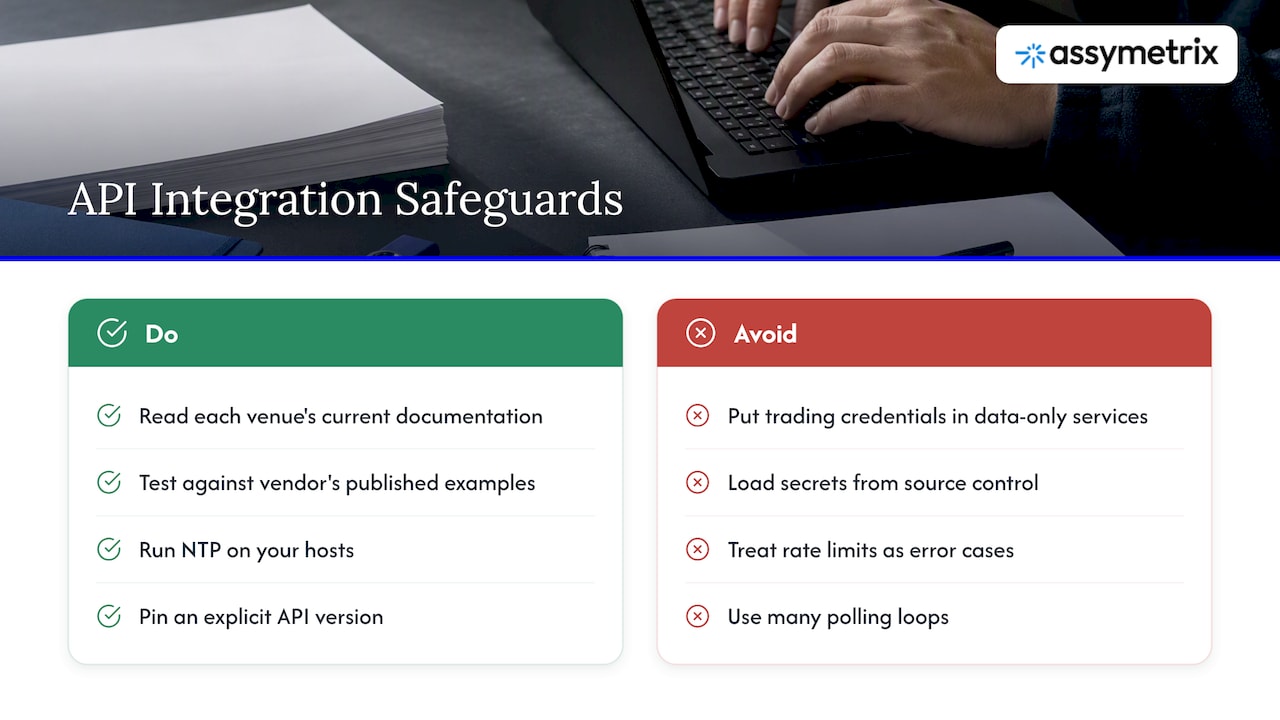
Read-only data versus trading. Market data is often available with an API key or with no credentials at all. Trading calls need more. Some venues sign requests with an RSA key, and on-chain venues use wallet signatures for order placement. Keep trading credentials out of any service that only needs data, and load secrets from a vault or environment, never from source control.
Request signing in Java. If a venue requires signed requests, java.security.Signature covers the common algorithms, and the exact padding and string-to-sign format must match the venue’s spec byte for byte. Write a unit test against the vendor’s published examples before you point it at a live endpoint. Clock skew also breaks signed requests, so run NTP on your hosts.
Rate limits. Treat them as part of your design, not an error case. Implement a token-bucket limiter per credential (Resilience4j’s RateLimiter or Guava’s RateLimiter both work), separate read and write budgets where the venue does, and respect Retry-After on HTTP 429 responses. Prefer one streaming connection over many polling loops.
Versioning. Venues revise endpoints, and the archived client above shows how quickly. Pin an explicit API version in your base URL where one exists, keep a changelog watch on every vendor you depend on, and isolate each venue behind an adapter so that a breaking change touches one module.
Combining venues in one Java pipeline
The moment you add a second venue, the real work begins. Each venue has its own market identifiers, its own contract structure, its own price conventions and its own resolution wording. The same real-world question can appear as a binary contract on one venue and as one leg of a multi-outcome event on another.
A workable normalization layer has five parts:
A canonical market ID that maps to each venue’s native ID, stored in your own table.
A common price unit. Express probabilities as a decimal between 0 and 1 using
BigDecimal, and convert venue-specific quoting at the adapter boundary.A common order-book model: a sorted list of price levels per side, with size in a single unit.
Resolution metadata stored alongside each market, because two contracts that look identical can resolve differently on edge cases.
UTC
Instanttimestamps everywhere, with both exchange time and your receive time recorded.
Building and maintaining this mapping is the most expensive part of a multi-venue system, and it is rarely the part that gives you an edge. That is why many teams pick a unified source. Our cross-venue data guide explains how canonical IDs work and why the mapping should come first, before any signal logic.
Reliability, latency and data quality
A Java service that runs for weeks has to plan for the bad days.
Idempotent ingestion. Key every trade on venue, market and trade ID so a replay after a reconnect never double counts.
Gap detection. Track the last sequence number or timestamp per stream and raise an alert when a feed goes quiet on a market that is normally active.
Clock discipline. Store both the venue’s timestamp and your arrival time. The difference is your latency measurement and your best early-warning metric.
Garbage collection. For low-latency consumers, allocation-heavy JSON parsing causes pauses. Reuse
ObjectReaderinstances, parse into compact records, and consider ZGC on current JDKs if tail latency matters.Thin markets. Wide spreads, stale last prices and one-sided books are normal. Filter on depth and recency before you trust a price.
Settlement edge cases. Markets can be voided, resolved late or disputed. Keep settlement as its own state, never infer it from price going to 0 or 1.
Separate your hot path (quote handling and decisions) from your cold path (storage, analytics). Push raw messages to a queue or append-only log first, and let downstream consumers parse from there. When something goes wrong, the raw log is what lets you reconstruct it.
Testing and maintaining the integration
External APIs change without asking you. Your test suite is how you find out first.
Record fixtures. Save real REST responses and WebSocket message sequences, including odd ones: empty books, voided markets, reconnect bursts.
Replay tests. Feed recorded streams through your book builder and assert the final book equals a recorded snapshot. This catches most drift bugs.
Contract tests. A scheduled job calls each live endpoint and validates the response against your expected JSON schema. A failure here means the vendor changed something.
Property tests. For normalization, assert that prices stay within 0 and 1, that bids sit below asks, and that sizes are never negative.
Canary monitoring. In production, alert on parse-error rate, unknown-field counts, message gap duration and reconnect frequency.
Keep a short runbook per venue: where the changelog lives, who owns the adapter, and how to roll back. When history matters for backtests, make sure your historical and live schemas are identical, otherwise a model that works in research fails in production. Our guide to reproducible backtests on historical data covers that gap.
Our perspective: normalize first, trade second
We build data infrastructure, so we see the same pattern in nearly every Java team that comes to us. The first month goes into the strategy, and the next four go into connectors, ID mapping, reconnect logic and schema repairs. The strategy was never the bottleneck.
Our view is that venue-neutral, normalized data should be treated like a database driver: a dependency you integrate once and trust, not a project you re-run for each exchange. Assymetrix aggregates Polymarket, Kalshi and Limitless into a single layer built on roughly 1.5 terabytes of history across nearly one billion rows of trading activity. The point of that scale is not the headline number. It is that a backtest and a live consumer read the same schema, with the same canonical IDs, from the same source.
We also think independence matters. A data provider tied to one exchange has a structural incentive to favor that exchange’s view of the market. A venue-neutral layer does not, which is why cross-venue comparisons, divergence checks and arbitrage signals are credible only when the data underneath is neutral.
What we advise Java teams: own your interface, keep raw payloads, test against recordings, and spend your engineering time on the part of the stack that is actually yours.
— Dean
Using Assymetrix from Java
Our Data API exposes REST and WebSocket access to cross-venue prediction market data through a single integration, so a Java client needs one authentication path, one schema and one set of canonical market IDs instead of one adapter per venue. It serves live data and the full historical archive, so research code and production code share the same models.
If you are scoping an integration, start with the Data API overview, then see how canonical IDs and REST plus WebSocket access fit together. For signal work built on the same data, our intelligence layer adds Smart Money tracking and cross-venue divergence on top of the raw feed.
FAQ
Is there an official Java SDK for prediction market APIs?
Not one you can assume. Venue-maintained client libraries mostly target other languages, and some have already been retired in favor of newer ones. Most Java teams write a small client on the JDK’s HTTP and WebSocket classes, or consume a normalized data API through a single adapter.
Should I use REST or WebSocket from Java?
Use both. REST suits market discovery, snapshots and historical queries. WebSocket suits live quotes, trades and order-book changes. Always seed a streaming book from a REST snapshot, and fetch a new one whenever you detect a gap.
How do I avoid hitting rate limits?
Put a token-bucket limiter in front of every credential, honor Retry-After on 429 responses, and replace polling loops with a streaming subscription wherever possible. Track read and write budgets separately if the venue does.
What Java types should I use for prices and timestamps?
Use BigDecimal or integer ticks for prices and sizes, never double, so rounding never creeps into your book. Use java.time.Instant in UTC for timestamps, and store both venue time and receive time.
Can the same Java code read Polymarket, Kalshi and Limitless?
Yes, if you read them through a normalized layer. Without one, you need a separate adapter, ID map and price converter for each venue. A unified API with canonical IDs removes that work.
Sources
Java Prediction Market API: Build a Reliable Integration
A Java prediction market API integration comes down to three choices: which HTTP and WebSocket client you use, how you model markets and order books, and whether you connect to each venue separately or to one normalized feed. Java has no shortage of tooling for this (java.net.http, Jackson, a reactive stack), but most venue SDKs are not written for it, so you will mostly be writing thin clients against REST and WebSocket endpoints yourself. This guide covers what to build, what to check, and where Java teams usually get hurt.
AssymetrixUnify Prediction Market Data in JavaAssymetrix brings Polymarket, Kalshi, and Limitless data together through one API, giving Java teams a unified cross-venue integration.Explore the Data API
TL;DR
Plan on writing your own thin client. Venue-maintained SDKs tend to target TypeScript or Python, and they change often, so a small Java layer you own is safer than a stale wrapper.
Use REST for discovery, snapshots and history, and WebSocket for live updates. Reconcile every stream against a REST snapshot.
Decide early whether you integrate each venue on its own or consume one normalized, cross-venue feed with canonical market IDs.
Model prices as
BigDecimalor integer ticks, timestamps asInstant, and keep raw payloads so you can replay and debug.Test with recorded fixtures and contract tests, so a schema change fails a build rather than a trading session.
Table of Contents
Is there an official Java SDK?
What data a Java client should be able to retrieve
Connecting over REST in Java
Streaming real-time updates with WebSocket
Authentication, signing, rate limits and versioning
Combining venues in one Java pipeline
Reliability, latency and data quality
Testing and maintaining the integration
Our perspective: normalize first, trade second
Using Assymetrix from Java
Sources
Is there an official Java SDK?
Short answer: do not count on one. The best-known venue client libraries are aimed at other languages. Polymarket’s original TypeScript CLOB client, for instance, is now archived and marked as no longer functional, with users pointed to a newer unified SDK. That is a useful warning for any language: client libraries in this market are replaced faster than the underlying concepts change.
For Java, that leaves three practical routes:
Raw HTTP and WebSocket clients. The JDK’s
java.net.http.HttpClienthandles REST and WebSocket without extra dependencies. Add Jackson or another JSON mapper and you have a complete stack.A generated client. If a venue publishes an OpenAPI description, generate typed models from it and wrap them in your own interface. Never let generated types leak into your strategy code.
A normalized data API. One integration gives you every covered venue through a single schema. This is the route we recommend for research and data pipelines, and we come back to it below.
Whichever you choose, put a small interface of your own between the vendor and your code. Something like MarketDataSource with listMarkets(), snapshot(marketId), history(marketId, range) and subscribe(marketIds, handler) is enough. Swapping a client then costs one class, not a rewrite.
What data a Java client should be able to retrieve
Before you write any code, list the data classes you need. Market-data vendors in traditional finance split their products into tiers. ICE’s documentation, for example, separates Level 1 data (trades, best bid and offer, reference data) from Level 2 depth. That split is a handy checklist for prediction markets too.
Data class | What it contains | Typical use |
|---|---|---|
Reference data | Market ID, question, outcomes, resolution rules, close time, status | Discovery, filtering, mapping across venues |
Level 1 | Best bid, best ask, last trade, volume | Dashboards, alerting, simple signals |
Level 2 | Full order-book depth by price level | Slippage estimates, market making, microstructure work |
Trades | Executed trades with price, size, side, timestamp | Flow analysis, VWAP, backtests |
Candles | OHLCV at fixed intervals | Charting, feature engineering |
Settlement | Final outcome and resolution time | Labels for models, calibration studies |
Wallet or account activity | Positions and fills for public on-chain venues | Smart Money and skill analysis |
The distinction between top-of-book and depth matters more than it first appears. A last price on a thin contract tells you little about what you could actually buy. Real-time quote, trade and depth coverage is also what separates a toy script from something you can rely on for short-horizon decisions. For a deeper look at depth specifically, see our order-book integration guide.
Connecting over REST in Java
REST is where you discover markets, pull snapshots and fetch history. A minimal client on the JDK looks like this. The base URL and path are placeholders, so substitute the venue or data provider you use.
HttpClient http = HttpClient.newBuilder()
    .connectTimeout(Duration.ofSeconds(5))
    .build();

HttpRequest req = HttpRequest.newBuilder()
    .uri(URI.create(BASE_URL + "/markets?status=open&limit=200"))
    .header("Authorization", "Bearer " + apiKey)
    .header("Accept", "application/json")
    .timeout(Duration.ofSeconds(10))
    .GET()
    .build();

HttpResponse<String> res =
    http.send(req, HttpResponse.BodyHandlers.ofString());

if (res.statusCode() == 429) {
    // honor Retry-After, then back off
}
MarketPage page = mapper.readValue(res.body(), MarketPage.class);
A few habits pay off immediately:
Always set timeouts. The JDK client has no default request timeout, and a hung call on a polling thread is a silent outage.
Reuse one
HttpClient. It is thread-safe and pools connections.Parse leniently. Configure Jackson with
FAIL_ON_UNKNOWN_PROPERTIESdisabled so a new field does not crash production, but log unknown fields so you notice.Paginate with cursors, not offsets, where the API supports it. Offsets drift while markets are being created.
Use virtual threads (Java 21 and later) for fan-out across many markets. Blocking calls become cheap, and the code stays readable.
For language-neutral detail on request patterns and history endpoints, our real-time and historical feed guide walks through them, and the Python data guide is a useful companion if your research team prototypes in notebooks before Java ports the pipeline.
Streaming real-time updates with WebSocket
Polling works for discovery and slow signals. For quotes, trades and order-book changes you want a push connection. The JDK’s java.net.http.WebSocket supports this natively.
WebSocket ws = http.newWebSocketBuilder()
    .header("Authorization", "Bearer " + apiKey)
    .buildAsync(URI.create(WS_URL), new Listener() {
        public CompletionStage<?> onText(WebSocket w,
                CharSequence data, boolean last) {
            buffer.append(data);
            if (last) {
                queue.offer(buffer.toString());
                buffer.setLength(0);
            }
            w.request(1);
            return null;
        }
    }).join();
Two details trip up most first implementations. The first is fragmentation: onText can deliver a message in pieces, so you must buffer until last is true. The second is back-pressure: call request(1) only after you have handed the message off, and do your parsing on another thread so the receive loop never stalls.
Streaming also brings the hardest correctness problem in this domain: order-book drift. If you apply incremental updates to a book and miss one, your local book silently diverges from the exchange. The defense is a sequence check on every message, a fresh REST snapshot on any gap, and a periodic checksum or top-of-book comparison. We cover the failure modes in detail in our guide to fixing order-book drift on WebSocket feeds and in the overview of prediction market WebSocket APIs.
Build reconnects as a first-class feature:
Reconnect with exponential backoff and jitter.
Resubscribe to every channel after reconnecting.
Fetch a snapshot for each subscribed market and discard buffered deltas older than it.
Only then resume applying live updates.
Authentication, signing, rate limits and versioning
These are the four areas where venues differ most, so read each venue’s current documentation rather than a tutorial, including this one.
Read-only data versus trading. Market data is often available with an API key or with no credentials at all. Trading calls need more. Some venues sign requests with an RSA key, and on-chain venues use wallet signatures for order placement. Keep trading credentials out of any service that only needs data, and load secrets from a vault or environment, never from source control.
Request signing in Java. If a venue requires signed requests, java.security.Signature covers the common algorithms, and the exact padding and string-to-sign format must match the venue’s spec byte for byte. Write a unit test against the vendor’s published examples before you point it at a live endpoint. Clock skew also breaks signed requests, so run NTP on your hosts.
Rate limits. Treat them as part of your design, not an error case. Implement a token-bucket limiter per credential (Resilience4j’s RateLimiter or Guava’s RateLimiter both work), separate read and write budgets where the venue does, and respect Retry-After on HTTP 429 responses. Prefer one streaming connection over many polling loops.
Versioning. Venues revise endpoints, and the archived client above shows how quickly. Pin an explicit API version in your base URL where one exists, keep a changelog watch on every vendor you depend on, and isolate each venue behind an adapter so that a breaking change touches one module.
Combining venues in one Java pipeline
The moment you add a second venue, the real work begins. Each venue has its own market identifiers, its own contract structure, its own price conventions and its own resolution wording. The same real-world question can appear as a binary contract on one venue and as one leg of a multi-outcome event on another.
A workable normalization layer has five parts:
A canonical market ID that maps to each venue’s native ID, stored in your own table.
A common price unit. Express probabilities as a decimal between 0 and 1 using
BigDecimal, and convert venue-specific quoting at the adapter boundary.A common order-book model: a sorted list of price levels per side, with size in a single unit.
Resolution metadata stored alongside each market, because two contracts that look identical can resolve differently on edge cases.
UTC
Instanttimestamps everywhere, with both exchange time and your receive time recorded.
Building and maintaining this mapping is the most expensive part of a multi-venue system, and it is rarely the part that gives you an edge. That is why many teams pick a unified source. Our cross-venue data guide explains how canonical IDs work and why the mapping should come first, before any signal logic.
Reliability, latency and data quality
A Java service that runs for weeks has to plan for the bad days.
Idempotent ingestion. Key every trade on venue, market and trade ID so a replay after a reconnect never double counts.
Gap detection. Track the last sequence number or timestamp per stream and raise an alert when a feed goes quiet on a market that is normally active.
Clock discipline. Store both the venue’s timestamp and your arrival time. The difference is your latency measurement and your best early-warning metric.
Garbage collection. For low-latency consumers, allocation-heavy JSON parsing causes pauses. Reuse
ObjectReaderinstances, parse into compact records, and consider ZGC on current JDKs if tail latency matters.Thin markets. Wide spreads, stale last prices and one-sided books are normal. Filter on depth and recency before you trust a price.
Settlement edge cases. Markets can be voided, resolved late or disputed. Keep settlement as its own state, never infer it from price going to 0 or 1.
Separate your hot path (quote handling and decisions) from your cold path (storage, analytics). Push raw messages to a queue or append-only log first, and let downstream consumers parse from there. When something goes wrong, the raw log is what lets you reconstruct it.
Testing and maintaining the integration
External APIs change without asking you. Your test suite is how you find out first.
Record fixtures. Save real REST responses and WebSocket message sequences, including odd ones: empty books, voided markets, reconnect bursts.
Replay tests. Feed recorded streams through your book builder and assert the final book equals a recorded snapshot. This catches most drift bugs.
Contract tests. A scheduled job calls each live endpoint and validates the response against your expected JSON schema. A failure here means the vendor changed something.
Property tests. For normalization, assert that prices stay within 0 and 1, that bids sit below asks, and that sizes are never negative.
Canary monitoring. In production, alert on parse-error rate, unknown-field counts, message gap duration and reconnect frequency.
Keep a short runbook per venue: where the changelog lives, who owns the adapter, and how to roll back. When history matters for backtests, make sure your historical and live schemas are identical, otherwise a model that works in research fails in production. Our guide to reproducible backtests on historical data covers that gap.
Our perspective: normalize first, trade second
We build data infrastructure, so we see the same pattern in nearly every Java team that comes to us. The first month goes into the strategy, and the next four go into connectors, ID mapping, reconnect logic and schema repairs. The strategy was never the bottleneck.
Our view is that venue-neutral, normalized data should be treated like a database driver: a dependency you integrate once and trust, not a project you re-run for each exchange. Assymetrix aggregates Polymarket, Kalshi and Limitless into a single layer built on roughly 1.5 terabytes of history across nearly one billion rows of trading activity. The point of that scale is not the headline number. It is that a backtest and a live consumer read the same schema, with the same canonical IDs, from the same source.
We also think independence matters. A data provider tied to one exchange has a structural incentive to favor that exchange’s view of the market. A venue-neutral layer does not, which is why cross-venue comparisons, divergence checks and arbitrage signals are credible only when the data underneath is neutral.
What we advise Java teams: own your interface, keep raw payloads, test against recordings, and spend your engineering time on the part of the stack that is actually yours.
— Dean
Using Assymetrix from Java
Our Data API exposes REST and WebSocket access to cross-venue prediction market data through a single integration, so a Java client needs one authentication path, one schema and one set of canonical market IDs instead of one adapter per venue. It serves live data and the full historical archive, so research code and production code share the same models.
If you are scoping an integration, start with the Data API overview, then see how canonical IDs and REST plus WebSocket access fit together. For signal work built on the same data, our intelligence layer adds Smart Money tracking and cross-venue divergence on top of the raw feed.
FAQ
Is there an official Java SDK for prediction market APIs?
Not one you can assume. Venue-maintained client libraries mostly target other languages, and some have already been retired in favor of newer ones. Most Java teams write a small client on the JDK’s HTTP and WebSocket classes, or consume a normalized data API through a single adapter.
Should I use REST or WebSocket from Java?
Use both. REST suits market discovery, snapshots and historical queries. WebSocket suits live quotes, trades and order-book changes. Always seed a streaming book from a REST snapshot, and fetch a new one whenever you detect a gap.
How do I avoid hitting rate limits?
Put a token-bucket limiter in front of every credential, honor Retry-After on 429 responses, and replace polling loops with a streaming subscription wherever possible. Track read and write budgets separately if the venue does.
What Java types should I use for prices and timestamps?
Use BigDecimal or integer ticks for prices and sizes, never double, so rounding never creeps into your book. Use java.time.Instant in UTC for timestamps, and store both venue time and receive time.
Can the same Java code read Polymarket, Kalshi and Limitless?
Yes, if you read them through a normalized layer. Without one, you need a separate adapter, ID map and price converter for each venue. A unified API with canonical IDs removes that work.
Sources
Other Blog


