Tracking Smart Money Wallets on Polymarket: 2026 Guide
Tracking Smart Money Wallets on Polymarket: 2026 Guide
Tracking Smart Money Wallets on Polymarket: 2026 Guide
Discover how to identify smart money wallets on Polymarket using on-chain data. Learn to spot trends and position entries effectively.

Tracking Smart Money Wallets on Polymarket: 2026 Guide
Smart money wallets on Polymarket are identifiable by three converging signals: consistent positive P&L across a statistically meaningful trade count, early position entry before market prices shift, and high resolution accuracy sustained over time rather than concentrated in a single event. Every one of those signals lives on-chain, permanently recorded on the Polygon blockchain and queryable by anyone with the right pipeline.
The core data sources are Polymarket’s REST API endpoints: /positions, /trades, and /profile. These return open positions with outcome token quantities, recent trade history, and aggregated statistics including win rate and total P&L. From those three endpoints alone, you can construct a wallet snapshot sufficient for initial screening. The harder problem is not data access. It is filtering: separating wallets with genuine informational edge from those riding luck, running market-making operations, or obscuring aggregate exposure across multiple addresses.
Consistent P&L across a substantial number of resolved trades, not a single outsized win
Win rate sustained above typical chance levels over a sustained period
Entry timing that precedes market price moves, not follows them
Position sizing that reflects conviction, not noise
Market category diversity that signals analytical breadth
Data-driven filtering on these criteria is the methodology. Everything else is anecdote.
Table of Contents
How to identify smart money wallets on Polymarket using on-chain data
Key on-chain signals that separate skill from noise
How developers can build a Polymarket wallet tracking system
How the Assymetrix Data API strengthens wallet identification
What successful smart money wallet identification looks like in practice
How to validate the predictive power of identified smart money wallets
Automation strategies for continuous smart money monitoring
Assymetrix gives you the data infrastructure to track smart money at scale
Key Takeaways
How to identify smart money wallets on Polymarket using on-chain data
The term “smart money” originates in traditional finance, where it describes capital controlled by institutional investors with superior information access. On Polymarket, the definition shifts. Capital size alone means nothing when a single retail trader with a structured research process can outperform a large wallet running on momentum. Prediction market research shows that markets are driven by a small number of skilled traders whose edge comes from informational advantage, not from deploying more capital.
What distinguishes a smart money wallet on Polymarket is behavioral consistency. These wallets accumulate early, often before any public catalyst shifts market sentiment. They specialize: a wallet that trades geopolitical events with a win rate above 60% over 200 trades is demonstrating domain expertise, not randomness. They also size positions with conviction, taking larger exposure in low-liquidity markets where execution cost is higher and the signal of entry is therefore stronger.
The challenge is that prediction markets are noisy. A wallet with a win rate above 60% over 20 trades is almost certainly lucky. The same win rate over 300 trades across diverse market categories is a different story entirely. Distinguishing the two requires probabilistic thinking, not just a leaderboard sort.
Informational edge, not capital size: a $500 wallet with 200 resolved trades and 63% accuracy outranks a $50,000 wallet with 15 trades
Domain specialization: repeated top-holder positions within one category (macro, politics, sports) suggest expertise
Early accumulation: entry prices consistently below where markets eventually settle
Conviction sizing: larger positions in thin markets, not just liquid ones
Sustained track record: performance measured in months, not days
Key on-chain signals that separate skill from noise
The quantitative thresholds that define a trackable smart money wallet are not arbitrary. Research on whale tracking methodology identifies minimum criteria: 100 resolved trades, positive ROI across the full history, consistent market diversity, and stable position sizing. A wallet with 300 trades at positive ROI across diverse categories carries more signal than one with 20 trades at positive ROI.
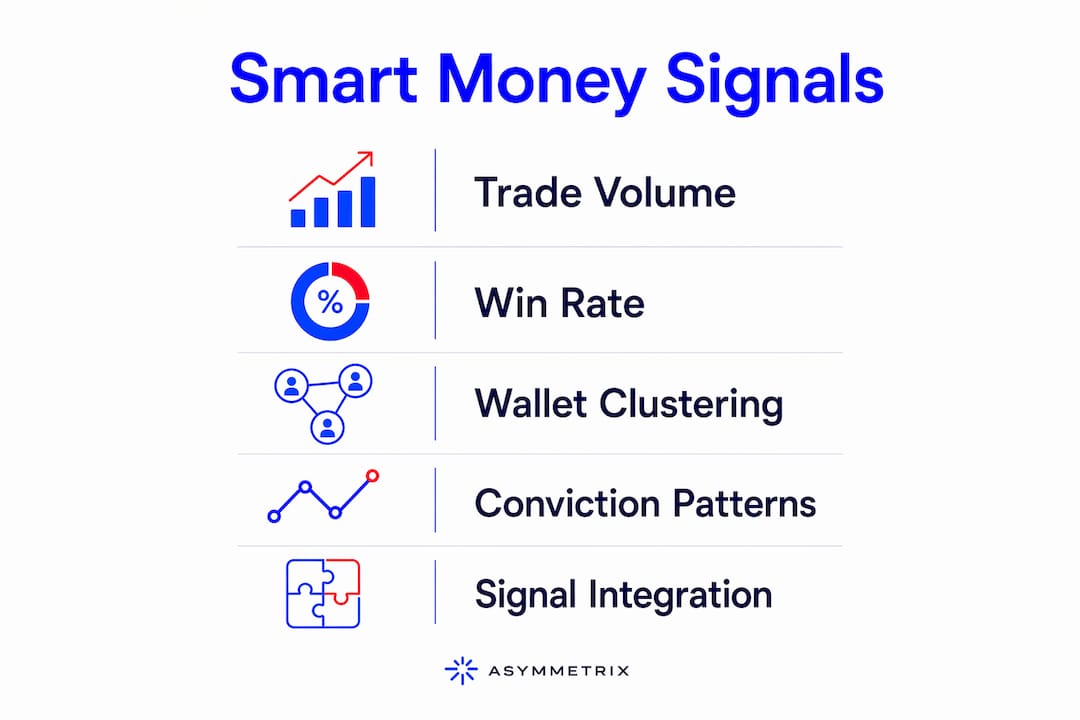
Beyond those baseline filters, specific on-chain patterns reveal conviction. Accumulation via multiple smaller trades over 48 hours suggests a trader building exposure without moving the market. A large limit buy in a low-liquidity market, where execution cost is higher, signals that the trader believes the edge justifies the spread. Timing relative to price movement is the strongest single indicator: entry price relative to resolution price is a more reliable alpha signal than win rate alone.

Wallet clustering adds another layer. Sophisticated traders frequently operate multiple addresses to hedge or obscure total exposure. Tracking a single address gives an incomplete picture. Funding source analysis, tracing which wallets share common deposit origins on Polygon, can map these to a central entity and reveal aggregate positioning that no single address shows.
Wash trading and market-making wallets are the most common false positives. These addresses generate high trade frequency with no sustained directional P&L. Filtering wash trading patterns requires excluding wallets with high-frequency, non-directional activity and near-zero net profit over time.
Metric | Weak signal | Strong signal |
|---|---|---|
Win rate | Below typical chance levels | Above 60% sustained |
Trade count | Fewer than 50 | 100 or more resolved |
Profit factor | — | Above 1.5 |
Track record | Under 1 month | months |
Market diversity | Single category | Multiple categories |
Entry timing | Follows price moves | Precedes price moves |
Integrating off-chain data such as order book depth and market volatility sharpens these signals further. On-chain data alone is a lagging indicator. A wallet entering a market where order book depth has just spiked is behaving differently from one entering a thin, quiet market. That context changes the interpretation of the same position size.
Pro Tip: Apply Bayesian updating to your wallet scoring. A wallet that has performed well across 150 trades should receive more weight than one with identical recent returns but only 30 trades. The Herfindahl-Hirschman Index (HHI) applied to a wallet’s market category distribution also helps quantify specialization versus scatter.
How developers can build a Polymarket wallet tracking system
The foundation of any tracking pipeline is the Polymarket REST API. Three endpoints cover the core data needs:
/positions?user=0x...returns all open positions for a wallet, including market ID, outcome token, and quantity/trades?user=0x...&limit=100returns the 100 most recent trades/profile?user=0x...returns aggregated statistics: total volume, P&L, and win rate
A basic Python script that polls these endpoints every 15–30 minutes for a curated watchlist of 20–30 wallets, then fires an alert when any wallet opens a new position above a threshold size, gives you a functional real-time feed. The Polymarket API endpoints for /positions, /trades, and /profile are the standard starting point for any wallet-level tracking pipeline.
Normalizing wallet histories over time is where most implementations break down. Raw trade data needs to be aggregated into rolling metrics: win rate over the last 90 days, profit factor by market category, average entry price relative to resolution price. Storing these as time-series records rather than point-in-time snapshots lets you detect when a wallet’s edge is decaying, which matters as much as identifying wallets with current edge.
Alert logic should combine multiple conditions rather than triggering on any single signal. A practical framework:
New position opened by a wallet with 100+ resolved trades and positive overall ROI
Position size above $3,000 USDC
Market is at least 14 days from resolution (filters out near-resolution arbitrage noise)
No existing position by this wallet in this market (new entry, not position management)
Wallets meeting all four criteria warrant investigation. The goal is not automated copying. It is generating a research queue: markets where a verified smart money wallet has taken a position, which you then evaluate against your own analysis. That combination, on-chain signal plus independent thesis, produces more consistent results than either source alone. For context on how ineffective trading systems fail, the pattern is almost always over-reliance on a single signal type.
Pro Tip: Build wallet clustering into your pipeline from day one. Query the funding transaction history for each tracked wallet on Polygon and group addresses that share a common deposit source. A single trader operating five wallets looks like five independent signals until you map the funding graph.
How the Assymetrix Data API strengthens wallet identification
Single-platform tracking has a structural blind spot: a wallet that looks directional on Polymarket may be hedging on Kalshi. The Assymetrix Data API at data.assymetrix.com resolves this by providing a normalized feed across Polymarket, Kalshi, and Limitless through a single integration. The dataset spans approximately 1.5 terabytes of historical data covering nearly one billion rows of trading activity.
That scale changes what is possible analytically. Cross-venue wallet analysis lets you see aggregate positioning rather than a single-venue slice. A wallet that appears to be taking a large directional position on Polymarket may simultaneously hold an offsetting position on Kalshi. Without cross-venue data, you are copying what looks like conviction but is actually a hedge.
The Assymetrix Trader Skill Score methodology addresses the skill-versus-luck problem directly. Rather than ranking wallets by raw P&L or win rate, the scoring model evaluates performance across multiple dimensions: timing alpha (entry price relative to resolution price), market category diversity, position sizing consistency, and track record duration. The result is a score that weights sustained cross-venue performance more heavily than any single-platform streak.
For developers, the API provides wallet-level historical data in a standardized schema, which eliminates the normalization work required when pulling from multiple native APIs with different data structures. The unified prediction market schema Assymetrix uses means a single query returns comparable records across venues without custom parsing per platform.
Cross-venue data reveals hedged positions that single-platform analysis misses
Standardized Trader Skill Scores filter false positives more reliably than raw win rate
Historical depth supports longitudinal analysis of wallet performance decay
Normalized schema reduces pipeline complexity for multi-venue tracking
What successful smart money wallet identification looks like in practice
The most instructive patterns in Polymarket wallet tracking are not the obvious ones. A wallet that drops $100,000 on a single market is visible and frequently discussed. The more valuable signal is a wallet that has placed 250 trades across politics, macro, and sports markets over eight months, maintains a win rate above 60%, and consistently enters positions at prices substantially below where markets eventually settle.
That entry price gap is the clearest behavioral signature of genuine informational edge. When a wallet repeatedly buys well below the resolution price on events that resolve at $1.00, the pattern is not luck. It reflects either superior research, faster access to relevant information, or a structured quantitative model that prices events more accurately than the market consensus at the time of entry.
Multiple high-performing wallets independently entering the same market within a 24-hour window is a different category of signal. The probability that three wallets with 100+ trade histories and positive ROI all independently take the same position by coincidence is low. That convergence pattern, detectable by monitoring your watchlist in aggregate rather than wallet by wallet, often precedes significant price moves.
The Polymarket whale tracking methodology recommends a tiered watchlist: a carefully managed core group of rigorously vetted wallets with high win rates and extended track records, plus a secondary monitoring tier of wallets that meet baseline thresholds but have shorter histories. Expanding the watchlist excessively degrades signal-to-noise ratio and leads to alert fatigue.
Position context matters as much as position size. A large buy in a market 30 days from resolution carries different weight than the same buy 48 hours before resolution. Near-resolution positions often reflect arbitrage pricing rather than directional conviction. Filtering by days-to-resolution is one of the most effective ways to isolate genuine informational bets from end-of-market noise.
How to validate the predictive power of identified smart money wallets
Identifying a wallet as smart money is a hypothesis. Validating it requires a structured testing approach applied to historical data before you weight any live signal from that wallet.
The primary validation method is out-of-sample backtesting. Split a wallet’s trade history into a training window (the period you used to identify it as smart money) and a holdout window (subsequent trades not used in selection). If the wallet’s edge persists in the holdout period, the signal is more likely to reflect genuine skill. If performance reverts to the mean, the original identification was probably driven by a lucky streak within the training window.
For wallets with a substantial number of resolved trades, you can apply statistical tests to the win rate to distinguish skill from chance. Fewer trades yield less confidence in the conclusion, motivating a minimum trade count threshold to ensure reliability.
Timing alpha validation works differently. Calculate the average entry price for each resolved trade and compare it to the market price at resolution. A wallet with consistent positive timing alpha (buying below resolution price on winning trades) across diverse market categories is demonstrating a repeatable edge, not a category-specific lucky run. The Yale research on prediction market skill confirms that timing of entry relative to resolution price is a stronger alpha indicator than win rate in isolation.
Reassess tracked wallets monthly. Performance decays. A wallet that demonstrated strong edge in 2024 may have lost it by mid-2026, either because the market has become more efficient in their specialty or because their strategy has changed. Treating wallet quality as static is one of the most common errors in prediction market tracking systems.
Automation strategies for continuous smart money monitoring
A production-grade monitoring system runs continuously, not on demand. The architecture has three layers: data ingestion, signal evaluation, and alert dispatch.
The ingestion layer polls the Polymarket API endpoints on a fixed schedule, typically every 15 minutes for position changes and every 5 minutes for new trades on high-conviction watchlist wallets. Each poll result is written to a time-series store with a timestamp, enabling rolling metric calculations without reprocessing full history on every cycle.
The signal evaluation layer applies your filtering criteria to each new data point. A new position from a watchlist wallet triggers a scoring check: does this wallet currently meet all threshold criteria (trade count, win rate, ROI, days-to-resolution filter)? If yes, the position enters the alert queue. If the wallet’s rolling metrics have decayed below threshold, the alert is suppressed and the wallet is flagged for review.
The alert dispatch layer routes qualified signals to your preferred channel: a Slack webhook, an email, or a direct feed into an execution system. The alert payload should include the wallet address, its current Trader Skill Score or equivalent metric, the market being entered, position size, current market price, and days to resolution. That context lets you evaluate the signal in seconds rather than pulling data manually.
For developers integrating the Assymetrix Data API, the cross-venue data stream means the ingestion layer covers Polymarket, Kalshi, and Limitless simultaneously. A wallet that opens positions on two venues within the same 24-hour window on the same underlying event is a significantly stronger signal than a single-venue entry. That multi-venue convergence detection is only possible with a unified data feed. The prediction market infrastructure layer that makes this kind of cross-venue alerting practical is exactly what separates a research-grade tracking system from a basic leaderboard scraper.
Maintain a curated watchlist rather than monitoring every wallet above a volume threshold. Quality over quantity applies directly here: 20 rigorously vetted wallets produce cleaner signals than 200 wallets filtered only by recent P&L.
Assymetrix gives you the data infrastructure to track smart money at scale
The gap between a basic Polymarket leaderboard and a production-grade smart money tracking system is mostly a data infrastructure problem. Raw API polling from a single venue gives you a partial view. Cross-venue historical depth, normalized schemas, and pre-computed skill scores are what turn that partial view into a reliable signal layer.
Assymetrix is built for exactly this use case. The Assymetrix Data API aggregates wallet-level trading data across Polymarket, Kalshi, and Limitless into a single normalized feed, backed by approximately 1.5 terabytes of historical data and nearly one billion rows of trading activity. Trader Skill Scores are pre-computed using cross-venue performance metrics, so you are not rebuilding that scoring logic from scratch. Smart Money wallet tracking, cross-venue arbitrage signals, and market divergence intelligence are surfaced through the same integration.
For developers building tracking pipelines, the normalized schema eliminates the custom parsing work that comes with pulling from three native APIs with different data structures. For quant traders, the historical depth supports the out-of-sample validation that distinguishes a real edge from a lucky streak. Start with the 2026 prediction market accuracy guide to understand the data methodology, then access the API at data.assymetrix.com to begin building.
FAQ
What defines a smart money wallet on Polymarket?
A smart money wallet demonstrates consistent, skill-based informational edge: positive ROI across 100 or more resolved trades, a win rate above 60% sustained over at least 90 days, and entry prices that consistently precede favorable market moves rather than following them.
How does Polymarket work on the blockchain?
Polymarket operates on the Polygon blockchain, meaning every trade, position, and wallet balance is permanently recorded and publicly queryable. Developers access this data through Polymarket’s REST API endpoints (/positions, /trades, /profile) or directly via Polygonscan transaction history.
What percentage of Polymarket wallets are profitable?
No publicly verified figure covers the full Polymarket wallet population. The practical signal is that wallets meeting the minimum thresholds of 100 resolved trades and a 60%+ win rate represent a small fraction of all active addresses, which is consistent with prediction market research showing that a small number of skilled traders drive the majority of accurate price discovery.
Can I use multiple wallets to track smart money on Polymarket?
Sophisticated traders often operate multiple wallet addresses to hedge or obscure aggregate exposure, so tracking a single address can give a misleading picture. Wallet clustering via funding source analysis on Polygon is the standard method for mapping related addresses to a central entity. The Assymetrix Data API surfaces cross-venue positioning that helps identify when a wallet’s Polymarket position is part of a larger hedged strategy.
Does Polymarket support tracking across multiple prediction market venues?
Polymarket itself is a single-venue platform. Cross-venue tracking, covering Polymarket alongside Kalshi and Limitless, requires a unified data layer. The Assymetrix Data API provides normalized cross-venue wallet data through a single integration, which is the practical solution for developers building multi-venue smart money monitoring systems.
Key Takeaways
Identifying smart money wallets on Polymarket requires cross-venue on-chain data, probabilistic skill scoring, and continuous monitoring, not a one-time leaderboard sort.
Point | Details |
|---|---|
Minimum trade threshold | Require 100 or more resolved trades before classifying any wallet as smart money. |
Win rate benchmark | A win rate above 60% sustained over 90 or more days separates skill from luck. |
Entry timing as alpha signal | Entry price consistently below resolution price is a stronger edge indicator than win rate alone. |
Wallet clustering is required | Sophisticated traders use multiple addresses; funding source analysis on Polygon maps them to a single entity. |
Assymetrix for cross-venue depth | The Assymetrix Data API provides normalized wallet data across Polymarket, Kalshi, and Limitless, enabling multi-venue smart money identification that single-platform tracking cannot replicate. |
Tracking Smart Money Wallets on Polymarket: 2026 Guide
Smart money wallets on Polymarket are identifiable by three converging signals: consistent positive P&L across a statistically meaningful trade count, early position entry before market prices shift, and high resolution accuracy sustained over time rather than concentrated in a single event. Every one of those signals lives on-chain, permanently recorded on the Polygon blockchain and queryable by anyone with the right pipeline.
The core data sources are Polymarket’s REST API endpoints: /positions, /trades, and /profile. These return open positions with outcome token quantities, recent trade history, and aggregated statistics including win rate and total P&L. From those three endpoints alone, you can construct a wallet snapshot sufficient for initial screening. The harder problem is not data access. It is filtering: separating wallets with genuine informational edge from those riding luck, running market-making operations, or obscuring aggregate exposure across multiple addresses.
Consistent P&L across a substantial number of resolved trades, not a single outsized win
Win rate sustained above typical chance levels over a sustained period
Entry timing that precedes market price moves, not follows them
Position sizing that reflects conviction, not noise
Market category diversity that signals analytical breadth
Data-driven filtering on these criteria is the methodology. Everything else is anecdote.
Table of Contents
How to identify smart money wallets on Polymarket using on-chain data
Key on-chain signals that separate skill from noise
How developers can build a Polymarket wallet tracking system
How the Assymetrix Data API strengthens wallet identification
What successful smart money wallet identification looks like in practice
How to validate the predictive power of identified smart money wallets
Automation strategies for continuous smart money monitoring
Assymetrix gives you the data infrastructure to track smart money at scale
Key Takeaways
How to identify smart money wallets on Polymarket using on-chain data
The term “smart money” originates in traditional finance, where it describes capital controlled by institutional investors with superior information access. On Polymarket, the definition shifts. Capital size alone means nothing when a single retail trader with a structured research process can outperform a large wallet running on momentum. Prediction market research shows that markets are driven by a small number of skilled traders whose edge comes from informational advantage, not from deploying more capital.
What distinguishes a smart money wallet on Polymarket is behavioral consistency. These wallets accumulate early, often before any public catalyst shifts market sentiment. They specialize: a wallet that trades geopolitical events with a win rate above 60% over 200 trades is demonstrating domain expertise, not randomness. They also size positions with conviction, taking larger exposure in low-liquidity markets where execution cost is higher and the signal of entry is therefore stronger.
The challenge is that prediction markets are noisy. A wallet with a win rate above 60% over 20 trades is almost certainly lucky. The same win rate over 300 trades across diverse market categories is a different story entirely. Distinguishing the two requires probabilistic thinking, not just a leaderboard sort.
Informational edge, not capital size: a $500 wallet with 200 resolved trades and 63% accuracy outranks a $50,000 wallet with 15 trades
Domain specialization: repeated top-holder positions within one category (macro, politics, sports) suggest expertise
Early accumulation: entry prices consistently below where markets eventually settle
Conviction sizing: larger positions in thin markets, not just liquid ones
Sustained track record: performance measured in months, not days
Key on-chain signals that separate skill from noise
The quantitative thresholds that define a trackable smart money wallet are not arbitrary. Research on whale tracking methodology identifies minimum criteria: 100 resolved trades, positive ROI across the full history, consistent market diversity, and stable position sizing. A wallet with 300 trades at positive ROI across diverse categories carries more signal than one with 20 trades at positive ROI.
Beyond those baseline filters, specific on-chain patterns reveal conviction. Accumulation via multiple smaller trades over 48 hours suggests a trader building exposure without moving the market. A large limit buy in a low-liquidity market, where execution cost is higher, signals that the trader believes the edge justifies the spread. Timing relative to price movement is the strongest single indicator: entry price relative to resolution price is a more reliable alpha signal than win rate alone.
Wallet clustering adds another layer. Sophisticated traders frequently operate multiple addresses to hedge or obscure total exposure. Tracking a single address gives an incomplete picture. Funding source analysis, tracing which wallets share common deposit origins on Polygon, can map these to a central entity and reveal aggregate positioning that no single address shows.
Wash trading and market-making wallets are the most common false positives. These addresses generate high trade frequency with no sustained directional P&L. Filtering wash trading patterns requires excluding wallets with high-frequency, non-directional activity and near-zero net profit over time.
Metric | Weak signal | Strong signal |
|---|---|---|
Win rate | Below typical chance levels | Above 60% sustained |
Trade count | Fewer than 50 | 100 or more resolved |
Profit factor | — | Above 1.5 |
Track record | Under 1 month | months |
Market diversity | Single category | Multiple categories |
Entry timing | Follows price moves | Precedes price moves |
Integrating off-chain data such as order book depth and market volatility sharpens these signals further. On-chain data alone is a lagging indicator. A wallet entering a market where order book depth has just spiked is behaving differently from one entering a thin, quiet market. That context changes the interpretation of the same position size.
Pro Tip: Apply Bayesian updating to your wallet scoring. A wallet that has performed well across 150 trades should receive more weight than one with identical recent returns but only 30 trades. The Herfindahl-Hirschman Index (HHI) applied to a wallet’s market category distribution also helps quantify specialization versus scatter.
How developers can build a Polymarket wallet tracking system
The foundation of any tracking pipeline is the Polymarket REST API. Three endpoints cover the core data needs:
/positions?user=0x...returns all open positions for a wallet, including market ID, outcome token, and quantity/trades?user=0x...&limit=100returns the 100 most recent trades/profile?user=0x...returns aggregated statistics: total volume, P&L, and win rate
A basic Python script that polls these endpoints every 15–30 minutes for a curated watchlist of 20–30 wallets, then fires an alert when any wallet opens a new position above a threshold size, gives you a functional real-time feed. The Polymarket API endpoints for /positions, /trades, and /profile are the standard starting point for any wallet-level tracking pipeline.
Normalizing wallet histories over time is where most implementations break down. Raw trade data needs to be aggregated into rolling metrics: win rate over the last 90 days, profit factor by market category, average entry price relative to resolution price. Storing these as time-series records rather than point-in-time snapshots lets you detect when a wallet’s edge is decaying, which matters as much as identifying wallets with current edge.
Alert logic should combine multiple conditions rather than triggering on any single signal. A practical framework:
New position opened by a wallet with 100+ resolved trades and positive overall ROI
Position size above $3,000 USDC
Market is at least 14 days from resolution (filters out near-resolution arbitrage noise)
No existing position by this wallet in this market (new entry, not position management)
Wallets meeting all four criteria warrant investigation. The goal is not automated copying. It is generating a research queue: markets where a verified smart money wallet has taken a position, which you then evaluate against your own analysis. That combination, on-chain signal plus independent thesis, produces more consistent results than either source alone. For context on how ineffective trading systems fail, the pattern is almost always over-reliance on a single signal type.
Pro Tip: Build wallet clustering into your pipeline from day one. Query the funding transaction history for each tracked wallet on Polygon and group addresses that share a common deposit source. A single trader operating five wallets looks like five independent signals until you map the funding graph.
How the Assymetrix Data API strengthens wallet identification
Single-platform tracking has a structural blind spot: a wallet that looks directional on Polymarket may be hedging on Kalshi. The Assymetrix Data API at data.assymetrix.com resolves this by providing a normalized feed across Polymarket, Kalshi, and Limitless through a single integration. The dataset spans approximately 1.5 terabytes of historical data covering nearly one billion rows of trading activity.
That scale changes what is possible analytically. Cross-venue wallet analysis lets you see aggregate positioning rather than a single-venue slice. A wallet that appears to be taking a large directional position on Polymarket may simultaneously hold an offsetting position on Kalshi. Without cross-venue data, you are copying what looks like conviction but is actually a hedge.
The Assymetrix Trader Skill Score methodology addresses the skill-versus-luck problem directly. Rather than ranking wallets by raw P&L or win rate, the scoring model evaluates performance across multiple dimensions: timing alpha (entry price relative to resolution price), market category diversity, position sizing consistency, and track record duration. The result is a score that weights sustained cross-venue performance more heavily than any single-platform streak.
For developers, the API provides wallet-level historical data in a standardized schema, which eliminates the normalization work required when pulling from multiple native APIs with different data structures. The unified prediction market schema Assymetrix uses means a single query returns comparable records across venues without custom parsing per platform.
Cross-venue data reveals hedged positions that single-platform analysis misses
Standardized Trader Skill Scores filter false positives more reliably than raw win rate
Historical depth supports longitudinal analysis of wallet performance decay
Normalized schema reduces pipeline complexity for multi-venue tracking
What successful smart money wallet identification looks like in practice
The most instructive patterns in Polymarket wallet tracking are not the obvious ones. A wallet that drops $100,000 on a single market is visible and frequently discussed. The more valuable signal is a wallet that has placed 250 trades across politics, macro, and sports markets over eight months, maintains a win rate above 60%, and consistently enters positions at prices substantially below where markets eventually settle.
That entry price gap is the clearest behavioral signature of genuine informational edge. When a wallet repeatedly buys well below the resolution price on events that resolve at $1.00, the pattern is not luck. It reflects either superior research, faster access to relevant information, or a structured quantitative model that prices events more accurately than the market consensus at the time of entry.
Multiple high-performing wallets independently entering the same market within a 24-hour window is a different category of signal. The probability that three wallets with 100+ trade histories and positive ROI all independently take the same position by coincidence is low. That convergence pattern, detectable by monitoring your watchlist in aggregate rather than wallet by wallet, often precedes significant price moves.
The Polymarket whale tracking methodology recommends a tiered watchlist: a carefully managed core group of rigorously vetted wallets with high win rates and extended track records, plus a secondary monitoring tier of wallets that meet baseline thresholds but have shorter histories. Expanding the watchlist excessively degrades signal-to-noise ratio and leads to alert fatigue.
Position context matters as much as position size. A large buy in a market 30 days from resolution carries different weight than the same buy 48 hours before resolution. Near-resolution positions often reflect arbitrage pricing rather than directional conviction. Filtering by days-to-resolution is one of the most effective ways to isolate genuine informational bets from end-of-market noise.
How to validate the predictive power of identified smart money wallets
Identifying a wallet as smart money is a hypothesis. Validating it requires a structured testing approach applied to historical data before you weight any live signal from that wallet.
The primary validation method is out-of-sample backtesting. Split a wallet’s trade history into a training window (the period you used to identify it as smart money) and a holdout window (subsequent trades not used in selection). If the wallet’s edge persists in the holdout period, the signal is more likely to reflect genuine skill. If performance reverts to the mean, the original identification was probably driven by a lucky streak within the training window.
For wallets with a substantial number of resolved trades, you can apply statistical tests to the win rate to distinguish skill from chance. Fewer trades yield less confidence in the conclusion, motivating a minimum trade count threshold to ensure reliability.
Timing alpha validation works differently. Calculate the average entry price for each resolved trade and compare it to the market price at resolution. A wallet with consistent positive timing alpha (buying below resolution price on winning trades) across diverse market categories is demonstrating a repeatable edge, not a category-specific lucky run. The Yale research on prediction market skill confirms that timing of entry relative to resolution price is a stronger alpha indicator than win rate in isolation.
Reassess tracked wallets monthly. Performance decays. A wallet that demonstrated strong edge in 2024 may have lost it by mid-2026, either because the market has become more efficient in their specialty or because their strategy has changed. Treating wallet quality as static is one of the most common errors in prediction market tracking systems.
Automation strategies for continuous smart money monitoring
A production-grade monitoring system runs continuously, not on demand. The architecture has three layers: data ingestion, signal evaluation, and alert dispatch.
The ingestion layer polls the Polymarket API endpoints on a fixed schedule, typically every 15 minutes for position changes and every 5 minutes for new trades on high-conviction watchlist wallets. Each poll result is written to a time-series store with a timestamp, enabling rolling metric calculations without reprocessing full history on every cycle.
The signal evaluation layer applies your filtering criteria to each new data point. A new position from a watchlist wallet triggers a scoring check: does this wallet currently meet all threshold criteria (trade count, win rate, ROI, days-to-resolution filter)? If yes, the position enters the alert queue. If the wallet’s rolling metrics have decayed below threshold, the alert is suppressed and the wallet is flagged for review.
The alert dispatch layer routes qualified signals to your preferred channel: a Slack webhook, an email, or a direct feed into an execution system. The alert payload should include the wallet address, its current Trader Skill Score or equivalent metric, the market being entered, position size, current market price, and days to resolution. That context lets you evaluate the signal in seconds rather than pulling data manually.
For developers integrating the Assymetrix Data API, the cross-venue data stream means the ingestion layer covers Polymarket, Kalshi, and Limitless simultaneously. A wallet that opens positions on two venues within the same 24-hour window on the same underlying event is a significantly stronger signal than a single-venue entry. That multi-venue convergence detection is only possible with a unified data feed. The prediction market infrastructure layer that makes this kind of cross-venue alerting practical is exactly what separates a research-grade tracking system from a basic leaderboard scraper.
Maintain a curated watchlist rather than monitoring every wallet above a volume threshold. Quality over quantity applies directly here: 20 rigorously vetted wallets produce cleaner signals than 200 wallets filtered only by recent P&L.
Assymetrix gives you the data infrastructure to track smart money at scale
The gap between a basic Polymarket leaderboard and a production-grade smart money tracking system is mostly a data infrastructure problem. Raw API polling from a single venue gives you a partial view. Cross-venue historical depth, normalized schemas, and pre-computed skill scores are what turn that partial view into a reliable signal layer.
Assymetrix is built for exactly this use case. The Assymetrix Data API aggregates wallet-level trading data across Polymarket, Kalshi, and Limitless into a single normalized feed, backed by approximately 1.5 terabytes of historical data and nearly one billion rows of trading activity. Trader Skill Scores are pre-computed using cross-venue performance metrics, so you are not rebuilding that scoring logic from scratch. Smart Money wallet tracking, cross-venue arbitrage signals, and market divergence intelligence are surfaced through the same integration.
For developers building tracking pipelines, the normalized schema eliminates the custom parsing work that comes with pulling from three native APIs with different data structures. For quant traders, the historical depth supports the out-of-sample validation that distinguishes a real edge from a lucky streak. Start with the 2026 prediction market accuracy guide to understand the data methodology, then access the API at data.assymetrix.com to begin building.
FAQ
What defines a smart money wallet on Polymarket?
A smart money wallet demonstrates consistent, skill-based informational edge: positive ROI across 100 or more resolved trades, a win rate above 60% sustained over at least 90 days, and entry prices that consistently precede favorable market moves rather than following them.
How does Polymarket work on the blockchain?
Polymarket operates on the Polygon blockchain, meaning every trade, position, and wallet balance is permanently recorded and publicly queryable. Developers access this data through Polymarket’s REST API endpoints (/positions, /trades, /profile) or directly via Polygonscan transaction history.
What percentage of Polymarket wallets are profitable?
No publicly verified figure covers the full Polymarket wallet population. The practical signal is that wallets meeting the minimum thresholds of 100 resolved trades and a 60%+ win rate represent a small fraction of all active addresses, which is consistent with prediction market research showing that a small number of skilled traders drive the majority of accurate price discovery.
Can I use multiple wallets to track smart money on Polymarket?
Sophisticated traders often operate multiple wallet addresses to hedge or obscure aggregate exposure, so tracking a single address can give a misleading picture. Wallet clustering via funding source analysis on Polygon is the standard method for mapping related addresses to a central entity. The Assymetrix Data API surfaces cross-venue positioning that helps identify when a wallet’s Polymarket position is part of a larger hedged strategy.
Does Polymarket support tracking across multiple prediction market venues?
Polymarket itself is a single-venue platform. Cross-venue tracking, covering Polymarket alongside Kalshi and Limitless, requires a unified data layer. The Assymetrix Data API provides normalized cross-venue wallet data through a single integration, which is the practical solution for developers building multi-venue smart money monitoring systems.
Key Takeaways
Identifying smart money wallets on Polymarket requires cross-venue on-chain data, probabilistic skill scoring, and continuous monitoring, not a one-time leaderboard sort.
Point | Details |
|---|---|
Minimum trade threshold | Require 100 or more resolved trades before classifying any wallet as smart money. |
Win rate benchmark | A win rate above 60% sustained over 90 or more days separates skill from luck. |
Entry timing as alpha signal | Entry price consistently below resolution price is a stronger edge indicator than win rate alone. |
Wallet clustering is required | Sophisticated traders use multiple addresses; funding source analysis on Polygon maps them to a single entity. |
Assymetrix for cross-venue depth | The Assymetrix Data API provides normalized wallet data across Polymarket, Kalshi, and Limitless, enabling multi-venue smart money identification that single-platform tracking cannot replicate. |
Other Blog


