The 8 Data Quality Checks Every Prediction Market Pipeline Needs
The 8 Data Quality Checks Every Prediction Market Pipeline Needs
The 8 Data Quality Checks Every Prediction Market Pipeline Needs
Discover essential data quality checks for your prediction market pipeline. Ensure accuracy and reliability at every stage of data ingestion.

The 8 Data Quality Checks Every Prediction Market Pipeline Needs
Run these gate checks on every incoming snapshot or event before anything downstream touches it: schema validation against a known contract registry, complement coherence (yes price plus no price approximately 1.0), timestamp normalization with monotonicity enforcement, uniqueness on transaction hash plus log index, completeness and freshness against expected snapshot cadence, and orderbook depth sanity across the top levels.
Some of these should halt ingestion outright. Block on: missing or mismatched schema, duplicate key violations, and gross price values outside 0 to 1. Alert but don’t block on: small coherence drift, minor latency spikes, or a single missed snapshot inside an otherwise healthy stream. A source like the Assymetrix Data API applies exactly this split, treating structural violations as hard failures and drift-type anomalies as monitored signals.
Schema validation against a versioned contract/ABI registry
Complement coherence: yes_price + no_price ≈ 1.0
Timestamp normalization to UTC with monotonic ordering
Uniqueness enforcement on (tx_hash, log_index)
Completeness and freshness against expected update frequency
Orderbook depth and top-of-book sanity checks
Key Takeaways
Data quality in prediction market pipelines depends on codeable gate checks, bridge-layer resolution, and stream-versus-batch reconciliation working together, not any single validator.
Point | Details |
|---|---|
Block on structural failures | Halt ingestion for missing schema, duplicate keys, and gross price values outside 0 to 1. |
Alert on drift, don’t block | Treat small coherence drift and minor latency spikes as monitored signals, not ingestion stoppers. |
Bridge-layer resolution is essential | Multi-path linking raises oracle-to-market coverage from roughly 73% to over 99%, per published research. |
Backfill gaps, don’t reingest everything | Targeted on-chain recovery repairs blackout gaps at a manageable, if higher, runtime cost. |
Assymetrix normalizes across venues | The Data API applies canonical schema, bridge-layer resolution, and targeted backfill across Polymarket, Kalshi, and Limitless. |
Table of Contents
What Causes Data Quality Failures in Prediction Market Feeds?
What Checks and Thresholds Should You Implement First?
How Should Pipeline Architecture Support Data Quality?
How Assymetrix Handles Data Quality at the Infrastructure Level
How Do You Monitor Data Quality in Production?
What Most Teams Get Wrong About Prediction Market Data Quality
Get Cross-Venue Prediction Market Data Without Building the Reconciliation Layer Yourself
Sources
What Causes Data Quality Failures in Prediction Market Feeds?
Every failure mode traces back to a specific, identifiable cause, which is good news for anyone trying to build a triage runbook instead of chasing ghosts.
Schema and ABI drift. When Polymarket migrated its order-matching contract, indexers still filtering by the old topic hash returned zero logs for v2 trades, not an error, just silence. Teams that only fetch v1 contracts miss v2 volume entirely because the event ABI and topic hash changed, and nothing in the pipeline complains.
Missing resolution and oracle linking gaps. Without a reliable bridge between oracle events and canonical market IDs, you cannot calibrate anything, because you never learn which side actually won.
Duplicate or out-of-order events. Chain reorgs and naive retry logic both produce repeated writes unless uniqueness constraints exist at the storage layer.
Timestamp mismatches. Block timestamps and wallclock ingestion timestamps diverge, and timezone normalization bugs silently reorder candles.
Ingestion blackouts. Raw ingestion gaps distort volume and produce gap-filled candles that look real but aren’t.
Cross-venue incoherence. When Kalshi and Polymarket prices on comparable contracts diverge past a sane threshold, it flags either a pipeline defect or a genuine market dislocation worth investigating.
One dataset audit found a DuckDB scan reporting roughly 21% of blocks missing in 2024 for a single ingestion source, over 3 million blocks absent in one year alone. That’s not a rounding error. That’s a pipeline that was quietly lying about volume for months.
What Checks and Thresholds Should You Implement First?
Completeness is the easiest check to automate and the one teams skip most. Define expected snapshots per minute per market, scan for missing ranges, and trigger backfill automatically the moment a gap exceeds your tolerance window.
Coherence checks come next. Yes price plus no price should land near 1.0, and a workable tolerance band is 0.005 to 0.02 depending on market liquidity. Pair it with a spread sanity ceiling, something like a max spread of 0.20, past which you flag the quote as suspect rather than trust it blindly.
Schema validation needs a real registry, not a hardcoded assumption. Maintain a mapping of contract ABIs by venue and version, and route anything that fails to match to a dead-letter queue instead of silently dropping it or, worse, misparsing it.
Deduplication is non-negotiable at the storage layer: enforce unique(tx_hash, log_index) and make writes idempotent, so a retried ingestion job can never double-count a fill.
Pro Tip: Prefer block timestamp over wallclock arrival time as your canonical clock, but keep a local ingestion timestamp cache alongside it. When the two diverge past a few seconds, that gap itself becomes a useful lag signal, not just metadata you throw away.
For orderbooks, reconstruct partial fills against top-N depth totals to validate reported volume instead of trusting a single trade print. Cross-venue checks benefit from a rolling z-score on price divergence between comparable markets, combined with volume correlation over the same window, since coherence-based surveillance patterns treat that divergence as both a manipulation signal and a data-quality signal simultaneously.
Resolution validation closes the loop: map oracle events to canonical market IDs, then run a Brier-score calibration pass once markets settle. A full oracle corpus, when properly bridged, can reach 99.4% linkage versus roughly 73% without that bridging layer, and that gap is the difference between a calibration score you can trust and one built on a quarter of missing ground truth.
How Should Pipeline Architecture Support Data Quality?
Reliable quality checks aren’t bolted on after ingestion. They’re a property of how the pipeline is built, and a few architectural decisions do most of the work.
Run detection on two paths: a fast stream path that flags anomalies in near real time, and a slower batch reconciliation pass that re-derives the same metrics from settled, authoritative data. When the two disagree, log it as a distinct rec_stream_vs_batch signal rather than silently overwriting one with the other. That disagreement rate is itself a health metric worth tracking over time.
A canonical market model matters more than most teams initially budget for. Metadata, fills, and oracle events need a shared lifecycle table they can all join against cleanly, or every downstream query becomes a bespoke reconciliation exercise.
Bridge-layer entity resolution is not an optional polish step. Without multiple linking paths between on-chain events and canonical market records, resolution and oracle data stay orphaned, and every calibration number built on top of that gap inherits its blind spots.
Targeted backfill instead of full reingestion: one arXiv replay recovered 100% of a 64-token sample versus 18.75% with API-only discovery, at a runtime cost that jumped from about 1 second to roughly 71 seconds.
A versioned contract and topic registry to catch ABI changes before they cause silent data loss.
Partitioning by market-day with incremental materialized views, so historical queries don’t force a full-table rescan every time.
The runtime tradeoff is real. Full on-chain recovery is slow, but for backtests and calibration work where completeness outweighs latency, it’s the right trade almost every time.
How Assymetrix Handles Data Quality at the Infrastructure Level
Assymetrix normalizes trading, orderbook, and resolution data from Polymarket, Kalshi, and Limitless into one canonical market schema, so a query against Assymetrix returns fields structured identically regardless of which venue produced the underlying event.
Retry-based ingestion with targeted backfill repairs blackout gaps without forcing a full historical reingestion every time a venue has an outage.
The backtesting dataset behind the platform spans approximately 1.5 terabytes and nearly one billion rows of historical trading activity, giving quant researchers enough depth to calibrate models against multiple market cycles rather than a single quarter. Developers can integrate through the Python API guide or streaming documentation, and both cover the schema normalization layer directly.
Canonical schema across all three venues, normalized at ingestion rather than at query time
Bridge-layer resolution linking oracle events to canonical market IDs across multiple paths
Retry and backfill mechanisms scoped to detected gaps, not blanket reingestion
Smart Money wallet tracking and Trader Skill Scores, which double as QA telemetry since abrupt behavior shifts often flag upstream data problems before a formal alert fires
Pro Tip: If your bot logic depends on cross-venue arbitrage signals, check the resolution linkage rate for each venue before you trust a divergence signal. A price gap caused by a broken oracle link looks identical to a real arbitrage opportunity until you check the plumbing.
How Do You Monitor Data Quality in Production?
Track five numbers continuously: p50/p95/p99 API latency, fetch error rate, completeness ratio against expected snapshot count, the stream-versus-batch disagreement rate, and resolution linkage percentage.
Define HEALTHY, DEGRADED, and UNHEALTHY thresholds for each metric and wire automated responses to each state, muting downstream consumers when a feed goes UNHEALTHY rather than letting bad data propagate.
Write unit tests for every validator function in isolation, then run replay-window integration tests against known historical periods with documented gaps.
Use ablation-style replay, disabling bridge-layer linking temporarily, to verify how much coverage that layer actually contributes.
On incident: triage the failure category, run a targeted backfill, re-run bridge linking, and notify downstream clients before escalating to manual reconciliation.
Schedule nightly replay jobs for historical repair and a daily reconciliation report comparing stream and batch outputs.
Pro Tip: Automated anomaly detection reduces alert fatigue more than any threshold tuning, and the SRE literature on anomaly detection applies directly here: fewer, higher-confidence alerts beat a flood of low-signal ones your team learns to ignore.
What Most Teams Get Wrong About Prediction Market Data Quality
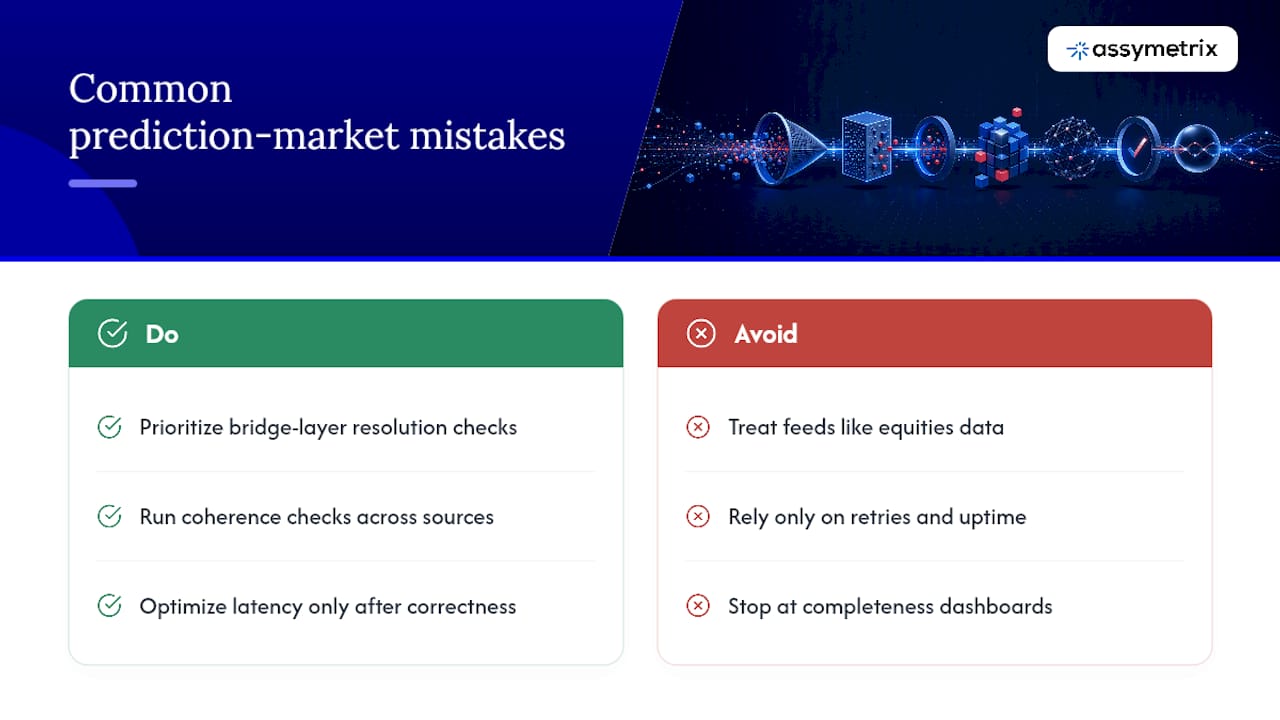
The instinct to treat prediction market feeds like equities data with an extra decoding step is where most pipelines fail. Traditional market data validation assumes a stable schema and a single source of settlement truth. Prediction markets give you neither: contract ABIs change under you, and resolution truth lives in an oracle layer that’s structurally separate from the trading venue.
The conventional advice, “add retries and monitor uptime,” misses the actual failure surface. Retries don’t fix a topic-hash mismatch from a v2 contract migration. Uptime monitoring doesn’t catch a coherence drift that’s technically online but quietly wrong. The teams that get burned are the ones who built completeness dashboards and called it a day, then discovered months later that a quarter of their oracle events were orphaned the whole time.
Prioritize bridge-layer resolution and coherence checks before you optimize latency. A fast pipeline feeding a bot bad calibration data is worse than a slightly slower one feeding it the truth. Speed matters only after correctness is settled, not before.
Get Cross-Venue Prediction Market Data Without Building the Reconciliation Layer Yourself
Building the checks in this article from scratch, schema registries, bridge-layer resolution, backfill orchestration, takes real engineering time before you write a single trading signal. Assymetrix runs that layer for you, delivering normalized, cross-venue real-time and historical data across Polymarket, Kalshi, and Limitless with reconciliation and backfill already built in.
The Data API ships with a Python integration guide and WebSocket streaming docs so you can start pulling normalized fills and resolution data in an afternoon, not a quarter. If you want to verify the completeness claims yourself, the backtesting dataset writeup documents the provenance behind roughly 1.5 terabytes and nearly a billion rows of historical trading activity. Start with the API guide, pull a sample of resolved markets, and check the linkage rate against your own calibration numbers before committing to a production integration.
Sources
FAQ
What is the most important data quality check for prediction markets?
Bridge-layer entity resolution between oracle events and canonical market IDs matters most, since without it resolution data stays orphaned and calibration scores lose their ground truth.
Should coherence checks block ingestion or just alert?
Coherence checks should generally alert rather than block, since small drift in yes price plus no price is common and only becomes a blocking issue when it exceeds a wide tolerance band, such as beyond 0.02.
How do you detect schema drift between venue API versions?
Maintain a versioned contract and topic registry, and route any event with an unrecognized ABI or topic hash to a dead-letter queue instead of silently dropping it.
What causes gap-filled candles in prediction market data?
Raw ingestion blackouts, missing blocks during outages or reorgs, force downstream systems to interpolate volume and price data, producing candles that look continuous but aren’t accurate.
Does the Assymetrix Data API handle cross-venue reconciliation automatically?
Yes, the Assymetrix Data API normalizes trading and resolution data across Polymarket, Kalshi, and Limitless into one canonical schema with built-in bridge-layer resolution and backfill.
The 8 Data Quality Checks Every Prediction Market Pipeline Needs
Run these gate checks on every incoming snapshot or event before anything downstream touches it: schema validation against a known contract registry, complement coherence (yes price plus no price approximately 1.0), timestamp normalization with monotonicity enforcement, uniqueness on transaction hash plus log index, completeness and freshness against expected snapshot cadence, and orderbook depth sanity across the top levels.
Some of these should halt ingestion outright. Block on: missing or mismatched schema, duplicate key violations, and gross price values outside 0 to 1. Alert but don’t block on: small coherence drift, minor latency spikes, or a single missed snapshot inside an otherwise healthy stream. A source like the Assymetrix Data API applies exactly this split, treating structural violations as hard failures and drift-type anomalies as monitored signals.
Schema validation against a versioned contract/ABI registry
Complement coherence: yes_price + no_price ≈ 1.0
Timestamp normalization to UTC with monotonic ordering
Uniqueness enforcement on (tx_hash, log_index)
Completeness and freshness against expected update frequency
Orderbook depth and top-of-book sanity checks
Key Takeaways
Data quality in prediction market pipelines depends on codeable gate checks, bridge-layer resolution, and stream-versus-batch reconciliation working together, not any single validator.
Point | Details |
|---|---|
Block on structural failures | Halt ingestion for missing schema, duplicate keys, and gross price values outside 0 to 1. |
Alert on drift, don’t block | Treat small coherence drift and minor latency spikes as monitored signals, not ingestion stoppers. |
Bridge-layer resolution is essential | Multi-path linking raises oracle-to-market coverage from roughly 73% to over 99%, per published research. |
Backfill gaps, don’t reingest everything | Targeted on-chain recovery repairs blackout gaps at a manageable, if higher, runtime cost. |
Assymetrix normalizes across venues | The Data API applies canonical schema, bridge-layer resolution, and targeted backfill across Polymarket, Kalshi, and Limitless. |
Table of Contents
What Causes Data Quality Failures in Prediction Market Feeds?
What Checks and Thresholds Should You Implement First?
How Should Pipeline Architecture Support Data Quality?
How Assymetrix Handles Data Quality at the Infrastructure Level
How Do You Monitor Data Quality in Production?
What Most Teams Get Wrong About Prediction Market Data Quality
Get Cross-Venue Prediction Market Data Without Building the Reconciliation Layer Yourself
Sources
What Causes Data Quality Failures in Prediction Market Feeds?
Every failure mode traces back to a specific, identifiable cause, which is good news for anyone trying to build a triage runbook instead of chasing ghosts.
Schema and ABI drift. When Polymarket migrated its order-matching contract, indexers still filtering by the old topic hash returned zero logs for v2 trades, not an error, just silence. Teams that only fetch v1 contracts miss v2 volume entirely because the event ABI and topic hash changed, and nothing in the pipeline complains.
Missing resolution and oracle linking gaps. Without a reliable bridge between oracle events and canonical market IDs, you cannot calibrate anything, because you never learn which side actually won.
Duplicate or out-of-order events. Chain reorgs and naive retry logic both produce repeated writes unless uniqueness constraints exist at the storage layer.
Timestamp mismatches. Block timestamps and wallclock ingestion timestamps diverge, and timezone normalization bugs silently reorder candles.
Ingestion blackouts. Raw ingestion gaps distort volume and produce gap-filled candles that look real but aren’t.
Cross-venue incoherence. When Kalshi and Polymarket prices on comparable contracts diverge past a sane threshold, it flags either a pipeline defect or a genuine market dislocation worth investigating.
One dataset audit found a DuckDB scan reporting roughly 21% of blocks missing in 2024 for a single ingestion source, over 3 million blocks absent in one year alone. That’s not a rounding error. That’s a pipeline that was quietly lying about volume for months.
What Checks and Thresholds Should You Implement First?
Completeness is the easiest check to automate and the one teams skip most. Define expected snapshots per minute per market, scan for missing ranges, and trigger backfill automatically the moment a gap exceeds your tolerance window.
Coherence checks come next. Yes price plus no price should land near 1.0, and a workable tolerance band is 0.005 to 0.02 depending on market liquidity. Pair it with a spread sanity ceiling, something like a max spread of 0.20, past which you flag the quote as suspect rather than trust it blindly.
Schema validation needs a real registry, not a hardcoded assumption. Maintain a mapping of contract ABIs by venue and version, and route anything that fails to match to a dead-letter queue instead of silently dropping it or, worse, misparsing it.
Deduplication is non-negotiable at the storage layer: enforce unique(tx_hash, log_index) and make writes idempotent, so a retried ingestion job can never double-count a fill.
Pro Tip: Prefer block timestamp over wallclock arrival time as your canonical clock, but keep a local ingestion timestamp cache alongside it. When the two diverge past a few seconds, that gap itself becomes a useful lag signal, not just metadata you throw away.
For orderbooks, reconstruct partial fills against top-N depth totals to validate reported volume instead of trusting a single trade print. Cross-venue checks benefit from a rolling z-score on price divergence between comparable markets, combined with volume correlation over the same window, since coherence-based surveillance patterns treat that divergence as both a manipulation signal and a data-quality signal simultaneously.
Resolution validation closes the loop: map oracle events to canonical market IDs, then run a Brier-score calibration pass once markets settle. A full oracle corpus, when properly bridged, can reach 99.4% linkage versus roughly 73% without that bridging layer, and that gap is the difference between a calibration score you can trust and one built on a quarter of missing ground truth.
How Should Pipeline Architecture Support Data Quality?
Reliable quality checks aren’t bolted on after ingestion. They’re a property of how the pipeline is built, and a few architectural decisions do most of the work.
Run detection on two paths: a fast stream path that flags anomalies in near real time, and a slower batch reconciliation pass that re-derives the same metrics from settled, authoritative data. When the two disagree, log it as a distinct rec_stream_vs_batch signal rather than silently overwriting one with the other. That disagreement rate is itself a health metric worth tracking over time.
A canonical market model matters more than most teams initially budget for. Metadata, fills, and oracle events need a shared lifecycle table they can all join against cleanly, or every downstream query becomes a bespoke reconciliation exercise.
Bridge-layer entity resolution is not an optional polish step. Without multiple linking paths between on-chain events and canonical market records, resolution and oracle data stay orphaned, and every calibration number built on top of that gap inherits its blind spots.
Targeted backfill instead of full reingestion: one arXiv replay recovered 100% of a 64-token sample versus 18.75% with API-only discovery, at a runtime cost that jumped from about 1 second to roughly 71 seconds.
A versioned contract and topic registry to catch ABI changes before they cause silent data loss.
Partitioning by market-day with incremental materialized views, so historical queries don’t force a full-table rescan every time.
The runtime tradeoff is real. Full on-chain recovery is slow, but for backtests and calibration work where completeness outweighs latency, it’s the right trade almost every time.
How Assymetrix Handles Data Quality at the Infrastructure Level
Assymetrix normalizes trading, orderbook, and resolution data from Polymarket, Kalshi, and Limitless into one canonical market schema, so a query against Assymetrix returns fields structured identically regardless of which venue produced the underlying event.
Retry-based ingestion with targeted backfill repairs blackout gaps without forcing a full historical reingestion every time a venue has an outage.
The backtesting dataset behind the platform spans approximately 1.5 terabytes and nearly one billion rows of historical trading activity, giving quant researchers enough depth to calibrate models against multiple market cycles rather than a single quarter. Developers can integrate through the Python API guide or streaming documentation, and both cover the schema normalization layer directly.
Canonical schema across all three venues, normalized at ingestion rather than at query time
Bridge-layer resolution linking oracle events to canonical market IDs across multiple paths
Retry and backfill mechanisms scoped to detected gaps, not blanket reingestion
Smart Money wallet tracking and Trader Skill Scores, which double as QA telemetry since abrupt behavior shifts often flag upstream data problems before a formal alert fires
Pro Tip: If your bot logic depends on cross-venue arbitrage signals, check the resolution linkage rate for each venue before you trust a divergence signal. A price gap caused by a broken oracle link looks identical to a real arbitrage opportunity until you check the plumbing.
How Do You Monitor Data Quality in Production?
Track five numbers continuously: p50/p95/p99 API latency, fetch error rate, completeness ratio against expected snapshot count, the stream-versus-batch disagreement rate, and resolution linkage percentage.
Define HEALTHY, DEGRADED, and UNHEALTHY thresholds for each metric and wire automated responses to each state, muting downstream consumers when a feed goes UNHEALTHY rather than letting bad data propagate.
Write unit tests for every validator function in isolation, then run replay-window integration tests against known historical periods with documented gaps.
Use ablation-style replay, disabling bridge-layer linking temporarily, to verify how much coverage that layer actually contributes.
On incident: triage the failure category, run a targeted backfill, re-run bridge linking, and notify downstream clients before escalating to manual reconciliation.
Schedule nightly replay jobs for historical repair and a daily reconciliation report comparing stream and batch outputs.
Pro Tip: Automated anomaly detection reduces alert fatigue more than any threshold tuning, and the SRE literature on anomaly detection applies directly here: fewer, higher-confidence alerts beat a flood of low-signal ones your team learns to ignore.
What Most Teams Get Wrong About Prediction Market Data Quality
The instinct to treat prediction market feeds like equities data with an extra decoding step is where most pipelines fail. Traditional market data validation assumes a stable schema and a single source of settlement truth. Prediction markets give you neither: contract ABIs change under you, and resolution truth lives in an oracle layer that’s structurally separate from the trading venue.
The conventional advice, “add retries and monitor uptime,” misses the actual failure surface. Retries don’t fix a topic-hash mismatch from a v2 contract migration. Uptime monitoring doesn’t catch a coherence drift that’s technically online but quietly wrong. The teams that get burned are the ones who built completeness dashboards and called it a day, then discovered months later that a quarter of their oracle events were orphaned the whole time.
Prioritize bridge-layer resolution and coherence checks before you optimize latency. A fast pipeline feeding a bot bad calibration data is worse than a slightly slower one feeding it the truth. Speed matters only after correctness is settled, not before.
Get Cross-Venue Prediction Market Data Without Building the Reconciliation Layer Yourself
Building the checks in this article from scratch, schema registries, bridge-layer resolution, backfill orchestration, takes real engineering time before you write a single trading signal. Assymetrix runs that layer for you, delivering normalized, cross-venue real-time and historical data across Polymarket, Kalshi, and Limitless with reconciliation and backfill already built in.
The Data API ships with a Python integration guide and WebSocket streaming docs so you can start pulling normalized fills and resolution data in an afternoon, not a quarter. If you want to verify the completeness claims yourself, the backtesting dataset writeup documents the provenance behind roughly 1.5 terabytes and nearly a billion rows of historical trading activity. Start with the API guide, pull a sample of resolved markets, and check the linkage rate against your own calibration numbers before committing to a production integration.
Sources
FAQ
What is the most important data quality check for prediction markets?
Bridge-layer entity resolution between oracle events and canonical market IDs matters most, since without it resolution data stays orphaned and calibration scores lose their ground truth.
Should coherence checks block ingestion or just alert?
Coherence checks should generally alert rather than block, since small drift in yes price plus no price is common and only becomes a blocking issue when it exceeds a wide tolerance band, such as beyond 0.02.
How do you detect schema drift between venue API versions?
Maintain a versioned contract and topic registry, and route any event with an unrecognized ABI or topic hash to a dead-letter queue instead of silently dropping it.
What causes gap-filled candles in prediction market data?
Raw ingestion blackouts, missing blocks during outages or reorgs, force downstream systems to interpolate volume and price data, producing candles that look continuous but aren’t accurate.
Does the Assymetrix Data API handle cross-venue reconciliation automatically?
Yes, the Assymetrix Data API normalizes trading and resolution data across Polymarket, Kalshi, and Limitless into one canonical schema with built-in bridge-layer resolution and backfill.
Other Blog


