Save Months Integrating CFTC Prediction Market Rules for Developers
Save Months Integrating CFTC Prediction Market Rules for Developers
Save Months Integrating CFTC Prediction Market Rules for Developers
Developer playbook on how CFTC oversight shapes US prediction market APIs, schema, and integrations. Covers canonical IDs, Smart Money, and a 1.5TB backfill.

Save Months Integrating CFTC Prediction Market Rules for Developers
This article covers platform-level trading and data-access rules for building on US prediction market venues, not federal rulemaking. For developers, that means four things matter immediately: authentication and rate-limit design, consistent market and outcome IDs across venues, order lifecycle and settlement timing, and where to source normalized historical data. Assymetrix aggregates cross-venue data with a canonical schema and deep backfill, which solves the normalization problem most integration projects hit first.
TL;DR:
Cross-venue normalization of market and outcome IDs simplifies data integration and error reduction, especially when dealing with different naming conventions and settlement rules.
Implementing websocket subscriptions for live data and REST for historical backfill optimizes rate limits, reduces latency, and improves data reliability in prediction markets.
Accurate modeling of settlement timing, including delays and dispute windows, is critical for realistic backtests and avoiding false profitability signals.
Establishing immutable raw data storage and schema validation prevents silent errors caused by venue updates or data drift, ensuring consistent backtest reproducibility.
Compliance requirements, such as identity verification, transaction reporting, and enforcing position limits, ensure platform stability and reduce risk of enforcement actions against participants.
AssymetrixSimplify Cross-Venue Market DataAssymetrix gives developers unified access to structured prediction market data across Polymarket, Kalshi, and Limitless through one integration.Explore Assymetrix
Table of Contents
API access and authentication rules for prediction market venues
Order types, matching rules, and settlement conventions on US venues
Canonical schema and data normalization for cross-venue feeds
Building smart money tracking and arbitrage signals
Moving from prototype to production safely
Market surveillance controls, position limits, and speed limits
How the CFTC oversight layer shapes platform rules
What compliance and reporting mean for your integration
How platforms classify and define prediction market products
Consumer protection expectations on regulated venues
What enforcement history means for platform stability
Where engineering effort actually pays off first
Assymetrix data API for developers and quant teams
Further technical reading
API access and authentication rules for prediction market venues
Most US prediction market venues issue API keys tied to an account, with some requiring HMAC-signed requests for order placement and a subset supporting OAuth for third-party app access. Key rotation should run on a fixed schedule, and secrets belong in a vault service rather than environment files checked into version control.
Rate limits vary by endpoint type: order placement endpoints are typically the most restrictive, market data endpoints looser. When a venue returns a 429, exponential backoff with jitter avoids synchronized retry storms across your bot fleet. Websocket connections suit live order book and trade updates; REST suits historical backfill and one-off queries. Relying on REST polling for live data wastes your rate budget and adds latency your competitors will not have.
Design your ingestion layer around these patterns:
Use websocket subscriptions for live trades and order book deltas, with a REST fallback for reconnect gaps.
Checkpoint sequence numbers per market so a dropped connection resumes without gaps or duplicates.
Treat historical backfill as replayable: store raw responses before transformation so you can reprocess without re-hitting the venue.
Version your schema mapping layer separately from ingestion code, since venues change field names more often than they change endpoints.
Assymetrix’s Data API addresses the multi-venue version of this problem directly: one integration point instead of three separate authentication schemes, rate limit budgets, and schema formats. The real-time and historical API guide documents streaming versus REST tradeoffs for teams building their own ingestion layer regardless of vendor choice.
Pro Tip: Log every rate-limit response with the endpoint, timestamp, and retry-after value; a week of this data tells you exactly where your ingestion architecture needs a queue.
Order types, matching rules, and settlement conventions on US venues
Order types on US prediction market venues generally include limit and market orders, with cancel-and-replace treated as two discrete lifecycle events rather than an atomic modification. Matching engines apply price-time priority, so a partial fill leaves the remainder resting at its original queue position rather than restarting at the back.
Order lifecycle events arrive through the API as discrete states: open, partially filled, filled, canceled, and rejected, each carrying its own timestamp your storage layer needs to capture separately.
Market lifecycle events cover creation, suspension or halt, and resolution or settlement; each is signaled through a distinct API event rather than inferred from price behavior, and a bot that infers halts from price will miss them.
Settlement timing varies by market type: some resolve near-instantly on an external data feed, others wait for a manual or oracle-based confirmation window that can run hours.
Post-settlement corrections happen when a resolution source is disputed; your reconciliation logic should treat a settled market as provisionally final, not permanently final, for a defined grace window.
Fee models typically apply to the taker side of a fill, with maker rebates on some venues; slippage modeling in backtests should use actual order book depth rather than last-trade price, since thin books on low-volume markets can move price meaningfully on modest size.
Getting settlement timing wrong is the single most common bug in prediction market backtests: a strategy that looks profitable using instant settlement assumptions can look very different once you model the actual confirmation delay.
Canonical schema and data normalization for cross-venue feeds
A reproducible backtest starts with a consistent schema, and cross-venue work fails without canonical identifiers that survive differences in how each platform names its markets and outcomes.
Store, at minimum:
market_idandoutcome_idusing a canonical mapping, not the venue’s native ID, so the same real-world event resolves to one row across platforms.venue_idto preserve provenance even after normalization.price,size, andsidefor every trade and order book snapshot.timestamp_created,timestamp_traded, andsettled_atas separate fields, all in UTC.A monotonic sequence ID per market to detect gaps in your ingestion stream.
Timestamp granularity differs across venues, some reporting to the millisecond, others to the second, so reconciling joined records requires deciding a tolerance window up front rather than discovering mismatches during a backtest. Canonical IDs matter most for deduplication and cross-venue joins: without them, arbitrage detection between the same event on two venues becomes a fuzzy-matching problem instead of a direct lookup.
Assymetrix’s Data API supplies canonical IDs alongside Smart Money wallet tracking, Trader Skill Scores, and cross-venue arbitrage signals, which removes the mapping step most teams otherwise build by hand.
A practical storage architecture separates three layers: a raw event layer that mirrors venue payloads exactly, a normalized layer applying canonical IDs and UTC timestamps, and an aggregated view layer for model consumption. Keeping the raw layer immutable means a schema bug in your normalization code never destroys source data.
Building smart money tracking and arbitrage signals
Wallet-level tracking requires trade history, timestamps, and order sizes per wallet, and cross-venue linkage is possible only where a wallet address or account identifier persists across platforms, which is not universal.
Feed rolling skill-scoring windows with realized profit and loss per trade, weighted by position size, to separate consistently accurate traders from lucky short-term streaks.
Weight volume leadership signals by recency, since a wallet’s edge in prediction markets tends to concentrate around specific event categories rather than persist evenly.
Set divergence thresholds for arbitrage detection based on typical bid-ask spread on each venue, not a fixed percentage, since spreads on thin markets are naturally wider.
Choose your latency window for divergence scoring based on your actual execution speed, since a signal computed on a five-second window is meaningless if your fill latency is thirty seconds.
These features include Smart Money wallet tracking and Trader Skill Scores, as well as cross-venue arbitrage signals that would otherwise require building the canonical mapping layer described above from scratch.
Pro Tip: Run every new arbitrage signal through a simulated execution test using historical order book depth before routing it to a live account; paper slippage and real slippage on thin prediction markets are rarely close.
Moving from prototype to production safely
A checklist that separates teams with reliable bots from teams debugging silent failures in production:
Sandbox test first. Run deterministic data replay against recorded historical sessions before connecting to a live account, and confirm your bot produces identical output on repeated runs of the same input.
Test fills synthetically. Simulate partial fills and rejections explicitly, since these paths get skipped in casual testing and cause the most production incidents.
Monitor end-to-end latency and fill rate, not just uptime. A sequence-gap alert catches dropped websocket messages before they silently corrupt your order book state.
Log immutably for audit. Keep an append-only event log of every order sent and every fill received, exportable for reconciliation against venue statements.
Preserve raw ticks for backtests. Reproducibility depends on storing the exact order book state your strategy saw, not a reconstructed approximation.
Data drift is the quiet failure mode: a venue changes a field name or timestamp format without a version bump, and your pipeline keeps running while silently misinterpreting data. A weekly schema validation job against a known-good sample catches this before it reaches a strategy.
Pro Tip: Store your reconciliation reports separately from your trading logs; the two serve different audiences and merging them makes both harder to read during an incident review.
Market surveillance controls, position limits, and speed limits
US prediction market venues run automated surveillance to flag wash trading, spoofing, and unusual order patterns, and bots that generate rapid order and cancel cycles without genuine price discovery risk automated review or account action. Position limits cap the maximum exposure a single account can hold in a given market, generally scaled to that market’s overall liquidity, and a bot that scales position size without checking current limits will hit a hard rejection at the worst possible moment.
Speed limits, sometimes implemented as minimum order intervals or maximum orders per second per account, exist to prevent a single participant from monopolizing the matching engine during volatile periods. Building your own client-side throttle below the venue’s published limit protects you from edge-case rejections during high-volume windows, when the venue’s own limit enforcement can behave less predictably.
Reconciliation dashboards that track your own order-to-cancel ratio and fill rate against expected values give an early warning before a surveillance flag becomes an account restriction. Assymetrix’s analysis of institutional participation and surveillance behavior on regulated venues gives useful context for teams designing bots that need to operate within these bounds without tripping automated review.
How the CFTC oversight layer shapes platform rules
The Commodity Futures Trading Commission oversees the regulated exchanges that list prediction markets in the United States, and that oversight is the reason platforms enforce the operational rules covered above rather than leaving them to each venue’s discretion. Position limits, surveillance requirements, and reporting obligations at the venue level exist because the exchange itself operates under a regulatory framework, even though the day-to-day mechanics developers integrate against are the platform’s own trading rules.
For a developer building bots or data pipelines, this layer mostly shows up indirectly: it is the reason venues publish clear rulebooks, maintain audit trails, and enforce the position and speed limits your bot needs to respect. Understanding that a regulatory backbone exists behind the operational rules helps explain why those rules are strict and stable rather than subject to frequent unannounced change.
Assymetrix’s prediction market landscape analysis for 2026 covers how institutional participation on regulated venues has grown alongside this oversight structure, useful context for teams evaluating which venues offer the operational stability production systems need.
What compliance and reporting mean for your integration
Compliance obligations at the venue level translate into a handful of concrete developer-facing requirements: account verification steps before API access is granted, transaction reporting that venues handle on their end but that your reconciliation logs should mirror, and record-keeping expectations that favor immutable audit trails over mutable databases.
Practically, this means your integration should assume identity verification happens before you ever get a working API key, so budget onboarding time into any project timeline. It also means your own audit logging should match the granularity venues expect from regulated participants: every order, every cancellation, every fill, timestamped and retained rather than overwritten. Teams that treat their own event logs as disposable debugging output often find they cannot reconstruct what happened during a dispute or an unexpected fill.

Building this logging layer once, at the start of a project, costs far less than retrofitting it after a reconciliation problem forces the question.
How platforms classify and define prediction market products
US-regulated prediction market venues structure their listed products as binary or scalar outcome contracts settled against a defined resolution source, a classification that shapes how each platform’s API models a “market.” Understanding this distinction matters for schema design: a binary contract has two outcomes and a simple settlement rule, while scalar or multi-outcome markets require your canonical schema to handle more than two outcome_id values per market_id.
Different venues use different terminology for the same underlying structure, which is precisely why canonical IDs matter for any project touching more than one platform. A market classified one way on one venue and another way on a second venue can still represent the same real-world event, and your normalization layer needs to bridge that terminology gap rather than assume identical structure.
Consumer protection expectations on regulated venues
Regulated US prediction market venues are expected to maintain fair and orderly markets, disclose contract terms and resolution sources clearly, and provide accessible dispute channels when a settlement is contested. For a developer, this shows up as published rulebooks describing exactly how each market resolves, which your ingestion pipeline should capture and store alongside the market metadata rather than treating resolution rules as static assumptions baked into code.
A bot or trading system that ignores published resolution criteria risks acting on an assumption that turns out to be wrong when an edge case resolves differently than expected. Storing the resolution source and rulebook reference alongside each market in your schema gives you a defensible record when a settlement dispute affects your positions, and it is a cheap addition compared to the debugging cost of not having it.
What enforcement history means for platform stability
Enforcement actions against prediction market participants or operators typically target manipulation, unregistered offerings, or violations of a venue’s own trading rules, and the practical effect for developers is that venues respond by tightening the surveillance and position-limit controls covered earlier in this guide. A bot that operates well within published limits and avoids manipulative patterns like wash trading rarely intersects with enforcement risk directly.
The more relevant takeaway for integration work is that rule enforcement tends to make platform behavior more predictable over time, not less: venues that have gone through a compliance tightening cycle generally end up with clearer published rulebooks and more consistent API-level signaling of lifecycle events. Building against a venue’s current published rules, and rechecking them periodically, is the practical safeguard rather than trying to predict enforcement trends.
Where engineering effort actually pays off first
Normalization and canonical IDs should come before signal engineering, always. A team that builds arbitrage detection on top of ad-hoc venue-native IDs will spend more time debugging false positives from mismatched markets than the signal itself is worth. Latency-sensitive execution matters for arbitrage and market-making strategies, less for signal research that runs on completed historical data. Small teams should resist the pull toward advanced scoring models before their ingestion and schema layer is boring and reliable: a skill score built on inconsistent data is worse than no score at all.
— Dean
Assymetrix data API for developers and quant teams
Building the cross-venue ingestion layer described in this guide from scratch, canonical IDs, backfill, wallet tracking, means months of engineering before a single strategy runs. A unified Data API can replace that build with one integration.
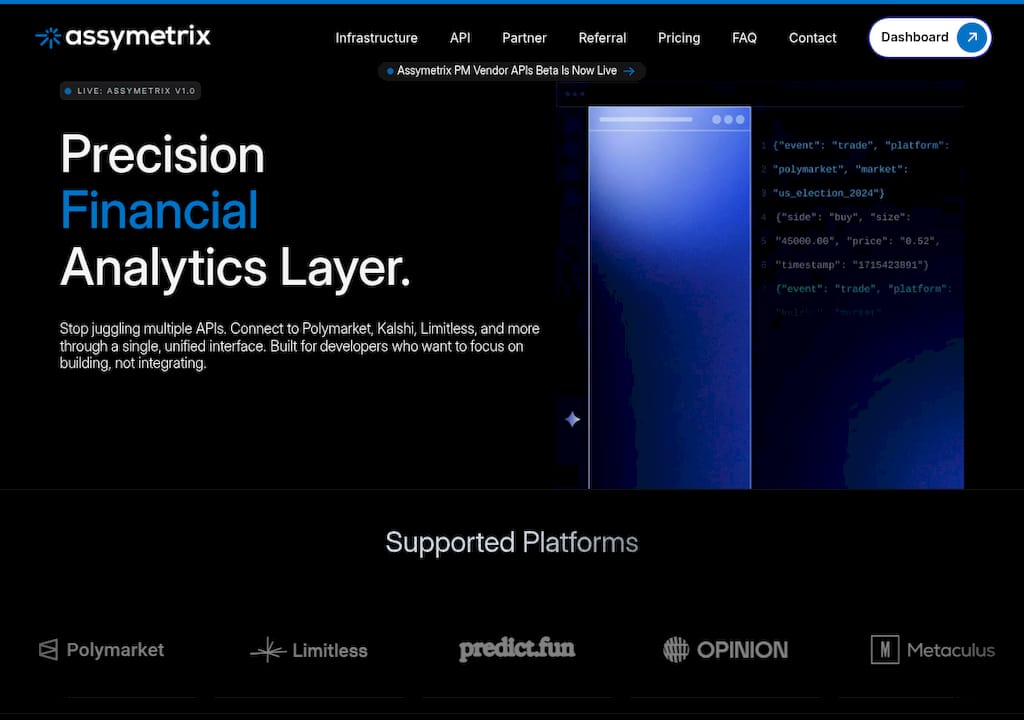
Canonical market and outcome IDs across supported venues, normalized for cross-venue joins.
Historical backfill spanning large volumes of trading data for reproducible backtests.
Wallet tracking and Trader Skill Scores available through the same endpoint as raw trade and order book data.
Streaming and historical access through a single schema, removing the need to maintain separate mapping code per venue.
When evaluating any data vendor for production use, check latency guarantees against your strategy’s actual execution window, confirm schema completeness against the fields your backtests need, and review licensing terms for commercial versus research use before committing engineering time to an integration.
Visit the Data API landing page to review endpoint documentation and request access.
Further technical reading
Prediction Market Data Feed: Real-Time and Historical API Guide for schema and streaming implementation detail.
Python Prediction Market Data: Developer API Guide for client code examples.
Copy Trading at Prop Firms: Where the Line Is Drawn for operational context on execution risk and copy-trading rules.
FAQ
What does “CFTC prediction market rules” mean for developers?
In a developer context, it refers to the platform-level trading and API rules on US prediction market venues: authentication, order lifecycle, settlement timing, and data schema conventions, not the federal regulatory rulemaking process.
How do I authenticate with prediction market APIs?
Most venues use API keys, with some requiring HMAC-signed requests for order placement and select platforms supporting OAuth for third-party applications. Store credentials in a secrets vault and rotate them on a fixed schedule rather than leaving static keys in code.
Why do canonical IDs matter for cross-venue trading?
Canonical IDs map the same real-world market across different venues so your system can deduplicate, join, and compare data without fuzzy matching. Assymetrix’s Data API provides these IDs alongside Smart Money tracking and cross-venue arbitrage signals to remove that mapping step.
How should I model settlement timing in backtests?
Settlement timing varies by market type, with some resolving near-instantly against an external feed and others waiting on a confirmation window. Use the venue’s actual published settlement conventions rather than assuming instant resolution, since that assumption is a common source of inflated backtest returns.
What is the risk of ignoring venue position and speed limits?
A bot that exceeds position or speed limits risks hard order rejections during high-volume periods and can trigger automated surveillance review. Building a client-side throttle below the venue’s published limit is a practical safeguard against both outcomes.
Save Months Integrating CFTC Prediction Market Rules for Developers
This article covers platform-level trading and data-access rules for building on US prediction market venues, not federal rulemaking. For developers, that means four things matter immediately: authentication and rate-limit design, consistent market and outcome IDs across venues, order lifecycle and settlement timing, and where to source normalized historical data. Assymetrix aggregates cross-venue data with a canonical schema and deep backfill, which solves the normalization problem most integration projects hit first.
TL;DR:
Cross-venue normalization of market and outcome IDs simplifies data integration and error reduction, especially when dealing with different naming conventions and settlement rules.
Implementing websocket subscriptions for live data and REST for historical backfill optimizes rate limits, reduces latency, and improves data reliability in prediction markets.
Accurate modeling of settlement timing, including delays and dispute windows, is critical for realistic backtests and avoiding false profitability signals.
Establishing immutable raw data storage and schema validation prevents silent errors caused by venue updates or data drift, ensuring consistent backtest reproducibility.
Compliance requirements, such as identity verification, transaction reporting, and enforcing position limits, ensure platform stability and reduce risk of enforcement actions against participants.
AssymetrixSimplify Cross-Venue Market DataAssymetrix gives developers unified access to structured prediction market data across Polymarket, Kalshi, and Limitless through one integration.Explore Assymetrix
Table of Contents
API access and authentication rules for prediction market venues
Order types, matching rules, and settlement conventions on US venues
Canonical schema and data normalization for cross-venue feeds
Building smart money tracking and arbitrage signals
Moving from prototype to production safely
Market surveillance controls, position limits, and speed limits
How the CFTC oversight layer shapes platform rules
What compliance and reporting mean for your integration
How platforms classify and define prediction market products
Consumer protection expectations on regulated venues
What enforcement history means for platform stability
Where engineering effort actually pays off first
Assymetrix data API for developers and quant teams
Further technical reading
API access and authentication rules for prediction market venues
Most US prediction market venues issue API keys tied to an account, with some requiring HMAC-signed requests for order placement and a subset supporting OAuth for third-party app access. Key rotation should run on a fixed schedule, and secrets belong in a vault service rather than environment files checked into version control.
Rate limits vary by endpoint type: order placement endpoints are typically the most restrictive, market data endpoints looser. When a venue returns a 429, exponential backoff with jitter avoids synchronized retry storms across your bot fleet. Websocket connections suit live order book and trade updates; REST suits historical backfill and one-off queries. Relying on REST polling for live data wastes your rate budget and adds latency your competitors will not have.
Design your ingestion layer around these patterns:
Use websocket subscriptions for live trades and order book deltas, with a REST fallback for reconnect gaps.
Checkpoint sequence numbers per market so a dropped connection resumes without gaps or duplicates.
Treat historical backfill as replayable: store raw responses before transformation so you can reprocess without re-hitting the venue.
Version your schema mapping layer separately from ingestion code, since venues change field names more often than they change endpoints.
Assymetrix’s Data API addresses the multi-venue version of this problem directly: one integration point instead of three separate authentication schemes, rate limit budgets, and schema formats. The real-time and historical API guide documents streaming versus REST tradeoffs for teams building their own ingestion layer regardless of vendor choice.
Pro Tip: Log every rate-limit response with the endpoint, timestamp, and retry-after value; a week of this data tells you exactly where your ingestion architecture needs a queue.
Order types, matching rules, and settlement conventions on US venues
Order types on US prediction market venues generally include limit and market orders, with cancel-and-replace treated as two discrete lifecycle events rather than an atomic modification. Matching engines apply price-time priority, so a partial fill leaves the remainder resting at its original queue position rather than restarting at the back.
Order lifecycle events arrive through the API as discrete states: open, partially filled, filled, canceled, and rejected, each carrying its own timestamp your storage layer needs to capture separately.
Market lifecycle events cover creation, suspension or halt, and resolution or settlement; each is signaled through a distinct API event rather than inferred from price behavior, and a bot that infers halts from price will miss them.
Settlement timing varies by market type: some resolve near-instantly on an external data feed, others wait for a manual or oracle-based confirmation window that can run hours.
Post-settlement corrections happen when a resolution source is disputed; your reconciliation logic should treat a settled market as provisionally final, not permanently final, for a defined grace window.
Fee models typically apply to the taker side of a fill, with maker rebates on some venues; slippage modeling in backtests should use actual order book depth rather than last-trade price, since thin books on low-volume markets can move price meaningfully on modest size.
Getting settlement timing wrong is the single most common bug in prediction market backtests: a strategy that looks profitable using instant settlement assumptions can look very different once you model the actual confirmation delay.
Canonical schema and data normalization for cross-venue feeds
A reproducible backtest starts with a consistent schema, and cross-venue work fails without canonical identifiers that survive differences in how each platform names its markets and outcomes.
Store, at minimum:
market_idandoutcome_idusing a canonical mapping, not the venue’s native ID, so the same real-world event resolves to one row across platforms.venue_idto preserve provenance even after normalization.price,size, andsidefor every trade and order book snapshot.timestamp_created,timestamp_traded, andsettled_atas separate fields, all in UTC.A monotonic sequence ID per market to detect gaps in your ingestion stream.
Timestamp granularity differs across venues, some reporting to the millisecond, others to the second, so reconciling joined records requires deciding a tolerance window up front rather than discovering mismatches during a backtest. Canonical IDs matter most for deduplication and cross-venue joins: without them, arbitrage detection between the same event on two venues becomes a fuzzy-matching problem instead of a direct lookup.
Assymetrix’s Data API supplies canonical IDs alongside Smart Money wallet tracking, Trader Skill Scores, and cross-venue arbitrage signals, which removes the mapping step most teams otherwise build by hand.
A practical storage architecture separates three layers: a raw event layer that mirrors venue payloads exactly, a normalized layer applying canonical IDs and UTC timestamps, and an aggregated view layer for model consumption. Keeping the raw layer immutable means a schema bug in your normalization code never destroys source data.
Building smart money tracking and arbitrage signals
Wallet-level tracking requires trade history, timestamps, and order sizes per wallet, and cross-venue linkage is possible only where a wallet address or account identifier persists across platforms, which is not universal.
Feed rolling skill-scoring windows with realized profit and loss per trade, weighted by position size, to separate consistently accurate traders from lucky short-term streaks.
Weight volume leadership signals by recency, since a wallet’s edge in prediction markets tends to concentrate around specific event categories rather than persist evenly.
Set divergence thresholds for arbitrage detection based on typical bid-ask spread on each venue, not a fixed percentage, since spreads on thin markets are naturally wider.
Choose your latency window for divergence scoring based on your actual execution speed, since a signal computed on a five-second window is meaningless if your fill latency is thirty seconds.
These features include Smart Money wallet tracking and Trader Skill Scores, as well as cross-venue arbitrage signals that would otherwise require building the canonical mapping layer described above from scratch.
Pro Tip: Run every new arbitrage signal through a simulated execution test using historical order book depth before routing it to a live account; paper slippage and real slippage on thin prediction markets are rarely close.
Moving from prototype to production safely
A checklist that separates teams with reliable bots from teams debugging silent failures in production:
Sandbox test first. Run deterministic data replay against recorded historical sessions before connecting to a live account, and confirm your bot produces identical output on repeated runs of the same input.
Test fills synthetically. Simulate partial fills and rejections explicitly, since these paths get skipped in casual testing and cause the most production incidents.
Monitor end-to-end latency and fill rate, not just uptime. A sequence-gap alert catches dropped websocket messages before they silently corrupt your order book state.
Log immutably for audit. Keep an append-only event log of every order sent and every fill received, exportable for reconciliation against venue statements.
Preserve raw ticks for backtests. Reproducibility depends on storing the exact order book state your strategy saw, not a reconstructed approximation.
Data drift is the quiet failure mode: a venue changes a field name or timestamp format without a version bump, and your pipeline keeps running while silently misinterpreting data. A weekly schema validation job against a known-good sample catches this before it reaches a strategy.
Pro Tip: Store your reconciliation reports separately from your trading logs; the two serve different audiences and merging them makes both harder to read during an incident review.
Market surveillance controls, position limits, and speed limits
US prediction market venues run automated surveillance to flag wash trading, spoofing, and unusual order patterns, and bots that generate rapid order and cancel cycles without genuine price discovery risk automated review or account action. Position limits cap the maximum exposure a single account can hold in a given market, generally scaled to that market’s overall liquidity, and a bot that scales position size without checking current limits will hit a hard rejection at the worst possible moment.
Speed limits, sometimes implemented as minimum order intervals or maximum orders per second per account, exist to prevent a single participant from monopolizing the matching engine during volatile periods. Building your own client-side throttle below the venue’s published limit protects you from edge-case rejections during high-volume windows, when the venue’s own limit enforcement can behave less predictably.
Reconciliation dashboards that track your own order-to-cancel ratio and fill rate against expected values give an early warning before a surveillance flag becomes an account restriction. Assymetrix’s analysis of institutional participation and surveillance behavior on regulated venues gives useful context for teams designing bots that need to operate within these bounds without tripping automated review.
How the CFTC oversight layer shapes platform rules
The Commodity Futures Trading Commission oversees the regulated exchanges that list prediction markets in the United States, and that oversight is the reason platforms enforce the operational rules covered above rather than leaving them to each venue’s discretion. Position limits, surveillance requirements, and reporting obligations at the venue level exist because the exchange itself operates under a regulatory framework, even though the day-to-day mechanics developers integrate against are the platform’s own trading rules.
For a developer building bots or data pipelines, this layer mostly shows up indirectly: it is the reason venues publish clear rulebooks, maintain audit trails, and enforce the position and speed limits your bot needs to respect. Understanding that a regulatory backbone exists behind the operational rules helps explain why those rules are strict and stable rather than subject to frequent unannounced change.
Assymetrix’s prediction market landscape analysis for 2026 covers how institutional participation on regulated venues has grown alongside this oversight structure, useful context for teams evaluating which venues offer the operational stability production systems need.
What compliance and reporting mean for your integration
Compliance obligations at the venue level translate into a handful of concrete developer-facing requirements: account verification steps before API access is granted, transaction reporting that venues handle on their end but that your reconciliation logs should mirror, and record-keeping expectations that favor immutable audit trails over mutable databases.
Practically, this means your integration should assume identity verification happens before you ever get a working API key, so budget onboarding time into any project timeline. It also means your own audit logging should match the granularity venues expect from regulated participants: every order, every cancellation, every fill, timestamped and retained rather than overwritten. Teams that treat their own event logs as disposable debugging output often find they cannot reconstruct what happened during a dispute or an unexpected fill.
Building this logging layer once, at the start of a project, costs far less than retrofitting it after a reconciliation problem forces the question.
How platforms classify and define prediction market products
US-regulated prediction market venues structure their listed products as binary or scalar outcome contracts settled against a defined resolution source, a classification that shapes how each platform’s API models a “market.” Understanding this distinction matters for schema design: a binary contract has two outcomes and a simple settlement rule, while scalar or multi-outcome markets require your canonical schema to handle more than two outcome_id values per market_id.
Different venues use different terminology for the same underlying structure, which is precisely why canonical IDs matter for any project touching more than one platform. A market classified one way on one venue and another way on a second venue can still represent the same real-world event, and your normalization layer needs to bridge that terminology gap rather than assume identical structure.
Consumer protection expectations on regulated venues
Regulated US prediction market venues are expected to maintain fair and orderly markets, disclose contract terms and resolution sources clearly, and provide accessible dispute channels when a settlement is contested. For a developer, this shows up as published rulebooks describing exactly how each market resolves, which your ingestion pipeline should capture and store alongside the market metadata rather than treating resolution rules as static assumptions baked into code.
A bot or trading system that ignores published resolution criteria risks acting on an assumption that turns out to be wrong when an edge case resolves differently than expected. Storing the resolution source and rulebook reference alongside each market in your schema gives you a defensible record when a settlement dispute affects your positions, and it is a cheap addition compared to the debugging cost of not having it.
What enforcement history means for platform stability
Enforcement actions against prediction market participants or operators typically target manipulation, unregistered offerings, or violations of a venue’s own trading rules, and the practical effect for developers is that venues respond by tightening the surveillance and position-limit controls covered earlier in this guide. A bot that operates well within published limits and avoids manipulative patterns like wash trading rarely intersects with enforcement risk directly.
The more relevant takeaway for integration work is that rule enforcement tends to make platform behavior more predictable over time, not less: venues that have gone through a compliance tightening cycle generally end up with clearer published rulebooks and more consistent API-level signaling of lifecycle events. Building against a venue’s current published rules, and rechecking them periodically, is the practical safeguard rather than trying to predict enforcement trends.
Where engineering effort actually pays off first
Normalization and canonical IDs should come before signal engineering, always. A team that builds arbitrage detection on top of ad-hoc venue-native IDs will spend more time debugging false positives from mismatched markets than the signal itself is worth. Latency-sensitive execution matters for arbitrage and market-making strategies, less for signal research that runs on completed historical data. Small teams should resist the pull toward advanced scoring models before their ingestion and schema layer is boring and reliable: a skill score built on inconsistent data is worse than no score at all.
— Dean
Assymetrix data API for developers and quant teams
Building the cross-venue ingestion layer described in this guide from scratch, canonical IDs, backfill, wallet tracking, means months of engineering before a single strategy runs. A unified Data API can replace that build with one integration.
Canonical market and outcome IDs across supported venues, normalized for cross-venue joins.
Historical backfill spanning large volumes of trading data for reproducible backtests.
Wallet tracking and Trader Skill Scores available through the same endpoint as raw trade and order book data.
Streaming and historical access through a single schema, removing the need to maintain separate mapping code per venue.
When evaluating any data vendor for production use, check latency guarantees against your strategy’s actual execution window, confirm schema completeness against the fields your backtests need, and review licensing terms for commercial versus research use before committing engineering time to an integration.
Visit the Data API landing page to review endpoint documentation and request access.
Further technical reading
Prediction Market Data Feed: Real-Time and Historical API Guide for schema and streaming implementation detail.
Python Prediction Market Data: Developer API Guide for client code examples.
Copy Trading at Prop Firms: Where the Line Is Drawn for operational context on execution risk and copy-trading rules.
FAQ
What does “CFTC prediction market rules” mean for developers?
In a developer context, it refers to the platform-level trading and API rules on US prediction market venues: authentication, order lifecycle, settlement timing, and data schema conventions, not the federal regulatory rulemaking process.
How do I authenticate with prediction market APIs?
Most venues use API keys, with some requiring HMAC-signed requests for order placement and select platforms supporting OAuth for third-party applications. Store credentials in a secrets vault and rotate them on a fixed schedule rather than leaving static keys in code.
Why do canonical IDs matter for cross-venue trading?
Canonical IDs map the same real-world market across different venues so your system can deduplicate, join, and compare data without fuzzy matching. Assymetrix’s Data API provides these IDs alongside Smart Money tracking and cross-venue arbitrage signals to remove that mapping step.
How should I model settlement timing in backtests?
Settlement timing varies by market type, with some resolving near-instantly against an external feed and others waiting on a confirmation window. Use the venue’s actual published settlement conventions rather than assuming instant resolution, since that assumption is a common source of inflated backtest returns.
What is the risk of ignoring venue position and speed limits?
A bot that exceeds position or speed limits risks hard order rejections during high-volume periods and can trigger automated surveillance review. Building a client-side throttle below the venue’s published limit is a practical safeguard against both outcomes.
Other Blog


