How AI Agents Use Event Market Signals Autonomously
How AI Agents Use Event Market Signals Autonomously
How AI Agents Use Event Market Signals Autonomously
Discover how autonomous AI agents leverage prediction market signals to make profitable trades. Unlock insights and actionable strategies today!

How AI Agents Use Event Market Signals Autonomously
Autonomous AI agents convert live and historical prediction-market signals into verifiable trade actions and RL rewards by mapping market probabilities, wallet flows, and cross-venue divergence through a modular belief-to-trade pipeline. The Raven-Agent architecture demonstrates this concretely: forecasting calibration alone does not produce positive risk-adjusted returns; you need an explicit layer that translates a model’s probability estimate into a sized, fee-adjusted position. Assymetrix’s 5+ years of timestamped resolution data across Polymarket, Kalshi, and Limitless supplies the ground-truth reward stream that makes Kelly-sized RL training reproducible and economically grounded.
Key Takeaways
Autonomous prediction-market agents require a belief-to-trade pipeline, verifiable RL rewards from historical resolution data, and strict separation of reasoning and execution to produce auditable, risk-adjusted returns.
Point | Details |
|---|---|
Stream high-frequency signals | Ingest live price ticks, volume spikes, and wallet activity via streaming endpoints for low-latency triggers. |
Use resolution data for RL rewards | Assymetrix’s 5+ years of timestamped resolution records provide the ground-truth reward stream for RLVR training. |
Separate reasoning and execution | Keep the belief model and signing keys on separate processes to limit blast radius and enable audits. |
Backtest with economic conversion | Convert probabilistic forecasts to hypothetical trades with fee adjustments and report cumulative-profit curves under edge-selection rules. |
Assymetrix unifies the data layer | A single Assymetrix integration supplies normalized real-time streams and bulk historical exports across Polymarket, Kalshi, and Limitless. |
Table of Contents
What signal types do autonomous agents consume from prediction markets?
How should you architect a modular autonomous prediction-market agent?
How do you translate model probability into a sized trade decision?
How do you design verifiable RL rewards from Assymetrix historical resolution data?
What execution controls and security patterns should your agent use?
How do you backtest and monitor agent performance in production?
How do you integrate the Assymetrix Data API into your agent pipeline?
What failure modes and red flags should you monitor for?
The case for verifiable rewards over proxy metrics
Assymetrix gives your agent the data layer it needs
Sources
What signal types do autonomous agents consume from prediction markets?
Prediction markets produce a richer signal taxonomy than most developers initially wire up. Each signal type serves a distinct role in the agent’s decision or reward pipeline.
Live price ticks (odds stream). The raw YES/NO price at each moment. Use streaming for momentum triggers: a price moving from 0.42 to 0.51 in under 60 seconds without accompanying volume is a candidate for mean-reversion, not a trend entry.
Volume and volume spikes. Sudden volume surges ahead of a resolution date often precede informed flow. Poll every 30–60 seconds; flag any 3x spike relative to the 24-hour rolling average.
Orderbook / CLOB snapshots. Where available (Polymarket’s CLOB), depth imbalance between the best bid and ask reveals short-term directional pressure. Best ingested via snapshot polling every few seconds rather than a full stream.
Wallet / Smart Money activity. Tracking which wallets enter a market and at what size is one of the highest-signal inputs available. A cluster of historically profitable wallets buying YES simultaneously is a stronger entry trigger than price alone. See Smart Money alert patterns for implementation details.
Cross-venue price divergence. The same underlying question trading at 0.61 on Polymarket and 0.55 on Kalshi is an arbitrage signal. Cross-venue signal fusion methods that combine faster venue order flow with prediction-market CLOB snapshots can detect mispricings before they close.
Time-to-close pressure. As a market approaches its resolution date, liquidity typically thins and price volatility compresses. Agents should weight signals differently within 24 hours of close versus 14 days out.
Resolution timestamps and outcome metadata. The resolved YES/NO outcome, paired with the exact timestamp, is the ground-truth label for RL reward calculation. Historical resolution records are not a nice-to-have; they are the training signal.
Normalized question metadata. Question text and resolution criteria, normalized to a canonical schema across venues, let agents compare semantically equivalent markets and avoid double-counting correlated positions.
Stream price ticks, wallet activity, and volume for low-latency triggers. Poll CLOB snapshots and cross-venue prices at a cadence your rate limits allow. Pull resolution timestamps in bulk for RL training.
How should you architect a modular autonomous prediction-market agent?
A production-grade agent separates concerns across six modules. Coupling reasoning and execution in a single process is the fastest path to an unauditable, hard-to-kill system.
Market scanner. Subscribes to streaming price and volume feeds; polls CLOB snapshots and cross-venue prices on a schedule. Filters markets by minimum volume liquidity and price range within reasonable bounds before passing candidates downstream.
Feature extractor. Normalizes raw ticks into engineered features: price momentum over configurable windows, volume delta acceleration, wallet entry counts, and cross-venue spread. Canonical market IDs from a unified API keep cross-venue features aligned.
Belief model (LLM or RL module). Accepts engineered features and outputs a calibrated probability estimate p. The Agora prediction agent uses Groq-hosted Mixtral for this step, combining news headlines with live market state to produce p before passing it to the decision layer.
Belief-to-trade layer. Converts p into a sized order using EV and Kelly math (detailed in the next section). This layer enforces minimum-edge thresholds and bankroll caps before any order reaches the execution queue.
Permissioned execution layer. Signs and submits orders using a dedicated execution key that has no access to the reasoning model’s state. Circle Programmable Wallets and Arc-style job lifecycle patterns are practical primitives here; AlphaOracle demonstrates settlement via Circle wallets on Arc testnet.
Persistence and audit ledger. Every decision, with its input features, computed EV, and order outcome, is written to an append-only log. This is the foundation for both backtesting and post-incident review.
Monitoring and alerting. Tracks live P&L, calibration drift, and anomalous signal patterns. Triggers circuit breakers when thresholds are breached.
Pro Tip: Keep the reasoning process and the signing key on separate processes, ideally separate machines. The reasoning layer should emit signed recommendations with confidence scores; the execution layer should validate those recommendations against a permission policy before touching a wallet. This limits blast radius and makes every trade auditable.
Integration touchpoints: connect the scanner to Polymarket’s Gamma API and Kalshi’s REST endpoints, or pull normalized feeds from the Assymetrix Data API to avoid per-venue schema translation.
How do you translate model probability into a sized trade decision?
The core formula is straightforward. The complexity lives in the adjustments.
Expected value:
EV = p × (1 − m) − (1 − p) × m
where p is your model’s probability and m is the current market price (cost per share). Add approximately one cent to m to approximate fees and slippage before computing EV. If EV is negative, skip the market.
Kelly sizing:
f* = (p − m) / (1 − m)
Full Kelly is aggressive. The AlphaOracle implementation uses half-Kelly with these kinds of hard caps as standard operational practice.
Decision pseudocode (high level):
Accept belief p from the belief model.
Fetch current market price m from the normalized feed.
Compute adjusted EV using m + 0.01 for fee approximation.
If EV < minimum edge threshold (e.g., 0.03), discard.
Compute half-Kelly fraction f; apply bankroll cap.
Run permission checks: volume guard, price-range filter (8%–92%), position limit.
If all checks pass, push order to execution queue.
How do you design verifiable RL rewards from Assymetrix historical resolution data?
Outcome-based rewards are the most reliable signal for training prediction-market agents. A resolved YES pays +1; a resolved NO pays −1 (or 0, depending on your reward normalization). The key is pairing each model probability estimate, made at a specific timestamp, with the ground-truth resolution outcome from the same market.
Assymetrix provides the dataset that makes this tractable:
Dimension | Assymetrix coverage |
|---|---|
Historical depth | 5+ years of timestamped data |
Total data volume | nearly one billion rows |
Venues covered | Polymarket, Kalshi, Limitless |
Resolution records | Timestamped YES/NO outcomes per market |
RLVR methods applied to probabilistic forecasting show that outcome-only RL adaptations, specifically ReMax and Modified-GRPO, improve both Brier score and Expected Calibration Error (ECE) and convert those calibration gains into higher hypothetical trading profit in controlled experiments. The training loop is: sample a market state, generate a probability estimate, receive the resolution outcome as a reward signal, and update the policy.
Evaluation metrics to track: soft-Brier score (penalizes confident wrong predictions more heavily), ECE (measures calibration bucket accuracy), and cumulative profit under edge-selection rules (Edge > ECE, Edge > 0, all edges).
Pro Tip: Sparse delayed rewards cause action collapse in low-cardinality RL environments. Require chain-of-thought reasoning tokens before the agent commits to a probability estimate. This maintains policy diversity and prevents the model from collapsing to a constant output. Baseline subtraction (ReMax-style) further stabilizes training by reducing variance in the reward signal.
What execution controls and security patterns should your agent use?
Autonomous agents that act without human intervention need layered controls. A single misconfigured permission is enough to drain a bankroll.
Separate reasoning keys from signing keys. The model that generates p should never have direct access to wallet credentials.
Use permissioned execution: define an allowlist of markets, maximum order sizes, and daily loss limits that the execution layer enforces independently of the reasoning model.
Implement rate limiting at the execution layer, not just at the API client level. Prediction market venues enforce their own rate limits; exceeding them mid-session can leave positions open without the ability to adjust.
Write every transaction to an append-only audit log with input features, computed EV, order details, and outcome. This log is your primary debugging tool and your backtesting ground truth.
Use dry-run mode during initial deployment. Route all orders to a preview queue; require human confirmation before live submission until the agent’s calibration is validated against historical data.
Implement circuit breakers: halt trading automatically if daily P&L drops below a configurable threshold, if calibration drift exceeds a set ECE bound, or if anomalous signal patterns are detected.
For settlement, Circle Programmable Wallets provide a programmable permission layer; Arc-style job lifecycle patterns give you onchain reputation and lifecycle tracking per the Agora agent pattern.
How do you backtest and monitor agent performance in production?
The backtesting protocol that converts probabilistic forecasts into economic evaluation follows a specific sequence. Align time-series price snapshots with your model’s probability outputs at each timestamp. Simulate entry cost by adding approximately one cent to the contemporaneous market price. Apply bet-selection rules in sequence: Edge > ECE, Edge > 0, and all edges. Compute cumulative-profit curves for each rule set and report bootstrap confidence intervals to quantify uncertainty.
Live production metrics to track continuously:
P&L and information ratio. Daily and rolling 30-day.
Brier score and ECE. Calibration drift is an early warning signal before P&L degrades.
Realized edge distribution. Compare predicted edge at entry to realized edge at resolution.
Smart Money hit-rate. What fraction of Smart Money wallet entries preceded a correct resolution?
Turnover. High turnover with flat P&L signals fee drag, not alpha.
Pro Tip: Use paired bootstrap or question-level resampling rather than time-series bootstrap when computing confidence intervals for cumulative-profit comparisons. Prediction market questions are not i.i.d.; question-level resampling respects the correlation structure and gives more honest uncertainty estimates. See the backtesting methodology guide for implementation details.
Cross-venue signal fusion adds another monitoring layer: track whether cross-venue divergence signals that preceded entries resolved in your favor at a higher rate than single-venue signals alone.
How do you integrate the Assymetrix Data API into your agent pipeline?
The Assymetrix Data API at Assymetrix provides normalized real-time streams and bulk historical exports across Polymarket, Kalshi, and Limitless through a single authentication layer. A unified prediction-market API exposes the endpoint types agents need: market listings, orderbook snapshots, trade histories, volume charts, and wallet profiles.
High-level integration sequence:
Authenticate once; store credentials in environment variables, never in code.
Subscribe to streaming endpoints for price ticks and wallet activity. These feed the market scanner and Smart Money modules in near real-time.
Schedule hourly bulk pulls for CLOB snapshots and cross-venue price comparisons. Reconcile against the stream to catch any gaps.
Pull historical resolution records in bulk for RL training. Use canonical market IDs to align cross-venue records into a single training dataset.
Periodically reconcile live resolution outcomes from Assymetrix against your local ledger to keep reward labels current.
Best practices: use canonical IDs for cross-venue matching to avoid treating the same underlying question as two separate training examples. Normalize all prices to a [0, 1] probability scale before feature engineering. For Python-based agents, the Python API guide includes client library examples.
Pro Tip: Combine streaming micro-batches with hourly bulk checkpoints. Streams minimize latency for live trading; bulk checkpoints catch any dropped messages and keep your RL training dataset consistent with what the production agent actually saw.
What failure modes and red flags should you monitor for?
Common pitfalls in production agents:
Action collapse in RL. The policy converges to always predicting 0.5 or always abstaining. Cause: sparse rewards without chain-of-thought guard-rails. Fix: add reasoning tokens and baseline subtraction.
Overfitting to platform microstructure. An agent trained only on Polymarket CLOB patterns may fail on Kalshi’s different market structure. Fix: train on normalized cross-venue data from a unified feed.
Ignoring fees and slippage. A model with positive EV before fees can be deeply negative after. Fix: always add the fee approximation before computing EV.
Miscalibrated LLM probabilities. LLMs without RL fine-tuning tend to be overconfident. Fix: measure ECE on a held-out resolution set before deploying.
Orphaned positions from missed resolutions. If your resolution reconciliation loop fails, the agent may hold positions in already-resolved markets. Fix: run a daily reconciliation job against the Assymetrix resolution feed.
Red flags in live operation and immediate mitigations:
Sudden wallet clustering around a single question with no news: pause trading on that market, require Smart Money confirmation before re-entry.
Thin orderbook with rapid price movement: increase minimum-edge threshold by 2x until depth normalizes.
Cross-venue price fracture that reverts within minutes: log as a potential manipulation signal; do not chase the reversion.
Inconsistent resolution metadata across venues: halt cross-venue arbitrage on that question until metadata reconciles.
The case for verifiable rewards over proxy metrics
The most common mistake in prediction-market agent development is optimizing for a proxy metric, calibration score, log-loss, or accuracy, without ever converting those metrics into economic outcomes. A model that is well-calibrated but systematically wrong on high-edge markets will look excellent on Brier score and lose money in production. The belief-to-trade research makes this gap explicit: forecasting performance and trading performance are distinct, and the gap between them is where most agents fail.
The practical implication is to build economic backtests from day one, not as an afterthought. Use Assymetrix’s historical resolution data to run cumulative-profit curves under multiple edge-selection rules before any live capital is at risk. If the agent cannot demonstrate positive expected value on historical data with realistic fee assumptions, no amount of calibration tuning will fix it in production.
Assymetrix gives your agent the data layer it needs
Prediction-market agents need two things the open web cannot reliably supply: normalized real-time streams across multiple venues and a deep, timestamped resolution dataset for RL training. Assymetrix provides both through a single integration at Assymetrix.
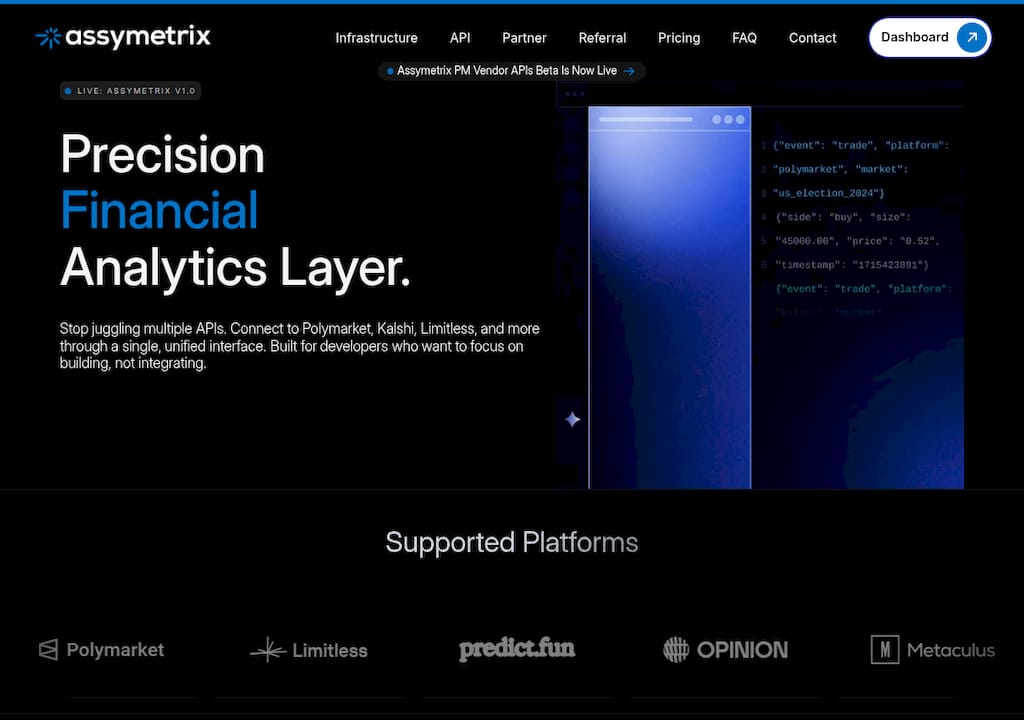
The platform delivers unified streaming feeds from Polymarket, Kalshi, and Limitless; Smart Money wallet tracking with alert signals; 5+ years of timestamped resolution records across nearly one billion rows of trading activity; normalized schemas and canonical market IDs for cross-venue feature pipelines; and bulk export for backtesting and RL training datasets. Developers building agents for the first time and quant teams scaling existing systems both start at the same place: the Data API developer guide, which covers authentication, streaming setup, bulk export, and schema reference.
Sources
This article is general information, not a substitute for advice from a qualified financial advisor. Consult a qualified financial professional about your own circumstances before acting on anything here.
FAQ
What signals do autonomous agents consume from prediction markets?
Agents ingest live price ticks, volume spikes, CLOB orderbook snapshots, Smart Money wallet entries, cross-venue price divergence, time-to-close pressure, and resolution timestamps. Each signal serves a distinct role: streaming signals trigger entries, resolution timestamps provide RL reward labels.
How does Kelly Criterion sizing work in a prediction-market agent?
The Kelly fraction is computed as (p − m) / (1 − m), where p is the model’s probability and m is the market price.
Why use historical resolution data as an RL reward signal?
Resolved YES/NO outcomes are verifiable binary labels that directly measure economic value. RLVR methods trained on outcome-only rewards, such as ReMax and Modified-GRPO, improve calibration metrics like Brier score and ECE and convert those gains into higher hypothetical trading profit.
How does Assymetrix support autonomous agent development?
Assymetrix provides normalized real-time streams and 5+ years of timestamped resolution data across Polymarket, Kalshi, and Limitless through a single API integration, giving agents both the live signals needed for trading and the historical ground truth needed for RL training and backtesting.
What is the most common failure mode in production prediction-market agents?
Action collapse in RL, where the policy converges to a constant output, is the most frequent failure. It is caused by sparse delayed rewards without chain-of-thought guard-rails. Adding reasoning tokens before probability estimation and using baseline subtraction (ReMax-style) stabilizes training.
How AI Agents Use Event Market Signals Autonomously
Autonomous AI agents convert live and historical prediction-market signals into verifiable trade actions and RL rewards by mapping market probabilities, wallet flows, and cross-venue divergence through a modular belief-to-trade pipeline. The Raven-Agent architecture demonstrates this concretely: forecasting calibration alone does not produce positive risk-adjusted returns; you need an explicit layer that translates a model’s probability estimate into a sized, fee-adjusted position. Assymetrix’s 5+ years of timestamped resolution data across Polymarket, Kalshi, and Limitless supplies the ground-truth reward stream that makes Kelly-sized RL training reproducible and economically grounded.
Key Takeaways
Autonomous prediction-market agents require a belief-to-trade pipeline, verifiable RL rewards from historical resolution data, and strict separation of reasoning and execution to produce auditable, risk-adjusted returns.
Point | Details |
|---|---|
Stream high-frequency signals | Ingest live price ticks, volume spikes, and wallet activity via streaming endpoints for low-latency triggers. |
Use resolution data for RL rewards | Assymetrix’s 5+ years of timestamped resolution records provide the ground-truth reward stream for RLVR training. |
Separate reasoning and execution | Keep the belief model and signing keys on separate processes to limit blast radius and enable audits. |
Backtest with economic conversion | Convert probabilistic forecasts to hypothetical trades with fee adjustments and report cumulative-profit curves under edge-selection rules. |
Assymetrix unifies the data layer | A single Assymetrix integration supplies normalized real-time streams and bulk historical exports across Polymarket, Kalshi, and Limitless. |
Table of Contents
What signal types do autonomous agents consume from prediction markets?
How should you architect a modular autonomous prediction-market agent?
How do you translate model probability into a sized trade decision?
How do you design verifiable RL rewards from Assymetrix historical resolution data?
What execution controls and security patterns should your agent use?
How do you backtest and monitor agent performance in production?
How do you integrate the Assymetrix Data API into your agent pipeline?
What failure modes and red flags should you monitor for?
The case for verifiable rewards over proxy metrics
Assymetrix gives your agent the data layer it needs
Sources
What signal types do autonomous agents consume from prediction markets?
Prediction markets produce a richer signal taxonomy than most developers initially wire up. Each signal type serves a distinct role in the agent’s decision or reward pipeline.
Live price ticks (odds stream). The raw YES/NO price at each moment. Use streaming for momentum triggers: a price moving from 0.42 to 0.51 in under 60 seconds without accompanying volume is a candidate for mean-reversion, not a trend entry.
Volume and volume spikes. Sudden volume surges ahead of a resolution date often precede informed flow. Poll every 30–60 seconds; flag any 3x spike relative to the 24-hour rolling average.
Orderbook / CLOB snapshots. Where available (Polymarket’s CLOB), depth imbalance between the best bid and ask reveals short-term directional pressure. Best ingested via snapshot polling every few seconds rather than a full stream.
Wallet / Smart Money activity. Tracking which wallets enter a market and at what size is one of the highest-signal inputs available. A cluster of historically profitable wallets buying YES simultaneously is a stronger entry trigger than price alone. See Smart Money alert patterns for implementation details.
Cross-venue price divergence. The same underlying question trading at 0.61 on Polymarket and 0.55 on Kalshi is an arbitrage signal. Cross-venue signal fusion methods that combine faster venue order flow with prediction-market CLOB snapshots can detect mispricings before they close.
Time-to-close pressure. As a market approaches its resolution date, liquidity typically thins and price volatility compresses. Agents should weight signals differently within 24 hours of close versus 14 days out.
Resolution timestamps and outcome metadata. The resolved YES/NO outcome, paired with the exact timestamp, is the ground-truth label for RL reward calculation. Historical resolution records are not a nice-to-have; they are the training signal.
Normalized question metadata. Question text and resolution criteria, normalized to a canonical schema across venues, let agents compare semantically equivalent markets and avoid double-counting correlated positions.
Stream price ticks, wallet activity, and volume for low-latency triggers. Poll CLOB snapshots and cross-venue prices at a cadence your rate limits allow. Pull resolution timestamps in bulk for RL training.
How should you architect a modular autonomous prediction-market agent?
A production-grade agent separates concerns across six modules. Coupling reasoning and execution in a single process is the fastest path to an unauditable, hard-to-kill system.
Market scanner. Subscribes to streaming price and volume feeds; polls CLOB snapshots and cross-venue prices on a schedule. Filters markets by minimum volume liquidity and price range within reasonable bounds before passing candidates downstream.
Feature extractor. Normalizes raw ticks into engineered features: price momentum over configurable windows, volume delta acceleration, wallet entry counts, and cross-venue spread. Canonical market IDs from a unified API keep cross-venue features aligned.
Belief model (LLM or RL module). Accepts engineered features and outputs a calibrated probability estimate p. The Agora prediction agent uses Groq-hosted Mixtral for this step, combining news headlines with live market state to produce p before passing it to the decision layer.
Belief-to-trade layer. Converts p into a sized order using EV and Kelly math (detailed in the next section). This layer enforces minimum-edge thresholds and bankroll caps before any order reaches the execution queue.
Permissioned execution layer. Signs and submits orders using a dedicated execution key that has no access to the reasoning model’s state. Circle Programmable Wallets and Arc-style job lifecycle patterns are practical primitives here; AlphaOracle demonstrates settlement via Circle wallets on Arc testnet.
Persistence and audit ledger. Every decision, with its input features, computed EV, and order outcome, is written to an append-only log. This is the foundation for both backtesting and post-incident review.
Monitoring and alerting. Tracks live P&L, calibration drift, and anomalous signal patterns. Triggers circuit breakers when thresholds are breached.
Pro Tip: Keep the reasoning process and the signing key on separate processes, ideally separate machines. The reasoning layer should emit signed recommendations with confidence scores; the execution layer should validate those recommendations against a permission policy before touching a wallet. This limits blast radius and makes every trade auditable.
Integration touchpoints: connect the scanner to Polymarket’s Gamma API and Kalshi’s REST endpoints, or pull normalized feeds from the Assymetrix Data API to avoid per-venue schema translation.
How do you translate model probability into a sized trade decision?
The core formula is straightforward. The complexity lives in the adjustments.
Expected value:
EV = p × (1 − m) − (1 − p) × m
where p is your model’s probability and m is the current market price (cost per share). Add approximately one cent to m to approximate fees and slippage before computing EV. If EV is negative, skip the market.
Kelly sizing:
f* = (p − m) / (1 − m)
Full Kelly is aggressive. The AlphaOracle implementation uses half-Kelly with these kinds of hard caps as standard operational practice.
Decision pseudocode (high level):
Accept belief p from the belief model.
Fetch current market price m from the normalized feed.
Compute adjusted EV using m + 0.01 for fee approximation.
If EV < minimum edge threshold (e.g., 0.03), discard.
Compute half-Kelly fraction f; apply bankroll cap.
Run permission checks: volume guard, price-range filter (8%–92%), position limit.
If all checks pass, push order to execution queue.
How do you design verifiable RL rewards from Assymetrix historical resolution data?
Outcome-based rewards are the most reliable signal for training prediction-market agents. A resolved YES pays +1; a resolved NO pays −1 (or 0, depending on your reward normalization). The key is pairing each model probability estimate, made at a specific timestamp, with the ground-truth resolution outcome from the same market.
Assymetrix provides the dataset that makes this tractable:
Dimension | Assymetrix coverage |
|---|---|
Historical depth | 5+ years of timestamped data |
Total data volume | nearly one billion rows |
Venues covered | Polymarket, Kalshi, Limitless |
Resolution records | Timestamped YES/NO outcomes per market |
RLVR methods applied to probabilistic forecasting show that outcome-only RL adaptations, specifically ReMax and Modified-GRPO, improve both Brier score and Expected Calibration Error (ECE) and convert those calibration gains into higher hypothetical trading profit in controlled experiments. The training loop is: sample a market state, generate a probability estimate, receive the resolution outcome as a reward signal, and update the policy.
Evaluation metrics to track: soft-Brier score (penalizes confident wrong predictions more heavily), ECE (measures calibration bucket accuracy), and cumulative profit under edge-selection rules (Edge > ECE, Edge > 0, all edges).
Pro Tip: Sparse delayed rewards cause action collapse in low-cardinality RL environments. Require chain-of-thought reasoning tokens before the agent commits to a probability estimate. This maintains policy diversity and prevents the model from collapsing to a constant output. Baseline subtraction (ReMax-style) further stabilizes training by reducing variance in the reward signal.
What execution controls and security patterns should your agent use?
Autonomous agents that act without human intervention need layered controls. A single misconfigured permission is enough to drain a bankroll.
Separate reasoning keys from signing keys. The model that generates p should never have direct access to wallet credentials.
Use permissioned execution: define an allowlist of markets, maximum order sizes, and daily loss limits that the execution layer enforces independently of the reasoning model.
Implement rate limiting at the execution layer, not just at the API client level. Prediction market venues enforce their own rate limits; exceeding them mid-session can leave positions open without the ability to adjust.
Write every transaction to an append-only audit log with input features, computed EV, order details, and outcome. This log is your primary debugging tool and your backtesting ground truth.
Use dry-run mode during initial deployment. Route all orders to a preview queue; require human confirmation before live submission until the agent’s calibration is validated against historical data.
Implement circuit breakers: halt trading automatically if daily P&L drops below a configurable threshold, if calibration drift exceeds a set ECE bound, or if anomalous signal patterns are detected.
For settlement, Circle Programmable Wallets provide a programmable permission layer; Arc-style job lifecycle patterns give you onchain reputation and lifecycle tracking per the Agora agent pattern.
How do you backtest and monitor agent performance in production?
The backtesting protocol that converts probabilistic forecasts into economic evaluation follows a specific sequence. Align time-series price snapshots with your model’s probability outputs at each timestamp. Simulate entry cost by adding approximately one cent to the contemporaneous market price. Apply bet-selection rules in sequence: Edge > ECE, Edge > 0, and all edges. Compute cumulative-profit curves for each rule set and report bootstrap confidence intervals to quantify uncertainty.
Live production metrics to track continuously:
P&L and information ratio. Daily and rolling 30-day.
Brier score and ECE. Calibration drift is an early warning signal before P&L degrades.
Realized edge distribution. Compare predicted edge at entry to realized edge at resolution.
Smart Money hit-rate. What fraction of Smart Money wallet entries preceded a correct resolution?
Turnover. High turnover with flat P&L signals fee drag, not alpha.
Pro Tip: Use paired bootstrap or question-level resampling rather than time-series bootstrap when computing confidence intervals for cumulative-profit comparisons. Prediction market questions are not i.i.d.; question-level resampling respects the correlation structure and gives more honest uncertainty estimates. See the backtesting methodology guide for implementation details.
Cross-venue signal fusion adds another monitoring layer: track whether cross-venue divergence signals that preceded entries resolved in your favor at a higher rate than single-venue signals alone.
How do you integrate the Assymetrix Data API into your agent pipeline?
The Assymetrix Data API at Assymetrix provides normalized real-time streams and bulk historical exports across Polymarket, Kalshi, and Limitless through a single authentication layer. A unified prediction-market API exposes the endpoint types agents need: market listings, orderbook snapshots, trade histories, volume charts, and wallet profiles.
High-level integration sequence:
Authenticate once; store credentials in environment variables, never in code.
Subscribe to streaming endpoints for price ticks and wallet activity. These feed the market scanner and Smart Money modules in near real-time.
Schedule hourly bulk pulls for CLOB snapshots and cross-venue price comparisons. Reconcile against the stream to catch any gaps.
Pull historical resolution records in bulk for RL training. Use canonical market IDs to align cross-venue records into a single training dataset.
Periodically reconcile live resolution outcomes from Assymetrix against your local ledger to keep reward labels current.
Best practices: use canonical IDs for cross-venue matching to avoid treating the same underlying question as two separate training examples. Normalize all prices to a [0, 1] probability scale before feature engineering. For Python-based agents, the Python API guide includes client library examples.
Pro Tip: Combine streaming micro-batches with hourly bulk checkpoints. Streams minimize latency for live trading; bulk checkpoints catch any dropped messages and keep your RL training dataset consistent with what the production agent actually saw.
What failure modes and red flags should you monitor for?
Common pitfalls in production agents:
Action collapse in RL. The policy converges to always predicting 0.5 or always abstaining. Cause: sparse rewards without chain-of-thought guard-rails. Fix: add reasoning tokens and baseline subtraction.
Overfitting to platform microstructure. An agent trained only on Polymarket CLOB patterns may fail on Kalshi’s different market structure. Fix: train on normalized cross-venue data from a unified feed.
Ignoring fees and slippage. A model with positive EV before fees can be deeply negative after. Fix: always add the fee approximation before computing EV.
Miscalibrated LLM probabilities. LLMs without RL fine-tuning tend to be overconfident. Fix: measure ECE on a held-out resolution set before deploying.
Orphaned positions from missed resolutions. If your resolution reconciliation loop fails, the agent may hold positions in already-resolved markets. Fix: run a daily reconciliation job against the Assymetrix resolution feed.
Red flags in live operation and immediate mitigations:
Sudden wallet clustering around a single question with no news: pause trading on that market, require Smart Money confirmation before re-entry.
Thin orderbook with rapid price movement: increase minimum-edge threshold by 2x until depth normalizes.
Cross-venue price fracture that reverts within minutes: log as a potential manipulation signal; do not chase the reversion.
Inconsistent resolution metadata across venues: halt cross-venue arbitrage on that question until metadata reconciles.
The case for verifiable rewards over proxy metrics
The most common mistake in prediction-market agent development is optimizing for a proxy metric, calibration score, log-loss, or accuracy, without ever converting those metrics into economic outcomes. A model that is well-calibrated but systematically wrong on high-edge markets will look excellent on Brier score and lose money in production. The belief-to-trade research makes this gap explicit: forecasting performance and trading performance are distinct, and the gap between them is where most agents fail.
The practical implication is to build economic backtests from day one, not as an afterthought. Use Assymetrix’s historical resolution data to run cumulative-profit curves under multiple edge-selection rules before any live capital is at risk. If the agent cannot demonstrate positive expected value on historical data with realistic fee assumptions, no amount of calibration tuning will fix it in production.
Assymetrix gives your agent the data layer it needs
Prediction-market agents need two things the open web cannot reliably supply: normalized real-time streams across multiple venues and a deep, timestamped resolution dataset for RL training. Assymetrix provides both through a single integration at Assymetrix.
The platform delivers unified streaming feeds from Polymarket, Kalshi, and Limitless; Smart Money wallet tracking with alert signals; 5+ years of timestamped resolution records across nearly one billion rows of trading activity; normalized schemas and canonical market IDs for cross-venue feature pipelines; and bulk export for backtesting and RL training datasets. Developers building agents for the first time and quant teams scaling existing systems both start at the same place: the Data API developer guide, which covers authentication, streaming setup, bulk export, and schema reference.
Sources
This article is general information, not a substitute for advice from a qualified financial advisor. Consult a qualified financial professional about your own circumstances before acting on anything here.
FAQ
What signals do autonomous agents consume from prediction markets?
Agents ingest live price ticks, volume spikes, CLOB orderbook snapshots, Smart Money wallet entries, cross-venue price divergence, time-to-close pressure, and resolution timestamps. Each signal serves a distinct role: streaming signals trigger entries, resolution timestamps provide RL reward labels.
How does Kelly Criterion sizing work in a prediction-market agent?
The Kelly fraction is computed as (p − m) / (1 − m), where p is the model’s probability and m is the market price.
Why use historical resolution data as an RL reward signal?
Resolved YES/NO outcomes are verifiable binary labels that directly measure economic value. RLVR methods trained on outcome-only rewards, such as ReMax and Modified-GRPO, improve calibration metrics like Brier score and ECE and convert those gains into higher hypothetical trading profit.
How does Assymetrix support autonomous agent development?
Assymetrix provides normalized real-time streams and 5+ years of timestamped resolution data across Polymarket, Kalshi, and Limitless through a single API integration, giving agents both the live signals needed for trading and the historical ground truth needed for RL training and backtesting.
What is the most common failure mode in production prediction-market agents?
Action collapse in RL, where the policy converges to a constant output, is the most frequent failure. It is caused by sparse delayed rewards without chain-of-thought guard-rails. Adding reasoning tokens before probability estimation and using baseline subtraction (ReMax-style) stabilizes training.
Other Blog


