
Article
Wall Street just published its first structured analytical framework for prediction market signal quality. The four-criteria formula is right as far as it goes. But it doesn't go far enough — and the five dimensions it's missing are exactly where the institutional moment is heading.
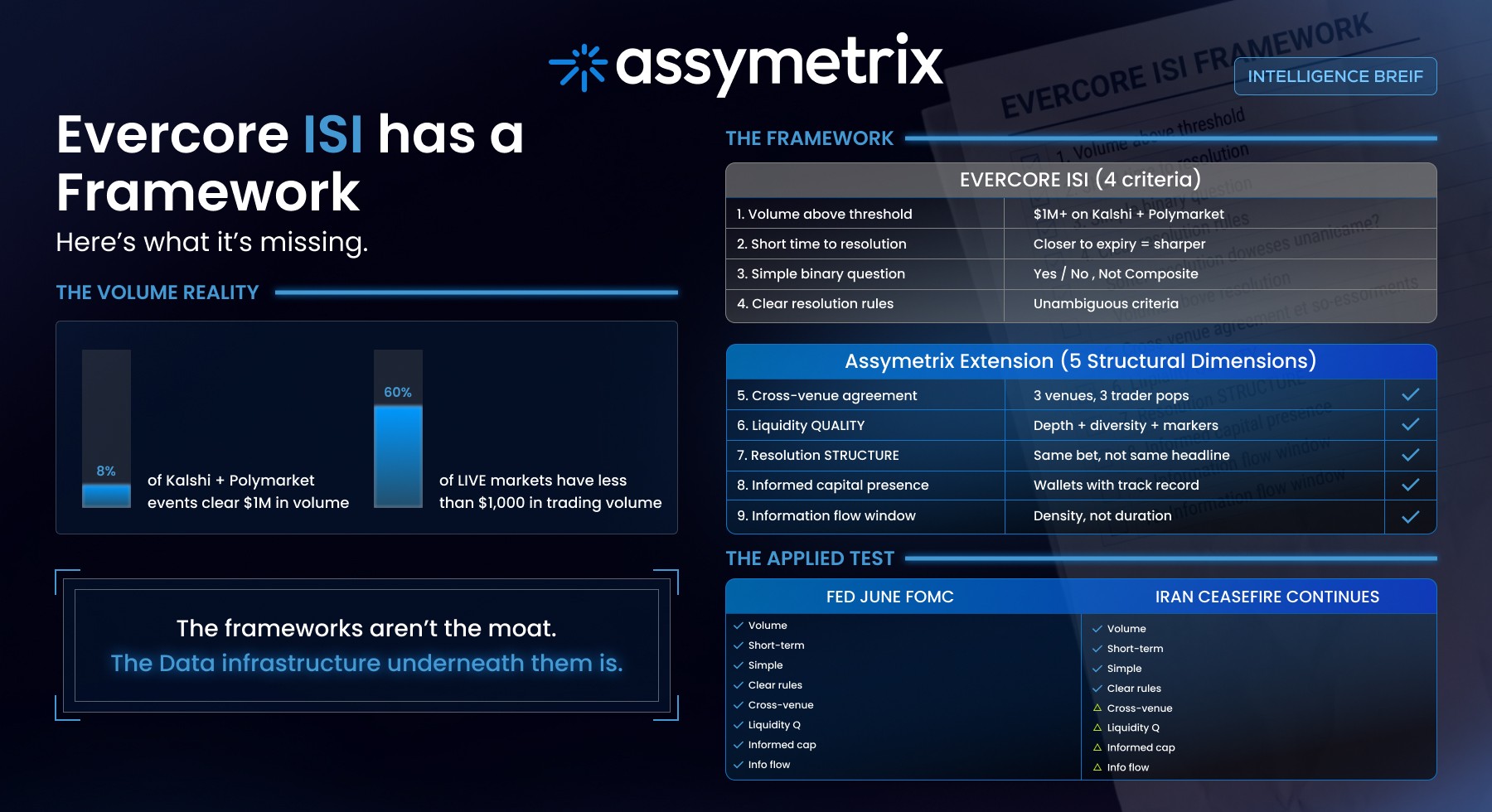
On May 17, Evercore ISI strategists led by Julian Emanuel published the first structured Wall Street analytical framework for when prediction markets produce trustworthy signals. The report, summarized by CNBC roughly a week later, lays out a four-criteria formula: high-volume markets, short-term contracts, simple questions, clear resolution rules. The strategists were careful to note what prediction markets are — and what they aren't. "Their limitation is that they do not discover the future so much as reveal what the crowd believes," Emanuel's team wrote. "The resulting price is not a perfect forecast, but it is often a useful expression of the live consensus probability."
That sentence is the most analytically honest framing of prediction markets we've seen from a major Wall Street research desk. It treats the markets as what they are — distributed-knowledge instruments — rather than what crypto Twitter sometimes claims they are (oracles, forecasting engines, truth machines).
But the framework is also incomplete. Evercore is right about the four criteria they identify. They're working with the only data their methodology can access: aggregated single-platform volume figures, contract duration, and high-level resolution metadata. The deeper structural factors that determine prediction market signal quality — the ones visible only with normalized cross-venue data and on-chain settlement traces — aren't in the framework. And in 2026's institutional moment, those missing dimensions are exactly where reliable analytical work has to happen.
This piece walks through what Evercore gets right, what their framework misses, and what an extended nine-dimension framework looks like for institutional use.
What Evercore Gets Right
Before extending the framework, the Evercore criteria are worth taking seriously on their own terms. Each one captures something real.
Volume matters, and Evercore quantifies the volume problem honestly. Their headline finding is striking: only about 8% of events on Kalshi and Polymarket clear $1 million in volume. Nearly 60% of live markets across the two platforms have less than $1,000 in trading volume. That's not a small caveat — it means roughly six out of every ten "active" prediction markets are essentially price-discovery exercises for a handful of traders, and price signals from those markets carry meaningfully less analytical weight than the headline number suggests. The volume distribution in prediction markets is extreme. Evercore deserves credit for surfacing it.
Time to resolution matters. Contracts closer to their termination date showed stronger probability calibration than longer-dated contracts in Evercore's analysis. The intuition is correct: shorter horizons mean more information has already arrived, fewer information shocks can still occur, and price discovery has had more iterations. A market on "Fed cuts at the June FOMC" with two weeks to go is structurally different from a market on "Fed cuts before year-end" with seven months to go — the same headline question, but very different signal-quality profiles.
Simple questions with clear resolution rules matter. Evercore is right that ambiguous resolution criteria contaminate price signals. A market that resolves on a binary outcome (rate cut yes/no) is more analytically tractable than one that resolves on a continuous variable (final rate to two decimal places) or a complex composite (multiple conditions, judgment calls, third-party adjudication). The "simple, clear" filter cleans the dataset of structurally noisy markets.
The honest framing of what prediction markets are. Evercore explicitly resists calling prediction markets a "north star." They acknowledge that diversity of traders can cut both ways — bringing useful information aggregation but also potentially "contaminating" prices when reasoning ranges from entertainment to hedging to expressive politics. They warn that geopolitical markets in particular "may be less about forecasting and more so representing a political view." This is exactly the right level of epistemic humility for a Wall Street research desk to bring to a new asset class.
All four criteria are real and useful filters. Evercore's framework — high-volume, short-term, simple, clear — gets institutional readers from "I'm not sure when to trust this signal" to "here are four filters to apply." That's a meaningful step forward, and other firms will likely adopt similar frameworks before the year is out.
What the Framework Is Missing
The limitation isn't that Evercore got something wrong. It's that their methodology can only see what's visible from aggregate, single-platform reporting. The deeper structural factors that determine prediction market signal quality require data the framework doesn't have access to — cross-venue normalized prices, on-chain settlement traces, orderbook composition, and wallet-level behavior.
Five dimensions are missing. Each one is the kind of structural insight that, in equity or fixed-income markets, would be standard analytical practice — and that becomes available only when the underlying data infrastructure exists.
1. Cross-venue agreement signals quality (and cross-venue divergence signals structure)
Evercore's framework treats Kalshi and Polymarket markets as parallel data points but doesn't systematically compare them. That misses one of the most powerful signal-quality filters available in prediction markets.
When the same event is priced similarly on Polymarket, Kalshi, and Limitless, that cross-venue agreement is a meaningful validation signal — three different trader populations with three different information sets reaching similar conclusions. When they diverge, the divergence itself is information. Sometimes it reveals real inefficiency. More often, it reveals structural mismatch: different resolution criteria, different source authorities, different timing windows, different contract drafting. As covered in Builder Brief #1's Finding #1, a significant share of seemingly-matched markets across platforms have at least one material structural difference.
A signal that holds across three platforms with structurally compatible contracts is qualitatively different from a signal that exists only on one. Evercore's volume filter passes high-volume single-venue markets that have no cross-venue corroboration. The extended framework would treat those markets as lower-confidence signals than otherwise-identical markets with cross-venue agreement.
2. Liquidity quality matters more than liquidity volume
The Evercore volume threshold — $1M+ in market volume — is a useful coarse filter, but volume alone is a misleading proxy for signal quality. Two markets can both clear $1M in volume and have completely different signal profiles depending on liquidity quality.
A market that has $1M in volume from a hundred different traders making small to mid-sized trades, with continuous two-sided quotes and tight spreads, is structurally different from a market with $1M in volume from one whale taking a directional position. The second market's "volume" reflects one trader's conviction; the first reflects collective price discovery. They are not the same signal. Evercore's framework treats them identically.
The dimensions that matter for liquidity quality include orderbook depth (how much can you trade without moving the price), trader concentration (how distributed is the volume across distinct participants), time-weighted activity (is the market continuously traded or burst-driven), and the presence of professional market makers like Wintermute, who as covered in IB#15 are now providing continuous two-sided liquidity across major prediction market venues. A market with thin orderbook depth, concentrated wallets, and no market-maker presence is a low-quality signal even at high volume. The volume number on its own doesn't reveal this.
3. Resolution structure compatibility matters more than resolution clarity
Evercore's "clear resolution rules" criterion catches markets with obviously ambiguous criteria — but it doesn't catch the more subtle and more dangerous failure mode: two markets with individually clear rules that resolve incompatibly across venues.
Consider a market titled "Strategy Bitcoin sale by May 31" on Platform A and a near-identical market on Platform B. Both have crystal-clear resolution rules. Platform A resolves on whether the sale occurred by the deadline. Platform B resolves on whether the sale was publicly disclosed by the deadline. If the sale happens May 27 but disclosure lands June 1, Platform A resolves YES and Platform B resolves NO. Both contracts behaved per their stated rules. Both rules were clear. The contracts asked structurally different questions that shared a headline.
This is the failure mode Evercore's framework can't catch. Resolution clarity is necessary but not sufficient. Resolution structure compatibility — whether two seemingly-matched contracts are actually asking the same question — requires cross-venue contract normalization that single-platform analysis cannot produce. Until that compatibility is validated, cross-venue divergence is uninterpretable, and any analytical framework that pools data across platforms risks averaging across contracts that aren't comparable.
4. Informed capital presence matters more than capital diversity
Evercore notes correctly that diverse trader populations can both help and hurt — bringing useful information aggregation but also potentially contaminating prices with entertainment-driven or expressive trading. The framework treats this as a binary "trader diversity is double-edged" warning.
The deeper analytical move is to ask not whether trader diversity exists, but whether informed capital is meaningfully present. Two markets can both have diverse trader populations and produce very different signal qualities depending on whether sophisticated participants with real information edge are actively engaged.
In a market where institutional capital has a genuine information edge — macro markets, election cycles, regulatory decisions, where research firms, professional traders, and quant funds bring structured analytical resources — more capital tends to improve accuracy because the marginal trader is informed. The signal sharpens as volume grows.
In a market where no participant has an information edge — niche corporate data, low-information geopolitical questions, markets pricing genuinely random events — more capital tends to amplify existing systematic biases. The same retail tilt that drove prices at low volume drives them at high volume. The signal doesn't sharpen; it just gets louder.
The distinction is observable on-chain. Wallets with consistent profitable performance across multiple resolved markets, wallets associated with known institutional addresses, wallets exhibiting the trading patterns of professional capital — these are detectable in public ledger data. Evercore's framework can't see this. The extended framework can.
5. Information flow window matters more than time to resolution
Evercore's short-term criterion is directionally right but compresses two different things into one variable. "Closer to resolution" can mean two structurally different scenarios.
A market two weeks from resolution where no new information will arrive between now and the resolution date is essentially price discovery on existing beliefs — the price reflects current consensus and will move only as residual uncertainty resolves. Useful, but limited. The market is processing what's already known.
A market two weeks from resolution where significant new information will arrive multiple times before resolution (a Fed meeting, an earnings release, a regulatory decision, a geopolitical inflection point) is structurally more analytically interesting. The market is processing incoming information in something close to real time, and the price trajectory between now and resolution becomes its own analytical signal.
The right criterion isn't "time to resolution" but "expected information flow density between now and resolution." A market three months out with weekly information updates is often a richer analytical signal than a market two weeks out where the underlying question is essentially settled and the price is just running out the clock. The extended framework would account for this rather than collapsing the dimension to simple duration.
The Extended Framework
Combining Evercore's four criteria with the five structural dimensions above produces a nine-dimension framework for evaluating prediction market signal quality. Each dimension contributes to overall confidence; markets that score well across multiple dimensions produce signals worth weighting heavily in institutional analysis.
Dimension | Source | What It Validates |
|---|---|---|
Volume above threshold | Evercore | Market has enough capital at risk to produce non-trivial signal |
Short time to resolution | Evercore | Less information shock risk between now and resolution |
Simple binary question | Evercore | Question can be priced cleanly without ambiguity |
Clear resolution rules | Evercore | Contract terms unambiguous within the platform |
Cross-venue agreement | Assymetrix | Three different trader populations validate the signal |
Liquidity quality (not just volume) | Assymetrix | Volume reflects distributed price discovery, not single-trader conviction |
Resolution structure compatibility | Assymetrix | Matched markets across venues are actually the same bet |
Informed capital presence | Assymetrix | Sophisticated capital with real edge is actively engaged |
Information flow window | Assymetrix | Significant information will arrive before resolution |
Markets that score well on the first four (Evercore) are filterable from public aggregate data. Markets that score well on the second five (Assymetrix) require cross-venue normalized data, on-chain settlement traces, and structural contract reconciliation that single-platform analysis cannot produce.
A market that passes Evercore's four filters but fails three of the structural five — high volume, short-term, simple, clear resolution, but no cross-venue corroboration, dominated by a few wallets, and incompatible with similar markets on other platforms — is a substantially weaker signal than the four-filter framework suggests. The reverse is also true: a moderate-volume market on a moderately complex question can be a very strong signal if it has cross-venue agreement, professional market making, informed capital, and active information flow.
What This Means for Institutional Use
Apply the extended framework to a few current high-volume markets and the analytical implications become concrete.
The Fed June FOMC market scores well across most dimensions. High volume on both Polymarket and Kalshi. Short time to resolution. Simple binary question. Clear resolution rules. Cross-venue agreement (both platforms pricing similarly). Professional market making present (Wintermute, plus institutional traders entering through Galaxy OTC). Informed capital active (every macro fund has views on Fed policy and capital to deploy). Significant information flow before resolution (Fed speakers, economic data, blackout period dynamics). This is the kind of signal that institutional research desks can legitimately weight heavily.
The Iran ceasefire continuation market scores well on the Evercore criteria — high volume, short-term, simple question — but worse on the structural dimensions. Cross-venue agreement is partial (different platforms have different ceasefire-definition criteria). Liquidity quality is mixed (some wallet concentration). Informed capital presence is genuinely uncertain (intelligence community participation in these markets is exactly the integrity question the Spagnuolo and Van Dyke cases raised). Information flow is asymmetric (some traders may have systematic edge over others). The four-filter framework would treat this as a strong signal; the nine-dimension framework would suggest caution.
Most low-volume Kalshi and Polymarket markets — the ~60% with less than $1K volume — fail the Evercore volume filter and shouldn't be analyzed seriously as signals at all. The extended framework agrees and adds that even moderate-volume markets in this category typically fail multiple structural dimensions. Single-platform low-volume markets are price-discovery exercises among a small handful of traders, not meaningful collective forecasts.
The pattern across the application is consistent: Evercore's framework is right about which markets to dismiss, but the structural framework is more accurate about which markets to trust at the high end.
Where This Goes
Frameworks are how new asset classes get incorporated into institutional workflows. Equity research developed frameworks for evaluating earnings quality, balance sheet strength, and management credibility over decades. Fixed income developed frameworks for credit analysis, duration risk, and yield curve interpretation. Crypto developed frameworks for tokenomics, on-chain activity, and protocol risk. Each framework started somewhere — often as a single major firm's published research that other firms then extended and critiqued.
Evercore ISI just put down the first marker for prediction markets. That's the right work and they deserve credit for doing it before any other major Wall Street firm. Other research desks will follow with their own variants over the coming months. Some will be better; some will be worse; the institutional community will eventually converge on something like a standard analytical framework for prediction market signal quality, in the same way equity research converged on standard frameworks for company valuation.
What's likely to happen in the meantime is that the published frameworks will get better as the data infrastructure improves. Evercore's four-criteria framework is what's possible with aggregated single-platform reporting. The nine-dimension framework is what becomes possible with normalized cross-venue data, on-chain settlement traces, and structural contract reconciliation. Future frameworks will incorporate more dimensions still as more data layers get built — wallet-level behavioral signals, resolution-source confidence scoring, intra-day liquidity profiles, and structural integrity flags being some of the obvious next steps.
The frameworks aren't the moat. The data infrastructure underneath them is.
Evercore's framework gets a serious Wall Street institution thinking analytically about prediction markets for the first time. That's worth celebrating. What comes next — operationalizing the framework, extending it with structural dimensions, applying it consistently across the thousands of markets institutional capital is now interacting with — requires the analytical infrastructure that doesn't ship with the published research.
That's what we're building.
This is the sixteenth installment in the Assymetrix Intelligence Brief series.
Previous: "The Institutional Plumbing for Prediction Markets Just Got Built."
At Assymetrix, we're building intelligence at the intersection of news, events, and technology — synthesizing real-time data across every prediction market platform so event-driven traders see the full picture. Join the platform waitlist or explore our PM Vendor APIs.
Other Blog


